
THE CLASS THAT BUILT AND FLEW
Wayne R. Lehman
Background
I am a fourth-grade teacher at Locust Grove Mennonite School just east of Lancaster, Pennsylvania. I also build model airplanes.
In March 1991 our class was studying people, industries, and transportation. The next lesson, "How an Airplane Is Made," explained how groups of people cooperate to produce jet aircraft at Boeing's Seattle plant. The thought struck me—how about having the class build an airplane instead of reading about it?
As I taught social studies for both sections of the fourth grade, my first decision was whether we should build one or two—one for each class. Knowing how young people take pride in their homeroom's accomplishments, I decided to go for two. So began an endeavor that at times seemed overwhelming, but in the end was most rewarding.
Planning the project
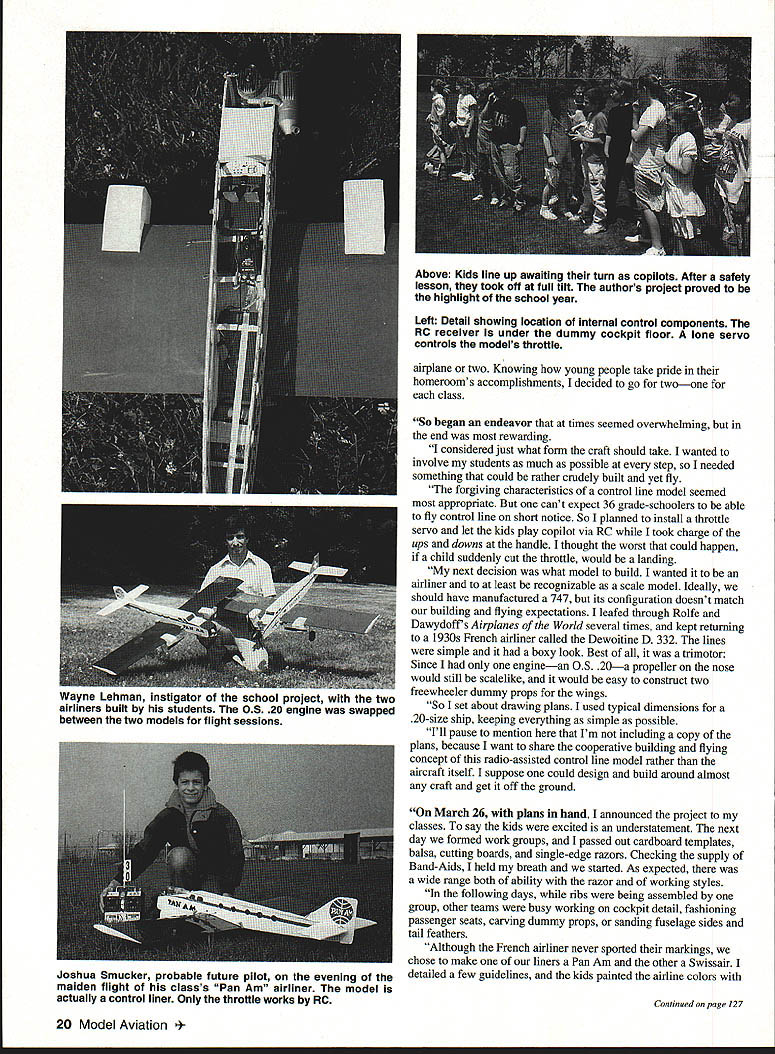
I wanted to involve the students as much as possible at every step, so I needed something that could be rather crudely built and yet fly. The forgiving characteristics of a control-line model seemed most appropriate. But one can't expect 36 grade-schoolers to be able to fly control line on short notice, so I planned to install a throttle servo and let the kids play copilot via radio while I took charge of the ups and downs at the handle. I thought the worst that could happen, if a child suddenly cut the throttle, would be a landing.
My next decision was what model to build. I wanted an airliner and at least something recognizable as a scale model. Ideally we would have built a 747, but its configuration didn't match our building and flying expectations. I leafed through Rolfe Dawydoff's Airplanes of the World several times and kept returning to a 1930s French airliner called the Dewoitine D.332. The lines were simple and boxy—best of all, it was a trimotor. Since I had only one engine—an O.S. .20—a propeller on the nose would still look scale-like, and it would be easy to construct two freewheeling dummy props for the wing engines.
I set about drawing plans, using typical dimensions for a .20-size ship and keeping everything as simple as possible. I'm not including a copy of the plans here; my aim is to share the cooperative building-and-flying concept of this radio-assisted control-line model rather than the specific aircraft. One could design and build around almost any craft that will get off the ground.
Building in the classroom
On March 26, plans in hand, I announced the project to the classes. The kids were excited. The next day we formed work groups and passed out cardboard templates, balsa cutting boards, and single-edge razors. Checking supplies and Band-Aids, I started.
There was a wide range of both ability and razor-working styles. In the following days, teams worked on different tasks simultaneously:
- Assembling wing ribs
- Fashioning cockpit detail and passenger seats
- Carving dummy props
- Sanding fuselage sides and tail surfaces
- Painting airline markings
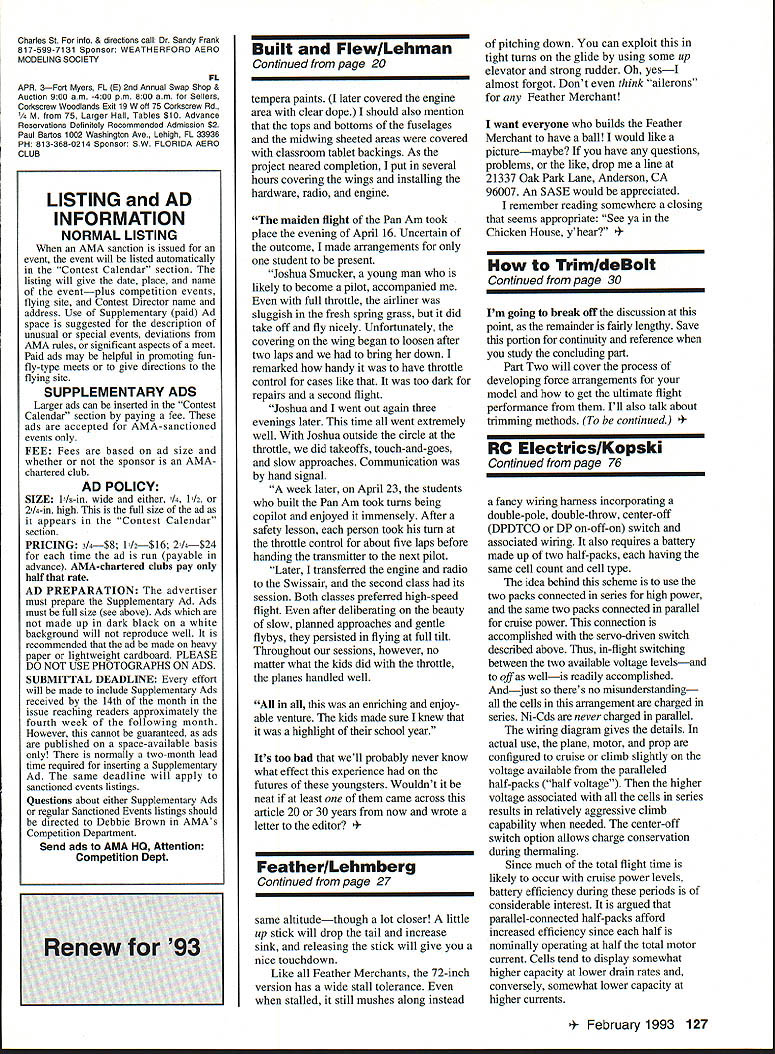
Although the Dewoitine never sported such markings, we chose to make one liner Pan Am and the other Swissair. I gave only a few guidelines; the kids painted the airline colors.
Finishing and assembly
We used tempera paints for the basic decoration. I later covered the engine area with clear dope. The tops and bottoms of the fuselages and the midwing sheeted areas were covered with classroom tablet backings. As the project neared completion, I put in several hours covering the wings and installing the hardware, radio, and engine. The O.S. .20 engine was swapped between the two models during flight sessions.
Maiden flights and student copilots
The maiden flight of the Pan Am took place the evening of April 16. Uncertain of the outcome, I made arrangements for only one student to be present—Joshua Smucker, a young man who is likely to become a pilot. Even with full throttle, the airliner was sluggish in the fresh spring grass, but it did take off and flew nicely. Unfortunately, the covering on the wing began to loosen after two laps and we had to bring her down. Joshua remarked how handy it was to have throttle control for cases like that. It was too dark for repairs and a second flight that night.
Joshua and I went out three evenings later. With Joshua outside the circle at the throttle, we did takeoffs, touch-and-goes, and slow approaches. Communication was by hand signal.
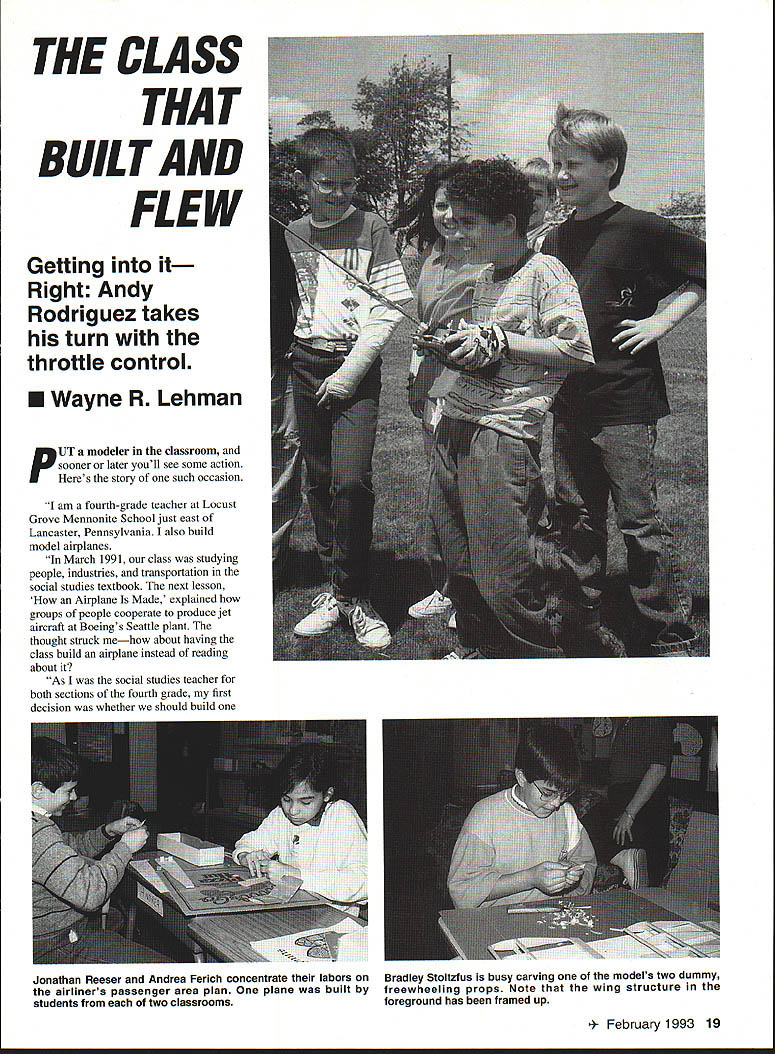
On April 23 the students who built the Pan Am took turns being copilot and enjoyed it immensely. After a safety lesson, each person took his turn at the throttle control for about five laps before handing the transmitter to the next pilot. Later I transferred the engine and radio to the Swissair, and the second class had its session.
Both classes preferred high-speed flight. Even after discussing the beauty of slow, planned approaches and gentle flybys, they persisted in flying at full tilt. Throughout our sessions, however, no matter what the kids did with the throttle, the planes handled well.
Conclusion
All in all, this was an enriching and enjoyable venture. The kids made sure I knew it was a highlight of their school year. It's too bad we'll probably never know what effect this experience had on the futures of these youngsters. Wouldn't it be neat if at least one of them came across this article 20 or 30 years from now and wrote a letter to the editor?
Transcribed from original scans by AI. Minor OCR errors may remain.

