
Classic Aircraft's Waco
By Stan Alexander
This article is dedicated to the memory of Ron Sears.
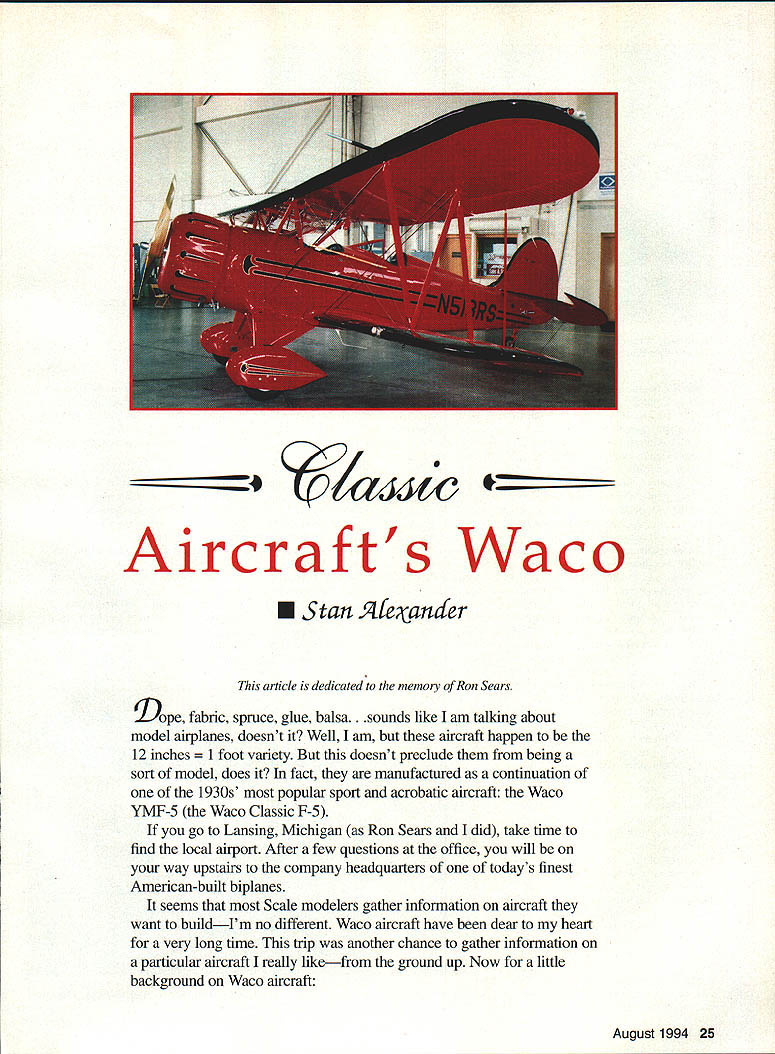
Dope, fabric, spruce, glue, balsa... sounds like I am talking about model airplanes, doesn't it? Well, I am, but these aircraft happen to be the 12 inches = 1 foot variety. But this doesn't preclude them from being a sort of model, does it? In fact, they are manufactured as a continuation of one of the 1930s' most popular sport and acrobatic aircraft: the Waco YMF-5 (the Waco Classic F-5).
If you go to Lansing, Michigan (as Ron Sears and I did), take time to find the local airport. After a few questions at the office, you will be on your way upstairs to the company headquarters of one of today's finest American-built biplanes.
It seems that most scale modelers gather information on aircraft they want to build—I'm no different. Waco aircraft have been dear to my heart for a very long time. This trip was another chance to gather information on a particular aircraft I really like—from the ground up.
A brief history of Waco
From the beginning, the Advance Aircraft Company shaped the golden age of aviation. Due to a change in ownership, the company name was changed from Advance Aircraft Company to Waco Aircraft Company. WACO stands for Weaver Aircraft Company, after one of the three founders, George E. (Buck) Weaver.
They began commercial production with their Model Six Waco biplane, which at first glance appears to be another Jenny, and for good reason. Many of the parts were from Curtiss Jenny surplus, including the OX-5 engines and flying surfaces.
By the mid-thirties, the Waco factory had turned out more than 2,500 aircraft—more than all other US aircraft factories combined. Among their most popular models were the YMF and UMF-5. The UMF was powered with a Continental engine, and the YMF sported a Jacobs engine, hence the change of the first letter.
Waco aircraft played just about every conceivable role: sport aircraft, mail planes, racers, cargo-passenger transport, military use, and were even mounted on floats. With its other capabilities, Wacos were also excellent aerobatic aircraft. This is where our story picks up, nearly 60 years later.
Revival by Classic Aircraft Corporation
What started as the dream of Richard S. Kettles (Classic Aircraft Corporation's president) is now the reality of many sport aviators around the world: owning a recreation of the past. Engines were round, there were two wings, most aircraft were two‑holers, gas fumes were a sort of perfume, flying wires sang their own song, and a gentle evening sunset was for you alone as you sat in the cockpit listening to the purring Jacobs engine.
Wacos are being built virtually as they were in the '30s by the Classic Aircraft Corporation of Lansing, Michigan. The operation is small, and the aircraft are custom-built. Other than some safety-related changes that have been made over the years, Wacos are built exactly as they were in the '30s. Factory photos confirm that this construction was utilized in the original Waco construction, just on a much larger scale.
The president of Classic Aircraft Corporation needed help. He had already built a Pica kit of the YMF-3 (much the same as the YMF-5). The Waco F-3 sported a smaller rudder than the F-5. His small design team consulted the National Air and Space Museum archivists. Robert B. Woods and Edward Pupek helped locate all 450 of the original F-5 drawings, which were in the files of the Smithsonian and the FAA's New York regional headquarters.
Several top employees of the Piper Aircraft Lock Haven plant (which had just shut down) came to work for the fledgling Classic Aircraft company. General Manager Bob Edelstein was one of the former Piper employees who joined Classic. His B.S. in Aeronautical Engineering from Northrop University made him a valuable asset to the company.
Bob was also an aeromodeler. In the engineering offices, Bob has antique model aircraft kits and the highly technical full-scale drawings of the Waco Classic F-5. In fact, many Classic Aircraft employees are modelers.
The current production line usually works on from one to four aircraft at the same time. The first aircraft took six months and 9,000 man-hours to complete. Now it takes about 4,500 man-hours to build one, with about 500 extra hours for the many options pilots request. The maximum number that can be manufactured in one year is 10 aircraft—a little less than one a month. Even in hard economic times there is a waiting list.
During our visit, there were three aircraft in production. Two were being framed up in different stages, and one was being test flown before shipment to Switzerland. All new owners receive complete instructions and flight training to make ownership transition to biplanes and conventional landing gear more enjoyable.
The Classic Aircraft Corporation's Classic Waco F-5 is built under the original type certificate. A closer inspection reveals that model aircraft and full-scale biplanes have much in common in building practices, materials, and suppliers.
Construction and materials
In one sense, the full-scale Classic Wacos are just large models with an FAA license. They are a re-creation of something built in the past. Many of the aircraft engineers who worked together to raise this type back into production are avid aeromodelers, including the president and general manager.
Aircraft materials that were used on full-scale aircraft in the '30s and on many home-built aircraft today are again used to construct these aircraft (as well as our large models). The box-and-stringer construction techniques are similar—except full-scale aircraft employ steel tubing while modelers use plywood and balsa box, then add the formers and stringers.
SIG Manufacturing, Inc., a longtime worldwide hobby supplier, carries balsa blocks for non-stressed areas that need to be formed and sanded down. Fiberglass is used for wingtips and leading edge panels for strength, much as modelers use fiberglass on wings to take the abuse fliers dish out. Sitka spruce is used as well as other types of spruce in the wing ribs and fuselage construction. Most of the wing spars and ribs are built from spruce and birch plywood.
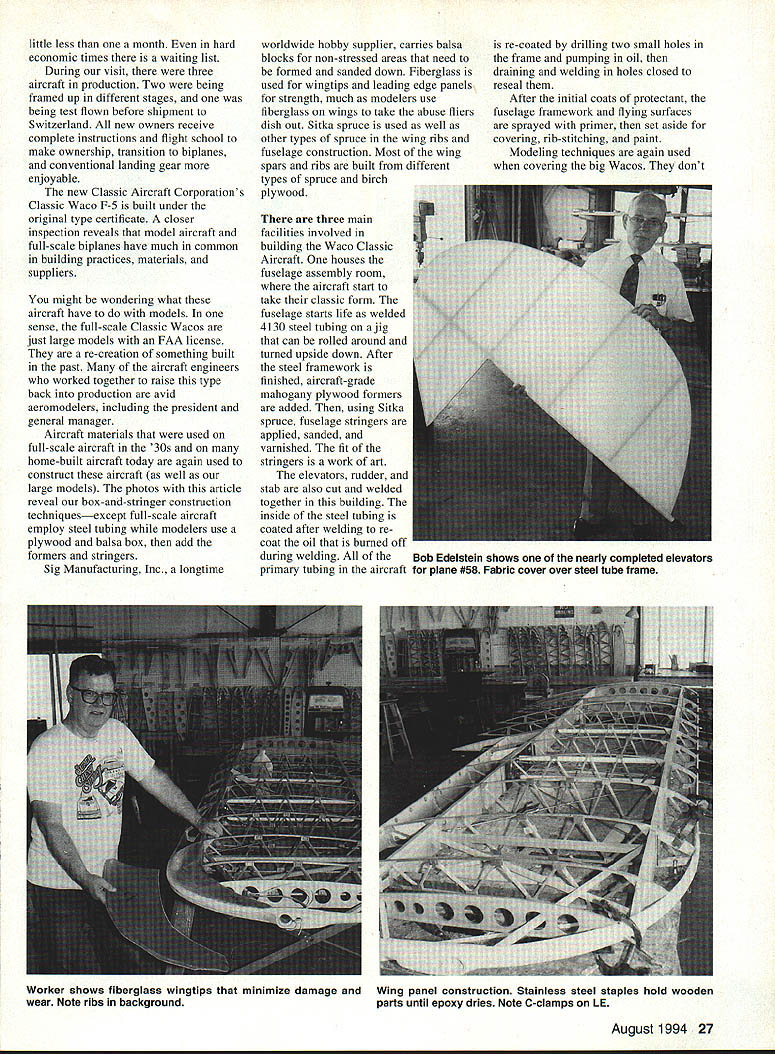
There are three main facilities involved in building the Waco Classic aircraft. One houses the fuselage assembly room, where the aircraft start to take their classic form. The fuselage starts life as welded 4130 steel tubing on a jig that can be rolled around and turned upside down. After the steel framework is finished, aircraft-grade mahogany plywood formers are added. Then, using Sitka spruce, fuselage stringers are applied, sanded, and varnished. The fit of the stringers is a work of art.
The elevators, rudder, and stabilizer are also cut and welded together in this building. The inside of the steel tubing is coated after welding to remove oil burned off during welding. All of the primary tubing in the aircraft is re-coated by drilling two small holes in the frame and pumping in oil, then draining and welding the holes closed to reseal them.
After the initial coats of protectant, the fuselage framework and flying surfaces are sprayed with primer, then set aside for covering, rib-stitching, and paint.
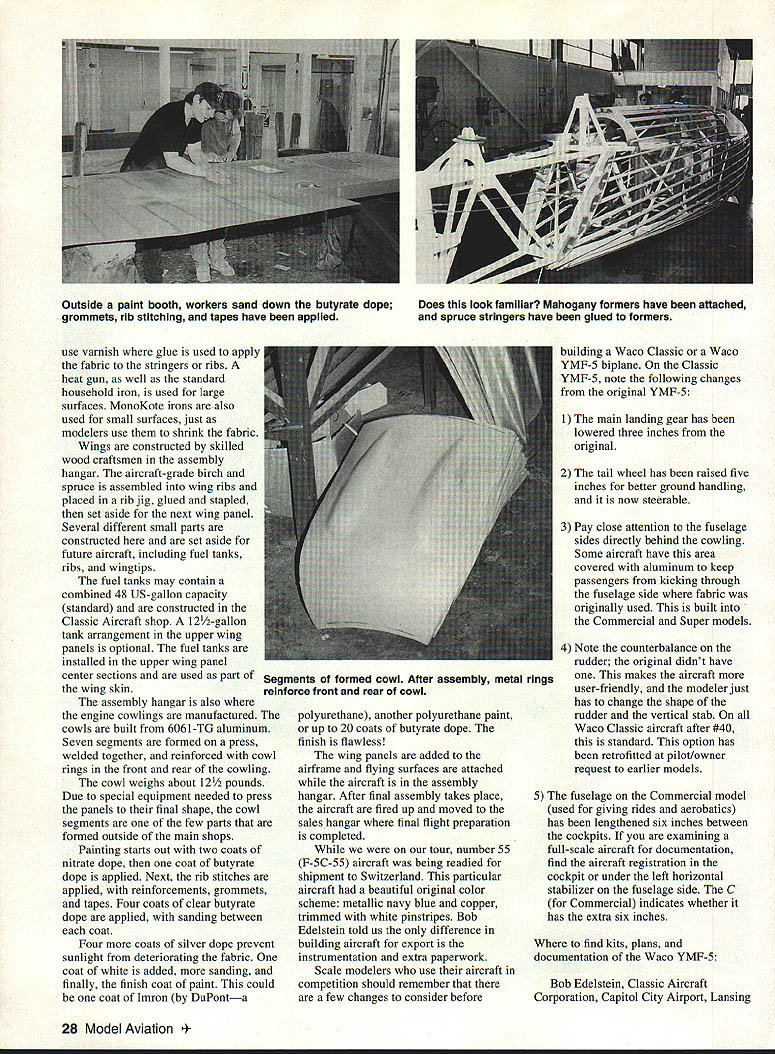
Modeling techniques are again used when covering the big Wacos. They don't use varnish where glue is used to apply the fabric to the stringers or ribs. A heat gun, as well as the standard household iron, is used for large surfaces. MonoKote irons are also used for small surfaces, just as modelers use them to shrink the fabric.
Wings are constructed by skilled wood craftsmen in the assembly hangar. Aircraft-grade birch and spruce are assembled into wing ribs, placed in a rib jig, glued and stapled, then set aside for the next wing panel. Several different small parts are constructed here and are set aside for future aircraft, including fuel tanks, ribs, and wingtips.
The fuel tanks may contain a combined 48 US-gallon capacity (standard) and are constructed in the Classic Aircraft shop. A 12½-gallon tank arrangement in the upper wing panels is optional. The fuel tanks are installed in the upper wing panel center sections and are used as part of the wing skin.
The assembly hangar is also where the engine cowlings are manufactured. The cowls are built from 6061-T6 aluminum. Seven segments are formed on a press, welded together, and reinforced with cowl rings in the front and rear of the cowl. The cowl weighs about 12½ pounds. Due to special equipment needed to press the panels to their final shape, the cowl segments are one of the few parts that are formed outside of the main shops.
Painting starts out with two coats of nitrate dope, then one coat of butyrate dope is applied. Next, the rib stitches are applied, with reinforcements, grommets, and tapes. Four coats of clear butyrate dope are applied, with sanding between each coat. Four more coats of silver dope prevent sunlight from deteriorating the fabric. One coat of white is added, more sanding, and finally, the finish coat of paint. This could be one coat of Imron (by DuPont—a polyurethane), another polyurethane paint, or up to 20 coats of butyrate dope. The finish is flawless!
The wing panels are added to the airframe and flying surfaces are attached while the aircraft is in the assembly hangar. After final assembly, the aircraft are fired up and moved to the sales hangar where final flight preparation is completed.
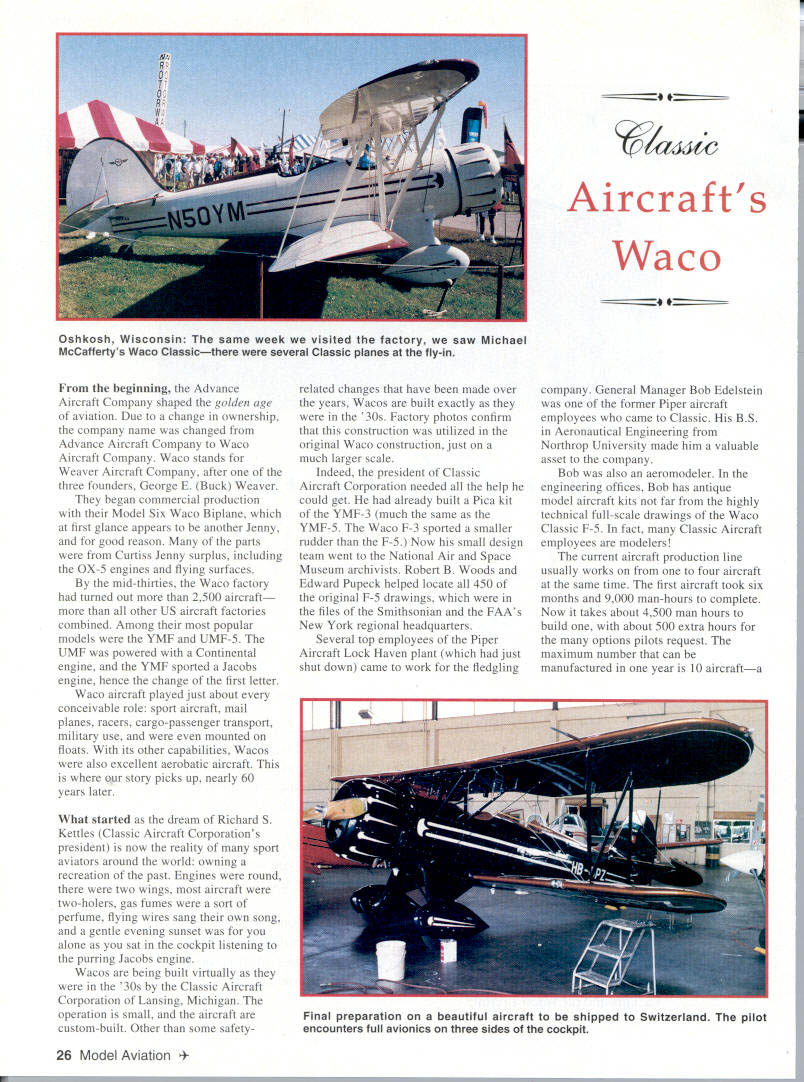
While we were on our tour, number 55 (F-5C-55) was being readied for shipment to Switzerland. This particular aircraft had a beautiful original color scheme: metallic navy blue and copper, trimmed with white pinstripes. Bob Edelstein told us the only difference in building aircraft for export is the instrumentation and extra paperwork.
Changes from the original YMF-5
Scale modelers who use their aircraft in competition should remember that there are a few changes to consider before building a Waco Classic or a Waco YMF-5 biplane. On the Classic YMF-5, note the following changes from the original YMF-5:
- The main landing gear has been lowered three inches from the original.
- The tailwheel has been raised five inches for better ground handling, and it is now steerable.
- Pay close attention to the fuselage sides directly behind the cowling. Some aircraft have this area covered with aluminum to keep passengers from kicking through the fuselage side where fabric was originally used. This is built into the Commercial and Super models.
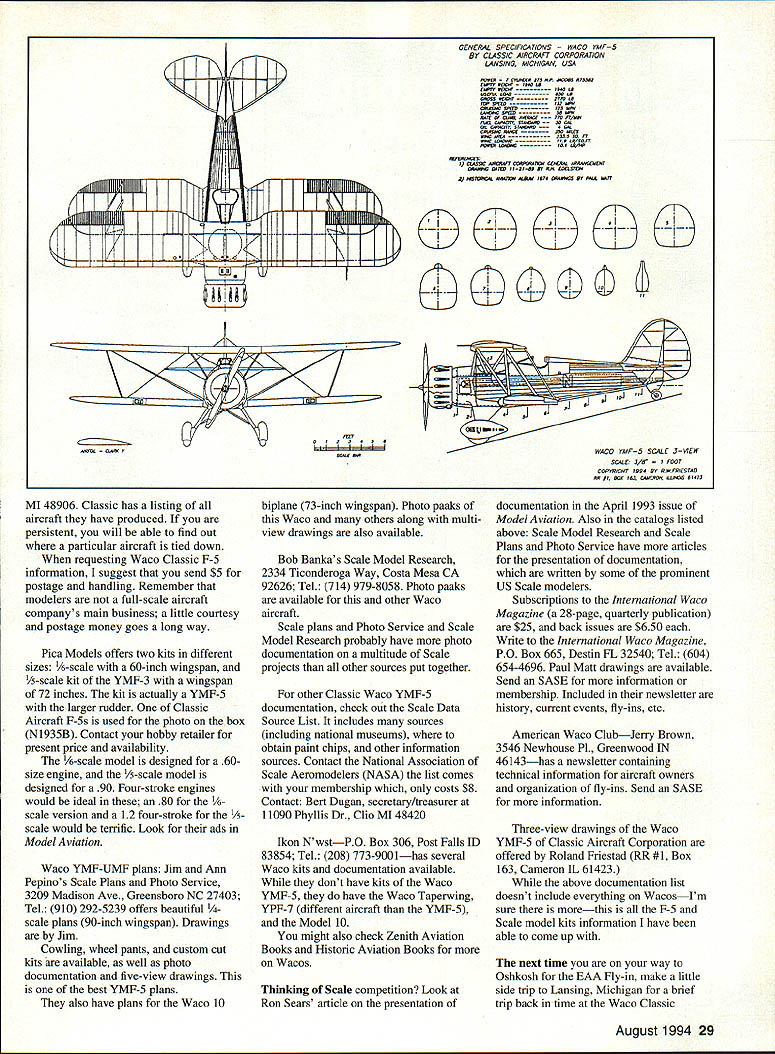
- Note the counterbalance on the rudder; the original didn’t have one. This makes the aircraft more user-friendly, and the modeler just has to change the shape of the rudder and the vertical stab. On all Waco Classic aircraft after #40, this is standard. This option has been retrofitted at pilot/owner requests to earlier models.
- The fuselage on the Commercial model (used for giving rides and aerobatics) has been lengthened six inches between the cockpits. If you are examining a full-scale aircraft for documentation, look for the aircraft registration in the cockpit or under the left horizontal stabilizer on the fuselage side. The "C" (for Commercial) indicates whether it has the extra six inches.
Where to find kits, plans, and documentation
- Classic Aircraft Corporation
Capitol City Airport, Lansing, Michigan 48906. Classic has a listing of all aircraft they have produced. If you are persistent, you will be able to find out where a particular aircraft is tied down. When requesting Waco Classic F-5 information, I suggest that you send $5 for postage and handling. Remember that modelers are not a full-scale aircraft company's main business; a little courtesy and postage money goes a long way.
- Pica Models offers two kits in different sizes: 1/2-scale with a 60-inch wingspan, and 1/3-scale kit of the YMF-3 with a wingspan of 72 inches. The kit is actually a YMF-5 with the larger rudder. One of Classic Aircraft F-5s is used for the photo on the box (N1935B). Contact your hobby retailer for present price and availability. The 1/4-scale model is designed for a .60-size engine, and the 1/2-scale model is designed for a .90. Four-stroke engines would be ideal in these; an .80 for the 1/3-scale version and a 1.2 four-stroke for the 1/2-scale would be terrific. Look for their ads in Model Aviation. They also have plans for the Waco 10 biplane (73-inch wingspan). Photo paks and multiview drawings are also available.
- Bob Benka’s Scale Model Research
2334 Ticonderoga Way, Costa Mesa, CA 92626; Tel. (714) 979-8058. Photo paks are available for this and other Waco aircraft.
- Scale Plans and Photo Service and Scale Model Research probably have more photo documentation on a multitude of scale projects than all other sources put together.
- For other Classic Waco YMF-5 documentation, check out the Scale Data Source List. It includes many sources (including national museums), where to obtain paint chips, and other information sources. Contact the National Association of Scale Aeromodellers (NASA); the list comes with your membership only, costs $8. Contact: Bert Dugan, secretary/treasurer, 11090 Phyllis Dr., Clio, MI 48420.
- Ikon N’west
P.O. Box 306, Post Falls, ID 83854; Tel.: (208) 773-9001—has several Waco kits and documentation available. While they don’t have kits of the Waco YMF-5, they do have the Waco Taperwing, YPF-7 (a different aircraft than the YMF-5), and the Model 10.
- Check Zenith Aviation Books and Historic Aviation Books for more on Wacos.
- Thinking of scale competition? Look at Ron Sears’ article on the presentation of documentation in the April 1993 issue of Model Aviation. Also in the catalogs listed above: Scale Model Research and Scale Plans and Photo Service have more articles for the presentation of documentation, written by some of the prominent US scale modelers.
- International Waco Magazine (28-page, quarterly)
Subscriptions $25; back issues $6.50 each. Write to International Waco Magazine, P.O. Box 665, Destin, FL 32540; Tel.: (604) 654-4696. Paul Matt drawings are available. Send an SASE for more information or membership. The newsletter includes history, current events, fly-ins, etc.
- American Waco Club — Jerry Brown, 3546 Newhouse Pl., Greenwood, IN 46143 — has a newsletter containing technical information for aircraft owners and organization for fly-ins. Send an SASE for more information.
- Three-view drawings of the Waco YMF-5 of Classic Aircraft Corporation are offered by Roland Fleischer (RR #1, Box 163, Cameron, IL 61423).
While the above documentation list doesn’t include everything on Wacos—I’m sure there is more—this is all the F-5 and scale model kits information I have been able to come up with.
The next time you are on your way to Oshkosh for the EAA Fly-in, make a little side trip to Lansing, Michigan for a brief trip back in time at the Waco Classic factory. Real airplanes have two wings and round engines. Good luck with your Waco!
Features
- FAA certificated (ATC 542)
- Three-place seating
- IFR and Night approved
- 275 hp Jacobs engine
- Commercial operation approved
- Approved aerobatics
- Front and rear heaters
- 24-volt electrical system
- Internal corrosion proofing for all tubing
- Stainless steel firewall
Performance — Waco YMF Super
- Maximum Indicated Airspeed Limit: 132 mph
- Cruise Speed at Cruise Power: 125 mph
- Cruising Range: 350 miles
- Power-Off Stall: 59 mph
- Fuel (standard tanks): 50 gal.
- Fuel (optional tanks): 72 gal.
- Oil Capacity, Standard: 4 gal.
- Gross Weight: 2,950 lb.
- Empty Weight: 1,985 lb.
- Maximum Useful Load: 830 lb.
- Wing Loading: 11.9 lb/sq. ft.
- Fuel Burn (cruise): 15 gph
Dimensions
- Wingspan: 30 feet
- Wing Area: 233.5 sq. ft.
- Length, Super or Commercial Model: 23 ft. 10 in.
- Length, Standard Model: 23 ft. 4 in.
- Height: 8 ft. 6 in.
Transcribed from original scans by AI. Minor OCR errors may remain.

