
Classroom Air Shows
By William L. Baker
Kids do turn on to model flying—provided there are things they can identify with. That means fun-to-fly models that can be built easily and cheaply.
Overview
In the past two years I have performed four "airshows" for children at our county library and in local schoolrooms. My most recent show last summer was the most successful, because I learned some things from experience that I can share with you. In contrast to the first show, which included every type of model known, I limited the latest show to rubber-powered models to introduce children to the idea that fun-to-fly models can be made simply and cheaply.
Featured models
- Gumdrop (MA, 9/77)
- Twiggy (MA, 7/76)
- Dandriaux Butterfly (MB, 2/78)
I wrote to the appropriate editors for permission for the library to duplicate these plans and instructions for free distribution to the children. The library handled publicity; on the day of the show we had about 100 kids, a good turnout for a weekday afternoon.
The show
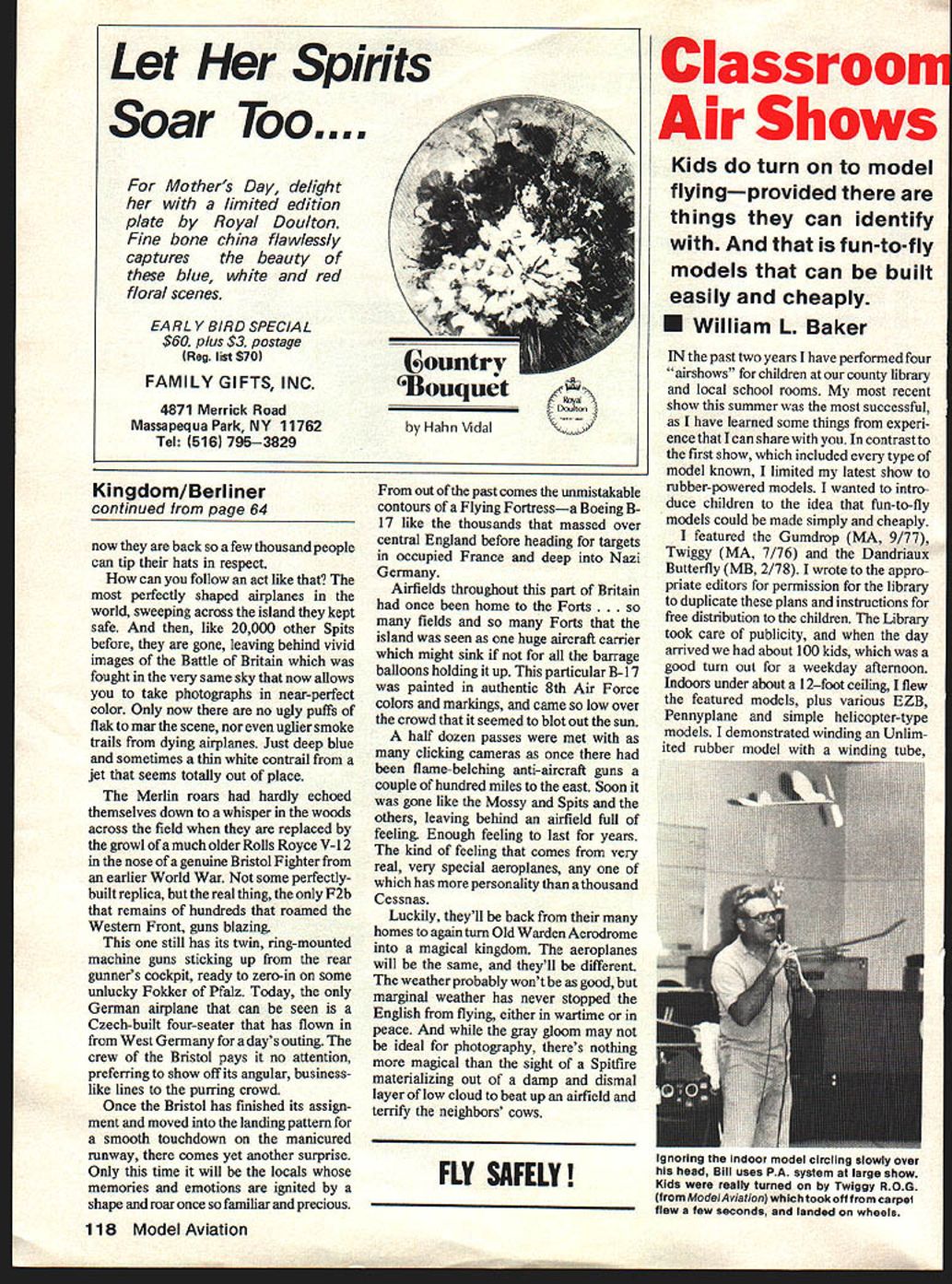
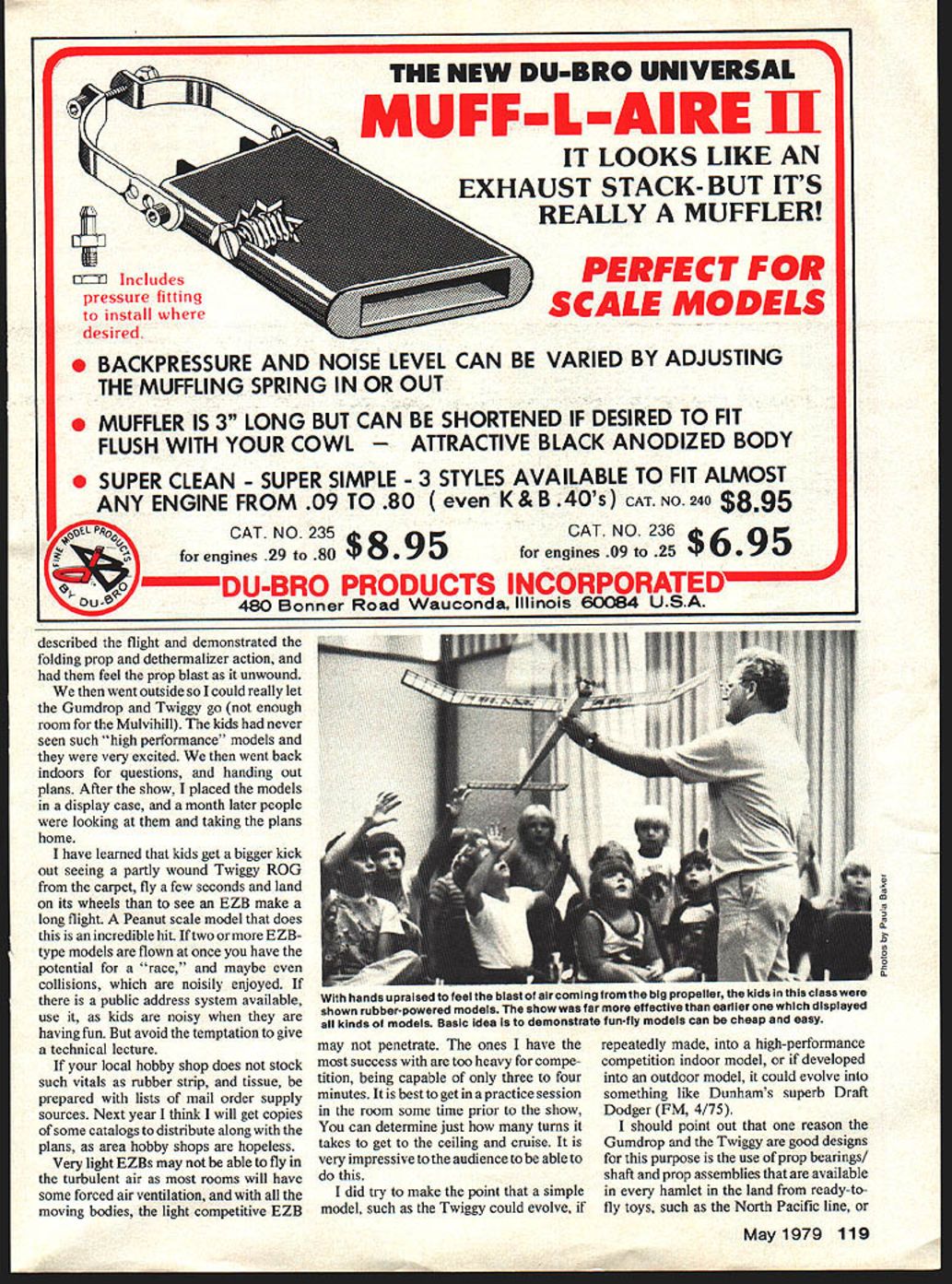
Indoors, under about a 12-foot ceiling, I flew the featured models plus various EZB, Pennylane and simple helicopter-type models. Demonstrations included:
- Winding an unlimited rubber model with a winding tube.
- Describing and demonstrating the folding prop and dethermalizer action.
- Letting the children feel the prop blast as it unwound.
We then went outside so I could really let the Gumdrop and Twiggy go (not enough room indoors for the Mulvihill). The kids had never seen such "high performance" models and were very excited. After the outdoor flights we returned indoors for questions and to hand out plans. I placed the models in a display case after the show, and a month later people were still looking at them and taking the plans home.
Demonstration tips
- It is very impressive to the audience if you can determine, in a practice session prior to the show, how many turns it takes for a model to reach the ceiling and cruise. Practice flying in the actual room if possible.
- If two or more EZB-type models are flown at once you have the potential for a "race," and maybe even collisions, which children enjoy.
- Use a public address system if one is available—kids are noisy when they are having fun. But avoid the temptation to give a technical lecture.
What kids enjoy
I have learned that kids get a bigger kick out of seeing a partly wound Twiggy ROG (rise-off-ground) from the carpet, fly a few seconds and land on its wheels than seeing an EZB make a long, slow flight. A Peanut-scale model that does a quick hop-and-land is an incredible hit.
The Twiggy deserves special mention: its asymmetrical wing (the right panel is larger) balances the right thrust molded into the prop bearing for automatic, safe flight turns. It is a brilliant design and the best "first model" I have seen—a bow to Clarence Mather.
Model development point
I try to make the point that a simple model such as the Twiggy could evolve, if repeatedly made and developed, into a high-performance competition indoor model. If developed into an outdoor model, it could evolve into something like Dunham's superb Draft Dodger (FM, 4/75).
Supplies and preparation
- If your local hobby shop does not stock essentials such as rubber strip and tissue, be prepared with lists of mail-order supply sources.
- Next year I plan to get copies of some catalogs to distribute along with the plans, as area hobby shops can be hopeless.
- Very light EZBs may not be able to fly well in rooms with forced-air ventilation and a lot of moving bodies; the turbulence can prevent light competitive EZBs from penetrating the air. Heavier models capable of three to four minutes may be more successful indoors.
Why Gumdrop and Twiggy work well
One reason the Gumdrop and the Twiggy are good designs for classroom or library shows is their use of prop bearings/shaft and prop assemblies that are available in many towns from ready-to-fly toys, such as the North Pacific line or other similar sources.
Final note
Any individual or club can put on such shows. It takes some practice to fly in a confined space, but it can be done, and you will find the audiences very appreciative.
FLY SAFELY
Transcribed from original scans by AI. Minor OCR errors may remain.

