
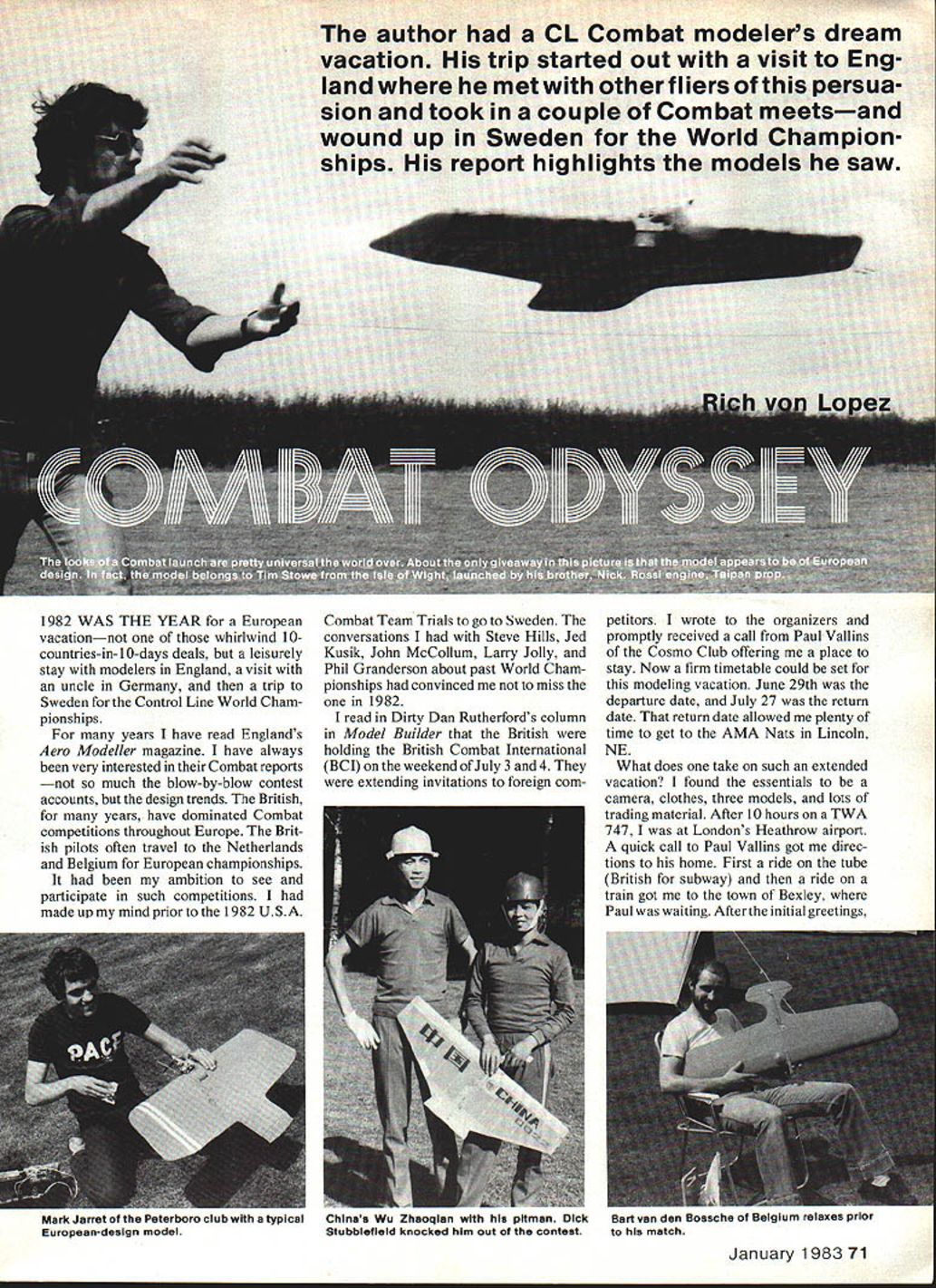



Combat Odyssey
Rich von Lopez
Trip overview
1982 was the year for a European vacation — not a whirlwind 10-countries-in-10-days deal, but a leisurely stay with modelers in England, a visit with an uncle in Germany, and then a trip to Sweden for the Control Line World Championships.
For many years I had read England's Aero Modeller magazine and followed their Combat reports. I was especially interested in design trends; the British have long dominated Combat competitions in Europe and often travel to the Netherlands and Belgium for championships. Before the 1982 U.S.A. Combat Team Trials I decided to go to Sweden. Conversations with Steve Hills, Jed Kusik, John McCollum, Larry Jolly, and Phil Granderson convinced me not to miss the 1982 World Championships.
I learned from Dirty Dan Rutherford's column in Model Builder that the British were holding the British Combat International (BCI) on the weekend of July 3–4 and were inviting foreign competitors. I wrote to the organizers and soon received a call from Paul Vallins of the Cosmo Club offering me a place to stay. My trip was set: depart June 29, return July 27, leaving time to get to the AMA Nats in Lincoln, NE.
What to take on such an extended trip? I found the essentials to be a camera, clothes, three models, and lots of trading material. After 10 hours on a TWA 747 I arrived at London's Heathrow. A tube and train ride got me to Bexley, where Paul met me. Conversation about Combat began immediately and continued until my departure from England. The first stop at his home was the workshop in the attic.
British models and materials
Construction techniques
British foam models differ considerably from American foam builders' approaches. The British commonly use built-up center ribs made of 1/2 x 1/8 x 15-in. spruce strips with balsa center blocks; the bellcrank is bolted between the spruce strips. They use a thin 2-in. bellcrank (about 1/16 in.) made from a phenolic-type material (feels like circuit-board stock).
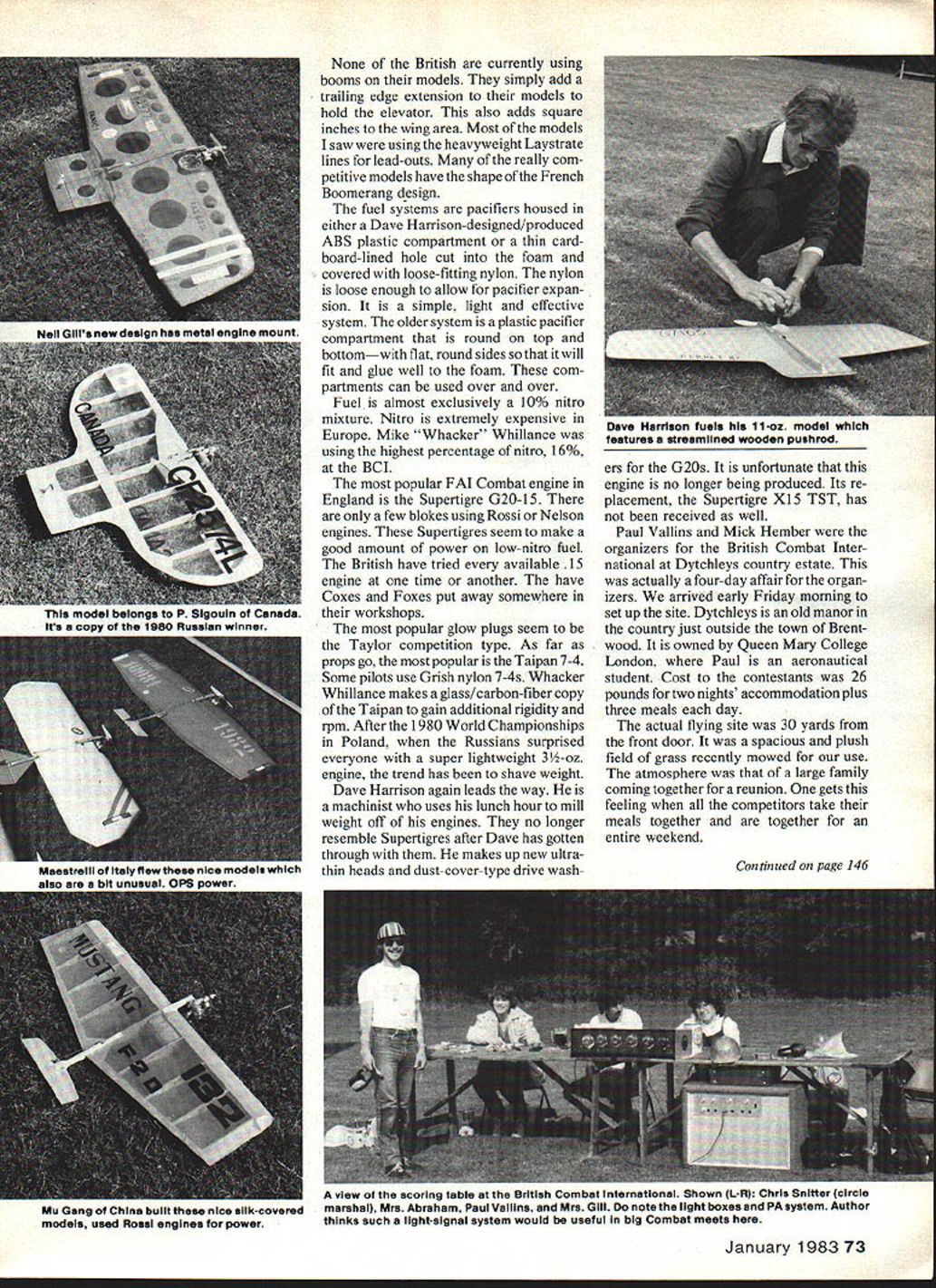
Lightness at any cost is a common philosophy among top builders. Dave Harrison, a trend setter and machinist, produces 11-oz. foam models with hollow foam cores tissue-covered. He makes hollow wooden, streamlined pushrods covered with silk or nylon and with adjustable attachments. These are labor-intensive but seldom destroyed and never flex.
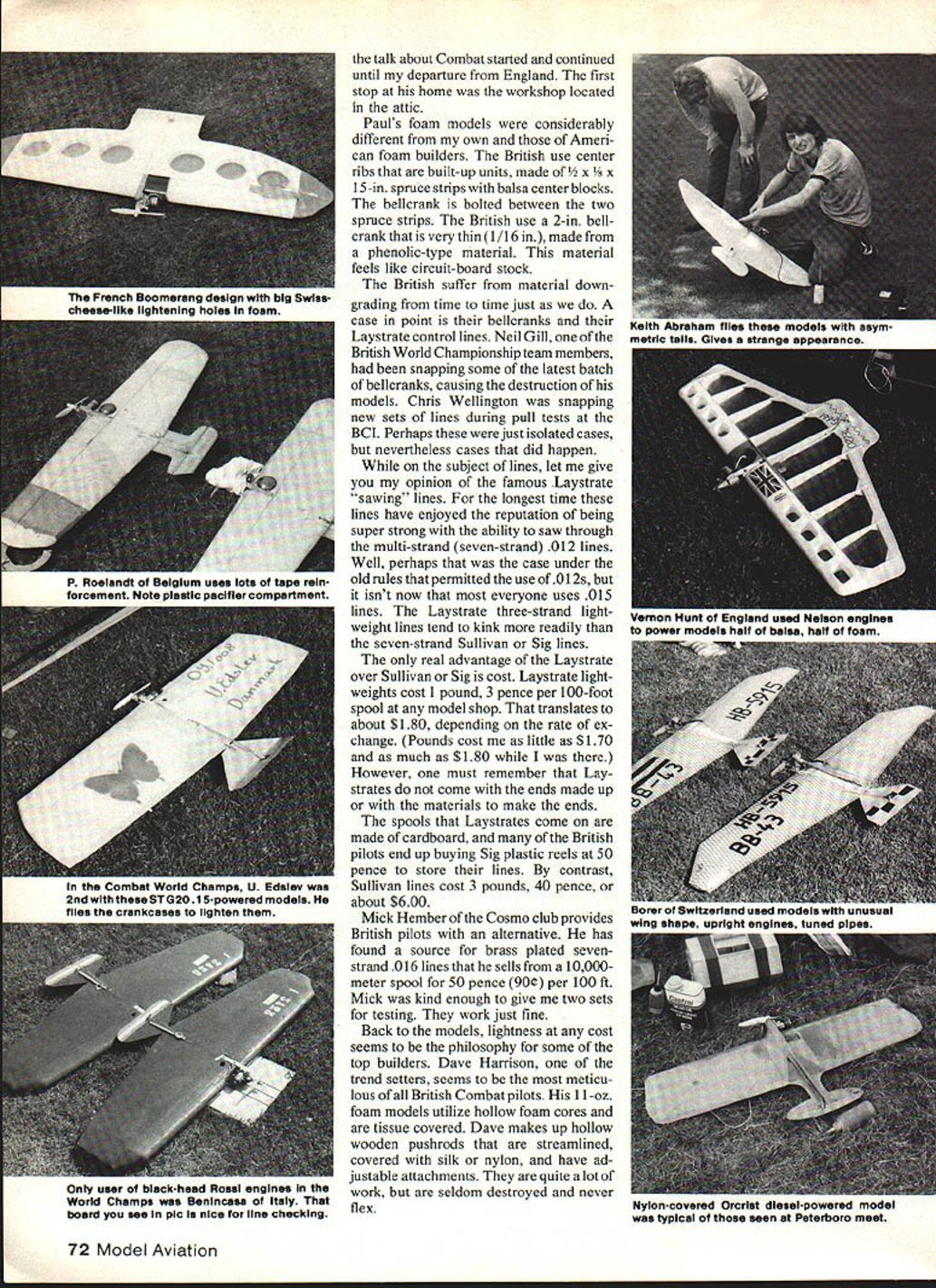
None of the British pilots I saw were using booms; instead they add a trailing-edge extension to hold the elevator, which also increases wing area. Many competitive models resemble the French Boomerang design.
Lines and fittings
The British experience material downgrading like anyone else. Examples:
- Some of the latest bellcranks were snapping (Neil Gill experienced this).
- New sets of Laystrate control lines were snapping during pull tests (Chris Wellington).
About Laystrate lines:
- Laystrate three-strand lightweights tend to kink more readily than seven-strand Sullivan or Sig lines, especially now that most pilots use .015 lines rather than .012.
- The main advantage of Laystrate is cost: about 1 pound, 3 pence per 100-foot spool (roughly $1.80, depending on exchange rate).
- Laystrate spools are cardboard and the lines do not come with ends made up; many pilots buy Sig plastic reels (about 50 pence) for storage.
- Sullivan lines cost about 3 pounds, 40 pence (roughly $6.00).
Mick Hember of the Cosmo Club found brass-plated seven-strand .016 lines sold from a 10,000-meter spool for about 50 pence (90c) per 100 ft. He provided me two sets for testing, and they worked well.
Fuel systems, fuel, engines and props
Fuel systems:
- Pacifiers housed in a Dave Harrison–designed ABS plastic compartment, or a thin cardboard-lined hole cut into the foam and covered with loose-fitting nylon to allow for pacifier expansion.
- Older plastic pacifier compartments (round top and bottom, flat round sides) are reusable and glue well to foam.
Fuel:
- Almost exclusively 10% nitro; nitro is very expensive in Europe.
- Mike "Whacker" Whillance used 16% at the BCI.
- Mexicans in Sweden were running Nelsons on 36% nitro; only Americans used more nitro than that at the Worlds.
Engines and plugs:
- The Supertigre G20-15 was the most popular FAI Combat engine in England. Only a few used Rossi or Nelson engines.
- The Supertigre X15 TST replacement was not as well received.
- Glow plugs: Taylor competition type were popular.
Props:
- Taipan 7-4 is the most popular prop; some use Grish nylon 7-4s.
- Whacker Whillance makes a glass/carbon-fiber copy of the Taipan for added rigidity and rpm.
- Bill Lee made special glass/carbon-fiber copies of Taipan 7-4s.
After the 1980 World Championships in Poland, where Russians introduced an ultra-light 3½-oz. engine, the trend shifted toward shaving engine weight. Dave Harrison mills weight off engines, creates ultra-thin heads, and fabricates dust-cover–type drive washers for G20s.
British Combat International (BCI) at Dytchleys
Organization and site
Paul Vallins and Mick Hember organized the BCI at Dytchleys country estate outside Brentwood. Dytchleys is an old manor owned by Queen Mary College London, where Paul was an aeronautical student. The event included:
- Cost: 26 pounds for two nights' accommodation plus three meals per day.
- The flying site was 30 yards from the front door: a spacious, well-mowed grass field.
- Atmosphere: congenial, like a family reunion with competitors eating together over the weekend.
The BCI drew 20 contestants, including Pieter Roelandt and Bart Van Den Bosse from Belgium. I served as one of the jury members. We used two scorers per model, one penalty observer per pit crew, and a circle marshal (Chris Snitter). Mick Hember provided a powerful P.A. system and two sets of timing light boxes with six lights (1 yellow warm-up, 4 green combat, 1 red end), visible from anywhere around the circle.
Test flying and results
During Saturday morning test flying I flew models belonging to Neil Gill, Peter Tribe, Whacker Whillance, and Dave Harrison. I let them fly the FAI model and one of my two 1/2 A models. The old Supertigre X15 and Tee Dee .049s did not like 10% nitro, so runs were not up to usual standards. Still, I think the British pilots got a good idea of U.S. model performance.
BCI placings:
- 1st: Peter Tribe
- 2nd: Neil Gill
- 3rd: Dave Harrison
- 4th: Whacker Whillance
British wind-up technique
A notable British tactic is the wind-up: two good pilots deliberately follow each other through loops, winding the lines together, then reverse to get out. This is spectacular to spectators and requires mutual trust. In a semi-final, Gill and Tribe demonstrated a remarkable wind-up; Tribe noted that about six loops is the practical limit before lines get too stiff.
Peterboro club and diesel Combat
The following weekend I attended the Peterboro club's 3rd round of the British Class A Diesel Combat series. This format resembles old British Combat before the glow engine invasion:
- No pressure allowed.
- One model per bout.
- Diesel engines (Oliver Tiger, PAW, MVVS) in use.
It mirrors the idea behind Slow Combat and seems to be working in England.
From England to Sweden
Neil Gill hosted dinner after the BCI and showed his World Championship models: he had built 16 of a new design with metal engine mounts and kindly took my three models to Sweden with him so I wouldn't have to carry them through Germany.
From my uncle's place in Göppingen, Germany, I took a train to Oxelösund, Sweden (the train stops 10 km away in Nyköping). I arrived at 7:30 a.m. with no Swedish currency; a helpful bus driver got me to Oxelösund regardless.
The first person I saw in Oxelösund was Gary Arnold carrying models. Soon the Americans arrived: Richard Stubblefield, George and Mitch Cleveland, the Fluker family, Ron Columbo, and the rest of the U.S. team. The town made a great first impression.
I roomed with Stubblefield and the Clevelands and headed out to the practice field. The Canadians and Mexicans were already testing.
Teams, models and equipment at the World Championships
Notable teams and equipment observed
- Canada: P. Siguion flew balsa models copied from the Russian 1980 designs and used hard tanks. C. Gibson was the only pilot using a Cox Conquest 15.
- Mexico: R. Monge, L. Silva, F. Quezada had improved foam models and Nelson engines run on 36% nitro. John McCollum supplied some custom-made glass props which impressed me.
- China: Each pilot flew different designs but all used Rossis on homemade wooden props. They used streamers on every practice flight for trim and checked body position in relation to the circle edge. They flew much without looking at the model and demonstrated systematic team operation.
- U.S. (selected): Gary Arnold, Tom Fluker, Richard Stubblefield flew large lightweight balsa Texas-style models powered by Fox engines fed by low-pressure pacifiers. Foxes were generally reliable during contest flights.
- Russia: Doroshenko (1980 World Champ) had at least one very fast engine; Titov and Kiseliov were a bit slower, Kiseliov used a single-blade prop. Their models were similar to 1980 designs (plans had been published).
- West Germany: R. Forstner had very lightweight motors of German origin, with some available for purchase.
- Italy: Benincasa, Maestrelli, Vegetti — Benincasa used the new black-head Rossi; Maestrelli and Vegetti used OPS engines. OPS impressed with speed and power.
- Netherlands & others: Koch (Netherlands) used an FMV engine developed by the Metkemeyer brothers. U. Edslev (Denmark) used a Super Tigre G20 .15 effectively. S. Borer (Switzerland) used a Rossi with a tuned pipe.
Most popular engine brand overall was Rossi. Nelson-powered pilots numbered six (the three Mexicans, plus V. Hunt and D. Wiseman of England, and F. Meyer of the Netherlands).
Special equipment notes
- Duke Fox built large-crankshaft .15s with a shaft diameter like a .36, a rear ball bearing, and a front bushing — essentially blow-proof shafts.
- Gary Arnold used the Super Tigre X15 with specially-machined back plates; the standard mounting lugs were removed so no other engines could be mounted. He had consistent runs but less power than most competitors.
- Some pilots used glass/carbon-fiber props to gain rigidity and rpm.
World Championships — practice and matches
Official practice at Ramsdal Sports Center began Wednesday. The American team flew three-man combat and 1/2 A matches for fun.
Stubblefield's first match was Thursday. After a pacifier failure and a reserve model substitution, he eventually took the whole opponent streamer and then removed the opponent's elevator; Stubblefield was disqualified for continuing to attack (rules discussion had identified flying out the time level as passive and against the rules).
Highlights and notable matches:
- Gary Arnold beat Yang Weimin (China) and advanced.
- Tom Fluker beat Mallorqui (Spain) with the highest score of the round.
- Stubblefield defeated Wu Zhaoqian (China) 5 cuts to 4 — a World Champs–high score of over 640.
- After the losers' round, 36 competitors remained; four matches on Friday reduced the field to 32 for the bracket.
Saturday and subsequent rounds:
- Fluker beat F. Mata (Spain) decisively.
- Mu Gang fought Titov (Russia); judges called it 3–3 in Titov’s favor despite many spectators scoring 5–3 for Mu Gang.
- Several pilots were disqualified or eliminated due to tactical mistakes (e.g., taking the whole streamer or passive flying).
- Stubblefield was the first American eliminated from the bracket, losing to S. Borer after taking the whole streamer.
- The British suffered a poor round: Hunt and Wiseman lost after taking the lot; Gill tied Benincasa then committed a fatal mistake in the rematch and was eliminated.
1/2 A finals (Sunday morning) — selected outcomes:
- Reigning champ Doroshenko fell to Beckers (Belgium).
- Titov beat Silva 3–1.
- Edslev beat Quesada 3–1.
- Benincasa knocked out Gary Arnold 2–1 (Arnold took the whole streamer).
- Furbo (Denmark) lost to Gibson.
- Vegetti beat Spain's Roura 440 to 400.
- Fluker beat Maestrelli 2–1 (306 to 190).
Quarter-finals and protests:
- Fluker vs. Titov: initial match ended with a line tangle and Fluker's streamer tangled; George Cleveland took 13 seconds to clear and launch; the match was initially awarded to Fluker, a protest was filed, and a rematch was ordered.
- In the rematch, Titov took the whole streamer while Fluker took three cuts and ultimately faked Titov into the ground — a standout match.
Semi-finals and final:
- Edslev defeated Salerma (Finland) through a combination of cuts, a mid-air, a line wrap, and finally cutting Salerma's model away.
- Fluker beat Benincasa after recovering from a mid-air, scoring 406 to 290.
- Consolation for 3rd place: Salerma won after Benincasa was disqualified for starting tactical flying before the signal.
Final:
- Tom Fluker, Jr. beat U. Edslev three-to-one in the final. It was a very emotional victory for many of us.
Notable observations and tactics
- Wind-up technique is a distinct British spectacle and requires great trust between pilots.
- Many pilots tend to stay planted rather than using the full circle for tactical advantage; they excel at following an opponent’s model through maneuvers.
- Strategic errors like taking the whole streamer, premature tactical flying, or removing the handle can be decisive.
- Ground time (recovering from mid-airs, line tangles, etc.) can severely hurt scores.
Closing impressions
My stay in England was highly educational. I visited many modelers' homes and workshops and two of London’s biggest model shops, Henry J. Nicholls and Michael's Models. I hope I can return the hospitality.
The World Championships in Sweden featured a wide variety of designs, engines, and team approaches. From the systematic Chinese practice methods to the Russian power engines and Italian OPS speed, it was an invaluable experience for learning trends and tactics in competitive Combat flying.
SAFE FLYING IS NO ACCIDENT
Transcribed from original scans by AI. Minor OCR errors may remain.

