
Competing by Air
Many competitors are intimidated by the prospect of flying to a major contest rather than driving. The concerns center on getting equipment safely to the site at an affordable price, particularly if the plane is large and fragile, such as a control-line stunter. These fears are not without basis, but with proper techniques in packaging and diplomacy with the airlines, the problems can be readily overcome.
Economics: Flying vs. Driving
First, evaluate your time off work and the real cost of using your car versus airfare and car rental. If a major contest or team trials is across the country, flying is often obvious. For intermediate distances, the choice is less clear. Example costs for a week at Nationals (substitute your own numbers):
- Flying
- Air fare + car: $360
- Car rental: $200
- Extra lost work: (varies)
- Food/motel @ $6 a/day: $360
- Total: $929
- Driving
- Car @ $0.15/mile: $450
- Two days @ $75: $360
- Total: $959
From this example, flying vs. driving is nearly a wash. If you value your time, dislike long drives, or want to avoid wear on a new car, flying is attractive—if you can deal with the logistics.
What to Bring
Accept that you cannot bring your entire shop. Bring items that are most susceptible to failure or that, if lost, will stop you cold:
- Extra wheel collars, props, spinner adapters
- A proven spare tank (faster and easier than bringing a soldering iron and repair supplies)
- A custom control handle or a transmitter with vital trim adjustments as carry-on (critical items that cannot be replaced readily)
Leave at home spare engines that are not ready to run (not broken in or worn out). Tools rarely used are often available from other modelers at the contest; evaluate usefulness versus the likelihood of needing an item during the week.
Carry-on and Shipping Fuel
- Carry critical, irreplaceable items as carry-on baggage (custom handles, irreplaceable transmitter settings).
- Fuel must be sent separately. Shipping fuel with your gear on a commercial airline incurs severe penalties; instead, call weeks in advance and arrange for fuel to be sent to your motel.
Crate Design and Packing
Decide whether to use a shipping crate, excess baggage, or air freight. Shipping in a crate and keeping it light minimizes aggravation. When an oversize object appears manageable by one person, airline apprehension is reduced.
Recommended crate design and packing techniques:
- Make the box not overly rigid—some flex transfers less shock to the plane.
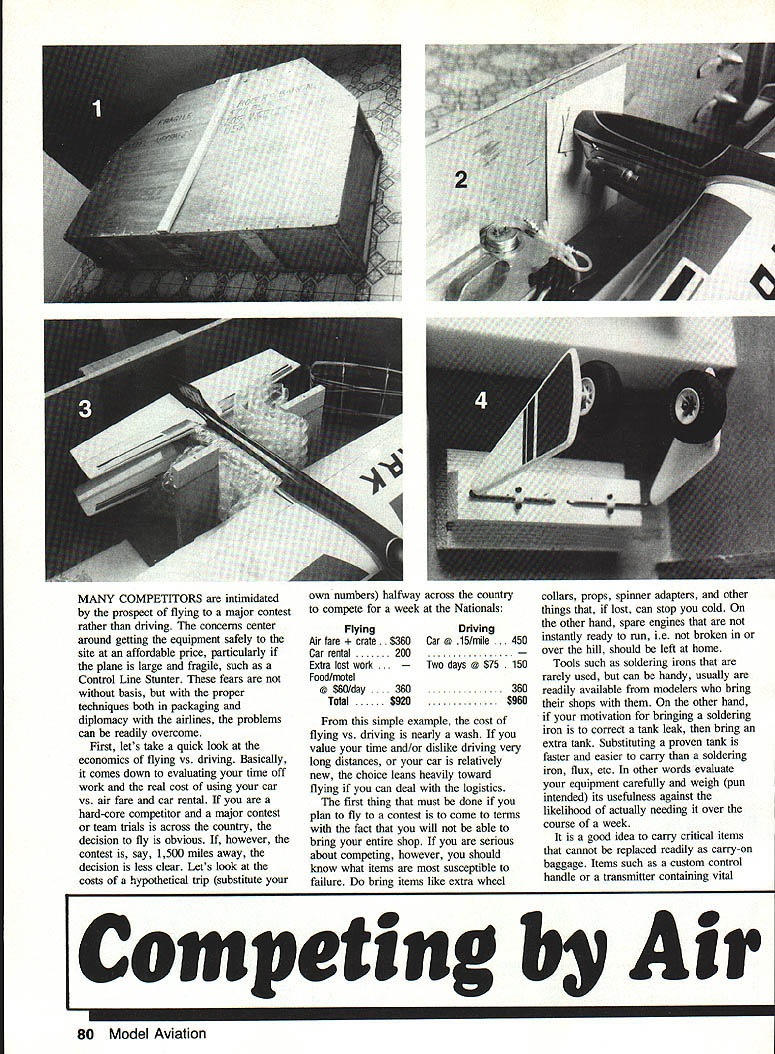
- Use 1/8-in. plywood stiffened externally with 3/4 x 3-in. braces.
- Bolt the engine to the bottom on a reinforced 3/4-in. wood plate.
- Use foam rubber to prevent the plane from rolling.
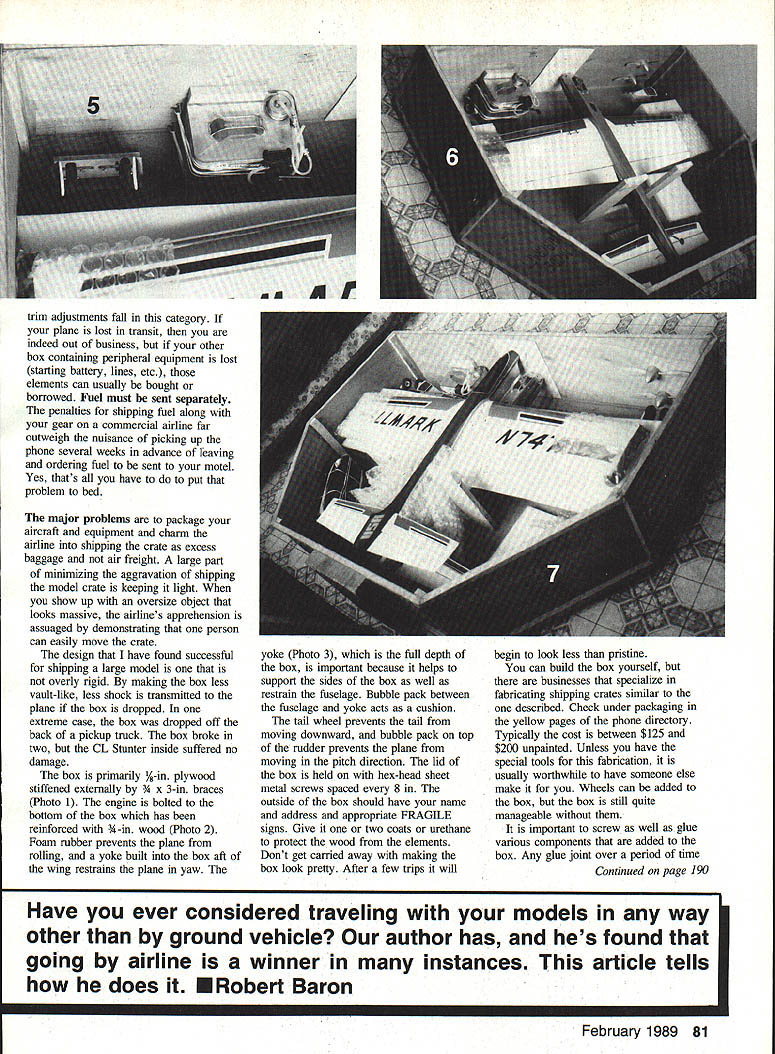
- Build a full-depth yoke aft of the wing to restrain yaw and support the box sides.
- Place bubble wrap between fuselage and yoke for cushioning.
- Add a tail-wheel stop to prevent downward tail movement and bubble wrap atop the rudder to prevent pitch movement.
- Secure the lid with hex-head sheet-metal screws spaced about every 8 in.
- Mark the outside with your name, address, and FRAGILE signs.
- Apply one or two coats of urethane to protect the wood from the elements.
- Keep aesthetics secondary—after a few trips the box will look worn.
You can build the box yourself or have specialized businesses fabricate it (check under "Packaging" in the phone directory). Typical cost: $125–$200 unpainted. Wheels can be added, but the box remains manageable without them.
It is important to both screw and glue added components; glue joints can pop loose over time and cause serious damage. For example, a landing-gear hold-down block should be secured with sheet-metal screws as well as glue.
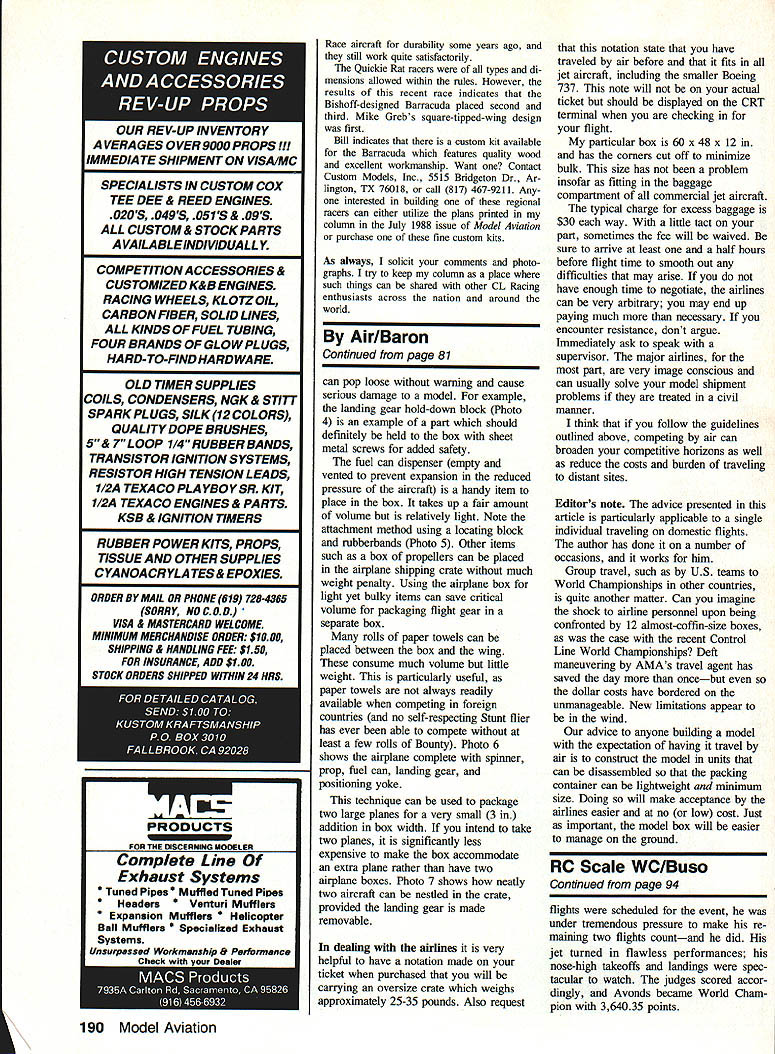
Include a vented, empty fuel can in the crate to avoid expansion at reduced pressure. Attach it securely (e.g., locating block and rubber bands). Use the airplane crate for light, bulky items (prop boxes, rolls of paper towels) to save volume in other boxes.
Packing Two Planes
If taking two large planes, design the crate to accommodate both with minimal added width. Nested packing is possible if landing gear is removable; this is usually cheaper than making two separate boxes.
Additional Packing Tips
- Paper towels (several rolls) occupy volume but add little weight—handy at contests and sometimes hotels without towels.
- Use available space wisely: store light, bulky items around the aircraft.
Dealing with Airlines
- When purchasing your ticket, request a notation on the reservation indicating you will carry an oversize crate weighing approximately 25–35 lb and that it fits in all jet aircraft including smaller types (e.g., Boeing 737). The note typically appears on the agent's terminal and can be displayed at check-in.
- Typical excess-baggage charge for a box of about 60 x 48 x 12 in. is around $30 each way; with tact, fees are sometimes waived.
- Arrive at the airport at least 1.5 hours before flight time to handle any difficulties. If you encounter resistance, remain civil and ask for a supervisor—major airlines are image conscious and will often resolve problems if treated respectfully.
- Don't argue with front-line staff; escalate politely when needed.
My personal crate is 60 x 48 x 12 in. with corners cut to minimize bulk; this size has generally fit baggage compartments on most commercial jets.
Conclusion
If you follow the guidelines above, competing by air can broaden your competitive horizons and reduce costs and travel burden to distant sites. Build models in disassemblable units where possible so packing containers can be lightweight and minimal in size—this improves airline acceptance and makes ground handling easier.
Editor's note
The advice is particularly applicable to a single individual traveling on domestic flights; the author has used these methods successfully. Group travel (for example, U.S. teams to World Championships) presents different challenges—multiple large boxes can shock airline personnel and require deft negotiation and higher costs. New limitations may appear, so plan accordingly.
Our advice to anyone building a model with air travel in mind: construct the model in units that can be disassembled so the packing container can be lightweight and minimum size. Doing so makes airline acceptance easier and handling on the ground simpler.
Transcribed from original scans by AI. Minor OCR errors may remain.

