
COMPETITION NEWS
Note From the Technical Director — Bob Underwood
A new year dawns soon. Clubs, especially in climates where seasons are noted by temperature changes, are looking toward building and planning 1991 activities. Meetings headline modelers' activities and feature "how-to" sessions punctuated by members regaling one another with last summer's exploits. As your group looks toward next year there are a number of changes to be aware of. "The times, they are a-changing" has special meaning not only for members in general, but for club officers and Contest Directors in particular. To help with activity planning, here are the changes that will be happening in the 1991 membership year.
Event Sanctioning
A major change beginning in 1991: non-flying events will no longer be sanctioned. Instead, a new Non-flying Event Listing will appear in Model Aviation each month. The listing will be structured like the current sanction listing, but will not use the sanction request and report paperwork. A form is available that your club can use to apply to have a mall show, seminar, etc., listed. Key facts:
- The Non-flying Event Listing form is sent directly to Headquarters for processing, allowing 90 days to insure at least one listing in Model Aviation. Fee: $10.00 (same as a sanction).
- Contest Director status is not required to apply.
- Special additional advertisement is still available at the same rate used for Sanctioned Event listings.
- If your chartered club needs an additional insured certificate for the mall, etc., a dated certificate is still available through the Chartered Club Department at Headquarters. Fee: $10.00 each.
- There is a limit on the amount of text accepted for the listing (approximately six to seven lines).
We will continue to accept Non-flying Event Listing requests on the regular sanction forms until the new form has been in circulation for several months and phased in. Questions? Give us a call and we'll fill you in.
In regular sanctioning, members in Districts 3, 6 and 7 should note that effective January 1 all sanction requests involving Free Flight and Control Line contests must be routed directly to Headquarters. At its April meeting the Executive Council decided to test whether contest coordination could be accomplished through Headquarters rather than by local district coordinators. The task is formidable and will require patience as the long-acquired local knowledge (traditional dates, event separation peculiarities, host variables, etc.) is communicated to Headquarters staff.
Contest Directors — Heads up!
A number of important changes will impact your tasks in 1991:
- For Radio Control events: all transmitters used in sanctioned events (not just contests, but fly-ins, demonstrations, etc.) will be required to have a certified RC AMA Gold sticker affixed. (This does not apply to transmitters on 27 MHz or 53 MHz.) This requirement is part of the 1991 Safety Code.
- New-membership signature requirement: beginning in 1991 new members must sign at the time of joining to acknowledge receipt of the AMA Safety Code. New members who join at sanctioned events will sign the actual membership application, which contains the Safety Code and a signature line. The new membership application form is included in the 1991 sanction package. If you need additional copies, contact the Competitions Department.
Another membership/insurance change: foreign nationals have long been required to purchase an Affiliate Membership to fly in sanctioned events or at chartered club fields and to produce proof of membership in their home national aero club. That practice continues, except that effective January 1, through an agreement with Canada's national organization (MAAC), Canadian nationals will not have to purchase an AMA Affiliate membership — the MAAC membership card will suffice as proof of insurance coverage. Still check that card for current status and list the member on the event report.
Event Report Forms and Flight Sheets
1991 will be the first complete year for use of the revised event report forms (forms 10 and 11). Most Contest Directors have returned the forms correctly this year, but some did not, which results in inaccurate counts of how many members actually flew in rule-book events. Reminders:
- List only one rule-book event on each sheet.
- Provide the names of all persons who flew that particular event — not just the first five winners. If a person flew multiple numbered events, their name should appear on each corresponding sheet.
- If your events are not rule-book events (Egg Drop, Spot Landing, Nostalgia, V8, Texaco, etc.), have everybody sign on one sheet; no need to identify the event.
- The goal is to capture accurate digital data on how many individuals participated in each numbered event — please help Headquarters with that task.
Publications, FAI Stamps and Other Notes
- There will be no new Competition Regulations book for 1991 — the same book as 1990 will remain in effect. Therefore, no new book will be mailed. Copies are still available for $2.00 plus shipping and handling. FAI Sporting Codes are available for $3.00 each.
- FAI stamps: at the time of writing it appears a new process will be in effect for purchasing FAI competition stamps. The stamps will likely be obtained through the National Aero Club (the FAI office in AMA). This will affect FAI team selection programs and whether Contest Directors can accept money at events for stamps. Details are still pending — stay tuned.
Rule Proposals Synopsis
I have just finished preparing the synopsis of rule proposals for the 1992–93 Competition Regulations rule cycle. The complete set appears elsewhere in this publication (first section in the November issue). Space constraints required condensing proposals, which will disappoint some who would prefer full proposal text and rationale. In a future column I will discuss "How to write a rule proposal." One important consideration often omitted from proposals is a clear statement of which specific event(s) the proposal is meant to address.
Examples:
- Several Scale proposals concerned the 4.6 declaration rule but failed to indicate the specific events involved. Because rule 4.6 appears in both RC Sport Scale (511, 512, 513) and Control Line Sport Scale (509), ambiguity can affect multiple events.
- Many changes in RC Sport Scale also affect Giant and Fun Scale — proposers must be specific, or the result is confusion.
Until next month!
---
MONTHLY UPDATE — NATIONAL RECORDS (processed during August 1990)
- Indoor — Category IV, Intermediate Stick, Open — 3314 — Joe Foster — 9/6/90
- Indoor — Category IV, Ornithopter, Open — 1701 — Frank Kieser — 9/11/90
- Control Line — .21 Sport Speed, Open — 154.17 mph — Frank Garzon / Frank Garzon Jr. — 9/12/90
- Speed, Open — 186.97 mph — George W. Brown Jr. — 9/7/90
- Class II — Navy Carrier, Open — 4658 points — Peter Mazur — 9/12/90
- FAI Outdoor Free Flight — F1J Power, Open — 1200 — Randy Archer — 9/4/90
Requests involving Free Flight and Control Line contests should be routed directly to Headquarters.
---
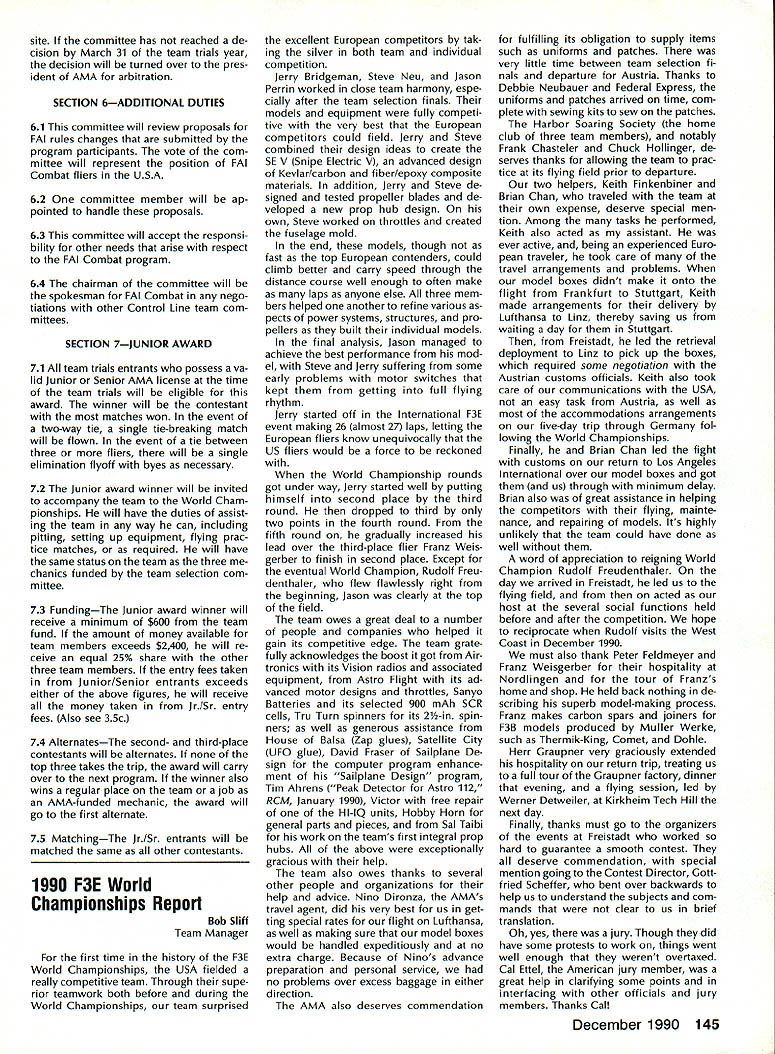
1990 F3E WORLD CHAMPIONSHIPS
Individual Results
- 1 Rudolf Freudenthaler — Austria
- 2 Jason Perrin — U.S.A.
- 3 Franz Weissgerber — F.R. Germany
- 8 Jerry Bridgeman — U.S.A.
- 9 Steve Neue — U.S.A.
Team Results
- 1 Austria — 14222
- 2 U.S.A. — 14095
- 3 F.R. Germany — 13984
---
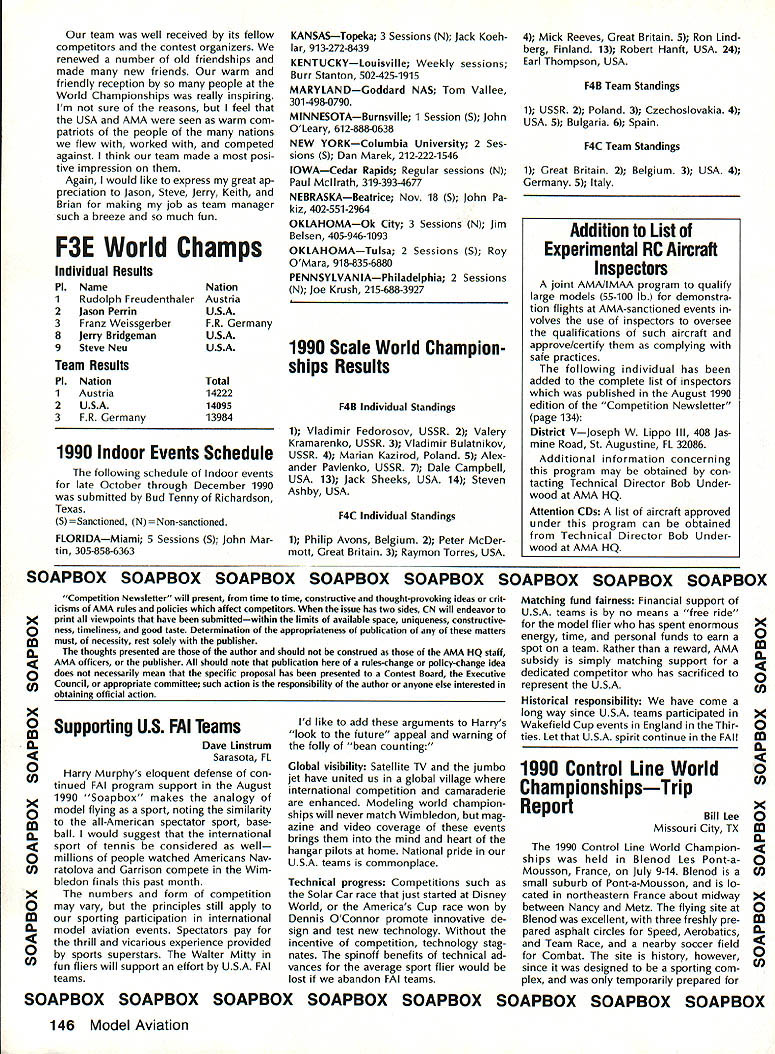
1990 INDOOR EVENTS SCHEDULE (late October–December 1990)
Submitted by Bud Tenny, Richardson, Texas. (S) = Sanctioned, (N) = Non-sanctioned.
- FLORIDA — Miami; 5 Sessions (S); John Martin, 305-858-6363
- KANSAS — Topeka; 3 Sessions (N); Jack Koehlar, 913-272-8439
- KENTUCKY — Louisville; Weekly sessions; Burr Stanton, 502-425-1915
- MARYLAND — Goddard NAS; Tom Vallee, 301-498-0790
- MINNESOTA — Burnsville; 1 Session (S); John O'Leary, 612-868-0668
- NEW YORK — Columbia University; 2 Sessions (S); Dan Marek, 212-222-1546
- IOWA — Cedar Rapids; Regular sessions (N); Paul McIlrath, 319-393-4677
- NEBRASKA — Beatrice; Nov. 18 (S); John Panik, 402-551-2964
- OKLAHOMA — Oklahoma City; 3 Sessions (N); Jim Belsen, 405-946-1093
- OKLAHOMA — Tulsa; 2 Sessions (S); Roy O'Mara, 918-835-6680
- PENNSYLVANIA — Philadelphia; 2 Sessions (N); Joe Krush, 215-688-3927
---
1990 SCALE WORLD CHAMPIONSHIPS RESULTS
F4B Individual Standings (selected)
- Vladimir Fedorosov — USSR
- Valery Kramarenko — USSR
- Vladimir Bulatnikov — USSR
- Marian Kazirod — Poland
- Alexander Pavlenko — USSR
- Dale Campbell — USA
- Jack Sheeks — USA
- Steven Ashby — USA
F4C Individual Standings (selected)
- Philip Avons — Belgium
- Peter McDermott — Great Britain
- Raymon Torres — USA
- Mick Reeves — Great Britain
- Ron Lindberg — Finland
- Robert Hanft — USA
- Earl Thompson — USA
F4B Team Standings
- USSR
- Poland
- Czechoslovakia
- USA
- Bulgaria
- Spain
F4C Team Standings
- Great Britain
- Belgium
- USA
- Germany
- Italy
---
ADDITION TO LIST OF EXPERIMENTAL RC AIRCRAFT INSPECTORS
A joint AMA/MMA program to qualify large models (55–100 lb.) for demonstration flights at AMA-sanctioned events uses inspectors to oversee qualifications and certify compliance with safe practices. The following individual has been added to the list published in the August 1990 Competition Newsletter (page 134):
- District IV — Joseph W. Lippo III, 408 Jasmine Road, St. Augustine, FL 32086.
Additional information may be obtained by contacting Technical Director Bob Underwood at AMA Headquarters. Attention Contest Directors: a list of aircraft approved under this program is available from Bob Underwood at HQ.
---
F2A — SPEED
For the first time in many years, the United States won the individual World Championship in Speed. Carl Dodge posted an excellent time of 302.01 km/hr in his first attempt — the first 300+ speed recorded in a World Championship and Carl's personal best. The other two U.S. speed fliers, John Newton and Billy Hughes, finished 12th and 18th respectively, and the three combined for a third-place Team award. John turned 281.46 km/hr; Billy posted 267.86 km/hr.
Speed observations:
- The official fuel prepared before the first round proved problematic. Midway through the second round a new bottle of fuel was opened and immediately engines would not run properly. The fuel was found to contain far more castor oil than it should have. The FAI jury ruled that all flights after the new bottle was opened would be re-flown after organizers mixed fresh fuel.
---
F2B — AEROBATICS
The Aerobatics team — Bill Werwage, Jim Casale, and Paul Walker — brought home the second-place Team prize. Paul placed 3rd individually, Jim 6th, and Bill 7th.
Aerobatics observations:
- Aerobatics is judged subjectively. The rule book specifies maneuvers precisely, but human judging varies. At these World Championships judges emphasized smoothness and overall impression rather than strict geometric sizes and intersection placement. This raises the question: should fliers adjust to the current judges’ preferences, or should judges strictly score according to the rule book? The issue needs addressing at the FAI level.
---
F2C — TEAM RACE
Team Race was a disappointment for the U.S. None of the teams achieved expected performances — problems included missed settings, missed opportunities, and disqualifications.
- Tim Gillott / Jeff Hollenfelder (top qualifying team) best time: 4:42.6 (well below their U.S. selection sub‑3:30 times).
- John McCollum / Chuck Rudner: best complete race 4:52.9; disqualified once for not keeping handle on the ground during a pit stop.
- Stew Willoughby / Bob Oge: 4:20.2 in first race; disqualified in second.
Team Race observations:
- The FAI jury ran a tight interpretation of rules. Fouls called were considered by many to be extreme (e.g., "failure to pass in three laps"). The "handle-on-ground" rule was enforced strictly, although experience suggests allowing the handle free of the ground but below the knee is safer.
---
F2D — COMBAT
Like Team Race, Combat was poor for the U.S., finishing tied for 8th. Issues included taking too much opponent streamer in the first pass, defensive flying afterward, and mechanical/fragility problems with newer high-tech models.
Combat observations:
- FAI Combat in Europe differs from U.S. Combat. Matches were often very rough, and European designs tended to absorb more abuse (triangular wing planforms, integrated elevator surfaces, foam/wood constructions). U.S. models were more fragile in comparison — perhaps time to consider design changes.
---
GENERAL COMMENTS
Participating in a World Championships is an incomparable experience. Competing with the best in the world is unique and the achievement is supported by AMA and the majority of AMA members who are not competition fliers. Those who represent the U.S. in FAI events — Control Line, Free Flight, Radio Control — help advance the sport.
Competition Newsletter is edited by Fredric O. Blanco, AMA 262485.
Until next month!
Transcribed from original scans by AI. Minor OCR errors may remain.

