

COMPETITION NEWS
A Note From the Technical Director
Bob Underwood
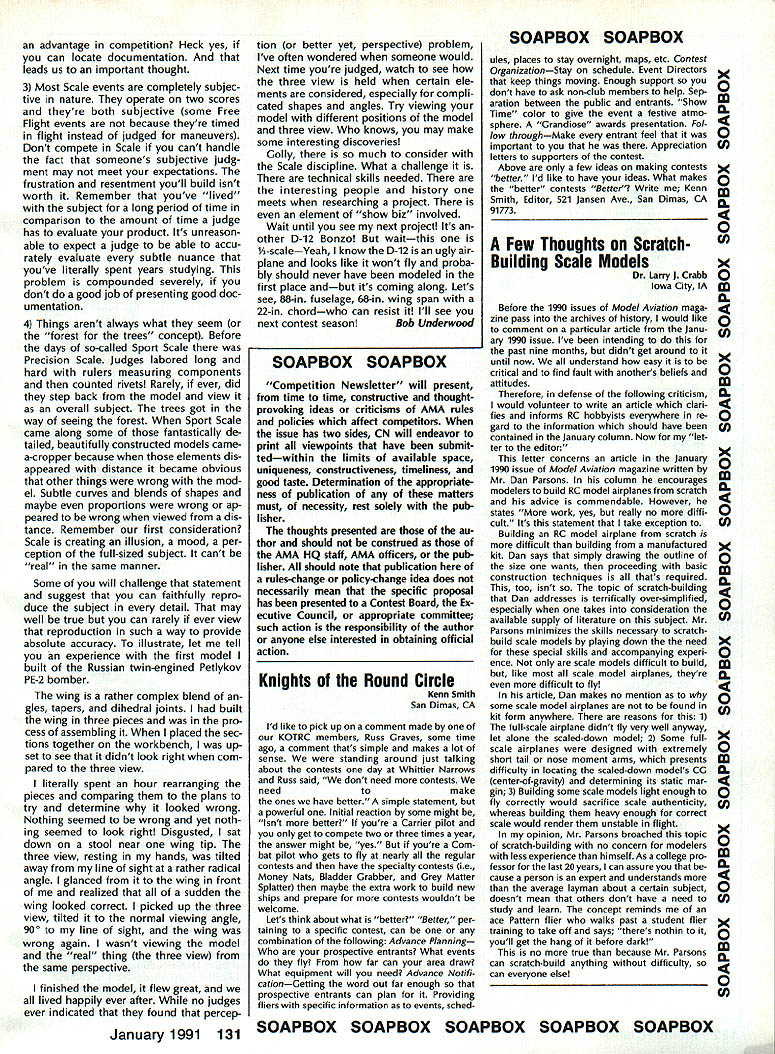
I build and fly Scale! That's hardly a great revelation to some of you. Nor is the term "Scale" any great mystery. It's not "a small, platelike dermal or epidermal structure forming the external covering of fishes, reptiles, and certain mammals." It isn't a "flaky oxide film formed on metal" or an "ascending or descending series of tones." For those of us in the airplane business, it's a somewhat smaller version of a bigger something that hopefully flies kind of like the larger one.
I build Scale. Many of you build Scale. Almost everyone likes Scale for one reason or another. Whether you're an "almost everyone" or not, I'm going to spend my column space in a Scale manner this month. So if you don't like it, find some other column to read and don't bother with us Scale nuts!
Are those of us that are into Scale nuts? Absolutely! Without question! And that goes for both definitions of the word — "crazy, insane" and "extremely enthusiastic." What other explanation could there be?
3) Most Scale events are completely subjective in nature. They operate on two scores and both are subjective (some Free Flight events are not, because they're timed in flight instead of judged for maneuvers). Don't compete in Scale if you can't handle the fact that someone's subjective judgment may not meet your expectations. The frustration and resentment you'll build isn't worth the remembrance that you've "lived" with the subject for a long period of time compared to the amount of time a judge has to evaluate your product. It's unreasonable to expect a judge to be able to accurately evaluate every subtle nuance that you've literally spent years studying. This problem is compounded severely if you don't do a good job of presenting good documentation.
4) Things aren't always what they seem (the "forest for the trees" concept). Before the days of so-called Sport Scale there was Precision Scale. Judges labored long and hard with rulers measuring components and then counted rivets! Rarely, if ever, did they step back from the model and view it as an overall subject. The trees got in the way of seeing the forest. When Sport Scale came along some of those fantastically detailed, beautifully constructed models came a-cropper because when those elements disappeared with distance it became obvious that other things were wrong with the model. Subtle curves and blends of shapes and maybe even proportions were wrong or appeared to be wrong when viewed from a distance.
Remember our first consideration: Scale is creating an illusion, a mood, a perception of the full-sized subject. It can't be "real" in the same manner.
Some of you will challenge that statement and suggest that you can faithfully reproduce the subject in every detail. That may well be true, but you can rarely, if ever, view that reproduction in such a way to provide absolute accuracy. To illustrate, let me tell you about an experience with the first model I built of the Russian twin-engined Petlyakov Pe-2 bomber.
The wing is a rather complex blend of angles, tapers, and dihedral joints. I had built the wing in three pieces and was in the process of assembling it. When I placed the sections together on the workbench, I was upset to see that it didn't look right when compared to the three-view.
I literally spent an hour rearranging the pieces and comparing them to the plans to try and determine why it looked wrong. Nothing seemed to be wrong and yet nothing seemed to look right! Disgusted, I sat down on a stool near one wing tip. The three-view, resting in my hands, was tilted away from my line of sight at a rather radical angle. I glanced from it to the wing in front of me and realized that all of a sudden the wing looked correct. I picked up the three-view, tilted it to the normal viewing angle — 90° to my line of sight — and the wing was wrong again. I wasn't viewing the model and the "real" thing (the three-view) from the same perspective.
I finished the model, it flew great, and we all lived happily ever after. While no judges ever indicated that they found that perception (or, better yet, perspective) problem, I've often wondered when someone would. Next time you're judged, watch to see how the three-view is held when certain elements are considered, especially for complicated shapes and angles. Try viewing your model with different positions of the model and three-view. Who knows — you may make some interesting discoveries!
Golly, there is so much to consider with the Scale discipline. What a challenge it is. There are technical skills needed. There are the interesting people and the history one meets when researching a project. There is even an element of "show biz" involved.
Wait until you see my next project! It's another D-12 Bonzo! But wait — this one is 1/9-scale. Yeah, I know the D-12 is an ugly airplane and looks like it won't fly and probably should never have been modeled in the first place — but it's coming along. Let's see: 88 in. fuselage, 68 in. wingspan with a 22 in. chord — who can resist it! I'll see you next contest season!
Bob Underwood
Call for Final Site Bid: CL Speed and Team Race
Clubs interested in hosting the 1992 CL Speed or Team Race Finals should submit bids in writing to AMA Headquarters (attn: Micheline Madison).
- Preferred dates for the finals should be during September or October, 1991.
- The bid should include:
- preferred dates,
- location,
- name of host club,
- contest director,
- budget,
- accommodations for competitors and officials.
- Finals sites and dates will be selected by the Speed and Team Race Team Selection Committees from among bids received by April 1, 1991.
1992 FAI Scale Team Selection Program
The purpose of the team selection program is to select six individuals to comprise a team to represent the United States at the 1992 Scale World Championships (events F4B and F4C), plus alternate team members.
- Selection method:
- The team and alternates will be selected by competing in static judging and a single-elimination contest at the 1991 U.S. Nationals (NATS).
- The results of the flying competition and static judging will determine team members and alternates.
- The top three placing competitors in F4B will comprise the team, with the fourth-place competitor serving as the team alternate. The F4C team and alternate will be determined in the same manner.
- The rules governing the Finals are contained in the current "FAI Sporting Code."
- Entry fees and deadlines:
- Entry fee: $75, payable to AMA Headquarters no later than 30 days prior to the Finals (postmark deadline).
- On-site late entry fee: $100, payable to the Contest Director up to one hour prior to the advertised starting time of the Finals.
- All entry fees will be held in escrow by AMA Headquarters.
- Dates and location: Details of the Finals, including date and location, will be announced as soon as possible.
- Membership and eligibility:
- All competitors must be current AMA and NAA members. Being an NAA member provides the FAI stamp and sporting license.
- Failure to comply with membership requirements will result in disqualification from the contest and render a flier ineligible to compete at the 1992 World Championships.
- Refunds:
- Only individuals who do not participate in the Finals are entitled to a full refund.
- Refund requests must be received at AMA Headquarters in writing within five business days upon completion of the Finals.
- Use of entry fees:
- Up to 50% of the total entry fee collected may be used to offset Finals expenses, with approval of the Scale Team Selection Committee.
- Requests for expense reimbursements must be accompanied by a receipt.
- Team fund and expenses:
- The Team Selection Committee shall allocate from the team fund money for the following team expenses:
- travel expenses not paid by AMA,
- vehicle rental,
- uniforms,
- other expenses approved by majority vote of the current Team Selection Committee.
- Use of team funds is limited to team expenses and the Finals expenses.
- Expenses for shipment of model boxes and fuel will be paid by AMA.
- Team management and nominations:
- The six team members will select a team manager by vote at the conclusion of the Finals.
- Nominees for manager may be submitted to AMA Headquarters no later than 30 days prior to the Finals. All nominees are subject to approval by AMA Headquarters and the Scale Team Selection Committee.
- A list of five nominees to serve as jury members at the Finals shall be submitted by the Team Selection Committee to the Competition Department at AMA Headquarters. Nominees must meet criteria in the Standing Rules and Laws of the Academy of Model Aeronautics.
Amendment to 1991 F3C Helicopter Team Selection Program
Currently, the last sentence of the Helicopter Team Selection Program, section II "QUALIFICATION", paragraph one, reads: "The program entry and FAI stamp fee must be paid prior to entry in a qualifying contest."
The program participants voted to replace this sentence with the following:
"Contestants who have flown in FAI Helicopter events at AMA-sanctioned contests beginning April 1, 1990 until September 30, 1990 are permitted to use the contests for the purpose of qualifying for the Finals, providing the 1990 FAI stamp was purchased prior to the flight. Upon payment of the program entry fee to AMA Headquarters the embossed entry form will be sent to the program participant. The contest director for the qualifying contest must complete parts 1 & 2, attesting to the entrant's performance. The signed qualification form must be forwarded to AMA Headquarters immediately so that records can be adjusted accordingly."
1990 Soaring Team Selection Finals
Byron Blakeslee, Contest Director
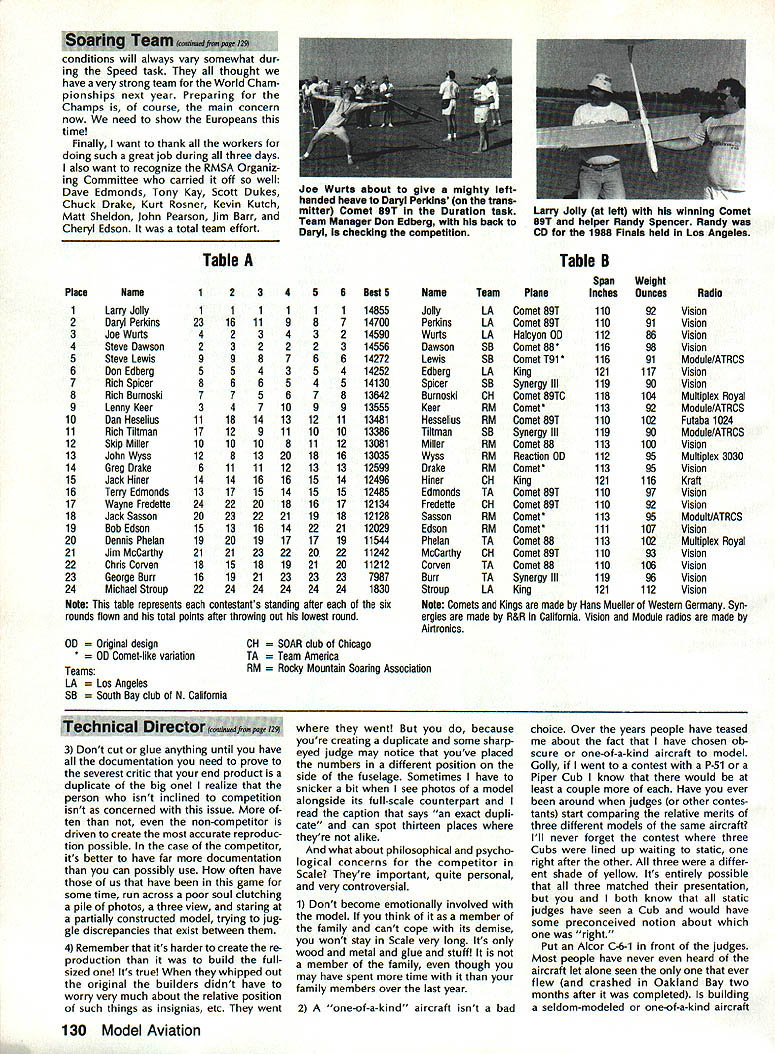
The 1990 F3B Team Selection Finals contest was held in Denver, CO over the Labor Day weekend, September 1–3. Twenty-four pilots from around the country were competing for the four spots on the U.S. team to the World Championships next year. The contest was sponsored by the Rocky Mountain Soaring Association, with much help from the Pikes Peak Soaring Society of Colorado Springs.
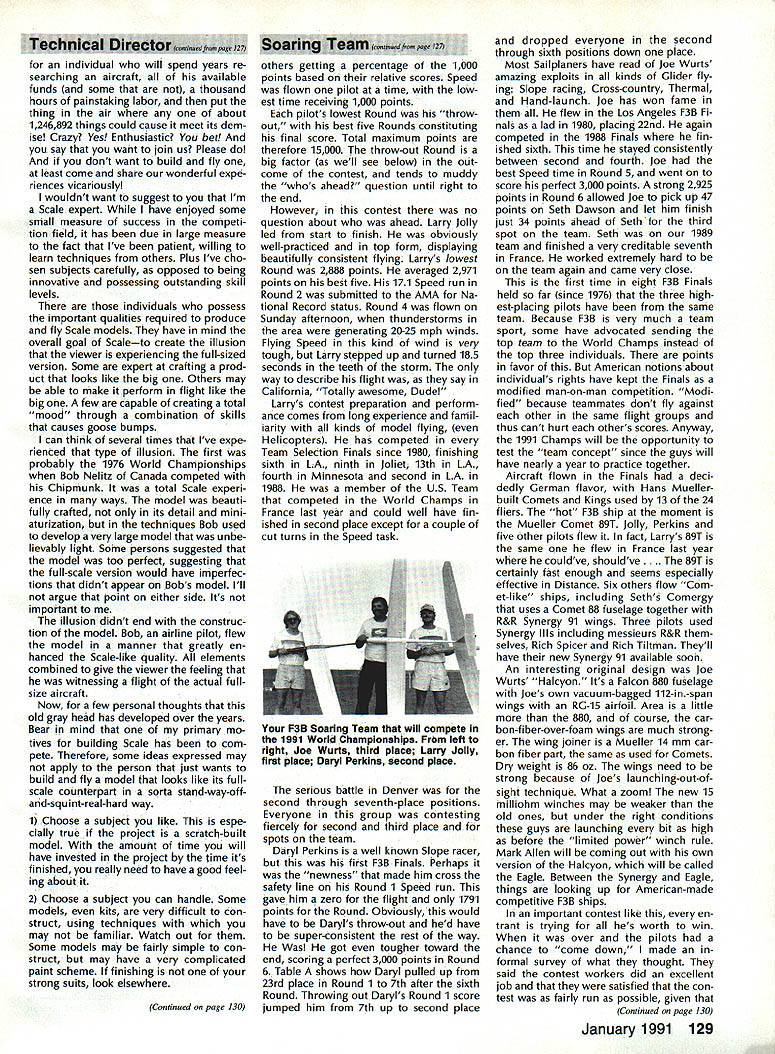
Larry Jolly, Darryl Perkins, and Joe Wurts will make up the U.S. Soaring Team going to the World Championships in the Netherlands next year. All three pilots are from the Los Angeles area. Seth Dawson and Steve Oaks were first and second alternates.
F3B Soaring is the only FAI-recognized class for international sailplane competition. There are three tasks: Duration, Distance, and Speed. A round consists of one of the three tasks. Six rounds were flown at the Finals, each worth a maximum of 3,000 points (1,000 points per task). In Duration and Distance, pilots flew in three- or four-man flight groups. The winner of each flight group received 1,000 points, with the remaining pilots scored relative to their performance.
Last of the 1992–93 Rules Proposals
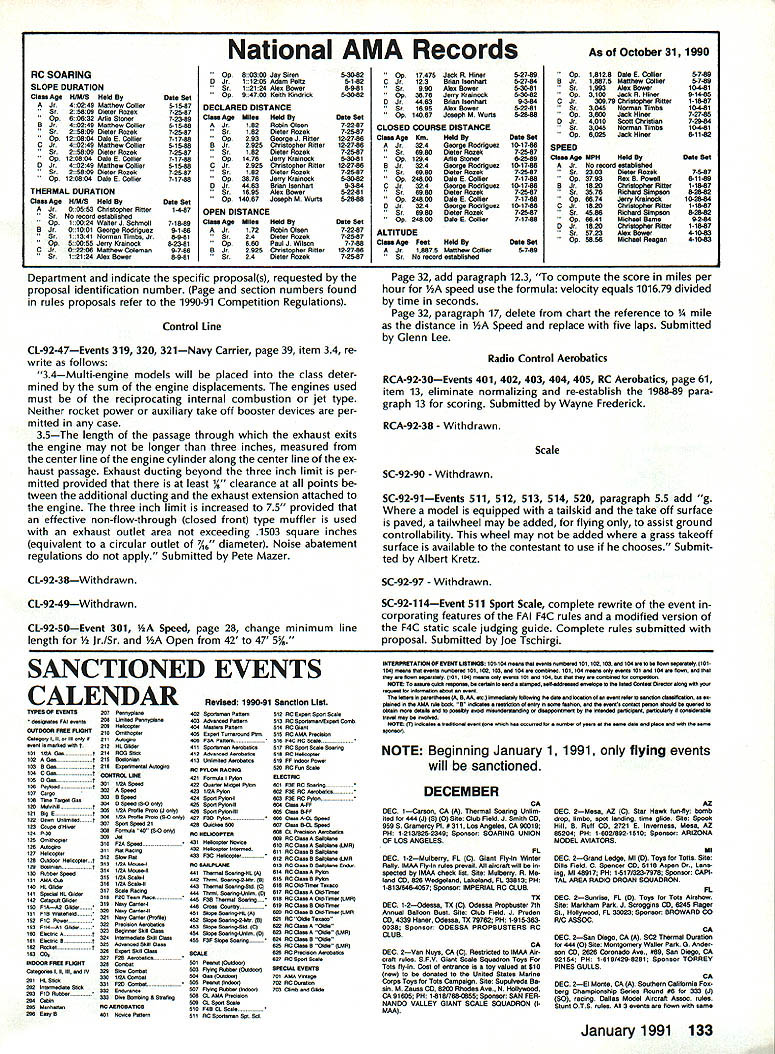
The following information is the last synopsis of the Competition Regulation rules proposals submitted for the present cycle. The November and December 1990 issues of Model Aviation magazine contained the main body of these proposals.
Please note that, in the interest of making efficient use of space in the magazine, only a brief description of each proposal is included. Modelers interested in studying any proposal in detail can request copies of the original proposal from AMA Headquarters. Special interest groups and model publications are encouraged to request proposals of interest to them. Not only will this provide interested parties with the complete text, but also the rationale presented by the individual submitting the proposal. Contact the Competition Department and indicate the specific proposal(s) requested by the proposal identification number. (Page and section numbers found in rules proposals refer to the 1990–91 Competition Regulations.)
Control Line
CL-92-47 — Events 319, 320, 321 — Navy Carrier, page 39, item 3.4, rewrite as follows:
- "3.4 — Multi-engine models will be placed into the class determined by the sum of the engine displacements. The engines used must be of the reciprocating internal combustion or jet type. Neither rocket power nor auxiliary take-off booster devices are permitted in any case.
- 3.5 — The length of the passage through which the exhaust exits the engine may not be longer than three inches, measured from the center line of the engine cylinder along the center line of the exhaust passage. Exhaust ducting beyond the three inch limit is permitted provided that there is at least 1/2" clearance at all points between the additional ducting and the exhaust extension attached to the engine. The three inch limit is increased to 7-1/2" provided that an effective non-flow-through (closed front) type muffler is used with an exhaust outlet area not exceeding .1503 square inches (equivalent to a circular outlet of 1/4" diameter). Noise abatement regulations do not apply."
Submitted by Pete Mazer.
CL-92-38 — Withdrawn.
CL-92-49 — Withdrawn.
CL-92-50 — Event 301, 1/4A Speed, page 28: change minimum line length for 1/2 in., 5/8 in., and 3/4 in. Open from 42' to 47' 5/8".
Transcribed from original scans by AI. Minor OCR errors may remain.

