
COMPETITION NEWS
A Note From the Technical Director
Bob Underwood
Once again your Technical Director tiptoed through the event reports to gain insights into the Academy's competition activities. Unlike last year's efforts, this year it was possible to identify activity in specific competition events by number. The exercise proved most interesting.
The complete report for 1990 will not be ready for a few more months. The data in this column are taken from contest reports returned by September 30, 1990, so be careful about the conclusions you draw. In January I will process the remaining reports and add that information to the system. The total number of different competitors (individual persons) stands at about 8,500 as of this report — very close to the 1989 number for the same time frame. If the remaining three months produce the same percentage as last year, the final count will be roughly 10% higher.
Last year we indicated the numbers would be somewhat flawed for various reasons. These numbers also are flawed, although not necessarily for the same reasons. The following problems affect the accuracy of the count:
- While the new Form 11 was available for the entire year, not all Contest Directors (CDs) used it. Some may have received their sanction kit before the new form was available; however, even very late in the year a few CDs sent back the old registration Form 10. Because of that, I could only pick up the five winners for the count instead of the whole entry. From now on we will be contacting the CDs to acquire the proper paperwork.
- We still have a penmanship problem. We changed the computer program to reject AMA numbers if they are unassigned, but we still couldn't link many indecipherable digits with a person's name. A person's name seldom forms number shapes in a readable fashion; letter shapes often suffer from “scribble-itis.” This problem is improved from last year, however.
- Some CDs combined several events on the same sheet. For instance, one CD listed RC Pattern event numbers (401 through 406) in a tiny space at the top of a single form and then listed all contestants for the contest on that one sheet. There was no way to determine how many — or who — entered each event.
- Some contests fly combined events. Common instances include Free Flight Power events flown together; Control Line Speed events flown against record; or RC Sport and Giant Scale combined. There is no way to enter that information without skewing the numbers. Those persons were not entered in the system. While this may cause an event count to be slightly low, it does not greatly affect the overall count of people flying contests, since the person usually appears in the system due to participation in another contest.
- Some problems with the numbers may be due to ill-prepared CDs. One CD complained we didn't send enough forms back, stating that when he opened the sanction envelope at the field the morning of the contest there were fewer than half the forms he expected. If the first time he looked at the paperwork was the morning of the contest, he would not have had time to read the instructions on how to fill them out. He complained he had 18 events but only eight forms; if he had read the instructions he would have discovered he needed a separate Form 11 only for certain rule-book events.
A couple of last thoughts before we get to the numbers. Due to the present computer program and system buffers, it was not possible to string all the event numbers together for an overall total in a few disciplines. I have divided Free Flight, Control Line, and Scale into logical groupings of like events. Due to that limitation (which will be corrected in the future), don't attempt to total the individual participant numbers in the various sections to arrive at a category total.
The "event entry" number simply indicates that some people enter more than one event. It's interesting to note that in RC Helicopter the event number and overall participant number are almost identical. That's because Helicopter uses a skill-level system for the pilot — you don't have multiple events being flown by one person. When you review those numbers you'll find that it appears two people moved from one class to another during the year.
Now to the numbers.
Outdoor Free Flight
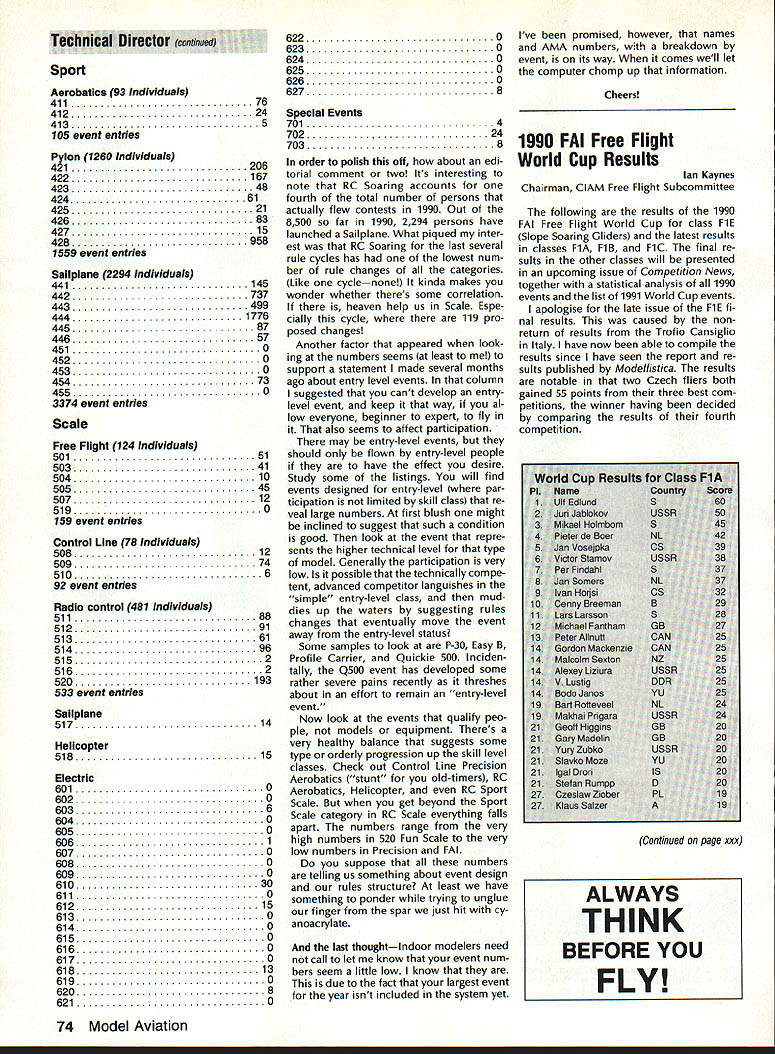
Power (379 Individuals) 101 ........................................... 252 102 ........................................... 11 103 ........................................... 50 104 ........................................... 32 105 ........................................... 30 106 ........................................... 10 107 ........................................... 9 108 ........................................... 1 152 ........................................... 6
537 event entries
Glider (336 Individuals) 140 ........................................... 239 141 ........................................... 57 142 ........................................... 97 150 ........................................... 57 151 ........................................... 12 422 ........................................... 4
632 event entries
Rubber (466 Individuals) 120 ........................................... 154 121 ........................................... 0 122 ........................................... 0 123 ........................................... 126 124 ........................................... 270 125 ........................................... 5 126 ........................................... 0 127 ........................................... 1 128 ........................................... 0 129 ........................................... 5 130 ........................................... 0 131 ........................................... 0 151 ........................................... 0
712 event entries
Miscellaneous (31 Individuals) 160 ........................................... 9 161 ........................................... 9 162 ........................................... 3 163 ........................................... 9
33 event entries
Indoor (191 Individuals) 201 ........................................... 2 202 ........................................... 16 203 ........................................... 16 204 ........................................... 10 205 ........................................... 2 206 ........................................... 88 207 ........................................... 38 208 ........................................... 45 209 ........................................... 0 210 ........................................... 10 211 ........................................... 49 212 ........................................... 4 213 ........................................... 54 214 ........................................... 0 215 ........................................... 0
314 event entries
Control Line
Speed (138 Individuals) 301 ........................................... 36 302 ........................................... 29 303 ........................................... 22 304 ........................................... 31 305 ........................................... 2 306 ........................................... 23 307 ........................................... 24 308 ........................................... 25 309 ........................................... 16 310 ........................................... 16
251 event entries
Aerobatics (392 Individuals) 322 ........................................... 140 323 ........................................... 77 324 ........................................... 80 325 ........................................... 79 326 ........................................... 74
458 event entries
Racing (165 Individuals) 311 ........................................... 21 312 ........................................... 89 313 ........................................... 83 314 ........................................... 18 315 ........................................... 3 316 ........................................... 63 318 ........................................... 8
260 event entries
Combat (387 Individuals) 328 ........................................... 208 329 ........................................... 243 330 ........................................... 144 331 ........................................... 27
622 event entries
Carrier (127 Individuals) 319 ........................................... 57 320 ........................................... 29 321 ........................................... 104
190 event entries
Miscellaneous Events 332 ........................................... 0 333 ........................................... 41
Radio Control
Pattern (1846 Individuals) 401 ........................................... 519 402 ........................................... 542 403 ........................................... 252 404 ........................................... 148 405 ........................................... 212 406 ........................................... 287
1960 event entries
Helicopter (234 Individuals) 431 ........................................... 75 432 ........................................... 97 433 ........................................... 64
236 event entries
CS Engines Approved for RC Quarter Midget Pylon
CS Competition Engines, from Cherokee Hill South Aero Engines Ltd., have been approved (in accordance with paragraph 4.2, page 78) by RC Race Contest Board Chairman Wayne Yeager for AMA rule-book event #422.
National Records: Monthly Update
The following new National Records have been processed during November 1990:
- Outdoor Free Flight — Category III: C Gas Senior — 5:36, Mike Keller, 5/27/90.
- Outdoor Free Flight — F1H Glider Open — 19:00, Martyn Cowley, 10/13/90.
- Outdoor Free Flight — CO Power Open — 33:55, Francis B. Hudson, 10/19/90.
- Control Line — Endurance Junior — 44:12, Mark E. Williams, 10/6/90.
U.S.A./FAI Free Flight Team Selection Finals
John Oldenkamp — San Diego, California
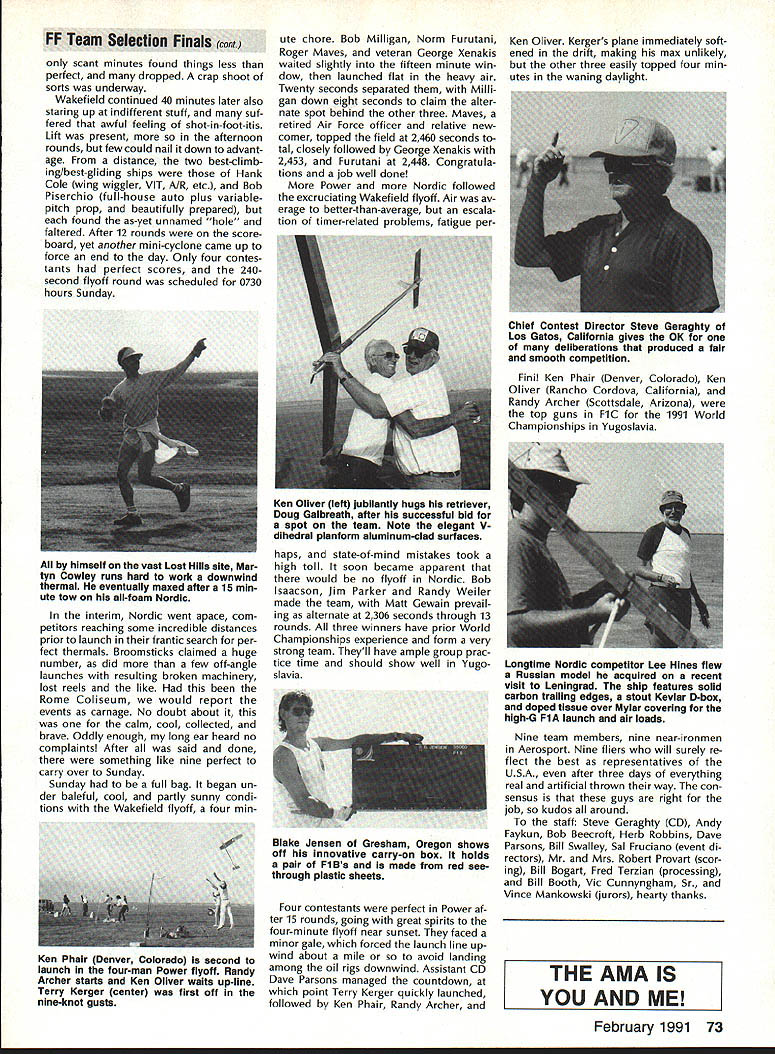
Lost Hills, California — September 21–23, 1990: One hundred one survivors of the rigorous preliminary schedules, plus spouses, pets, helpers, and a few others, showed up to compete for nine spots on the team that will represent the U.S.A. in the 1991 World Championships in Yugoslavia.
Steve Geraghty of Los Gatos, California presided as Contest Director, aided by six event directors and a panel of three jurists to settle disputes. There were few protests, fair and smooth management, hot competition, and some surprises. An errant rattlesnake posed a real field hazard (it was corralled in a heavy box for the weekend) and became more of a curiosity; the sizable Lost Hills venue proved its world-class caliber.
The meet format was an experiment: categories F1A, F1B, and F1C were flown two per day, freeing one odd group out for timing. Sixteen one-half-hour rounds were scheduled (eight per day), plus flyoffs; initial rounds were 210 seconds each. Launch windows were 30 minutes for regular rounds and 15 minutes for flyoffs. The result was outstanding, with ample timing personnel for each lane and a minimum of last-minute shouting. Sixteen rounds were run on the boards for Nordic, Wakefield, and Power — a tough and true test.
Competitors came from all corners of the country. Notable entrants included Wakefield World Champion Bob White; Lee Hines (second-place Nordic 1979); former team members Walt Ghio, Doug Galbreath, Matt Gewain, Jim Quinn, Bob Piserchio, Roger Simpson, Jim Parker, Randy Archer, Bob Isaacson, and Randy Weiler; World Junior Power Champion Mike Keller; and many international free-flight contributors such as Henry Struck, Hank Cole, Fred Pearce, Jim O'Reilly, Chris Matsuno, Buckets Johnson, and Doug Joyce.
Weather interruptions ranged from light sprinkles to hard rain, lightning and thunder, zero-visibility dust storms, mud, and strong gales. A tropical storm far enough north off the California coast caused a tube-like low-pressure disturbance that stretched across the region. An intense high over Oregon/Washington fed unusual and unkind conditions. Despite this, between storms there were becoming thermals and generally positive conditions.
Wakefield went to the starting poles first thing Friday morning under light spatters. Thirty-five launched and 23 maxed in the early rounds, showing the vastly improved potential of the ships. Subsequent rounds were difficult: some pilots launched into broomstick-style lift and fell short. A sudden dust squall forced a halt after round seven, with only six fliers “clean.”
Power (F1C) mirrored Wakefield, with spectacular climbs and full maxes through midday. Mechanical failures eliminated a few; at dusk 11 fliers had perfect scores. An on-off rain followed as competitors moved to quarters.
Saturday was mixed; Nordic hopefuls started at 0730 with furtive gusts, cold cells, and indifferent conditions. Some who hooked early found good air; others waiting a few minutes found it less than perfect. Wakefield continued later and many suffered from inconsistent lift. The two best-climbing/best-gliding ships observed were those of Hank Cole and Bob Piserchio, but both encountered holes and faltered. After 12 rounds another mini-cyclone forced an early end to the day. Only four contestants had perfect scores; a 240-second flyoff was scheduled for 0730 Sunday.
Nordic produced some incredible distances and many broomstick launches with resulting broken gear and lost reels. After all was said and done, nine contestants were perfect and carried over to Sunday.
Sunday began partly sunny and cool with the Wakefield flyoff, a four-minute task. Bob Milligan, Norm Furutani, Roger Mayes, and veteran George Xenakis launched close together within the window. Twenty seconds separated them, with Milligan finishing eight seconds behind to claim the alternate spot. Roger Mayes topped the field with 2,460 seconds total, George Xenakis followed with 2,453, and Norm Furutani with 2,448 — congratulations to them.
More Power and Nordic followed. Due to timer problems, fatigue, and other mishaps, there would be no Nordic flyoff. The Nordic team selected were Bob Isaacson, Jim Parker, and Randy Weiler, with Matt Gewain as alternate at 2,306 seconds through 13 rounds. All three winners have prior World Championships experience and form a very strong team.
Four contestants were perfect in Power after 15 rounds and went into a four-minute flyoff near sunset. They faced a minor gale that forced the launch line upwind about a mile to avoid downwind oil rigs. Assistant CD Dave Parsons managed the countdown; Terry Kerger launched first, followed by Ken Phair, Randy Archer, and Ken Oliver. Kerger's plane softened in the drift, making his max unlikely, while the other three easily topped four minutes in the waning daylight.
Editorial Notes (Technical Director)
- RC Soaring accounts for one-fourth of the total number of people who actually flew contests in 1990. Out of roughly 3,500 competitors so far in 1990, 2,294 have launched a sailplane. Interestingly, RC Soaring has had one of the lowest numbers of rule changes in recent cycles, which raises the question of whether there's a correlation between stability and participation.
- Entry-level events: You can't develop an entry-level event and keep it entry-level if you allow everyone, beginner to expert, to fly in it. Entry-level events should be flown primarily by entry-level people to have the desired effect. Examples to consider include P-30, Easy B, Profile Carrier, and Quickie 500. Q500 has experienced difficulties lately as it struggles to remain an entry-level event.
- Events that qualify people rather than equipment show a healthier progression through skill classes. Look at Control Line Precision Aerobatics, RC Aerobatics, Helicopter, and RC Sport Scale. But beyond Sport Scale, participation in RC Scale becomes uneven — high numbers in 520 Fun Scale versus very low numbers in Precision and FAI Scale.
- Indoor modelers: your event numbers appear low because the largest indoor event for the year hasn't yet been included in the system. Names and AMA numbers with a breakdown by event are on their way; when received, the computer will process that information.
Cheers!
Transcribed from original scans by AI. Minor OCR errors may remain.

