
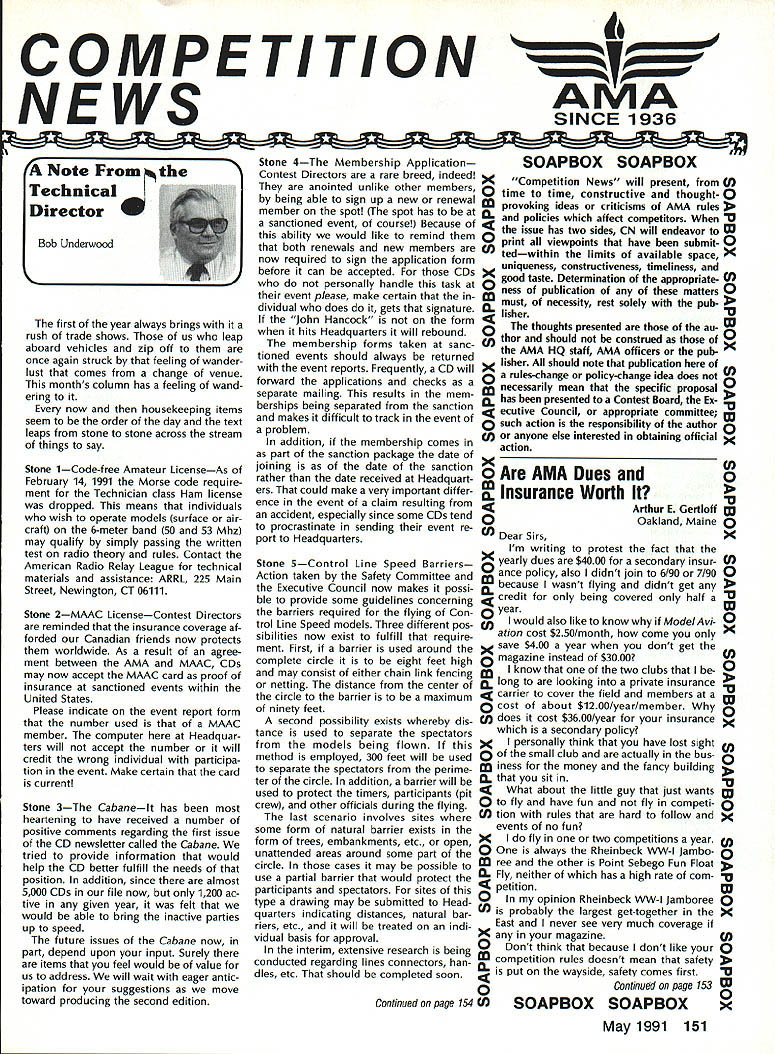
COMPETITION NEWS
A Note From the Technical Director
Bob Underwood
The first of the year always brings a rush of trade shows. Those of us who leap aboard vehicles and zip off to them are once again struck by that feeling of wanderlust that comes from a change of venue. This month's column has a feeling of wandering to it.
Every now and then housekeeping items seem to be the order of the day and the text leaps from stone to stone across the stream of things to say.
Stone 1 — Code-free Amateur License
As of February 14, 1991, the Morse code requirement for the Technician-class ham license was dropped. This means individuals who wish to operate models (surface or aircraft) on the 6-meter band (50–53 MHz) may qualify simply by passing the written test on radio theory and rules. Contact the American Radio Relay League for technical materials and assistance:
- ARRL, 225 Main Street, Newington, CT 06111
Stone 2 — MAAC License
Contest Directors are reminded that the insurance coverage afforded our Canadian friends now protects them worldwide. As a result of an agreement between the AMA and MAAC, CDs may accept a MAAC card as proof of insurance at sanctioned events within the United States. When reporting the event, please indicate that the insurance number used belongs to a MAAC member and ensure the card is current. If the card number is not indicated properly on the event report, the computer at Headquarters may not credit the correct individual with participation.
Stone 3 — The Cabane
It has been heartening to receive a number of positive comments regarding the first issue of the CD newsletter called The Cabane. We tried to provide information that would help the CD better fulfill the needs of the position. With almost 5,000 CDs in our files but only about 1,200 active in any given year, we felt we could bring many inactive parties up to speed.
Future issues of The Cabane will, in part, depend upon your input. Please send suggestions and items you feel would be of value; we eagerly anticipate your contributions as we move toward producing the second edition.
Stone 4 — The Membership Application
Contest Directors are a rare breed indeed: they are authorized to sign up new or renewing members on the spot (at sanctioned events). Because of this ability, remind both renewals and new members that they are required to sign the application form before it can be accepted. If you delegate this task at an event, make certain the person handling it obtains the applicant's signature. If the signature is missing when the form reaches Headquarters, the application will be returned.
Membership forms taken at sanctioned events should always be returned with the event reports. Frequently a CD will forward applications and checks as a separate mailing; this separates memberships from the sanction and makes tracking difficult if a problem arises.
If membership is processed as part of the sanction package, the date of joining is the date of the sanction rather than the date received at Headquarters. That can make a very important difference in the event of a claim resulting from an accident, especially since some CDs procrastinate in sending their event reports.
Stone 5 — Control Line Speed Barriers
Action by the Safety Committee and the Executive Council provides guidelines for barriers required when flying Control Line Speed models. Three options exist to fulfill the requirement:
- Full circular barrier: A barrier around the complete circle, 8 feet high, consisting of chain-link fencing or netting. The distance from the center of the circle to the barrier is a maximum of 90 feet.
- Distance separation: Use distance to separate spectators from the models. Spectators must be 300 feet from the perimeter of the circle. In addition, a barrier must protect timers, participants (pit crew), and other officials during flying.
- Partial or natural barriers: Where natural features (trees, embankments, etc.) or open, unattended areas provide partial protection, a partial barrier may be acceptable. Submit a drawing to Headquarters indicating distances and natural barriers; each site will be treated individually for approval.
Extensive research regarding line connectors, angle lugs, and related items is currently underway and should be completed soon.
Technical Director (continued) — Stone 6: Leap to the Other Bank
Every month when I pen this column (whoops—that should be "computer" this column!) I wonder what response will come as a result. I certainly am not so vain as to think the bulk of the membership even bothers to read it. Even when I receive verbal or written comment, the reaction is often directed toward an element I assigned little importance to. It's amazing that members will listen and even attend or expect to receive invitations to meetings.
Recently I rambled on about my competition love, scale, including opinions and perceptions gained through 23 years of participation, never dreaming of the response I received. A profound thank you to those who indicated the column provided information of value. Your notes and calls imparted warm fuzzies as far as feelings are concerned.
And here we are on the other side of the stream and not even wet!
Cheers!
---
SOAPBOX
Competition News will present, from time to time, constructive, thought‑provoking ideas and criticisms of AMA rules and policies that affect competitors. Every issue has two sides; Competition News will endeavor to print viewpoints that have been submitted within the limits of available space. Uniqueness, constructiveness, timeliness, and good taste will determine the appropriateness of publication. Final determination of publication rests solely with the editor.
Thoughts presented by authors should not be construed as the position of AMA Headquarters staff, AMA officers, or the publisher. Publication of a rules-change or policy-change idea does not necessarily mean the specific proposal has been presented to the Contest Board, Executive Council, or the appropriate committee. Responsibility for pursuing official action rests with the author or anyone else interested in obtaining it.
Are AMA Dues and Insurance Worth It?
Arthur E. Gertloff, Island, Maine
Dear Sirs:
I'm writing to protest the yearly dues ($40.00) and the secondary insurance policy. I didn't join in 6/90–7/90 because I wasn't flying and therefore didn't get credit for being covered half the year. I'd also like to know: Model Aviation costs $2.50/month (about $30/year), so does skipping the magazine really save much? I know two clubs considering a private insurance carrier to cover field members at a cost of about $1,200/year for the club (about $3,600/year for three fields) instead of the secondary policy. I personally think AMA has lost sight of the small club; it has become business with money and fancy buildings. What about the little guy who just wants to fly, have fun, and compete? Rules are hard to follow and events are no fun.
In Response to Mr. Gertloff
Geoffrey Styles AMA Director of Marketing
Dear Mr. Gertloff:
Many thanks for your letter of January 4, 1991. We are always pleased to hear from members and always willing to listen to constructive input.
The policies we pursue are established by the Executive Council. The Vice‑Presidents, volunteers elected from each District, represent you on the Council. Don Krafft is your Vice‑President in District 1; he is the person to contact if you have ideas you wish presented to the Council.
AMA is democratic and Council members listen to members. This can be seen in recent Council action regarding member‑to‑member liability insurance coverage.
Let me respond to your questions and comments in order.
AMA insurance has always been secondary. For members who do not have personal or homeowners' insurance, AMA coverage is primary. If it were primary for everyone, membership cost would be much higher and the national effort to promote model aviation would suffer. In actual daily cost, AMA membership is less than 11 cents per day. This small amount brings many benefits:
- Model Aviation magazine (newsstand value $2.50).
- Representation to government at all levels, including the FCC, FAA, and Department of the Interior.
- Accident/medical insurance, $25,000.
- Fire and theft insurance, $1,000 for equipment.
- Personal liability coverage, $1 million.
- Title owner insurance coverage, primary.
There are many other services and benefits listed on our "34 Reasons to be an AMA Member" sheet. Perhaps the best reason to support AMA is to retain your flying privileges. We work closely with the FAA and have successfully avoided federal regulation that would restrict model aviation activities.
We have also fought state legislation that would have severely curtailed model aircraft flying. The FAA could introduce regulations that make outdoor model flying impractical—Federal Air Regulation 101 covers remotely piloted vehicles and could be expanded to include all radio‑flown models. We maintain excellent relations with the FAA and avoid restrictive regulation through cooperation and a safety‑minded attitude.
You would not be flying radio‑controlled aircraft today if it were not for AMA's efforts with the FCC. AMA is active and respected by the FCC. RC boaters and car enthusiasts also owe their radio frequencies to AMA. We constantly monitor other applications to the FCC that could take assigned channels away from hobbyists.
You mentioned previous partial-year credits. They were dropped by Council action on the advice of our auditors. Credit notes had circulated in quantities representing an unknown liability; to clear the records we were advised to discontinue issuing such credits.
Magazine service to members can be offered at low cost as part of membership due to the volume of copies issued monthly. The $36 figure you quoted covers insurance protection and a portion of the magazine subscription. A complete income and expense statement is printed in Model Aviation every year so members can see where funds are spent.
Representation at shows, government representation, research facilities at the National Center, library and museum operations, pamphlets, brochures, videotapes, books provided to clubs, flying site applications, and other services are all budgeted and funded from general revenues.
Competition rules are formulated by the members, not by AMA staff. The contests cycle is two years; any member can propose changes. Proposals are printed in Model Aviation for review and comment. Contest Boards, composed of volunteers listed in Model Aviation, initiate changes based on the needs of each event. This office assembles and prints the biennial Rule Book but does not determine how events should be flown.
If you are considering an individual insurance policy for your club, study it closely to ensure it provides the coverage you require. If you send a copy to our insurance specialist, Carl Manory, we will review it for you. Joining AMA is voluntary; the 180,000‑plus members and 2,500‑plus clubs generally feel they receive good value for their dues because of the many services AMA provides.
For the past three years AMA has sponsored several Fun‑Fly events aimed at the "little guy" who wants to fly and enjoy camaraderie. This policy recognizes that most people fly for fun and relaxation.
You mentioned Rheinbeck. Without AMA insurance coverage that event would not take place. Annual events such as NATS and several others have been located in New England in recent years, which benefits fliers in your area. AMA sponsorship of such events has helped improve public perception of model aviation. The publicity from major meets is beneficial to sport fliers and enthusiasts.
The "fancy building" you mention belongs to all AMA members. The National Center is open to the public six days a week and is a home for members who visit. Many members of Congress, Senators, aviation officials, and other government people have visited the building as part of our efforts to publicize the positive aspects of model aviation. This is the lobbying we do on members' behalf, getting recognition at high levels.
We hope you and your club members are working with your state public officials and legislators.
Magazine coverage of events depends on volunteer writers and photographers who visit shows and submit stories. AMA does not have roving reporters traveling the country on members' dues. If you can write and photograph, please consider submitting an article—Model Aviation's editor would welcome it.
You mentioned others offering lower-cost insurance. AMA is self‑insured. If you can find a company to offer insurance for all 180,000 members at a lower cost, we would like to hear from you. We work with a strong loss-control group, many of whose staff are club members interested in models.
We have 57 employees who work hard for the members. Many could earn more elsewhere, but they stay because they like what they do and believe in the association's activities and goals. We invite you to visit Headquarters and make your own survey of what is done and how it is done.
Sincerely,
Geoffrey Styles AMA Director of Marketing
Transcribed from original scans by AI. Minor OCR errors may remain.

