
COMPETITION NEWSLETTER
EXECUTIVE COUNCIL DECISIONS CONCERNING NATS AND OTHER COMPETITION MATTERS
1976 National Contest
Last month's CM reported on recommendations the Nats Executive Committee was presenting to the Executive Council for approval at the council's February 14 meeting. By and large the NEC recommendations were accepted; other changes are indicated below.
Championships. Junior, Senior and Open Championships reinstated, but RC and Scale Category Championships have been dropped. Thus, the championships to be up for competition this year consist of Junior age category, Senior age category, Open age category, Free Flight Category, Control Line Category and Indoor Category. (Omitted, as compared to 1975, are the Grand National Championship, Club Championship, Team Championship, Radio Control Category and Scale Category.)
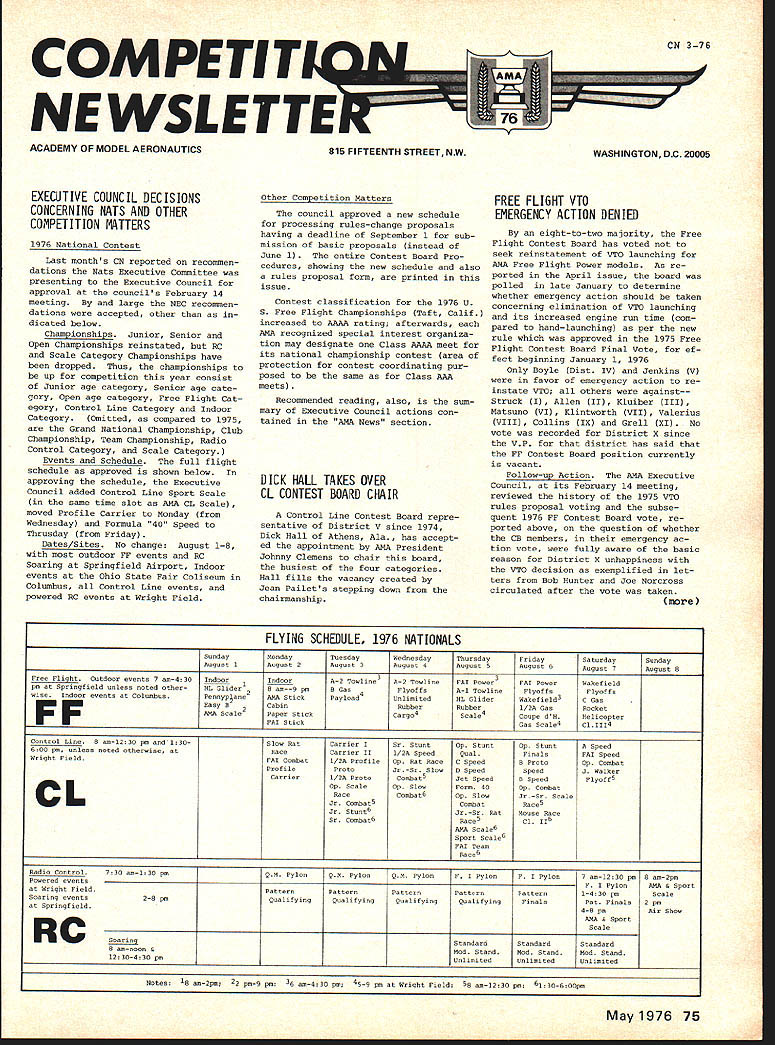
Events and Schedule. The full flight schedule as approved is shown below. In approving the schedule, the Executive Council added Control Line Sport Scale (in the same time slot as AMA CL Scale), moved Profile Carrier to Monday (from Wednesday) and Formula 40 Speed to Thursday (from Friday).
Dates/Sites. No change: August 1-8, with most outdoor FF events and RC soaring at Springfield Airport; indoor events at the Ohio State Fair Coliseum in Columbus; all Control Line events, and powered RC events at Wright Field.
Other Competition Matters
The council approved a new schedule for processing rules-change proposals, having a deadline of September 1 for submission of basic proposals (instead of June 1). The entire Contest Board Procedures, showing the new schedule and a rules proposal form, are printed in this issue.
Contest classification for the 1976 U. S. Free Flight Championships (Taft, Calif.) was increased to AAAA rating; afterwards AMA-recognized special interest organizations may designate one Class AAAA meet as its national championship; contest area protection and contest coordinating purposes are the same as Class AAA meets. Recommended reading, also, is the summary of Executive Council actions contained in the "AMA News" section.
DICK HALL TAKES OVER CL CONTEST BOARD CHAIR
A Control Line Contest Board representative of District V since 1974, Dick Hall of Athens, Ala., has accepted the appointment by AMA President Johnny Clemens to chair this board, the busiest of the four categories. Hall fills the vacancy created by Jean Pailets stepping down from the chairmanship.
FREE FLIGHT VTO EMERGENCY ACTION DENIED
By an eight-to-two majority, the Free Flight Contest Board has voted not to seek reinstatement of VTO launching for AMA Free Flight Power models. As reported in the April issue, the board polled late January to determine whether emergency action should be taken concerning the 1975 VTO rules proposal and voted against emergency action to reinstate VTO launching and its increased engine run times compared with hand-launching per the new rule approved by the 1975 Free Flight Contest Board final vote, effective beginning January 1, 1976. Only Boyle (Dist. IV) and Jenkins (V) voted in favor of emergency action; the others were against — Struck (II), O'Hara (III), Matsuno (VI), Flintworth (VII), Valerius (VIII), Collins (IX), Grell (XI). No vote was recorded for District X since the vice-president for that district has said the FF Contest Board position is currently vacant.
Follow-up Action. The AMA Executive Council, at its February 14 meeting, reviewed the history of the 1975 VTO rules proposal and the subsequent 1976 FF Contest Board vote reported above, and examined whether Contest Board members voting for emergency action were fully aware of the basic reasons for the VTO decision. Letters from Bob Hunter and Joe Horcross circulated after the vote were cited in the review.
FF VTO (Cont.)
Although the council clearly indicated that the matter rests in the hands of the CB rather than the council, the council also is concerned anytime there may be a question regarding whether members have been adequately and properly represented. To make sure of the latter point, the council has asked the Contest Board to take one more look at the controversy so that no further complaint of possible focus on the wrong issue may be made. Thus, a ballot was distributed on February 23 asking the following question: "Based on information and events since, if you were to re-vote on the question of whether any emergency action should be taken to reconsider the 1975 VTO, would you vote differently than you did on the January ballot which resulted in an 8 to 2 vote against taking emergency action?"
CD CHECKS OF FCC LICENSES AT CONTESTS MAY PRESENT PROBLEMS
John Strong of the AMA Frequency Committee says Contest Directors should be aware of certain problems which may arise in checking FCC licenses at contests and fun flies.
- A Class D (voice) CB license is not valid for Radio Control operation.
- A Class C (RC) license is required to operate RC gear in the 27MHz and 72MHz bands.
- Amateur licenses must be of the proper type for the equipment flown. Novice—not valid for any RC operation. Technician—acceptable for RC operation on or above 50 MHz only. General—required for 10 Meter operation (as well as 6 Meter frequencies).
NATS RADIO CONTROL EVENTS INFORMATION
Pattern
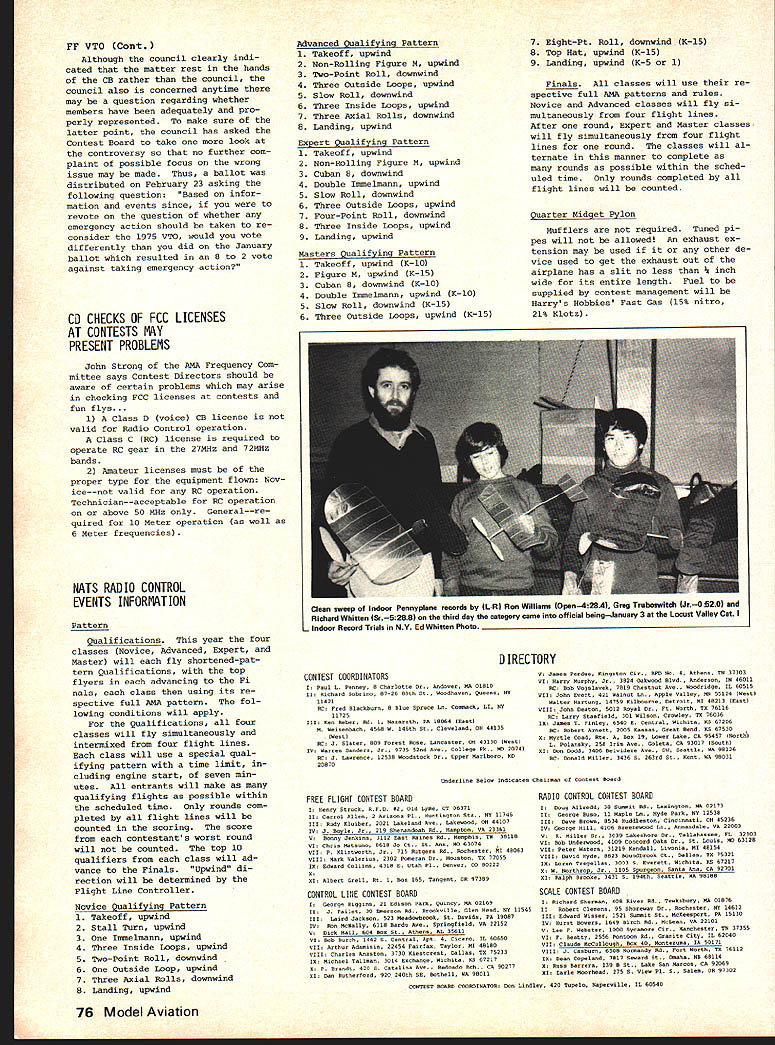
Qualifications. This year the four classes (Novice, Advanced, Expert, and Master) will each fly shortened-pattern qualifications with the top flyers in each advancing to the Finals. Each class will use the respective full AMA pattern in the Finals. The following conditions will apply:
- For the qualifications, all four classes will fly simultaneously and be checked from four flight lines.
- Each class will use a special qualifying pattern with a time limit, including engine start, of seven minutes.
- All entrants will make as many qualifying flights as possible within the scheduled time. Only rounds completed by all flight lines will be counted in the scoring.
- The score from each contestant's worst round will not be counted. The top 10 qualifiers from each class will advance to the Finals.
- "Upwind" direction will be determined by the Flight Line Controller.
Novice Qualifying Pattern
- Takeoff, upwind
- Stall Turn, upwind
- One Immelmann, upwind
- Three Inside Loops, upwind
- Two-Point Roll, downwind
- One Outside Loop, upwind
- Three Axial Rolls, downwind
- Landing, upwind
Advanced Qualifying Pattern
- Takeoff, upwind
- Non-Rolling Figure M, upwind
- Two-Point Roll, downwind
- Three Outside Loops, upwind
- Slow Roll, downwind
- Three Inside Loops, upwind
- Three Axial Rolls, downwind
- Landing, upwind
Expert Qualifying Pattern
- Takeoff, upwind
- Non-Rolling Figure M, upwind
- Cuban 8, downwind
- Double Immelmann, upwind
- Slow Roll, downwind
- Three Outside Loops, upwind
- Four-Point Roll, downwind
- Landing, upwind
Masters Qualifying Pattern
- Takeoff, upwind (K-10)
- Eight-Point Roll, downwind (K-15)
- Top Hat, upwind (K-15)
- Landing, upwind (K-15)
Finals. All classes will use their respective AMA patterns and rules. Novice and Advanced classes will fly simultaneously from four flight lines. After one round, Expert and Master classes will fly simultaneously from four flight lines. The classes will alternate in this manner to complete as many rounds as possible within the scheduled time. Only rounds completed by all eight lines will be counted.
Quarter Midget Pylon
Mufflers are not required. Tuned pipes will not be allowed. An exhaust extension may be used if it is attached so the exhaust or any other device used to get the exhaust out of the pit area has a slot no less than 1 inch wide for its entire length. Fuel to be supplied by contest management will be Harry's Hobby Fast Gas (15% nitro, 21% Klotz). The two-year cycle for considering competition rules changes with effect January 1, 1978, began on January 1, 1976 — the opening date for accepting basic rule-change proposals. The deadline for submitting basic rule-change proposals to the current cycle has been extended from June 1 to September 1, 1976 (postmark) as indicated in separate articles and in the schedule below. The time, thus, is now and within the next few months to be considering and proposing what changes are needed. Use the proposal form printed on page 79, or if you prefer to keep the magazine input request a rules proposal form from AMA HQ (and please be sure to include a pre-addressed and stamped return envelope).
The complete Contest Board Procedures document as printed here will be an invaluable aid in understanding the significance of Contest Board matters that will be printed in CM from time-to-time.
CONTEST BOARD PROCEDURES
AS REVISED FEBRUARY 1976
Foreword
The purpose of this document is to assist Contest Board Members in effectively monitoring and accomplishing rules revisions.
The Contest Board Member must act to maintain high competitive standards and good sportsmanship. Proposals cannot be made with the intent (or often are unknowingly generated), so each proposal should be carefully studied before action is taken.
Proposals should be reviewed for ambiguities in scoring, judging, and interpretation which might create hardships at the contest level. Contest Board Members and Contest Directors should attempt to view problems from many perspectives. Consensus among Contest Board members with regard to the intent of a rule should be obtained and communicated to the contestants. Members of all Contest Boards should familiarize themselves with the rules that prevail in all categories. Care should be taken to avoid generating rules that conflict, or could be confused with rules in the other categories.
ANALYSIS OF PROPOSALS BY CONTEST BOARDS
- Manufacturing—Will current equipment tend to be made obsolete?
- Protestors—Will the change tend to eliminate a source of protest at meets, or are protests more likely?
- Model Processing Time—Will the change tend to increase or decrease the time required to process models for competition?
- Design—Will the builder be given new or less freedom of choice in design?
- Contests—Will the effort required to conduct a contest be increased or decreased?
- Present models—Will a modeler be able to effectively compete with current models, or will he have to build new ones?
- Effect on Competition—Will the new rules of the proposed change, if passed, be to encourage or discourage contest participation?
PROCEDURES
Rules Review Schedule
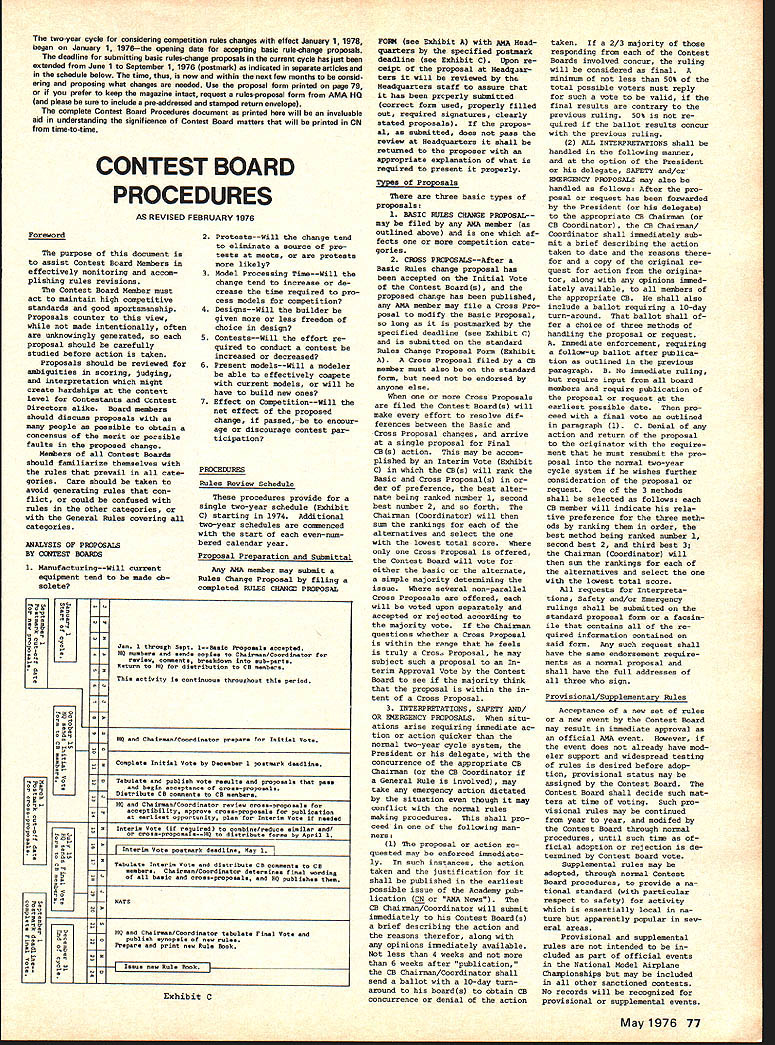
These procedures provide for a single two-year schedule (Exhibit C) starting in 1974. Additional two-year schedules are commenced with the start of each even-numbered calendar year.
Proposal Preparation and Submittal
Any AMA member may submit a Rules Change Proposal by filling a completed RULES CHANGE PROPOSAL FORM (see Exhibit A) with AMA Headquarters by the specified postmark deadline (see Exhibit C). Upon receipt of the proposal at Headquarters it will be reviewed by the Headquarters staff to see that it has been properly submitted (correct form used, properly filled out, required signatures, clearly stated proposed change). If the proposal, as submitted, does not pass the review at Headquarters it shall be returned to the proposer with an appropriate explanation of what is required to present it properly.
Types of Proposals
There are three basic types of proposals:
- BASIC RULES CHANGE PROPOSAL—may be filed by any AMA member (as outlined above) and is one which affects one or more competition categories.
- CROSS PROPOSALS—After a Basic Rules Change proposal has been accepted and the Initial Vote of the Contest Board(s) and the proposed change has been published, any AMA member may file a Cross Proposal to modify the Basic Proposal so long as it is postmarked by the specified deadline (see Exhibit C) and is submitted on the Standard Rules Change Proposal Form (Exhibit A). A Cross Proposal filed by a member must also be on the standard form, but need not be endorsed by anyone else.
When one or more Cross Proposals are filed the Contest Boards(s) will make every effort to resolve differences between the Basic and Cross Proposals (procedures, and arrive at a single proposal for Final (CB) action. This may be accomplished by an Interim Vote (Exhibit B) in which the CB(s) will rank the Basic and Cross Proposals (as to order of preference, the best alternatives being ranked number 1, second best number 2, and so forth). The Chairmen (Coordinator) will then sum the rankings for each of the alternatives and select the single proposal having the lowest score. Where only one Cross Proposal is offered, the Contest Board(s) will vote to either accept or reject the alternate, a simple majority determining the issue. Where several non-parallel Cross Proposals are offered, each will be voted upon separately and accepted or rejected according to the majority vote. If the Chairmen question whether a Cross Proposal is within the scope back to the Basic (i.e., is truly a Cross Proposal) he may subject such a proposal to an Interim Approval Vote by the Contest Board to see if the majority think that the proposal is within the intent of a Cross Proposal.
- INTERPRETATIONS, SAFETY AND/OR EMERGENCY PROPOSALS. Where situations arise requiring immediate action or action quicker than the normal two-year cycle system, the President or his delegate, with the concurrence of the appropriate CB Chairman (or the CB Coordinator if a General Rule is involved), may take any emergency action dictated by the circumstances. If an obvious conflict with the normal rules-making procedures arises, the normal method will be followed.
The proposal or action requested may be enforced immediately. Such an enforcement action taken and the justification for it shall be published in the earliest possible issue of the Academy publication (CM or AMA News). The CB Chairman/Coordinator will submit immediately to his Contest Board(s) a brief description of the action and the reasons therefor, along with any opinions immediately available. Not less than 4 weeks and not more than 6 weeks after publication, the CB Chairman/Coordinator shall send a ballot with a 10-day turnaround to his board(s) to obtain CB concurrence or denial of the action taken. If a 2/3 majority of those responding from each of the Contest Boards involved concur, the ruling will be considered as final. If a minimum of not less than 50% of the total possible voters must reply for such a vote to be valid, if the final results are contrary to the previous ruling, then a new ruling shall be published to concur with the previous ruling.
All interpretations shall be printed in the following manner and at the option of the President or his delegate, SAFETY and/or EMERGENCY PROPOSALS may also be handled as follows: After the proposal or request has been forwarded by the President (or his delegate) to the appropriate CB Chairman (or CB Coordinator), the CB Chairman/Coordinator shall immediately submit a brief description of the action taken to the general membership for comment via the pages of the Academy (or by direct mail) before final action is taken. Such comments will be considered in the final action.
Provisional/Supplementary Rules
Acceptance of a new set of rules or a new event by the Contest Board may result in immediate approval as an official AMA event. However, if the event does not already have modeler support or is judged widespread based on the tracks and members of contests, provisional status may be assigned by the Contest Board. The Contest Board shall decide such matters at the time of voting. Such provisional rules may be continued from year to year, and modified by the Contest Board during normal action procedures, until such time as official adoption or rejection is determined by the Contest Board vote.
Supplemental rules may be adopted, through normal Contest Board procedures, to provide a national standard (with particular regard to safety) for activity which is essentially local in nature. Supplemental rules shall be indicated to the membership as provisional and supplemental and their status noted in the Nationals classification and within the applicable contest rules. No records will be recognized for provisional or supplemental events.
Competition Newsletter
Academy of Model Aeronautics Executive Council Decisions Concerning Nats and Other Competition Matters
1976 National Contest
Last month's CM reported recommendations that the Executive Committee was presenting to the Executive Council for approval at the February 14 meeting. A large number of NEC recommendations were accepted; others are indicated below.
Championships
Junior, Senior and Open Championships reinstated. RC Scale Category Championships have been dropped. Thus championships in the upcoming competition year consist of Junior age category, Senior age category, Open age category, Free Flight category, Control Line category and Indoor category. (Omitted compared to 1975: Grand National Championship, Club Championship, Team Championship, Radio Control category, Scale category.)
Events Schedule
The full flight schedule approved is shown below. In approving the schedule the Executive Council added Control Line Sport Scale in the same time slot. AMA CL Scale moved Profile Carrier to Monday–Wednesday; Formula 40 Speed to Thursday–Friday.
Dates/Sites
No change. Outdoor events: RC Soaring — Springfield Airport. Indoor events: Ohio State Fair Coliseum — Columbus. Control Line events and powered RC events — Wright Field.
Other Competition Matters
The council approved new schedule processing rules. Change proposals have a deadline of September 1; submission of basic proposals instead of June 1; entire Contest Board procedures showing the new schedule and the rules proposal form will be printed in the Contest Board section. Contest classification: 1976 U.S. Free Flight Championships, Taft, Calif., increased to AAAA rating. Afterwards AMA recognized that a special interest organization may designate a Class AAAA meet as its national championship contest for area protection and contest coordinating purposes; the same procedure applies as for Class AAA meets. Recommended reading: a summary of Executive Council actions is contained in the AMA News section.
Dick Hall Takes Over CL Contest Board Chair
Control Line Contest Board representative from District V since 1974, Dick Hall of Athens, Ala., has accepted appointment by AMA President Johnny Clemens as chair of the board's busiest four categories. Hall fills the vacancy created by Jean Pailet's stepping down as chairman.
Free Flight VTO Emergency Action Denied
By an eight-to-two majority the Free Flight Contest Board has voted not to seek reinstatement of VTO launching for AMA Free Flight power models. As reported in the April issue, the board polled late January to determine whether an emergency action should be taken concerning elimination of VTO launching and its increased engine run time compared with hand launching per the new rule approved by the 1975 Free Flight Contest Board. Final vote effective beginning January 1, 1976: only Boyle (Dist. IV) and Jenkins (V) voted in favor of emergency action to reinstate VTO; others were against — Struck (I), Tiber (III), Matsuno (VI), Flintworth (VII), Valerius (VIII), Collins (IX), Grell (XI). No vote recorded from District X since the VP district seat has said the FF Contest Board position is currently vacant.
Followup Action
AMA Executive Council at its February 14 meeting reviewed the history of the 1975 VTO rules proposal, voting and the subsequent 1976 FF Contest Board vote reported above, and questioned whether CB members voting for emergency action were fully aware of the basic reasons for the change. District X unhappiness with the VTO decision was exemplified by letters from Bob Hunter and Joe Horcross circulated after the vote was taken.
Flying Schedule — 1975 Nationals
(The schedule table as approved for the 1975 Nationals was printed in the magazine. The published flying schedule lists events by day and time, showing indoor and outdoor events, control line, free flight, radio control, speed, combat, scale and other contest categories as approved by the Contest Board and Executive Council.)
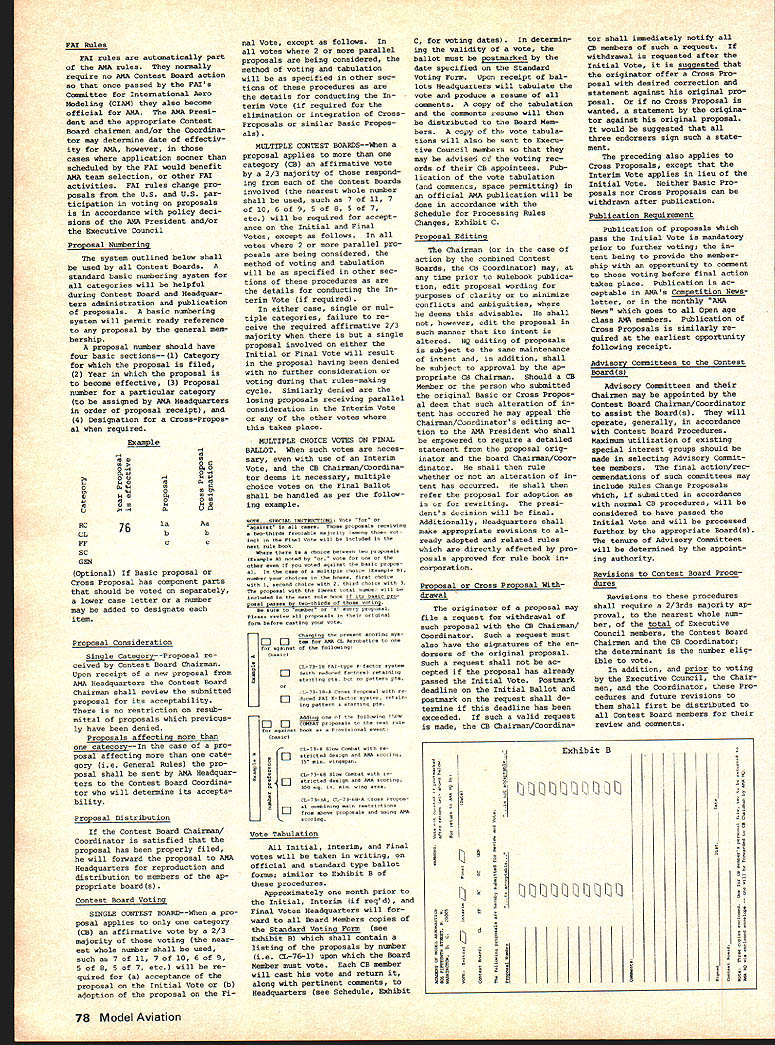
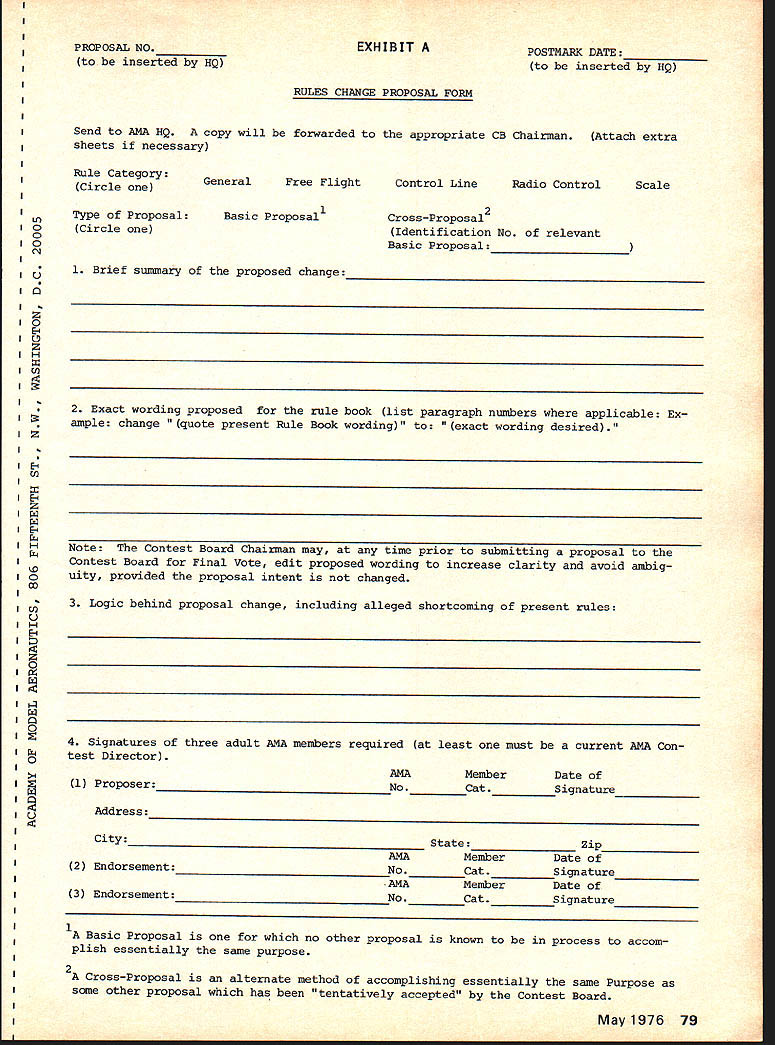
EXHIBIT A
RULES CHANGE PROPOSAL FORM
PROPOSAL NO. ______________________ (to be inserted by HQ) POSTMARK DATE: ______________________ (to be inserted by HQ)
Send to AMA HQ. A copy will be forwarded to the appropriate CB Chairman. (Attach extra sheets if necessary)
Rule Category: (Circle one) General Free Flight Control Line Radio Control Scale
Type of Proposal: (Circle one) Basic Proposal1 Cross-Proposal2 (Identification No. of relevant Basic Proposal: ___________________ )
- Brief summary of the proposed change:
_________________________________________________________________________________ _________________________________________________________________________________ _________________________________________________________________________________
- Exact wording proposed for the rule book (list paragraph numbers where applicable; Example: change "(quote present Rule Book wording)" to: "(exact wording desired)."
- Logic behind proposal change, including alleged shortcoming of present rules:
- Signatures of three adult AMA members required (at least one must be a current AMA Contest Director).
- Disallow engine down‑thrust or elevator radio control.
- Glow engines will be allowed a 20‑second engine run, and ignition engines will be allowed a 25‑second engine run.
- Procedure—During engine run, only rudder control will be used; after completion of engine run, radio control will be used to stop the engine at which time the model aircraft will be free‑flown with hands off the transmitter. When it becomes necessary to control the aircraft, either for the purpose of dethermaling, sail, landing or returning to the field, the pilot will use only rudder control. If in the event this cannot be achieved, the flight will be considered an attempt and not official.
Note: The Contest Board Chairman may, at any time prior to submitting a proposal to the Contest Board for Final Vote, edit proposed wording to increase clarity and avoid ambiguity, provided the proposal intent is not changed.
(1) Proposer: AMA No. ______ Member No. ______ Date of Signature ______ Cat. ______ Address: _____________________________________________________________________ City: _____________________________________ State: _______ Zip: _________________
(2) Endorsement: AMA No. ______ Member No. ______ Date of Signature ______ Cat. ______
(3) Endorsement: AMA No. ______ Member No. ______ Date of Signature ______ Cat. ______
1 A Basic Proposal is one for which no other proposal is known to be in process to accomplish essentially the same purpose.
2 A Cross-Proposal is an alternate method of accomplishing essentially the same purpose as some other proposal which has been "tentatively accepted" by the Contest Board.
Competition Newsletter
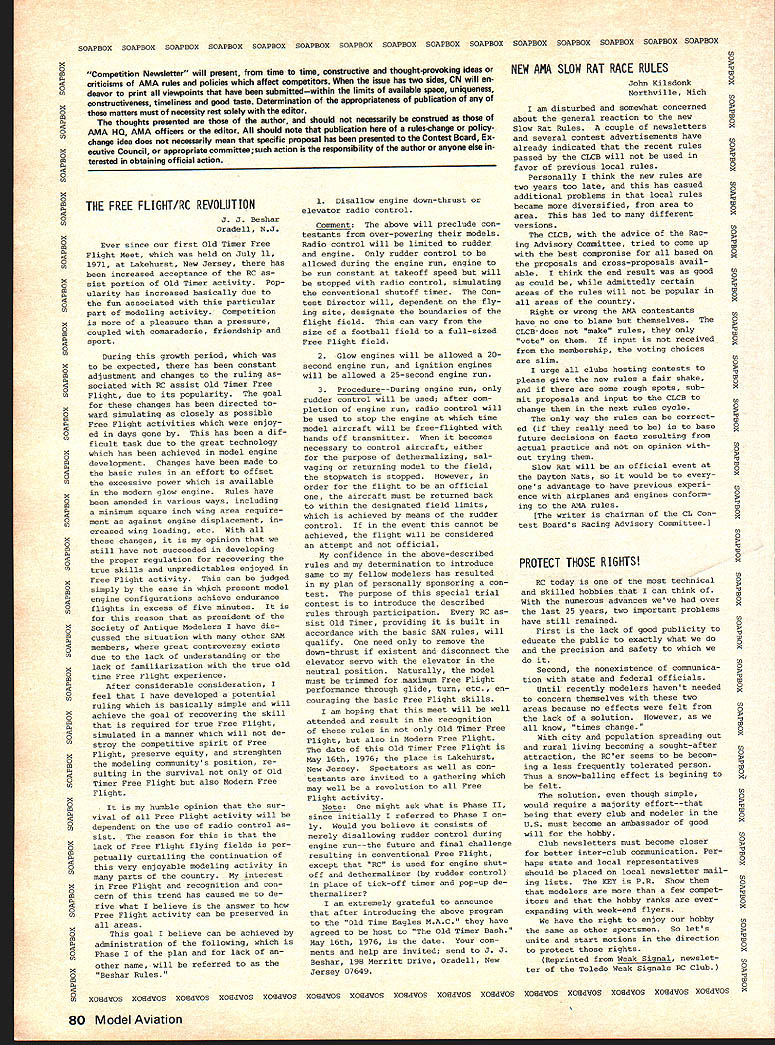
"Competition Newsletter" will present, from time to time, constructive and thought-provoking ideas or criticisms of AMA rules and policies which affect competitors. When the issue has two sides, CN will endeavor to print all viewpoints that have been submitted—within the limits of available space, uniqueness, constructiveness, timeliness and good taste. Determination of the appropriateness of publication of any of those matters must of necessity rest solely with the editor.
The thoughts presented are those of the author, and should not necessarily be construed as those of AMA HQ, AMA officers or the editor. All should note that publication here of a rule-change or policy-change idea does not necessarily mean that specific proposal has been presented to the Contest Board, Executive Council, or appropriate committee; such action is the responsibility of the author or anyone else interested in obtaining official action.
THE FREE FLIGHT/RC REVOLUTION
J. J. Bess, Oradell, N.J.
Ever since our first Old Timer Free Flight meet which was held on July 11, 1971, at Lakehurst, New Jersey, there has been increasing acceptance of the RC as a separate portion of Old Timer activity. Popularity has increased basically due to the fun associated with this particular sort of modeling activity. Competition is more of a pleasure than a pressure, coupled with camaraderie, friendship and sport.
During this growth period, which was to be expected, there has been constant adjustment and changes to the rules associated with the RC assist Old Timer Free Flight, due to its popularity. The goal for these changes has been directed toward eliminating as closely as possible Free Flight activities which were enjoyed in days gone by. This has been a difficult task due to the great technology which has been achieved in model engine development. Changes have been made to the basic rules in an effort to offset the excessive power which is available in the modern glow engine. Rules have been amended in various ways, including a minimum square inch wing area requirement as against engine displacement, increased wing loading, etc. With all these changes it is my opinion that we still have not succeeded in developing the proper regulation for recovering the true skills and unpredictables enjoyed in Free Flight activity. This can be judged simply by the ease in which present modern engine configurations achieve endurance flights in excess of five minutes. It is for this reason that as president of the Society of Antique Modelers I have discussed the situation with many other AMA members, where great controversy exists due to the lack of understanding or the lack of familiarization with the true old time Free Flight experience.
After considerable consideration, I feel that I have developed a potential ruling which is basically simple and will achieve the goal if recovered the skill that is required for true Free Flight. Simulated in a manner which will not destroy the competitive spirit of Free Flight, preserve quality of the models and strengthen the modeling community's position, resulting in the survival not only of Old Timer Free Flight but also Modern Free Flight.
It is my humble opinion that the survival of all Free Flight activity will be dependent on the use of radio control in the class. The reason for this is that the lack of real Flight-Try fields is perpetually curtailing the continuation of this very enjoyable modeling activity in many parts of the country. My interest in Free Flight and recognition and concern of this trend has caused me to desire what I believe is the answer to how Free Flight activity can be preserved in all areas.
This goal I believe can be achieved by administration of the following, which is Phase II of the plan and for lack of another name, will be referred to as the "Beshar Rules."
Comment: The above will preclude contestants from over‑powering their models. Radio control will be limited to rudder and engine only. Only rudder control to be allowed during the engine run; engine to be run constant at takeoff speed but will be stopped with radio control, simulating the conventional shutoff timer. The Contest Director will, dependent on the flying site, designate the manipulators for the flight field. This can vary from the size of a football field to a full‑sized Free Flight field.
I am hoping that this method will be given a trial and result in the recognition of these rules in not only Old Timer Free Flight but also in Modern Free Flight.
Note: One might ask what is Phase II, since initially I referred to Phase I. One might ask why not Phase I? Would you believe it consists of reducing down‑thrust and elevator control during engine run—this will be the future and final challenge which will result in conventional Free Flight. The Beshar Rules are to be considered a follow-up and a transition toward that final goal.
I am extremely grateful to announce that after introducing the above program to the Old Timer Eagles M.A.C., they have agreed to host the "Old Timer Bash" May 16th, 1976. The event organizers and helpers are invited; send to: J. J. Bess, 198 Merritt Drive, Oradell, New Jersey 07649.
Transcribed from original scans by AI. Minor OCR errors may remain.

