
Easy B Model Rules Interpretation Vote
Background
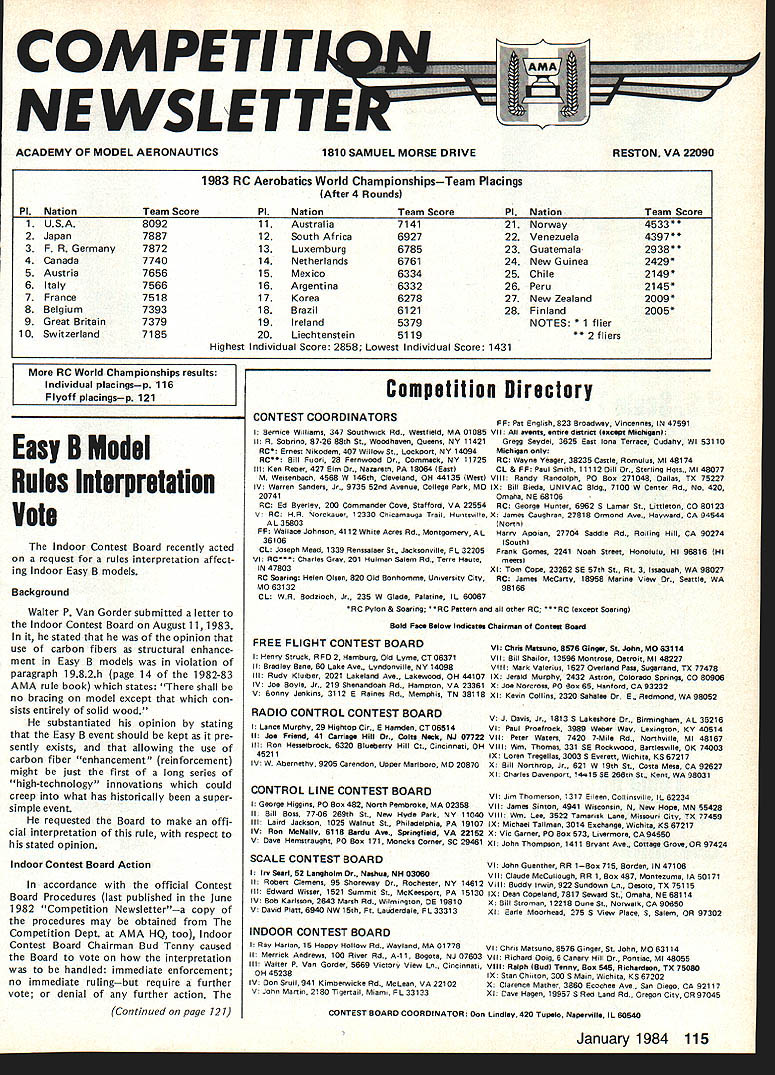
Walter P. Van Gorder submitted a letter to the Indoor Contest Board on August 11, 1983. In it he stated that he was of the opinion that use of carbon fibers as structural enhancement in Easy B models violated paragraph 1982h (page 14 of the 1982–83 AMA rule book), which states: "There shall be no bracing on model except that which consists entirely of solid wood."
He argued that the Easy B event should be kept as it presently exists, and that allowing the use of carbon-fiber "enhancement" (reinforcement) might be the first of a long series of high-technology innovations that could creep into what has historically been a super-simple event.
He requested the Board make an official interpretation of this rule with respect to his stated opinion.
Indoor Contest Board Action
In accordance with the official Contest Board Procedures (last published in the June 1982 Competition Newsletter — a copy of the procedures may be obtained from the Competition Dept. at AMA HQ), Indoor Contest Board Chairman Bud Tenny caused the Board to vote on how the interpretation was to be handled. The options were:
- Immediate enforcement.
- No immediate ruling, but require a further vote.
- Denial of any further action.
The Board voted to require immediate enforcement of the interpretation.
However, the interpretation still must be validated by another Indoor Contest Board vote, which will be taken in four to six weeks of this published notice. In the interval between publication of this notice and the forthcoming Indoor Contest Board vote, interested modelers are invited to comment on this interpretation by contacting (preferably in writing) their local AMA District Indoor Contest Board member (whose name and address appears in the Competition Directory found elsewhere in the Competition Newsletter).
The Venue (the "mushroom")
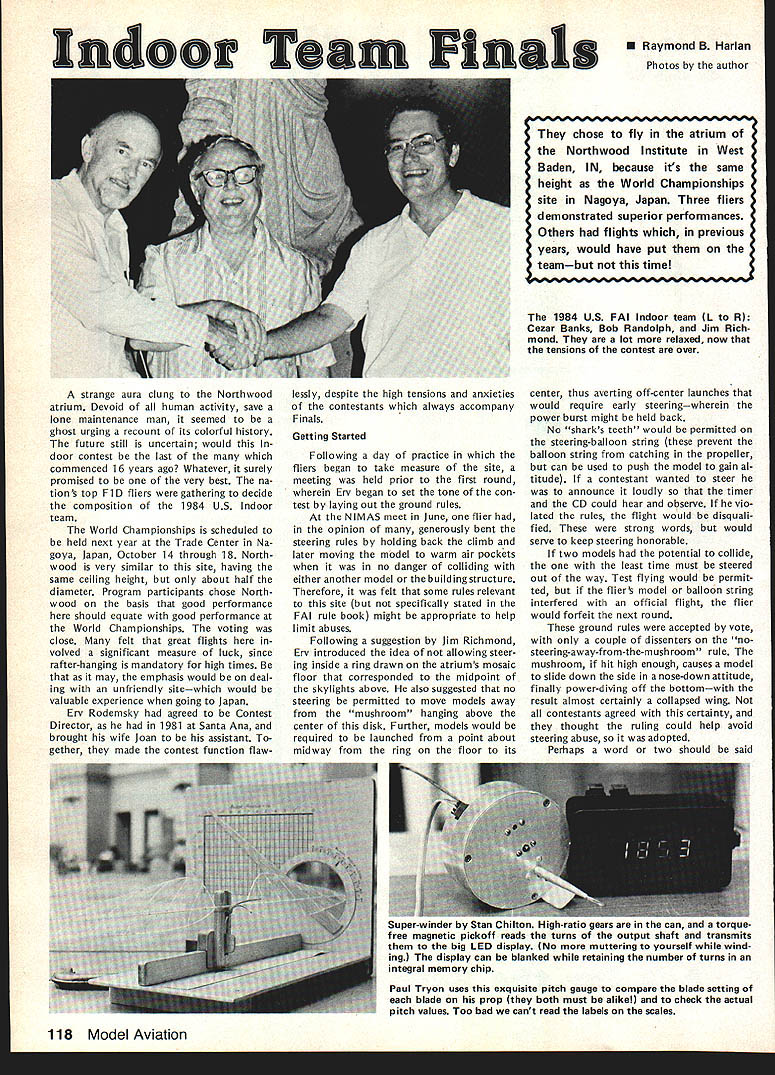
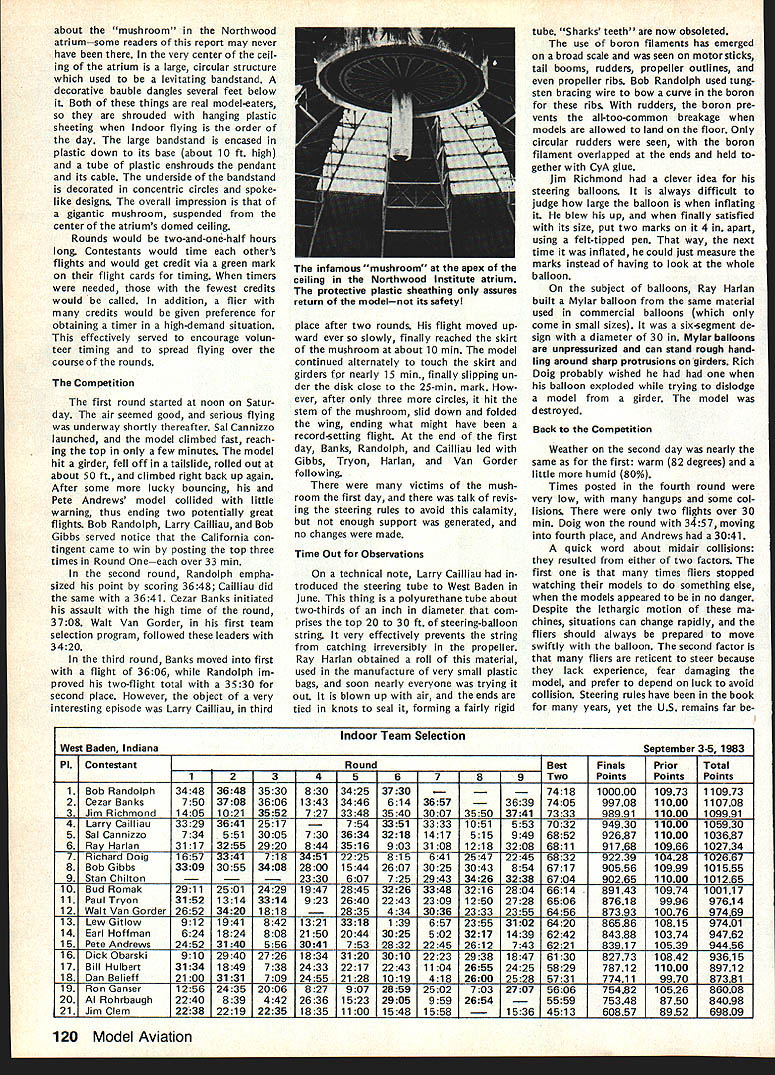
In the very center of the ceiling of the Northwood atrium is a large, circular structure that used to be a levitating bandstand. A decorative pendant dangles several feet below it. Both features are real model-eaters, so they are shrouded with hanging plastic sheeting when indoor flying is in session.
The large bandstand is encased in plastic down to its base (about 10 ft. high) and a tube of plastic enshrouds the pendant and its cable. The underside of the bandstand is decorated in concentric circles and spoke-like designs. The overall impression is that of a gigantic mushroom suspended from the center of the atrium's domed ceiling.
Rounds were two and one-half hours long. Contestants timed each other's flights and received credit via a green mark on their flight cards for timing. When timers were needed, those with the fewest credits were called. In addition, a flier with many credits was given preference for obtaining a timer in a high-demand situation. This effectively encouraged volunteer timing and helped spread flying activity over the course of the rounds.
The Competition
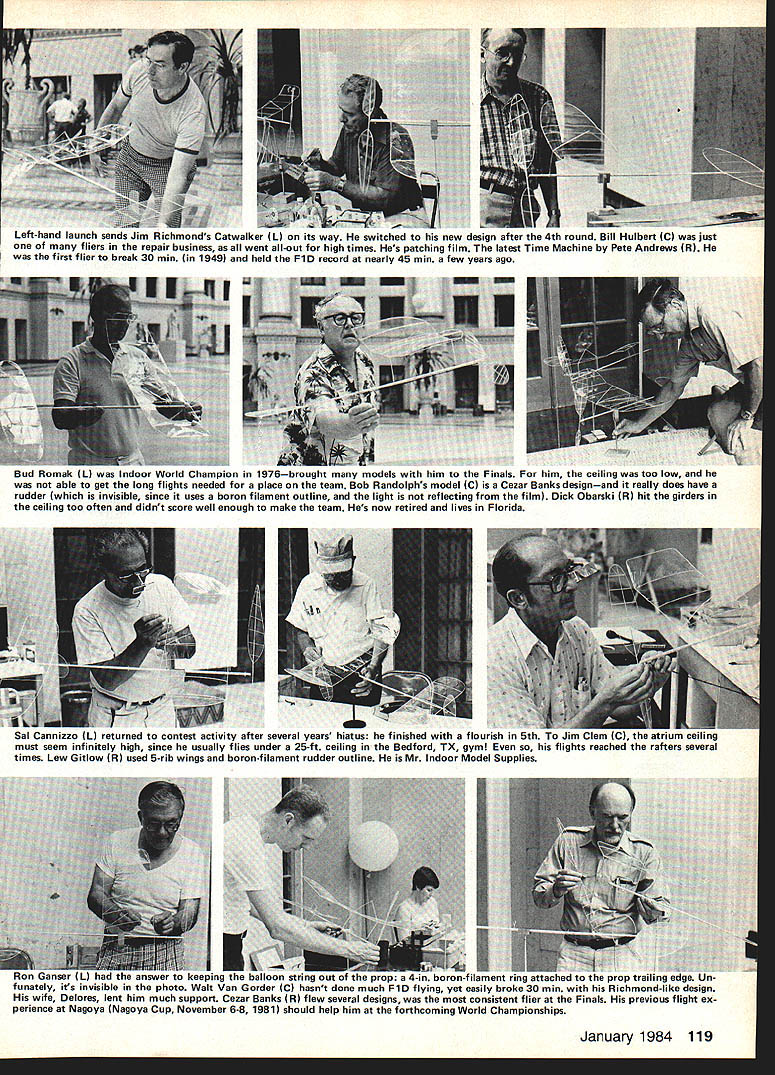
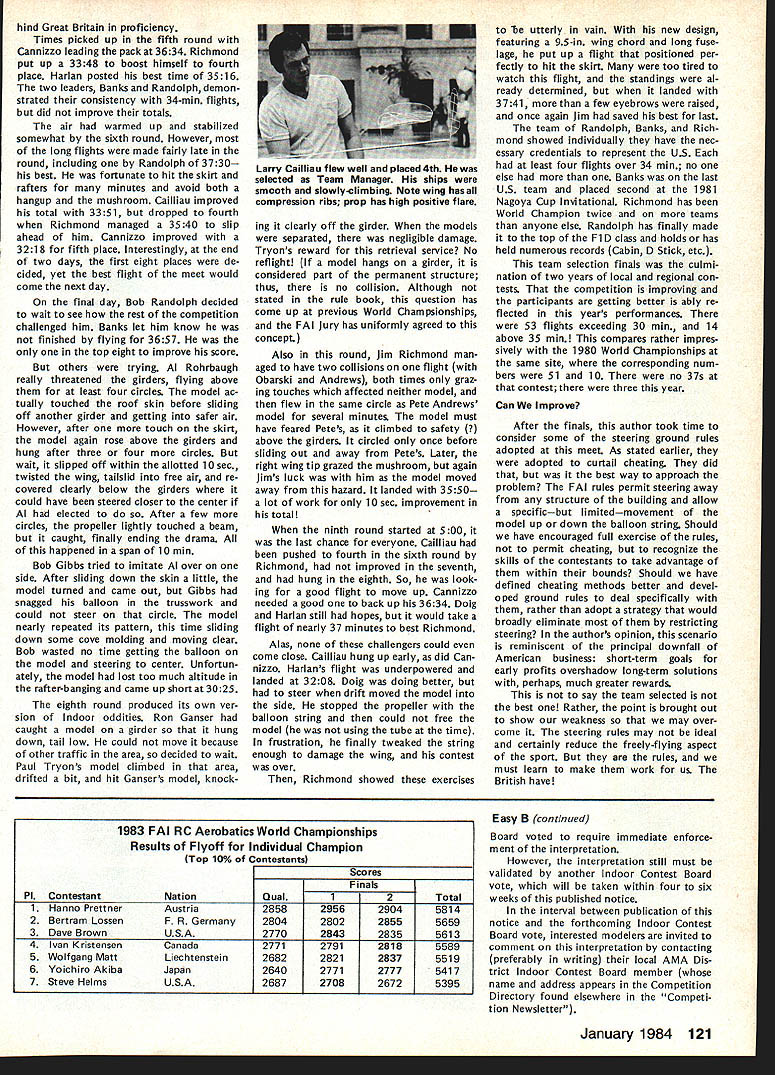
The first round started at noon on Saturday. The air seemed good, and serious flying was underway shortly thereafter. Sal Cannizzo launched, and the model climbed fast, reaching the top in only a few minutes. The model hit a girder, fell off in a tailslide, rolled out at about 50 ft., and climbed right back up again. After some lucky bouncing, his and Pete Andrews' models collided with little warning, ending two potentially great flights. Bob Randolph, Larry Cailliau, and Bob Gibbs served notice that the California contingent came to win by posting the top three times in Round One—each over 33 minutes.
In the second round, Randolph emphasized his point by scoring 36:48; Cailliau did the same with a 36:41. Cezar Banks initiated his assault with the high time of the round, 37:08. Walter Van Gorder, in his first team selection program, followed these leaders with 34:20.
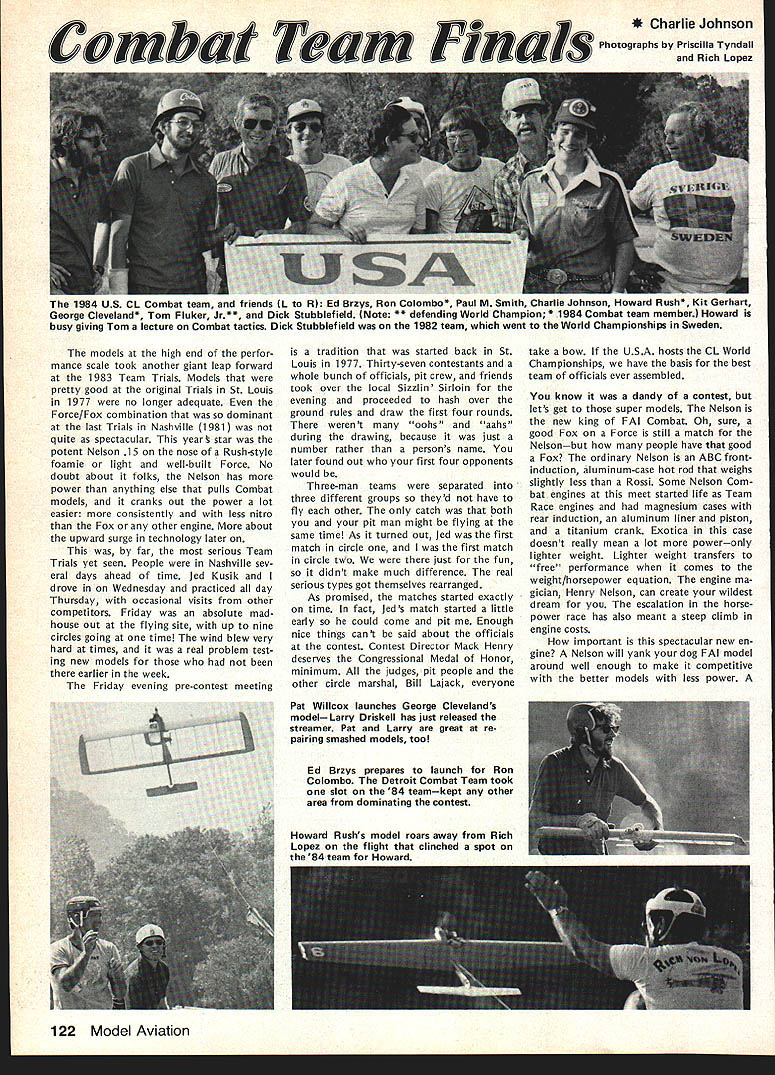
In the third round, Banks moved into first with a flight of 36:06, while Randolph improved his two-flight total with a 35:30 for second place. A notable episode involved Larry Cailliau, in third place after two rounds. His flight moved upward over slow air and finally reached the skirt of the mushroom at about 10 minutes. The model continued alternately to touch the skirt and girders for nearly 15 minutes, finally slipping under the disk close to the 25-minute mark. After only three more circles it hit the stem of the mushroom, slid down and folded the wing, ending what might have been a record-setting flight.
At the end of the first day, Banks, Randolph, and Cailliau led with Gibbs, Tryon, Harlan, and Van Gorder following. There were many victims of the mushroom on the first day, and there was talk of revising the steering rules to avoid this calamity; not enough support was generated, and no changes were made.
Time Out for Observations
Larry Cailliau had introduced the steering tube to West Baden in June. This is a polyurethane tube about two-thirds of an inch in diameter that compresses the top 20 to 30 ft. of steering-balloon string. It very effectively prevents the string from catching irreversibly in the propeller. Ray Harlan obtained a roll of this material (used in the manufacture of very small plastic bags), and soon nearly everyone was trying it out. It is blown up with air and the ends are tied in knots to seal it, forming a fairly rigid tube. "Sharks' teeth" are now obsoleted.
The use of boron filaments has emerged on a broad scale and was seen on motor sticks, tail booms, rudders, propeller outlines, and even propeller ribs. Bob Randolph used tungsten bracing wire to bow a curve in the boron for these ribs. With rudders, the boron prevents the all-too-common breakage when models are allowed to land on the floor. Only circular rudders were seen, with the boron filament overlapped at the ends and held together with CYA glue.
Jim Richmond had a clever idea for his steering balloons. It is always difficult to judge how large the balloon is when inflating it. He blew his up and, when finally satisfied with its size, put two marks on it 4 in. apart using a felt-tipped pen. That way, the next time it was inflated he could just measure the marks instead of having to judge the whole balloon.
Ray Harlan built a Mylar balloon from the same material used in commercial balloons (which only come in small sizes). It was a six-segment design with a diameter of 30 in. Mylar balloons are unpressurized and can stand rough handling around sharp protrusions on girders. Rich Doig probably wished he had had one when his balloon exploded while trying to dislodge a model from a girder; the model was destroyed.
Back to the Competition
Weather on the second day was nearly the same as the first: warm (82 degrees) and a little more humid (80%).
Times posted in the fourth round were very low, with many hangups and some collisions. There were only two flights over 30 minutes. Doig won the round with 34:57, moving into fourth place, and Andrews had a 30:41.
A word about midair collisions: they result from either of two factors. First, many fliers stop watching their models to do something else when the models appear to be in no danger. Despite the lethargic motion of these machines, situations can change rapidly, and the flier should always be prepared to move swiftly with the balloon. Second, many fliers are reticent to steer because they lack experience, fear damaging the model, and prefer to depend on luck to avoid collision. Steering rules have been in the book for many years, yet the U.S. remains far behind.
Times picked up in the fifth round with Cannizzo leading the pack at 36:34. Richmond put up a 33:48 to boost himself to fourth place. Harlan posted his best time of 35:16. The two leaders, Banks and Randolph, demonstrated their consistency with 34-minute flights, but did not improve their totals.
The air had warmed and stabilized somewhat by the sixth round. Most of the long flights were made fairly late in the round, including one by Randolph of 37:30—his best. He was fortunate to hit the skirt and rafters for many minutes and avoid both a hangup and the mushroom. Cailliau improved his total with 33:51 but dropped to fourth when Richmond managed a 33:49 to slip ahead of him. Cannizzo improved with a 32:18 for fifth place. Interestingly, at the end of two days, the first eight places were decided, yet the best flight of the meet would come the next day.
On the final day, Bob Randolph decided to wait to see how the rest of the competition challenged him. Banks let him know he was not finished by flying for 36:57; he was the only one in the top eight to improve his score.
Al Rohrbaugh threatened the girders, flying above them for at least four circles. The model actually touched the roof skin before sliding off another girder and getting into safer air. After another touch on the skirt, the model rose above the girders and hung for three or four more circles, but then slipped off within the allotted 10 seconds, twisted the wing, tailslid into free air, and recovered clearly below the girders where it could have been steered closer to the center. After a few more circles, the propeller lightly touched a beam and caught, finally ending the drama. All of this happened in a span of 10 minutes.
Bob Gibbs tried to imitate Al on one side. After sliding down the skin a little, the model turned and came out, but Gibbs had snagged his balloon in the trusswork and could not steer on that circle. The model nearly repeated its pattern, this time sliding down some cove molding and moving clear. Bob wasted no time getting the balloon on the model and steering to center, but the model had lost too much altitude in the rafter-banging and came up short at 30:25.
The eighth round produced its own oddities. Ron Ganser had caught a model on a girder so that it hung down, tail low. He could not move it because of other traffic in the area, so he decided to wait. Paul Tryon's model climbed in that area, drifted a bit, and hit Ganser's model, knocking it clearly off the girder.
Jim Richmond, with a new design featuring a 9.5-in. wing chord and a long fuselage, put up a flight that positioned perfectly to hit the skirt. Many were too tired to watch this flight and the standings were already mostly determined, but when it landed with 37:41, more than a few eyebrows were raised. Jim had once again saved his best for last.
The team of Randolph, Banks, and Richmond showed individually that they have the necessary credentials to represent the U.S. Each had at least four flights over 34 minutes; no one else had more than one. Banks was on the last U.S. team and placed second at the 1981 Nagoya Cup Invitational. Richmond has been World Champion twice and has won more than anyone else. Randolph has finally made it to the top of the F1D class and holds or has held numerous records (Cabin D, Stick, etc.).
This team selection final was the culmination of two years of local and regional contests. That the competition is improving and the participants are getting better is reflected in this year's performances. There were 53 flights exceeding 30 minutes and 14 above 35 minutes. This compares rather impressively with the 1980 World Championships at the same site, where the corresponding numbers were 51 and 10. There were no 37-minute flights at that contest; there were three this year.
Can We Improve?
After the finals, the author considered some of the steering ground rules adopted at this meet. As stated earlier, they were adopted to curtail cheating. They did that, but was it the best way to approach the problem?
The FAI rules permit steering away from any structure of the building and allow a specific—but limited—movement of the model up or down the balloon string. Should we have encouraged full exercise of the rules, not to permit cheating, but to recognize the skills of contestants to take advantage of them within their bounds? Should we have defined cheating methods better and developed ground rules to deal specifically with them, rather than adopt a strategy that would broadly eliminate most of them by restricting steering?
In the author's opinion, this scenario is reminiscent of a principal downfall of American business: short-term goals for early profits overshadow long-term solutions with, perhaps, much greater rewards. This is not to say the team selected is not the best one; rather, the point is brought out to show our weakness so that we may overcome it. The steering rules may not be ideal and certainly reduce the freely flying aspect of the sport. But they are the rules, and we must learn to make them work for us. The British have!
Transcribed from original scans by AI. Minor OCR errors may remain.

