
Competition Newsletter
Academy of Model Aeronautics 1810 Samuel Morse Drive, Reston, VA 22090
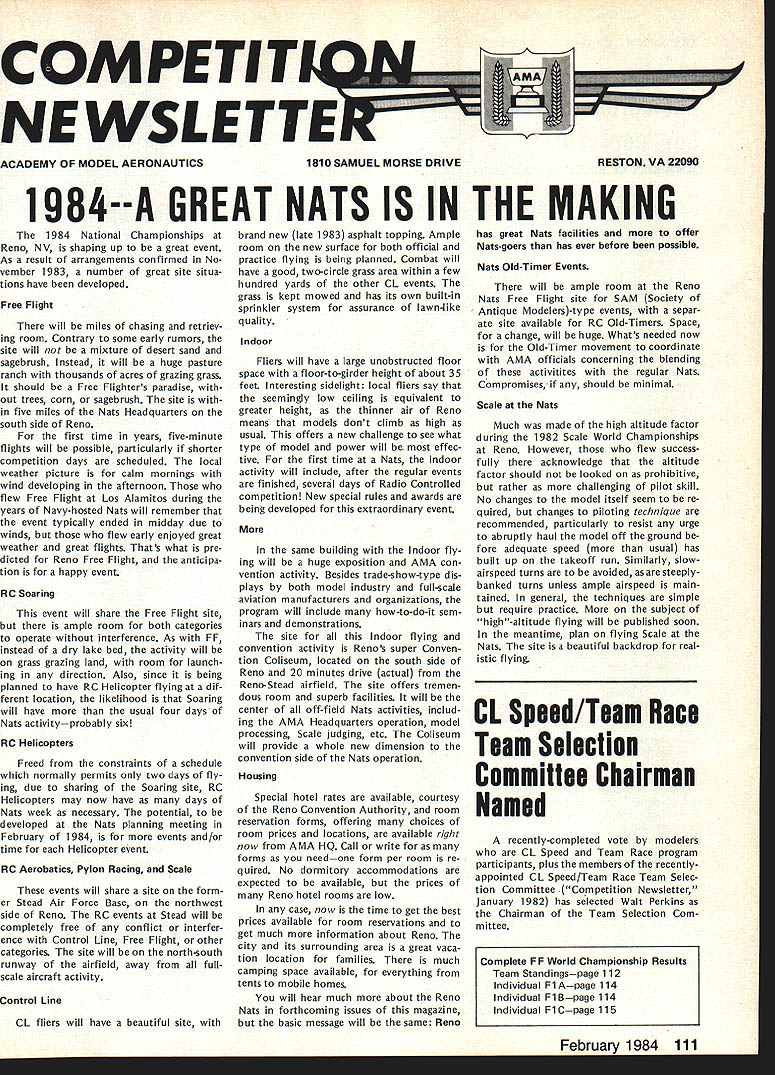
1984 — A GREAT NATS IS IN THE MAKING
The 1984 National Championships at Reno, NV, are shaping up to be a great event. As a result of arrangements confirmed in November 1983, a number of excellent site situations have developed.
Free Flight
There will be miles of chasing and retrieving room. Contrary to some early rumors, the site will not be a mixture of desert sand and sagebrush. Instead, it will be a huge pasture ranch of thousands of acres of grazing grass — a Free Flighters' paradise, without trees, corn, or sagebrush. The Free Flight site is within five miles of Nats Headquarters on the south side of Reno.
For the first time in years, five-minute flights will be possible, particularly if shorter competition days are scheduled. The local weather pattern is for calm mornings with wind developing in the afternoon. Those who flew Free Flight at Los Alamitos during the Navy-hosted Nats will remember that events typically ended by midday due to winds, but early fliers enjoyed great weather and great flights. The same is predicted for Reno Free Flight, and anticipation is high for a successful event.
RC Soaring
RC Soaring will share the Free Flight site, and there should be ample room for both categories to operate without interference. Instead of a dry lake bed, activity will be on grass grazing land, with room for launching in any direction. Since RC Helicopter flying is being planned at a different location, Soaring will likely have more than the usual four days of Nats activity — probably six.
RC Helicopters
Freed from the constraints of a schedule that normally permits only two days of flying (due to sharing the Soaring site), RC Helicopters may have as many days of Nats week as necessary. The potential for additional events and/or more time for each Helicopter event will be developed at the Nats planning meeting in February 1984.
RC Aerobatics, Pylon Racing, and Scale
These events will share a site on the former Stead Air Force Base on the northwest side of Reno. The RC events at Stead will be completely free of conflict or interference with Control Line, Free Flight, or other categories. The site will be on the north–south runway of the airfield, away from all full-scale aircraft activity.
Control Line
Control Line fliers will have a beautiful site with brand-new (late 1983) asphalt topping. There will be ample room on the new surface for both official and practice flying. Combat will have a good two-circle grass area within a few hundred yards of the other CL events; the grass is kept mowed and has its own built-in sprinkler system to ensure lawn-like quality.
Indoor
Indoor fliers will have a large unobstructed floor space with a floor-to-girder height of about 35 feet. Local fliers note that the seemingly low ceiling is effectively greater height in the thinner Reno air, since models don't climb as high as usual. This offers a new challenge to see what type of model and power will be most effective.
For the first time at a Nats, the Indoor activity will include several days of Radio Controlled competition after the regular events are finished. New special rules and awards are being developed for this extraordinary addition.
More (Exposition and Convention)
In the same building as the Indoor flying will be a huge exposition and the AMA convention. Besides trade-show displays by model industry and full-scale aviation manufacturers and organizations, the program will include many how-to seminars and demonstrations.
The site for Indoor flying and convention activity is Reno's Super Convention Coliseum, located on the south side of Reno and about a 20-minute drive from the Reno-Stead airfield. The Coliseum offers tremendous room and superb facilities. It will be the center for all off-field Nats activities, including AMA Headquarters operations, model processing, Scale judging, and more. The Coliseum will provide a whole new dimension to the convention side of Nats operations.
Housing
Special hotel rates are available courtesy of the Reno Convention Authority. Room reservation forms, offering many choices of prices and locations, are available from AMA Headquarters now. One form per room is required. No dormitory accommodations are expected to be available, but many Reno hotel rooms are affordably priced.
Now is the time to get the best prices for room reservations and to obtain more information about Reno. The city and its surrounding area are a great vacation location for families, with much camping space available for everything from tents to mobile homes.
You will hear much more about the Reno Nats in forthcoming issues of this magazine. The basic message will remain: Reno has great Nats facilities and more to offer Nats-goers than ever before.
Nats Old-Timer Events
There will be ample room at the Reno Free Flight site for SAM (Society of Antique Modelers)-type events, with a separate site available for RC Old-Timers. Space will be huge. Old-Timer organizers should coordinate with AMA officials concerning blending these activities with the regular Nats; compromises, if any, should be minimal.
Scale at the Nats
Much was made of the high-altitude factor during the 1982 Scale World Championships at Reno. Those who flew successfully there noted that altitude should not be seen as prohibitive but rather as a challenge to pilot skill. No changes to the model itself seem required, but changes to piloting technique are recommended:
- Avoid hauling the model off the ground abruptly before adequate speed has built up on the takeoff run.
- Avoid slow-airspeed turns and steeply banked turns unless ample airspeed is maintained.
These techniques are simple but require practice. More on the subject of high-altitude flying will be published soon. In the meantime, plan on flying Scale at the Nats — the site is a beautiful backdrop for realistic flying.
1983 World Championships — Goulburn, Australia
For the second time in a row, the Free Flight World Championships suffered from poor weather and possibly being held at the wrong time of year or at an inadequate site. At the presentation banquet, Ian Kaynes, chairman of the FAI's CIAM Free Flight Committee and a member of the '83 WC jury, commented that CIAM must be very careful about site and weather conditions for future World Championships; twice they have been caught by terrible weather conditions. There were many caustic remarks about site selections, especially from countries that pay out of their own pockets to attend. One caution: when CIAM has only one offer to host a World Championship, being overly critical of the site or weather could lead to no World Championships being held.
Arrival and Sightseeing
We arrived in Sydney and, after a minor misdirection by a kindly taxi driver who led us to our hotel for a nominal fee, spent some spare time sightseeing. Sydney was lovely — a mix of very old and very modern buildings. We enjoyed a harbor cruise with lunch aboard and saw the famous Opera House and the beautiful harbor.
We then traveled to Goulburn, the site of the 1983 World Free Flight Championships. Once out of the city and into the country, the countryside was beautiful and lush — their drought had ended. Our accommodations in Goulburn were clean and the local people were great. Unfortunately, the weather was not: wind, wind, and more wind. No flight-testing could be done except at the Reg Attam contest held the weekend before the World Championships; otherwise, we had one really nice flying day but mainly detuned models in anticipation of wind.
Weather and Contest Conditions
Saturday (Glider Day) involved shagging A-2 Towline Gliders for the Glider team. Sunday was Wakefield Day, my day, but the wind rose after the first round and conditions became very rough; the contest was halted after four rounds. At that time I had four maxes and one turn; the team helped repair the model that afternoon to get me ready for Tuesday morning.
Monday was Power Day (we shagged F1Cs); it rained and the wind blew. Activity started about 5:30–6:00 a.m., and by the last round our radios and glasses were wet from rain. Tuesday resumed Wakefield flying. Round five began in wind and rain; I made a bad judgment and the model struck. Doreen shed a tear as my hopes fell to earth. Round six was also in poor conditions; the model was too wet and suffered wing flutter, costing another max. That ended my contest.
Team Performance and Support
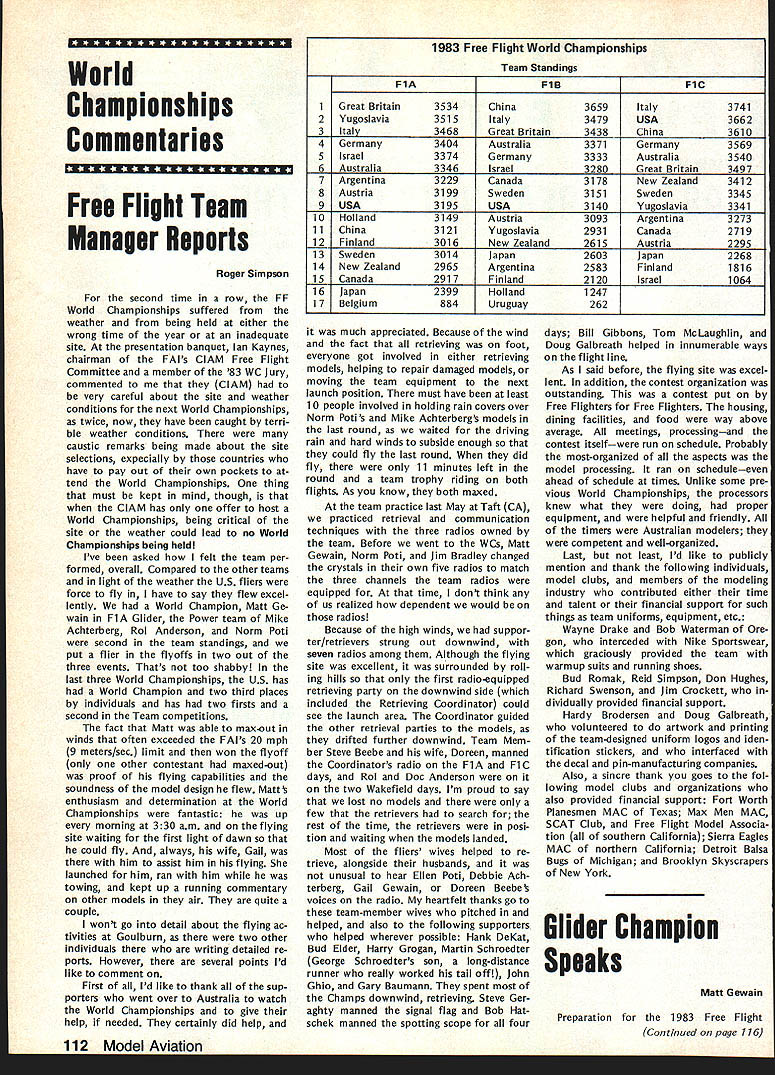
Despite the weather, the U.S. team had notable successes. Compared to other teams and in light of the conditions, U.S. fliers performed very well. Highlights:
- World Champion: Matt Gewain in F1A Glider.
- Power team (Mike Achterberg, Rol Anderson, Norm Poti) placed second in the team standings.
- U.S. fliers reached flyoffs in two of the three events.
Matt Gewain's max-out performances in winds often exceeding the FAI's 20 mph (9 m/s) limit, and then winning a flyoff (only one other contestant had maxed-out), testified to his flying skill and the soundness of his model design. Matt's enthusiasm and determination were remarkable; he was up every morning at 3:30 a.m., waiting for first light to fly. His wife, Gail, was a constant and effective assistant — launching, towing, and providing running commentary.
Because of high winds, retrievers were deployed downwind with radios. Only the first radio-equipped retrieving party (which included the Retrieving Coordinator) could see the launch area; the Coordinator guided the other parties as models drifted. Team members who manned the Coordinator's radio at various times included Steve Beebe and his wife, Doreen, and Rol and Doc Anderson. I'm proud to say we lost no models; only a few required searching — most retrievers were in position and waiting when models landed.
Many fliers' wives helped retrieve alongside their husbands. My heartfelt thanks to Ellen Poti, Debbie Achterberg, Gail Gewain, and Doreen Beebe for their help. Additional supporters who helped wherever possible included:
- Hank Dekat
- Bud Elder
- Harry Grogan
- Martin Schroedter (George Schroedter's son)
- John Ghio
- Gary Baumann
They spent most of the Championships downwind, retrieving. Steve Geraghty manned the signal flag and Bob Hatsack manned the spotting scope for all four days. Bill Gibbons, Tom McLaughlin, and Doug Galbreath helped in innumerable ways on the flight line.
At team practice the previous May at Taft, CA, we practiced retrieval and communication techniques with three team radios. Before the WCs, Matt Gewain, Norm Poti, and Jim Bradley changed the crystals in their five radios to match the three channels the team radios used. We did not realize how dependent we would be on those radios until the event.
Contest Organization and Processing
The contest organization was outstanding: housing, dining facilities, and food were above average. Meetings, processing, and contest operations ran on schedule. Model processing was probably the most organized aspect — it ran on schedule, sometimes ahead of schedule. Processors were competent, equipped properly, and helpful. All timers were Australian modelers, and they were competent and well organized.
Acknowledgments
I want to publicly thank the individuals, model clubs, and industry members who contributed time, talent, or financial support for team uniforms, equipment, and other needs:
- Owen Drake and Bob Waterman of Owego, who interceded with Nike Sportswear to provide the team with warm-up suits and running shoes.
- Bud Romak, Reid Simpson, Don Hughes, Richard Swenson, and Jim Crockett, who provided financial support.
- Hardy Broderson and Doug Galbreath, who volunteered artwork and printing of team uniform logos and identification stickers, and interfaced with decal and pin manufacturers.
Clubs and organizations that provided financial support:
- Fort Worth Planesman MAC (Texas)
- Max Me, MAC, SCAT Club, and France Field (southern California)
- Sierra Eagles MAC (northern California)
- Delano Beta and Bugs (Michigan)
- Brooklyn Skycatchers (New York)
My sincere thanks to all who helped.
Personal Reflections and Farewell
Although I lost the contest, I learned how many friends I had made — the hardest part was saying goodbye. It's truly too bad the rest of the world cannot get along as well as the modeling community does.
I want to thank all the Australians who worked hard to put on this contest — they were great. Last, but not least, I thank my wife for standing by me and working as hard as I did. (She talks too much, but I love her anyway!) We'll get them next time.
I also can't conclude without mentioning Roger Simpson, our team manager. He had many problems to handle and did a tremendous job. When we left the U.S. for Australia I didn't know Roger well; now I consider him a good friend. I kidded him a lot in Australia, and he'd better know — I'm not one bit sorry! It served him right.
Transcribed from original scans by AI. Minor OCR errors may remain.

