
The AMA Competition Rule Book: Problem Areas
For many years there have been procedural problems that have prevented the issuance of a new AMA rule book "on time" (prior to the date when it becomes effective). In an effort to remedy this situation, there is to be a meeting—probably in April 1984—between the AMA Executive Council and the AMA Contest Board chairmen. The object of the meeting is to discuss this long-standing problem and to, it is hoped, take action to solve it.
Whatever action is taken at this meeting will probably involve changing the Contest Board Procedures (which are printed in this issue), and it is possible that some changes will be made in the rules-processing schedule. Thus, the procedures published this month might be modified, with the goal of producing the next rule book (1986–87) somewhat sooner than would result using the present procedures.
The situation, therefore, is that although a new rule-book cycle has been started, it may not run exactly as indicated in the current procedures.
Results of the forthcoming meeting will be published at the earliest possible date.
AMA Competition Rules: A New Cycle of Revisions Starts Now
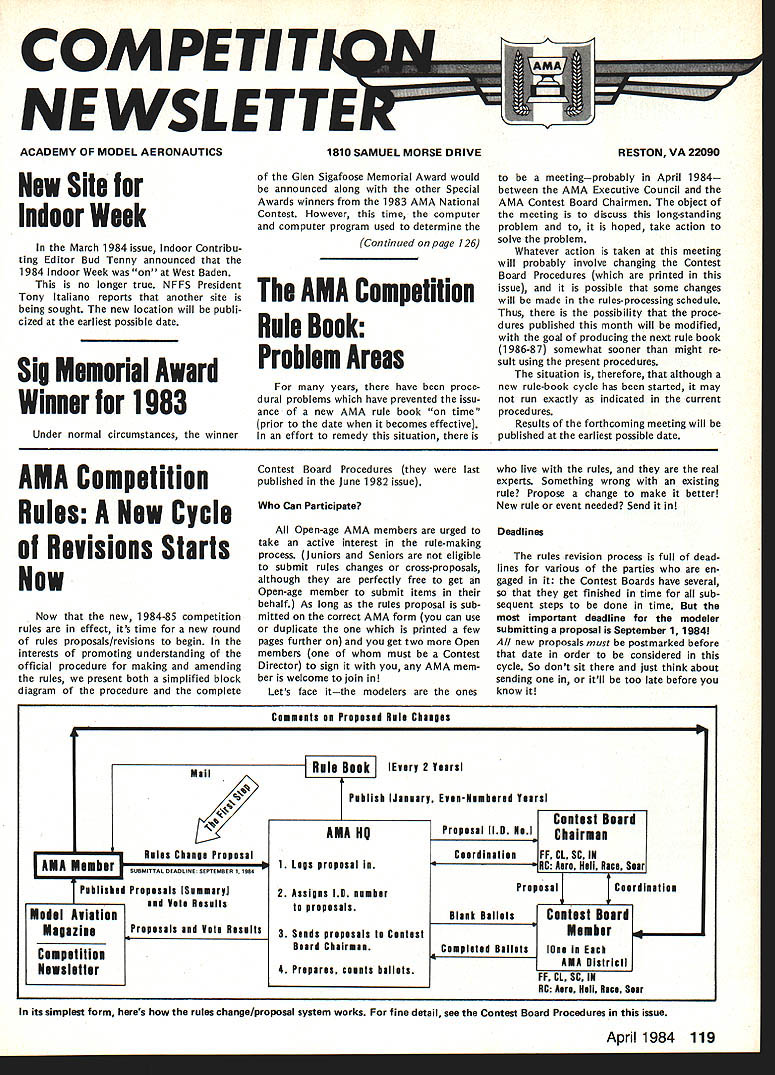
Now that the new 1984–85 competition rules are in effect, it is time for a new round of rules proposals and revisions to begin. To promote understanding of the official procedure for making and amending rules, we present both a simplified block diagram of the procedure and the complete Contest Board Procedures (they were last published in the June 1982 issue).
Who Can Participate?
All open-age AMA members are urged to take an active interest in the rule-making process. Juniors and seniors are not eligible to submit rules changes or cross-proposals, although they are free to have an open-age member submit items on their behalf. As long as the rules proposal is submitted on the correct AMA form (you may use or duplicate the one printed a few pages further on) and you get two more open members (one of whom must be a Contest Director) to sign it with you, any AMA member is welcome to join in.
The modelers are the ones who live with the rules, and they are the real experts. Something wrong with an existing rule? Propose a change to make it better. New rule or event needed? Send it in.
Deadlines
The rules revision process is full of deadlines for the various parties involved; the Contest Boards must meet several deadlines so all subsequent steps can be completed in time. But the most important deadline for the modeler submitting a proposal is September 1, 1984. All new proposals must be postmarked before that date in order to be considered in this cycle. So don't wait—submit your proposal before it's too late.
In its simplest form, here's how the rules change/proposal system works. For fine detail, see the Contest Board Procedures in this issue.
CIAM REPORTS
Education and Information
Travis McGinnis Member, Information and Education Subcommittee
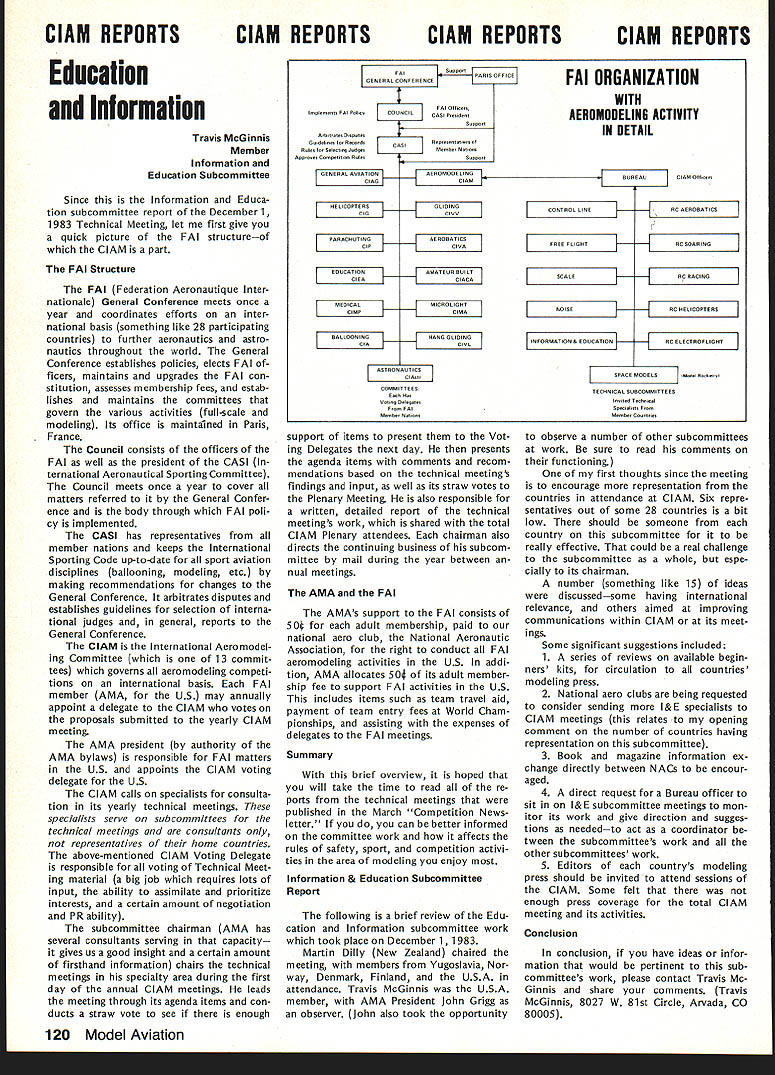
This is the Information and Education subcommittee report of the December 1, 1983 technical meeting. First, a quick picture of the FAI structure—of which the CIAM is a part.
The FAI Structure
The FAI (Fédération Aéronautique Internationale) General Conference meets once a year and coordinates international efforts (about 28 participating countries) to further aeronautics and astronautics worldwide. The General Conference establishes policies, elects FAI officers, maintains and upgrades the FAI constitution, assesses membership fees, and establishes and maintains the committees that govern the various activities (full-scale and modeling). Its office is in Paris, France.
The Council consists of the officers of the FAI as well as the president of CASI (International Aeronautical Sporting Committee). The Council meets once a year to cover matters referred to it by the General Conference and is the body through which FAI policy is implemented.
CASI has representatives from all member nations and keeps the International Sporting Code up to date for all sport aviation disciplines (ballooning, modeling, etc.) by making recommendations to the General Conference. It arbitrates disputes, establishes guidelines for selection of international judges, and reports to the General Conference.
CIAM is the International Aeromodelling Committee (one of 13 committees) that governs aeromodeling competitions internationally. Each FAI member (AMA for the U.S.) may annually appoint a delegate to CIAM who votes on proposals submitted to the yearly CIAM meeting.
The AMA president (by authority of the AMA bylaws) is responsible for FAI matters in the U.S. and appoints the CIAM voting delegate for the U.S.
CIAM calls on specialists for consultation in its yearly technical meetings. These specialists serve on subcommittees for the technical meetings and are consultants only, not representatives of their home countries. The CIAM voting delegate is responsible for all voting of technical meeting material, a job that requires extensive input, the ability to assimilate and prioritize interests, and negotiation and public-relations ability.
The subcommittee chairman (AMA has several consultants serving in that capacity) chairs the technical meetings in his specialty area during the first day of the annual CIAM meetings. He leads the meeting through its agenda items and conducts a straw vote to determine which items have enough support to present to the Voting Delegates the next day. He then presents the agenda items with comments and recommendations to the Plenary Meeting and is responsible for a written, detailed report of the technical meeting's work, which is shared with the CIAM plenary attendees. Each chairman also directs the continuing business of his subcommittee by mail during the year between annual meetings.
The AMA and the FAI
AMA's support to the FAI consists of $0.50 for each adult membership, paid to our national aero club, the National Aeronautic Association, for the right to conduct all FAI aeromodelling activities in the U.S. In addition, AMA allocates 50% of its adult membership fee to support FAI activities in the U.S. This includes team travel aid, payment of team entry fees at World Championships, and assistance with expenses of delegates to FAI meetings.
Summary
With this brief overview, it is hoped you will read all the reports from the technical meetings that were published in the March Competition Newsletter. If you do, you can be better informed about committee work and how it affects the rules of safety, sport, and competition activities in the area of modeling you enjoy most.
Information & Education Subcommittee Report
The following is a brief review of the Education and Information subcommittee work that took place on December 1, 1983.
Martin Dilly (New Zealand) chaired the meeting, with members from Yugoslavia, Norway, Denmark, Finland, and the U.S.A. in attendance. Travis McGinnis was the U.S.A. member, with AMA President John Grigg as an observer. John also observed a number of other subcommittees at work.
One of my first thoughts since the meeting is to encourage more representation from the countries in attendance at CIAM. Six representatives out of some 28 countries is low. There should be someone from each country on this subcommittee for it to be really effective. That would be a real challenge to the subcommittee as a whole, and especially to its chairman.
About 15 ideas were discussed—some having international relevance, others aimed at improving communications within CIAM or at its meetings. Significant suggestions included:
- A series of reviews on available beginners' kits, for circulation to all countries' modeling presses.
- National aero clubs (NACs) are being requested to consider sending more information-and-education specialists to CIAM meetings.
- Encourage book and magazine information exchange directly between NACs.
- Request that a Bureau officer sit in on I&E subcommittee meetings to monitor its work and act as a coordinator between the subcommittee and other subcommittees.
- Invite editors of each country's modeling press to attend sessions of CIAM; some felt there was insufficient press coverage of CIAM meetings and activities.
Conclusion
If you have ideas or information pertinent to this subcommittee's work, please contact Travis McGinnis and share your comments.
Travis McGinnis 8027 W. 81st Circle, Arvada, CO 80005
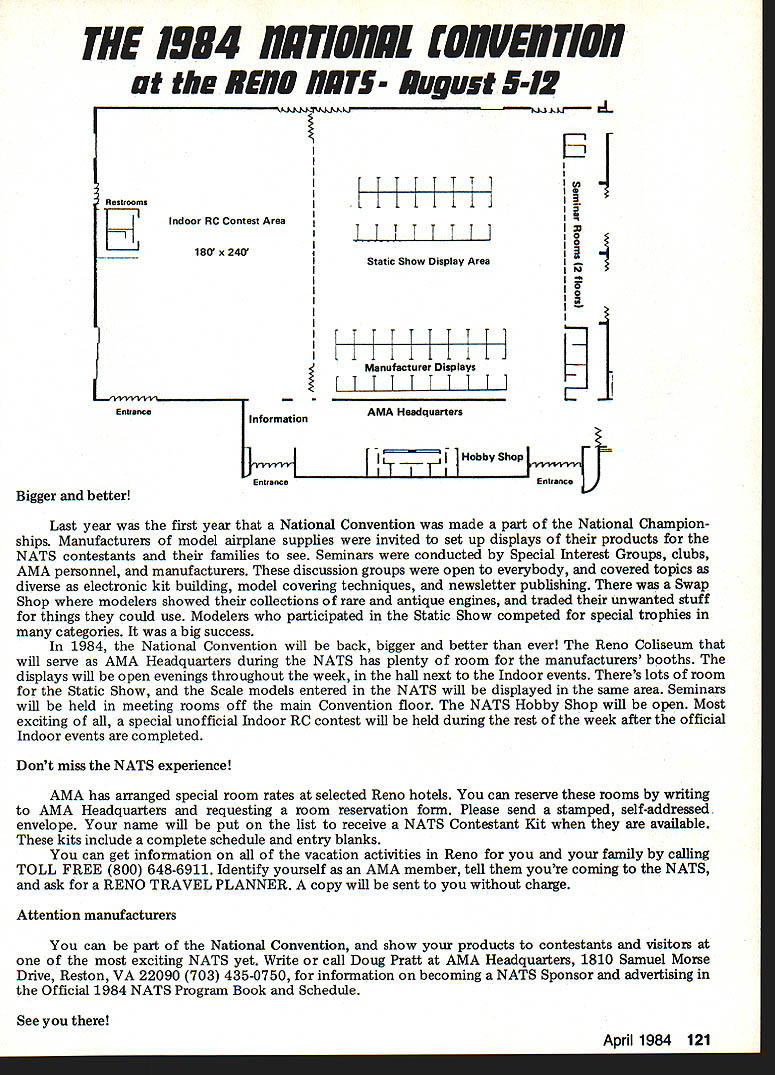
THE 1984 NATIONAL CONVENTION at the RENO NATS — August 5–12
Bigger and better!
Last year was the first year that a National Convention was made part of the National Championships. Manufacturers of model airplane supplies were invited to set up displays of their products for NATS contestants and their families to see. Seminars were conducted by special interest groups, clubs, AMA personnel, and manufacturers. These discussion groups were open to everybody and covered topics as diverse as electronic kit building, model covering techniques, and newsletter publishing. There was a Swap Shop where modelers showed collections of rare and antique engines and traded unwanted items. Modelers who participated in the Static Show competed for special trophies in many categories. It was a big success.
In 1984 the National Convention will be back, bigger and better than ever! The Reno Coliseum that will serve as AMA headquarters during the NATS has plenty of room for manufacturers' booths. The displays will be open evenings throughout the week in the hall next to the indoor events. There's lots of room for the Static Show, and the scale models entered in the NATS will be displayed in the same area. Seminars will be held in meeting rooms off the main convention floor. The NATS Hobby Shop will be open. Most exciting of all, a special unofficial indoor RC contest will be held during the rest of the week after the official indoor events are completed.
Don't miss the NATS experience!
AMA has arranged special room rates at selected Reno hotels. You can reserve these rooms by writing to AMA Headquarters and requesting a room reservation form. Please send a stamped, self-addressed envelope. Your name will be put on the list to receive a NATS Contestant Kit when they are available. These kits include a complete schedule and entry blanks.
You can get information on vacation activities in Reno for you and your family by calling toll free (800) 648-6911. Identify yourself as an AMA member, tell them you're coming to the NATS, and ask for a Reno Travel Planner. A copy will be sent to you without charge.
Attention manufacturers
You can be part of the National Convention and show your products to contestants and visitors at one of the most exciting NATS yet. Write or call Doug Pratt at AMA Headquarters, 1810 Samuel Morse Drive, Reston, VA 22090 (703) 435-0750, for information on becoming a NATS sponsor and advertising in the Official 1984 NATS Program Book and Schedule.
See you there!
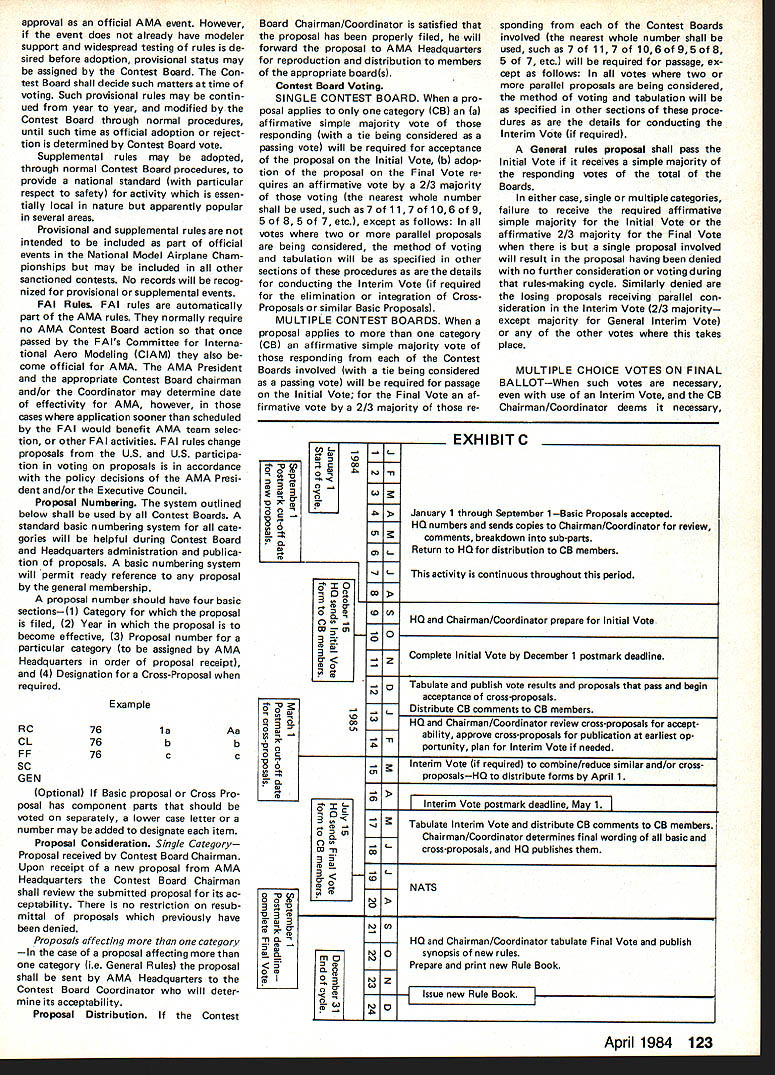
The two-year cycle for considering competition rules changes, with effective date of January 1, 1986, began on January 1, 1984—the opening date for accepting basic rules-change proposals.
THE DEADLINE FOR SUBMITTING BASIC RULES-CHANGE PROPOSALS IN THE CURRENT CYCLE IS SEPTEMBER 1, 1984 (postmark), as indicated in the schedule, Exhibit C. Now is the time to consider and propose what changes are needed. Use the proposal form printed a couple of pages farther back; photocopies are acceptable. Additional rules-proposal forms may be obtained from AMA headquarters (please include a pre-addressed and stamped envelope with requests).
The complete Contest Board Procedures document printed here will be an invaluable aid in understanding Contest Board matters that will be printed in CN from time to time.
Contest Board Procedures
As revised, October 1981
Forward
The purpose of this document is to assist Contest Board members in effectively monitoring and accomplishing rules revisions.
The Contest Board member must act to maintain high competitive standards and good sportsmanship. Proposals counter to this view, while not made intentionally, often are unintentionally generated, so each proposal should be carefully studied before action is taken.
Proposals should be reviewed for ambiguities in scoring, judging, and interpretation which might create hardships at the contest level for contestants and contest directors alike. Board members should discuss proposals with as many people as possible to obtain a consensus on the merit or possible faults in the proposed change.
Members of all Contest Boards should familiarize themselves with the rules that prevail in all categories. Care should be taken to avoid generating rules that conflict with, or could be confused with, rules in other categories or with the General Rules covering all categories.
Analysis of Proposals by Contest Boards
- Manufacturing—Will current equipment be made obsolete?
- Protests—Will the change tend to eliminate a source of protests at meets, or are protests more likely?
- Model processing time—Will the change tend to increase or decrease the time required to process models for competition?
- Designs—Will the builder be given more or less freedom of choice in design?
- Contests—Will the effort required to conduct a contest be increased or decreased?
- Present models—Will a modeler be able to effectively compete with current models, or will he have to build new ones?
- Effect on competition—Will the net effect of the proposed change, if passed, be to encourage or discourage contest participation?
Procedures
Rules Review Schedule. These procedures provide for a single two-year schedule (Exhibit C) starting in 1974. Additional two-year schedules commence with the start of each even-numbered calendar year.
Proposal Preparation and Submittal. Any AMA member may submit a Rules Change Proposal by filing a completed Rules Change Proposal Form (see Exhibit A) with AMA Headquarters by the specified postmark deadline (see Exhibit C). Upon receipt at Headquarters, the proposal will be reviewed by Headquarters staff to ensure it has been properly submitted (correct form, properly filled out, required signatures, clearly stated proposals). If the proposal, as submitted, does not pass review, it shall be returned to the proposer with an explanation of what is required to present it properly.
Types of Proposals. There are three basic types of proposals:
- Basic Rules Change Proposal — may be filed by any AMA member and is one which affects one or more competition categories.
- Cross Proposal — After a Basic Rules Change Proposal has been accepted on the Initial Vote of the Contest Board(s) and the proposed change has been published, any AMA member may file a Cross Proposal to modify the Basic Proposal, so long as it is postmarked by the specified deadline (see Exhibit C) and is submitted on the standard Rules Change Proposal Form (Exhibit A). A Cross Proposal filed by a CB member must also be on the standard form, but need not be endorsed by anyone else.
Where one or more Cross Proposals are filed, the Contest Board(s) will make every effort to resolve differences between the Basic and Cross Proposal changes and arrive at a single proposal for final action. This may be accomplished by an Interim Vote (Exhibit C) in which the CB(s) will rank the Basic and Cross Proposals in order of preference, the best alternate being ranked number 1, second best number 2, and so forth. The chairman (coordinator) will sum the rankings for each alternative and select the one with the lowest total score.
Where only one Cross Proposal is offered, the Contest Board will vote for either the basic or the alternate; a simple majority determines the issue. Where several non-parallel Cross Proposals are offered, each will be voted on separately and accepted or rejected according to majority vote. Selecting alternatives on General Proposals/Cross Proposals in the Interim Vote shall be determined by a simple majority vote of the total of the boards.
If the chairman questions whether a Cross Proposal is truly within the range of a Cross Proposal, he may subject it to an Interim Approval Vote by the Contest Board to see if the majority consider it within the intent of a Cross Proposal.
- Interpretations, Safety and/or Emergency Proposals — When situations require immediate action or action quicker than the normal two-year cycle, the President or his delegate, with the concurrence of the appropriate CB chairman (or the CB coordinator if a General Rule is involved), may take any emergency action dictated by the situation, though it may conflict with the normal rule-making procedures. This shall proceed in one of the following manners:
(1) The proposal or action required may be enforced immediately. In such instances, the action taken and the justification for it shall be published in the earliest possible issue of the Academy publication (Competition Newsletter or AMA News). The CB chairman/coordinator will submit immediately to his Contest Board(s) a brief describing the action and the reasons therefor, along with any immediately available opinions. Not less than four weeks and not more than six weeks after publication, the CB chairman/coordinator shall send a ballot with a 10-day turn-around to his board(s) to obtain CB concurrence or denial of the action taken. If a two-thirds majority of those responding from each of the Contest Boards involved concur, the ruling will be considered final. A minimum of not less than 50% of the total possible voters must reply for such a vote to be valid; if the final results are contrary to the previous ruling, 50% is not required if the ballot results concur with the previous ruling.
(2) All interpretations shall be handled in the following manner, and at the option of the President or his delegate, safety and/or emergency proposals may also be handled as follows: After the proposal or request has been forwarded by the President (or his delegate) to the appropriate CB chairman/coordinator, the chairman/coordinator shall immediately submit a brief describing the action taken to the Contest Board and a copy of the original request for action from the originator, along with any immediately available opinions, to all members of the appropriate CB. He shall include a ballot requiring a 10-day turn-around. That ballot shall offer a choice of three methods of handling the proposal or request.
A. Immediate enforcement, requiring a follow-up ballot after publication as outlined above. B. No immediate ruling, but require input from all board members and publication of the proposal or request at the earliest possible date; then proceed with a final vote as outlined in paragraph (1). C. Denial of any action and return of the proposal to the originator with the requirement that he must resubmit the proposal into the normal two-year cycle for further consideration.
Each CB member will indicate his relative preference for the three methods by ranking them in order, the best method being ranked number 1, second best 2, and third best 3; the chairman/coordinator will sum the rankings and select the method with the lowest total score.
All requests for interpretations, safety and/or emergency rulings shall be submitted on the standard proposal form or a facsimile that contains all required information. Any such request shall have the same endorsement requirements as a normal proposal and shall include the full addresses of all three who sign.
Provisional/Substantive Rules. Acceptance of a new set of rules or a new event by the Contest Board may result in immediate approval as an official AMA event. However, if the event does not already have modeler support and widespread testing of rules is desired before adoption, provisional status may be assigned by the Contest Board. The Contest Board shall decide such matters at time of voting. Provisional rules may be continued from year to year and modified by the Contest Board through normal procedures until official adoption or rejection is determined by Contest Board vote.
Supplemental rules may be adopted, through normal Contest Board procedures, to provide a national standard (with particular respect to safety) for activity which is essentially local in nature but popular in several areas.
Provisional and supplemental rules are not intended to be included as part of official events in the National Model Airplane Championships but may be included in other sanctioned contests. No records will be recognized for provisional or supplemental events.
FAI Rules. FAI rules are automatically part of the AMA rules. They normally require no AMA Contest Board action so that once passed by CIAM they also become official for AMA. The AMA President and the appropriate Contest Board chairman and/or the coordinator may determine date of effectivity for AMA, however, in cases where earlier application would benefit AMA team selection or other FAI activities. FAI rules change proposals from the U.S. and U.S. participation in voting on proposals are in accordance with AMA presidential and Executive Council policy decisions.
Proposal Numbering. The system outlined below shall be used by all Contest Boards. A standard basic numbering system for all categories will be helpful during Contest Board and Headquarters administration and publication of proposals. A proposal number should have four basic sections:
- Category for which the proposal is filed.
- Year in which the proposal is to become effective.
- Proposal number for a particular category (to be assigned by AMA Headquarters in order of proposal receipt).
- Designation for a Cross Proposal when required.
Example:
- RC 76 1a Aa
- CL 76 2 b c
- FF 76 3 d e
- SC 76 4 f
- GEN 76 5 g
(Optional) If a basic proposal or Cross Proposal has component parts that should be voted on separately, a lower-case letter or a number may be added to designate each item.
Proposal Consideration — Single Category. Upon receipt of a new proposal from AMA Headquarters the Contest Board chairman shall review the submitted proposal for acceptability. There is no restriction on resubmittal of proposals previously denied.
Proposal Consideration — Multiple Categories. In the case of a proposal affecting more than one category (i.e., General Rules) the proposal shall be sent by AMA Headquarters to the Contest Board coordinator who will determine its acceptability.
Proposal Distribution. If the Contest Board chairman/coordinator is satisfied the proposal has been properly filed, he will forward it to AMA Headquarters for reproduction and distribution to members of the appropriate board(s).
Contest Board Voting
Single Contest Board. When a proposal applies to only one category, an affirmative simple majority vote of those responding (with a tie considered as a passing vote) is required for acceptance on the Initial Vote. Adoption on the Final Vote requires a two-thirds affirmative majority of those voting (use the nearest whole number, e.g., 7 of 11, 7 of 10, 6 of 9, etc.), except for parallel proposals where two or more parallel proposals are being considered. Where parallel proposals are considered, the method of voting and tabulation will be specified in other sections of these procedures, as are the details for conducting the Interim Vote (if required) for elimination or integration of Cross Proposals.
Multiple Contest Boards. When a proposal applies to more than one category, an affirmative simple majority vote of those responding from each of the Contest Boards involved (with a tie considered as a passing vote) is required for passage on the Initial Vote. For the Final Vote, an affirmative two-thirds majority of those responding from each of the Contest Boards involved is required for passage (nearest whole number). In all votes where two or more parallel proposals are being considered, the method of voting and tabulation will be as specified in other sections of these procedures.
A General Rules proposal shall pass the Initial Vote if it receives a simple majority of the responding votes of the total of the Boards.
Failure to receive the required affirmative simple majority on the Initial Vote or the affirmative two-thirds majority on the Final Vote (when a single proposal is involved) will result in the proposal being denied with no further consideration during the rules-making cycle. Similarly denied are losing proposals receiving parallel consideration in the Interim Vote or any other votes where this takes place.
Multiple-choice votes on the Final Ballot. When such votes are necessary, and the CB chairman/coordinator deems it necessary, the method of voting and tabulation will be specified in other sections of these procedures.
Note: Vote "for" or "against" in all cases. Proposals receiving a two-thirds favorable majority (among those voting) in the Final Vote will be included in the next rule book.
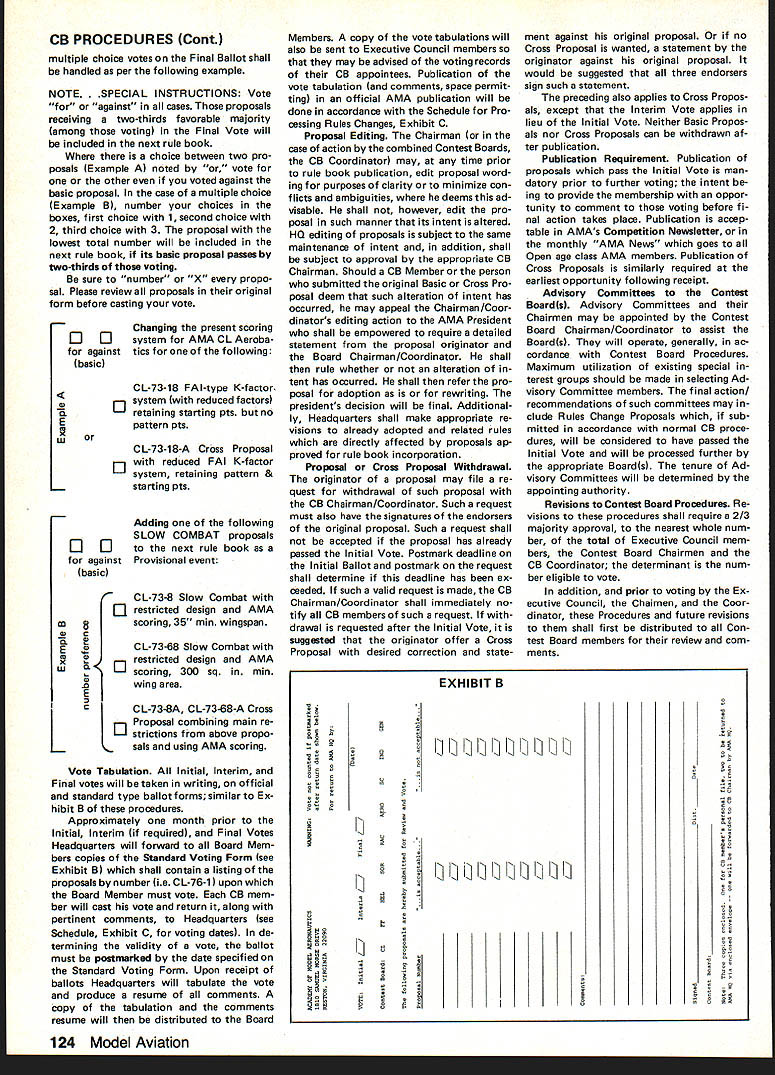
Where there is a choice between two proposals (Example A) noted by "or," vote for one or the other even if you voted against the basic proposal. In the case of a multiple choice (Example B), number your choices in the boxes: first choice with 1, second choice with 2, third choice with 3. The proposal with the lowest total number will be included in the next rule book, if its basic proposal passes by two-thirds of those voting.
Be sure to number or mark every proposal. Please review all proposals in their original form before casting your vote.
Example ballot choices:
- Changing the present scoring system for AMA CL Aerobatics to one of the following:
- CL-73-18 FAI-type K-factor system (with reduced factor) retaining starting points but no pattern points; or
- CL-73-18-A Cross Proposal with reduced FAI K-factor system, retaining pattern and starting points.
- Adding one of the following Slow Combat proposals to the next rule book as a provisional event:
- CL-73-8 Slow Combat with restricted design and AMA scoring, 35 in. minimum wingspan.
- CL-73-68 Slow Combat with restricted design and AMA scoring, 300 sq. in. minimum wing area.
- CL-73-8A, CL-73-8A Cross Proposal combining main restrictions from the above proposals and using AMA scoring.
Vote Tabulation. All Initial, Interim, and Final votes will be taken in writing on official standard ballot forms similar to Exhibit B.
Approximately one month prior to the Initial, Interim (if required), and Final Votes, Headquarters will forward to all board members copies of the Standard Voting Form (see Exhibit B), which will list the proposals by number (i.e., CL-76-1) upon which the board member must vote. Each CB member will cast his vote and return it, along with pertinent comments, to Headquarters (see Schedule, Exhibit C, for voting dates). The ballot must be postmarked by the date specified on the Standard Voting Form. Upon receipt, Headquarters will tabulate the vote and produce a summary of all comments. A copy of the tabulation and comments will then be distributed to the board members. A copy of the vote tabulations will also be sent to Executive Council members so they may be advised of the voting records of their CB appointees. Publication of the vote tabulation (and comments, space permitting) in an official AMA publication will be done in accordance with the Schedule for Processing Rules Changes, Exhibit C.
Proposal Editing. The chairman (or in the case of action by the combined Contest Boards, the CB coordinator) may, at any time prior to rule book publication, edit proposal wording for clarity or to minimize conflicts and ambiguities where he deems this advisable. He shall not, however, edit the proposal in such a manner that its intent is altered. Headquarters editing of proposals is subject to the same maintenance of intent and shall be subject to approval by the appropriate CB chairman. Should a CB member or the person who submitted the original Basic or Cross Proposal deem that an alteration of intent has occurred, he may appeal the chairman/coordinator's editing action to the AMA President, who will be empowered to require a detailed statement from the proposal originator and the board chairman/coordinator. The President shall then rule whether an alteration of intent has occurred and refer the proposal for adoption as is or for rewriting. The President's decision will be final. Additionally, Headquarters shall make appropriate revisions to already adopted and related rules that are directly affected by proposals approved for rule book incorporation.
Proposal or Cross Proposal Withdrawal. The originator of a proposal may file a request for withdrawal of such proposal with the CB chairman/coordinator. Such a request must also have the signatures of the endorsers of the original proposal. Such a request shall not be accepted if the proposal has already passed the Initial Vote. Postmark deadlines on the Initial Ballot and postmark on the request shall determine if this deadline has been exceeded. If a valid request is made, the CB chairman/coordinator shall immediately notify all CB members. If withdrawal is requested after the Initial Vote, it is suggested the originator offer a Cross Proposal with desired correction and a statement against his original proposal. If no Cross Proposal is desired, a statement by the originator against his original proposal, signed by all three endorsers, is suggested.
This preceding also applies to Cross Proposals, except that the Interim Vote applies in lieu of the Initial Vote. Neither Basic Proposals nor Cross Proposals can be withdrawn after publication.
Publication Requirement. Publication of proposals that pass the Initial Vote is mandatory prior to further voting; the intent is to provide the membership an opportunity to comment to those voting before final action. Publication is acceptable in AMA's Competition Newsletter or in the monthly AMA News, which goes to all open-age class AMA members. Publication of Cross Proposals is similarly required at the earliest opportunity following receipt.
Advisory Committees to the Contest Board(s). Advisory committees and their chairmen may be appointed by the Contest Board chairman/coordinator to assist the board(s). They will operate generally in accordance with Contest Board Procedures. Maximum utilization of existing special interest groups should be made in selecting committee members. Final actions or recommendations of such committees may include Rules Change Proposals which, if submitted in accordance with normal CB procedures, will be considered to have passed the Initial Vote and will be processed further by the appropriate board(s). The tenure of advisory committees will be determined by the appointing authority.
Revisions to Contest Board Procedures. Revisions to these procedures shall require a two-thirds majority approval, to the nearest whole number, of the total of Executive Council members, the Contest Board chairmen, and the CB coordinator; the determinate is the number eligible to vote.
Prior to voting by the Executive Council, the chairmen, and the coordinator, these procedures and future revisions shall first be distributed to all Contest Board members for their review and comments.
Exhibit C
January 1 through September 1 — Basic Proposals accepted. Headquarters numbers and sends copies to chairman/coordinator for review, comments, breakdown into sub-parts. Returned to Headquarters for distribution to CB members.
This activity is continuous throughout this period.
Headquarters and chairman/coordinator prepare for Initial Vote.
Complete Initial Vote by December 1 postmark deadline.
Tabulate and publish vote results and proposals that pass and begin acceptance of cross-proposals. Distribute CB comments to CB members.
Headquarters and chairman/coordinator review cross-proposals for acceptability, approve cross-proposals for publication at earliest opportunity, plan for Interim Vote if needed.
Interim Vote (if required) to combine/reduce similar and/or cross-proposals — Headquarters to distribute forms by April 1.
Interim Vote postmark deadline, May 1.
Tabulate Interim Vote and distribute CB comments to CB members. Chairman/coordinator determines final wording of all basic and cross-proposals, and Headquarters publishes them.
Headquarters and chairman/coordinator prepare for Final Vote and publish synopsis of new rules. Prepare and print new Rule Book.
Issue new Rule Book.
Multiple choice votes on the Final Ballot
Multiple choice votes on the Final Ballot shall be handled as per the instructions above. Vote "for" or "against" in all cases. Those proposals receiving a two-thirds favorable majority (among those voting) in the Final Vote will be included in the next rule book.
Be sure to number or mark every proposal and review proposals in their original form before casting your vote.
CB Procedures (Cont.)
Vote Tabulation and Ballots
All Initial, Interim, and Final votes will be taken in writing on official standard ballot forms similar to Exhibit B. Ballots must be returned to Headquarters and postmarked by the date specified on the Standard Voting Form. Headquarters will tabulate the vote and distribute the tabulation and comments to board members and Executive Council members.
Proposal Editing and Appeals
The chairman/coordinator may edit wording for clarity or to minimize conflicts, without altering intent. Appeals go to the AMA President, whose decision is final.
Withdrawal and Publication
Proposals may be withdrawn before Initial Vote if endorsed signatories concur; proposals cannot be withdrawn after publication. Publication of Initial-Vote-passing proposals is mandatory prior to further voting.
Advisory Committees and Revisions
Advisory committees may be appointed to assist boards. Revisions to these procedures require a two-thirds majority of eligible voters and prior distribution to all Contest Board members.
Exhibit B
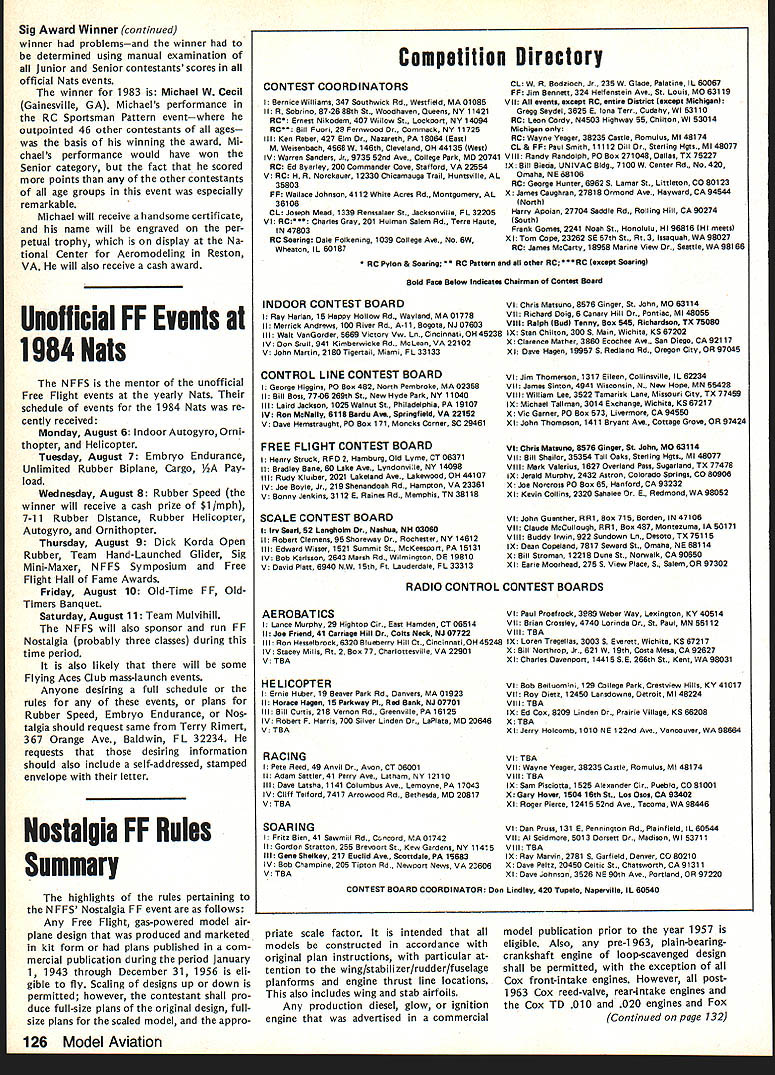
Sig Award Winner (continued)
The winner had problems—and the winner had to be determined using manual examination of all junior and senior contestants' scores in all official NATS events.
The winner for 1983 is: Michael W. Cecil (Gainesville, GA). Michael's performance in the RC Sportsman Pattern event—where he outpointed 46 other contestants of all ages—was the basis of his winning the award. Michael's performance would have won the senior category, but the fact that he scored more points than any other contestant of all age groups in the event was especially remarkable.
Michael will receive a handsome certificate, and his name will be engraved on the perpetual trophy, which is on display at the National Center for Aeromodelling in Reston, VA. He will also receive a cash award.
Unofficial FF Events at the 1984 NATS
The NFFS is the mentor of the unofficial Free Flight events at the yearly NATS. Their schedule of events for the 1984 NATS is:
- Monday, August 6: Indoor Autogyro, Ornithopter, and Helicopter.
- Tuesday, August 7: Embryo Endurance, Unlimited Rubber Biplane, Cargo, V-2 Payload.
- Wednesday, August 8: Rubber Speed (the winner will receive a cash prize of $1 per mph), 7–11 Rubber Distance, Rubber Helicopter, Autogyro, and Ornithopter.
- Thursday, August 9: Dick Korda Open Rubber, Team Hand-Launched Glider, Sig Mini-Max, NFFS Symposium and Free Flight Hall of Fame Awards.
- Friday, August 10: Old-Time Free Flight, Old-Timers Banquet.
- Saturday, August 11: Team Mulvihill.
The NFFS will also sponsor and run FF Nostalgia (probably three classes) during this time period. It is also likely there will be some Flying Aces Club mass-launch events.
Anyone desiring a full schedule, the rules for any of these events, or plans for Rubber Speed, Embryo Endurance, or Nostalgia should request them from:
Terry Rimer 367 Orange Ave., Baldwin, FL 32234
Please include a self-addressed, stamped envelope with requests.
Nostalgia FF Rules Summary
Highlights of the rules pertaining to the NFFS Nostalgia FF event are as follows:
Any free flight, gas-powered model airplane design that was produced and marketed in kit form or had plans published in a commercial publication during the period January 1, 1943 through December 31, 1956 is eligible to fly. Scaling of designs up or down is permitted; however, the contestant shall produce full-size plans of the original design, full-size plans for the scaled model, and the appropriate scale factor. Models should be constructed in accordance with original plan instructions, with particular attention to the wing/stabilizer/rudder/fuselage platforms and engine thrust-line locations. This also includes wing and stabilizer airfoil.
Any production diesel, glow, or ignition engine that was advertised in a commercial model publication prior to 1957 is eligible. Also, any pre-1963 plain-bearing, plain-bearing-crankshaft engine of loop-scavenged design shall be permitted, with the exception of all Cox front-intake engines. However, all post-1963 Cox reed-valve, rear-intake engines and the Cox TD .010 and .020 engines and Fox ... (Continued on page 132)
Transcribed from original scans by AI. Minor OCR errors may remain.

