
1985 U.S. RC Soaring Team Selection Program News
The team-selection process for the 1985 U.S. RC Soaring team is now in progress. A new system is being used this time. Previously, the U.S. team was selected by participation in a series of Quarter-finals, Semi-finals, and a Finals. This time, there will be an unlimited number of Qualification Attempts and a Finals.
Qualification
In order to participate in the team-selection Finals, an aspirant must first register with the Competition Department at AMA Headquarters (a fee of $30 is required). By return mail, they will receive a qualification form and further instructions. With this, they may make an unlimited number of qualification attempts before the August 1, 1984 cutoff date.
A successful qualification attempt occurs when, on the same day, the aspirant first makes an FAI Speed run of 27 seconds or better and then, within two hours and with the same model, scores a minimum of 400 points in the FAI Duration task (perfection is 460 points).
- The Speed run must be made on a measured FAI course with the proper sighting devices and with a winch conforming to FAI regulations ("weak link" in towline not required).
- The qualification-attempt event must have been registered beforehand with the Team Selection Committee and with AMA HQ.
- An AMA Contest Director must witness and certify the qualification attempt.
Team Selection Finals
The date and location of the Finals have not yet been selected—although, traditionally, the Finals have been held on the Labor Day weekend.
The Finals will be scheduled as a four-day affair and will be run much as previous Finals have been. An additional entry fee of $40 will be required for entry in the Finals.
There will be one "cut" in the Finals, with the final flying limited to 15 pilots. The post-cut scoring will be a continuation of the pre-cut contest, rather than being a totally separate event. If enough rounds are flown, there will be a throw-away round.
The World Championships will be held in 1985 in Australia—probably in April.
Increased Participation
It is hoped that the new team selection process will result in a greater number of contestants entering the program. Since the new program is a qualification process, rather than an elimination process, anyone who is really prepared to fly competitively at the national level has a much better opportunity to make it to the Finals. It also makes it less likely that someone who is not really prepared will be qualified.
Local clubs are encouraged to schedule FAI contests during the qualification "window."
Remember: qualification must be completed before August 1, 1984.
1984 NATS UPDATE!
Reno, Nevada — Aug. 5–12
Flying to Reno — Will the Olympics Interfere?
With the Summer Olympics being held on the West Coast, there has been concern that crowds and travel disruptions would make it hard to get to Reno for the NATS, and hard to find a room when you arrive. Some airlines have announced they will not offer discount fares for the Olympics, and schedules and car rental companies have sometimes tacked surcharges onto their basic prices. Will this affect those traveling to Reno for the 1984 NATS?
No. Reno is not an official Olympic terminal city and has not been "blacked out" to discount air fares. Furthermore, the "blackout" appears to be lifting in some California cities as well. Both TWA and United have announced the availability of some discount fares for the Olympic period.
As for housing, rooms are seldom hard to find in Reno, but rates vary widely through the year. The low room rates advertised in the winter don't apply during peak months like August. Use the Room Reservation Forms available from AMA Headquarters. Sending a stamped, self-addressed envelope to AMA with your request for NATS forms will get you a form that will make your reservations through the Reno Housing Authority. There are several hotels on the form to choose from. This assures you of a place to stay; when you get there, you can change your hotel if you find another you prefer.
Ordering a Room Reservation Form from AMA Headquarters also puts you on the list to receive NATS Entry Kits. These include a final schedule, entry forms, and all the information you need to register as a NATS contestant.
Discount Air Fares
AMA members can get economical air fares to and from Reno by calling Associated Travel in Boston. Toll-free number: (800) 343-4064. Tell them you are an AMA member and that you will be attending the National Championships and National Convention.
Help Wanted!
The Academy of Model Aeronautics needs lots of willing volunteers between August 3 and August 12 to help with the Reno NATS. Meet thousands of fellow modelers, be an official at national events, and see parts of the hobby you may never have seen before. Partial work days are fine—spend as much time as you feel you can.
Benefits:
- A package of Official NATS paraphernalia.
- An invitation to the Officials Party.
- FREE 1985 AMA membership for four or more full days of work (does not have to be consecutive days; partial days totaling four or more qualify).
- Up to $10 per day room and board reimbursement for qualifying volunteers.
No experience necessary—just plenty of enthusiasm! For registration or information, contact:
- Muriel Kee, Local Manpower Coordinator, 11452 Rocky Mountain, Reno, NV 89506. Phone: (702) 972-6753.
- Or AMA HQ, Joyce Hager, 1810 Samuel Morse Drive, Reston, VA 22090. Phone: (703) 435-0750.
Flying High at Reno: The Effect of High Altitude and High Temperature on the Performance of Model Aircraft
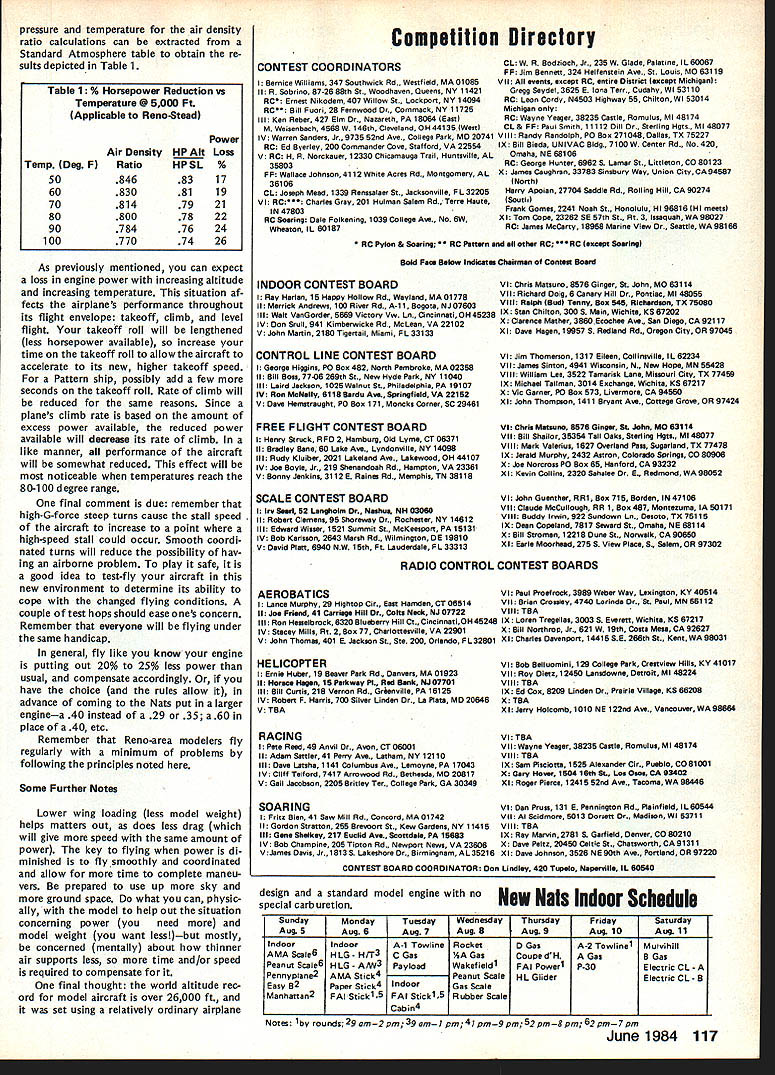
Much has been said about problems to be expected at this year's National Championships because of the high field elevation. Common sense is often lacking in these discussions. Reno model flying is enjoyed by many resident modelers without resorting to many tricks or special designs.
This article is based largely on information from Jim Stimson, an active modeler from Carson City, NV (near Reno). Jim is a retired Air Force officer and aeronautical engineer with 30 years' experience flying prop- and jet-powered aircraft. Most of the information here is more appropriate to Radio Control activities, but much is good background for Control Line and Free Flight.
The effects of altitude and temperature—and, to a lesser extent, humidity—significantly affect engine performance, particularly when one flies at 5,000 feet and in temperatures in the range of 80–100°F, which we can expect at Reno-Stead during the Nationals in August 1984.
The rest of this article explains how and why these factors (temperature and altitude) degrade aircraft engine performance and provides common-sense recommendations to play it safe and still maximize the available power from your engine.
In the Standard Atmosphere, sea-level air pressure is 29.92 in. of mercury and standard temperature is 59°F (15°C). At a location like Reno, the atmosphere is not "standard" due to higher altitude (less pressure) and higher temperature (in August).
Some Definitions of Terms
- Pressure Altitude: The reading a full-scale aircraft pilot gets from the altimeter when the altimeter's barometric pressure dial is set at 29.92 in. Hg. This reading is not the height above sea level except under standard atmospheric conditions.
- Density Altitude: Pressure altitude corrected for non-standard air temperature. Aircraft performance will be as though operating at the density altitude. Performance decreases with increasing altitude and increasing temperature.
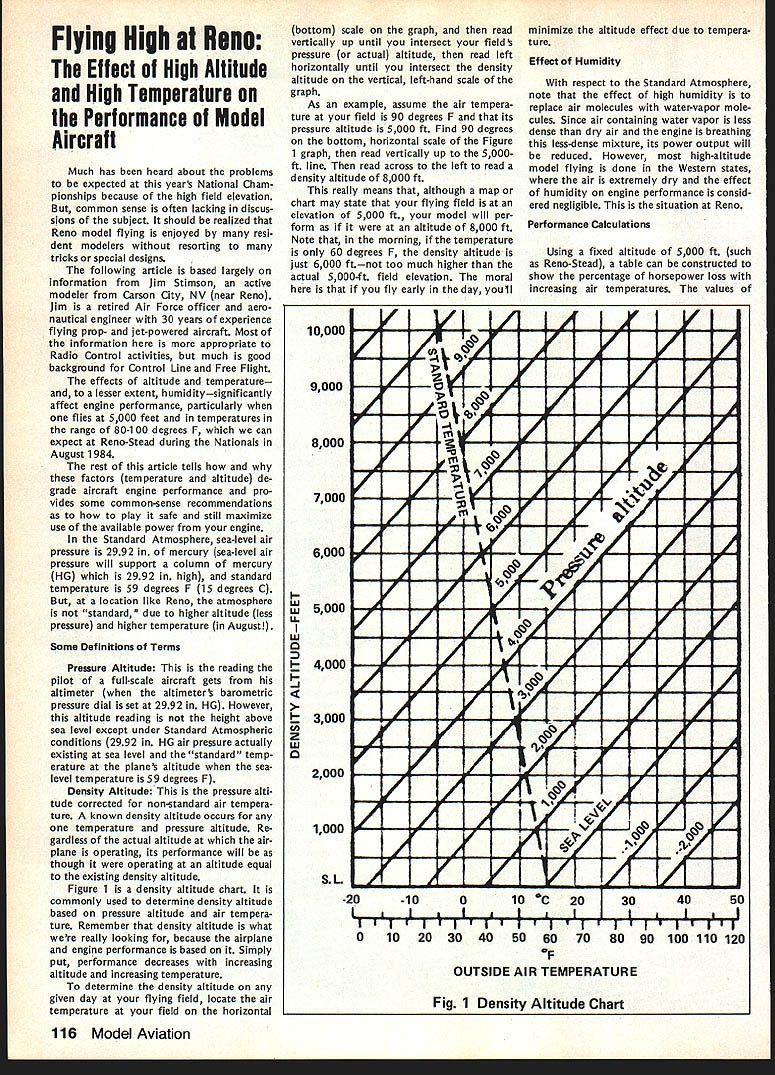
Figure 1 (not shown) is a density altitude chart. It is commonly used to determine density altitude based on pressure altitude and air temperature. To determine density altitude on any given day:
- Locate the air temperature at your field on the horizontal (bottom) scale of the graph.
- Read vertically up until you intersect your field's pressure (or actual) altitude.
- Read left horizontally to intersect the density altitude on the vertical, left-hand scale.
Example: If air temperature is 90°F and pressure altitude is 5,000 ft, reading the chart gives a density altitude of 8,000 ft. Although a map may state your field is at 5,000 ft elevation, your model will perform as if at 8,000 ft. In the morning, if the temperature is 60°F, the density altitude might be only 6,000 ft—much closer to the actual 5,000-ft elevation. The moral: fly early in the day to minimize temperature effects.
Effect of Humidity
High humidity replaces air molecules with water-vapor molecules. Since humid air is less dense than dry air, engine power will be reduced. However, in western states where the air is extremely dry (such as Reno), the effect of humidity on engine performance is negligible.
Performance Calculations
Using a fixed altitude of 5,000 ft (such as Reno-Stead), the following table shows the percentage of horsepower loss with increasing air temperatures.
Table 1: % Horsepower Reduction vs Temperature @ 5,000 ft (Applicable to Reno-Stead)
- Temp. (Deg. F): 50, 60, 70, 80, 90, 100
- Air Density Ratio: .846, .830, .814, .796, .784, .770
- Power HP Loss (%): 13, 17, 19, 21, 24, 27
As mentioned, expect a loss in engine power with increasing altitude and temperature. This affects takeoff, climb, and level flight. Your takeoff roll will be lengthened (less horsepower available), so allow more time on the takeoff roll to achieve normal higher takeoff speed. Rate of climb will be reduced because climb rate depends on excess power. All aircraft performance will be somewhat reduced, most noticeably when temperatures reach the 80–100°F range.
High-G steep turns increase stall speed and can cause a high-speed stall. Smooth, coordinated turns reduce the chance of airborne problems. Test-fly your aircraft in the new environment to determine its behavior. A couple of test hops should ease concerns. Remember that everyone will be flying under the same handicap.
In general, fly as if your engine is producing 20–25% less power and compensate accordingly. Or, if rules allow and you have the choice, consider installing a larger engine in advance of the Nats (for example, a .40 instead of a .29 or .35; a .60 in place of a .40).
Reno-area modelers regularly fly with a minimum of problems by following these principles.
Some Further Notes
- Lower wing loading (less model weight) helps, as does reduced drag (which gives more speed with the same power).
- Fly smoothly and coordinated; allow more time and space to complete maneuvers.
- Reduce model weight where practical and avoid unnecessary drag.
- The world altitude record for model aircraft is over 26,000 ft, set using a relatively ordinary airplane design and a standard model engine with no special carburetion.
Free Flight Cargo Event
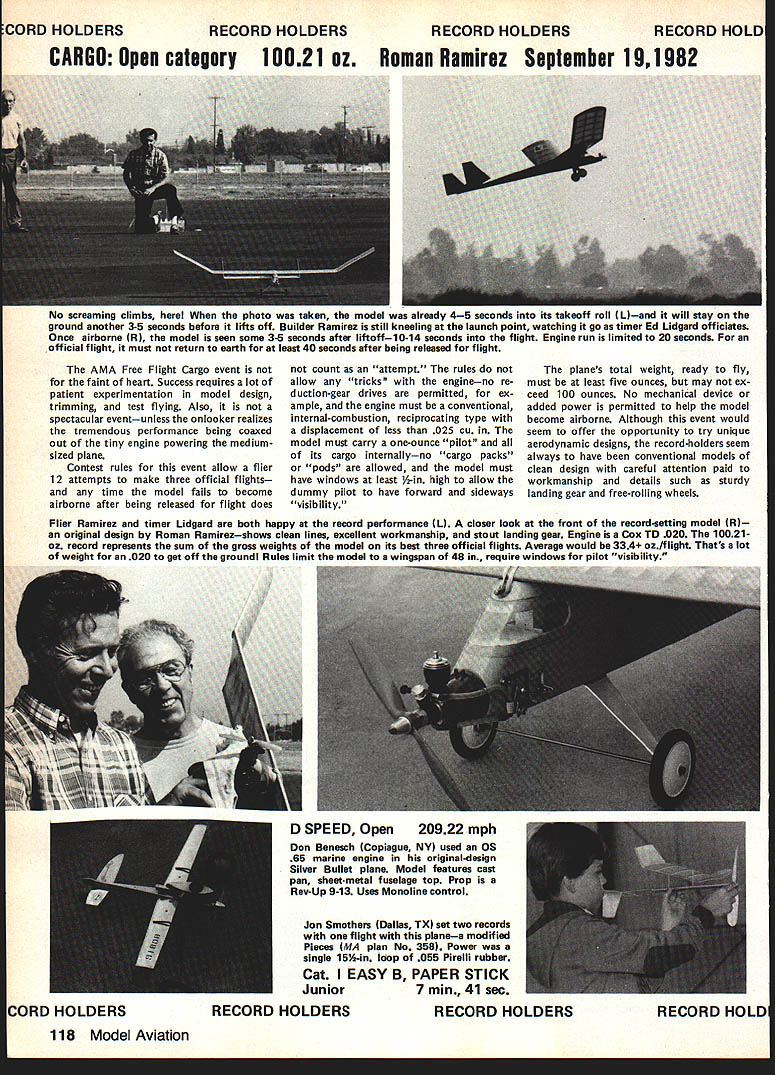
The AMA Free Flight Cargo event is not for the faint of heart. Success requires patient experimentation in model design, trimming, and test flying. It is not a spectacular event to the casual onlooker—unless they realize the tremendous performance coaxed from a tiny engine powering a medium-sized plane.
Contest rules:
- A flier is allowed 12 attempts to make three official flights.
- Any time the model fails to become airborne after being released does not count as an "attempt."
- No "tricks" with the engine are permitted—no reduction-gear drives, for example.
- Engine must be a conventional internal-combustion reciprocating type with displacement less than .025 cu. in.
- The model must carry a one-ounce "pilot" and all cargo internally—no external "cargo packs" or "pods" allowed.
- Model must have windows at least 1/4 in high to permit the dummy pilot forward and sideways "visibility."
- Total ready-to-fly weight must be at least five ounces but not exceed 100 ounces.
- No mechanical device or added power is permitted to help the model become airborne.
- While unique aerodynamic designs can be tried, record-holders have tended to use conventional models of clean design with careful workmanship, sturdy landing gear, and free-rolling wheels.
Example: Flier Roman Ramirez and timer Lidgard celebrated a record performance. An original design by Roman Ramirez, powered by a Cox TD .020, achieved a combined weight of 100.21 oz across its best three official flights (average 33.4 oz/flight). That is a lot of weight for an .020 to lift! Rules limit wingspan to 48 in and require windows for pilot "visibility."
Selected Records and Performances
- D SPEED, Open: 209.22 mph — Don Benesch (Copiague, NY) used an OS .65 marine engine in his original-design Silver Bullet plane. Model features cast pan and sheet-metal fuselage top. Prop: Rev-Up 9-13. Uses Monoline control.
- Jon Smothers (Dallas, TX) set two records with one flight using a modified Pieces (MA Plan No. 358). Power was a single 15/64‑in. loop of .055 Pirelli rubber.
- Cat. I EASY B, PAPER STICK (Junior): 7 min., 41 sec.
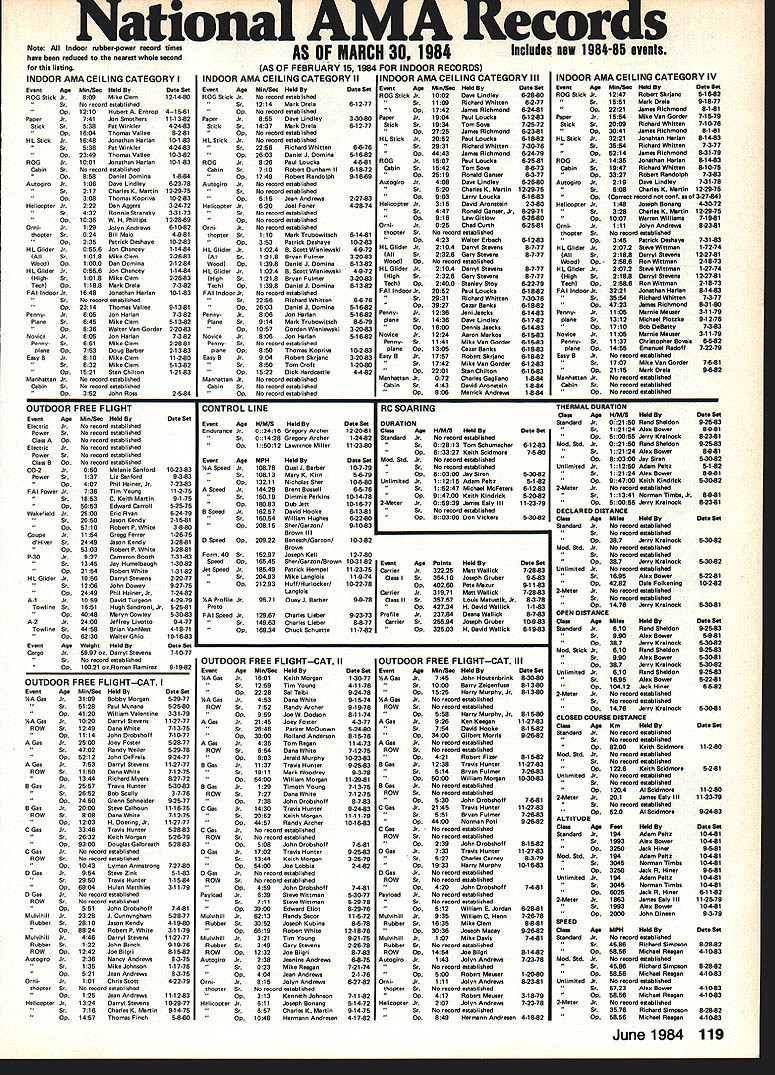
National AMA Records
Note: All Indoor rubber‑power record times have been reduced to the nearest whole second for this listing.
As of March 30, 1984.
Includes new 1984–85 events.
- INDOOR AMA CEILING CATEGORY I
- INDOOR AMA CEILING CATEGORY II
- INDOOR AMA CEILING CATEGORY III
- INDOOR AMA CEILING CATEGORY IV
- OUTDOOR FREE FLIGHT
- CONTROL LINE
- RC SOARING
- THERMAL DURATION
- OUTDOOR FREE FLIGHT — CAT. I
- OUTDOOR FREE FLIGHT — CAT. II
- OUTDOOR FREE FLIGHT — CAT. III
- CLOSED COURSE DISTANCE
- ALTITUDE
- SPEED
June 1984
Transcribed from original scans by AI. Minor OCR errors may remain.

