
COMPETITION NEWSLETTER
1976 FREE FLIGHT NATS
Hardy Brodersen & Homer Smith FF Category Co-Directors
Free Flight Nats staffing requirements break down into several broad categories:
- Event Directors, AMA Outdoor Events
- Event Directors, FAI Outdoor Events
- Event Directors, Indoor
- Processors, AMA Events, Outdoor
- Processors, FAI Events, Outdoor
- Processors, FAI Indoor
- Engine Timers, AMA Events
- Engine Timers, FAI Events
- Flight Timers, FAI Events
- Jury, FAI Outdoor Events
- Scoring, Tabulation, Outdoor AMA
- Scoring, Tabulation, Outdoor FAI
- Scoring, Tabulation, Indoor
The game plan to fill these jobs is to find the best men available for one-day duty as volunteers without pay, who may otherwise be entered in the Nationals. Notice that FAI Event Directors will have at least two and possibly three days activity: supervision of processing the night before the event itself, and the fly-offs. AMA Event Directors will have one-day duty for each event. Additional responsibilities for each event director are supervision of scoring, on-field processing, on-field tabulation, special continuous scoring display and trophy distribution at the close of flying on each day.
The drudgery jobs: processing, scoring, tabulation and FAI timing are offered on a paying basis. When you work four days (or more) you get free billeting for each night worked and reimbursement for transportation to and from the Nats based on 8 cents per mile, but paid only for not less than 200 miles or more than 500 miles. Example: if you live 350 miles from Springfield (AAA data will be determining) you will get 700 x .08 = $56.00. That is all, brother. The most you could make is $80.00 if you lived further than 500 miles away. Furthermore, manpower budgeting anticipates that most of these posts will be filled by volunteers for less than four days' duty with no reimbursement for travel expense. So, it is not a money maker—but it is an important involvement in the greatest contest in the world.
There are some tentative plans for mementos for the Nats workers. For example, last year all of the Nats workers got a little plaque and got their name mentioned in Competition News (especially if they were from Texas). This year we are trying to organize T-shirts which will distinguish the individual as being on-duty while he wears them and which may be kept as a keepsake. The T-shirts will have a graphic on the front in red and blue saying "76 FF NATS" with a credit for the donor on
INDOOR PROGRAM OPINION SURVEY SHOWS WIDE DIVERSITY
On some of the most important questions included in the recent survey of Indoor Team Program participants, response in many cases was far from unanimous—leading us to speculate that the Indoor Team Selection Committee (Bucky Servaites, chairman) will need to pull its best thinking together to arrive at an agreeable program for selecting the U.S. 1978 Indoor World Championships Team. Results of the survey:
TWO-YEAR VS. ONE-YEAR PROGRAM. Twenty-five preferred a two-year program having one regional meet per zone in 1976 and one regional meet per zone in 1977, plus the Team Finals, while 20 favored a one-year program instead. In a separate question, 18 felt a two-year program would be a problem for already-selected team members for the 1976 World Championships, while 20 did not feel it to be a problem.
POINTS VS. TIME. In considering a system where a regional score is carried to the Team Finals, 25 were in favor of a system using points, 15 favored using flight times only, and 3 felt either system to be okay. Those in favor of points (or a combination of points-times) were 14 to 10 in favor of keeping the previous point system except adding 10–15 bonus points for contests including Team Finals highest two-flight total, and there was a 12–8 response for changing the weight of the Team Finals score from 60% to 66 2/3%.
CROSS-ZONE FLYING. The response was 23 to 19 against permitting unlimited cross-zone flying in the regional meets to obtain an improved score. On how many regional meets a participant should be allowed to enter (beyond the basic two), the responses were: 11 for no limit, 5 against any additional, 12 for one additional, 5 for two additional, and 7 for three additional.
VOTING BY COMMITTEE MEMBERS. Response was 28 to 18 for votes by committee members to be weighted by the number of flying program participants in their respective districts.
TEAM MANAGER SELECTION. Several questions were asked relative to this, including automatic selection of the fourth place winner, choice by team, combination choice by the team and the committee, and choice by the committee. No clear preference was shown, other than opposition to choice of the team manager by the program committee.
GENERAL. Those responding did feel that the past program picked a very strong team, that the preferred program should be designed to pick the strongest team as opposed to greatest participation; that four regional zones as in the previous program should be maintained; that a single-site Team Finals should be continued; that Akron (if available) would be a suitable 1977 Team Finals site; and that perpetual awards for the Indoor Program should be obtained using program funds.
PARTICIPANT VOTE TO COME. The full opinion survey results plus any additional comments made by those responding have been distributed to each member of the Indoor Team Selection Committee for evaluation. From this we anticipate the committee will develop a program proposal and final questionnaire ballot for response by program participants, and assuming sufficiently affirmative response, announcement of the program for selecting the 1978 U.S. Indoor World Championships Team.
NATS FOLLOW-UP
EVENT SCHEDULE ERRORS. Peanut Scale is included in the regular event schedule of the 1976 Nationals, despite its not showing on the flight schedule printed last month—in fact there will be an Indoor Peanut Scale event as well as an Outdoor Peanut Scale event. Also, CL Profile Carrier will be flown on Wednesday, August 4—and not Monday as shown last month.
Indoor Peanut Scale is scheduled for Sunday, August 1, at the Ohio State Fair Coliseum in Columbus—2 pm to 9 pm. Outdoor Peanut Scale is scheduled for Thursday, August 5, at Wright Field—5 pm to 9 pm. Both events will be judged according to the AMA Peanut Scale rules put forward by C. Learoyd.
FREE FLIGHT A GAS is scheduled for Wednesday, August 4. Please note that the Nats schedule in this issue (page 56) has the corrections and revisions.
S.A.M. OLD TIMER NATS. Approval has been obtained to stage the Society of Antique Modelers' 1976 Nationals in conjunction with the AMA Nats—at Wright Field, July 31-August 2 (with RC Old-Timer events being only on the first two days, since AMA RC events will be on the third day).
Some important questions included in the recent survey of Indoor Team Program participants. Responses were in cases far from unanimous—leading us to speculate the Indoor Team Selection Committee, Bucky Servaites, chairman, will need to pull its best thinking together to arrive at an agreeable program for selecting the U.S. 1978 Indoor World Championships Team.
TWO-YEAR VS ONE-YEAR PROGRAM
Twenty-five preferred a two-year program, having a regional meet per zone in 1976, a regional meet per zone in 1977, plus Team Finals. Twenty favored a one-year program instead. In a separate question, 18 felt a two-year program would be a problem for already-selected team members from the 1976 World Championships; 20 did not feel it would be a problem.
POINTS VS TIME
Considering a system in which a regional score carried to the Team Finals, 25 favored a system using points, 15 favored using flight times, 4 favored a combination points/times system, and 3 felt either system would be okay. Fourteen and ten respondents favored keeping the previous point system except adding 10–15 bonus points per contest including Team Finals (highest two-flight total). In a 12–8 response on changing the weight of the Team Finals score to 60%–66%, a majority favored the times system or a combination points/times; either favored by 13 and 5 respondents, respectively, returning to the total time system used in the 1973–74 program.
CROSS-ZONE FLYING
Response: 23 for, 19 against permitting unlimited cross-zone flying in regional meets to obtain an improved score. Regional-meet participants should be allowed to enter beyond the basic two: response was 11 for no limit, 5 against additional entries, 12 for one additional, 5 for two additional, and 7 for three additional.
VOTING BY COMMITTEE MEMBERS
Response: 28 for weighted votes by committee members according to the number of flying program participants in their respective districts; 18 against.
TEAM MANAGER SELECTION
Several questions asked relative to including automatic selection of the fourth-place winner, choice of team manager, combination choice, or team committee choice. No clear preference was shown; responses indicated opposition to choice of team manager by the program committee.
GENERAL
Respondents felt the past program picked a very strong team. Most preferred a program that should be designed to pick the strongest team as opposed to maximizing participation. That four regional zones of the previous program should be maintained, and single-site Team Finals should continue at Akron.
Competition Newsletter
6TH ANNUAL FREE FLIGHT CHAMPIONSHIPS
Jim Scarborough
'Bigger and better'; the theme of the USFFC has not been let down this year. To start with, the 6th Annual Meet has an AAAA rating bestowed upon it by the AMA Executive Council! I know the meet will live up to its rating, we are working hard to ensure it.
Outdoor Peanut Scale has been added for the Peanut but combined A and B Old-Timer Gas, and then split into Cabin and Pylon events. Class C Old-Timer has also been split into Cabin and Pylon. These maneuvers end up effectively adding an event to the Old-Timer slate.
A grand total of 32 events are offered for the serious competitor to attack. Trophies will be awarded to 5th in each event. And entry fees have not been increased! In these days of rising prices, this is no small feat.
A lot of discussion was centered on determining the method of flying AMA Gas events. Clubs were polled the length of California and it was almost unanimous; by 1975 power rules! So that's what it will be. We feel sure the Eastern flyer who has been struggling to keep a plane on the field with a 7-sec. run and two-minute max will appreciate letting 'em unwind. We can't guarantee absolute perfect weather, so if conditions warrant, the CD can and will use Category II rules.
Speaking of CDs, Sandy Norton has bowed out after 5 years of hard service. This year finds the last two years' assistant, Joe Norcross, running things. Joe has had plenty of experience, and will conduct a top-notch contest.
Lee Himes, a familiar name to most I'm sure, will CD the Indoor event.
To help alleviate the Kitty Litter factory problem, we've hired a full-time guard to patrol the premises. He is an old-time free flighter, none other than Vic Cunningham, Sr. When the drift isn't toward the Kitty Litter pile, Vic will help at the registration table.
If I can get my wife away from the duties of being a mother, Judy will again run the Sweepstakes and Team signup. Jean Bogart will run registration with the expertise she has demonstrated these past years.
Hand-launch glider flyers will launch from a designated area to prevent them from running all over the field while attempting 'tactical flying,' i.e., piggybacking.
We have worked hard to bring a meet for the modelers, by the modelers. We are looking forward to seeing you Memorial Day Weekend at Taft, the mecca of the Free Flight.
RC SOARING TEAM PROGRAM
Jim Simpson Program Administrator
I would like to take this opportunity to encourage every RC sailplane pilot in the U.S. to seriously consider the following points, then enter the FAI RC Soaring Team Selection Program.
- The main objective of this program is to identify the best sailplane pilots in the U.S. To be sure we have the best requires everyone possible to enter.
- As presently designed, the program offers an equal chance to all. This is because it is a new concept, and there are no established favorites. Also because the program includes three separate tasks (duration, speed and distance) no single design appears to have a clear-cut advantage. Finally, because the 'hot shots' tend to overstress their sailplanes, this means they are apt to draw zeros or low scores, which broadens chances for us all.
- The program is extremely economical and can keep entrants busy all year long. Almost any sailplane will qualify, and the entry fee is only $25.00, paid one time. This fee covers two Quarter Final contests (there is an additional $9 scheduled) plus the Semi-Finals. Quarter Finals will be held in the month of May.
Advancement from the QF's to the Semi-Finals requires the entrant only to achieve 80% or more of the winner's score. From the Semi-Finals to the Team Finals, advancement will be on a prorata basis.
- Winning at the Team Finals in Denver, Colo., means being our country's best pilot, and of course the top three will comprise the U.S. team we will send to South Africa for the World Championships competition in April 1977!
With these points in mind I would like to encourage every RC soaring pilot in America to enter this program for the honor of our country and the glory of winning in competition.
RULE BOOK IS ON THE WAY
As this was written the AMA rule book for 1976-1977 was already well into the process of printing, and a mass mailing to all AMA members whose applications for 1976 AMA membership had reached AMA HQ by March 31 was to have been completed at least a week prior to the mailing of this issue of Model Aviation.
It is likely, thus, that your rule book already will be in hand—although inconsistencies in mail delivery beyond our control may delay the book in some instances. Suggestion: If you believe your membership application reached AMA HQ by March 31, and if you haven't received your rule book by May 15, write to AMA HQ and inquire.
Rule books for those who signed up after March 31 will be mailed in weekly or bi-weekly batches, or as volume warrants.
NATS RC OPERATIONS
AMA Vice President Don Lowe, who works at Wright Field, reports some interference problems over the years on the 6-meter band in the area. Those Nats RC contests who have a radio choice should try to use 27 MHz or 72 MHz equipment, if possible, since no interference has been observed on those frequencies at the Nats site.
FROST RE-ELECTED MACA PRESIDENT
Gaining more votes from members of the Miniature Aircraft Combat Association than any of the other contenders, Gary Frost has been re-elected president for the current term. His address, by the way, is what it was originally: 22 Glynn Dr., Florissant, Mo. 63031. Congratulations, Gary!
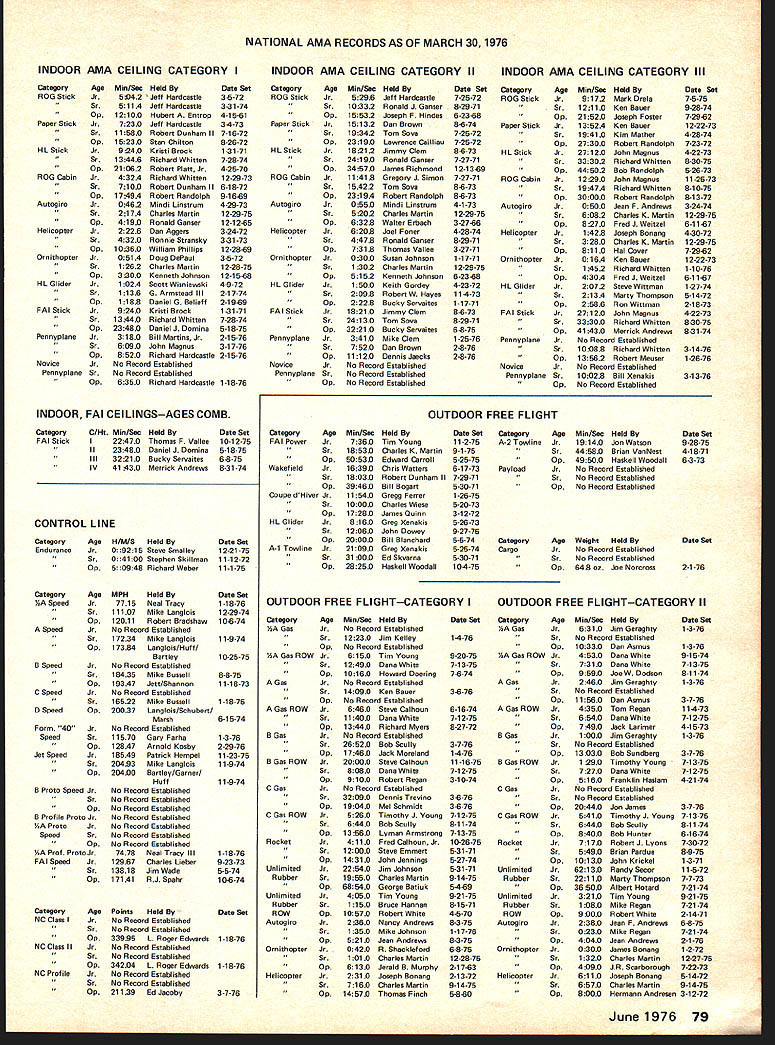
NAT'L RECORDS APPROVED FOR NOVICE PENNYPLANE
A mistake by the FF Contest Board Chairman compounded by the NATS CD not catching it resulted in an erroneous report that there would be no national AMA records for Indoor Novice Pennyplane models due to the provisional status of the rules. This was wrong because, in fact, the Contest Board approved official rules status for both Pennyplane and Novice Pennyplane—the condition necessary for instituting national records.
Flights in AMA-sanctioned competition (from January 1, 1976) with models built according to Novice Pennyplane specifications can be considered for national AMA records in Junior, Senior and Open age classes and in each of the three ceiling height categories.
INTERNATIONAL CONTEST CALENDAR
Going to Europe sometime this year and hope to take in a model airplane contest or two while there? If so you ought to write to AMA HQ for a copy of the two-page 1976 International Aeronautical Sporting Calendar of events registered with the FAI. Please include a stamped self-addressed envelope with requests.
Listed are the three World Championships to be held in 1976 (CL & RC Scale; Control Line Stunt, Speed and Team Race; and Indoor), four Continental Championships, and 33 Open International Contests (the U.S. Nats is one of this latter group—for the FF Wakefield, Rubber, Nordic A-2 Glider and FAI Power events).
'76 FREE FLIGHT NATS
(continued from page 75)
the sleeve. Such donors as SIG, Goldberg, Midwest, M.A.N. (are you listening?)
Some of the criticism and comments from the troops are herewith acknowledged: we have been called for excessive emphasis on FAI. These same voices did not notice who built the ROW tank last year, or who, several years ago, put energy behind keeping A Gas on the menu. This Free Flight Nats management's philosophy is to run the events according to the rule book. And to recognize the distinction between AMA and FAI competition, and present each category in its best presentation. To characterize each in a few words: the AMA events, particularly the gas events, are open flying events with substantially unrestricted design specifications. The modeller can fly any time of day, and has fairly unrestricted opportunity to decide when and how to fly. The can pace his activity according to the posted scores of his competition and the weather. His only constraint is to get his flights in on time, and, with a perfect score, to leave time to add his fly-off flights. The FAI events, by specific definition of the models and method of competing, provide constraints on area, weight, and available power (for towline length), and in procedures for flying. Rounds, starting lines and positions, special procedures for fly-offs. To fly FAI events some other way (for example, without rounds, as we used to do), does not satisfy the proper presentation of these events. I hope you can agree that we are giving both basic categories proper emphasis, not excessive emphasis for either.
We have been called for not separating Juniors and Seniors in the FAI events. Well, this year the FAI events are on the International FAI Calendar. FAI rules for this class of competition call for a special Junior class if three or more entrants under 18 years of age present themselves. Instead of conforming to this essentially European approach to the Junior problem, our FAI events this year will for the first time make new Perpetual Awards for the highest placing Junior in F1A, F1B, and F1C, and for the highest placing Senior in these same events. These new perpetual awards have been established by two of the oldest and most prestigious FAI-oriented groups in American modeling: Scatter, Los Angeles, California, will provide the three awards for the Juniors. The Skyscrapers of Brooklyn, New York, will provide the three awards for the highest-placing Seniors. Details on these awards will be given at a later time.
"The Skyscrapers are delighted with this opportunity to further support International Class Free Flight in the U.S.A.
"For more than 20 years, the club has sponsored an annual FAI challenge meet for competition by both individuals and teams. This meet has always been flown under the rounds system and has, at times, attracted world-class competitors from Europe. The club has always drawn heavy participation from Free Flighters in the northeastern U.S. and Canada.
"The Skyscrapers, whose membership includes several former members of U.S. World Championship Teams—there were two Skyscrapers on the U.S. 1975 team, for example—believe that by giving U.S. flyers more opportunities to compete to world standards, the club is helping to strengthen the U.S. capability at world championship meets.
"This is why we heartily endorse the fact that FAI events at the Nats will be flown to the letter of the FAI rules.
"We also believe that, by giving additional incentive and recognition to the younger flyers in these events, we will be helping to further strengthen our future teams.
"The Skyscrapers of Brooklyn, New York, feel it is a fitting addition to the celebration of our 40th anniversary to contribute a special award to the highest placing Junior flyer in each of the three FAI outdoor free flight events."
Aside from this new and unique recognition of Junior and Senior achievement in FAI competition, scoring will be with all age classes combined. The underlying philosophy of this Free Flight Nats management is that the Junior and Senior should enter into the main stream of competition immediately. This is world championship class competition. His score is posted right alongside Henry Spence, Paul Crowley, Frank Parmenter, and Jim Richmond. And, more to the point, he is ranked with his fellow Juniors and Seniors on the scoreboard. His achievements are measured meaningfully and directly in a scale of 1 to 100 rather than in a scale of 1 to 3 or 5 if we were flying only against other Juniors (or other Seniors).
Indoor AMA duration events now have the new (new to the Nats) steering rule. Also, we will fly FAI Indoor Stick by rounds, beginning at noon, when we hope the air will have settled. We take notice of reports and expressions of concern regarding the difficulties of managing the flying site with the new steering rules. We plan to announce and enforce procedures for the use of balloons for steering and retrieving during the contest, and appreciate having been alerted to possible problems as a result of the experience of others.
Another recommendation from several quarters concerns AMA outdoor fly-off procedures. Since the flying occurs at 4:30 P.M. each day, we have no choice but to add fly-off flights consecutively, at the contestant's discretion, during the contest day. All flying stops at 4:30 P.M., so don't start your string of maxes early.
A special condition pertains at Springfield. We are required to be alert to possible emergency landings on the takeoffs, even though the field is closed. This will occur unannounced. You will find yourself almost anywhere on the field, walking in, or in a car, or on a motorcycle. The method of signaling an alert will be announced, but it will include flashing the runway lights. You are required to immediately leave the operating runway and stay off until clearance is signaled. If you are down-wind chasing, and not back to the field having not heard the initial alert signal, the flashing runway lights will nevertheless warn you of traffic. Do not go onto a runway when the lights are flashing.
Time one—fly one is the method for most of the events. The experience has been excellent in the past, not requiring any special procedure or record keeping. Let's keep it that way. Of course there are always the special few who are above all this. Some of them are the biggest errors. They have become highly visible in their absence from the timing chores.
A new and special feature, which we have enthusiastically accepted as part of the menu, is a Canadian specialty—Unlimited Flight Rubber. For the earliest possible starting time, each contestant has one unlimited flight with the timer free to chase downwind with the model. Model specifications are unlimited. One flight—the highest total wins. Prizes and contest management to be provided by the Toronto FAI Group.
At the Nats Planning Meeting it was erroneously assumed that we would be able to time AMA events using binoculars. If word of this has leaked out to cause consternation, please disregard. The Nats will be conducted according to the rule book, as far as possible: unaided vision is specified. This will cause the Category Directors to give special attention to timing considerations at the beginning of each day's flying, to decide if a 5-minute max can be kept in sight. You may very well be told to make 5-minute maxes on an otherwise adequate site as a so-called 5-minute limit, if, in the judgment of the Category Directors, the time is predicted to be sufficient to carry the model out of sight before a 5-minute max is reached.
Now, take a look at the beginning of this article again. Select the Event Director jobs or any of the other assignments that might be of interest to you. Send us your name, address and telephone number and tell us your age, your experience, and anything about your help. We shall be watching your entry to the assignments. If you are interested in timing jobs, please indicate if you can provide a stopwatch. The Nats Planning Committee will supply the lists and telephone numbers for those who volunteer. Also include your wishes to pre-secure billeting in the nearby area and whether you would prefer billeting at the local high school or with a family. Send it to: NATS, Box 1104, Birmingham, Michigan 48012. Remember, the best jobs go to the first responders; be courteous. Be careful to make a distinction between whether you volunteer or on a non-reimbursable basis or whether you require billeting or travel reimbursement and will work four or more days.
Some important questions included in a recent survey of Indoor Team Program participants elicited responses in most cases far from unanimous — leading us to speculate the Indoor Team Selection Committee, Bucky Servaites, chairman, will need to pull its best thinking together to arrive at an agreeable program selecting the U.S. 1978 Indoor World Championships team.
Results of survey
TWO-YEAR VS ONE-YEAR PROGRAM
Twenty-five preferred a two-year program, having a regional meet per zone in 1976 and a regional meet per zone in 1977 plus Team Finals. Twenty favored a one-year program instead. In a separate question, 18 felt a two-year program would be a problem for already-selected team members for the 1976 World Championships; 20 did not feel it would be a problem.
POINTS VS TIME
Considering a system in which the regional score is carried to the Team Finals, 25 favored a system using points, 15 favored using flight times, 4 favored a combination of points and times, and 3 felt either system was acceptable. Fourteen and ten favored keeping the previous point system except adding 10–15 bonus points in contests (including Team Finals — highest two-flight total). In response to changing the weight of the Team Finals score to 60% (or 66%), respondents tended to favor the times system or a combination points–times. Thirteen and five favored returning to the total-time system used in the 1973–74 program.
CROSS-ZONE FLYING
Twenty-three (with 19 noted in another tabulation) were against permitting unlimited cross-zone flying at regional meets to obtain improved scores. On whether regional-meet participants should be allowed to enter beyond the basic two entries: 11 favored no limit, 5 were against additional entries, 12 favored one additional entry, 5 favored two additional, and 7 favored three additional.
VOTING BY COMMITTEE MEMBERS
Response: 28 — 18 votes: committee members' votes should be weighted by the number of flying-program participants in their respective districts.
TEAM MANAGER SELECTION
Several questions were asked concerning methods of team-manager selection, including automatic selection of the fourth-place winner, allowing the team to choose its manager, a combination choice, or selection by the committee. No clear preference was shown; respondents expressed varying opinions, with some opposition to choice of team manager solely by the program committee.
GENERAL
Respondents felt the past program picked a very strong team and preferred a program designed to select the strongest team rather than one designed solely to produce the greatest participation. The four regional zones of the previous program should be maintained, and Team Finals should remain single-site.
Transcribed from original scans by AI. Minor OCR errors may remain.

