
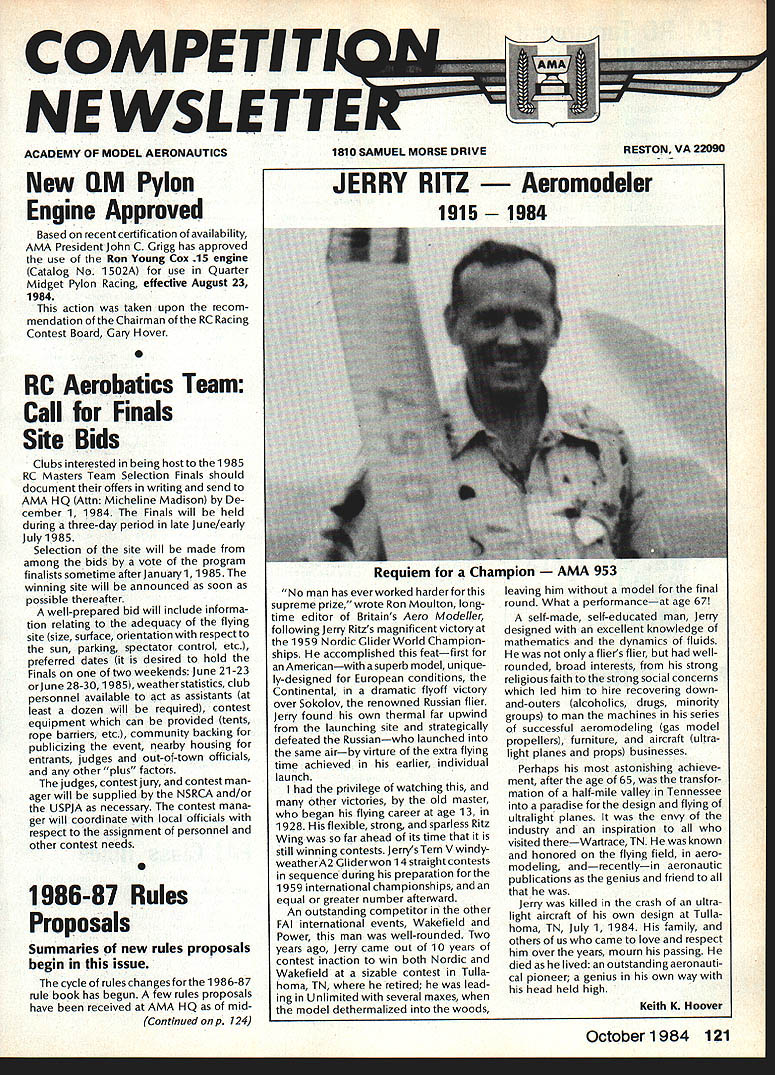
JERRY RITZ — Aeromodeler 1915 — 1984
"No man has ever worked harder for this supreme prize," wrote Ron Moulton, longtime editor of Britain's Aero Modeller, following Jerry Ritz's magnificent victory at the 1959 Nordic Glider World Championships. He accomplished this feat — first for an American — with a superb model, uniquely designed for European conditions, the Continental, in a dramatic flyoff victory over Sokolov, the renowned Russian flier. Jerry found his own thermal far upwind of the launching site and strategically defeated the Russian — who launched into the same air — by virtue of the extra flying time achieved in his earlier, individual launch.
We had the privilege of watching this and many other victories in the old master, who began his flying career at age 13 in 1928. His flexible, strong, sparless Ritz Wing was far ahead of its time; it is still winning contests. Jerry's Tern V, an A/2 glider, won 14 straight contests in sequence during his preparation for the 1959 international championships, and an equal or greater number afterward.
An outstanding competitor in other FAI international events — Wakefield and Power — this man was well-rounded. Two years ago, Jerry came out of 10 years of contest inaction to win both the Nordic Wakefield and a sizable contest. At Tullahoma, TN, he retired leading Unlimited with several maxes when the model dethermalized into the woods, leaving him without a model for the final round. What a performance — at age 67!
A self-made, self-educated man, Jerry designed with an excellent knowledge of mathematics and the dynamics of fluids. He was not only a flier's flier, but had broad interests, from his strong religious faith to strong social concerns which led him to hire recovering down-and-outers (alcoholics, drug addicts, minority groups) in his series of successful aeromodeling (gas model propellers), furniture, and aircraft (ultralight planes, plans and props) businesses.
Perhaps his most astonishing achievement, after the age of 65, was the transformation of a half-mile valley in Tennessee into a paradise for the design and flying of ultralight planes. It was the envy of the industry and an inspiration to all who visited there — Wartrace, TN. He was known and honored on the flying field, in aeromodeling, and — recently — in aeronautic publications as the genius and friend that he was.
Jerry was killed in the crash of an ultralight aircraft of his own design at Tullahoma, TN, July 1, 1984. His family, and others of us who came to love and respect him over the years, mourn his passing. He died as he lived: an outstanding aeronautical pioneer; a genius in his own way with his head held high.
Keith K. Hoover
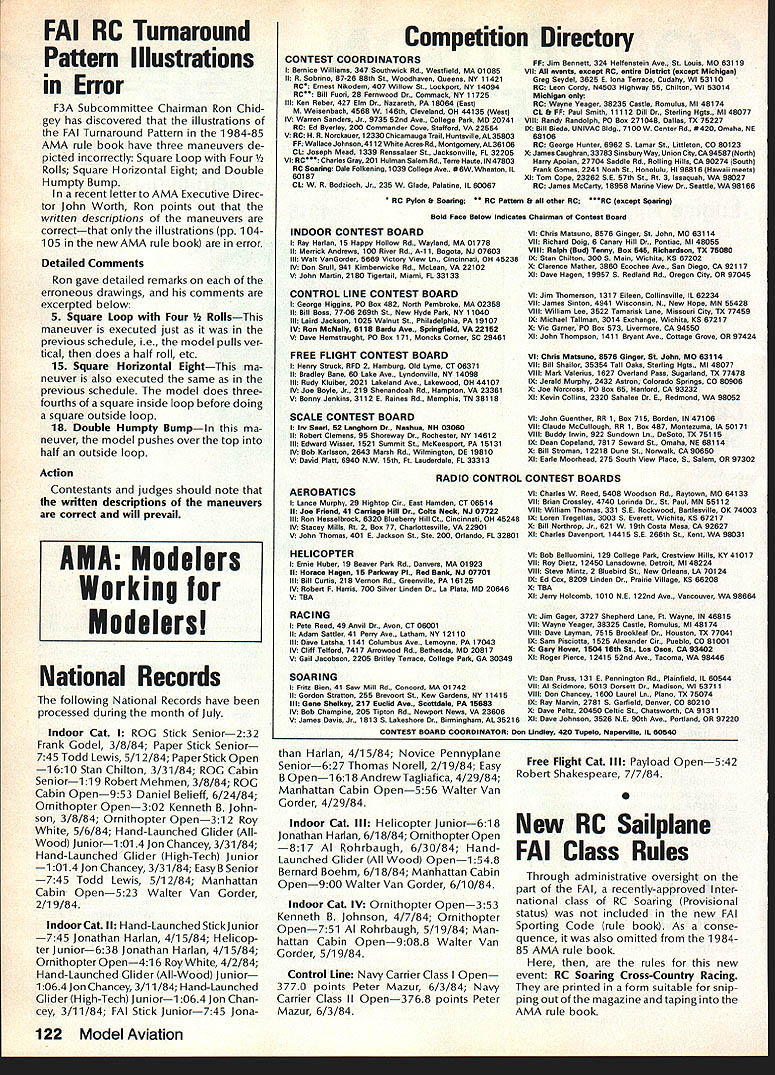
FAI RC Turnaround Pattern Illustrations in Error
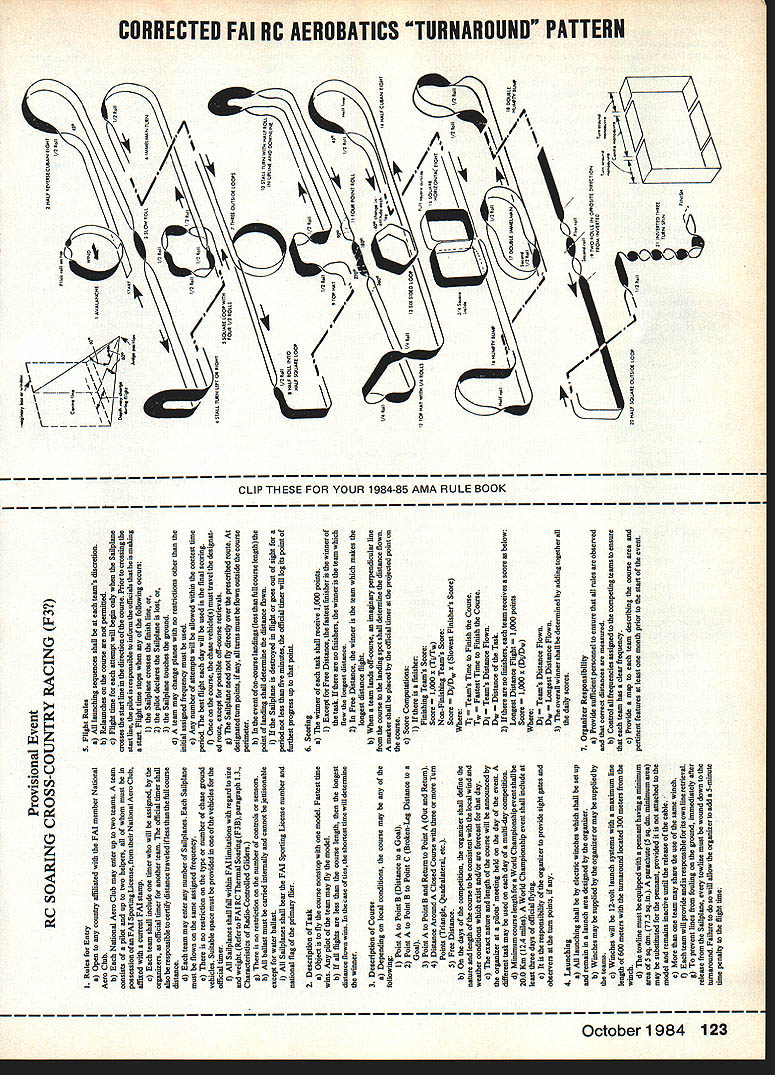
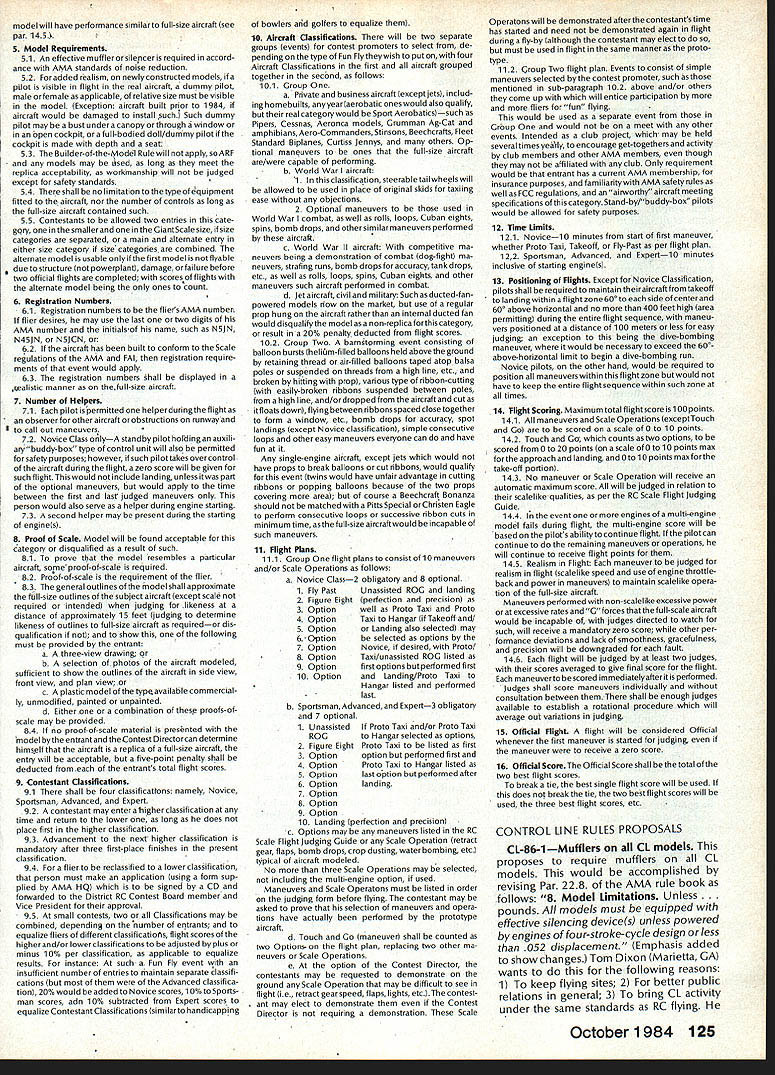
F3A Subcommittee Chairman Ron Chidgey has discovered that the illustrations of the FAI Turnaround Pattern in the 1984–85 AMA rule book have three maneuvers pictured incorrectly: Square Loop with Four 1/2 Rolls; Square Horizontal Eight; and Double Humpty Bump.
In a recent letter to AMA Executive Director John Worth, Ron points out that the written descriptions of the maneuvers are correct — only the illustrations (pp. 104–105 in the new AMA rule book) are in error.
Detailed Comments
Ron gave detailed remarks on each of the erroneous drawings, and his comments are excerpted below:
- 5. Square Loop with Four 1/2 Rolls — This maneuver is executed just as it was in the previous schedule, i.e., the model pulls vertical up to the top and performs the half rolls as described in the text.
- 15. Square Horizontal Eight — This maneuver is executed the same as in the previous schedule. The model does three-quarters of a square inside loop before doing a square outside loop.
- 18. Double Humpty Bump — In this maneuver, the model pushes over the top into half an outside loop.
Action
Contestants and judges should note that the written descriptions of the maneuvers are correct and will prevail.
CORRECTED FAI RC AEROBATICS "TURNAROUND" PATTERN
CLIP THESE FOR YOUR 1984–85 AMA RULE BOOK
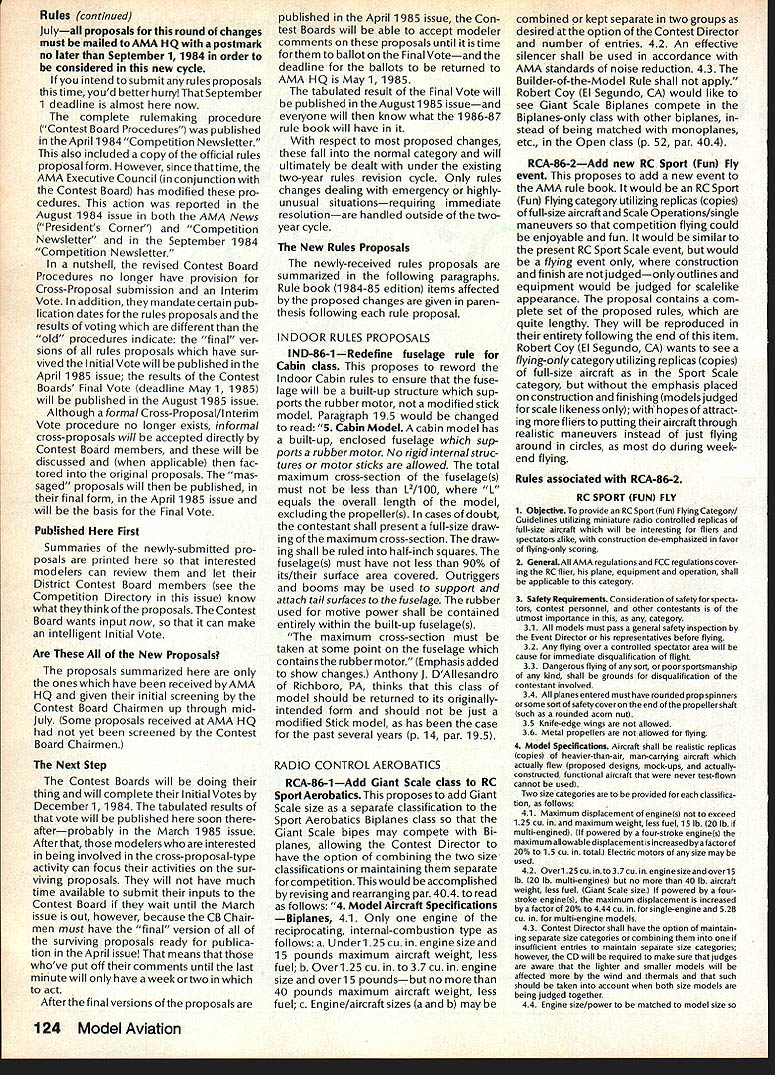
Rules (continued)
July — all proposals for this round of changes must be mailed to AMA HQ with a postmark no later than September 1, 1984 in order to be considered in this new cycle.
If you intend to submit any rules proposals this time, you'd better hurry! That September 1 deadline is almost here now.
The complete rulemaking procedure ("Contest Board Procedures") was published in the April 1984 Competition Newsletter. This also included a copy of the official rules proposal form. However, since that time, the AMA Executive Council (in conjunction with the Contest Board) has modified these procedures. This action was reported in the August 1984 issue in both the AMA News ("President's Corner") and Competition Newsletter and in the September 1984 Competition Newsletter.
In a nutshell, the revised Contest Board Procedures no longer have provision for Cross-Proposal submission and an Interim Vote. In addition, they mandate certain publication dates for the rules proposals and the results of voting which are different than the "old" procedures indicate: the final versions of all rules proposals which have survived the Initial Vote will be published in the April 1985 issue; the results of the Contest Boards' Final Vote (deadline May 1, 1985) will be published in the August 1985 issue.
Although a formal Cross-Proposal/Final Vote procedure no longer exists, informal cross-proposals will be accepted directly by Contest Board members, and these will be discussed and (when applicable) factored into the original proposals. The "massaged" proposals will then be published, in their final form, in the April 1985 issue and will be the basis for the Final Vote.
Published here First
Summaries of the newly submitted proposals are printed here so that interested modelers can review them and let their District Contest Board members (see the Competition Directory in this issue) know what they think of the proposals. The Contest Board wants input now, so that it can make an intelligent Initial Vote.
Are These All of the New Proposals?
The proposals summarized here are only the ones which have been received by AMA HQ and given their initial screening by the Contest Board Chairmen up through mid-July. (Some proposals received at AMA HQ had not yet been screened by the Contest Board Chairmen.)
The Next Step
The Contest Boards will complete their Initial Votes by December 1, 1984. The tabulated results of that vote will be published here soon thereafter—probably in the March 1985 issue. After that, those modelers who are interested in being involved in cross-proposal-type activity can force their activities on the surviving proposals. They will not have much time available to submit their inputs to the Contest Board if they wait until the March issue is out, however, because the CB Chairmen must have the final versions of all of the surviving proposals ready for publication in the April issue! That means that those who've put off their comments until the last minute will only have a week or two in which to act.
After the final versions of the proposals are published in the April 1985 issue, the Contest Boards will be able to accept modeler comments on these proposals until it is time for them to ballot on the Final Vote — and the deadline for the ballots to be returned to AMA HQ is May 1, 1985.
The tabulated result of the Final Vote will be published in the August 1985 issue — and everyone will then know what the 1986–87 rule book will contain.
With respect to most proposed changes, these fall into the normal category and will ultimately be dealt with under the existing two-year rules revision cycle. Only rules changes dealing with emergency or highly unusual situations — requiring immediate resolution — are handled outside of the two-year cycle.
The New Rules Proposals
The newly received rules proposals are summarized in the following paragraphs. The proposals (1984–85 edition) items affected by the proposed changes are given in parentheses following each rule proposal.
INDOOR RULES PROPOSALS
#### IND-86-1 — Redefine fuselage rule for Cabin class
This proposes to reword the Indoor Cabin rules to ensure that the fuselage will be a built-up structure which supports the rubber motor, not a modified stick model. Paragraph 19.5 would be changed to read:
"5. Cabin Model. A cabin model has a built-up, enclosed fuselage which supports the rubber motor. No rigid internal structures or more motor sticks are allowed. The total maximum cross-section of the fuselage(s) must not be less than L^2/100, where 'L' equals the overall length of the model, excluding the propeller(s). In cases of doubt, the contestant shall present a full-size drawing of the maximum cross-section. The drawing shall be ruled into half-inch squares. The fuselage(s) must have not less than 90% of its/their surface area covered. Outriggers and booms may be used to support and attach tail surfaces to the fuselage. The rubber used for motive power shall be contained entirely within the built-up fuselage(s)."
"The maximum cross-section must be taken at some point on the fuselage which contains the rubber motor." (Emphasis added to show changes.)
Anthony J. D'Allesandro of Richboro, PA, thinks that this class of model should be returned to its originally intended form and should not be just a modified Stick model, as has been the case for the past several years (p. 14, par. 19.5).
RADIO CONTROL AEROBATICS
#### RCA-86-1 — Add Giant Scale class to RC Sport Aerobatics
This proposes to add Giant Scale size as a separate classification to the Sport Aerobatics Biplanes class so that Giant Scale bipes may compete with bipes, allowing the Contest Director to have the option of combining the two size classifications or maintaining them separate for competitive/ranking purposes. This would be accomplished by revising and rearranging par. 40.4 to read as follows:
"4. Model Aircraft Specifications — Biplanes. 4.1. Only one engine of the reciprocating, internal-combustion type as follows. a. Under 1.25 cu. in. engine size and 15 pounds maximum aircraft weight, less fuel; b. Over 1.25 cu. in. to 3.7 cu. in. engine size and over 15 pounds — but not more than 40 pounds maximum aircraft weight, less fuel; c. Engine/aircraft sizes (a and b) may be combined or kept separate in two groups as desired at the option of the Contest Director and number of entries. 4.2. An effective silencer shall be used in accordance with AMA standards of noise reduction. 4.3. The Builder-of-the-Model Rule shall not apply."
Robert Coy (El Segundo, CA) would like to see Giant Scale Biplanes compete in the Biplanes-only class with other biplanes, instead of being matched with monoplanes, etc., in the Open class (p. 52, par. 40.4).
#### RCA-86-2 — Add new RC Sport (Fun) Fly event
This proposes to add a new event to the AMA rule book. It would be an RC Sport (Fun) Flying category utilizing replicas (copies) of full-size aircraft and Scale Operations/single maneuvers so that competition flying could be enjoyable and fun. It would be similar to the present RC Sport Scale event, but would be a flying event only, where construction and finish are not judged — only outlines and construction would be judged for scale likeness. The proposal contains a complete set of proposed rules, which are lengthy. They will be reproduced in their entirety following this item. Robert Coy (El Segundo, CA) wants to see a flying-only category utilizing replicas of full-size aircraft as in the Sport Scale category, but without the emphasis placed on construction and finishing (models judged for scale likeness only), with hopes of attracting more fliers to putter their aircraft through realistic maneuvers instead of just flying around in circles, as most do during weekend flying.
Rules associated with RCA-86-2
RCA SPORT (FUN) FLY
- Objective.
To provide an RC Sport (Fun) Flying Category utilizing radio-controlled replicas of full-size aircraft which will be interesting for both fliers and spectators. Competition flying will emphasize safe, realistic, and entertaining flight maneuvers rather than detailed construction and finish judging.
- General.
All AMA regulations and FCC regulations covering the RC flier, his plane, equipment and operation shall be applicable to this category.
- Safety Requirements.
Consideration of safety for spectators, contest personnel and other contestants is of the utmost importance in this category.
3.1. All models must pass a general safety inspection by the Contest Director or his representative prior to flying.
3.2. Any flying over a controlled spectator area will be cause for immediate disqualification of the flight.
3.3. Demonstration of poor airmanship, poor workmanship, or poor maintenance will be cause for disqualification.
3.4. All planes entered must have rounded prop spinners or other safety devices as required by the Contest Director.
3.5. Metal propellers are not allowed for flying.
- Model Specifications.
Aircraft shall be realistic replicas of full-size aircraft. Specific classifications, engine sizes, weights and other limitations shall be as follows and will be used to place entrants in appropriate classes for judging and ranking. (Detailed subparagraphs describing engine displacement, weight limits, silencing requirements, and other construction-related items are included in the full proposal to be published in a subsequent issue.)
Models will have performance similar to full-size aircraft (see par. 14.5).
- Model Requirements.
5.1. An effective muffler or silencer is required in accordance with AMA standards of noise reduction.
5.2. For advanced classes, on newly constructed models, if a pilot is visible in flight in the real aircraft, a dummy pilot, male or female as applicable, of relative size must be visible in the model. (Exception: aircraft built prior to 1984 — if the aircraft would be damaged to install such a dummy pilot, the dummy may be a bust under a canopy or through a window, or a full-bodied doll/dummy pilot if the cockpit has depth and a seat.)
5.3. The Builder-of-the-Model Rule will not apply, so ARF and any models may be used, as long as they meet replica acceptability; workmanship will not be judged except for safety standards.
5.4. There shall be no limitation to the type of equipment fitted to the aircraft, nor the number of controls as long as the full-size aircraft contained such.
5.5. Contestants are allowed two entries in this category: one in the smaller and one in the Giant Scale size, if size categories are separated, or a main and alternate entry in either size category if size categories are combined. The alternate model is usable only if the first model is not flyable due to structure (not powerplant), damage, or failure before two official flights are completed; scores of flights with the alternate model will be the only ones to score in that case.
- Registration Numbers.
6.1. Registration numbers to be the flier's AMA number. If the flier desires, he may use the last one or two digits of his AMA number and the initials of his name, such as N45CN, N5JCN, or the like.
6.2. If the aircraft has been built to conform to the Scale regulations of the AMA and FAI, then registration requirements of that event would apply.
6.3. The registration numbers shall be displayed in a realistic manner as on the full-size aircraft.
- Number of Helpers.
7.1. Each pilot is permitted one helper during the flight as an observer for other aircraft or obstructions on runway and to call out maneuvers.
7.2. Novice Class only — A standby pilot holding an auxiliary "buddy-box" type of control unit will be permitted for safety purposes; however, it shall not take over control of the aircraft during the judged maneuvers — a zero score will be given for such a flight if it does. This does not include landing unless landing is part of optional maneuvers, but applies to the time between the first and last judged maneuvers only. This person would also serve as a helper during engine starting.
7.3. A second helper may be present during the starting of engines.
- Proof of Scale.
8.1. To prove that the model resembles a particular aircraft, some proof-of-scale is required.
8.2. Proof-of-scale is the responsibility of the flier.
8.3. The general outlines of the model shall approximate the full-size outlines of the subject aircraft (except where scale is not required or intended). When judging for likeness, at a distance of approximately 15 feet to determine likeness of outlines to the full-size aircraft, one of the following must be provided by the entrant: a. A three-view drawing; or b. A selection of photos of the aircraft modeled, sufficient to show the outlines of the aircraft in side view, front view, and plan view; or c. A plastic model of the type available commercially, in scale, painted or unpainted; or d. Either one or a combination of these proofs-of-scale may be provided.
8.4. If no proof-of-scale material is presented with the model by the entrant and the Contest Director can determine himself that the aircraft is a replica of a full-size aircraft, the entrant will be acceptable, but a five-point penalty shall be deducted from each flight of the entrant's total flight score.
- Contestant Classifications.
9.1. There shall be four classifications: Novice, Sportsman, Advanced, and Expert.
9.2. A contestant may enter a higher classification at any time and return to the lower one, as long as he does not place first in the higher classification.
9.3. Advancement to the next higher classification is mandatory after three first-place finishes in the present classification.
9.4. For a flier to be reclassified to a lower classification, that person must make an application (using a form supplied by AMA HQ) which is to be signed by a CD and forwarded to the District RC Contest Board member and Vice President for their approval.
9.5. At small contests, two or all classifications may be combined, depending on the number of entrants; to equalize results of different classifications, flight scores of the higher and/or lower classifications may be adjusted by plus or minus 10% per classification to equalize results. For instance: at a Fun Fly event with an insufficient number of entries to maintain separate classifications (but most entrants were Advanced), 20% would be added to Novice scores, 10% to Sportsman scores, and 10% subtracted from Expert scores to equalize contestant classifications (similar to handicapping in bowling and golf).
- Aircraft Classifications.
There will be two separate groups (events) for contest promoters to select from, depending on the type of Fun Fly they wish to put on, with four Aircraft Classifications in the first and all aircraft grouped together in the second, as follows:
10.1. Group One. Private and business aircraft (except jets), including home-built, any year (aerobatic ones would also qualify, but their scale category would be Sport Aerobatics) — such as Pipers, Cessnas, Aeroncas, Mooneys, Beechcrafts, Staggerwings, Ambassadors, Aero Commanders, Stinsons, Fleet Standard Biplanes, Curtiss Jennys, and many others. Optional maneuvers to be ones that the full-size aircraft were/are capable of performing.
a. World War I aircraft.
b. In this classification, steerable tailwheels will be allowed to be used in place of original skids for taxiing without objection.
c. World War II aircraft: competitive maneuvers might include demonstration of combat/dogfight maneuvers, strafing runs, bomb drops for accuracy, tank drops, as well as rolls, loops, spins, Cuban eights, and other maneuvers such aircraft performed in combat.
10.2. Group Two. A barnstorming event consisting of balloon bursts (helium-filled balloons held above the ground by retaining thread or air-filled balloons taped atop balsa poles or suspended on threads from a high line, etc.), and bomb drops, with ribbons suspended between poles and/or from a high line, to be broken by hitting with a prop; various types of ribbon targets, spot landings, balloon bursts, dropping beans, and other similar light events for accuracy and showmanship. (Contest Director to furnish more precise descriptions and safety requirements.)
- Flight Plans.
11.1. Group One flight plans consist of 10 maneuvers and/or Scale Operations as follows:
a. Novice Class — 2 obligatory and 8 optional.
- Fly past.
- Figure eight.
- Option.
- Option.
- Option.
- Option.
- Option.
- Option.
- Option.
- Option.
b. Sportsman, Advanced, and Expert — 3 obligatory and 7 optional.
- Unassisted (if Proto Taxi and/or Proto Taxi & Ramp are used).
- Figure eight.
- Option.
- Option.
- Option.
- Option.
- Option.
- Option.
- Option.
- Option.
(Note: Options may include maneuvers such as touch-and-go, simulated bombing runs, spot landings, aerobatic maneuvers appropriate to the aircraft, slow flight, and other scale operations. The Contest Director shall publish a list of approved optional maneuvers and their descriptions in the contest announcement.)
11.2. Group Two flight plans to be selected by the Contest Director from the list of optional barnstorming events and maneuvers as appropriate for show and competition.
- Time Limits.
12.1. Novice — 10 minutes from start of first maneuver, whether Proto Taxi, Taxi, Aero Fly, as per first pilot.
12.2. Sportsman, Advanced, and Expert — 12 minutes.
12.3. Flight times shall be timed from the moment the model leaves the ground on the first flight and ends when it lands on the final landing or when the flight is terminated by the pilot.
- Positioning of Flights.
Except for Novice Classification, pilots shall be required to maintain their aircraft on the takeoff line (or landing line) and remain within a flight zone 60° to each side of center and 60° above horizontal, and no more than 400 feet high (area permitting), during the entire flight. There shall be no head-to-head passes positioned at a distance of 100 meters or less for easy judging; an exception is the dive-bombing maneuver, where it may be necessary to exceed the 60° above-horizontal limit to begin a dive-bombing run.
13.1. Novice pilots are required to position all maneuvers within this flight zone but would not have to keep the entire flight sequence within the zone at all times.
- Flight Scoring.
Maximum total flight score is 100 points.
14.1. All maneuvers and Scale Operations (except Touch and Go) are to be scored on a scale of 0 to 10 points.
14.2. Touch and Go, which counts as two options, is to be scored from 0 to 20 points (0 to 10 points max for the approach/landing and landing, and 0 to 10 points max for the take-off portion).
14.3. No maneuver or Scale Operation will receive an automatic maximum score. All will be judged in relation to their scale-like qualities, as per the RC Scale Flight Judging Guide.
14.4. In the event one or more engines of a multi-engine model fails during flight, the multi-engine score will be based on the pilot's ability to continue flight. If the pilot can continue to the remaining maneuvers or operations, he will continue to receive flight points for them.
14.5. Realism in flight: final maneuvers to be judged for scale-like realism and use of engine throttle and power settings to maintain scale-like operation of the full-size aircraft.
14.6. Maneuvers performed with non-scale-like excessive power or at excessive rates and "G" forces that the full-scale aircraft would be incapable of will receive a mandatory zero score; other performance deviations and lack of smoothness, gracefulness, and precision will be downgraded for each fault.
14.7. Each flight will be judged by at least two judges, with the scores averaged to give the final score for the flight. Each maneuver is to be scored immediately after performed. Judges shall score maneuvers individually and without consultation between them. There shall be enough judges available to establish a rotational procedure which will average out variations in judging.
- Official Flight.
A flight will be considered Official whenever the first maneuver is started for judging, even if the maneuver were to receive a zero score.
- Official Score.
The Official Score shall be the total of the two best flight scores.
- Tie-breaking.
To break ties, the best single flight score will be used. If a tie still exists, the two best flight scores will be used, then the three best flight scores, etc.
Competition Newsletter
Notes that, in most cases, model performance will increase (since tuned pipes could be used as the "silencing devices"), and the equipment is available or easily made right now. He notes that the technology to do this is available now, whereas it was not about 10 years ago (p. 18, par. 22.8).
CL-86-2 — Exempt Combat events from muffler requirements/noise standards
This proposes to make the Combat event exempt from any muffler or noise-standard rules. This would be accomplished by revising par. 33.3 of the AMA rule book as follows:
"3. Equipment. Propulsion . . . events. Combat models are exempt from any muffler requirements and noise level standards or limits contained in the General or Control Line General sections of the rule book or in any other document." (Emphasis added to show changes.)
Paul M. Smith (Sterling Heights, MI) contends that all Combat engines and airplanes are designed to operate without mufflers, and that any muffler requirements would make all existing equipment obsolete and destroy the event. Among his opposing statements to the muffler requirement (CL-86-1) are the following:
- It attracts a crowd. This is essential to interest others in the hobby. Many of us in AMA now were first introduced to modeling by the sound of an engine.
- It gives people a fair warning of an oncoming model. A model airplane is a motor vehicle with the energy to kill or injure. A muffled engine is like a gun silencer.
- It prevents dangerous models from being flown in the midst of innocent bystanders. Modelers with electric Pylon Racers that weigh five pounds and go 100 mph think they can fly in a crowded city park because they don't make any noise. The scream of a Combat motor is good. It keeps us a fair distance from other people. A quiet motor in the city is like a rattlesnake with its rattle cut off (p. 37, par. 33.3).
CL-86-3 — Don't end Combat matches for collisions/line tangles/flyaways
This proposes to reduce the number of factors which terminate a Combat match. This would be accomplished by deleting paragraphs 33.8.1.d., e., and f. from the AMA rule book. Paul M. Smith (Sterling Heights, MI) says that the three paragraphs in question cause the majority of the problems, protests, and arguments in Combat, and that most local contests delete these rules and run much better as a consequence. He notes that it is very difficult for contest organizers to find officials who are qualified to administer the rules as written. He observes that, in the absence of these rules, most Combat models involved in collisions and line tangles are repaired, and the matches continue; however, if the rules are enforced, then the man who is ahead usually claims that his model is unflyable and wins the match without going up again. Rather than allow judges (who might show some degree of contestant preference) to affect the outcome of a match by deciding whether a plane is flyable or unflyable, Paul says that, in reality, flyability is determined by the skill and motivation of the flier and his mechanics (p. 38, par. 33.8.1.d., e., f.).
CL-86-4 — Combat circle layout change
This proposes to delete the 65-ft. radius circle from the Combat flight circle layout. This would be accomplished by revising par. 33.5 as follows:
"5. Contest Site. Each Combat circle shall be laid out using two concentric circles to provide a five-foot-radius pilots' circle and a 75-ft.-radius safety circle. Spectators . . . . Director."
Dan Miles (Keego Harbor, MI) says that the present 65-ft.-radius circle serves no function, since there is already a 75-ft.-radius safety circle. He feels that it is an unnecessary burden for contest organizers to mark a 65-ft.-radius circle which has no function. He wonders if the 65-ft. circle was inadvertently left over from a previous rule change? (p. 37, par. 33.5.)
CL-86-5 — Aerobatics: change level flight to circling flight
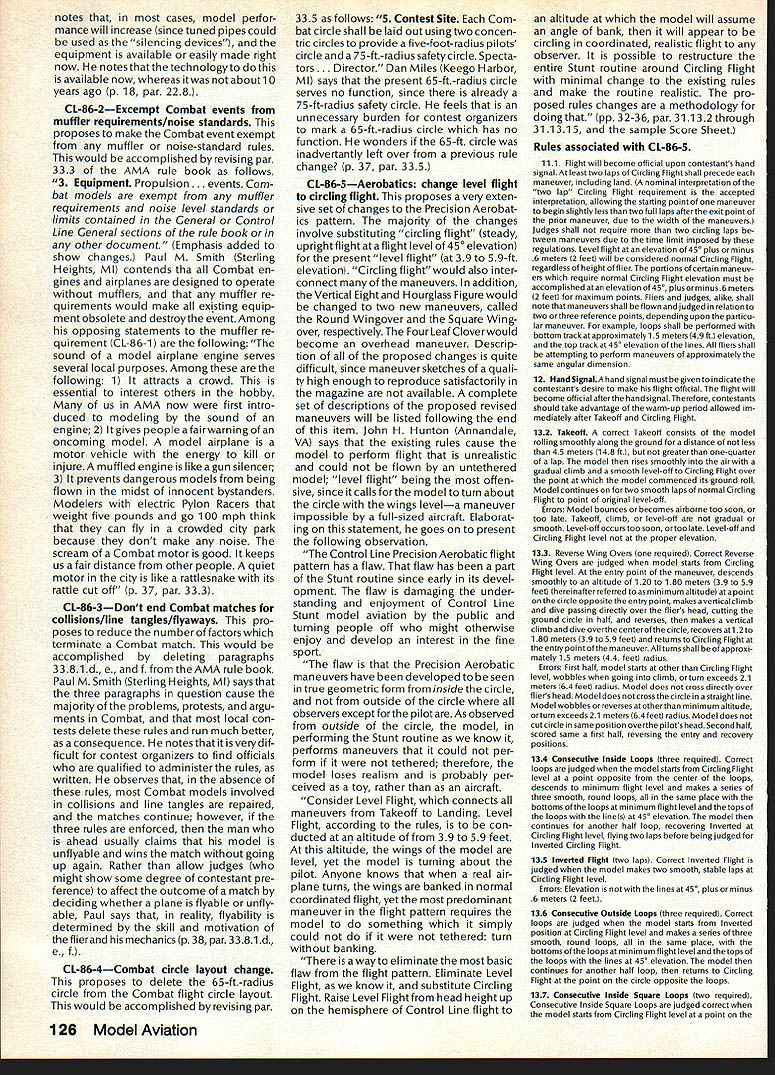
This proposes an extensive set of changes to the Precision Aerobatic pattern. The majority of the changes involve substituting "circling flight" (steady, upright flight at a flight level of roughly 45° elevation) for the present "level flight" (at 3.9 to 5.9 ft. elevation). "Circling flight" would also interconnect many of the maneuvers. In addition, the Vertical Eight and Hourglass Figure would be changed to two new maneuvers, called the Round Wingover and the Square Wingover, respectively. The Four Level Clover would become an overhead maneuver.
Description of all of the proposed changes is difficult to reproduce here without numerous sketches of adequate quality. A complete set of descriptions of the proposed revised maneuvers will be listed following the end of this item. John H. Hunton (Annandale, VA) says that the existing rules cause the model to perform flight that is unrealistic and could not be flown by an untethered model; "level flight" being the most offensive, since it calls for the model to turn about the circle with the wings level — a maneuver impossible by a full-sized aircraft. Elaborating:
"The Control Line Precision Aerobatic flight pattern has a flaw. That flaw has been a part of the Stunt routine since early in its development. The flaw is damaging the understanding and enjoyment of Control Line Stunt model aviation by the public and by young people who might otherwise develop an interest in the fine sport.
"The flaw is that the Precision Aerobatic maneuvers have been developed to be seen in true geometric form from inside the circle, and not from outside of the circle where all observers except for the pilot are. As observed from outside of the circle, the model, in performing the Stunt routine as we know it, performs maneuvers that it could not perform if it were not tethered; therefore, the model loses realism and is probably perceived as a toy, rather than as an aircraft.
"Consider Level Flight, which connects all maneuvers from Takeoff to Landing. Level Flight, according to the rules, is to be conducted at an altitude of from 3.9 to 5.9 feet. At this altitude, the wings of the model are level, yet the model is turning about the pilot. Anyone knows that when a real airplane turns, the wings are banked in normal coordinated flight, yet the most predominant maneuver from the flight pattern requires the model to do something which it simply could not do if it were not tethered: turn without banking.
"There is a way to eliminate the most basic flaw from the flight pattern. Eliminate Level Flight, as we know it, and substitute Circling Flight. Raise Level Flight from head height up on the hemisphere of Control Line flight to an altitude at which the model will assume an angle of bank, then it will appear to be circling in coordinated, realistic flight to any observer. It is possible to restructure the entire Stunt routine around Circling Flight with minimal change to the existing rules and make the routine realistic. The proposed rules changes are a methodology for doing that." (pp. 32–36, pars. 31.13.2, 31.13.15, and the sample Score Sheet.)
Rules associated with CL-86-5
- Flight will become official upon the contestant's hand signal. At least two laps of Circling Flight shall precede each maneuver, including Takeoff and Circling Flight. Judges will penalize contestants who do not complete the required number of Circling Flight laps before starting a maneuver. Some judges feel this is unnecessary and that the present rules providing for Line Up and the official start of a flight are adequate. Others contend that the proposed change makes the flight more realistic and provides a standard procedure for all contestants.
- Hand Signal.
A hand signal must be given to indicate the contestant's desire to make the flight official. The flight will become official after the hand signal. Contestants should take advantage of the warm-up period allowed by the present Level Flight and Circling Flight.
- Takeoff.
A correct takeoff consists of the model rolling along the ground for a distance of not less than 10 feet. The model must be airborne at the end of the takeoff roll and be in Circling Flight within a reasonable time. A takeoff which is too vertical, or which results in an immediate climb to a high altitude, will be penalized. Models taking off more smoothly and remaining at Circling Flight height will be given preference.
13.1. Reverse Wing Over (one required). Correct Reverse Wing Over is judged when the model commences its first Circling Flight lap. At the entry point of the maneuver, the model must begin a smooth reversal from an altitude of 1.20 to 1.80 meters (3.9 to 5.9 feet) and complete the reversal while maintaining a constant bank angle and not climbing or diving excessively. Recoveries are to be at 1.20 to 1.80 meters (3.9 to 5.9 feet) and returns to Circling Flight at the entry point of the maneuver. All turns shall be of approximately 1.5 meters (4.4 feet) radius.
13.2. Humpty Bump. Corrections or levels about the center of the figure should be executed and recovery must be in Circling Flight at the correct altitude.
13.3. Consecutive Inside Loops (three required). Correct Inside Loops are judged when the model starts from Circling Flight level, completes the loops in the same place, and returns to Circling Flight. The model should maintain the proper entry and exit altitude and present as smooth a series of loops as possible.
13.4. Consecutive Outside Loops (three required). Correct Outside Loops are judged when the model starts from Circling Flight level, executes the loops over the top of the circle, and returns to Circling Flight at the end point of the circles.
13.5. Inverted Flight (two laps). Correct Inverted Flight is judged when the model makes two smooth, stable laps at the proper altitude, maintaining heading and bank appropriate to controlled inverted flight.
13.6. Consecutive Outside Loops (three required). Consecutive Outside Loops are judged when the model starts from Circling Flight level at an entry point, completes three loops and returns to Circling Flight at the exit point.
13.7. Consecutive Inside Square Loops (two required). Consecutive Inside Square Loops are judged correct when the model starts from Circling Flight level at a point on the circle opposite the loops and completes the square loops with the model returning to Circling Flight level at a point on the circle opposite the loops.
13.8. Consecutive Outside Square Loops (two required). Consecutive Outside Square Loops are judged correct when the model starts from Circling Flight at 45° elevation and flies a square course consisting of two segments at minimum flight level and top segments at 45° elevation. The two bottom corners are equal, and so are the two top corners. The maneuver begins and ends with the model in Circling Flight at the point of start of the first turn.
13.9. Consecutive Inside Triangular Loops (two required). Correct Triangular Loops are judged when the model starts from Circling Flight level at a point opposite the loops and descends smoothly to fly a triangular course, starting and ending with the base. The three sides must be of equal length and the three corner angles of equal size. The top corner is to be placed at 45° elevation. The second Triangular Loop must be flown in the same flight path as the first. All corners must be smooth, precise, and of approximately 1.5 meters (4.9 feet) radius. After exiting the final bottom loop the model climbs back to Circling Flight elevation at a point opposite from the loops.
13.10. Horizontal Eights (two required). Horizontal Eights are to be entered and completed at the top of the Outside Loop figure. The model must dive vertically and then perform the Inside Loop. Correct Eights are judged when the model makes two Eights, each consisting of two round circles of the same size, tangent to each other and in a horizontal line. The model must enter the Eight from Circling Flight level and return to Circling Flight level at the top of the Outside Loop figure. The top of the Eights is at the 45° elevation point; the bottoms of the circles are at minimum flight height. Loops should be symmetrical.
Errors: Model is not vertical at the center of the figure. Tops of circles are not within 0.6 meter (2 feet) of 45° elevation. Bottoms of circles are not within 1.2–1.8 meters (4–6 feet) height. Loops are not round and equal in size. Point of intersection varies. Second Eight is not in the same position as the first.
13.11. Square Horizontal Eights (two required). The Eights are to be entered at the top of the Outside Loop at Circling Flight level, and after completion of two Eights exit is made in the same direction. The Inside Loop must be flown first. Correct Eights are judged when the model starts from the top of the Outside Loop, completes square-shaped Eights with vertical climbs and dives, and returns to Circling Flight in the same direction.
13.12. Round Wing Over (two required). At a point on the circle opposite the center of the maneuver the model descends smoothly to minimum height at the center of the rounded area and performs a 1/4 Inside Loop, continuing over the pilot's head to a 3/4 Outside Loop with the bottom of the loop inverted and at minimum height, over the pilot's head to an Inside Loop, repeating the maneuver to a final V inside loop, exiting, then climbing smoothly back to Circling Flight.
Maximum 40 points, minimum 10 points. Errors: Entry and bottoms of partial loops are not at minimum height. Partial loops are not round and equal in size. Point of intersection is not directly over the pilot's head. Second Wing Over is not in the same position as the first.
13.13. Square Wing Over (one required). At a point on the circle opposite the center of the maneuver the model descends smoothly from Circling Flight to minimum height at the entrance to the bottom leg of the figure, the width of the bottom leg being equal to the bottom leg of the Square Loop, with turns of approximately 1.5 meters (4.9 feet) radius and vertical climbs and dives directly over the head of the pilot to complete the initial leg, then climbing back to Circling Flight.
Maximum 40 points, minimum 10 points. Errors: Entry and bottoms of figure are not at minimum height. Figure is not equal on each leg. Point of intersection is not directly over the pilot's head. Second Eight is not in the same position as the first.
The Score Sheet (p. 36) would have to be modified to agree with these proposed maneuvers.
Transcribed from original scans by AI. Minor OCR errors may remain.

