
Competition Newsletter
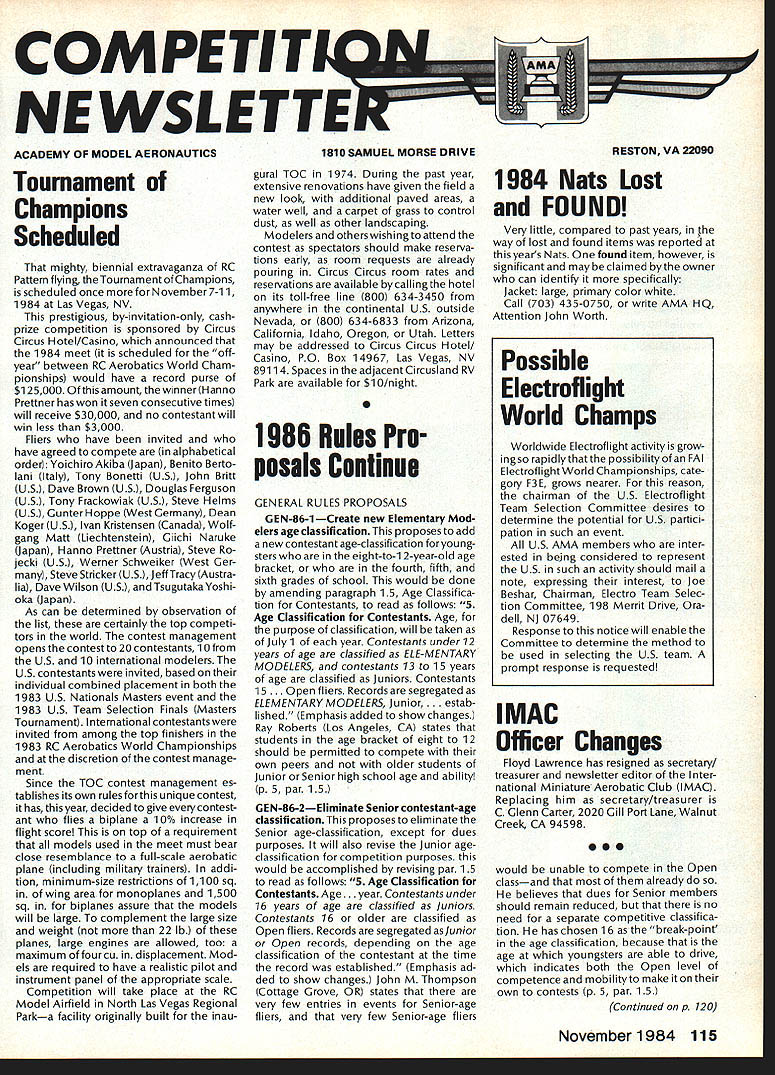
Tournament of Champions Scheduled
The mighty biennial extravaganza of RC pattern flying, the Tournament of Champions, is scheduled for November 7–11, 1984, in Las Vegas, NV. This prestigious, by-invitation-only, cash-prize competition is sponsored by the Circus Circus Hotel/Casino. Scheduled in the off-year between RC Aerobatics World Championships, the 1984 meet will feature a record purse of $125,000. The winner, Hanno Prettner (who has won seven consecutive times), will receive $30,000; no contestant will win less than $3,000.
Fliers invited and who have agreed to compete (alphabetical order):
- Yoichiro Akiba (Japan)
- Benito Bertolani (Italy)
- Tony Bonetti (U.S.)
- John Britt (U.S.)
- Dave Brown (U.S.)
- Douglas Ferguson (U.S.)
- Tony Frackowiak (U.S.)
- Steve Helms (U.S.)
- Gunter Hoppe (West Germany)
- Dean Koger (U.S.)
- Ivan Kristensen (Canada)
- Wolfgang Matt (Liechtenstein)
- Giichi Naruke (Japan)
- Hanno Prettner (Austria)
- Steve Rojecki (U.S.)
- Werner Schweiker (West Germany)
- Steve Stricker (U.S.)
- Jeff Tracy (Australia)
- Dave Wilson (U.S.)
- Tsugutaka Yoshioka (Japan)
Contest management opens the contest to 20 contestants (10 U.S., 10 international). U.S. contestants were invited based on their combined placement in the 1983 U.S. Nationals Masters event and the 1983 U.S. Team Selection Finals (Masters Tournament). International contestants were invited from among top finishers in the 1983 RC Aerobatics World Championships and at the discretion of contest management.
This year the TOC contest management decided to award a 10% increase in flight score to every contestant who flies a biplane. Models used in the meet must closely resemble a full-scale aerobatic plane (including military trainers). Minimum-size restrictions require 1,100 sq. in. of wing area for monoplanes and 1,500 sq. in. for biplanes to ensure large models. Maximum weight is 22 lb. Large engines are permitted up to a maximum displacement of four cu. in. Models are also required to have a realistic pilot and instrument panel of appropriate scale.
Competition will take place at the RC Model Airfield in North Las Vegas Regional Park, a facility originally built for the inaugural TOC in 1974. Recent renovations include additional paved areas, a water well, grass to control dust, and other landscaping improvements.
Modelers and spectators should make reservations early. Circus Circus room rates and reservations are available by calling toll-free 800-634-3450 (continental U.S.); outside Nevada call 800-634-6833. Mail: Circus Circus Hotel & Casino, P.O. Box 14967, Las Vegas, NV 89114. Spaces in the adjacent Circusland RV Park are available for $10/night.
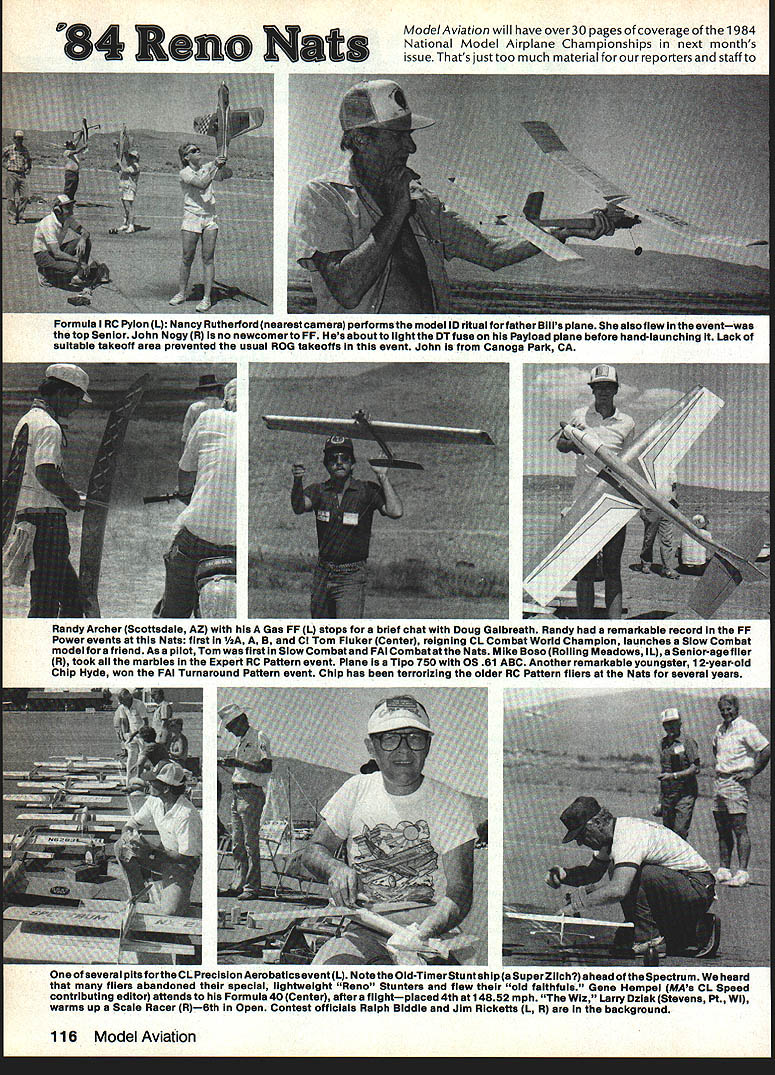
'84 Reno Nats
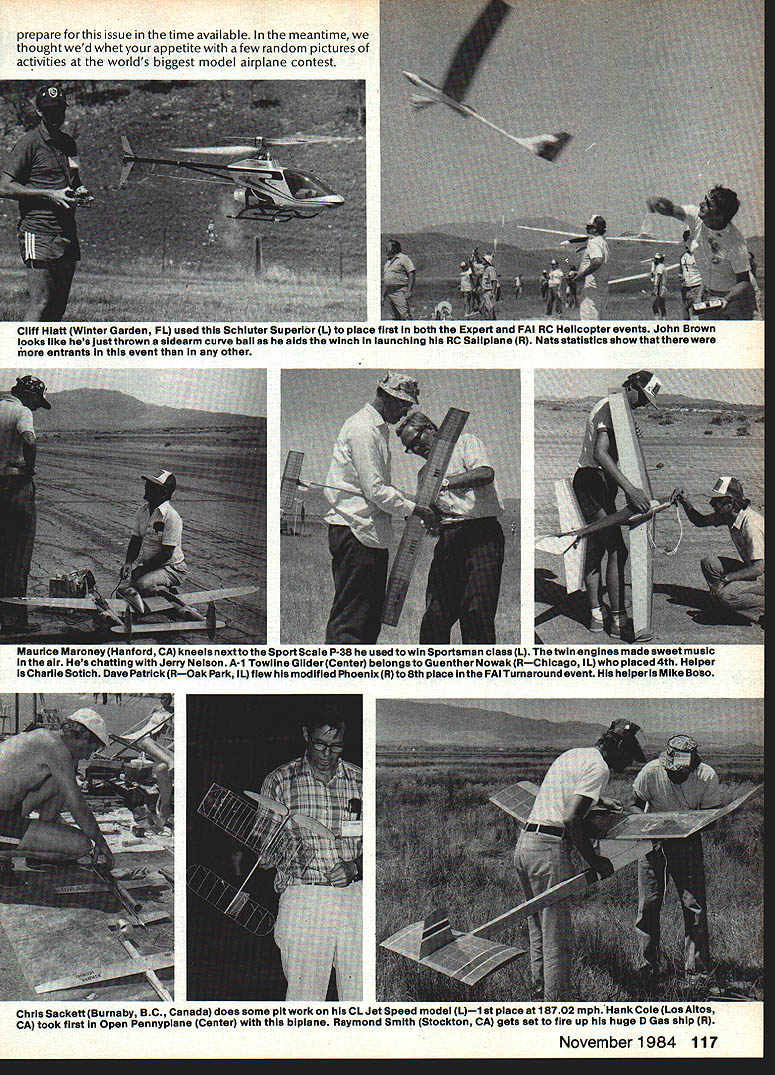
Model Aviation will have over 30 pages of coverage of the 1984 National Model Airplane Championships in next month's issue.
Photo captions and notes from the Nats:
- Formula I RC Pylon: Nancy Rutherford (nearest camera) performs the model ID ritual for her father Bill's plane. She also flew in the event and was the top Senior. John Nogy (right) is preparing to hand-launch his Payload plane; lack of suitable takeoff area prevented the usual ROG takeoffs. John is from Canoga Park, CA.
- Randy Archer (Scottsdale, AZ) with his A Gas free flight model stops for a brief chat with Doug Galbreath. Randy placed first in 1/2A, A, B, and C FF power events at this Nats.
- Tom Fluker, reigning CL Combat World Champion, launches a Slow Combat model for a friend. Tom placed first in Slow Combat and FAI Combat at the Nats.
- Mike Boso (Rolling Meadows, IL), a Senior-age flier, won the Expert RC Pattern event with a Tipo 750 powered by an OS .61 ABC.
- 12-year-old Chip Hyde won the FAI Turnaround Pattern event; he has been highly competitive with older RC Pattern fliers at the Nats.
- CL Precision Aerobatics pits: note the Old-Timer Stunt ship ahead of the Spectrum. Many fliers flew their reliable "old faithfuls" rather than ultralight "Reno" stunters.
- Gene Hempel (MA's CL Speed contributing editor) attends to his Formula 40, which placed 4th at 148.52 mph.
- Larry Dziak (Stevens, Pa., WI), "The Wiz," warms up a Scale Racer—6th in Open.
- Contest officials Ralph Biddle and Jim Ricketts are pictured in the background.
1986 Rules Proposals Continue
General Rules Proposals
- GEN-86-1 — Create new Elementary Modelers age classification
Proposes adding a new contestant age classification for youngsters 8–12 years old (fourth–sixth grades). Amend paragraph 15, Age Classification — Contestants, to read:
- Age Classification — Contestants' age, for purposes of classification, will be taken as of July 1 of the year. Contestants under 12 years of age classified ELEMENTARY MODELERS. Contestants 13–15 years of age classified Juniors. Contestants 16 and over classified Open fliers. Records segregated as ELEMENTARY, JUNIOR and OPEN records, depending on the age classification of the contestant at the time the record was established.
Ray Roberts (Los Angeles, CA) states students in the 8–12 bracket should compete with their peers rather than older students.
- GEN-86-2 — Eliminate Senior contestant-age classification
Proposes eliminating the Senior age classification except for dues purposes and revising the Junior age classification for competition. Revise paragraph 15 to read:
- Age Classification — Contestants' age, for purposes of classification, will be taken as of July 1 of the year. Contestants under 16 years of age classified Juniors. Contestants 16 and over classified Open fliers. Records segregated as Junior and Open records depending on the age classification of the contestant at the time the record was established.
John M. Thompson (Cottage Grove, OR) states... [text truncated]
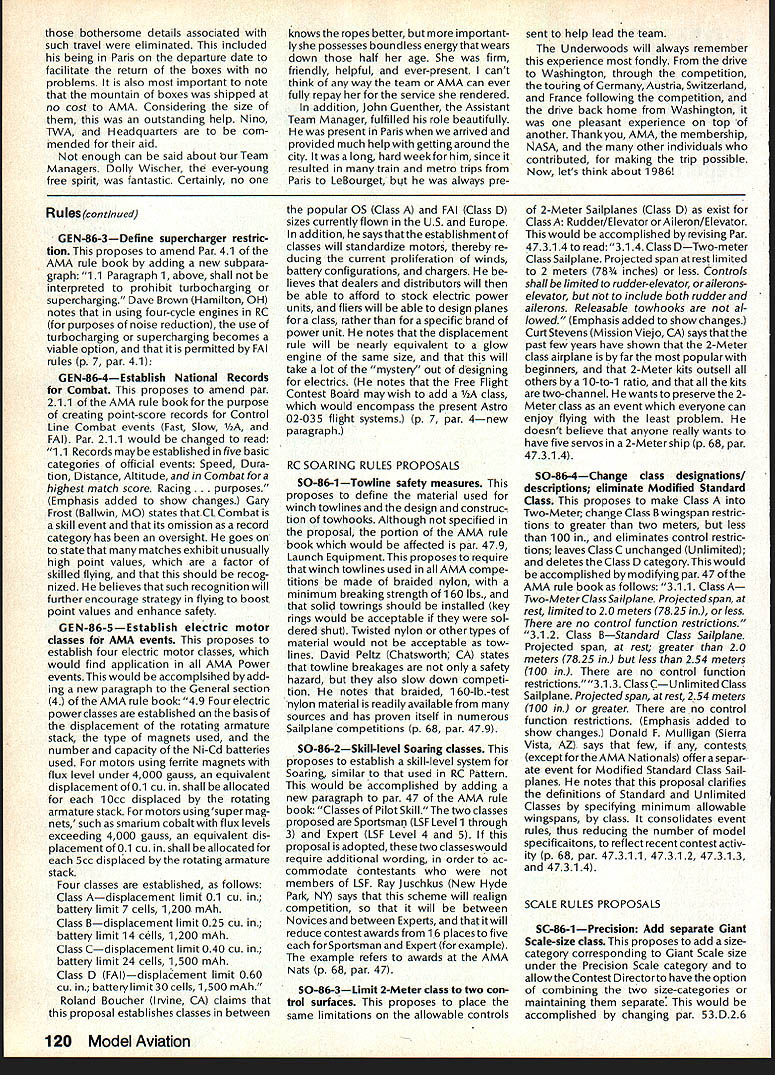
- GEN-86-3 — Define supercharger restriction
Proposes to amend Par. 4.1 by adding: "4.1 Paragraph 1, above, shall not be interpreted to prohibit turbocharging or supercharging." Dave Brown (Hamilton, OH) notes that with four-cycle engines used for noise reduction, turbocharging or supercharging is a viable option and is permitted by FAI rules.
- GEN-86-4 — Establish National Records for Combat
Proposes amending par. 2.1.1 to create point-score records for Control Line Combat events (Fast, Slow, 1/2A, and FAI). Change would allow records in Speed, Duration, Distance, Altitude, and Combat (highest match score). Gary Frost (Ballwin, MO) argues C/L Combat is a skill event and should be recognized with records to encourage strategy and safety.
- GEN-86-5 — Establish electric motor classes for AMA events
Proposes establishing four electric power classes applicable to all AMA Power events by adding a new paragraph: "9. Four electric power classes are established on the basis of the displacement of the rotating armature stack, the type of magnets used, and the number and capacity of the Ni-Cd batteries used. For motors using ferrite magnets with flux level under 4,000 gauss, an equivalent displacement of 0.1 cu. in. shall be allocated for each 10 cc displaced by the rotating armature stack. For motors using super magnets, such as samarium-cobalt with flux levels exceeding 4,000 gauss, an equivalent displacement of 0.1 cu. in. shall be allocated for each 5 cc displaced by the rotating armature stack." Four classes proposed:
- Class A — displacement limit 0.1 cu. in.; battery limit 7 cells, 1,200 mAh.
- Class B — displacement limit 0.25 cu. in.; battery limit 14 cells, 1,200 mAh.
- Class C — displacement limit 0.40 cu. in.; battery limit 24 cells, 1,500 mAh.
- Class D (FAI) — displacement limit 0.60 cu. in.; battery limit 30 cells, 1,500 mAh.
Roland Boucher (Irvine, CA) says this standardizes classes between popular sizes and will reduce proliferation of custom winders and battery configurations, helping dealers stock equipment and enabling fliers to design to class standards.
RC Soaring Rules Proposals
- SO-86-1 — Towline safety measures
Proposes defining winch towline material and towhook construction (affects par. 47.9, Launch Equipment). Requires braided nylon towlines with minimum breaking strength of 160 lb and solid towrings (soldered key rings acceptable). Twisted nylon or other materials would be unacceptable. David Peltz (Chatsworth, CA) notes braided 160-lb nylon is widely available and has proven reliable.
- SO-86-2 — Skill-level Soaring classes
Proposes establishing pilot skill classes for Soaring similar to RC Pattern: Sportsman (LSF Level 1–3) and Expert (LSF Level 4–5). Add a "Classes of Pilot Skill" paragraph to par. 47. Ray Jusuchkus (New Hyde Park, NY) believes this will realign competition and allow more appropriate award structures (e.g., fewer award places per class at nationals).
- SO-86-3 — Limit 2-Meter class to two-control surfaces
Proposes restricting 2-Meter Sailplanes (Class D) to two-control surfaces: rudder/elevator or aileron/elevator (not both). Revise par. 47.3.1.4 to read: "Class D — Two-meter Class Sailplane. Projected span at rest limited to 2 meters (78.74 in.) or less. Controls shall be limited to rudder-elevator, or aileron-elevator, but not include both rudder and ailerons. Releasable towhooks are permitted." Curt Stevens (Mission Viejo, CA) argues this preserves accessibility for beginners and reflects market kit trends.
- SO-86-4 — Change class designations/descriptions; eliminate Modified Standard Class
Proposes making Class A into Two-Meter; set Class B wingspan to greater than two meters but less than 100 in. and eliminate control restrictions for that class; leave Class C (Unlimited) unchanged; delete Class D. Modifications would apply to par. 47.
Scale Rules Proposals
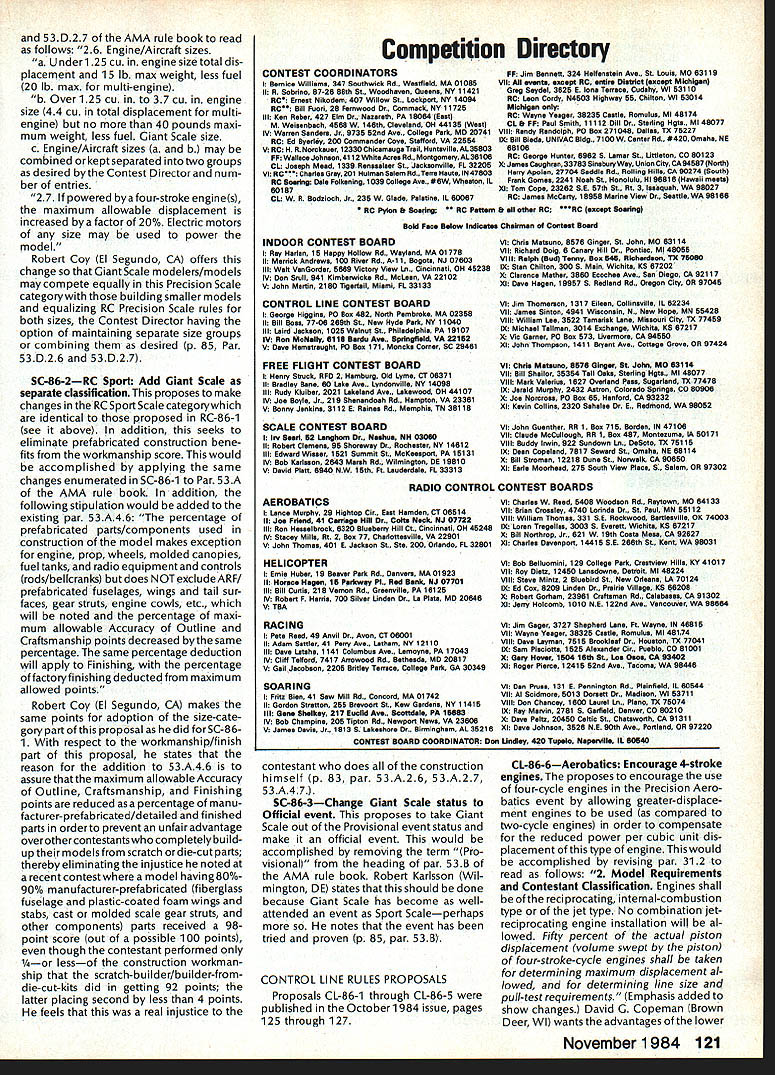
- SC-86-1 — Precision: Add separate Giant Scale-size class
Proposes adding a Giant Scale size category in addition to existing scale size categories and limiting the Precision Scale category to existing classes by changing par. 53.D.2.6 and the Contest Director's interpretations.
- SC-86-2 — RC Sport: Add Giant Scale as separate classification
Proposes changes identical to SC-86-1 for RC Sport Scale (par. 53.A) and seeks to eliminate prefabricated construction benefits from the workmanship score. Adds to par. 53.A.4.6 a stipulation that engine, prop, wheels, molded canopy pieces, fuel tanks, and radio equipment are excepted from prefabrication penalties, but ARF/prefabricated fuselages, wings, tails, gear struts, engine cowlings, etc., will be noted and the maximum allowable Accuracy of Outline, Craftsmanship, and Finishing points reduced proportionally to the percentage of prefabricated parts. Robert Coy (El Segundo, CA) argues this prevents unfair advantage for near-complete factory-built models receiving high workmanship scores against scratch-built models.
- SC-86-3 — Change Giant Scale status to Official event
Proposes removing the "Provisional" status from Giant Scale (par. 53.B) and making it an official event. Robert Karlsson (Wilmington, DE) argues Giant Scale attendance justifies official status.
Control Line Rules Proposals
- Proposals CL-86-1 through CL-86-5 were published in the October 1984 issue (pages 125–127).
Transcribed from original scans by AI. Minor OCR errors may remain.

