
COMPETITION NEWSLETTER
Academy of Model Aeronautics 1810 Samuel Morse Drive Reston, VA 22090 USA
U.S. Sweeps Indoor World Champs!
Preliminary results of the 1984 Indoor World Championships (FAI class F1D), Nagoya, Japan — received at press time by telephone from World Champion Jim Richmond.
Individual Results
- 1. J. Richmond (U.S.A.)
- 2. C. Banks (U.S.A.)
- 3. R. Randolph (U.S.A.)
- 4. Pentti Nore (Finland)
- 5. Bailey (U.K.)
Team Standing
- 1. U.S.A.
- 2. Poland
- 3. Switzerland
This 1–2–3 finish is the sixth time U.S. teams have swept the top three places at World Championships. Previous sweeps:
- 1966 — CL Speed (England)
- 1968 — CL Speed (Finland)
- 1974 — RC Scale (Lakehurst, NJ)
- 1976 — CL Aerobatics (Netherlands)
- 1980 — CL Aerobatics (Poland)
RC Aerobatics Team Selection Program — Revised
A recent vote by the RC Aerobatics Team Selection Committee (8 yes, 2 no) has extended the deadline for entry into the program until March 1, 1985.
Modelers desiring to enter the team selection program may do so by sending the $15 program entry fee to Micheline Madison at AMA Headquarters. All entry fees will go into the F3A team fund. One—and only one—contest that was entered prior to joining the team selection program may be counted toward qualifying for the Masters Tournament.
Masters Tournament — Summarized
Contestants may qualify to enter the Masters Tournament by any one of the following methods:
- Enter and make at least one official flight in the Masters or FAI Turnaround event in five AMA contests between March 1, 1984 and March 1, 1985.
- Finish in the upper 50% of the Masters or FAI Turnaround event in at least two AMA contests between March 1, 1984 and March 1, 1985.
- Finish in the upper 50% of the Masters or FAI Turnaround event at the 1984 AMA Nationals.
RC Aerobatics Team — Last Call for Finals Site Bids
No offers were received in response to the notice in the October 1984 issue of Model Aviation. Time is short — action is needed now.
Clubs interested in hosting the 1985 RC Masters Team Selection Finals should document their offers in writing and send them to AMA Headquarters (Attn: Micheline Madison) by January 1, 1985. The Finals will be held during a three-day period in late June/early July 1985. Selection of the site will be made from among the bids by a vote of the program finalists sometime after February 1, 1985. The winning site will be announced as soon as possible thereafter.
A well-prepared bid should include:
- Adequacy of the flying site (size, surface, orientation with respect to the sun, parking, spectator control, etc.)
- Preferred dates (desired weekends: June 21–23 or June 28–30, 1985)
- Weather statistics
- Club personnel available to act as assistants (at least a dozen will be required)
- Contest equipment available (tents, rope barriers, etc.)
- Community backing and publicity plans
- Nearby housing for entrants, judges, and out-of-town officials
- Any other “plus” factors
The judges, contest jury, and contest manager will coordinate with local officials regarding assignment of personnel and other contest needs.
Attention All RC Fliers
AMA President John C. Grigg directs the following message to be publicized in the Competition Newsletter at the earliest possible date:
We live by many laws in this country, whether we agree with them or not. The Federal Communications Commission (FCC) is the rules-making body of the Federal Government, granted the power to make and enforce rules through an act of Congress. The rules they lay down for operation of radio-transmitting devices must be followed under penalty of law; the use of radio transmitters on frequencies not permitted for a specific application is a violation of that law.
We have been granted license-free use of specific radio-transmission frequencies for control of model aircraft by the FCC. The use of any other than those specific frequencies is a violation of law unless you hold a valid license issued by the FCC to operate on such other frequency. Part of the response to our request and plea was the very good record of modelers following the rules. We have recently had attention brought to the fact that a few people feel they can operate outside the allotted frequencies and punitive action is being taken by the law.
I hereby direct that any Event Director or Club Safety Officer who finds a member of AMA operating a radio transmitter on other than a legitimate radio frequency, as established by the FCC, has the authority to eject that individual from the event or flying field, and should report the same in writing to AMA Headquarters for possible further action. Further, the same action may be taken against anyone using a radio transmitter on the legitimate frequencies when such transmitter does not bear the FCC-required type-acceptance certification.
I urge all Contest Directors, Club Safety Officers, and club officers to diligently apply this ruling in the best interest of all modelers.
RC Helicopter “Weighted Blades” Emergency Rule Rescinded
Information concerning this RC Helicopter Emergency Safety Proposal was published in the September 1984 issue (page 117). The RC Helicopter Contest Board voted not to ratify this Immediate Enforcement rule by a vote of four in favor, six against. As a consequence, the proposed rule is no longer in effect.
Summary of the proposed rule (now rescinded):
- It had prohibited the use of metal or knife-edged rotor blades (both main rotor and tail rotor) on model RC helicopters.
- It also prohibited the use of metal in rotor blades at any point more than two inches beyond the blade root attachment point.
Corrected Nats Results: Unlimited RC Sailplane — Senior Class
AMA Headquarters completed a 100% survey of all 1984 Nats RC Sailplane official flight records to verify the field-tabulated score cards. In the process it was discovered that the previously published results (December 1984 issue) for Senior Unlimited Sailplane were in error. The complete, corrected results:
Points
- 1. Alex Bereczky, Anaheim, CA — 3968
- 2. Mike Garton, Muscatine, TX — 3825
- 3. Brian Richard, Lancaster, CA — 3403
- 4. David Pugh, Kent, WA — 3357
- 5. Jim M. Brandon, Anaheim, CA — 3272
- 6. Ken Becker, Pleasanton, CA — 2720
- 7. Ron Collins, Fresno, CA — 2650
- 8. Shawn Lenci, Escalon, CA — 2433
Trophies were awarded through third place.
More 1984 Nats Results — RC FAI Sailplanes
Final Overall Standings
- 1. Scott Christensen, Buffalo Grove, IL — 5432
- 2. Terry Edmondson, Iowa City, IA — 5362
- 3. Robert Guzman, Mexico DF, Mexico — 4671
- 4. Leigh Hodgdon, Cupertino, CA — 4561
- 5. Earl Levin, Sunnyvale, CA — 4086
- 6. Greg Cole, Grand Forks, ND — 3757
- 7. Jorge Guzman, Mexico DF, Mexico — 3643
(Information obtained from Jim Scarborough, as reported to him by Dave Peltz.)
They Served With Pride . . . (1984 Control Line World Championships)
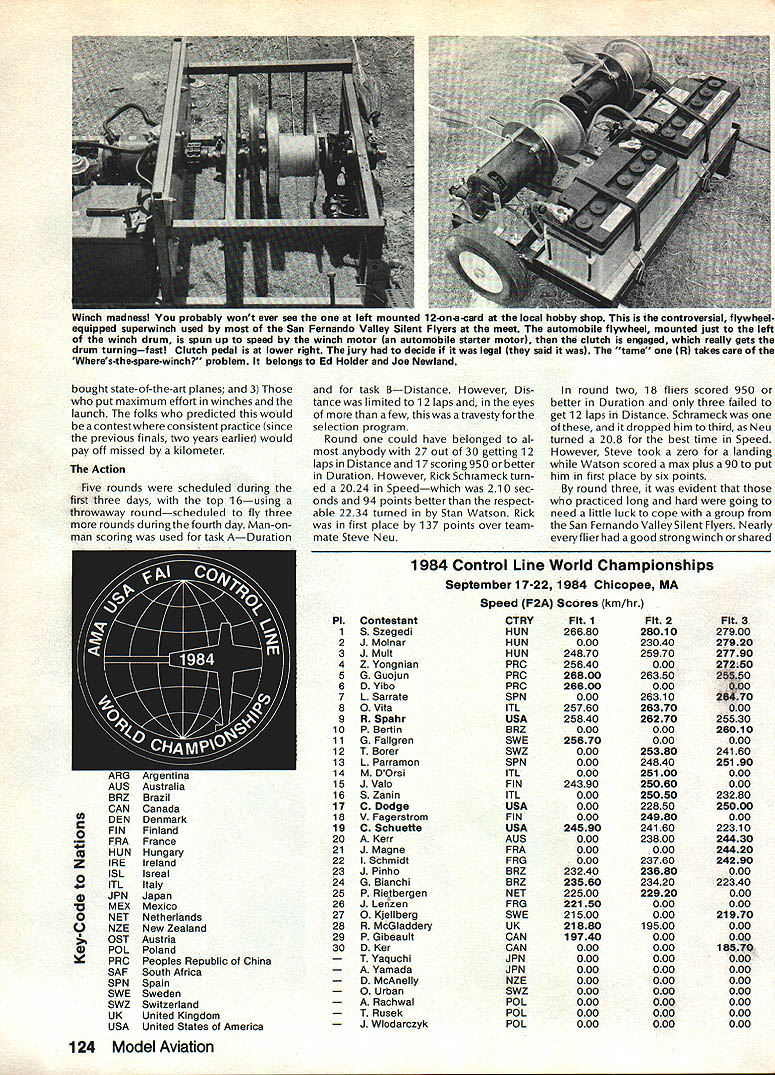
The 1984 Control Line World Championships in the United States provided an opportunity for our FAI teams and supporters to repay the international hosts of past years and to demonstrate that AMA can organize and run this four-category event.
Traditionally, a bid to host World Championships starts locally. For CL, with its four separate events and the scale of the U.S., no single local source could do the whole job. Instead, officials and workers rallied nationally and worked together.
Credit goes to many who gave of themselves: Dr. Laird Jackson (served on the FAI jury and carried the proposal from concept to reality), AMA HQ’s Vince Mankowski (Contest Director), and a top-notch team of event officials from all over the country.
Event highlights and officials:
- F2A Speed: Directed by Gene Hempel (TX); officials included Frank Garzon, Bob Lieber, Bill Wisniewski, Glenn Lee, Al Stegnes, Cliff Norman, Charlie Davis, and others. Flights ran on a six-minute schedule.
- F2B Aerobatics: Directed by Art Adamisin (MI); assistant director George Higgins; recorder Bill Zimmer; other officials and tabulators included Tom Dixon, Marie Adamisin, Jim Renkar, Terry Meredith, Karen Meredith, Doris Zimmer, Dava Maddox, Betty Adamisin, and Karen Meador.
- F2C Team Race: Directed by Bill Wright (MO) with Jim Dunkin as circle marshal; core officials included Vic Garner, Herb Stockton, Phil and Jeff Johnson, Bev Wisniewski, Ralph Biddle, and local/New England-area workers; also Conrad Cloete (South Africa).
- F2D Combat: Directed by Phil Carter (PA) with Mack Henry (TN) as circle marshal; crew included Gary and Sandy Frost, Scott Schmidt, Bill Harris, Danny Hay, Gary Arnold, Steve Sacco, Bill Gimmy, Gil Reedy, and others.
Other contributors: Eva Biddle, Bob Landry, Ed and Louise Izzo, John Byrne, and eight AMA HQ employees who even cleaned the site of trash after the meet. FAI officials included Don Jehlick (F2C), Keith Trostle (F2B), and Rich Lopez (F2D).
To run the world's most important Control Line contest means striving to make it the best contest — and we had the best people.
Free Flight Team Finals
Report by John Lenderman — Photos by the author
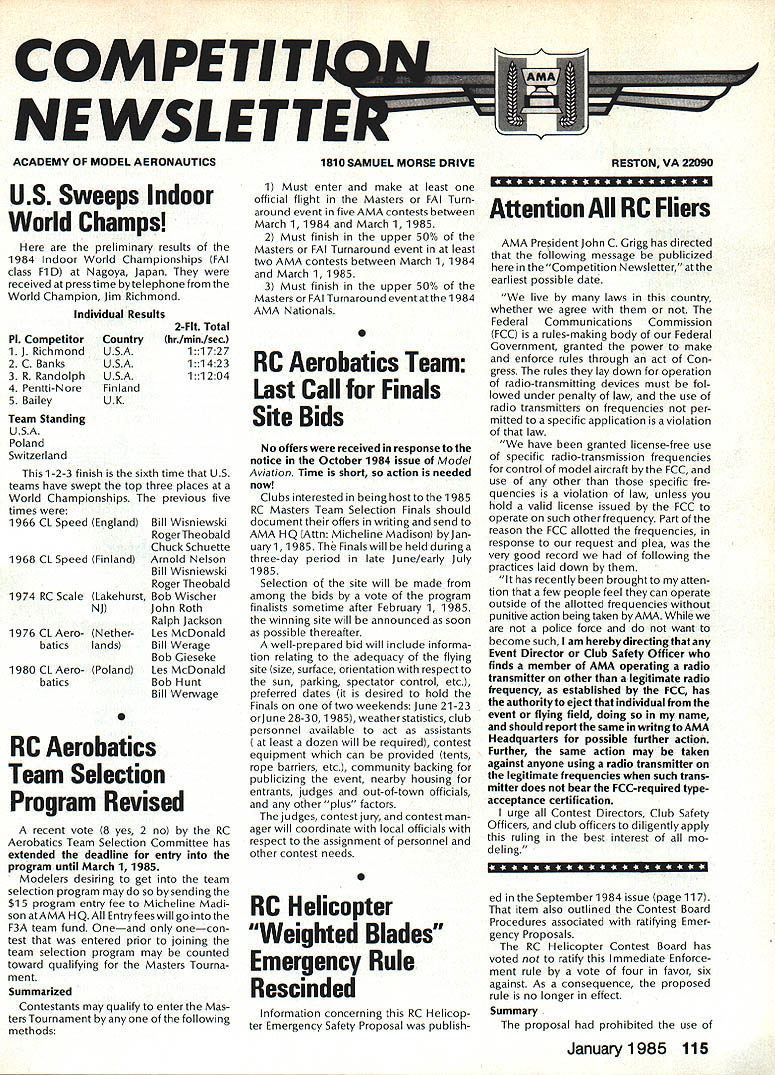
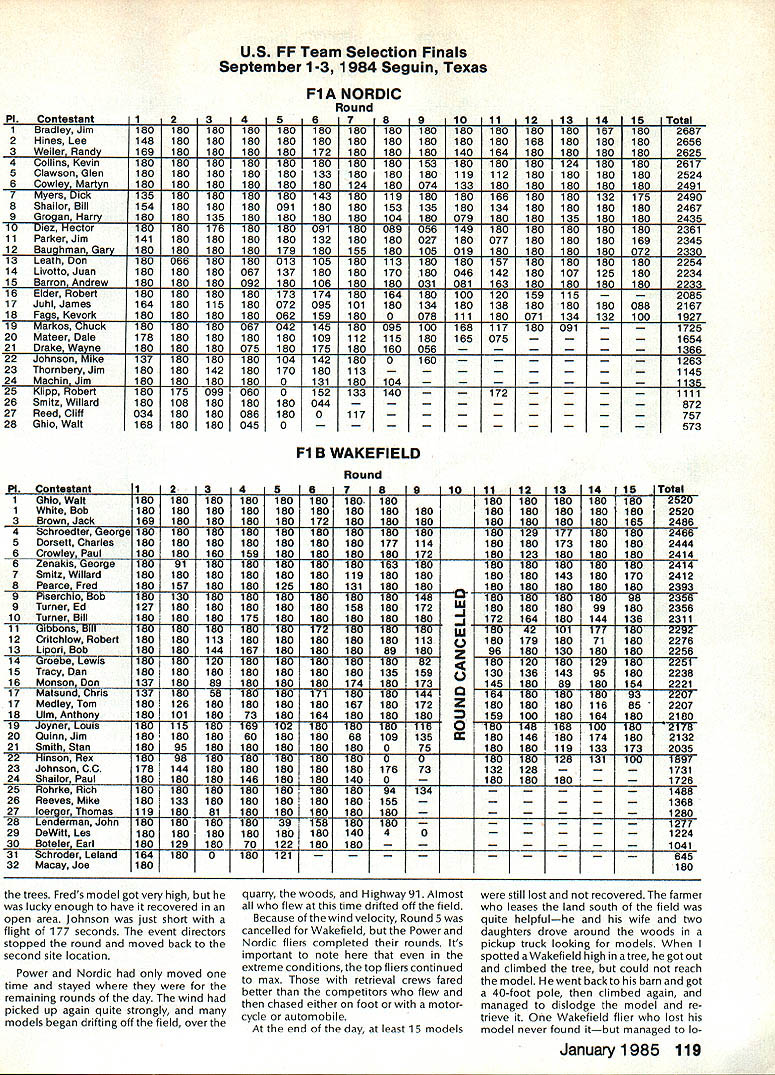
Labor Day Weekend at Seguin, Texas: Many of the U.S.A.’s best Free Flight activity took place as modelers sought to fill nine slots on the U.S. Free Flight team for the 1985 World Championships in Yugoslavia.
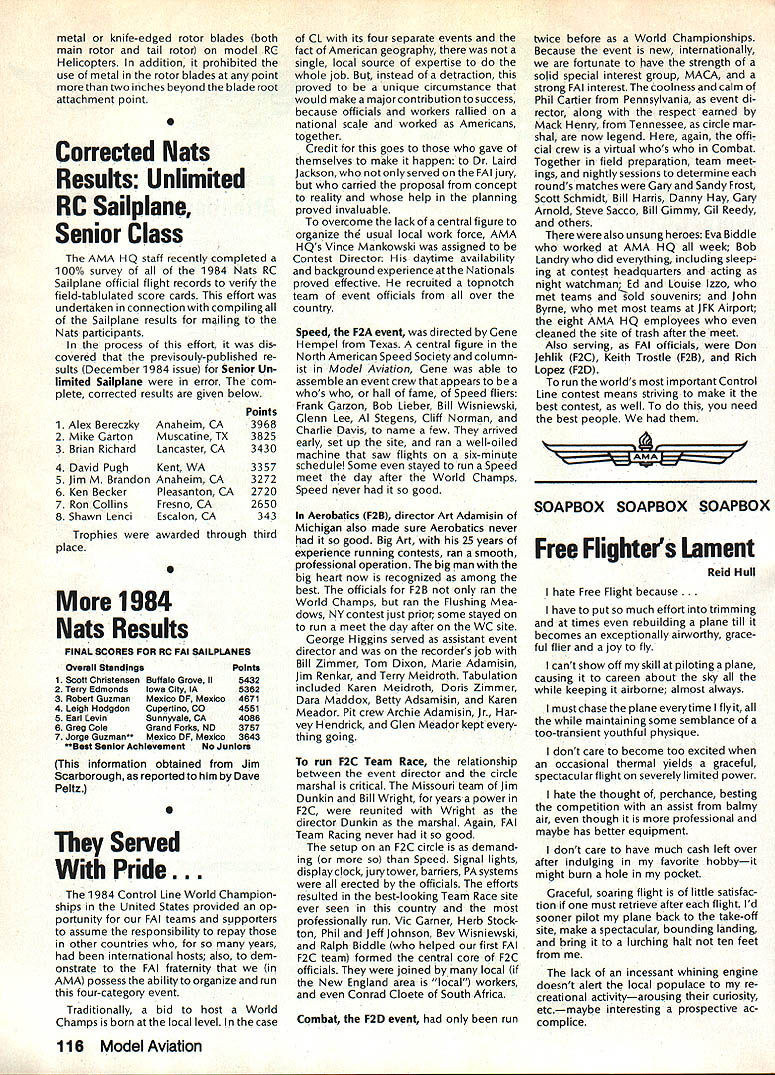
Most finalists arrived Wednesday, inspected the field, prepared models, and socialized. The field was adequate provided wind came from the north or south and was not excessively strong. Practice showed high-quality flying and well-trimmed models; only one model had serious glide trouble in practice.
Terminology used in this report: “Nordic” (F1A), “Wakefield” (F1B), and “Power” (F1C).
Observations and equipment:
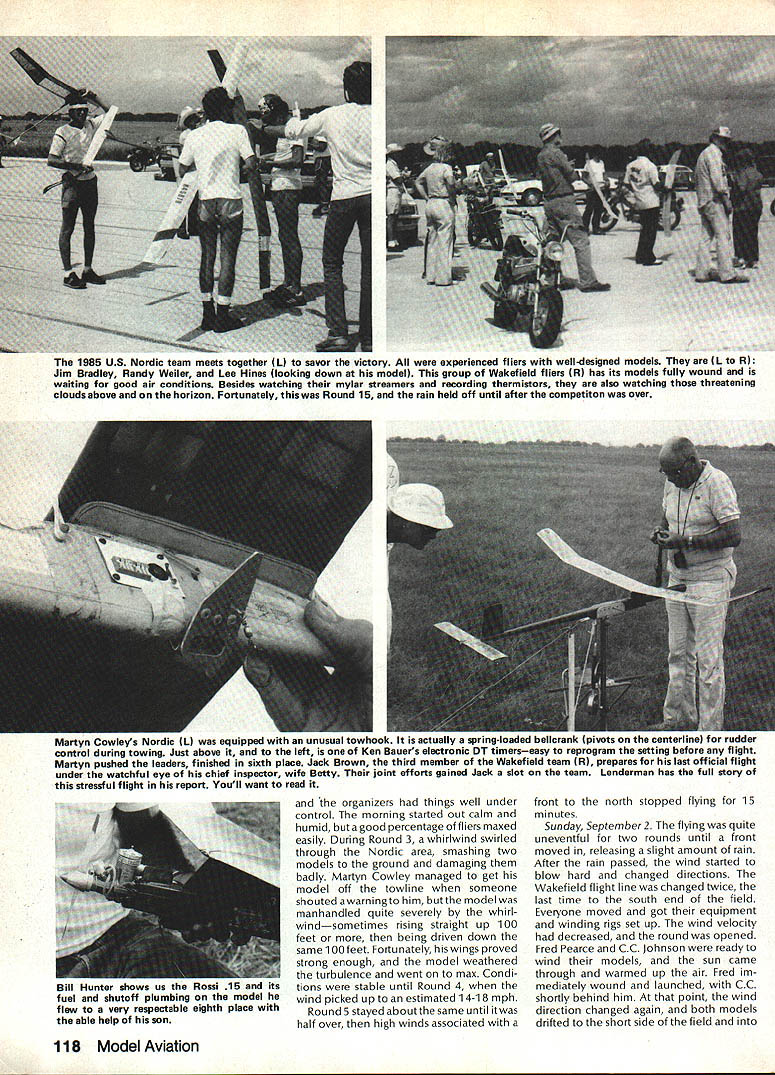
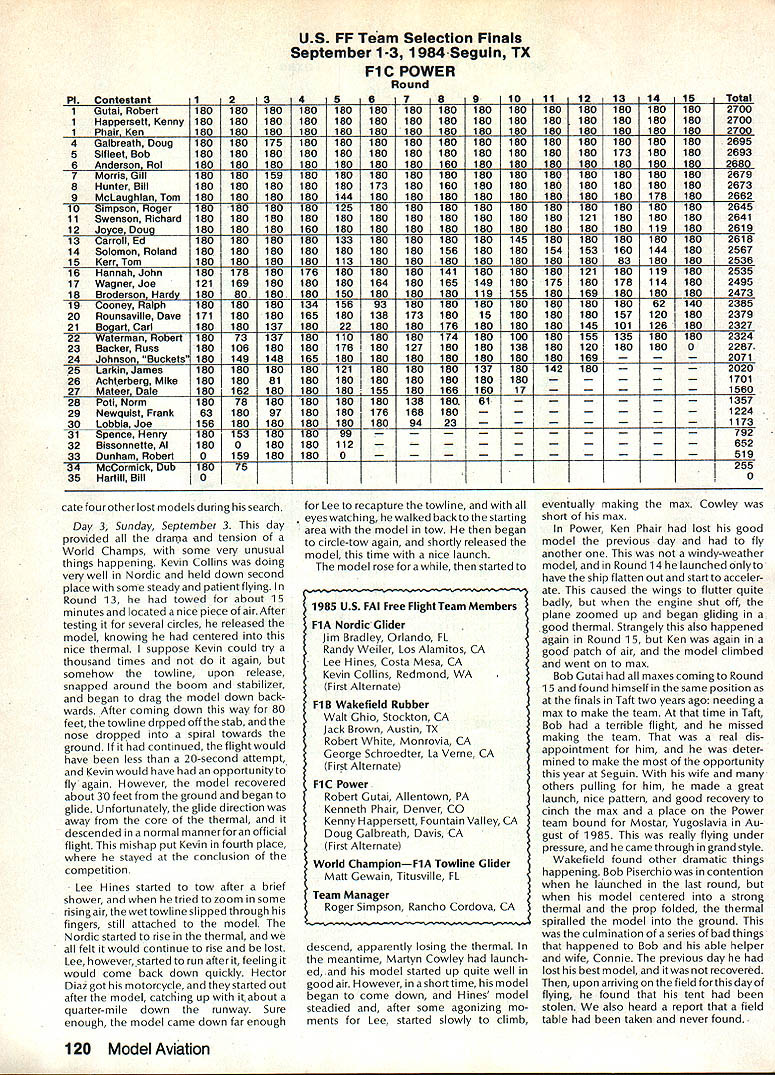
- Power: Predominant engines included K&B, Cox, Rossi, and Nelson. About 25% used folding props. Ken Happersett had wings covered with very thin aluminum sheet (.00125 thick) used for helicopter blades. Most Power ships were well finished with attention to detail.
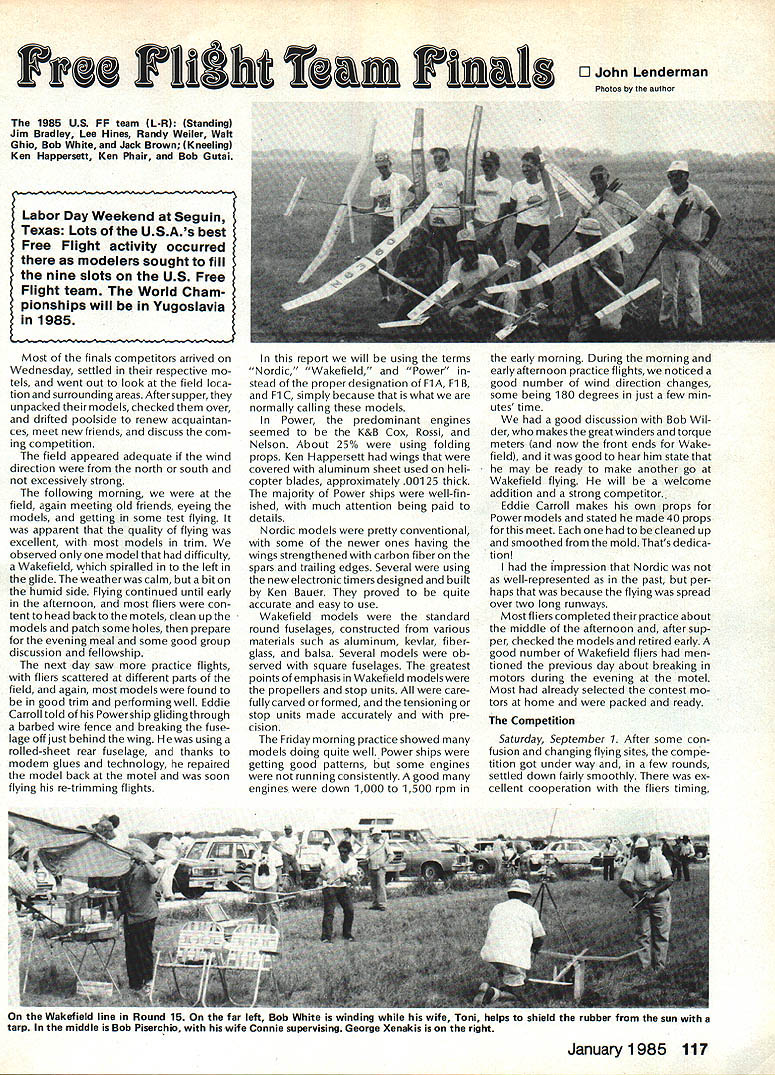
- Nordic: Conventional designs; some used carbon-fiber reinforcement on spars and trailing edges. Electronic timers built by Ken Bauer proved accurate and easy to use.
- Wakefield: Standard round fuselages of aluminum, Kevlar, fiberglass, and balsa; some square fuselages were seen. Emphasis was on propellers and stop units, which were carefully formed.
Event chronology and conditions:
- Friday practice: Models performed well; some engines ran low (1,000–1,500 rpm down) in the early morning. Wind direction changed frequently, sometimes 180 degrees in minutes.
- Incidents: Eddie Carroll broke a fuselage behind the wing in practice but repaired it with modern adhesives and returned to flying. Bob Wilder (maker of winders and torque meters) considered returning to Wakefield flying. Eddie Carroll made 40 props for Power entries — dedication noted.
- Competition rounds: A whirlwind during Round 3 in the Nordic area damaged two models; Martyn Cowley’s model was severely tossed but survived and maxed. By Round 4 wind rose to an estimated 14–18 mph; Round 5 saw high winds and eventual stoppage. On Sunday, a passing front brought rain and strong, shifting winds; many Wakefields drifted into trees or off-field. Wakefield Round 5 was cancelled; Power and Nordic completed their rounds. At least 15 models were unrecovered by day’s end; local farmers and families helped recover several.
Notable moments and competitors:
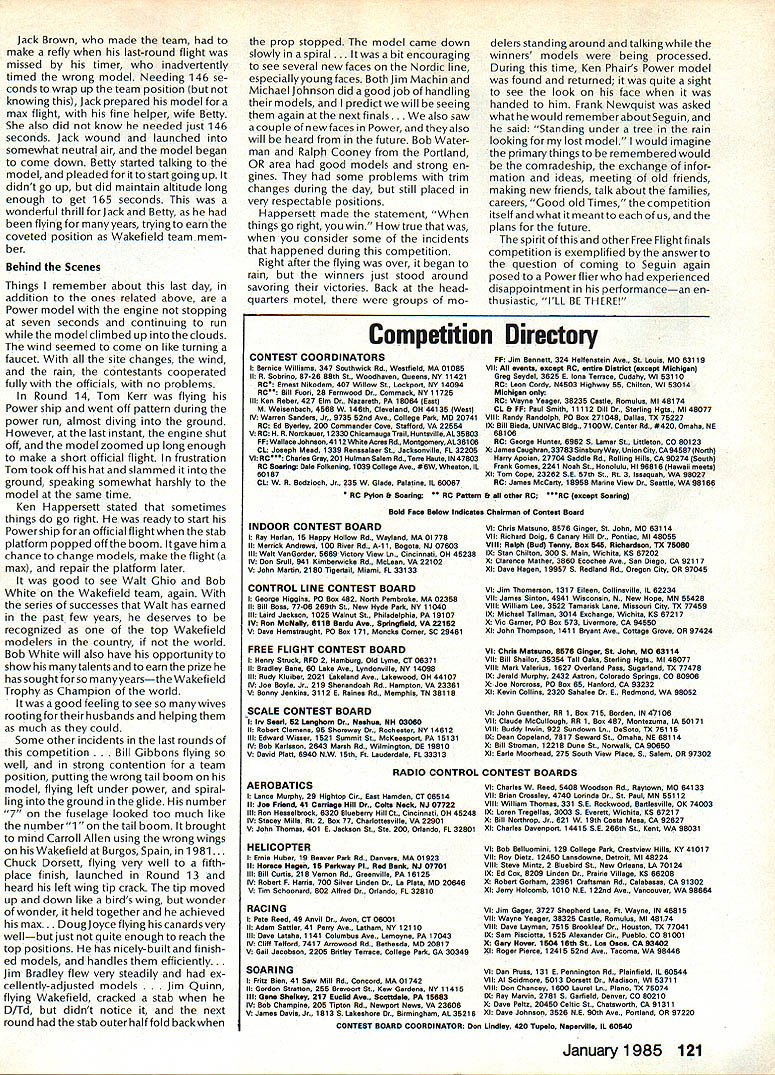
- Jack Brown had to refly when a timer missed his last-round flight; needing 146 seconds, his wife Betty helped and the model achieved 165 seconds, securing a team position.
- Tom Kerr’s Power ship almost dove during the power run but the engine shut off in time for a short official flight.
- Ken Happersett had a stab platform pop off before a flight, repaired it later and posted a max.
- Walt Ghio and Bob White made the Wakefield team; both long-time top competitors.
- Bill Gibbons mistakenly fitted the wrong tail boom and crashed; Chuck Dorsett cracked a wing tip but still maxed; Jim Quinn cracked a stab after D/T and later had half the stab fold but the model descended slowly.
- New faces in Nordic and Power were encouraging; Bob Waterman and Ralph Cooney (Portland, OR) placed well after trim problems.
Spirit and camaraderie:
- Despite lost models and bad weather, competitors shared comradeship, exchanged information, and celebrated victories together. The consensus was enthusiasm to return — “I’LL BE THERE!”
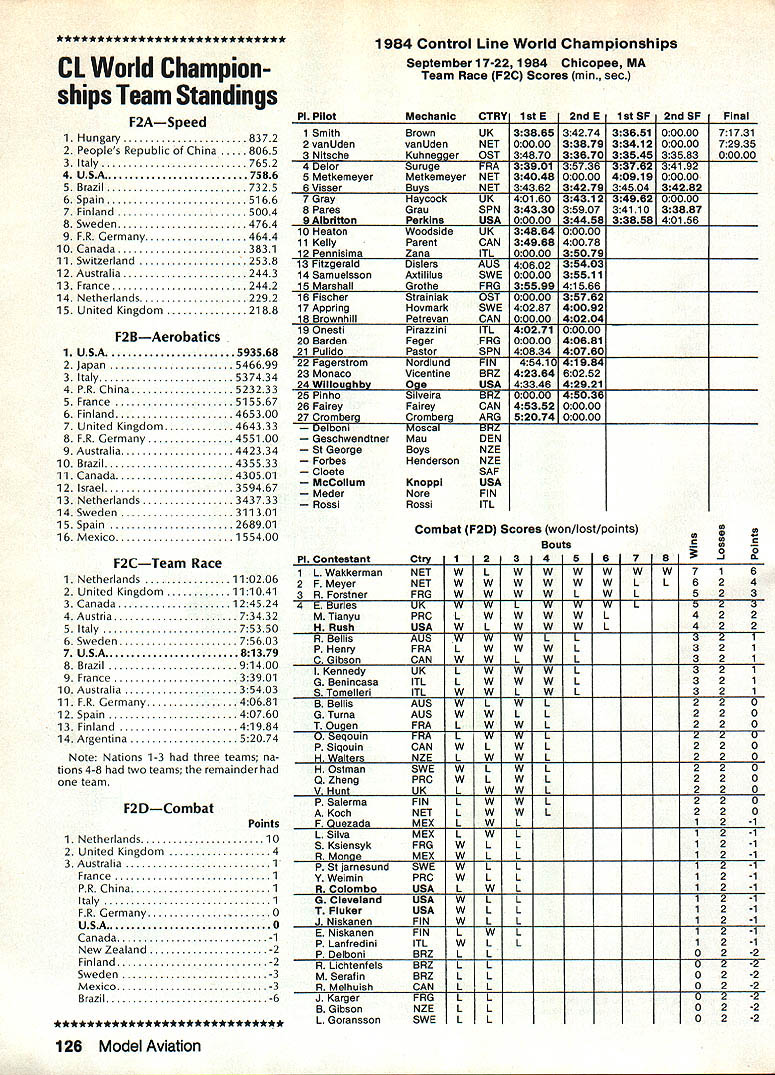
1984 Control Line World Championships — Team Standings (Selected)
F2A — Speed
- 1. Hungary — 837.2
- 2. People’s Republic of China — 806.5
- 3. Italy — 765.2
- 4. U.S.A. — 758.6
- 5. Brazil — 732.5
- 6. Spain — 516.6
- 7. Finland — 500.4
- 8. Sweden — 476.4
- 9. F.R. Germany — 464.4
- 10. Canada — 383.1
- 11. Switzerland — 253.8
- 12. Australia — 244.3
- 13. France — 244.2
- 14. Netherlands — 229.2
- 15. United Kingdom — 218.8
F2B — Aerobatics
- 1. U.S.A. — 5935.68
- 2. Japan — 5466.99
- 3. Italy — 5374.34
- 4. P.R. China — 5232.33
- 5. France — 5155.67
- 6. Finland — 4653.00
- 7. United Kingdom — 4643.33
- 8. F.R. Germany — 4551.00
- 9. Australia — 4423.34
- 10. Brazil — 4355.33
- 11. Canada — 4305.01
- 12. Israel — 3594.67
- 13. Netherlands — 3437.33
- 14. Sweden — 3113.01
- 15. Spain — 2689.01
- 16. Mexico — 1554.00
F2C — Team Race (team standings by total time)
- 1. Netherlands — 11:02.06
- 2. United Kingdom — 11:10.41
- 3. Canada — 12:45.24
- 4. Austria — 7:34.32
- 5. Italy — 7:53.50
- 6. Sweden — 7:56.03
- 7. U.S.A. — 8:13.79
- 8. Brazil — 9:14.00
- 9. France — 3:39.01
- 10. Australia — 3:54.03
- 11. F.R. Germany — 4:06.81
- 12. Spain — 4:07.60
- 13. Finland — 4:19.84
- 14. Argentina — 5:20.74
Note: Nations 1–3 had three teams; nations 4–8 had two teams; the remainder had one team.
F2D — Combat (points)
- 1. Netherlands — 10
- 2. United Kingdom — 4
- 3. Australia — 1
- =. France — 1
- =. P.R. China — 1
- =. Italy — 1
- 7. F.R. Germany — 0
- 8. U.S.A. — 0
- 9. Canada — -1
- 10. New Zealand — -2
- 11. Finland — -2
- 12. Sweden — -3
- 13. Mexico — -3
- 14. Brazil — -6
1984 Control Line World Championships — Team Race (F2C) Selected Results
(Selected placings, pilot — mechanic — country — final time)
- Smith — Brown — UK — Final: 7:17.31
- vanUden — vanUden — NED — Final: 7:29.35
- Nitsche — Kuhnegger — OST — Final: 0:00.00 (see published table)
- Delor — Suruge — FRA — Final: 0:00.00
- Metkemeyer — Metkemeyer — NED — Final: 0:00.00
- Visser — Buys — NED — Final: 0:00.00
- Gray — Haycock — UK — Final: 0:00.00
- Pares — Grau — SPN — Final: 0:00.00
- Albritton — Perkins — USA — Final: 0:00.00
- Heaton — Woodside — UK — Final: 0:00.00
- Kelly — Parenti — CAN — Final: 0:00.00
- Pennsamo — Zana — AUS — Final: 0:00.00
- Fitzgerald — Dislers — AUS — Final: 0:00.00
- Samuelsson — Axtellius — SWE — Final: 0:00.00
- Marshall — Grothe — FRG — Final: 0:00.00
(Entries and some times not fully legible on scan; published table shows zeros where indicated.)
-- End of Competition Newsletter --
Transcribed from original scans by AI. Minor OCR errors may remain.

