
1976-77 PROGRAM FOR 1977 U.S. RC AEROBATICS TEAM
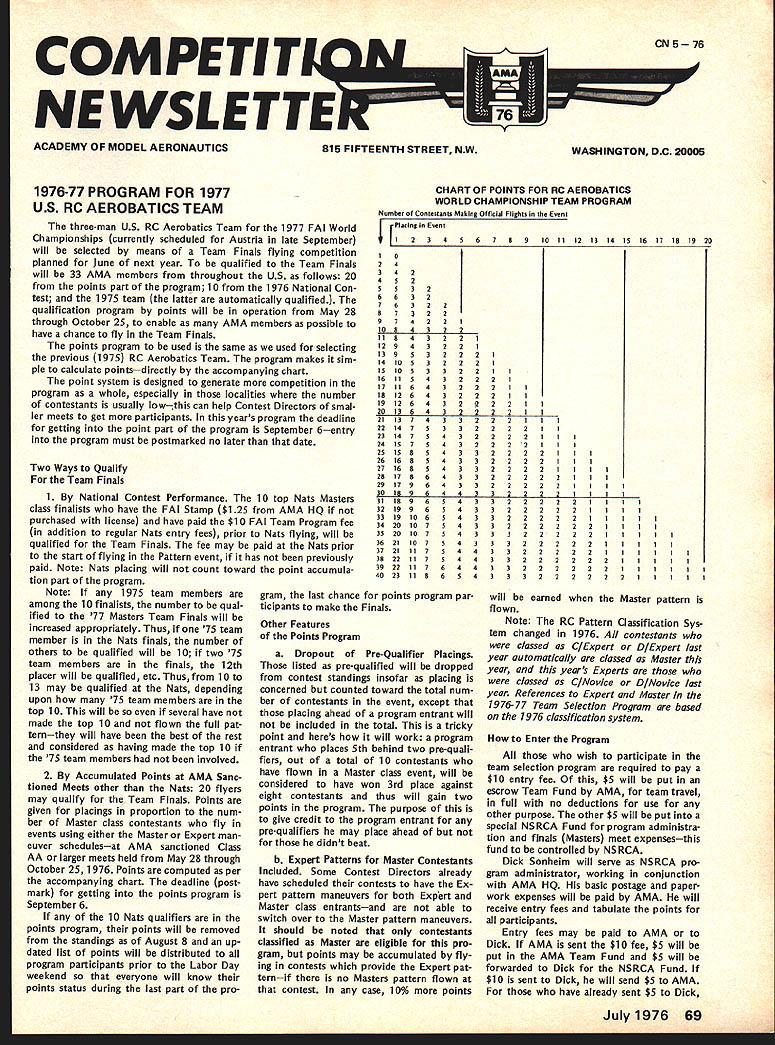
The three-man U.S. RC Aerobatics Team for the 1977 FAI World Championships (currently scheduled for Austria in late September) will be selected by means of a Team Finals flying competition planned for June of next year. To be qualified to the Team Finals will be 33 AMA members from throughout the U.S. as follows: 20 from the points part of the program; 10 from the 1976 National Contest; and the 1975 team (the latter are automatically qualified). The qualification program by points will be in operation from May 28 through October 25, to enable as many AMA members as possible to have a chance to fly in the Team Finals.
The points program to be used is the same as we used for selecting the previous (1975) RC Aerobatics Team. The program makes it simple to calculate points—directly by the accompanying chart. The point system is designed to generate more competition in the program as a whole, especially in those localities where the number of contestants is usually low—this can help Contest Directors of smaller meets to get more participants. In this year's program the deadline for getting into the point part of the program is September 6—entry into the program must be postmarked no later than that date.
Two Ways to Qualify For the Team Finals
- By National Contest Performance. The 10 top Nats Masters class finalists who have the FAI Stamp ($1.25 from AMA HQ if not purchased with license) and have paid the $10 FAI Team Program fee (in addition to regular Nats entry fees), prior to Nats flying, will be qualified for the Team Finals. The fee may be paid at the Nats prior to the start of flying in the Pattern event, if it has not been previously paid. Note: Nats placing will not count toward the point accumulation part of the program.
Note: If any 1975 team members are among the 10 finalists, the number to be qualified to the '77 Masters Team Finals will be increased appropriately. Thus, if one '75 team member is in the Nats finals, the number of others to be qualified will be 10; if two '75 team members are in the finals, the 12th placer will be qualified, etc. Thus, from 10 to 13 may be qualified Nats depending upon how many '75 team members are involved. This will be so even if several have not made the top 10 and not flown the full pattern—they will have been the best of the rest and considered as having made the top 10 if the '75 team members had not been involved.
- By Accumulated Points at AMA sanctioned meets other than the Nats. Twenty flyers may qualify for the Team Finals. Points are given for placings in proportion to the number of Master class contestants who fly events using either the Master or Expert maneuver schedules at AMA sanctioned Class AA or larger meets held from May 28 through October 25, 1976. Points are computed as per the accompanying chart. The deadline (postmark) for getting into the points program is September 6.
If any of the 10 Nats qualifiers are in the points program, their points will be removed from the standings as of August 8 and an updated list of points will be distributed to program participants prior to the Labor Day weekend so that everyone will know points status during the last part of the program. This is the last chance for points program participants to make the Finals.
Other Features of the Points Program
a. Dropout of Pre-Qualifier Placings. Those listed as pre-qualified will be dropped from contest standings insofar as placing is concerned toward the total number of contestants in the event, except that placings ahead of a program entrant will be included in the total. This is a tricky point and here's how it will work: a program entrant who places 5th behind two pre-qualifiers out of a total of 10 contestants who have flown in a Master class event will be considered to have won 3rd place against eight contestants and thus will gain two points. This will give credit to the program entrant for any pre-qualifiers he may have placed ahead of but not for those he didn't beat.
b. Expert Patterns for Master Contestants Included. Some Contest Directors already have scheduled contests to have Expert pattern maneuvers for both Expert and Master class entrants and are able to switch over to the Master pattern maneuvers should contestants request. All contestants who enter and fly the Master pattern will be counted as Master contestants for the purpose of points, but points may be accumulated by flying in contests which provide the Expert pattern for entry into the program if there is no Master pattern flown at that contest. In any case, 10% more points will be earned when the Master pattern is flown.
Note: The RC Pattern Classification System changed in 1976. All contestants who were classified as C/Expert or D/Expert last year automatically are classed as Master this year and are known as Masters; those who were classed as C/Novice or D/Novice last year are of course in the lower classes. References to Expert and Master in the 1976-77 Team Selection Program are based on the 1976 classification system.
How to Enter the Program
All those who wish to participate in the team selection program are required to pay a $10 entry fee. Of this, $5 will be put in an escrow Team Fund by AMA for team travel, in full with no deductions for use for any other purpose. The other $5 will be put into a special NSRCA Fund for program administration and finals (Masters) meet expenses—this fund to be controlled by NSRCA.
Dick Sopheil will serve as NSRCA program administrator, working in conjunction with AMA HQ. His basic postage and paperwork expenses will be paid by AMA. He will receive entry fees and be available to calculate the points for all participants.
Entry fees may be paid to AMA or to Dick. If AMA is sent the $10 fee, $5 will be put in the AMA Team Fund and $5 will be forwarded to Dick for the NSRCA Fund. If $10 is sent to Dick, he will send $5 to AMA. For those who have already sent $5 to Dick, arrangements will be made to account for that payment.
Competition Newsletter
Points program participants who mail in entry fees (or who enter at the Nats) will receive certification forms which they must have signed by Contest Directors of meets in which the contestant has placed sufficiently high to gain points (see chart of point system). It will be the contestant's responsibility to obtain certification for placing in these meets and submitting same to Dick Sonheim.
All entrants in the program will receive photocopies of information published in the AMA Competition Newsletter concerning the program. The newsletter will be the official source of continuing news and details of program progress.
The Team Finals
FAI World Championship procedures, rules and scoring, will be used for the U.S. Team Finals. These concern model sizes and weights, judging, number of flights, etc., insofar as is practical. Note: models must be within weight limit, with fuel, ready to fly.
All finalists will be required to pay a fee of $10 at the Finals site before flying.
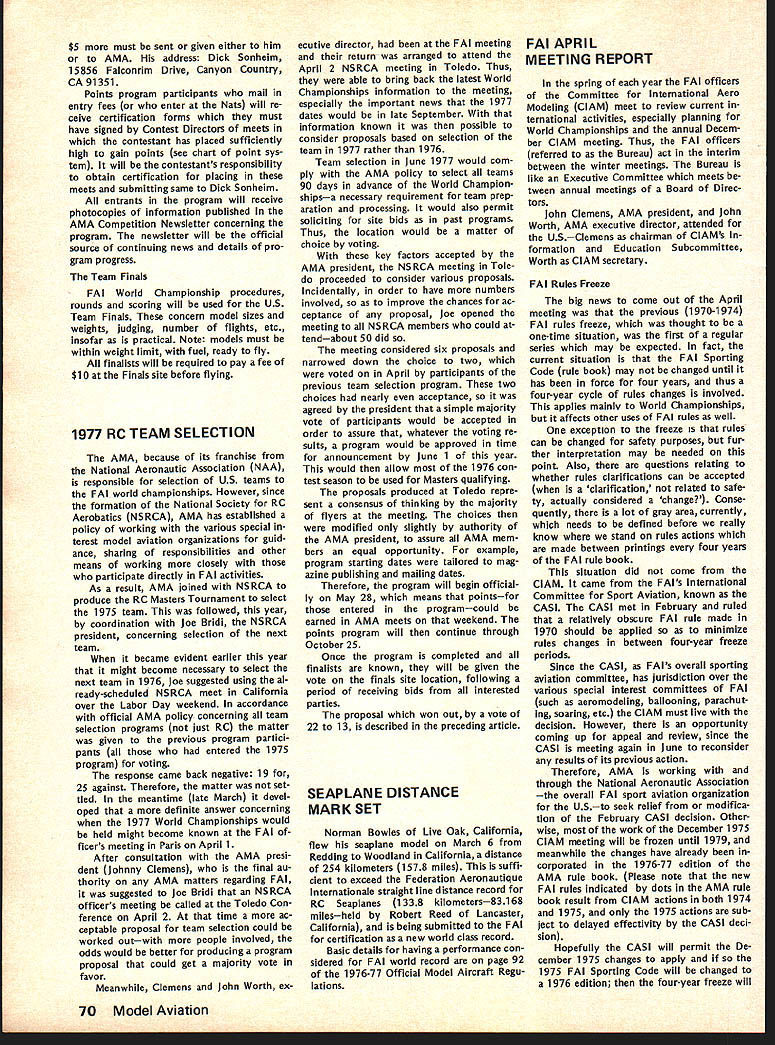
1977 RC TEAM SELECTION
The AMA, because of its franchise with the National Aeronautic Association (NAA), is responsible for selection of U.S. teams to the FAI World Championships. However, since the formation of the National Society for RC Aerobatics (NSRCA), AMA has established a policy of working with the various specialist interest model aviation organizations for guidance, sharing of responsibilities and other means of working more closely with those who participate directly in FAI activities.
As a result, AMA joined with NSRCA to produce the RC Masters Tournament to select the 1975 team. This was followed, this year, by coordination with Joe Brid, the NSRCA president, concerning selection of the next team.
When it became evident earlier this year that it might become necessary to select the next team in 1976, Joe suggested using the already-scheduled NSRCA meet in California over the Labor Day weekend. In accordance with official AMA policy, concerning all team selection programs (not just RC) the matter was given to the previous program participants (all those who had entered the 1975 program) for voting.
The response came back negative: 19 for, 25 against. Therefore, the matter was not settled. In the meantime (late March) it developed that a more definite answer concerning whether the 1977 World Championships would be held might become known at the FAI officer's meeting in Paris on April 1.
After consultation with the AMA president (Johnny Clemens), who is the final authority on any AMA matters regarding FAI, it was suggested to Joe Brid that an NSRCA officer's meeting be called at the Toledo conference on April 2. At that time a more acceptable proposal for team selection could be worked out—what more people involved, the odds would be better for producing a program proposal that could get a majority vote in favor.
Meanwhile, Clemens and John Worth, executive director, had been at the FAI meeting and their return was arranged to attend the April 2 NSRCA meeting in Toledo. Thus, they were able to bring back the latest World Championships information to the meeting, especially the important news that the 1977 dates would be in late September. With that information known it was then possible to consider proposals based on selection of the team in 1977 rather than 1976.
Team selection in June 1977 would comply with the AMA policy to select all teams 90 days in advance of the World Championships—a necessary requirement for team preparation and processing. It would also permit soliciting for site bids as in past programs. Thus, the location would be a matter of choice by voting.
With those key factors accepted by the AMA president, the NSRCA meeting in Toledo proceeded to consider various proposals. Incidentally, in order to have more numbers involved, as to improve the chances for acceptance of any proposal, Joe opened the meeting to all NSRCA members who could attend—about 50 did so.
The meeting considered six proposals and narrowed down the choice to two, which were voted on in April by participants of the previous team selection program. These two choices had nearly even acceptance, so it was agreed by the president that a simple majority vote of participants would be accepted in order to assure that, whatever the voting results, a program would be approved in time for announcement by June 1 of this year. This would then allow most of the 1976 contest season to be used for Masters qualifying.
The proposals produced at Toledo represent a consensus of thinking by the majority of flyers at the meeting. The choices then were modified only slightly by authority of the AMA president, to assure that all AMA members are given an equal opportunity. For example, program starting dates were tailored to major publishing and mailing dates.
Therefore, the program will begin officially on May 28, which means that points—for those entered in the program—could be earned in AMA meets on that weekend. The points program will then continue through October 25.
Once the program is completed and all finalists are known, they will be given the vote on the finals site location, following a period of receiving bids from all interested parties.
The proposal which won out, by a vote of 22 to 13, is described in the preceding article.
Competition Newsletter
apply. There's no real assurance this will happen, so there is a question of what to do with the FAI rules changes that are already in the AMA rule book.
For Now Use AMA Book As Is
Until more information is available from the FAI in June, the AMA rule book will be used as is for AMA contests. No real problem there. A problem may exist, however, for team selection programs — which rules will be used to pick U.S. teams?
Decisions may vary from one program to another. For the current RC Soaring Program, for example, the AMA rule book version of the FAI rules will be used for at least the initial Quarter Final team selection meets in May. Rules for the later Semi-Finals and Team Finals can be changed, or not, according to the latest information that will be available from the June CASI meeting. Meanwhile, RC Pattern team selection will also go by the AMA rule book for this year's qualifying program, but the Team Finals meet in June 1977 may use the 1975 version of the rules — but that's too early to know yet.
Three-Year Cycle Proposed For World Championships
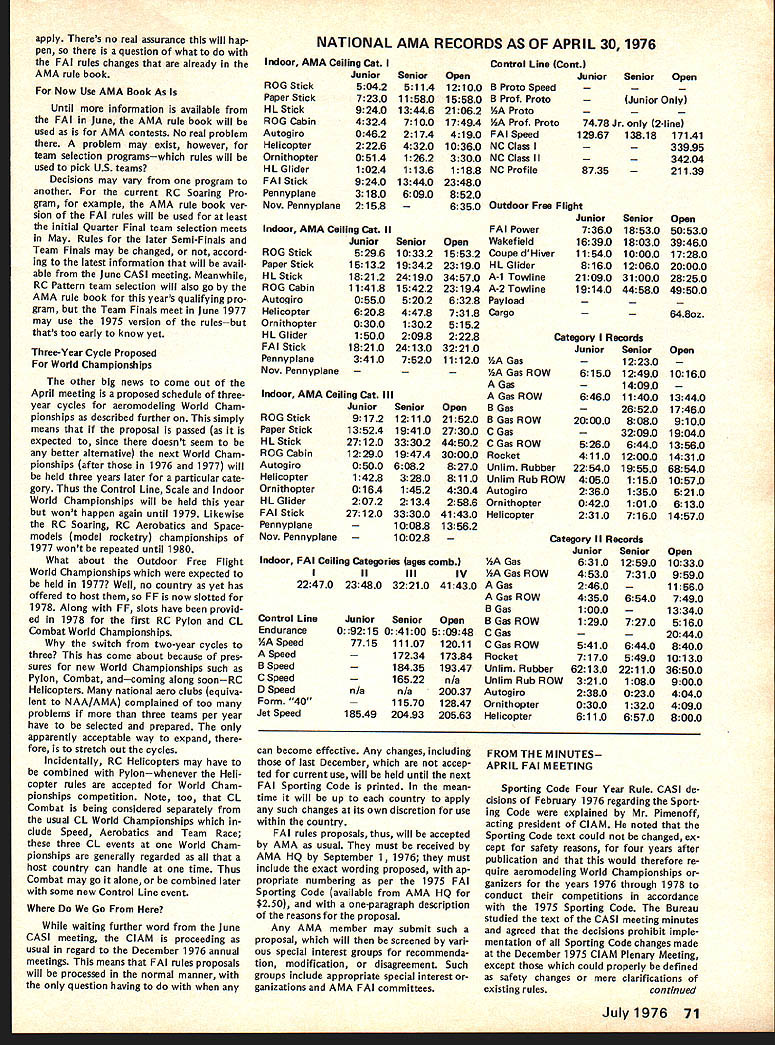
The other big news to come out of the April meeting is a proposed schedule of three-year cycles for aeromodeling World Championships as described further on. This simply means that if the proposal is passed (as it is expected to, since there doesn't seem to be any better alternative) the next World Championships (after those in 1976 and 1977) will be held three years later for a particular category. Thus the Control Line, Scale and Indoor World Championships will be held this year but won't happen again until 1979. Likewise the RC Soaring, RC Aerobatics and Spacemodels (model rocketry) championships of 1977 won't be repeated until 1980.
What about the Outdoor Free Flight World Championships which were expected to be held in 1977? Well, no country as yet has offered to host them, so FF is now slotted for 1978. Along with FF, slots have been provided in 1978 for the first RC Pylon and RC Combat World Championships.
Why the switch from two-year cycles to three? This has come about because of pressures for new World Championships such as Pylon, Combat, and — coming along soon — RC Helicopters. Many national aero clubs (equivalent to NAA/AMA) complained of too many problems if more than three teams per year have to be selected and prepared. The only apparently acceptable way to expand, therefore, is to stretch out the cycles.
Incidentally, RC Helicopters may have to be combined with Pylon — whenever the Helicopter rules are accepted for World Championships competition. Note, too, that Combat is being considered separately from the usual CL World Championships which include Speed, Aerobatics and Team Race; these three CL events at one World Championships are generally regarded as all that a host country can handle at one time. Thus Combat may go it alone, or be combined later with some new Control Line event.
Where Do We Go From Here?
While waiting further word from the June CASI meeting, the CIAM is proceeding as usual in regard to the December 1976 annual meetings. This means that FAI rules proposals will be processed in the normal manner, with the only question having to do with when any can become effective. Any changes, including those of last December, which are not accepted for current use, will be held until the next FAI Sporting Code is printed. In the meantime it will be up to each country to apply any such changes at its own discretion for use within the country.
FAI rules proposals, thus, will be accepted by AMA as usual. They must be received by AMA HQ by September 1, 1976; they must include the exact wording proposed, with appropriate numbering as per the 1975 FAI Sporting Code (available from AMA HQ for $2.50), and with a one-paragraph description of the reasons for the proposal.
Any AMA member may submit such a proposal, which will then be screened by various special interest groups for recommendations, modification, or disagreement. Such groups include appropriate special interest organizations and AMA FAI committees.
FROM THE MINUTES — APRIL FAI MEETING
Sporting Code Four Year Rule. CASI decisions of February 1976 regarding the Sporting Code were explained by Mr. Pimmet, acting president of CIAM. He noted that the Sporting Code text could not be changed, except for safety reasons, for four years after publication and that this would therefore require aeromodeling World Championships organizers for the years 1976 through 1978 to conduct their competitions in accordance with the 1975 Sporting Code. The Bureau studied the text of the CASI meeting minutes and agreed that the decisions prohibit implementation of all Sporting Code changes made at the December 1975 CIAM Plenary Meeting, except those which could properly be defined as safety changes or more clarifications of existing rules.
Competition Newsletter
ACADEMY OF MODEL AERONAUTICS 815 FIFTEENTH STREET NW WASHINGTON, DC 20005
1976-77 PROGRAM FOR 1977 U.S. RC AEROBATICS TEAM
A three-man U.S. RC Aerobatics Team for the 1977 FAI World Championships, currently scheduled in Austria in late September, will be selected. Means of selection: Team Finals flying competition planned next June. Qualified Team Finals will be 33 AMA members throughout U.S. The program follows a 20-point part program.
The 10 top 1976 National Contest Masters class finalists and the 1975 team latter automatically qualified. Qualification program points will be in operation May 28 through October 25 to enable AMA members to possibly have a chance to fly in the Team Finals. Points program used is the same as used selecting the previous 1975 RC Aerobatics Team program. The program makes simple calculation of points — directly accompanying chart. The point system is designed to generate competition program activity throughout the whole country, especially in localities where the number of contestants is usually low. This can help Contest Directors at smaller meets get participants. Years program deadline for getting points part program is September 6. Entry in the program must be postmarked no later date.
Two Ways to Qualify for Team Finals
- National Contest Performance
- The 10 top Nats Masters class finalists have FAI stamps. The $125 FAI license has been purchased by AMA HQ. Competitors must have paid $10 FAI Team Program fee in addition to regular Nats entry fees prior to Nats flying to be qualified for Team Finals. Fee may be paid at Nats prior to start of flying in the Pattern event if not previously paid. Note: Nats placings will count toward point accumulation in the points program. Note: 1975 team members among the 10 finalists — the number qualified affects 1977 Masters Team Finals and will be increased appropriately. Thus if 1975 team members make the Nats finals, the number of other qualifiers will increase (e.g., if two 1975 team members are in the top 10, the 12th placer will be qualified, etc.). Thus from 10 to 13 may qualify from Nats depending upon how many 1975 team members are among the top 10. If several have made the top 10 but flown full pattern, the best rest will be considered having made top 10 where 1975 team members are involved.
- Accumulated Points — AMA Sanctioned Meets other than Nats
- Twenty flyers may qualify for Team Finals. Points given are by placings in proportion to number of Master class contestants making official flights using either Master or Expert maneuver schedules at AMA sanctioned Class AA larger meets held May 28 through October 25, 1976. Points computed per accompanying chart. Deadline postmark for getting points in program is September 6. Nats qualifiers in points program — points will be removed from standings August 8. Updated list of points will be distributed to program participants prior to Labor Day weekend so everyone will know points status during last part program.
CHART OF POINTS FOR RC AEROBATICS WORLD CHAMPIONSHIP TEAM PROGRAM
Number Contestants Making Official Flights — Event Placings (Points)
[Chart as printed — preserves original numeric layout]
5 6 7 8 9 10 2 4 3 2 4 2 4 5 2 3 5 3 2 6 6 3 2 7 6 3 2 2 8 7 3 2 2 9 7 4 2 2 10 9 7 4 3 3 2 2 11 10 9 7 4 3 3 2 2 2 12 11 8 4 3 2 2 2 2 1 1 13 12 9 4 3 2 2 2 2 1 1 1 14 13 9 3 3 2 2 2 2 1 1 1 1 15 14 10 5 3 2 2 2 2 1 1 1 1 1 16 15 10 5 3 3 2 2 2 2 1 1 1 1 1 17 16 11 5 4 3 2 2 2 2 1 1 1 1 1 1 18 17 11 6 4 3 2 2 2 2 1 1 1 1 1 1 1 19 18 12 6 4 3 2 2 2 2 1 1 1 1 1 1 1 1 20 19 12 6 4 3 3 3 3 3 3
[Extended numeric rows continue as printed on original page]
Other Features — Points Program
- Dropout Pre-Qualifier: Placings listed pre-qualified will be dropped from contest standings insofar as the placing concerned is counted toward total number of contestants in the event except placing ahead of program entrant will be included in total. For tricky point here's how the program works: entrant places 5th behind two pre-qualifiers out of total 10 contestants who have flown Master class event will be considered to have won 3rd place against eight contestants, thus will gain two points in the program. Purpose: give credit in program; entrant who beat pre-qualifiers may place ahead but didn't beat number of Expert Patterns Master contestants included. Some Contest Directors already have scheduled contests have Expert pattern maneuvers; both Expert and Master class entrants are able to switch over to Master pattern maneuvers. Should be noted.
(Article continues with chart details and program examples as printed.) The matter was first referred to the Racing Advisory Committee, and a poll of the CLBC and the RAC was taken to determine general feeling on the advisability of such a change in the rules. The results of an informal poll showed the CLBC in favor of a change by a vote of 4 to 3 (4 abstained) and the RAC tied at 4 to 4 (all RAC members responded). In neither case was there strong indication that the 2/3 majority necessary for ratification of an emergency rule change would be reached by the CLBC if the rule change came to a formal final vote.
Further investigations reveal that experiments have already confirmed that sleeve bearings can be fitted to the modified .40s with very little loss in performance. Therefore, it is apparent that a rule change to allow plain bearings only would serve little purpose. Therefore, I, as chairman of the CLBC, cannot concur in such a rule change. Further consideration of emergency rule changes for Slow Rat can, thus, only be based on new and much stronger evidence that a change is necessary and that a change is formulated which is workable and will serve a useful purpose.
FOUR FF TEAM FINALS SITES BEING LOOKED AT
Flying sites at Pensacola, Fla., Hutchinson, Kans., Lake Charles, La., and Blaine, Minn., are being investigated by the 1977 FF Team Program Site Committee (headed by Bob Sifleet) as possibilities for the Team Finals over Labor Day weekend this year, according to FF Team Selection Committee Chairman Bob Stalick. This word came before the results of the FAI CIAM Bureau (officers) meeting were known — reported elsewhere in this issue — and it was not known when this was written whether the proposed scheduling of the World Championships will have an effect on current team selection planning.
On another subject, Stalick indicates that a Procedural Manual is slated for development — and for which suggestions, ideas and experiences are needed. What the committee has in mind is to develop a manual which could be used by all future officials of Outdoor FAI Team Selection Programs — including Semi-Finals directors, Team Finals directors, program managers, and team members. Input is needed. Send to Program Committee Chairman Bob Stalick, 1120 Shady Lane, Albany, Oregon 97321.
CL SPEED CHART OMISSION
If you're a CL Speed flyer, try to avoid going between 179.93 mph and 200.14 mph — because if you don't, the speed chart in the 1976-77 rule book won't do you much good! But if you'll clip out the missing part of the chart printed next to this paragraph (the nine-second range) and stick it into your rule book on page 20, you'll be in good shape. Sorry for the error.
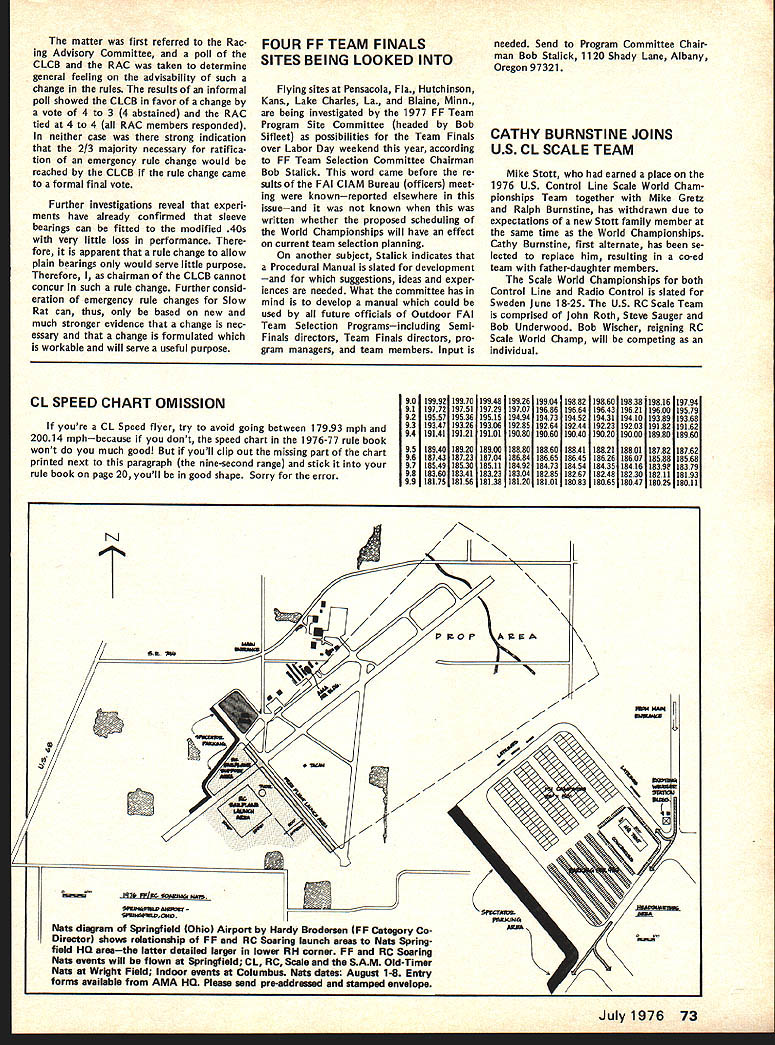
Nats diagram of Springfield (Ohio) Airport by Hardy Broderson (FF Category Co-Director) shows relationship of FF and RC Soaring launch areas to Nats Springfield HQ area — the latter detailed larger in lower R.H. corner. FF and RC Soaring Nats events will be flown at Springfield; CL, RC, Scale and the S.A.M. Old-Timer Nats at Wright Field; Indoor events at Columbus. Nats dates: August 1–8. Entry forms available from AMA HQ. Please send pre-addressed and stamped envelope.
CATHY BURNSTINE JOINS U.S. CL SCALE TEAM
Mike Stott, who had earned a place on the 1976 U.S. Control Line Scale World Championships Team together with Mike Gretz and Ralph Burnstine, has withdrawn due to expectations of a new Stott family member at the same time as the World Championships. Cathy Burnstine, first alternate, has been selected to replace him, resulting in a coed team with father-daughter members.
The Scale World Championships for both Control Line and Radio Control is slated for Sweden June 18–25. The U.S. RC Scale Team is comprised of John Roth, Steve Sauger and Bob Underwood. Bob Wischer, reigning RC Scale World Champ, will be competing as an individual.
Transcribed from original scans by AI. Minor OCR errors may remain.

