
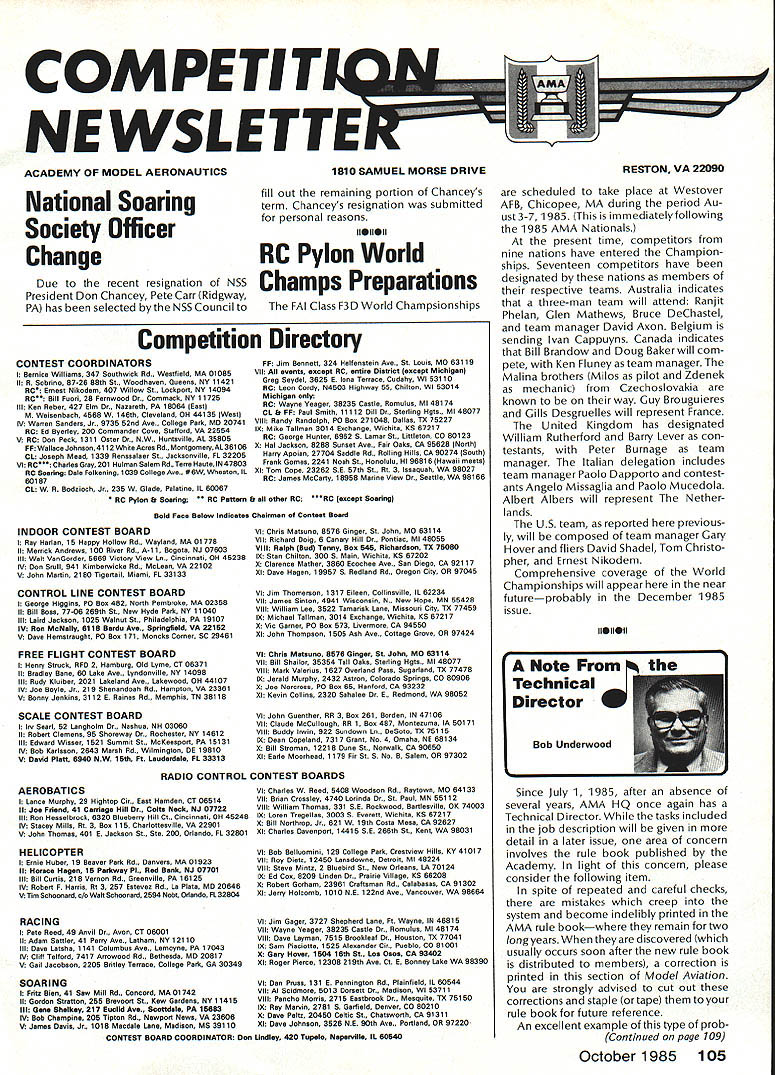
COMPETITION NEWSLETTER
National Soaring Society Officer Change
Due to the recent resignation of NSS President Don Chancey, Pete Carr (Ridgway, PA) has been selected by the NSS Council to fill out the remaining portion of Chancey's term. Chancey's resignation was submitted for personal reasons.
RC Pylon World Champs Preparations
The FAI Class F3D World Championships
The FAI Class F3D World Championships are scheduled to take place at Westover AFB, Chicopee, MA during the period of Aug. 3–7, 1985. This is immediately following the 1985 AMA Nationals.
At the present time, competitors from nine nations have entered the Championships. Seventeen competitors have been designated by these nations as members of their respective teams.
- Australia: Ranjit Phelan, Glen Mathews, Bruce DeChastel; team manager David Axon.
- Belgium: Ivan Cappuyns.
- Canada: Bill Brandow, Doug Baker; team manager Ken Fluney.
- Czechoslovakia: The Milan brothers — Milos (pilot) and Zdenek (mechanic).
- France: Guy Bourgeois, Gilles Desruelles.
- United Kingdom: William Rutherford, Barry Lever; team manager Peter Burnage.
- Italy: Angelo Missaglia, Paolo Mucedola; team manager Paolo Dapporto.
- Netherlands: Albert Albers.
- United States: Team manager Gary Hoover; fliers David Shadel, Tom Christopher, and Ernest Nikodem.
Comprehensive coverage of the World Championships will appear here in the near future — probably in the December 1985 issue.
RC Masters Tournament—1985
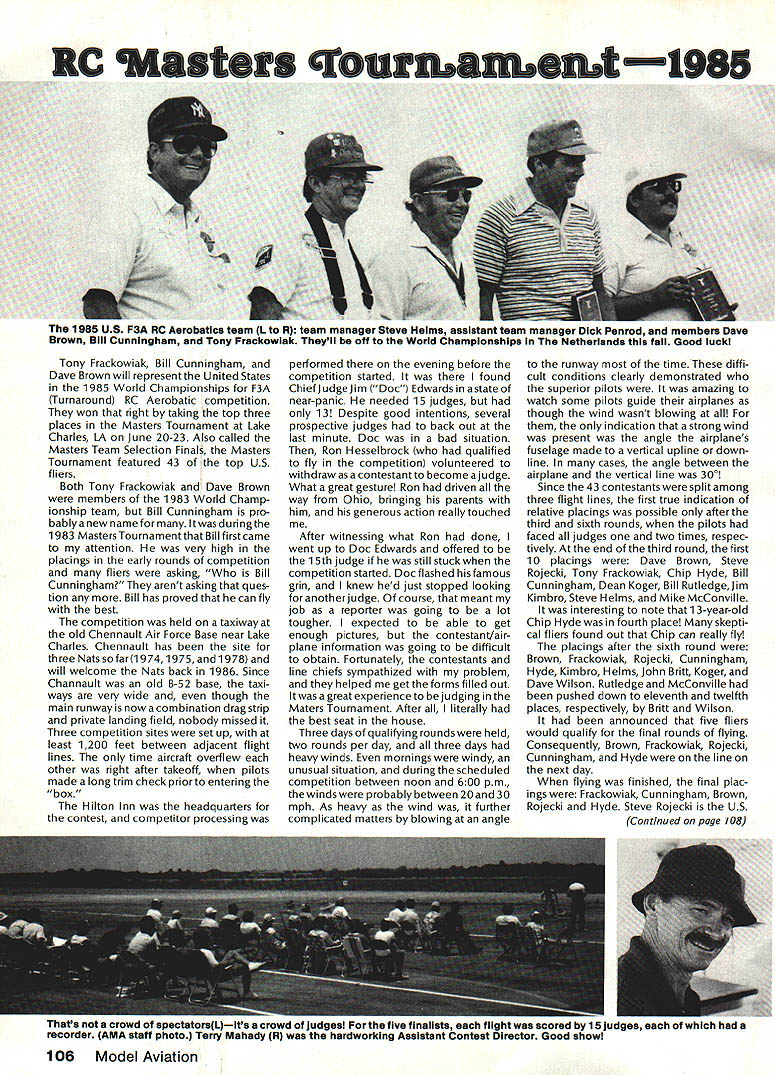
Tony Frackowiak, Bill Cunningham, and Dave Brown will represent the United States in the 1985 World Championships for F3A (Turnaround) RC Aerobatic competition. They earned that right by taking the top three places in the Masters Tournament at Lake Charles, LA on June 20–23. Also called the Masters Team Selection Finals, the Masters Tournament featured 43 of the top U.S. fliers.
Both Tony Frackowiak and Dave Brown were members of the 1983 World Championship team. Bill Cunningham may be a new name to many; during the 1983 Masters Tournament he finished very high in the early rounds and drew much attention. He has proved he can fly with the best.
The competition was held on a taxiway at the old Chenault Air Force Base near Lake Charles. Chenault has been the site for three Nats so far (1974, 1975, and 1978) and will welcome the Nats back in 1986. Since Chenault was an old B-52 base, the taxiways are very wide. Three competition sites were set up, with at least 1,200 feet between adjacent flight lines. The only time aircraft overflew each other was right after takeoff, when pilots made a long trim check prior to entering the "box."
The Hilton Inn was the contest headquarters, and competitor processing was performed there on the evening before the competition started. Chief judge Jim ("Doc") Edwards needed 15 judges but had only 13 because several prospective judges had to back out at the last minute. Ron Hesselbrock, who had qualified to fly, volunteered to withdraw as a contestant to become a judge. After witnessing Ron's gesture, the author offered to be the 15th judge. Although serving as a judge made reporting more difficult, contestants and officials helped supply forms and information. It was a great experience to judge at the Masters Tournament — literally the best seat in the house.
Three days of qualifying rounds were held, two rounds per day, and each day featured heavy winds. Even mornings were unusually windy; during the noon–6:00 p.m. competition periods winds were probably between 20 and 30 mph and often blew at an angle to the runway. These difficult conditions clearly demonstrated who the superior pilots were. Some pilots guided their airplanes as though the wind wasn't blowing at all; often the only indication of wind was the angle the airplane's fuselage made to a vertical upline or downline — in many cases as much as 30°.
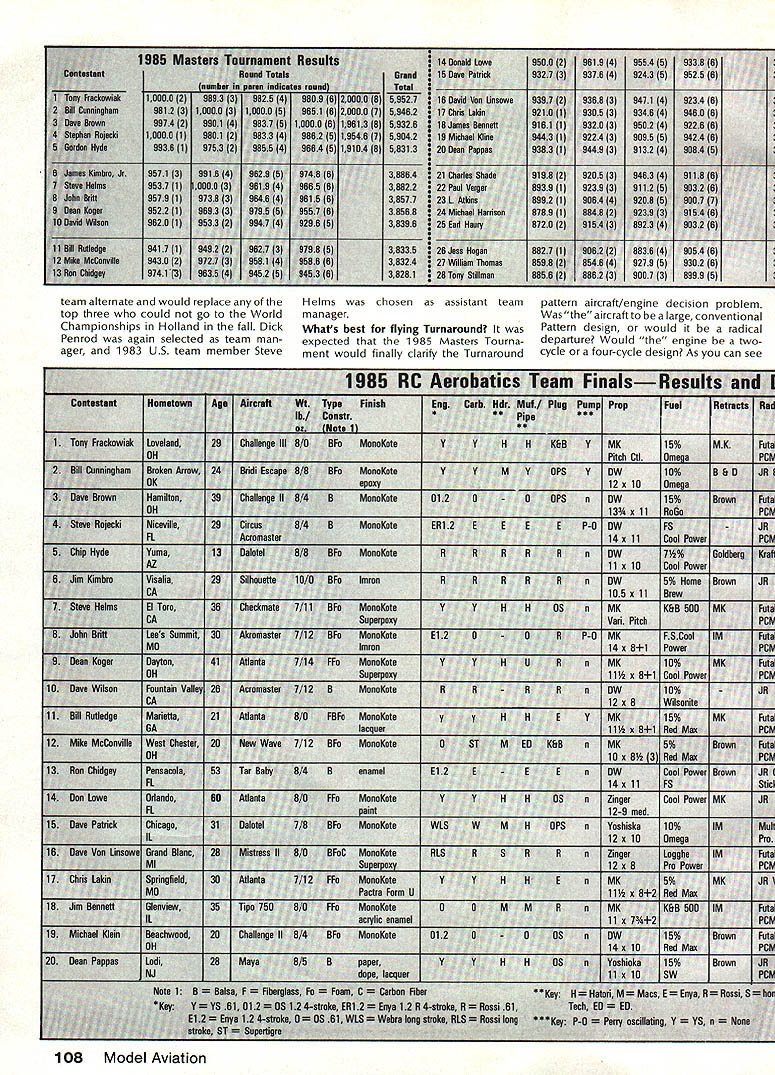
Because the 43 contestants were split among three flight lines, the first true indication of relative placings was possible only after the third and sixth rounds, when each pilot had been seen once and twice by all judges, respectively. At the end of the third round, the top ten were: Dave Brown, Steve Rojecki, Tony Frackowiak, Chip Hyde, Bill Cunningham, Dean Koger, Bill Rutledge, Jim Kimble, Steve Helms, and Mike McConville. Thirteen-year-old Chip Hyde was in fourth place — many specialty fliers discovered that Chip can really fly. After the sixth round the top placings were: Brown, Frackowiak, Rojecki, Cunningham, Hyde, Kimble, Helms, Britt, Koger, and Dave Wilson. Rutledge and McConville had dropped to eleventh and twelfth. Brown, Frackowiak, Rojecki, Cunningham, and Hyde were on the line for the final day.
When flying was finished, the final placings were: 1) Tony Frackowiak; 2) Bill Cunningham; 3) Dave Brown; 4) Steve Rojecki; 5) Chip Hyde. Steve Rojecki is the U.S. team alternate and would replace any of the top three who could not go to the World Championships in Holland in the fall. Dick Penrod was again selected as team manager, and 1983 U.S. team member Steve Helms was chosen as assistant team manager.
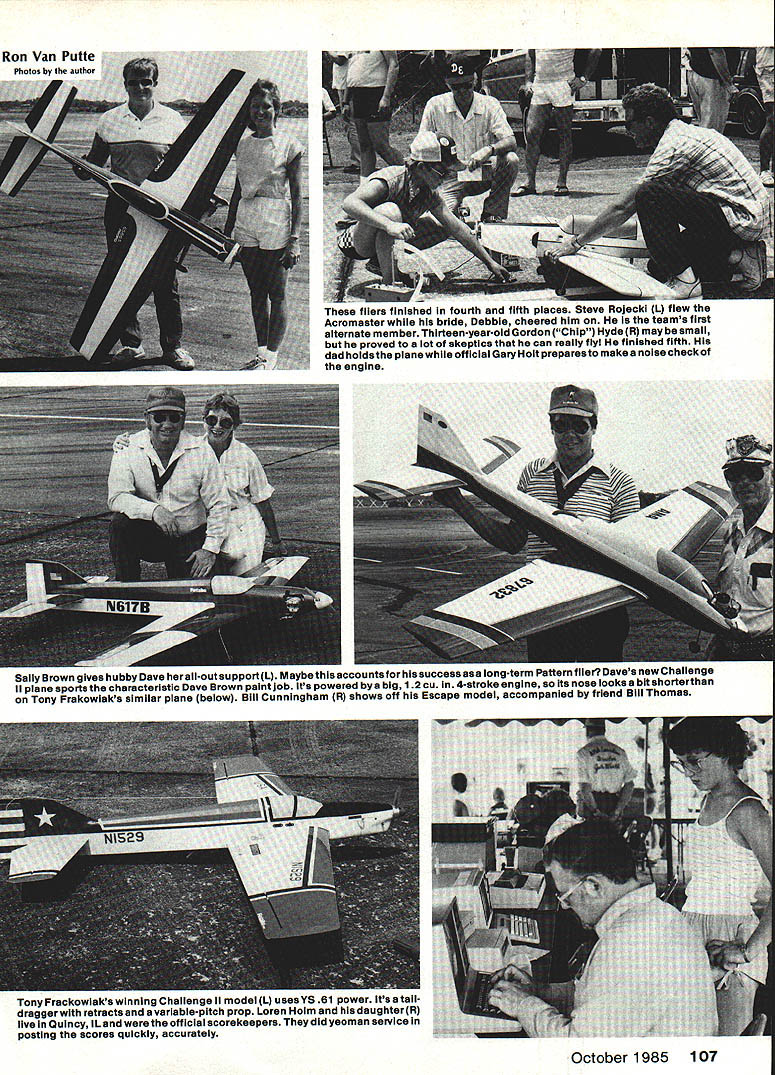
Photographs and captions from the event noted:
- Steve Rojecki flew the Acromaster while his bride Debbie cheered him on. He is the team's first alternate.
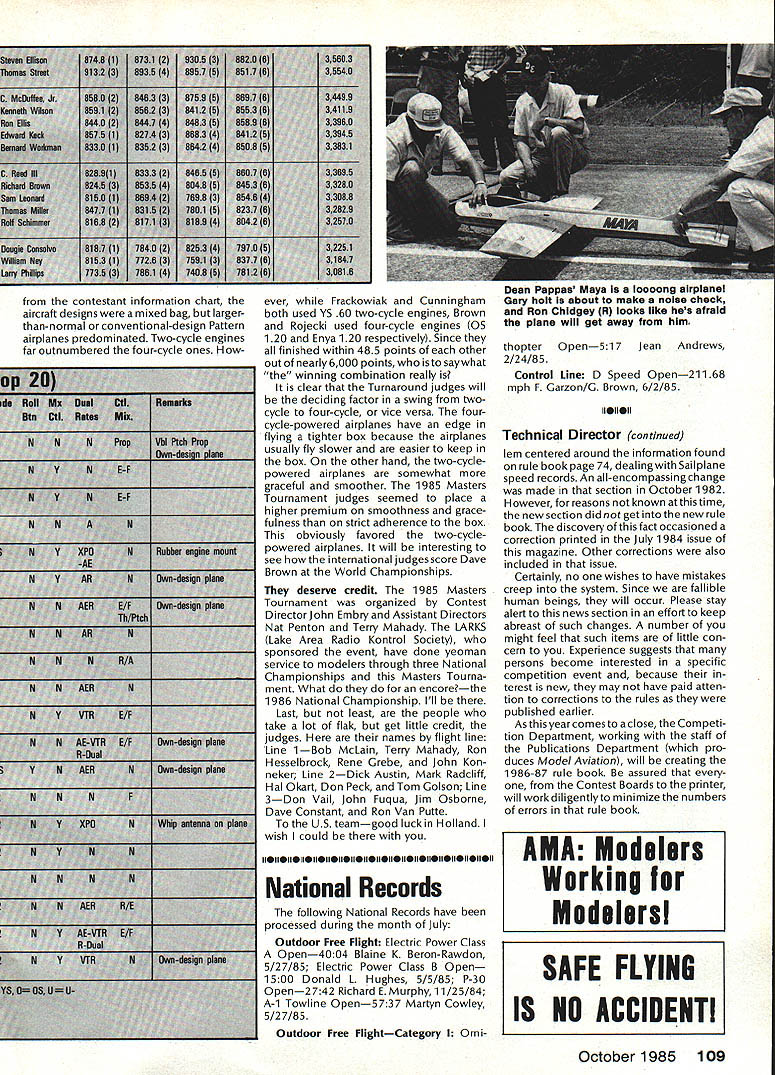
- Thirteen-year-old Gordon ("Chip") Hyde proved many skeptics wrong by finishing fifth. His father held the plane while official Gary Holt prepared a noise check of the engine.
- Sally Brown supported husband Dave; Dave's Challenge II plane sported his characteristic paint job and was powered by a 1.2 cu. in. 4-stroke engine.
- Bill Cunningham showed off his Escape model, accompanied by friend Bill Thomas.
- Tony Frackowiak's winning Challenge II model used YS .61 power; it is a tail-dragger with retracts and a variable-pitch prop.
- Loren Holm and his daughter, official scorekeepers from Quincy, IL, did yeoman service in posting the scores quickly and accurately.
Which combination is best for Turnaround? The 1985 Masters Tournament was expected to clarify the aircraft/engine decision for the Turnaround pattern. From the contestant information, aircraft designs were a mixed bag, but larger-than-normal or conventional-design Pattern airplanes predominated. Two-cycle engines outnumbered four-cycle ones. Frackowiak and Cunningham used YS .60 two-cycle engines; Brown and Rojecki used four-cycle engines (OS 1.20 and Enya 1.20, respectively). Since they all finished within 48.5 points of each other out of nearly 6,000 points, it is difficult to say what "the" winning combination really is.
Judges will influence any swing from two-cycle to four-cycle. Four-cycle-powered airplanes have an edge in flying a tighter box because they usually fly slower and are easier to keep in the box, while two-cycle-powered airplanes are often more graceful and smoother. The 1985 Masters Tournament judges seemed to place a higher premium on smoothness and graceful lines than on strict adherence to the box, which favored the two-cycle-powered airplanes. It will be interesting to see how international judges score Dave Brown at the World Championships.
The 1985 Masters Tournament was organized by Contest Director John Embry and Assistant Directors Pat Penton and Terry Mahady. The LARKS (Lake Area Radio Kontrol Society), who sponsored the event, have done yeoman service to modelers through three National Championships and this Masters Tournament. The author plans to attend the 1986 National Championship at Chenault.
Judges by flight line:
- Line 1: Bob McLain, Terry Mahady, Ron Hesselbrock, Gene Grebe, John Konkeller.
- Line 2: Dick Austin, Mark Radcliff, Hal Obert, Don Peck, Tom Goss.
- Line 3: Don Vail, John Fuqua, Jim Osborne, Dave Constant, Ron Van Putte.
To the U.S. team — good luck in Holland.
National Records
The following National Records have been processed during the month of July:
- Outdoor Free Flight — Electric Power Class A Open: 40:04, Blaine K. Beron-Rawdon, 5/27/85.
- Outdoor Free Flight — Electric Power Class B Open: 15:00, Donald L. Hughes, 5/5/85.
- P-30 Open: 27:42, Richard E. Murphy, 11/25/84.
- A-1 Towline Open: 57:37, Martyn Cowley, 5/27/85.
Competition Newsletter
Competition News will present, from time to time, constructive and thought‑provoking ideas or criticisms of AMA rules and policies which affect competitors. When an issue has two sides, CN will endeavor to present all viewpoints that have been submitted — within the limits of available space, appropriateness, contributiveness, timeliness, and good taste. Determination of the appropriateness of publication of any of these matters must necessarily rest solely with the publisher.
The thoughts presented are those of the author and should not necessarily be construed as those of AMA (or AMA officers) or the publisher. Publication here, or a phrase change or policy change idea, does not necessarily mean that a specific proposal has been presented to the Contest Board, Executive Council, or appropriate committee; such action is the responsibility of the author or anyone else interested in obtaining official action.
CONTEST COORDINATORS
- I — Bernice Williams, 347 Southwick Rd., Westfield, MA 01085
- II — R. Sobrino, 87-26 88th St., Woodhaven, Queens, NY 11421
- RC S — Ernest Nikodem, 407 Willow St., Lockport, NY 14084
- RC — Bill Peon, 28 Fernwood, Commack, NY 11725
- III — Ken Reber, 427 Elm Dr., Nazareth, PA 18084
- Bert M. Weisenbach, 4568 W. 148th, Cleveland, OH 44135
- IV — Warren Sanders Jr., 9735 52nd Ave., College Park, MD 20741
- RC — Ed Byerley, 200 Commander Cove, Stafford, VA 22554
- V — RC Don Peck, 1311 Dotter Dr. NW, Huntsville, AL 35805
- FF — Wallace Johnson, 4112 White Acres Rd., Montgomery, AL 36108
- CL — Joseph Mead, 1339 Rensselaer St., Jacksonville, FL 32205
- VI — RC Charles Gray, 201 Hulman Salem Rd., Terre Haute, IN 47803
- RC Scorer — Dale Folkening, 1039 College Ave., Wheaton, IL 60187
- CL — W. Bodainch Jr., 235 W. Glade, Palatine, IL 60067
- RC Pylon & Soaring / AC Pattern — All other RCs except Soaring
INDOOR CONTEST BOARD
- I — Ray Harlan, 15 Happy Hollow Rd., Wayland, MA 01778
- II — Merrick Andrews, 100 River Rd., A-11, Bogota, NJ 07603
- III — Walt VanGorder, 5668 Victory View Ln., Cincinnati, OH 45238
- IV — Don Strull, 941 Kimberwicke Rd., McLean, VA 22102
- V — John Martin, 2180 Tigertail, Miami, FL 33133
CONTROL LINE CONTEST BOARD
- I — George Higgins, P.O. Box 482, North Pembroke, MA 02358
- II — Bill Boos, 7706 269th St., New Hyde Park, NY 11040
- III — Laird Jackson, 1025 Wales St., Philadelphia, PA 19107
- IV — Ron McNally, 6118 Bards Ann., Springfield, VA 22182
- V — Dane Hemmert, P.O. Box 171, Meocks Corner, SC 29481
FREE FLIGHT CONTEST BOARD
- I — Henry Strock, RFD 2, Hamburg, Old Lyme, CT 06371
- II — Bradley Bane, 80 Lake Ave., Lyndonville, NY 14098
- III — Rody Kisiber, 2021 Lakeland Ave., Lakewood, OH 44107
- IV — Joe Boyle Jr., 219 Shenandoah Rd., Hampton, VA 23361
- V — Bonny Jenkins, 3112 B. Raines Rd., Memphis, TN 38118
SCALE CONTEST BOARD
- I — Tim Snarl, 52 Langholm Dr., Nashua, NH 03060
- II — Robert Clemens, 95 Shoreway Dr., Rochester, NY 14612
- III — Edward Winner, 1521 Summit St., McKeesport, PA 15131
- IV — Bob Karlsson, 2643 Marsh Rd., Wilmington, DE 19810
- V — David Plant, 8940 NW 18th Pt., Fort Lauderdale, FL 33313
AEROBATICS
- I — Lance Murphy, 29 Hightop Cir., East Hamden, CT 06514
- II — Joe Friend, 41 Carriage Hill Dr., Colts Neck, NJ 07722
- III — Ron Hesselbrock, 6320 Blueberry Hill Ct., Cincinnati, OH 45248
- IV — Stacey Mills, P.O. Box 115, Charlottesville, VA 22901
- V — John Thomas, 401 E. Jackson St., Ste. 200, Orlando, FL 32801
HELICOPTER
- I — Ernie Hober, 19 Beaver Park Rd., Danvers, MA 01923
- II — Horace Hegen, 15 Parkway Pl., Red Bank, NJ 07701
- III — Bill Curtis, 218 Vernon Rd., Greenville, PA 16125
- IV — Robert F. Harris, 3257 Estevez Rd., La Plata, MD 20646
- V — Tim Schoonard, c/o Wah Schoonard, 2594 North, Orlando, FL 32804
RACING
- I — Pete Reed, 49 Anvil Dr., Avon, CT 06001
- II — Adam Settler, 41 Perry Ave., Latham, NY 12110
- III — Dave Latsha, 1141 Columbus Ave., Lemoyne, PA 17043
- IV — Cliff Telford, 7417 Arrowood Rd., Bethesda, MD 20817
- V — Gail Jacobson, 2205 Bentley Terrace, College Park, GA 30349
SOARING
- I — Fritz Bien, 41 Sam Mill Rd., Concord, MA 01742
- II — Gordon Stratton, 255 Brentwood St., Kem Gardens, NY 11415
- III — Gene Shalkay, 217 Euclid Ave., Scottsdale, PA 18483
- IV — Bob Champine, 208 Tiptoe Rd., Newport News, VA 23806
- V — James Davis Jr., 1018 Macdale Lane, Madison, MS 39110
- FF — Jim Bennett, 324 Helfenstein Ave., St. Louis, MO 63119
All events except AC entire District except Michigan:
- Greg Seydel, 3825 B Sea Terrace, Cudahy, WI 53110
- RC — Leon Cordy, N4503 Highway 55, Chilton, WI 53014
- Michigan AC — Wayne Yeager, 38235 Castle, Romulus, MI 48174
- CI PP — Paul Smith, 11112 Dill Dr., Sterling Hgts., MI 48077
- VIII — Randy Randolph, P.O. Box 271048, Dallas, TX 75227
- IX — Mike Tallman, 3014 Exchange, Wichita, KS 67217
- AC — George Hopter, 6962 S. Lamar St., Littleton, CO 80123
- X — Hal Jackson, 8288 Sunset Ann., Fair Oaks, CA 95628
- North — Harry Apsian, 27704 Saddle Rd., Rolling Hills, CA 90274
- South — Frank Gomes, 2241 Noah St., Honolulu, HI 96816
- Hawaii meets XI — Tom Cope, 23262 SE 57th St., Rt. 3, Issaquah, WA 98027
- AC — James McCarty, 18958 Marine View Dr., Seattle, WA 98165
PROPOSED RULES FOR RC DURATION CONTESTS
- General
- All AMA safety rules, all general rules for non‑scale Radio Control events given in Section 24 of the AMA rule book, and all local rules as outlined by the Contest Director at individual events will be applicable to this event, provided local rules do not conflict with AMA rules.
- Objective
- To provide an event for engine‑powered models with flight durations as the basis of competition and which can be flown in fields with small takeoff and landing areas, through the use of Radio Control equipment and techniques to return the model to a designated recovery area after each flight.
- Model Aircraft Specifications
- The design and configuration of models will be inspected before the first flight, and any deviation from the criteria in these specifications will be grounds for disqualification. The Contest Director can, at his discretion, require a test flight for models of unconventional design or those where features unusual to typical models are considered for certification. Techniques may be required to demonstrate that the model can be flown safely.
3.1 Engines. Models will be powered by a single reciprocating engine specifically designed and produced in quantities of 500 or more for model aircraft use and available through normal retail outlets. 3.2 Maximum piston displacement will be .25 cubic inch for two‑stroke engines and 2.5 cubic inches for four‑stroke engines. 3.3 Minimum weight. The total weight of the model in ready‑to‑fly configuration (but without fuel) shall be no less than 20 ounces.
- Control System
- All models will have a control system whereby the engine can be shut down at a predetermined time after launch and the contestant can restart the engine after the model is under control and approaching the designated recovery area at the end of each flight.
4.1 Engine Control System. Engine control and/or shut‑off can be accomplished by a radio control device or by another system that will provide positive engine shut‑off at a predetermined time after the model is launched. 4.2 Flight Control System. All models will be equipped with an FCC‑approved radio system which operates on one of the frequencies approved by the FCC for model airplane use. The radio system will have a minimum of one function other than the operation of the engine that can be continuously controlled by the pilot. All models must be capable of maintaining straight and level flight, and recovery to the designated landing area.
- Contest Operations Procedures
- All flights will be launched from and returned to the designated landing area. Contestants must be cleared and described to call contestants who have declared their intent to fly. Radio procedures and the Contest Director's decisions are final during the contest.
- When a model is launched, the contestant must notify the Contest Director. Repeat launches to the same frequency will be recorded. A contestant may leave the flight line for necessary repairs. When the engine is restarted on the contestant's model, the contestant will inform the Contest Director before the model resumes flight. The Contest Director or official helpers may assist the pilot if the model is deemed unsafe.
- A contestant may be allowed extra time for touchdown in order to prevent damage to the model. The Contest Director may disallow an attempt if he feels conditions make it unsafe.
- Timing of Flights
- Timing for each flight starts at the instant the model is launched by hand or released for ROG takeoff. Time for the model begins when the model is airborne. Timing stops when the model touches the ground, strikes an obstruction which prevents further flight, passes from sight of the timers, or when the engine is shut off on purpose or the engine dies from fuel exhaustion. If the model is restarted after landing it will be disallowed for that flight and the time will not be scored.
- If an engine flames out and cannot be restarted but the model is still under control, the flight will be scored as a normal flight.
- A claimant of a restart shall call the attention of the Contest Director before resuming any further flying.
- Scoring of Flights
- Scoring time will be the total time elapsed from the official start of the flight to the instant the model touches the ground or strikes an obstruction. All flights shall be scored in whole seconds and any fraction over one‑half second will be rounded up.
- Landings Outside the Designated Recovery Area
- Any flight which lands outside the recovery area will be disallowed for that flight. The model must be recoverable without undue assistance.
- Flyoffs
- If, after all contestants have recorded three official flights or six attempts, the Contest Director has declared the contest to be over, two or more contestants who have identical scores will be allowed one flyoff attempt each. Maximum flight time for flyoffs will be the same as for official flights; engine runs for flyoffs will not exceed that allowed for official flights.
Proposed by: [name not printed here on scan]
Transcribed from original scans by AI. Minor OCR errors may remain.

