
CL Speed Team: An Apology
Last month, in reporting on the CL Speed team finals, the wrong modeler was credited with being the alternate team member.
Cliff Norman is the alternate team member. Our apologies to Cliff for being the victim of this communications error.
Art Scholl, Former Aeromodeler, Killed
The internationally-recognized full-scale aerobatic pilot and airshow performer Art Scholl was killed in the crash of his aerobatic biplane on September 17, 1985.
Although best-known for his abilities as a full-scale flier, Art credited his lifelong interest in aviation to his early interest in building and flying model airplanes.
The fatal accident, the cause of which remains unknown, occurred while Art was filming some background footage for the forthcoming motion picture, "Top Gun."
Scholl had flown his Pennzoil Chipmunk aerobatic plane before an estimated combined airshow audience of 80 million persons over the past 20 years and had appeared in more than 200 motion picture features, documentaries, and TV commercials.
RC Tournament of Champions Discontinued (But...See p. 105)
Circus Circus Hotel/Casino management announced that the biennial Tournament of Champions, one of the world's premier RC Pattern contests, has been permanently discontinued (the next one would have been held in 1986).
William C. Bennett, chairman of the board and chief executive officer of Circus Circus Enterprises, Inc., announced his regret that this outstanding event, inaugurated in 1974 by himself and Walt Schroder, was being discontinued because of the limitations of time available to the Circus Circus staff — a situation which has arisen because of the phenomenal growth and expansion of Circus Circus over the years. He noted that, since its inception in 1974, the Tournament of Champions has awarded $468,925 in prize money — the richest events in the history of aeromodeling.
Bennett further stressed his pleasure with the many associations he has made with the world's greatest RC pilots, judges, officials, and fans. He hopes to maintain his contact with this great sport through his involvement with Circus Hobbies, Inc.
A Note From the Technical Director
There are two items of interest which, as Technical Director, I would like to call to your attention. First, an Emergency Safety Rule was approved at the August 5, 1985 Executive Council meeting. It will be included in the 1986-87 AMA rule book. This item, to be placed in the Contest Directors' section of the book, will state that: "The Contest Director at an AMA-sanctioned event has the authority to perform safety inspections of any equipment and to prevent any participant from using equipment which, in the CD's opinion, is deemed unsafe."
The purpose of adding the item is to allow the CD a general authority in all events which is now granted in only some specific contest events. The statement is not intended to restrict participation but, rather, to create an environment designed to promote safe operation in our sanctioned events. Some concern has been expressed that a CD could use this item in a capricious manner to prevent a person from flying. While such a possibility exists, I would prefer to think that our CDs will exercise this option only in the most necessary cases.
A second item of interest concerns an annual award to be presented for technical achievement. While all of the details will not be presented here, be alert to the fact that, beginning January 1, 1986, we will be searching the model airplane world for an achievement that contributes in a significant manner to the technical development of the hobby/sport.
In selecting a recipient for the award, consideration will be given to (but not limited to) items or processes that:
- Improve the performance of existing equipment,
- Represent equipment that performs new tasks,
- Tend to make easier the tasks now required in building or flying,
- Encourage safety considerations or noise-suppression.
Consideration of the item or process will be based on (but not limited to) the following factors:
- Its need,
- The manner in which it performs,
- Its innovative quality,
- The possibilities for future development and applications.
There will be application forms available from the Technical Director for use in nominating the potential recipients of the award.
The 1986 Nats is Coming!
The 1986 National Contest will be bigger and better than ever! For the first time, the Nats — the world's largest model airplane contest — will be extended to run over two weekends.
The '86 Nats is being scheduled as part of the AMA's Fiftieth Anniversary Celebration observation. An entirely new attraction of the big meet will occur on the final weekend — August 2-3, 1986 — and will have as its centerpiece attraction a huge Fly-in.
The contest will start on Friday, July 25, 1986 at Lake Charles, LA. The final day of competition will be Friday, August 1. The Nats has been held there on three previous occasions. At this stage of the planning for the '86 Nats, a detailed daily schedule is not available. The schedule will be published in a future issue, as will a continuing series of information updates. Watch the "Competition Newsletter"!
RC Electriflight World Champs Due in 1986
As announced in the July 1985 "Competition Newsletter," a team selection program is in operation to select the three-man team which will represent the U.S. in the 1986 FAI Class F3E Electriflight World Championships August 20-22, 1986 in Lommel, Belgium.
Because of the fact that present FAI rules only recognize Motorgliders, only that category.
RC Aerobatics Contest Board Action: Reclassification Rule Clarification
RC Aerobatics Contest Board Chairman Joe Friend announced the results of the recent ballot on how to handle a Rules Clarification. (The Board could have voted for either Immediate Enforcement, No Immediate Enforcement, or Denial.) The Board's vote was for No Immediate Enforcement, and this requires that the details of the Request for Clarification be published in Model Aviation and a subsequent Contest Board vote be taken to decide on the fate of the matter.
Rule Clarification
The item in question is the "automatic"
Scale Team Finals
Photos by Bob Wischer
RC ♦ Bob Wischer
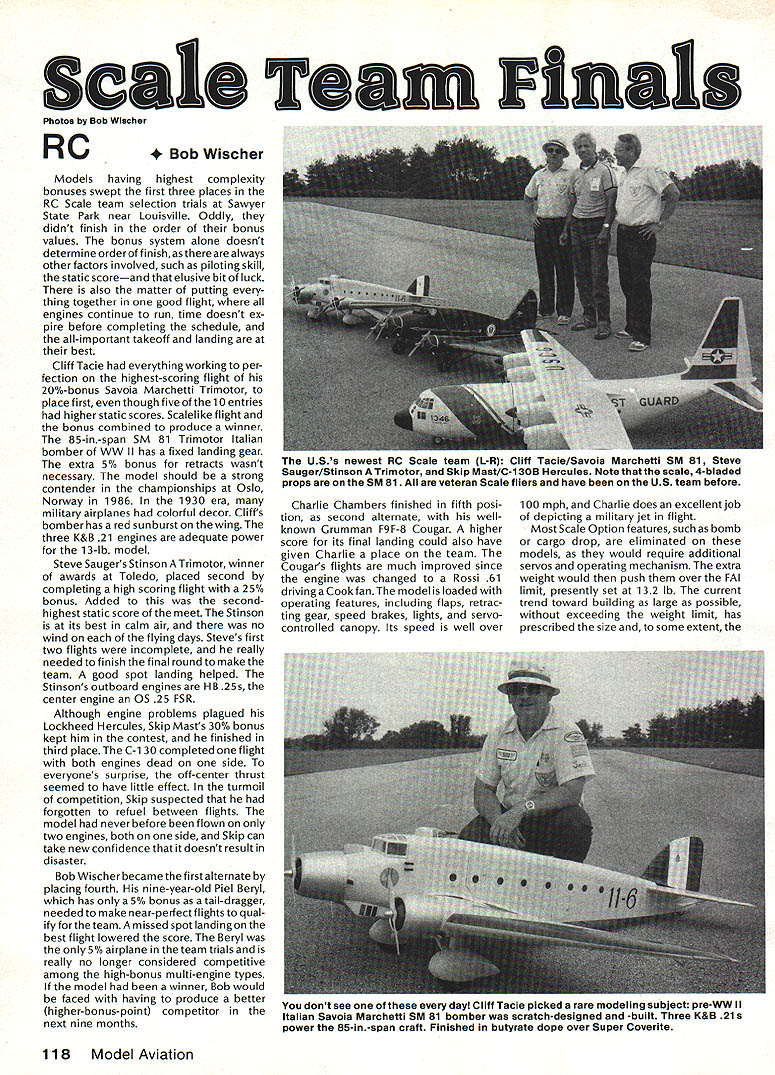
Models having highest complexity bonuses swept the first three places in the RC Scale team selection trials at Sawyer State Park near Louisville. Oddly, they didn't finish in the order of their bonus values. The bonus system alone doesn't determine order of finish, as there are always other factors involved, such as piloting skill, the static score—and that elusive bit of luck. There is also the matter of putting everything together in one good flight, where all engines continue to run, time doesn't expire before completing the schedule, and the all-important takeoff and landing are at their best.
Cliff Tacie had everything working to perfection on the highest-scoring flight of his 20%-bonus Savoia Marchetti Trimotor, to place first, even though five of the 10 entries had higher static scores. Scalelike flight and the bonus combined to produce a winner. The 85-in.-span SM 81 Trimotor Italian bomber of WW II has a fixed landing gear. The extra 5% bonus for retracts wasn't necessary. The model should be a strong contender in the championships at Oslo, Norway in 1986. In the 1930 era, many military airplanes had colorful décor. Cliff's bomber has a red sunburst on the wing. The three K&B .21 engines are adequate power for the 13-lb. model.
Steve Sauger's Stinson A Trimotor, winner of awards at Toledo, placed second by completing a high scoring flight with a 25% bonus. Added to this was the second-highest static score of the meet. The Stinson is at its best in calm air, and there was no wind on each of the flying days. Steve's first two flights were incomplete, and he really needed to finish the final round to make the team. A good spot landing helped. The Stinson's outboard engines are HB .25s, the center engine an OS .25 FSR.
Although engine problems plagued his Lockheed Hercules, Skip Mast's 30% bonus kept him in the contest, and he finished in third place. The C-130 completed one flight with both engines dead on one side. To everyone's surprise, the off-center thrust seemed to have little effect. In the turmoil of competition, Skip suspected that he had forgotten to refuel between flights. The model had never before been flown on only two engines, both on one side, and Skip can take new confidence that it doesn't result in disaster.
Bob Wischer became the first alternate by placing fourth. His nine-year-old Piel Beryl, which has only a 5% bonus as a tail-dragger, needed to make near-perfect flights to qualify for the team. A missed spot landing on the best flight lowered the score. The Beryl was the only 5% airplane in the team trials and is really no longer considered competitive among the high-bonus multi-engine types. If the model had been a winner, Bob would be faced with having to produce a better (higher-bonus-point) competitor in the next nine months.
Charlie Chambers finished in fifth position, as second alternate, with his well-known Grumman F9F-8 Cougar. A higher score for its final landing could also have given Charlie a place on the team. The Cougar's flights are much improved since the engine was changed to a Rossi .61 driving a Cook fan. The model is loaded with operating features, including flaps, retracting gear, speed brakes, lights, and servo-controlled canopy. Its speed is well over 100 mph, and Charlie does an excellent job of depicting a military jet in flight.
Most Scale Option features, such as bomb or cargo drop, are eliminated on these models, as they would require additional servos and operating mechanisms. The extra weight would then push them over the FAI limit, presently set at 13.2 lb. The current trend toward building as large as possible, without exceeding the weight limit, has prescribed the size and, to some extent, the type of model selected by participants in the FAI program. Large models have more realistic performance. The exception is a model such as Charlie Chambers' ducted fan, which substitutes speed for size.
A vote by team members elected Dolly Wischer as team manager and Mike Gretz as assistant, but his travel with the team depends upon fund availability. The team selected at Louisville, and the aircraft that were flown, should do well in the international competition at Oslo. All of the models are serious contenders to become FAI RC Scale champion.
CL — Mike Gretz
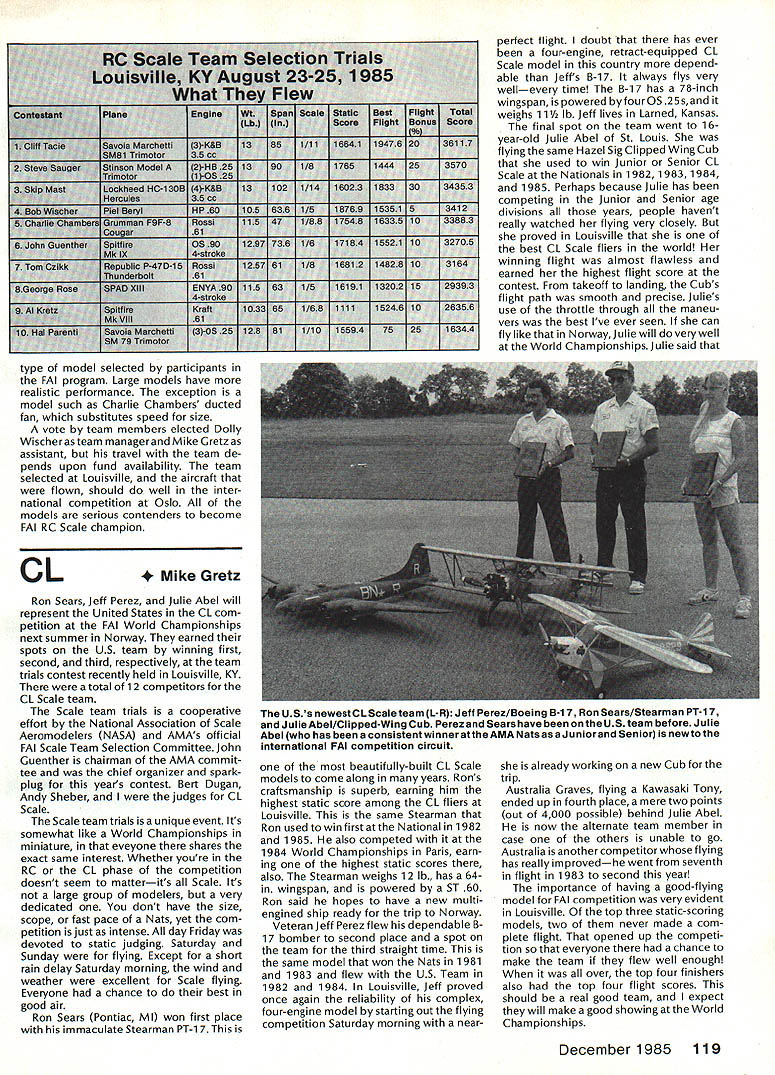
Ron Sears, Jeff Perez, and Julie Abel will represent the United States in the CL competition at the FAI World Championships next summer in Norway. They earned their spots on the U.S. team by winning first, second, and third, respectively, at the team trials contest recently held in Louisville, KY. There were a total of 12 competitors for the CL Scale team.
The Scale team trials is a cooperative effort by the National Association of Scale Aeromodellers (NASA) and AMA's official FAI Scale Team Selection Committee. John Guenther is chairman of the AMA committee and was the chief organizer and spark-plug for this year's contest. Bert Dugan, Andy Sheber, and I were the judges for CL Scale.
The Scale team trials is a unique event. It's somewhat like a World Championships in miniature, in that everyone there shares the exact same interest. Whether you're in the RC or the CL phase of the competition doesn't seem to matter—it's all Scale. It's not a large group of modelers, but a very dedicated one. You don't have the size, scope, or fast pace of a Nats, yet the competition is just as intense. All day Friday was devoted to static judging. Saturday and Sunday were for flying. Except for a short rain delay Saturday morning, the wind and weather were excellent for Scale flying. Everyone had a chance to do their best in good air.
Ron Sears (Pontiac, MI) won first place with his immaculate Stearman PT-17. This is one of the most beautifully-built CL Scale models to come along in many years. Ron's craftsmanship is superb, earning him the highest static score among the CL fliers at Louisville. This is the same Stearman that Ron used to win first at the National in 1982 and 1985. He also competed with it at the 1984 World Championships in Paris, earning one of the highest static scores there. Also, the Stearman weighs 12 lb., has a 64-in. wingspan, and is powered by a .75 OS. Ron said he hopes to have a new multi-engine ship ready for the trip to Norway.
Veteran Jeff Perez flew this dependable B-17 bomber to second place and a spot on the team for the third straight time. This is the same model that won the Nats in 1981 and 1983 and flew with the U.S. team in 1982 and 1984. In Louisville, Jeff proved once again the reliability of his complex, four-engine model by starting out the flying competition Saturday morning with a near-perfect flight. I doubt that there has ever been a four-engine, retract-equipped CL Scale model in this country more dependable than Jeff's B-17. It always flies very well—every time! The B-17 has a 78-in. wingspan, is powered by four OS .25s, and is getting 11 1/2 lb. Jeff lives in Larned, Kansas.
The final spot on the team went to 16-year-old Julie Abel of St. Louis. She was flying the same Hazel Sigi Clipped Wing Cub that she used to win Junior or Senior CL Scale at the Nationals in 1982, 1983, 1984, and 1985. Perhaps because Julie has been competing in the Junior and Senior age groups all those years, people haven't really watched her flying very closely. But she proved in Louisville that she is one of the best CL Scale fliers in the world! Her winning flight was almost flawless and earned her the highest flight score at the contest. From takeoff to landing, the Cub's flight was smooth and precise. Julie's performance through all the maneuvers was the best I've ever seen. If she can fly like that in Norway, Julie will do very well at the World Championships.
CL Aerobatics Team Finals
• Lou Dudka Photos by the author
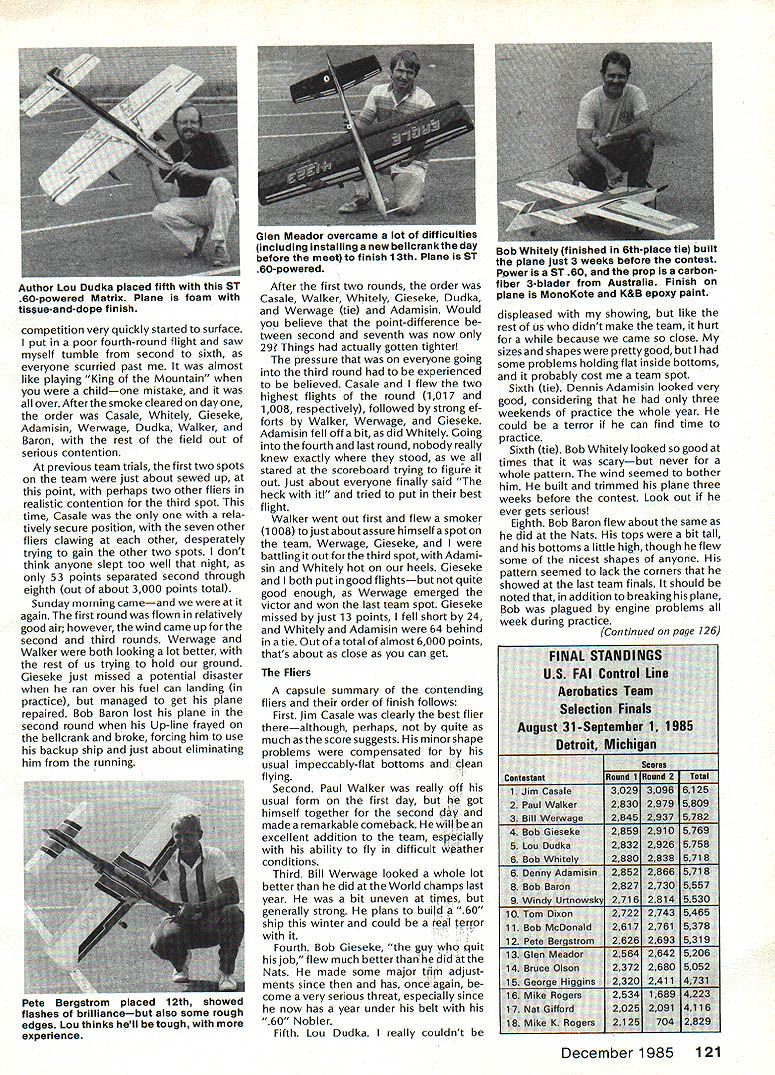
WHEW! This simple, one-word exclamation sums up the story of this year's team-selection finals for the 1986 U.S. FAI Control Line Aerobatics team. The contest site was the parking lot of the Henry Ford Community College in Detroit, MI. Never have—or any of the other competitors—ever experienced anything like these two days of competition, which were described by veteran Stunt flier Bill Werwage as like batting your head against a concrete wall. (Bill is in his 33rd year of model airplane competition, and this was his tenth Stunt team tryout.) Because of the intensity and brutal nature of the contest, I'm sure that if we didn't choose our strongest team this year—we never will!
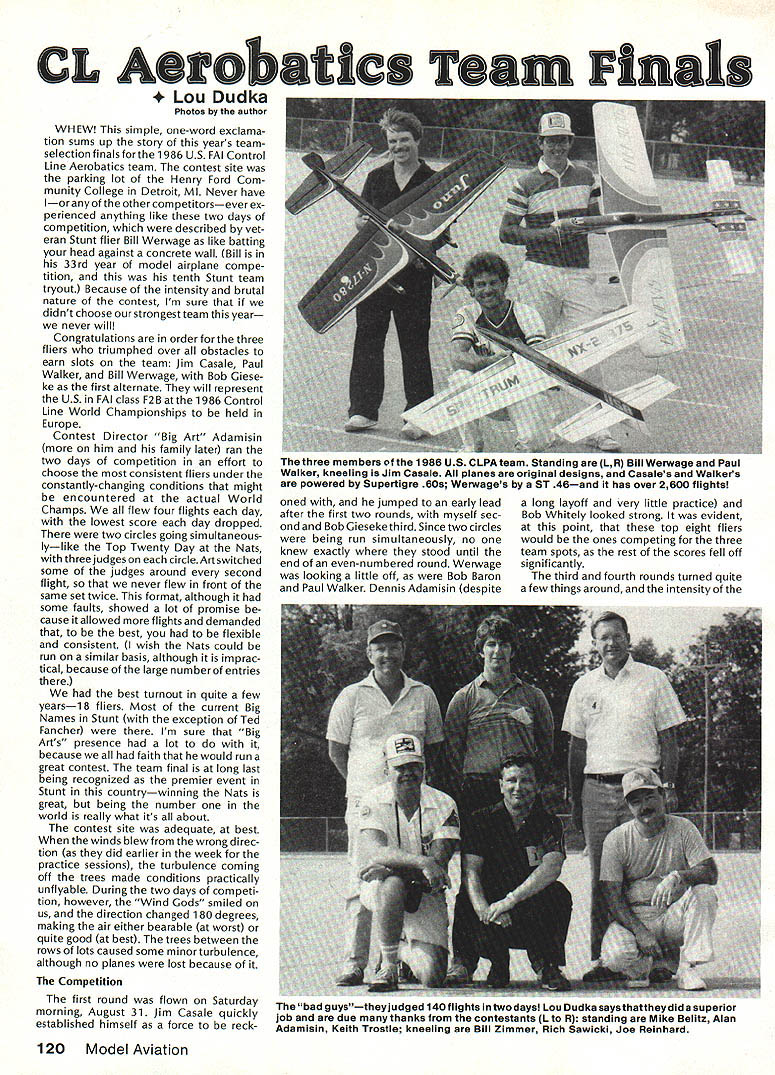
Congratulations are in order for the three fliers who triumphed over all obstacles to earn slots on the team: Jim Casale, Paul Walker, and Bill Werwage, with Bob Gieseke as the first alternate. They will represent the U.S. in FAI class F2B at the 1986 Control Line World Championships to be held in Europe.
Contest Director "Big Art" Adamisin (more on him and his family later) ran the two days of competition in an effort to choose the most consistent fliers under the constantly-changing conditions that might be encountered at the actual World Champs. We all flew four flights each day, with the lowest score each day dropped. There were two circles going simultaneously—like the Top Twenty Day at the Nats, with three judges on each circle. Art switched some of the judges around every second flight, so that we never flew in front of the same set twice. This format, although it had some faults, showed a lot of promise because it allowed more flights and demanded that, to be the best, you had to be flexible and consistent. (I wish the Nats could be run on a similar basis, although it is impractical, because of the large number of entries there.)
We had the best turnout in quite a few years—18 fliers. Most of the current Big Names in Stunt (with the exception of Ted Fancher) were there. I'm sure that "Big Art's" presence had a lot to do with it, because we all had faith that he would run a great contest. The team final is at long last being recognized as the premier event in Stunt in this country—winning the Nats is great, but being the number one in the world is really what it's all about.
The contest site was adequate, at best. When the winds blew from the wrong direction (as they did earlier in the week for the practice sessions), the turbulence coming off the trees made conditions practically unflyable. During the two days of competition, however, the "Wind Gods" smiled on us, and the direction changed 180 degrees, making the air either bearable (at worst) or quite good (at best). The trees between the rows of lots caused some minor turbulence, although no planes were lost because of it.
The Competition
The first round was flown on Saturday morning, August 31. Jim Casale quickly established himself as a force to be reckoned with, and he jumped to an early lead after the first two rounds, with myself second and Bob Gieseke third. Since two circles were being run simultaneously, no one knew exactly where they stood until the end of an even-numbered round. Werwage was looking a little off, as were Bob Baron and Paul Walker. Dennis Adamisin (despite
a long layoff and very little practice) and Bob Whiteley looked strong. It was evident, at this point, that these top eight fliers would be the ones competing for the three team spots, as the rest of the scores fell off significantly.
The third and fourth rounds turned quite a few things around, and the intensity of competition very quickly started to surface. I put in a poor fourth‑round flight and saw myself tumble from second to sixth, as everyone scurried past me. It was almost like playing "King of the Mountain" when you were a child—one mistake, and it was all over. After the smoke cleared on day one, the order was Casale, Whitely, Gieseke, Adamisin, Werwage, Dudka, Walker, and Baron, with the rest of the field out of serious contention.
At previous team trials, the first two spots on the team were just about saved up, at this point, with perhaps two other fliers in realistic contention for the third spot. This time, Casale was the only one with a relatively secure position, with the seven other fliers clawing at each other, desperately trying to gain the other two spots. I don't think anyone slept too well that night, as only 53 points separated second through eighth (out of about 3,000 points total).
Sunday morning came—and we were at it again. The first round was flown in relatively good air; however, the wind came up for the second and third rounds. Werwage and Walker were both looking a lot better, with the rest of us trying to hold our ground. Gieseke just missed a potential disaster when he ran over his fuel can landing (in practice), but managed to get his plane repaired. Bob Baron lost his plane in the second round when his up‑line frayed on the bellcrank and broke, forcing him to use his backup ship and just about eliminating him from the running.
After the first two rounds, the order was Casale, Walker, Whitely, Gieseke, Dudka, and Werwage (tie) and Adamisin. Would you believe that in the point‑difference between second and seventh was now only 29? Things had actually gotten tighter!
The pressure that was on everyone going into the third round had to be experienced to be believed. Casale and I flew the highest flights of the round (1,017 and 1,008, respectively), followed by strong efforts by Walker, Werwage, and Gieseke. Adamisin fell off a bit, as did Whitely. Going into the fourth and last round, nobody really knew exactly where they stood, as we all stared at the scoreboard trying to figure it out. Just about everyone finally said "The heck with it!" and tried to put in their best flight.
Walker went out first and flew a smoker (1,008) to just about assure himself a spot on the team. Werwage, Gieseke, and I were battling it out for the third spot, with Adamisin and Whitely hot on our heels. Gieseke and I both put in good flights—but not quite good enough, as Werwage emerged the victor and won the last team spot. Gieseke missed by just 13 points, I fell short by 24, and Whitely and Adamisin were 64 behind in a tie. Out of a total of almost 6,000 points, that's about as close as you can get.
The Fliers
A capsule summary of the contending fliers and their order of finish follows:
First. Jim Casale was clearly the best flier there—although, perhaps, not by quite as much as the score suggests. His minor shape problems were compensated for by his usual impeccably‑flat bottoms and clean flying.
Second. Paul Walker was really off his usual form on the first day, but he got himself together for the second day and made a remarkable comeback. He will be an excellent addition to the team, especially with his ability to fly in difficult weather conditions.
Third. Bill Werwage looked a whole lot better than he did at the World champs last year. He was a bit uneven at times, but generally strong. He plans to build a ".60" ship this winter and could be a real terror with it.
Fourth. Bob Gieseke, "the guy who quit his job," flew much better than he did at the Nats. He made some major trim adjustments since then and has, once again, become a very serious threat, especially since he now has a year under his belt with his ".60" Nobler.
Fifth. Lou Dudka. I really couldn't be displeased with my showing, but like the rest of us who didn't make the team, it hurt for a while because we came so close. My sizes and shapes were pretty good, but I had some problems holding flat inside bottoms, and it probably cost me a team spot.
Sixth (tie). Dennis Adamisin looked very good, considering that he had only three weekends of practice the whole year. He could be a terror if he can find time to practice.
Sixth (tie). Bob Whitely looked so good at times that it was scary—but never for a whole pattern. The wind seemed to bother him. He built and trimmed his plane three weeks before the contest. Look out if he ever gets serious!
Eighth. Bob Baron flew about the same as he did at the Nats. His tops were a bit tall, and his bottoms a little high, though he flew some of the nicest shapes of anyone. His pattern seemed to lack the corners that he showed at the last team finals. It should be noted that, in addition to breaking his plane, Bob was plagued by engine problems all week during practice.
FINAL STANDINGS U.S. FAI Control Line Aerobatics Team Selection Finals August 31–September 1, 1985 Detroit, Michigan
- Jim Casale — Round 1: 3,029 Round 2: 3,096 Total: 6,125
- Paul Walker — Round 1: 2,830 Round 2: 2,979 Total: 5,809
- Bill Werwage — Round 1: 2,845 Round 2: 2,937 Total: 5,782
- Bob Gieseke — Round 1: 2,859 Round 2: 2,910 Total: 5,769
- Lou Dudka — Round 1: 2,832 Round 2: 2,926 Total: 5,758
- Bob Whitely — Round 1: 2,880 Round 2: 2,838 Total: 5,718
- Denny Adamisin — Round 1: 2,852 Round 2: 2,866 Total: 5,718
- Bob Baron — Round 1: 2,872 Round 2: 2,730 Total: 5,602
- Windy Urtnowsky — Round 1: 2,716 Round 2: 2,814 Total: 5,530
- Tom Dixon — Round 1: 2,722 Round 2: 2,743 Total: 5,465
- Bob McDonald — Round 1: 2,617 Round 2: 2,761 Total: 5,378
- Pete Bergstrom — Round 1: 2,626 Round 2: 2,693 Total: 5,319
- Glen Meador — Round 1: 2,564 Round 2: 2,642 Total: 5,206
- Bruce Olson — Round 1: 2,372 Round 2: 2,680 Total: 5,052
- George Higgins — Round 1: 2,320 Round 2: 2,411 Total: 4,731
- Mike Rogers — Round 1: 2,534 Round 2: 1,689 Total: 4,223
- Nat Gifford — Round 1: 2,025 Round 2: 2,091 Total: 4,116
- Mike K. Rogers — Round 1: 2,125 Round 2: 704 Total: 2,829
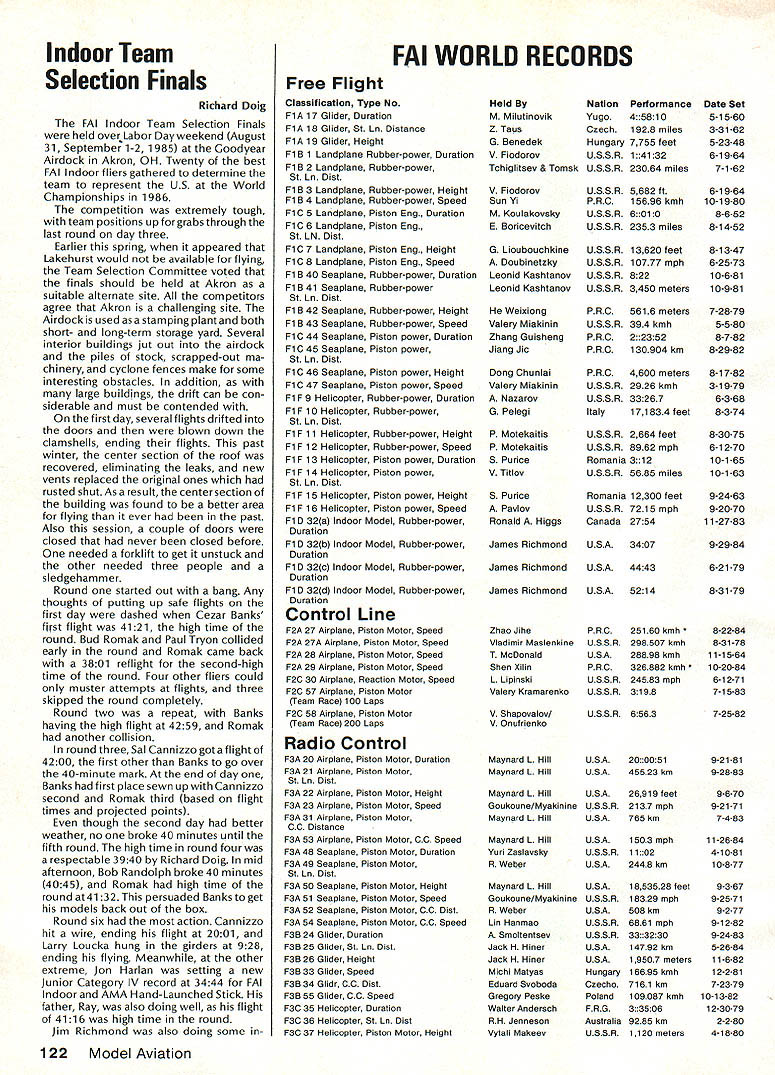
Indoor Team Selection Finals
Richard Doig
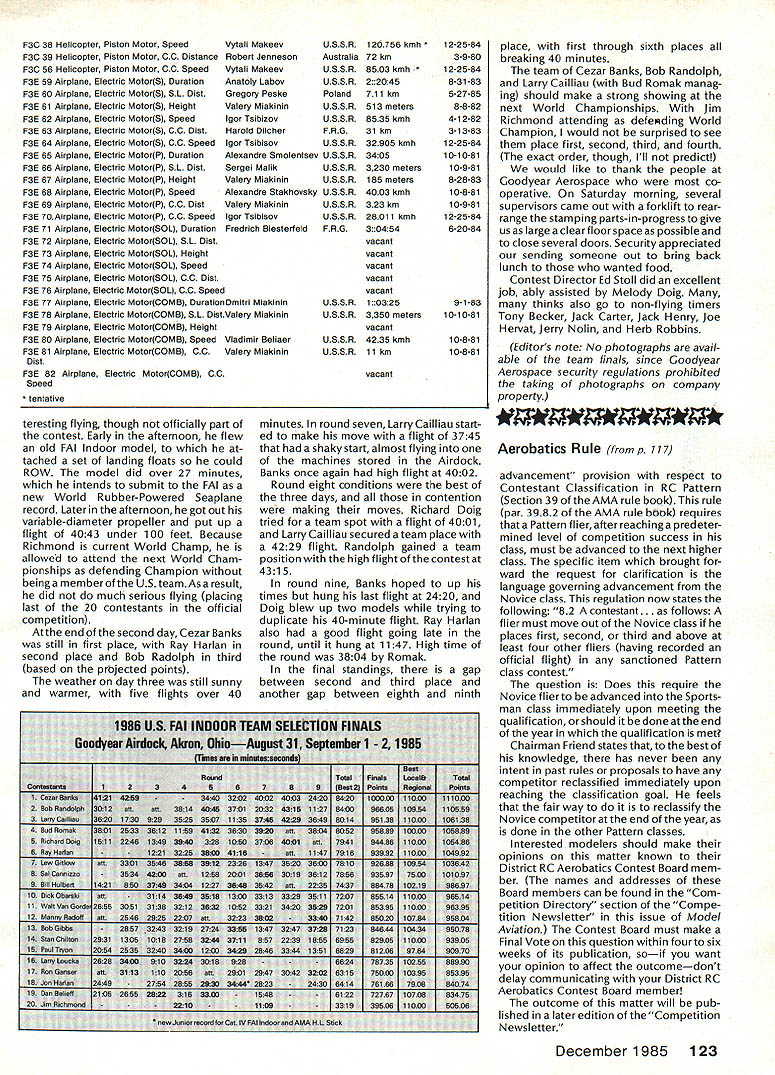
The FAI Indoor Team Selection Finals were held over Labor Day weekend (August 31, September 1-2, 1985) at the Goodyear Airdock in Akron, OH. Twenty of the best FAI indoor flyers gathered to determine the team to represent the U.S. at the World Championships in 1986.
The competition was extremely tough, with team positions up for grabs through the last round on day three.
Earlier this spring, when it appeared that Lakehurst would not be available for flying, the Team Selection Committee voted that the finals should be held at Akron as a suitable alternate site. All the competitors agree that Akron is a challenging site. The Airdock is used as a stamping plant and both short- and long-term storage yard. Several interior buildings jut out into the airdock and the piles of stock, scrapped-out machinery, and cyclone fences make for some interesting obstacles. In addition, as with many large buildings, the drift can be considerable and must be contended with.
On the first day, several flights drifted into the doors and then were blown down the clamshells, ending their flights. This past winter, the center section of the roof was recovered, eliminating the leaks, and new tents replaced the original ones which had rusted shut. As a result, the center section of the building was found to be a better area for flying than it ever had been in the past. Also this session, a couple of doors were closed that had never been closed before. One needed a forklift to get it unstuck and the other needed three people and a sledgehammer.
Round one started out with a bang. Any thoughts of putting up safe flights on the first day were dashed when Cezar Banks' first flight was 4:21, the high time of the round. Bud Romak and Paul Tryon collided early in the round and Romak came back with a 38:01 ref light for the second-high time of the round. Four other fliers could only muster attempts at flights, and three skipped the round completely.
Round two was a repeat, with Banks having the high flight at 42:59, and Romak had another collision.
In round three, Sal Cannizzo got a flight of 42:00, the first other than Banks to go over the 40-minute mark. At the end of day one, Banks had first place sewn up with Cannizzo second and Romak third (based on flight times and projected points).
Even though the second day had better weather, none broke 40 minutes until the fifth round. The high time in round four was a respectable 39:40 by Richard Doig. In mid afternoon, Bob Randolph broke 40 minutes (40:45), and Romak had high time of the round at 41:32. This persuaded Banks to get his models back out of the box.
Round six had the most action. Cannizzo hit a wire, ending his flight at 20:01, and Larry Loucka hung in the girders at 9:28, ending his flying. Meanwhile, the other extreme, Don Harlan was winning at a new Junior Category IV record at 34:44 for FAI Indoor and AMA Hand-Launched Stick. His father, Ray, was also doing well, as his flight of 41:16 was high time in the round.
Jim Richmond was also doing some in- Interesting flying, though not officially part of the contest. Early in the afternoon, he flew an old FAI Indoor model, to which he attached a set of landing floats so he could ROW. The model did over 27 minutes, which he intends to submit to the FAI as a new World Rubber-Powered Seaplane record. Later in the afternoon, he got out his variable-diameter propeller and put up a flight of 40:43 under 100 feet. Because Richmond is current World Champ, he is allowed to attend the next World Championships as defending Champion without being a member of the U.S. team. As a result, he did not do much serious flying (placing last of the 20 contestants in the official competition).
At the end of the second day, Cezar Banks was still in first place, with Ray Harlan in second place and Bob Randolph in third (based on the projected points).
The weather on day three was still sunny and warmer, with five flights over 40 minutes. In round seven, Larry Cailliau started to make his move with a flight of 37:45 that had a shaky start, almost flying into one of the machines stored in the Airdock. Banks once again had high flight at 40:02.
Round eight conditions were the best of the three days, and all those in contention were making their moves. Richard Doig tried for a team spot with a flight of 40:01, and Larry Cailliau secured a team place with a 42:29 flight. Randolph gained a team position with the high flight of the contest at 43:15.
In round nine, Banks hoped to up his times but had his last flight at 24:20, and Doig blew up two models while trying to duplicate his 40-minute flight. Ray Harlan also had a good flight going late in the round, until it hung at 11:47. High time of the round was 38:04 by Romak.
In the final standings there is a gap between second and third place and another gap between eighth and ninth place, with first through sixth places all breaking 40 minutes.
The team of Cezar Banks, Bob Randolph, and Larry Cailliau (with Bud Romak managing) should make a strong showing at the next World Championships. With Jim Richmond not attending as defending World Champion, I would not be surprised to see them place first, second, third, and fourth. (The exact order, though, I'll not predict!)
We would like to thank the people at Goodyear Aerospace who were most cooperative. On Saturday morning, several supervisors came out with a forklift to rearrange the stamping parts-in-progress to give us as large a clear floor space as possible and to close several doors. Security appreciated our sending someone out to bring back lunch to those who wanted food.
Contest Director Ed Stoll did an excellent job, ably assisted by Melody Doig. Many, many thanks also go to non-flying timers Tony Becker, Jack Carter, Jack Henry, Joe Herrat, Jerry Nolin, and Herb Robbins.
(Editor's note: No photographs are available of the team finals, since Goodyear Aerospace security regulations prohibited the taking of photographs on company property.)
Competition Newsletter
CL Speed Team — An Apology
Last month, in reporting CL Speed team finals, the wrong modeler was credited as being an alternate team member. Cliff Norman, alternate team member, apologizes for being the victim of a communications error.
Art Scholl, Former Aeromodeler, Killed
Internationally-recognized full-scale aerobatic pilot and airshow performer Art Scholl was killed in the crash of his aerobatic biplane on September 17, 1985. Although best-known for his abilities as a full-scale flier, Scholl is credited with a lifelong interest in aviation and an early interest in building and flying model airplanes. The cause of the fatal accident remains unknown. The accident occurred while Scholl was filming some background footage for the forthcoming motion picture Top Gun. Scholl had flown a Pennzoil Chipmunk aerobatic plane before an estimated combined airshow audience of 80 million persons over the past 20 years and appeared in some 200 motion-picture features, documentaries, and TV commercials.
RC Tournament Champions Discontinued — But See p. 105
Circus Circus Hotel/Casino management announced the biennial Tournament Champions, the world's premier RC Pattern contest, has been permanently discontinued; the next event would have been held in 1986. William C. Bennett, chairman of the board and chief executive officer of Circus Circus Enterprises, Inc., announced regret at discontinuing the outstanding event inaugurated in 1974. He and Walt Schroder noted it is being discontinued because of limitations in time available to Circus Circus staff. A situation has arisen because of the phenomenal growth and expansion of Circus Circus over the years. Since its inception in 1974, Tournament Champions has awarded $468,925 in prize money — the richest events in the history of aeromodeling. Bennett further stressed the pleasure the association has known with the world's greatest RC pilots, judges, officials, and fans, and hopes to maintain contact with the great sport through involvement with Circus Hobbies, Inc.
Note — Technical Director W. Bob Underwood
The Technical Director would like to call attention to two items of interest.
First: An Emergency Safety Rule approved at the August 5, 1985 Executive Council meeting will be included in the 1986–87 AMA rule book. The item, placed in the Contest Directors section of the book, will state the Contest Director of an AMA‑sanctioned event has the authority to perform safety inspections of equipment and to prevent a participant from using equipment the CD, in his opinion, deems unsafe. The purpose of adding the item is to allow the CD general authority similar to that now granted in some specific contest events. The statement is intended to protect participation rather than restrict it, and to create an environment designed to promote safe operation at sanctioned events. Some concern has been expressed that a CD could use the item in a capricious manner to prevent a person from flying. Such a possibility exists; we would prefer to think CDs will exercise the option only in necessary cases.
Second: An annual award presented for technical achievement. Details will be presented later; be alert to the fact that beginning January 1, 1986, AMA will be searching the model airplane world for an achievement which contributes in a significant manner to the technical development of the hobby/sport. When selecting a recipient, award consideration will be given to the following item/process categories:
- Improves performance of existing equipment
- Represents equipment that performs new tasks
- Tends to make easier tasks now required in building/flying
- Encourages safety considerations, noise suppression
Consideration of any item for the award process will be based on the following factors:
- Its need
- The manner in which it performs
- Its innovative quality
- Possibilities for future development and applications
Application forms will be available from the Technical Director for use in nominating potential recipients.
The 1986 Nats — Coming
The 1986 National Contest will be bigger and better than ever. For the first time, the Nats — the world's largest model airplane contest — will be extended over two weekends. The '86 Nats are being scheduled as part of AMA's Fiftieth Anniversary Celebration observation. An entirely new attraction at the big meet will occur the final weekend, August 2–3, 1986, and will have as its centerpiece a huge Fly‑in. The contest will start Friday, July 25, 1986, at Lake Charles, LA; the final day of competition will be Friday, August 1. The Nats has been held on three previous occasions [as stage planning]. A detailed daily schedule is available and will be published in a future issue as part of a continuing series of information updates. Watch Competition Newsletter for updates.
PARTICIPANTS' COMMENTS: RC SOARING WORLD CHAMPIONSHIPS
(The members of the U.S. Soaring team and the team manager were invited to submit comments and observations about their experiences at the 1985 Soaring World Championships. The following responses were received. Similar invitations are offered to the members and managers of all U.S. teams participating in World Championships.)
Manager's Report
Blaine Beron-Rawdon
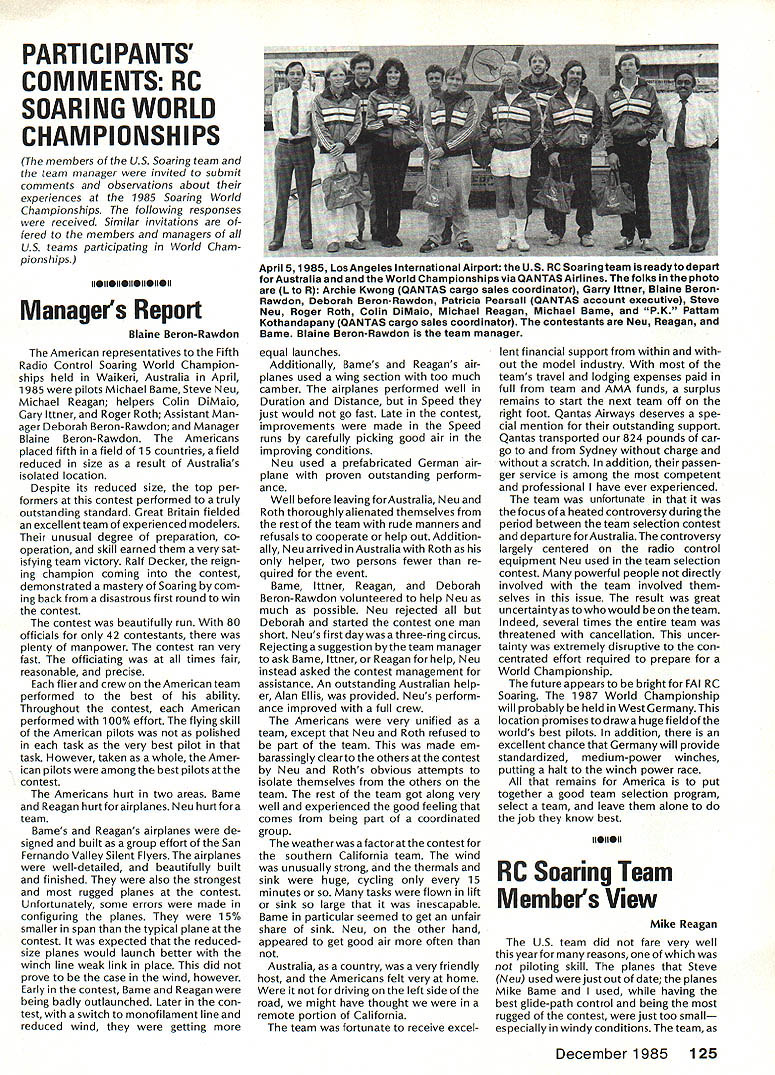
The American representatives to the Fifth Radio Control Soaring World Championships held in Waikerie, Australia in April, 1985 were pilots Michael Bame, Steve Neu, Michael Reagan; helpers Colin DiMaio, Gary Ittner, and Roger Roth; Assistant Manager Deborah Beron-Rawdon; and Manager Blaine Beron-Rawdon. The Americans placed fifth in a field of 15 countries, a field reduced in size as a result of Australia's isolated location.
Despite its reduced size, the top performers at this contest performed to a truly outstanding standard. Great Britain fielded an excellent team of experienced modelers. Their unusual degree of preparation, cooperation, and skill earned them a very satisfying team victory. Ralf Decker, the reigning champion, retained his title.
The contest was beautifully run. With 80 officials for only 42 contestants, there was plenty of manpower. The contest ran very fast. The officiating was at all times fair, reasonable, and precise.
Each flier and crew on the American team performed to the best of his ability. Throughout the contest, each American performed with 100% effort. The flying skill of the American pilots was not as polished in each task as the very best pilot in that task. However, taken as a whole, the American pilots were among the best pilots at the contest.
The Americans hurt in two areas. Bame and Reagan hurt for airplanes. Neu hurt for a team.
Bame's and Reagan's airplanes were designed and built as a group effort of the San Fernando Valley Silent Flyers. The airplanes were well-detailed, and beautifully built and finished. They were also the heaviest and most rugged planes at the contest. Unfortunately, some errors were made in configuring the planes. The error was smaller in span than the typical plane at the contest. It was expected that the reduced-size planes would launch better with the wing line weak link in place. This did not occur to be the case in the wind, however. Early in the contest, Bame and Reagan were being badly outlaunched. Later in the contest, with a switch to monofilament line and reduced wind, they were getting more equal launches.
Additionally, Bame's and Reagan's airplanes used a wing section with too much camber. The airplanes performed well in Duration and Distance, but in Speed they just would not go fast. Late in the contest, improvements were made in the Speed runs by carefully picking good air in the improving conditions.
Neu used a prefabricated German airplane with proven outstanding performance.
Well before leaving for Australia, Neu and Roth thoroughly alienated themselves from the rest of the team with rude manners and refusals to cooperate or help out. Additionally, Neu arrived in Australia with Roth as his only helper, two persons fewer than required for a team.
Bame, Ittner, Reagan, and Deborah Beron-Rawdon volunteered to help Neu as much as possible. Neu rejected all but Deborah and started the contest one man short. Neu's first day was a three-ring circus. Rejecting a suggestion by the team manager to ask Bame, Ittner, or Reagan for help, Neu instead asked the contest organizer to ask Bame, Ittner, or Reagan for help. Neu insisted that the contest management be asked to help. The contest director, Alan Ellis, was quite willing to supply assistance. The Americans were very unified as a team, except that Neu and Roth refused to be part of the team. This was made embarrassingly clear to the others at the contest by Neu and Roth's obvious attempts to isolate themselves from the others on the team. The rest of the team got along very well and experienced the good feeling that comes from being part of a coordinated group.
The weather was a factor at the contest for the southern California team. The wind was unusually strong, and the thermals and sink were huge, cycling on every 15 minutes or so. Many tasks were flown in lift or sink so large that it was inescapable. Bame in particular seemed to get an unfair share of sink. Neu, on the other hand, appeared to get good air more often than not.
Australia, as a country, was a very friendly host, and the Americans felt very at home. Were it not for the difference in the left side of the road, we might have thought we were in a remote portion of California.
The team was fortunate to receive excellent financial support from within and without the model industry. With most of the team's travel and lodging expenses paid in full from team and AMA funds, a surplus remains to start the next team off on the right foot. Qantas Airlines deserves special mention for their outstanding support. Qantas transported our 824 pounds of cargo to and from Sydney without charge and without a scratch. In addition, their passenger service is among the most competent and professional I have ever experienced.
The team indicates that it was the better contest in that the team selection and departure for Australia were handled in a professional manner. The controversy centered in the radio control equivalent of "who's on the team" — people not directly involved with the team involved themselves in this issue. The result was great uncertainty as to who would be on the team. Indeed, several times the team was threatened with cancellation. This uncertainty was extremely disruptive to the concentrated effort required to prepare for a World Championship.
The future appears to be bright for R/C Soaring. The 1987 World Championship will probably be held in West Germany; this location promises to draw a huge field of the world's best pilots. In addition, there is an excellent chance that Germany will provide standardized, medium‑power winches, putting a halt to the winch‑power race.
All that remains for America is to put together a good team selection program, select a team, and leave them alone to do the job they know best.
Competition Newsletter
CL Speed Team — An Apology
Last month, in reporting CL Speed team finals, the wrong modeler was credited — the alternate team member, Cliff Norman. The alternate team member apologizes; Cliff was the victim of a communications error.
Art Scholl — Former Aeromodeler Killed
Internationally recognized full‑scale aerobatic pilot and airshow performer Art Scholl was killed in the crash of an aerobatic biplane on September 17, 1985. Although best known for his abilities as a full‑scale flier, Scholl credited a lifelong interest in aviation to an early interest in building and flying model airplanes. The fatal accident, the cause of which remains unknown, occurred as Scholl was filming some background footage for the forthcoming motion picture Top Gun. Scholl had flown a Pennzoil Chipmunk aerobatic plane before an estimated combined airshow audience of 80 million persons over the past 20 years and had appeared in some 200 motion picture features, documentaries and TV commercials.
RC Tournament Champions Discontinued
Circus Circus Hotel/Casino management announced the biennial Tournament Champions, the world’s premier R/C Pattern contest, has been permanently discontinued. The next contest would have been held in 1986. William C. Bennett, chairman of the board and chief executive officer of Circus Circus Enterprises, Inc., announced with regret that the outstanding event, inaugurated in 1974 by himself and Walt Schroder, is being discontinued because of limitations in time available from Circus Circus staff. "A situation has arisen because of phenomenal growth and expansion of Circus Circus over the years," he noted. Since its inception in 1974, Tournament Champions has awarded $468,925 in prize money — the richest events in the history of aeromodeling. Bennett further stressed the pleasure the associations have had with the world’s greatest R/C pilots, judges, officials and fans, and hopes to maintain contact with the great sport through the involvement of Circus Hobbies, Inc.
A Note — Technical Director W. Bob Underwood
First, an Emergency Safety Rule approved at the August 5, 1985 Executive Council meeting will be included in the 1986–87 AMA rule book. The item, placed in the Contest Directors section of the book, will state that the Contest Director at an AMA‑sanctioned event has the authority to perform safety inspections of equipment and to prevent a participant from using equipment the CD deems unsafe. The purpose of adding the item is to allow the CD a general authority now granted in some specific contest events. The statement is intended not to restrict participation but to create an environment designed to promote safe operation at sanctioned events. Some concern has been expressed that a CD could use the item in a capricious manner to prevent a person from flying; such a possibility exists, but it is hoped that CDs will exercise the option only in necessary cases.
Second, an item of interest concerns an annual award presented for technical achievement. Details will be presented later, but be alerted to the fact that beginning January 1, 1986, AMA will be searching the model airplane world for achievements that contribute in a significant manner to the technical development of the hobby/sport. In selecting a recipient, award consideration will be given to items or processes that:
- Improve the performance of existing equipment
- Represent equipment that performs new tasks
- Tend to make easier the tasks now required in building and flying
- Encourage safety considerations and noise‑suppression
Consideration of items will be based on the following factors:
- Its need
- The manner in which it performs
- Its innovative quality
The 1986 Nats Is Coming
The 1986 National Contest will be bigger and better than ever. For the first time, the Nats, the world’s largest model airplane contest, will be extended over two weekends. The ’86 Nats are being scheduled as part of the AMA’s Fiftieth Anniversary Celebration observation. An entirely new attraction at the big meet will occur the final weekend — August 2–3, 1986 — and will have as its centerpiece a huge Fly‑in. The contest will start Friday, July 25, 1986, at Lake Charles, LA, and the final day of competition will be Friday, August 1. The Nats has been held on three previous occasions under similar planning. A detailed daily schedule for the ’86 Nats will be published in a future issue as part of a continuing series of information updates. Watch Competition Newsletter for more details.
Transcribed from original scans by AI. Minor OCR errors may remain.

