
Competition Newsletter
ACADEMY OF MODEL AERONAUTICS
More Nats Results
The Senior-class winners in the CL Formula "40" Speed event were accidentally left out of the Nats results in the November 1985 issue.
CL Formula "40" Speed — Seniors — MPH
- Joe Gruber, Glendale, NY — 145.57
- James W. Ricketts, Sioux Falls, SD — 138.25
Watch Out for Changes in the New 1986-87 Competition Rules!
The new 1986-87 rule book will be out soon, and the rules will become effective January 1, 1986. All competitors should carefully check the rules for their favorite event(s) for changes. It is a cause for much consternation and frustration to arrive at the first contest of the 1986 season and find, during model processing or flying, new rules that you are not prepared for.
Examples of changes:
- RC Giant Scale and Sport Scale Sailplane are no longer provisional events.
- RC Helicopter rules have been completely overhauled.
- Scale Helicopter rules have changed.
- Maximum engine displacement (four-cycle) has changed in RC Sport Scale and RC Giant Scale.
These are just a few examples — review the new book carefully.
1986 World Championships Unsettled
As of the end of October, the sites for the forthcoming Indoor and Control Line World Championships have not been approved by the FAI. This is an unusual situation so late in the program. The sites will probably not be approved until the December FAI/CIAM meeting in Paris. We will report on this as soon as possible thereafter.
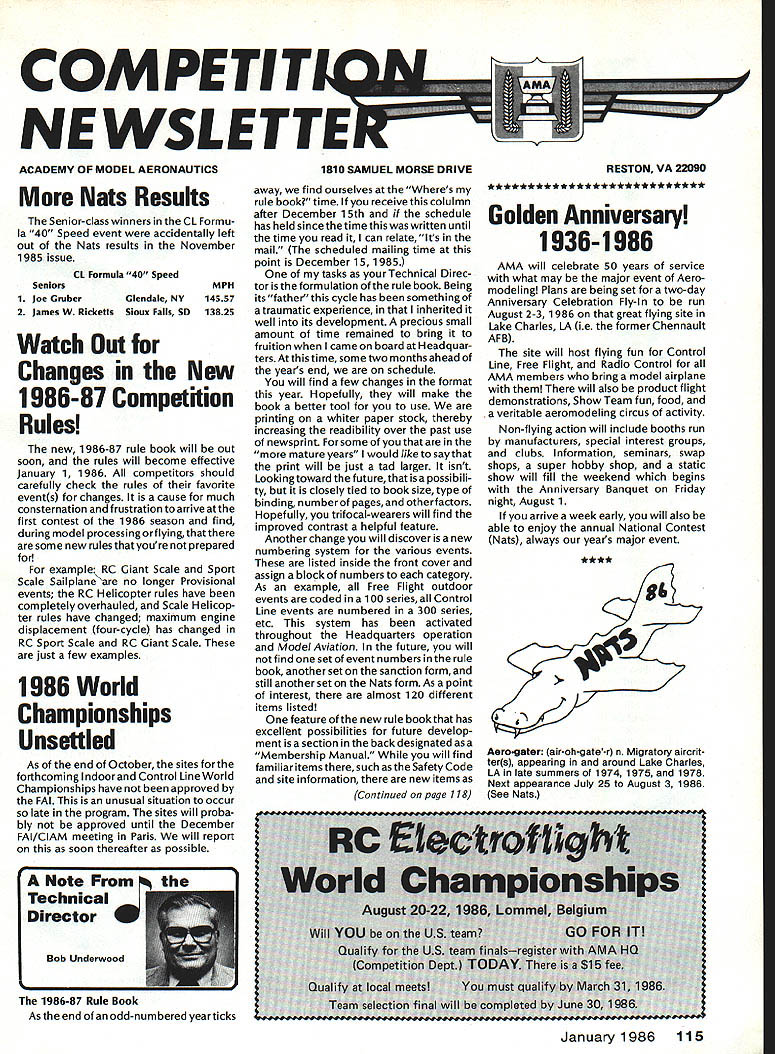
A Note From the Technical Director
Bob Underwood
The 1986-87 Rule Book
As the end of an odd-numbered year approaches, we find ourselves at the "Where's my rule book?" time. If you receive this column after December 15 and the schedule has held, I can say, "It's in the mail." (The scheduled mailing time at this point is December 15, 1985.)
One of my tasks as Technical Director is the formulation of the rule book. Being its "father" this cycle has been somewhat traumatic, since I inherited it well into its development. A precious small amount of time remained to bring it to fruition when I came on board at Headquarters. At this time, some two months ahead of the year's end, we are on schedule.
You will find a few format changes this year intended to make the book a better tool:
- We are printing on a whiter paper stock, increasing readability over the past use of newsprint.
- The print will be slightly larger for improved legibility for those in the "more mature years." Further increases depend on book size, binding type, number of pages, and other factors.
- Improved contrast should help trifocal wearers.
Another change is a new numbering system for the various events. The front cover lists blocks of numbers assigned to each category (for example, all Free Flight outdoor events are in the 100 series; Control Line events in the 300 series). This system has been activated throughout Headquarters and Model Aviation so that the event numbers will be consistent across the rule book, sanction forms, and Nats forms. There are almost 120 different items listed.
One feature with excellent potential is a section in the back designated as a "Membership Manual." While it includes familiar items such as the Safety Code and site information, there are new items as well.
Golden Anniversary! 1936–1986
AMA will celebrate 50 years of service with what may be the major event of aeromodeling. Plans are being set for a two-day Anniversary Celebration Fly-In to be run August 2–3, 1986, at the Lake Charles, LA flying site (the former Chennault AFB).
The site will host flying for Control Line, Free Flight, and Radio Control for all AMA members who bring a model airplane. There will also be product flight demonstrations, show team exhibitions, food, and a wide variety of aeromodeling activities.
Non-flying attractions will include booths run by manufacturers, special interest groups, and clubs. Information seminars, swap shops, a super hobby shop, and a static show will fill the weekend, which begins with the Anniversary Banquet on Friday night, August 1.
If you arrive a week early, you can also enjoy the annual National Contest (Nats), always the year's major event. Next appearance: July 25 to August 3, 1986.
FAI Combat Trials — Report
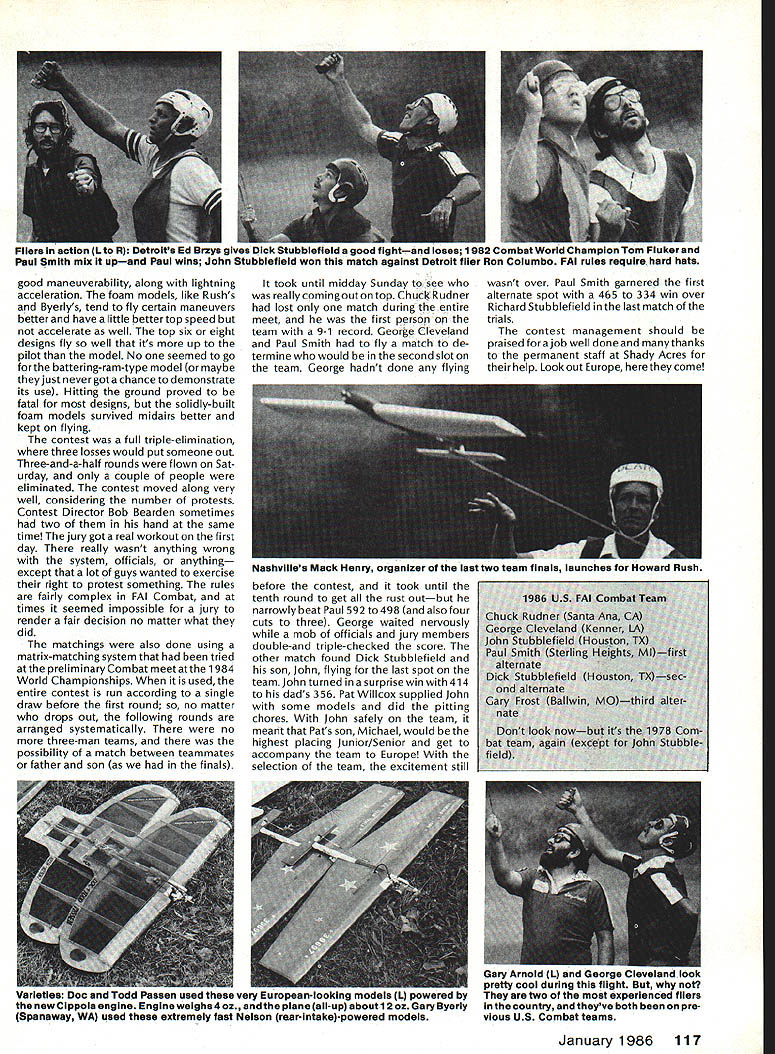
Many of the top designs demonstrated good maneuverability and lightning acceleration. Solidly built foam models (like those by Rush and Byerly) tended to fly certain maneuvers better and had slightly higher top speed, though they did not accelerate as well as some other designs. The top six or eight designs flew so well that pilot skill became the deciding factor. Few contestants favored the battering-ram-type model, or at least none had a chance to show its strengths. Hitting the ground proved fatal for most designs, but the durable foam models survived midairs better and often kept flying.
The contest was a full triple-elimination format (three losses eliminated a competitor). Three-and-a-half rounds were flown on Saturday, and only a couple of people were eliminated. The contest moved along well despite the number of protests; Contest Director Bob Beaden sometimes had two protests in hand at once. The jury was busy on the first day. The rules are fairly complex in FAI Combat, and at times it seemed difficult for a jury to render a perfectly fair decision.
Matchings were done using a matrix-matching system tried at the preliminary Combat meet at the 1984 World Championships. With this system, the entire contest is run according to a single draw before the first round; subsequent rounds are arranged systematically regardless of dropouts. There were no more three-man teams, and matches between teammates (or even father and son) were possible, as happened in the finals.
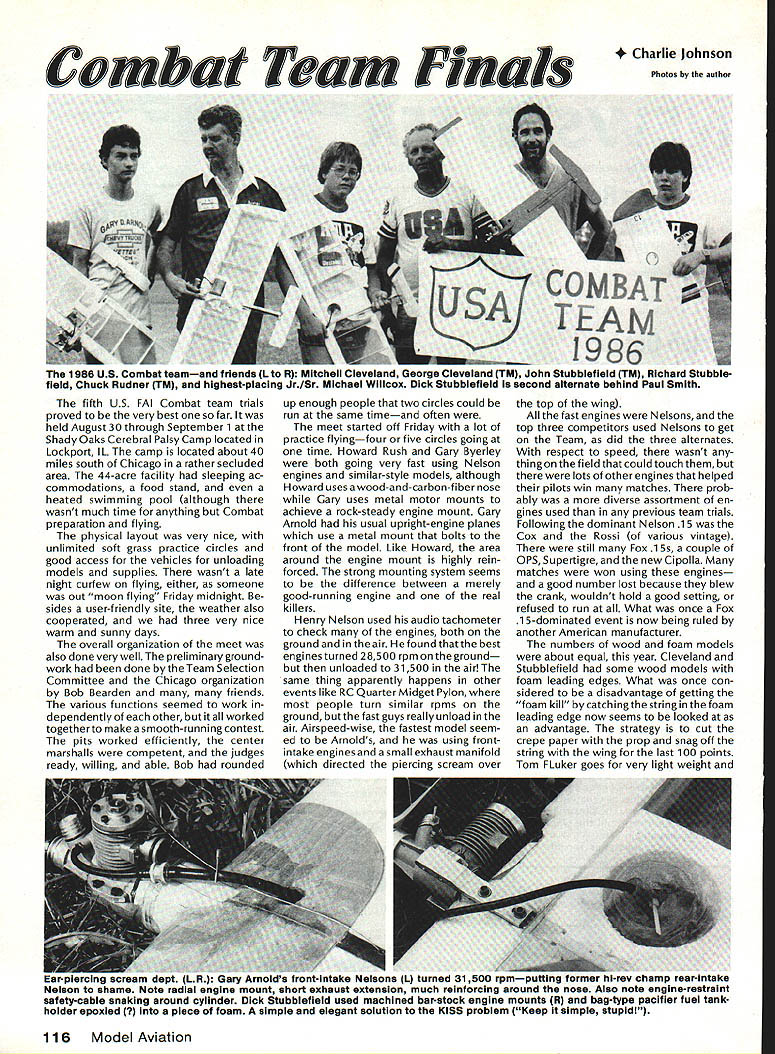
It took until midday Sunday to determine the top competitors. Chuck Rudner had lost only one match during the entire meet and finished with a 9–1 record to secure the top spot on the team. George Cleveland and Paul Smith flew a match to determine the second slot; George, who had not flown before the contest, gradually shook off rust and narrowly beat Paul 592 to 498 (four cuts to three). The jury double- and triple-checked the score.
Another match for the final team spot featured Dick Stubblefield and his son John. John turned in a surprise win, 414 to 356. Pat Willcox supplied John with some models and handled pitting chores. With John on the team, Pat's son Michael became the highest-placing Junior/Senior and earned the chance to accompany the team to Europe. Paul Smith secured the first alternate spot with a 465 to 334 win over Richard Stubblefield in the last match of the trials.
Contest management and the permanent staff at Shady Acres deserve praise for a job well done.
1986 U.S. FAI Combat Team
- Chuck Rudner (Santa Ana, CA)
- George Cleveland (Kenner, LA)
- John Stubblefield (Houston, TX)
Alternates:
- Paul Smith (Sterling Heights, MI) — first alternate
- Dick Stubblefield (Houston, TX) — second alternate
- Gary Frost (Ballwin, MO) — third alternate
Don't look now — it's the 1978 Combat team again, except for John Stubblefield.
Transcribed from original scans by AI. Minor OCR errors may remain.

