
Competition Newsletter
AMA Competition Rules: A New Cycle of Revisions Starts Now
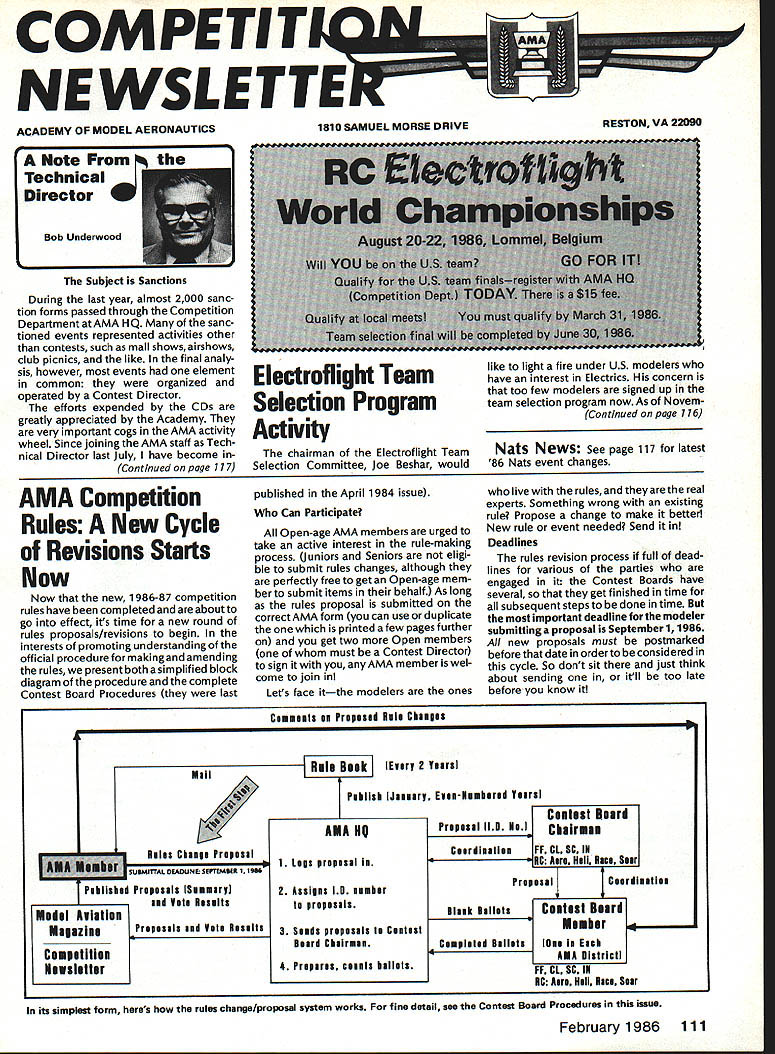
Now that the new 1986–87 competition rules have been completed and are about to go into effect, it's time for a new round of rules proposals and revisions to begin. To promote understanding of the official procedure for making and amending the rules, we present both a simplified block diagram of the procedure and the complete Contest Board Procedures (last published in April 1984).
Who Can Participate?
- All adult (Open-age) AMA members are urged to take an active interest in the rule-making process.
- Juniors and Seniors are not eligible to submit rules changes directly, but they may have an Open-age member submit items on their behalf.
- Any AMA member may submit a proposal as long as:
- The rules proposal is submitted on the correct AMA form (photocopies acceptable).
- The proposal has the signatures of the proposer and two additional Open-age AMA members.
Modelers are the ones who live with the rules and are the real experts. If something is wrong with an existing rule, propose a change. If a new rule or event is needed, send it in.
Deadlines
- The rules revision process follows a schedule with several deadlines for various parties (Contest Boards, Headquarters, etc.).
- The most important deadline for modelers submitting proposals in this cycle is September 1, 1986. All new proposals must be postmarked before that date to be considered.
- The two-year cycle for considering competition rules changes (with effective date January 1, 1988) begins January 1, 1986 — this is the opening date for accepting basic rules-change proposals.
- Use the proposal form printed in this issue or request additional forms from AMA Headquarters (include a stamped, self-addressed envelope).
The complete Contest Board Procedures printed here will help you understand Contest Board matters that will be printed in Competition Newsletter (CN) from time to time.
Contest Board Procedures
AS REVISED MAY 1984
Forward
The purpose of this document is to assist Contest Board (CB) members in effectively monitoring and accomplishing rules revisions.
Contest Board members must act to maintain high competitive standards and good sportsmanship. Proposals that are counter to this view often are generated unknowingly, so each proposal should be carefully studied before action is taken. Proposals should be reviewed for ambiguities in scoring, judging, and interpretation that might create hardships for contestants and contest directors. Board members should discuss proposals with as many knowledgeable people as possible to obtain consensus on merits or faults.
Members of all contest boards should familiarize themselves with the rules that prevail in all categories and avoid generating rules that conflict with or could be confused with rules in other categories or with the general rules.
Analysis of Proposals by Contest Boards
When analyzing proposals, consider these questions:
- Manufacturing — Will current equipment tend to be made obsolete?
- Protests — Will the change tend to eliminate a source of protests, or make protests more likely?
- Model Processing Time — Will the change increase or decrease the time required to process models for competition?
- Designs — Will the builder be given more or less freedom of choice in design?
- Contest — Will the effort required to conduct a contest be increased or decreased?
- Present Models — Will a modeler be able to effectively compete with current models, or will he have to build new ones?
- Effect on Competition — Will the net effect of the proposed change encourage or discourage contest participation?
Procedures
#### Rules Review Schedule
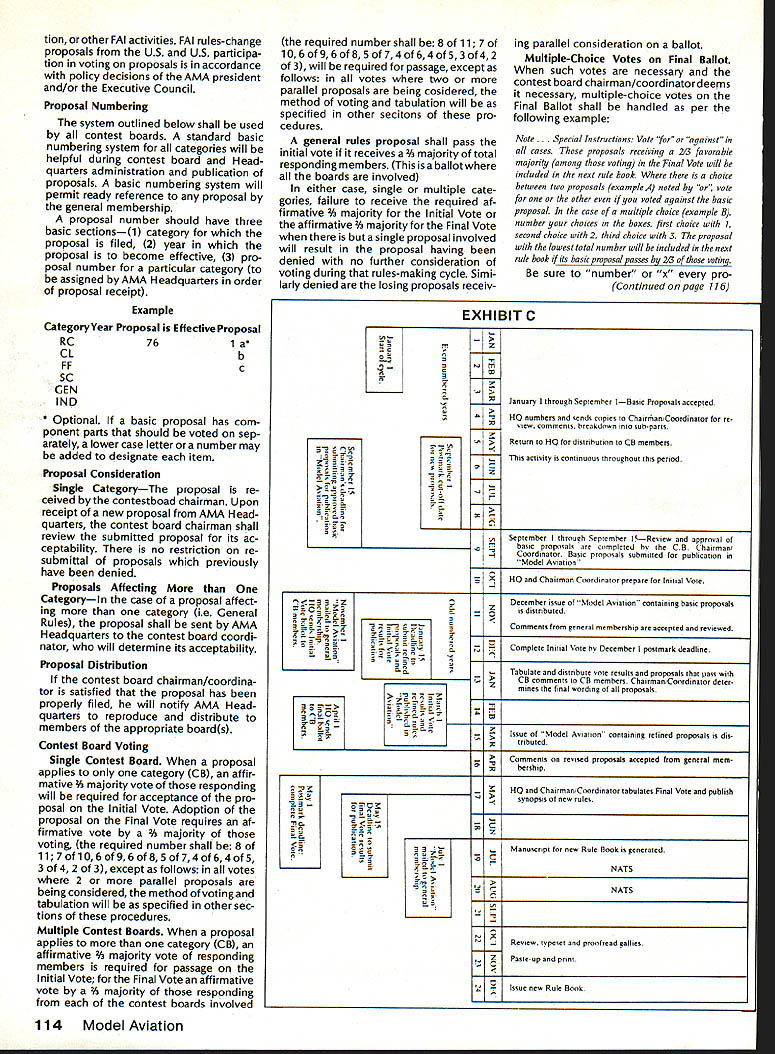
- These procedures provide for a single two-year schedule (Exhibit C) starting in 1974.
- Additional two-year schedules commence with the start of each even-numbered calendar year.
#### Proposal Preparation and Submittal
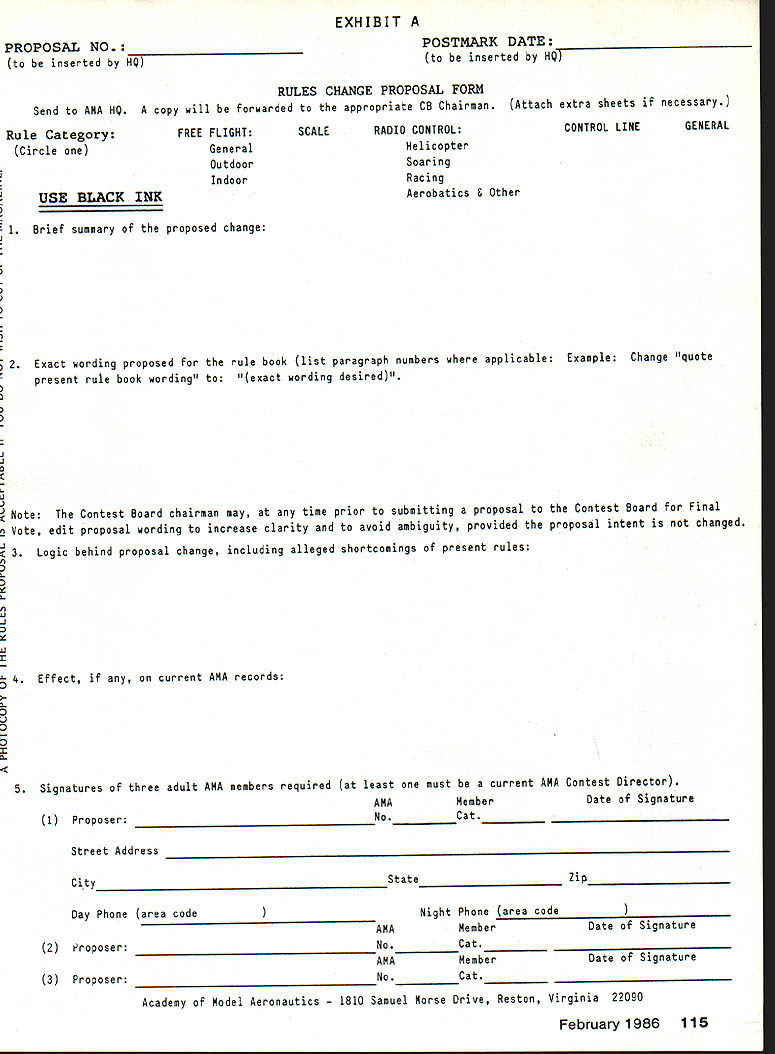
- Any adult AMA member may submit a rules-change proposal by filing a completed RULES CHANGE PROPOSAL FORM (see Exhibit A) with AMA Headquarters by the specified postmark deadline (see Exhibit C).
- Upon receipt, Headquarters staff will review the proposal for correct form, required signatures, and clarity. If the proposal does not pass review, it will be returned with an explanation of what is required to present it properly.
#### Types of Proposals
There are two basic types of proposals:
- Basic Rules Change Proposals
- May be filed by any adult AMA member and affect one or more competition categories.
- Interpretations, Safety and/or Emergency Proposals
- When immediate action is required or quicker action than the two-year cycle is needed, the president or his delegate, with concurrence of the appropriate CB chairman or the CB coordinator (for General Rules), may take emergency action. This proceeds in one of two manners:
- (1) Immediate enforcement: The action may be enforced immediately. The action and justification shall be published in the earliest possible Academy publication. The CB chairman/coordinator will submit to his contest board(s) a brief describing the action and reasons, with available opinions. Not less than 4 weeks and not more than 6 weeks after publication, the chairman/coordinator shall send a ballot with a 10-day turnaround to obtain CB concurrence or denial. If a 2/3 majority of those responding from each contest board involved concur, the ruling is final. A minimum of 50% of total possible voters must reply for validity; if final results are contrary to the previous ruling, fifty percent is not required if the ballot results concur with the previous ruling.
- (2) Interpretations handled by ballot: After forwarding the request to the appropriate contest board chairman/coordinator, the chairman/coordinator shall immediately send a brief and the original request to all members of the appropriate contest board, along with a ballot requiring a 10-day turnaround. The ballot will offer three methods of handling the proposal:
A. Immediate enforcement, requiring a follow-up ballot for publication as above. B. No immediate ruling; require input from all board members and publication of the proposal at the earliest possible date, then proceed with a final vote as in (1). C. Denial of any action and return of the proposal to the originator; the originator must resubmit the proposal into the normal two-year cycle for further consideration.
- Each contest board member ranks the three methods (1 = best, 3 = worst). The chairman/coordinator sums rankings and selects the alternative with the lowest total.
- All requests for Interpretations, Safety, and/or Emergency rulings shall be submitted on the standard proposal form or a facsimile containing the required information. Such requests must have the same endorsement requirements as a normal proposal and must include full addresses of all three signers.
Provisional / Supplementary Rules
- Acceptance of a new set of rules or new event by the contest board may result in immediate approval as an official AMA event.
- If the contest board does not have modeler support and widespread testing is desired before adoption, Provisional status may be assigned. Provisional rules may be continued year-to-year and modified until official adoption or rejection by contest board vote.
- Supplemental rules may be adopted to provide a national standard (particularly for safety) for activities that are local in nature but popular in several areas.
- Provisional and Supplemental rules are not intended to be part of official events at the National Model Airplane Championships but may be included in other sanctioned contests. No records will be recognized for Provisional or Supplemental rules.
FAI Rules
- FAI rules become part of AMA rules when adopted by AMA contest board action once passed by FAI's Committee for International Aeromodeling (CIAM).
- The AMA president and appropriate contest board chairman/coordinator may determine an effective date for AMA adoption. If earlier application than FAI's schedule would benefit AMA team selection, the originator shall request immediate AMA adoption with justification.
- A 2/3 majority of voting members of the contest board(s) concerned is required for immediate adoption. If approved, publication and ballot procedures discussed earlier shall be followed.
Proposal Numbering
- All contest boards shall use a standard basic numbering system with three sections:
- Category for which the proposal is filed.
- Year in which the proposal is to become effective.
- Proposal number for that category (assigned by AMA Headquarters in order of receipt).
Example:
- Category — Year — Proposal is Effective — Proposal
- RC — 76 — 1a*
- CL — 76 — b
- FF — 76 — c
- SC — (example entry)
- GEN — (general)
- IND — (indoor)
* Optional: If a basic proposal has component parts to be voted on separately, a lowercase letter or number may be added.
Proposal Consideration
- Single Category: The proposal is received by the contest board chairman who reviews it for acceptability. There is no restriction on resubmitting previously denied proposals.
- Proposals Affecting More than One Category: AMA Headquarters sends the proposal to the contest board coordinator to determine acceptability.
Proposal Distribution
- If the contest board chairman/coordinator finds the proposal properly filed, he will notify AMA Headquarters to reproduce and distribute it to members of the appropriate board(s).
Contest Board Voting
#### Single Contest Board
- When a proposal applies to only one category, an affirmative 3/4 majority of those responding is required for acceptance on the Initial Vote.
- Adoption on the Final Vote requires an affirmative 3/4 majority of those voting. (Examples of required numbers: 8 of 11; 7 of 10; 6 of 9; 6 of 8; 5 of 7; 4 of 6; 4 of 5; 3 of 4; 2 of 3.)
- In votes where two or more parallel proposals are considered, the method of voting and tabulation will be specified elsewhere in these procedures.
#### Multiple Contest Boards
- When a proposal applies to more than one category, an affirmative 3/4 majority of responding members is required for passage on the Initial Vote.
- For the Final Vote, an affirmative vote by a 3/4 majority of those responding from each contest board involved is required (same numeric examples as above).
- A general rules proposal shall pass the Initial Vote if it receives a 3/4 majority of total responding members (a ballot where all boards are involved).
- Failure to receive the required 3/4 majority on the Initial or Final Vote results in denial of the proposal for that rules-making cycle; losing proposals on parallel ballots are similarly denied.
#### Multiple-Choice Votes on Final Ballot
- Special instructions: Vote "for" or "against" in all cases.
- Proposals receiving a 2/3 favorable majority may be included in the next rule book.
- Where there is a choice between two proposals noted by "or," vote for one or the other even if you voted against the basic proposal.
- For multiple-choice ballots, number choices in order of preference starting with 1. The proposal with the lowest total number will be included in the next book if its basic proposal passes by 2/3 of those voting.
- Be sure to "number" or mark every proposal.
EXHIBIT A
PROPOSAL NO.: _______________________________________ POSTMARK DATE: ____________________________ (to be inserted by HQ) (to be inserted by HQ)
RULES CHANGE PROPOSAL FORM
Send to AMA Headquarters. A copy will be forwarded to the appropriate CB Chairman. (Attach extra sheets if necessary.)
Rule Category (circle one):
- FREE FLIGHT: General / Outdoor / Indoor
- SCALE
- RADIO CONTROL: Helicopter / Soaring / Racing / Aerobatics & Other
- CONTROL LINE
- GENERAL
USE BLACK INK
- Brief summary of the proposed change:
(Provide a concise summary.)
- Exact wording proposed for the rule book (list paragraph numbers where applicable; Example: Change "quote present rule book wording" to: "(exact wording desired)").
Note: The Contest Board chairman may, at any time prior to submitting a proposal to the Contest Board for Final Vote, edit proposal wording to increase clarity and avoid ambiguity, provided the proposal intent is not changed.
- Logic behind the proposal change, including alleged shortcomings of present rules:
(Explain rationale.)
- Effect, if any, on current AMA records:
(State any impact.)
- Signatures of three adult AMA members required (at least one must be a current AMA Contest Director).
- (1) Proposer: ____________________________________ AMA No. _______ Member Cat. ______ Date of Signature _______________
Street Address ___________________________________________________________________________________________ City ____________________________________________ State ________________ Zip _______________________ Day Phone (area code _______) ____________________ Night Phone (area code _______) ______________________
- (2) Proposer: ____________________________________ AMA No. _______ Member Cat. ______ Date of Signature _______________
(Street Address, City, State, Zip, Phone as above)
- (3) Proposer: ____________________________________ AMA No. _______ Member Cat. ______ Date of Signature _______________
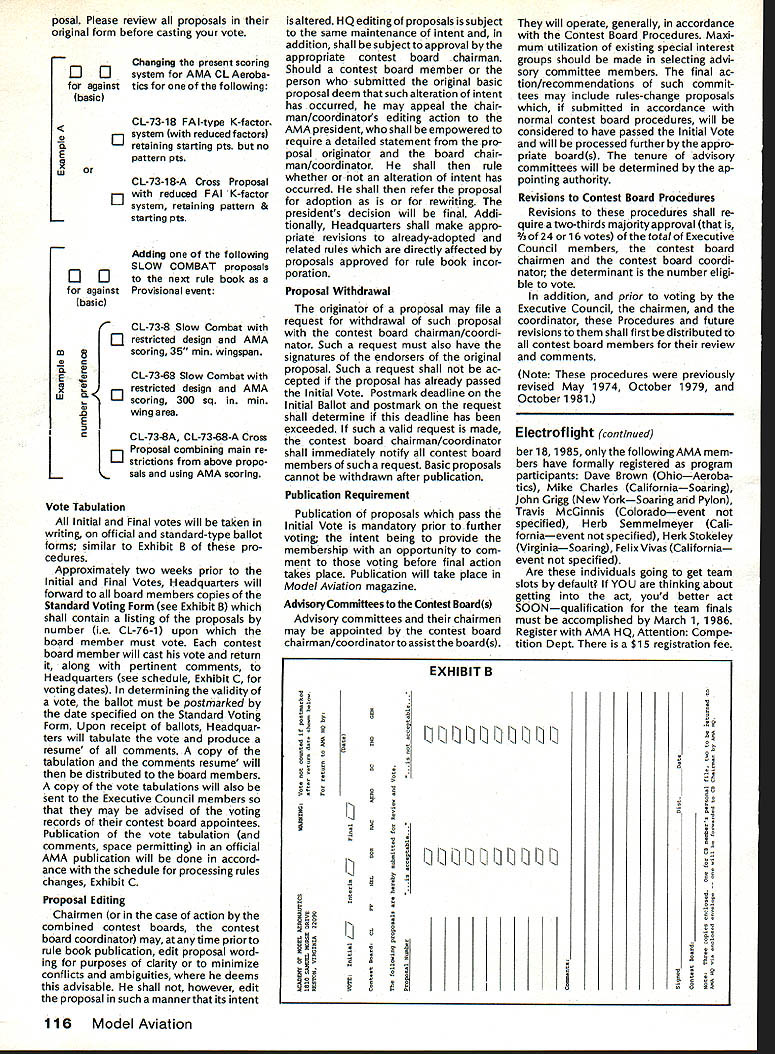
- Changing the present scoring system for AMA CL Aerobatics:
- for or against (basic)
- Example A:
- CL-73-18 FAI-type K-factor system (with reduced factors) retaining starting points but no pattern points, or
- CL-73-18-A Cross Proposal with reduced FAI K-factor system, retaining pattern & starting points.
- Adding one of the following SLOW COMBAT proposals as a Provisional event:
- for or against (basic)
- Example B (number preference):
- CL-73-8 Slow Combat with restricted design and AMA scoring, 36" minimum wingspan.
- CL-73-68 Slow Combat with restricted design and AMA scoring, 300 sq. in. minimum wing area.
- CL-73-8A, CL-73-68-A Cross Proposal combining main restrictions from above and using AMA scoring.
- All Initial and Final votes will be in writing, on official standard ballot forms similar to Exhibit B.
- Approximately two weeks prior to Initial and Final Votes, Headquarters will forward copies of the Standard Voting Form listing proposals by number (e.g., CL-76-1).
- Each contest board member casts his vote and returns it with comments to Headquarters by the postmark deadline shown on the Standard Voting Form.
- Headquarters tabulates votes, produces a resume of comments, and distributes the tabulation and comments to board members.
- A copy of vote tabulations will also be sent to Executive Council members to inform them of contest board voting records. Publication of vote tabulation and comments (space permitting) will follow the rules change processing schedule (Exhibit C).
- Chairmen or the contest board coordinator may edit proposal wording prior to rule book publication to increase clarity or minimize conflicts, provided the proposal intent is not altered.
- Headquarters editing is subject to approval by the appropriate contest board chairman.
- If a contest board member or the originator believes the intent has been altered, he may appeal to the AMA president, who will obtain statements and rule whether an alteration of intent occurred. The president's decision is final.
- Headquarters shall make appropriate revisions to already-adopted and related rules directly affected by proposals approved for rule book incorporation.
- The originator may request withdrawal by filing a request with the contest board chairman/coordinator, with endorsers' signatures.
- Requests will not be accepted if the proposal has already passed the Initial Vote. Postmarks on the Initial Ballot and the withdrawal request determine timeliness.
- Basic proposals cannot be withdrawn after publication.
- Publication of proposals that pass the Initial Vote is mandatory prior to further voting to give membership an opportunity to comment.
- Publication will take place in Model Aviation magazine.
- Advisory committees and their chairmen may be appointed by the contest board chairman/coordinator to assist the board(s).
- They will operate generally in accordance with Contest Board Procedures.
- The final recommendations of such committees may include rules-change proposals which, if submitted through normal procedures, will be considered to have passed the Initial Vote and will be subject to further action.
- Tenure of advisory committees is determined by the appointing authority.
- Revisions to these procedures require a two-thirds majority approval (2/3 of 24 or 16 votes) of the total Executive Council members, the contest board chairmen, and the contest board coordinator; the determinant is the number eligible to vote.
- Prior to voting by the Executive Council, the chairmen, and the coordinator, these Procedures and future revisions shall be distributed to all contest board members for review and comment.
- As of 1985, the following AMA members have formally registered as program participants:
- Dave Brown (Ohio — Aerobatics)
- Mike Charles (California — Soaring)
- John Grigg (New York — Soaring and Pylon)
- Travis McGinnis (Colorado — event not specified)
- Herb Semmelmeyer (California — event not specified)
- Herb Stokley (Virginia — Soaring)
- Felix Vivas (California — event not specified)
- Will these individuals receive team slots by default? If you are thinking about getting into the program, act soon — qualification for the team finals must be accomplished by March 1, 1986.
- Register with AMA Headquarters, Attention: Competition Dept. There is a $15 registration fee.
- There is a revised Indoor schedule.
- Indoor Hand-Launched Glider (Hi-Tech) has been dropped as a separate event.
- Novice Pennyplane has been added.
- Navy Carrier Class I and Class II will be flown on the same day.
- There is no longer a separate Expert class. FAI is now the top class.
- These events will start earlier than customary:
- Processing will be on Friday, July 25.
- Flying will begin Saturday, July 26.
- RC and CL Scale processing will be on Wednesday, July 30.
- Flying will be on Thursday, July 31 and Friday, August 1.
Academy of Model Aeronautics — 1810 Samuel Morse Drive, Reston, Virginia 22090
Please review all proposals in their original form before casting your vote.
Example ballot items:
Vote Tabulation
Proposal Editing
Proposal Withdrawal
Publication Requirement
Advisory Committees to the Contest Board(s)
Revisions to Contest Board Procedures
(Note: Prior revisions were May 1974, October 1979, and October 1981.)
Electroflight (continued)
New at the '86 Nats
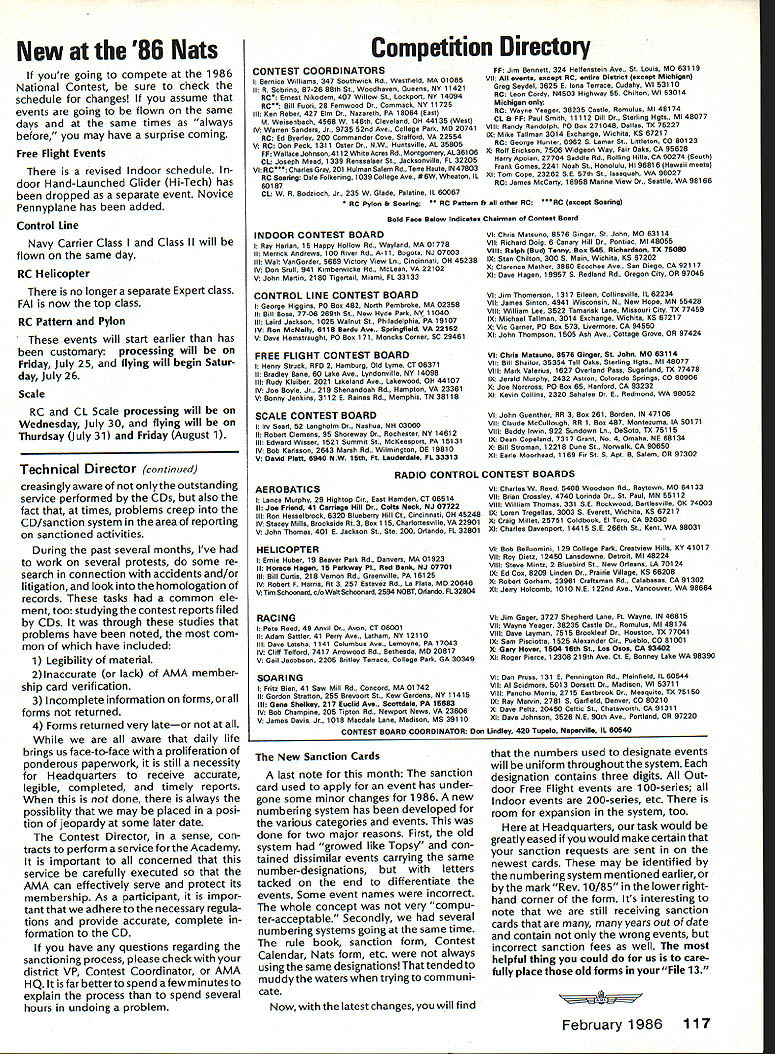
If you're going to compete at the 1986 National Contest, check the schedule for changes. Do not assume events will be flown on the same days and times as in past years.
Free Flight Events
Control Line
RC Helicopter
RC Pattern and Pylon
Scale
Technical Director (continued)
The Contest Director (CD) system provides outstanding service, but problems have crept into the CD/sanction system in reporting sanctioned activities. Recent reviews of contest reports filed by CDs revealed common problems:
- Legibility of material.
- Inaccurate or missing AMA membership card verification.
- Incomplete information on forms, or failure to return all forms.
- Forms returned very late — or not at all.
While paperwork can be onerous, Headquarters needs accurate, legible, complete, and timely reports. Failure to provide these may place the AMA in jeopardy later (e.g., protests, accident investigation, record homologation).
- The Contest Director in effect contracts to perform a service for the Academy; that service must be carefully executed so AMA can effectively serve and protect its membership.
- As participants, adhere to regulations and provide accurate, complete information to the CD.
If you have questions about the sanctioning process, contact your district VP, Contest Coordinator, or AMA Headquarters. It is far better to spend a few minutes clarifying the process than several hours undoing a problem.
The New Sanction Cards
- The sanction card used to apply for an event has undergone minor changes for 1986. A new numbering system has been developed for categories and events.
- Reasons for the change:
- The old system had grown inconsistently, with dissimilar events carrying the same numbers and letters tacked on to differentiate them; some event names were incorrect and the system was not computer-friendly.
- Several numbering systems were in use simultaneously (rule book, sanction form, Contest Calendar, Nats form), causing inconsistencies.
- The new system:
- Numbers used to designate events are now uniform throughout the system.
- Each designation contains three digits.
- Example: Outdoor Free Flight events are 100-series; Indoor events are 200-series.
- There is room for expansion.
- Headquarters requests that sanction requests be sent on the new cards, identifiable by the new numbering system or by the mark "Rev. 10/85" in the lower right corner of the form.
- HQ is still receiving many outdated sanction cards with wrong events and incorrect sanction fees. Please discard old forms and use the current forms.
Transcribed from original scans by AI. Minor OCR errors may remain.

