
COMPETITION NEWSLETTER
1986 Control Line World Championships — Date & Site Set
The 1986 Control Line World Championships will be held July 30 through August 4, 1986, at Pécs, Hungary. The site is approximately 125 miles south/southwest of Budapest and about 230 miles south of Vienna, near the Hungary/Yugoslavia border.
Supporters
- Registration fee: $20 per person (official supporters).
- Lodging/board (double occupancy, five nights, including meals):
- Hotel: $150 per person.
- Dormitory: $70 per person.
- Victory banquet tickets: $20 per person.
- Distances: hotel is about 2 km from the flying site; dormitory is about 1.5 km away.
- Supporters must make their own travel arrangements; coordination available through AMA travel agent Nino Di Ronza (phone 703/471-0105).
Deadline
- Send registration and housing fees to Micheline Madison, AMA HQ, no later than April 15, 1986.
1986 Scale World Championships
The 1986 Scale World Championships will be held July 14 through 20 at Kjeller Airport near Oslo, Norway.
Supporters
- Official supporter fee: $368 (includes contest registration, banquet, and "hotel service"; does not include transportation).
- Send the indicated fee to AMA HQ, Attention: Micheline Madison.
- Travel arrangements can be made through AMA travel advisor Nino Di Ronza (phone 703/471-0105).
FAI Scale Subcommittee Studies RC Giant Scale
The FAI/CIAM Scale Subcommittee polled members about establishing a Giant Scale category. Questions included:
- Is there interest in Giant Scale in your country?
- Which option should be pursued?
- a) Ignore the trend toward Giant Scale models.
- b) Increase the maximum weight and power limits of the present F4C class.
- c) Create a new international class for Giant Scale.
Poll results and observations
- About a dozen respondents were evenly divided on whether their nations had interest in Giant Scale; Australia, France, and the U.S. were noted as having active Giant Scale programs.
- Respondents were evenly divided between ignoring the trend and creating a new international class.
- Most respondents opposed increasing the weight and power limits of F4C.
- Main concerns cited for creating an FAI Giant Scale class:
- Prohibitive costs for the average modeler.
- Safety issues.
- Transportation problems for very large models.
Action
- The Subcommittee chair determined no further action until the Subcommittee meets to discuss the subject (scheduled for April 1986).
AMA RESTON, VA 22090
Bits & Pieces
Technical Director: W. Bob Underwood
Bit Piece No. 1 — Rule Book Corrections and Notes
Please mark the following corrections in the rule book:
- Page 30 — Carrier: Line length. Carrier should read 600–606.
- Page 32 — Carrier: Typo; the last word should be "contest."
- Page 127 — Ribbon No. 1 field color: In the Non-Aircraft frequency table, RC 80 should be Gray instead of Violet.
- Page 70 — In the Triathlon scoring table, the value "1 minute 38 seconds" should be "1:14.144."
- Inside front cover — Add event 214: ROG Stick (Indoor ROG Stick). Change the name of event 201 to HL Stick.
Notes and comments
- The above glitches have generated many positive suggestions, including course size/type details used in the rule book and other match concepts. Updates will be provided in future columns.
- Some have requested page numbers next to events listed on the inside front cover — a logical suggestion.
- The event list also included Alternate Peanut Scale events (Indoor and Outdoor); those events are no longer in the book.
- Input to the Membership Manual section is important to keep the rule book meaningful to non-competitive modelers. Additional items will be noted for the next rules-change cycle.
Bit Piece No. 2 — Frequency/Sound Committees and Radio-Frequency Issues
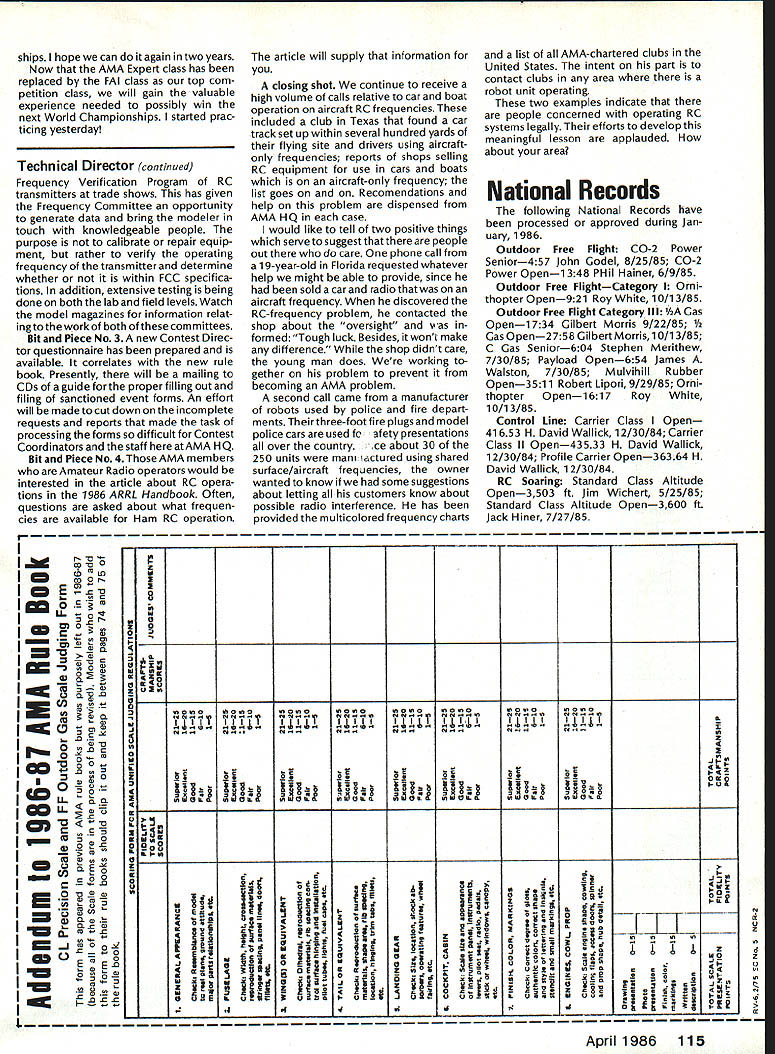
The Frequency/Sound Committees have generated a great deal of correspondence recently. Several issues concerning misuse of aircraft frequencies have been reported, including:
- Car and boat operation on aircraft RC frequencies (e.g., a car track within several hundred yards of a flying site using aircraft-only frequencies).
- Shops selling RC equipment intended for cars/boats that operate on aircraft-only frequencies.
Examples of positive responses
- A 19-year-old in Florida contacted AMA when he discovered his car radio was on an aircraft frequency. The shop was unhelpful; AMA is assisting the young man to resolve the problem and prevent it from becoming a wider AMA issue.
- A manufacturer of robots used by police and fire departments discovered about 30 of 250 units were produced using shared surface/aircraft frequencies. AMA provided multicolored frequency charts and a list of AMA-chartered clubs to help notify local clubs and prevent interference.
These examples show that individuals and manufacturers are concerned about legal and safe RC operation. AMA continues to provide recommendations and assistance in such cases. Consider what is happening in your area and report problems to AMA HQ.
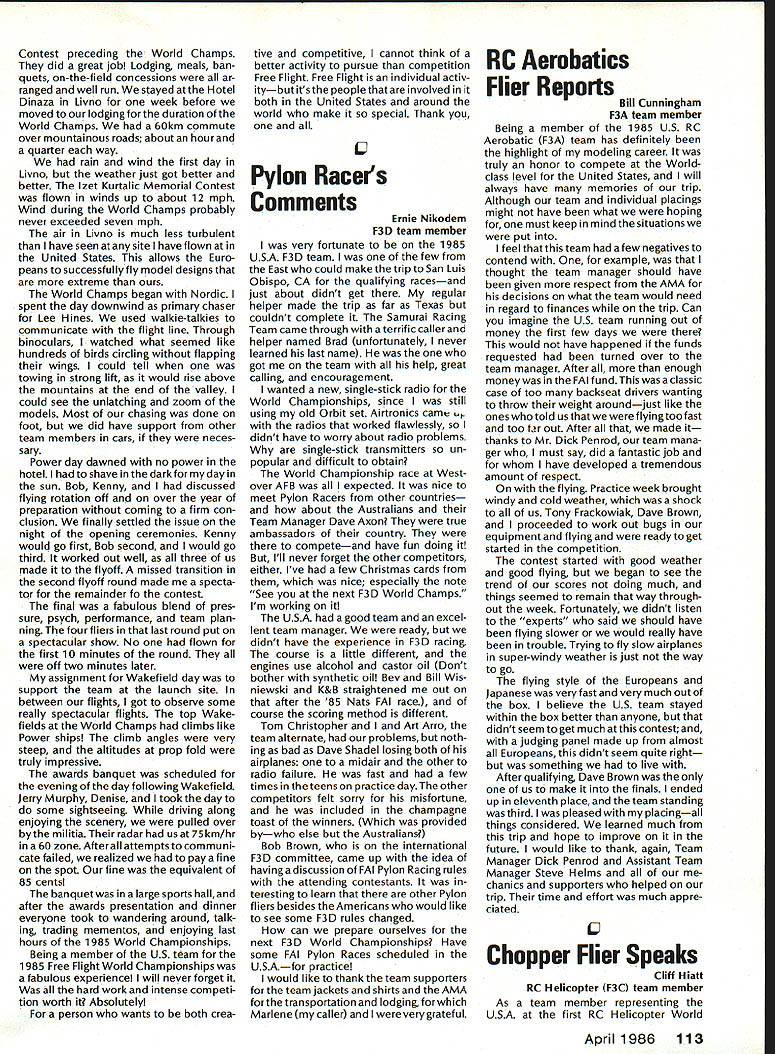
Free Flight World Championships — Team Reports (Livno, Yugoslavia)
Towline / Bradley (continued)
- Field description: long and almost flat; grass is short due to grazing sheep and cattle.
- Acknowledgment: Thanks to all supporters and especially the chasers — a no-glory but essential job.
The Experience of a Lifetime
Bob Gutai — F1C (Power) team member
- Opening ceremony: A thrilling experience and a point of pride to be part of model aviation.
- Customs snag: Initial model box inspection in Dubrovnik caused alarm until cleared after about an hour.
- Practice and contest: Arrived in Livno in time for practice and the Izet Kurtalic memorial contest preceding the World Championships. U.S. power team finished second at that event.
- Team experience: Memorable hospitality from Yugoslavians — picnic in the mountains with native food, beer ("Pivo"), and plum brandy ("Sljivovic"); lamb on a spit was served.
- Social interactions: Extensive trading of T-shirts, pins, and decals; many friendships formed and renewed.
- Post-contest: Visited Sarajevo and Visoko; hosted and escorted by local organizers who showed hospitality and local sites (including mosques and family visits).
- Additional meet: Competed at the "Soko Cup" in Mostar — good contest, followed by banquet and awards.
Observations as a Competitor
Kenny Happersett — F1C team member
- Livno site: Superb flying and retrieval conditions; regarded as one of the finest flying sites in the world.
- Preparation: The U.S. team benefited from arriving eight days early for practice and acclimation. Some Eastern Bloc teams practiced extensively (up to three months) and often returned to Livno for practice during the year.
- Design observations:
- East European and Far East teams presented advanced designs (especially in F1B and F1C).
- F1C advanced designs often resembled powered Nordics: undercambered wings, forward CGs, small stabilizers, longer tail moment arms, folding props, and no landing gear for smooth grassy fields.
- Some nations used feathered/delayed props and auto surfaces.
- Builder rule: The "builder of the model" rule was not strictly observed; many parts appeared professionally produced in machine shops, indicating a professional approach in some countries.
- U.S. situation: U.S. flyers were well-prepared in skill but behind in design performance compared to top international designs. Improved and timely technical reporting on international advances is needed for U.S. competitors to catch up.
- Acknowledgments: Thanks to team supporters and mechanics, including Russ Baker and his wife Carolyn.
Power Flier Comments
Ken Phair — F1C team member
- Field and organization: Livno field described as beautiful, virtually flat, and well-suited for long flights. Aero Club Izet Kurtalic organized the World Champs and the preceding Open International contest; lodging, meals, and on-field concessions were well handled.
- Travel and weather: Stayed at Hotel Dinara before moving closer to the event; had a 60 km commute over mountainous roads. Weather improved over the contest period; winds during the World Champs generally stayed below 7 mph.
- Flight observations: Air at Livno is less turbulent than many U.S. sites, allowing more extreme designs to fly successfully.
- Team rotation and results: Team decided flight rotation at opening ceremonies; all three U.S. power fliers made the flyoff. A missed transition ended Ken's contest during a flyoff round.
- Wakefield day: Observed spectacular climbs and high-altitude prop folds.
- Banquet and closing: Awards banquet held in a large sports hall; low-cost interaction with local authorities (example of a small on-the-spot fine).
- Final thoughts: Being part of the U.S. team at the World Championships was a fabulous experience and well worth the hard work.
National Records (Processed/Approved January 1986)
Outdoor Free Flight
- CO-2 Power Senior — 45.7 — John Goebel — 8/25/85
- CO-2 Power Open — 13.8 — H. P. Hill Haner — 6/9/85
Outdoor Free Flight — Category I
- Ornithopter Open — 9.21 — Roy White — 10/13/85
Outdoor Free Flight — Category III
- A Gas Open — 17.34 — Gilbert Morris — 9/22/85
- B Gas Open — 27.58 — Gilbert Morris — 10/13/85
- C Gas Senior — 6.04 — Stephen Merrihew — 7/30/85
- Payload Open — 6.54 — James A. Walton — 7/30/85
- Mulvihill Rubber Open — 33.11 — Robert Lipin — 9/29/85
- Ornithopter Open — 16.17 — Roy White — 10/13/85
Control Line
- Carrier Class I Open — 416.53 — H. David Wallick — 12/30/84
- Carrier Class II Open — 435.33 — H. David Wallick — 12/30/84
- Carrier Class III Open — 363.64 — H. David Wallick — 12/30/84
RC Soaring
- Standard Class Altitude Open — 3,503 ft — Jim Wichert — 5/25/85
- Standard Class Altitude Open — 3,600 ft — Jack Hiner — 7/27/85
Transcribed from original scans by AI. Minor OCR errors may remain.

