
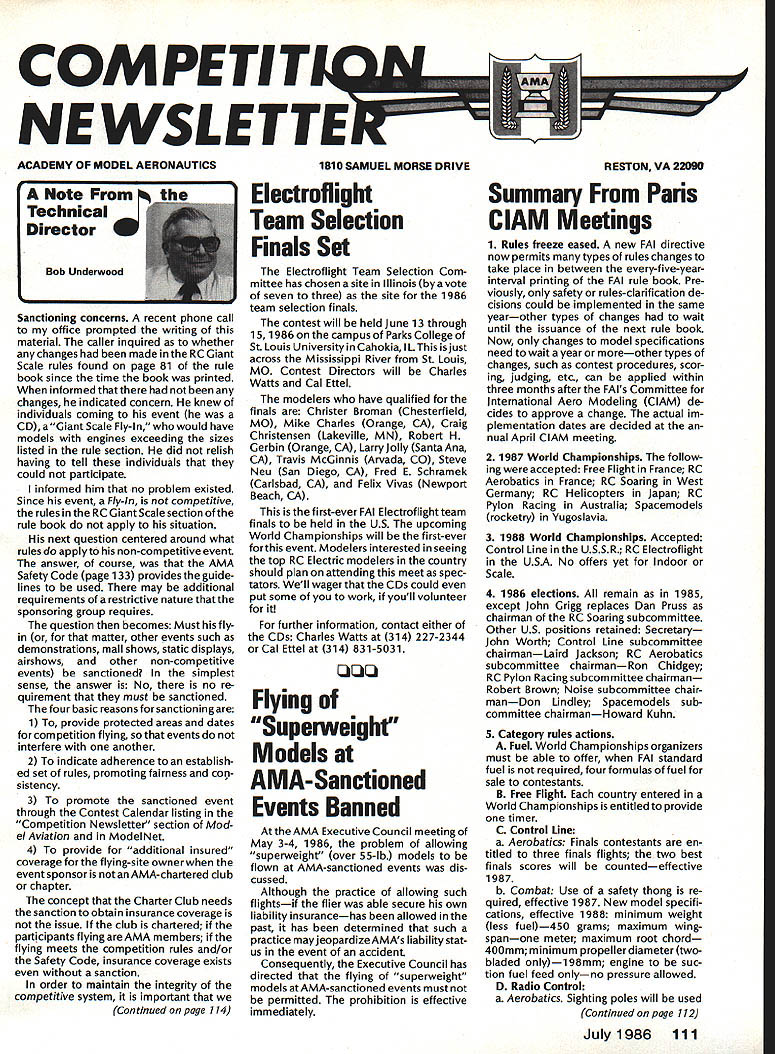
Competition Newsletter
ACADEMY OF MODEL AERONAUTICS 1810 Samuel Morse Drive Reston, VA 22060
A Note From the Technical Director
Bob Underwood
Sanctioning concerns. A recent phone call to my office prompted this note. The caller asked whether any changes had been made to the RC Giant Scale rules (page 81 of the rule book) since the book was printed. When I informed him there had not been changes, he expressed concern: individuals planning to attend his Giant Scale Fly-In would have models with engines exceeding the sizes listed in the rule section. He did not relish having to tell these individuals they could not participate.
I informed him there was no problem. Since his event was a fly-in (non-competitive), the competitive rules in the RC Giant Scale section do not apply. The AMA Safety Code (page 133) provides the guidelines to be used at non-competitive events. Sponsoring groups may impose additional, more restrictive requirements if they wish.
Must fly-ins or other non-competitive events (demonstrations, mall shows, static displays, airshows, etc.) be sanctioned? No — there is no requirement that they be sanctioned. The four basic reasons for sanctioning are:
- To provide protected areas and dates for competition flying so events do not interfere with one another.
- To indicate adherence to an established set of rules, promoting fairness and consistency.
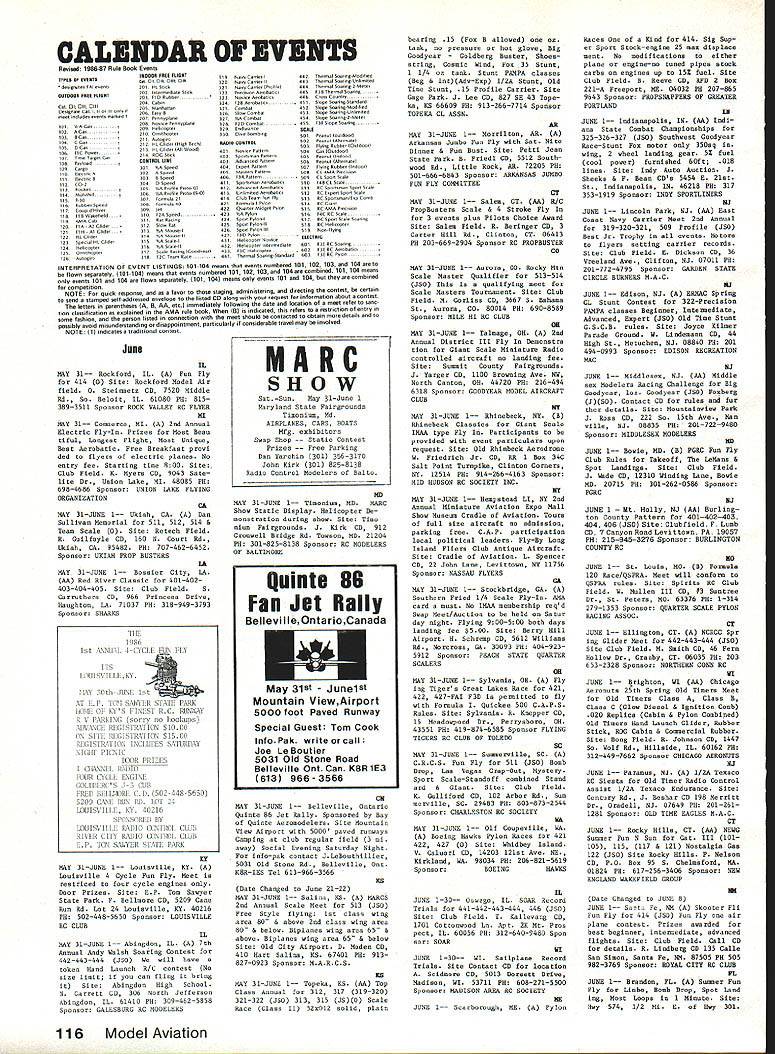
- To promote the sanctioned event through the Contest Calendar listing in the "Competition Newsletter" section of Model Aviation and in ModelNet.
- To provide "additional insured" coverage for the flying-site owner when the event sponsor is not an AMA-chartered club or chapter.
A chartered club does not need a sanction to obtain insurance coverage for club-sponsored flying if participants are AMA members and the flying meets the competition rules and/or the Safety Code. However, sanctioning is important to maintain the integrity of the competitive system.
The non-competitive event presents a gray area: fun flies often attract participants who also compete. We must carefully consider how such events fit into the overall scheme. A sanction also helps the Academy determine the types and levels of activities in which members participate via information on the sanction application and the Contest Director's report.
An appeal: I regularly receive requests for fun-fly ideas — both from clubs that have run them before and from clubs that never have. To provide more than personal anecdotes, I have started a list of fun-type events with simple descriptions of "rules." Please send your tried-and-true fun-fly event ideas to AMA Headquarters so we can build a Sport Flier's Fun-Fly Book. I hope to receive input from Free Flight, Control Line, and Radio Control disciplines.
Frequency Committee information: Three trade shows to date have included a transmitter-checking process manned by the Frequency Committee and volunteers. Valuable information has been obtained; the most transmitters checked at one show was just under 200 (Toledo). AMA members Mike Still, Gary Hardwick, and Nick Jones assisted the Committee for three days. Results are being compiled and will be available soon.
A meeting during the Toledo show between the Frequency Committee and radio control industry representatives resulted in valuable dialogue. Areas discussed included:
- Comprehensive guidelines for equipment requirements looking toward 1991.
- Channel identification as the "old" frequencies are phased out at the end of 1987.
- Means of minimizing model aircraft / surface model frequency-use problems.
Read the RC columns in this and other magazines for detailed information on these subjects.
Electroflight Team Selection Finals Set
The Electroflight Team Selection Committee has chosen Illinois by a vote of seven to three. The 1986 team selection finals contest will be held June 13–15, 1986 on the campus of Parks College, St. Louis University, Cahokia, IL (just across the Mississippi River from St. Louis, MO).
Contest Directors: Charles Watts and Cal Ettel.
Modelers qualified for the finals: Christer Broman (Chesterfield, MO); Mike Charles (Orange, CA); Craig Christensen (Lakeville, MN); Robert H. Gerbin (Orange, CA); Larry Jolly (Santa Ana, CA); Travis McGinnis (Arvada, CO); Steve Neu (San Diego, CA); Fred E. Schramek (Carlsbad, CA); Felix Vivas (Newport Beach, CA).
This is the first-ever FAI Electroflight team finals held in the U.S. preceding the upcoming World Championships. Modelers interested in seeing the top RC electric modelers in the country should plan to attend as spectators.
For information contact: Charles Watts, (314) 227-2344; Cal Ettel, (314) 831-5031.
Flying Superweight Models — AMA-Sanctioned Events Banned
At its May 3–4, 1986 meeting the AMA Executive Council discussed allowing superweight models (over 55 lb) at AMA-sanctioned events. Although previously permitted if the flier secured personal liability insurance, the Council determined this practice may jeopardize AMA's liability status in the event of an accident. Consequently, flying superweight models at AMA-sanctioned events is prohibited effective immediately.
Summary — Paris CIAM Meetings
- Rules freeze eased. A new FAI directive permits certain types of rule changes between the five-year printing intervals of the FAI Sporting Code. Previously, safety-rule clarifications could be implemented the same year, while other changes had to wait for the next rule book. Now: changes to model specifications must wait one year, but other changes (contest procedures, scoring, judging, etc.) can be applied within three months after CIAM approves the change. Actual implementation dates are decided at the annual April CIAM meeting.
- 1987 World Championships accepted:
- Free Flight — France
- RC Aerobatics — France
- RC Soaring — West Germany
- RC Helicopters — Japan
- RC Pylon Racing — Australia
- Space Models (rocketry) — Yugoslavia
- 1988 World Championships accepted:
- Control Line — USSR
- RC Electroflight — accepted (location not shown)
Additional CIAM notes:
- D. Helicopters: Many details of contest procedure and maneuver judging were clarified and will be covered in a separate report.
- E. Scale: A maximum total bonus percentage was approved effective 1988. The bonus for "two or more engines" is 10%. Effective immediately: a safety device is required for control line; options are acceptable if evidence shows applicability to the aircraft type; operation of RC retractable landing gear must be done "in full view of the judges." Effective 1987, legs of RC Triangular Flight are redefined as 150 meters minimum, and for Rectangular Flight the short leg is 75 meters, the long leg is 150 meters.
- F. Records: For Duration and Distance in a Closed Circuit, powered models shall not use slope lift, effective immediately (July 1, 1986).
- G. General: More specific and complete details of the April 1986 CIAM actions will be presented in future issues of Model Aviation.
'86 Canadian Nats Set for British Columbia
AMA members on the West Coast and in the Northwest who cannot attend the 1986 AMA Nats (Lake Charles, LA) may consider the 1986 Canadian Nationals, held July 19–26 (the week before the AMA event).
Advance entry must be received before June 13, 1986; otherwise a $10 late fee applies. Entry forms from Mr. Brian Dalling, 4214-W. 15 Ave., Vancouver, BC V6R 3A6, Canada. AMA members should note Canadian rules may differ from AMA rules and age-groupings are different. MAAC rule books: MAAC, Box 9, Oakville, Ontario L6J 4Z5, Canada; telephone (416) 844-8764. Charges: RC Pattern and RC Helicopter rule books $4 each; RC Soaring, Free Flight, and Control Line rule books $2.50 each.
Advance entry fees: $25 (Open) or $10 (Junior) for basic entry. Additional events: $5 each (Open), $3 each (Junior). Only four of the meet's 33 events have separate Open and Junior categories. There are no Indoor events.
The contest will be headquartered in Delta, British Columbia, with events at various nearby sites.
Submitting FAI Rules Proposals
Modelers wishing to submit proposals for FAI international competition rules must send them first to AMA Headquarters (Attention: Michelene Madison). Deadline for initial submission is August 1, 1986.
There is no official AMA or FAI form for proposals; however, each submission must refer to the appropriate sections and paragraphs of the FAI Sporting Code using the Code's numbering system. Note: the 1979 edition of the FAI Sporting Code is no longer valid. A limited number of the latest edition of the Sporting Code are available (cost $3) from AMA Headquarters. Members who want copies of only a section can obtain photocopies of that section at no charge upon request (send a business-size SASE).
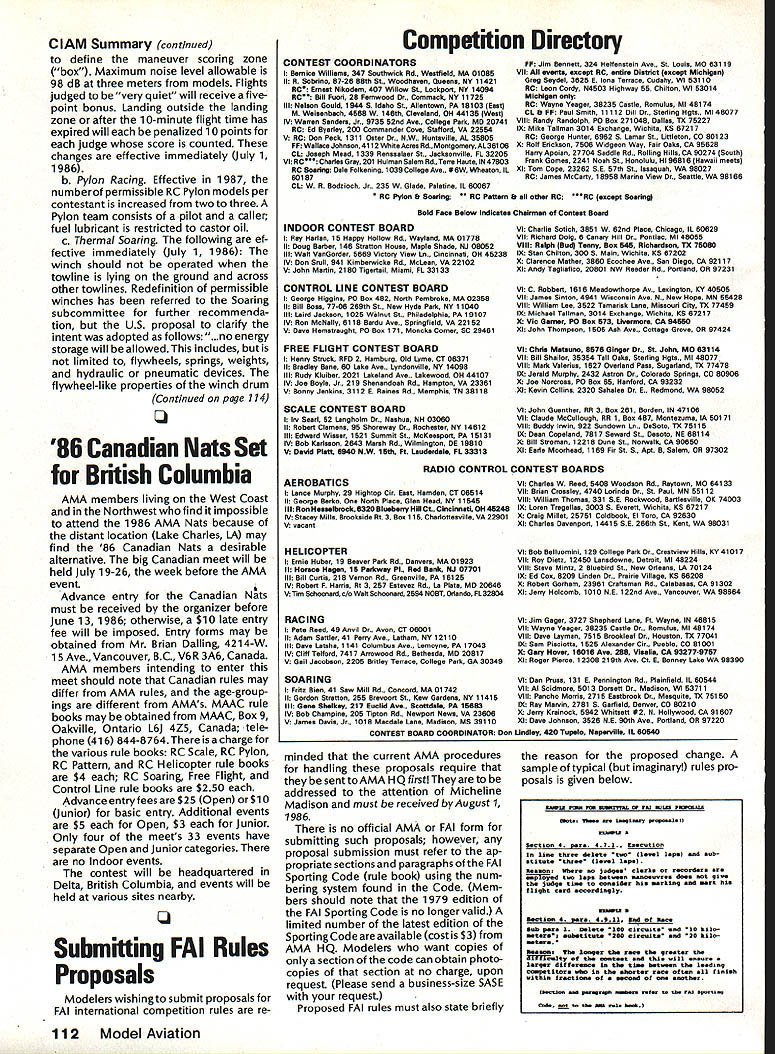
Proposed FAI rules must briefly state the reason for the change. A sample proposal (typical but imaginary) appears with the notice in the print edition.
AMA Procedure for Submitting FAI Rules Proposals
AMA's in-house procedure (last published July 1982) requires the following before a U.S. proposal is submitted to CIAM as an agenda item:
U.S. Proposals to CIAM; Procedures
No proposal will be submitted by the U.S. delegation unless it has first:
A. Been reviewed by the associated Team Selection Committee and approved by a majority of that committee. B. Been reviewed by the U.S. representative to the associated CIAM subcommittee (approval by the U.S. representative is not required). C. Been reviewed by the AMA President and by the U.S. voting delegate to CIAM after item A is accomplished. (According to AMA Bylaws, the AMA President has final authority on any FAI matters.)
If no Team Selection Committee exists for the affected area, item A is waived; in that case item B must include approval of a U.S. representative to the CIAM committee.
A proposed FAI rule change must be sent initially to AMA HQ (Attention: Michelene Madison) where it will be copied and referred to the appropriate person or committee for review. Deadline for initial submission is August 1. The reviewing party/parties must complete their review and return the proposal, with their vote and comments, by September 15. From that point, the U.S. CIAM delegation will handle the proposal. Proposed rule changes and the subsequent review/vote will be publicized in the "Competition Newsletter" if time permits.
The ultimate fate of any proposal reaching CIAM will be publicized in the AMA delegation's report of the annual CIAM meeting (appearing in the "Competition Newsletter" soon after the annual CIAM plenary meeting).
Scheduling an International Contest
Organizers who want to sponsor an International Contest in 1987 (and have it listed in the FAI International Calendar) should send a letter of particulars to AMA HQ, attention: Competition Dept., no later than October 15, 1986. The letter should include a summary of contest organization: location, dates, entry fees, and address and telephone number of the Contest Director or other key contact.
Plans Swap With Overseas Modeler
AMA HQ has received a request from a Polish modeler who wants working plans (or another elaboration) of B. J. Schwammann's two-place, homebuilt Scorpion helicopter. The modeler, Leszek Florczak, is willing to swap working plans for the Polish homebuilt B. Jankowski's Praszki design. If interested in an exchange, please contact AMA Technical Director Bob Underwood.
Contest Board Members Need Ideas!
Vic Garner CLCB Chairman
As a member of the Control Line Contest Board (CLCB), I am often asked why I voted one way when others disagree. I ask whether those thoughts were passed to the appropriate advisory committee or Contest Board member for the AMA district. Rarely are they.
If you have thoughts on proposed rule changes, get involved. Contest Board members appreciate input during the cycle; after-the-fact is nearly too late. If you have something to say about rules, do it — and do it promptly. Your letter could make the difference.
Transcribed from original scans by AI. Minor OCR errors may remain.

