
Competition Newsletter
A Note From the Technical Director
Bob Underwood
The MARC Show held at the Timonium Fairgrounds, outside Baltimore, MD, was the most recent Gold Star transmitter-checking period. Just over 250 transmitters were checked in two days (the most of any show to date). The results were typical of other checks that have been conducted, with a fair number of sets rejected for various reasons.
Some hobby dealers have recently instituted a program requiring the purchaser of a radio to sign a type of release form. The form contains the purchaser's name, address, brand of equipment purchased and its serial number, and the frequency of the unit. In addition, a statement is included that the purchaser has read and understands the frequency-allocation system for model aircraft and surface use. At the time of purchase this form is signed and dated by the purchaser and retained by the dealer.
This course of action has been taken for two reasons. First, it provides a necessary means of educating the purchaser about frequency use. Secondly, it is felt that such action affords the dealer a degree of protection against a liability suit by showing that the dealer has made a reasonable effort to instruct and inform the purchaser of his responsibilities. In this day of the "liability lottery," such action appears to have merit.
Within the last several months there have been incidents indicating some Contest Directors do not always check carefully for current AMA membership cards and/or FAI stamps at sanctioned events. This can—and has—created problems, particularly if an accident occurs at the sanctioned event. Contest Directors must recognize that, since they are acting as agents of the Academy, a high degree of responsibility exists. It is therefore imperative that contest report forms be accurately and legibly filled out and returned to AMA H.Q. promptly. An updated Contest Director's Guide is in the final stages of preparation and should answer the various questions involved in filling out the many forms. We understand that compensation for CDing even an average-sized event is a pittance compared to the time and energy involved; nevertheless, a significant part of the Academy's activity revolves around volunteer help.
Recently, the United States Indoor Championships were held at the Niagara Falls, NY Convention Center. Along with the usual high-quality three-day contest, the day prior to the meet featured a five-hour AMA Cub (Delta Dart) building and flying session for 200 youngsters, ages eight to 13 years, who were students in the Niagara Falls schools.
I was pleased to help organize the event, along with Tony Italiano and local contact Jack Brown. The several hours were somewhat frantic but rewarding as we saw the children's work. A resounding "Thank you" must be given to those modelers who arrived early for the Championships and helped out in this activity.
Helpers (in alphabetical order):
- Tony Becker
- Dick Doig
- Ron Ganser
- Les Garber
- Ken Groves
- Frank Keiser
- Larry Loucka
- Paul Loucka
- Jack McGillivray
- Dick Miller
- Dick Obarski
- Harold Stewart
- Anne Underwood
- Cathy Underwood
- Rae Underwood
- Jamie Whitbeck
- Gordy Wisniewski
There were many tired but happy participants among both builders and organizers. Maybe a budding modeler will bloom from that modeling garden.
A profound question posed by Don Lindley, Contest Board Coordinator during the Indoor Championships, discussing the rule book questions: "Did anyone ever think how much money AT&T makes as a result of people that didn't read the AMA rule book?" Think about it.
US FAI Electroflight Team Set
The US Electroflight team finals were held at Parks Air College, Cahokia, IL, on June 13–15, 1986. A three-man team was selected as a result of the competition: Rick Schramek, Mike Charles, and Steve Neu. Team manager Felix Vivas will represent the U.S. at the first F3E World Championships, to be held August 22–30, 1986, in Lommel, Belgium. Cal Ettel and Charles Watts shared the task of directing the meet; the jury consisted of Team Selection Committee Chairman Joe Beshar, Dave Brown, and Bob Sliff.
AMA Record Errors
Due to an interpretation error concerning Category III Outdoor Free Flight records, the listing of National Records in the July 1986 issue of Model Aviation indicated Category III records were vacated with the issuance of the 1986–87 AMA Rule Book. This is incorrect — the records have not been vacated. The confusion arose because the rules change resulted in the maximum flight time for the third succeeding rounds being changed to two minutes. We regret the error and apologize.
PUBLIC NOTICE
FEDERAL COMMUNICATIONS COMMISSION 1919 M STREET N.W. WASHINGTON, D.C. 20554
May 22, 1985
MODELERS AND DEALERS CAUTIONED ON PROPER USE OF R/C CHANNELS
Frequencies in the 72–76 MHz band are authorized in Section 95.207 of the Commission's Rules as radio control (R/C) channels for use in remotely controlling model craft. Certain channels are designated for model R/C aircraft only while others are designated for model R/C surface (non-flying) craft only.
The FCC has been informed that some R/C systems for surface craft use have been sold equipped for operation on channels specified for model aircraft use. The unfortunate result is that such improperly channeled systems, when used in model flying areas, interfere with the remote control of model aircraft. An out-of-control flying model can be a serious safety hazard.
Section 302 of the Communications Act of 1934, as amended (47 U.S.C.), provides that no person shall market or use a device which fails to comply with the Commission's regulations. The willful and knowing sale or use of an R/C device which transmits on an incorrect frequency is in violation of that section of the Communications Act.
Dealers selling an R/C system with a model craft for which it is intended to be used, or with knowledge of the intended use, are responsible for ensuring that the R/C system is equipped with proper transmitting frequencies. Similarly, each operator of an R/C transmitter is responsible for determining that it transmits on a channel authorized for the type of model craft being remotely controlled.
For further information on this subject contact the Personal Radio Branch at (202) 632-4964.
—FCC—
This FCC Public Notice was issued as a result of strenuous efforts of the AMA's Frequency Committee, AMA HQ, and the AMA's legal counsel. Copies of the notice are included in information packets mailed by AMA HQ to hobby dealers, media contacts, and others.
F3A (Aerobatics) Rules Changes
Paragraphs 5.1.2 and 5.1.8 — General Characteristics of F3A Models. The noise rule will be deleted and replaced with the following paragraph:
"The maximum noise level will be 98 dB measured at three meters from the centerline of the model with the model placed on the ground at the flying site. With the motor running at full power, measurement will be taken 90 degrees to the flight path on the right-hand side and downwind from the model. The microphone will be placed on a stand 30 cm above the ground in line with the motor. No noise-reflecting objects shall be nearer than three meters to the model or microphone. The noise measurement will be made prior to each flight. In the event that a model fails the noise test, no indication shall be given to the pilot and/or his team or to the judges, and both the transmitter and the model shall be impounded by the flight line official immediately following the flight. No modification or adjustment to the model shall be permitted (other than refueling). The model shall be retested by a second noise test steward using a second noise meter, and in the event that the model fails the retest, the score for the preceding flight shall be zero."
In addition, the following sentence will be added to Paragraph 5.1.8:
"At the conclusion of the flight, each judge will independently score the model for in-flight noise level, indicating if the model is too noisy, average, or very quiet. If a majority of the judges score the model too noisy, the flight score will be penalized five points for every counting judge. If a majority of the judges score the model very quiet, the flight score will receive a five-point bonus for each counting judge."
The first change simplifies the noise check by standardizing the measurement at three meters and eliminating the stand previously required for the recheck. Noise measurements in the past have been erratic and unreliable, making officials hesitant to disqualify contestants unless the limit was grossly exceeded.
The second part of the new rule introduces a subjective in-flight noise score. The "carrot/stick" approach gives judges a tool to reward contestants who develop quiet power combinations and to penalize those who are loud in flight despite passing the ground test. There are safeguards: a majority of the judges must agree before a five-point bonus or penalty is assigned, and five points is small enough to be non-decisive in most cases (equivalent to roughly one point on a K-5 maneuver).
The F3A Subcommittee is also beginning work on a rewrite of the Judges' Guide to make it more definitive and useful, and on new maneuvers for the 1989 and 1991 World Championships. Suggestions and feedback are encouraged.
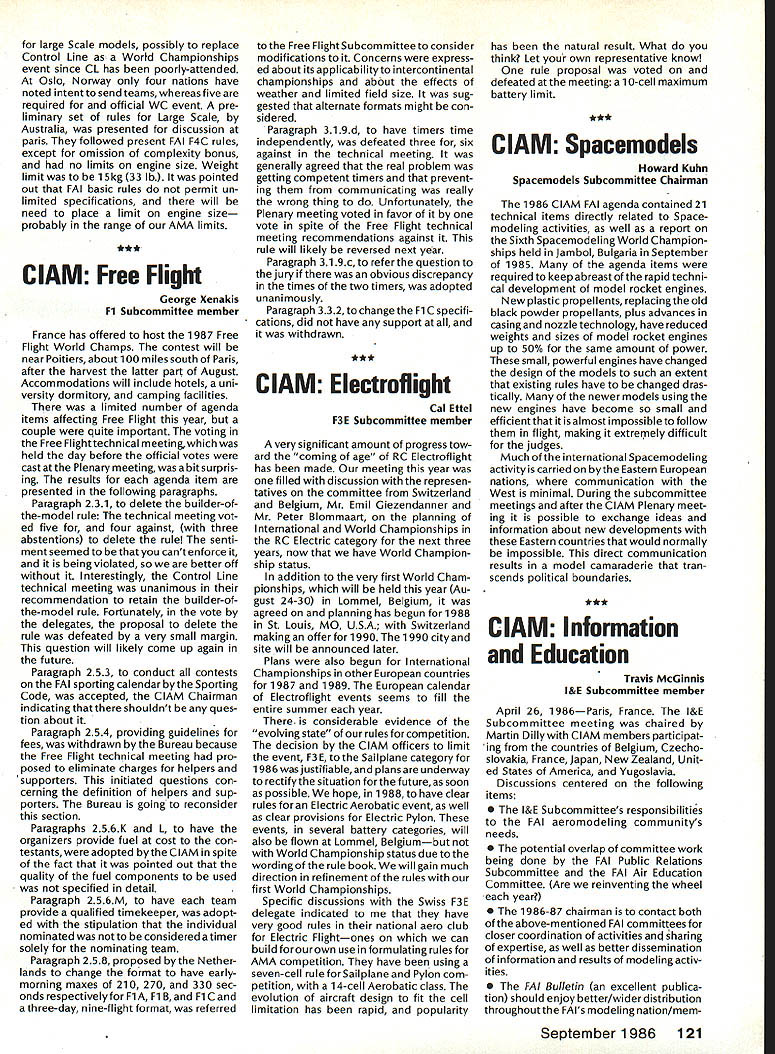
CIAM: Scale
Bob Wischer F4B/C Subcommittee member
Several important agenda items will affect Scale models being built for future World Championships and selection trials. The "rules-freeze" that was imposed until 1989 has been rescinded, so some items are of immediate concern to contestants. For example, the new seven-kilogram maximum weight limit is assumed applicable for the 1987 team trials and the 1988 World Championships.
The most important agenda item for RC Scale modelers was the adoption of a 20% maximum accumulation of flight score bonuses under the complexity-bonus system, effective in 1987. There was a strong movement to postpone the adoption, but early notification was deemed necessary because models were being designed and built and were affected.
The proposal to delete all bonuses for wing configuration was rejected. However, a U.S. proposal to deny a bonus to biplanes only will be brought before the Scale Subcommittee next year. The bonus schedule for biplanes, triplanes, and quadruplanes will remain in effect for another year. A proposal to reduce bonuses for multi-engined RC models was accepted: beginning in 1987, all aircraft with more than one engine will receive a complexity bonus of 10%. The rationale is that twin-engine models suffer greater disadvantage due to offset thrust than models with three or more engines.
A proposal to remove limits on maximum wing area for Control Line and RC models was defeated because basic FAI rules require some definite limit. A new proposal will be submitted next year to raise the present 150 square decimeters to a higher level, possibly 250 square decimeters. This change is considered necessary for safety reasons given the increased weight limit.
Beginning in 1987, Control Line Scale models shall use a security cord on the handle. Effective immediately, for CL and RC Scale, the contestant shall give evidence that flight options selected are typical and within the normal capabilities of the aircraft type modeled. The key word is "type" — contestants must now prove the general type was aerobatic or performed a particular function, not that the exact airframe did so.
For RC, the description of flap and landing gear demonstrations is changed (effective 1986) from "directly in front of the judges" to "in full view of the judges," recognizing these operations take time to perform.
For RC, in the triangular and rectangular circuit maneuvers, the point of beginning is now the center of the landing circle rather than the pilot's transmitter. The triangle size is increased to 150-meter legs, and the rectangle to 75- and 150-meter legs, effective in 1987. In the loop description, the words "smooth round" are deleted because not all prototypes performed in that manner; this change is applied immediately.
For the future, expect the RC complexity-bonus system to be replaced by:
- Wings — pre-1920 biplane with undercambered airfoil — 50%
- Multiplane (more than two wings) — 10%
- Engines (two or more) — 10% (already adopted for 1987)
- Landing gear — fixed or retractable — 5%
- Models of aircraft flown before the end of 1910 — 5%
The Control Line Scale class has enjoyed a revival at our Nats and FAI team trials, but entry numbers remain a concern internationally. If entries remain low, future championships may be forced to separate classes, as happened in 1982.
CIAM: Free Flight
George Xenakis F1 Subcommittee member
France has offered to host the 1987 Free Flight World Championships near Poitiers, about 100 miles south of Paris, after the harvest in late August. Accommodations will include hotels, a university dormitory, and camping facilities.
There were a limited number of agenda items affecting Free Flight this year, but a couple were important. Voting in the Free Flight technical meeting (held the day before the Plenary votes) produced some surprising results. Highlights follow:
- Paragraph 2.3.1, to delete the builder-of-the-model rule: The technical meeting voted five for, four against, with three abstentions, to delete the rule. The sentiment was enforcement is difficult and the rule is being violated. However, the delegates narrowly defeated the proposal, so the rule remains for now.
- Paragraph 2.5.3, to conduct all contests on the FAI sporting calendar by the Sporting Code: Accepted.
- Paragraph 2.5.4, providing guidelines for fees: Withdrawn by the Bureau after the Free Flight technical meeting proposed eliminating charges for helpers and supporters; the Bureau will reconsider definitions and wording.
- Paragraphs 2.5.6.K and L, to have organizers provide fuel at cost: Adopted, despite concerns that the quality of fuel components was not specified in detail.
- Paragraph 2.5.6.M, to have each team provide a qualified timekeeper: Adopted with the stipulation that the nominated individual is not considered a timer solely for the nominating team.
- Paragraph 2.5.8 (Netherlands proposal) to change the format to early-morning maxes of 210, 270, and 330 seconds for F1A, F1B, and F1C respectively, and a three-day, nine-flight format: Referred to the Free Flight Subcommittee for consideration due to concerns about intercontinental applicability, weather, and limited field size.
- Paragraph 3.1.9.d, to have timers time independently: Defeated in the technical meeting (3 for, 6 against); however, the Plenary meeting later voted in favor by one vote. This rule may be revisited next year.
- Paragraph 3.1.9.c, to refer the question to the jury if there is an obvious discrepancy in the times of two timers: Adopted unanimously.
- Paragraph 3.3.2, to change the F1C specifications: Withdrawn for lack of support.
CIAM: Electroflight
Cal Ettel F3E Subcommittee member
Significant progress toward the development of RC Electroflight has been made. Representatives from Switzerland and Belgium contributed to planning international and World Championships in the RC Electric category for the next three years now that the category has World Championship status.
The first World Championships will be held this year (Aug 24–30) in Lommel, Belgium. Planning is underway for 1988 in St. Louis, MO, U.S.A., with Switzerland making an offer for 1990 (site to be announced later). Plans were also begun for International Championships in other European countries for 1987 and 1989.
The CIAM decision to limit the F3E event to the Sailplane category for 1986 was justified; plans are underway to refine events for the future. By 1988 we hope to have clear rules for Electric Aerobatic events and provisions for Electric Pylon in several battery categories. These additional events will be flown at Lommel but not at World Championship status due to rule-book wording. The first World Championships will provide valuable direction for rule refinement.
Some national rules (for example, Switzerland's) offer useful approaches for AMA competition, such as cell-count limitations: they have used a seven-cell rule for Sailplane and Pylon with a 14-cell Aerobatic class, which led to rapid aircraft design evolution and popularity. One rule proposal at CIAM — a 10-cell maximum battery limit — was voted on and defeated.
CIAM: Spacemodels
Howard Kuhn Spacemodels Subcommittee Chairman
The 1986 CIAM FAI agenda contained 21 technical items directly related to Spacemodeling activities, as well as a report on the Sixth Spacemodeling World Championships held in Lamboal, Bulgaria, in September 1985. Many agenda items were required to keep pace with rapid technical development of model rocket engines. New plastic propellants, replacing old black powder propellants, plus advances in casing and nozzle technology, have reduced weights and sizes of engines by up to 50% for the same amount of power. These small, powerful engines have changed model design to such an extent that existing rules must be changed drastically. Many newer models using these engines have become so small and light that it is almost impossible to follow them in flight, making judging extremely difficult.
Much international spacemodeling activity is carried on by Eastern European nations, where communication with the West is limited. The subcommittee meetings and the CIAM Plenary allow useful exchange of ideas and information, fostering camaraderie that transcends political boundaries.
CIAM: Information and Education
Travis McGinnis I&E Subcommittee member
April 26, 1986 — Paris, France. The I&E Subcommittee meeting was chaired by Martin Dilly with CIAM members participating from Belgium, Czechoslovakia, France, Japan, New Zealand, the United States, and Yugoslavia. Discussion centered on:
- The I&E Subcommittee's responsibilities to the FAI aeromodelling community's needs.
- The potential overlap of committee work between the FAI Public Relations Subcommittee and the FAI Air Education Committee and the need for closer coordination.
- Contacting both FAI committees for closer coordination, sharing expertise, and better dissemination of information and results.
- Wider distribution of the FAI Bulletin throughout the FAI's modeling nations.
- Limited response to an information-gathering questionnaire; as more are returned, a profile of national aeroclub activities will be developed.
- Availability of a magazine list of model-flying publications (updated addresses as of January 1986) from the FAI office or AMA HQ.
- A communication failure that prevented invitations to the world's modeling press to cover CIAM activities; steps will be taken to correct this.
- Redrafting FAI record dossiers into story form for sharing in the modeling press (including three-view drawings and translations).
- Urging organizers of FAI events to use the FAI logo on event correspondence and advertisements.
A few notes from the FAI Bulletin that summarize CIAM activity:
- CIAM has nine subcommittees for specialist disciplines plus additional ones for information, education, and sound limitation.
- The proliferation of RC specialties led to five RC committees: RC Aerobatics, RC Soaring, RC Helicopters, RC Pylon Racing, and RC Electroflight.
- Plenary meetings usually see delegates from about 30 nations, plus observers and technical specialists.
- The Sporting Code (Section 4) covering model flying now has 176 pages compiled by the CIAM Technical Secretary.
- World Championships for model-flying disciplines are held in alternate years, with Continental events between them. In 1985 the World Free Flight Championships in Yugoslavia saw 251 fliers from 34 nations competing; four other World Championships and three European ones were also held that year, along with 60 Open FAI International Contests for model flying.
Transcribed from original scans by AI. Minor OCR errors may remain.

