
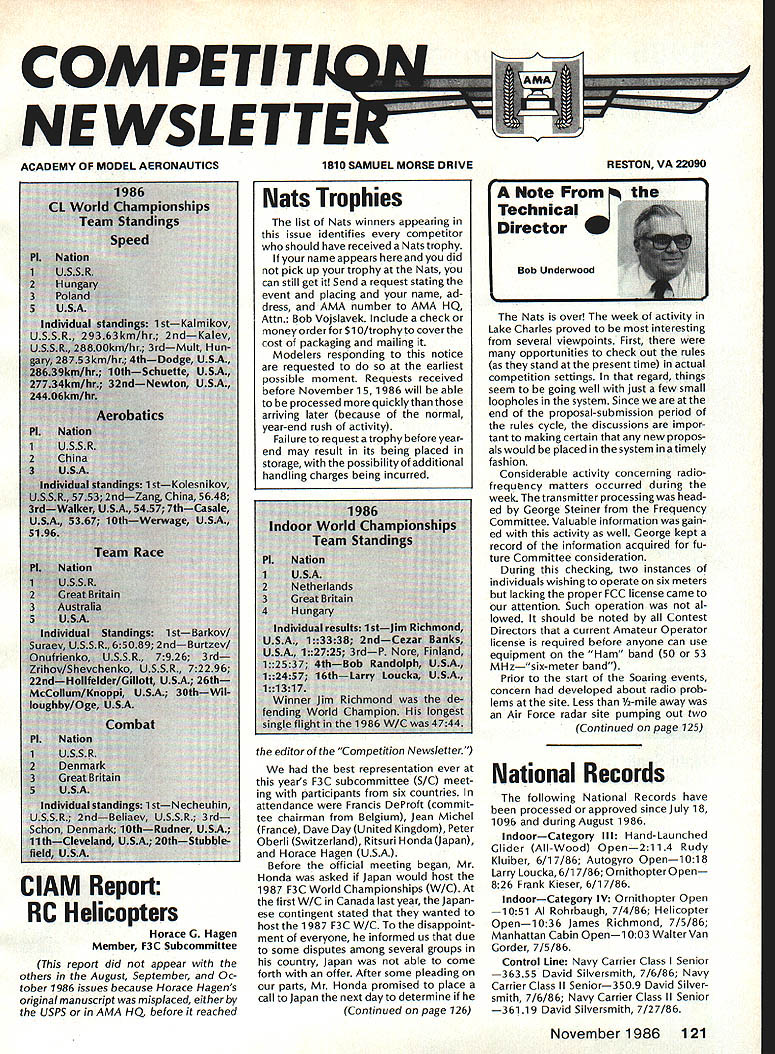
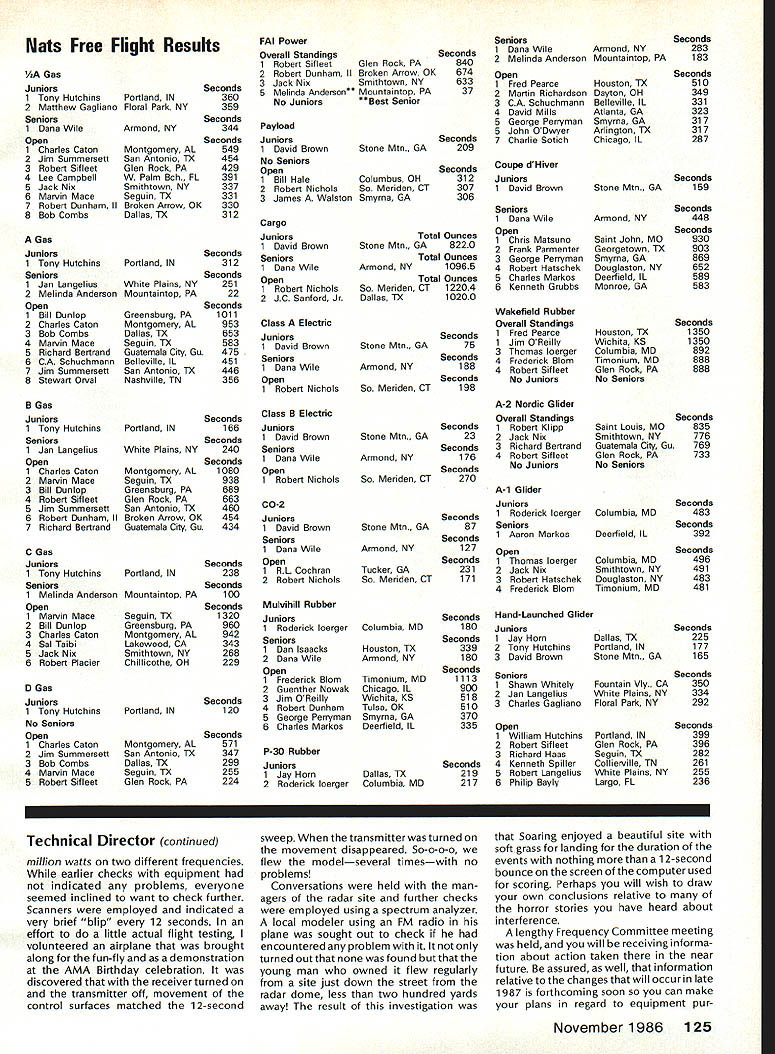
Competition Newsletter
CIAM Report: RC Helicopters
Horace G. Hagen Member, F3C Subcommittee
(Note: This report did not appear in the August, September, or October 1986 issues because Horace Hagen's original manuscript was misplaced by USPS or at AMA HQ before it reached the editor.)
Best representation ever — the F3C Subcommittee (S/C) meeting had participants from six countries: Francis DeProft (committee chairman, Belgium); Jean Michel (France); Dave Day (United Kingdom); Peter Oberli (Switzerland); Ritsuri Honda (Japan); and Horace Hagen (U.S.A.).
Before the official meeting began, Mr. Honda was asked if Japan would host the 1987 F3C World Championships (W/C). At the first W/C in Canada the previous year, the Japanese contingent had stated they wanted to host the 1987 event. Initially Mr. Honda informed us that, due to disputes among several groups in Japan, the country could not come forth with an offer. After some pleading, Mr. Honda promised to call Japan the next day to determine whether an offer could be obtained.
Nats — Trophy Notice
Nats winners whose names appeared in the issue but who did not pick up their trophies can still receive them. To request a trophy, send the following to AMA HQ, Attn: Bob Vojslavek:
- Event, placing, name, address, and AMA number
- Include check or money order: $10 per trophy (packing and mailing)
Requests received before November 15, 1986, will be processed quickly; those arriving later will be subject to the normal year-end rush. Failure to request a trophy before yearend may result in it being placed in storage with possible additional handling charges.
Nats — Lake Charles Activity
Over the Nats week at Lake Charles there were useful opportunities to test current rules in actual competition settings. Generally things went well, with only a few small loopholes noted. Since the end of the proposal-submission period in the rules cycle, ongoing discussions are ensuring that new proposals will be placed in the system in a timely fashion.
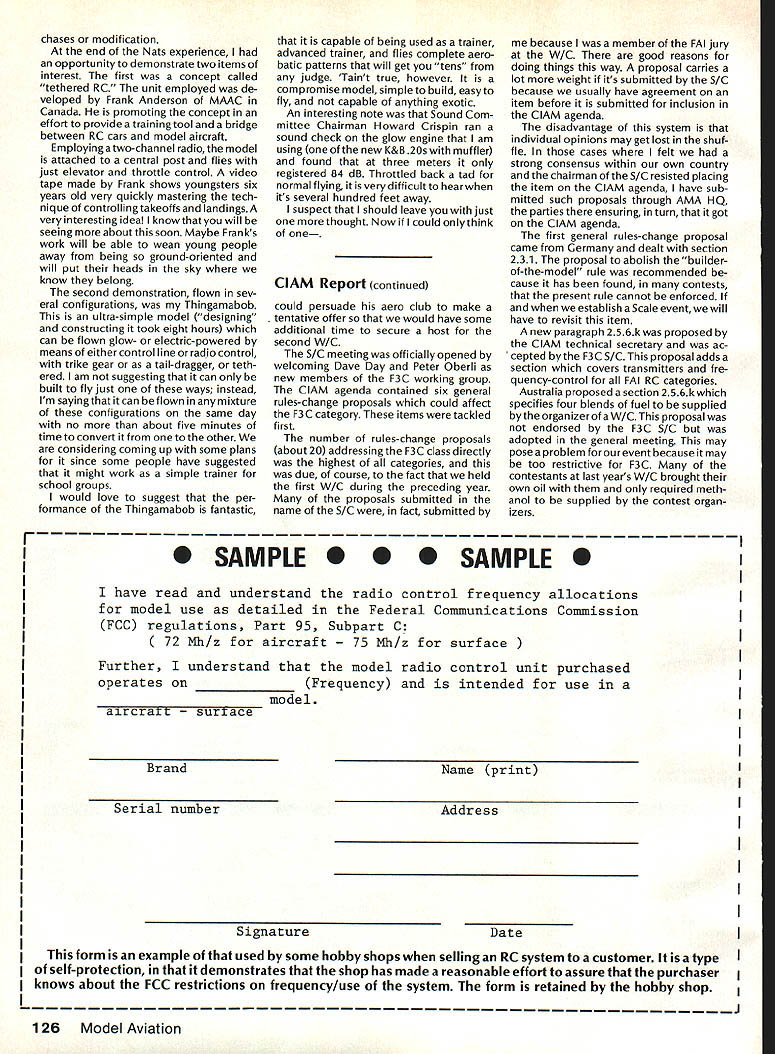
Considerable activity concerned radio-frequency matters. Transmitter processing was headed by George Steiner and the Frequency Committee. Valuable information was gathered and records kept for future committee consideration. During checks, two individuals were found wishing to operate on the six-meter band without proper FCC licenses. Such operation is not allowed. Contest Directors require a current Amateur Operator license before anyone may use equipment on the ham band 50–53 MHz (six‑meter band).
Prior to the start of the soaring events, concern developed about radio problems at the site. Less than 1/2 mile away an Air Force radar site was pumping out two sweep signals that initially appeared as interference on the scoring computer screen. When a transmitter was turned on the sweep movement disappeared, so models were flown several times with no problems.
Managers of the radar site were consulted and further checks were done with a spectrum analyzer. A local modeler using an FM radio in his plane was located to see whether he had encountered problems; in fact, he flew regularly from a site less than 200 yards from the radar dome without trouble. Soaring enjoyed a good site with only minor scoring screen noise (a 12‑second bounce) for the duration of the events. Draw your own conclusions about many of the interference horror stories you may have heard.
A lengthy Frequency Committee meeting was held; information about its actions and the changes coming in late 1987 will be provided to help you plan equipment purchases.
CIAM Report (continued)
At the end of the Nats I demonstrated two items of interest.
- Tethered RC: Developed by Frank Anderson of MAAC (Canada) as a training tool bridging RC cars and model aircraft. Using a two-channel radio, the unit is attached to a central post and flies with elevator and throttle control only. A videotape shows youngsters as young as six mastering takeoffs and landings quickly. Expect to see more about this concept.
- The Thingamabob: An ultra-simple model I built in about eight hours. It can be flown glow- or electric-powered, by control line or radio control, with trike gear or taildragger gear, or tethered. It can be converted between configurations in about five minutes. Plans may be considered for a simple trainer for school groups. It is a compromise model: simple to build and easy to fly, but not capable of advanced aerobatics.
Sound Committee Chairman Howard Crispin ran a sound check on the glow engine (a K&B .20 with muffler) and found that at three meters it registered only 84 dB. Throttle back slightly for normal flying and it is difficult to hear at several hundred feet.
F3C Subcommittee Meeting — Rules and Proposals
The S/C meeting officially opened by welcoming Dave Day and Peter Oberli as new members. The CIAM agenda contained six general rules-change proposals potentially affecting F3C; these were addressed first.
There were about 20 rules-change proposals directly addressing F3C—the highest of all categories—reflecting the recent first W/C. Many proposals submitted in the name of the S/C were submitted by me as a member of the FA jury at the W/C. Proposals submitted by the S/C generally carry more weight because consensus is reached before submission, though individual opinions can be lost. Where consensus within the U.S. existed but the S/C chairman rescinded placing an item on the CIAM agenda, I submitted proposals through AMA HQ to ensure inclusion.
Summary of notable proposals and outcomes:
- Section 2.3.1 (Germany): Proposal to abolish the "builder-of-the-model" rule was recommended because enforcement is impractical. If a Scale event is established, this will need revisiting.
- Section 2.5.6.k (CIAM technical secretary): New paragraph covering transmitters and frequency control for all FAI RC categories was proposed and accepted by the F3C S/C.
- Australia proposed section 2.5.6.k specifying four blends of fuel to be supplied by a W/C organizer. The S/C did not endorse this proposal, but it was adopted in the general meeting. This may be restrictive for events where contestants bring their own oil and only require methanol from organizers.
Helicopter Rules Changes
- Section 5.4.1 (Contest Area): Proposal adds a prohibited zone behind the flight-line judges, specifies flag height (50 cm, basswood poles), recommends heli-pad marking systems (discouraging platforms), and reduces helipad size to 1.2 meters diameter (so standard plywood sheets can be used). These changes were adopted.
- Section 5.4.2 (Assembly): A German proposal removed the "not permitted" paragraph. Rationale: models requiring only a few minutes of assembly time do not exist at this competition level, and it is impossible to prove whether a model was assembled entirely by the pilot.
- Section 5.4.3 (Rotor Blades / Tip Weights): Germany submitted a proposal concerning balancing measures in rotor blades, specifying they must be executed so that pieces cannot be propelled away in case of blade failure. Because it states the obvious, no one objected, but it is not enforceable. The debate over metal tip weights continues internationally. The rule forbidding metal weights in rotor blades will remain in effect until 1989, when a new FAI Sporting Code will be issued. The current consensus within the S/C is that there will likely be no restrictions after 1989; the S/C will provide suggested safe methods for CG-correction or increasing rotor moment of inertia.
Examples and notes:
- I submitted a laminated wooden blade design (manufactured in Japan, imported by Hobby Shack) that corrects CG using many thin laminations and is slightly nose-heavy—demonstrating alternatives to metal slugs.
- Ernie Huber has experimented with a relatively safe method of adding tip weight: suspending lead or steel shot in a mix of baking soda and CA cement. In crashes the shot dispersed rather than being emitted as a solid mass.
- Section 5.4.4 (Mechanic/Caller and Number of Models): An S/C proposal specifies:
a) Each contestant is allowed only one mechanic/caller. The mechanic/caller cannot act as coach but may announce the start and finish of each maneuver. Team managers cannot help the contestant at the starting box. Team managers may observe flights from a position five meters behind the judges and away from the starting box. Team managers can be substituted if there is no mechanic/caller. b) The number of models eligible for entry is two (2). A competitor may change models provided he remains in the starting box.
- Section 5.4.7 (Marking): The change results in a zero score for the entire flight if the model is flown under the prohibited area (previously only the maneuver that overflew the judges was scored zero).
- Section 5.4.9 (Judging): Changed so the high and low scores for each maneuver are dropped (instead of the high and low total scores). This change is intended to make it easier to determine the winner; initial trials showed the final scores had a wider spread.
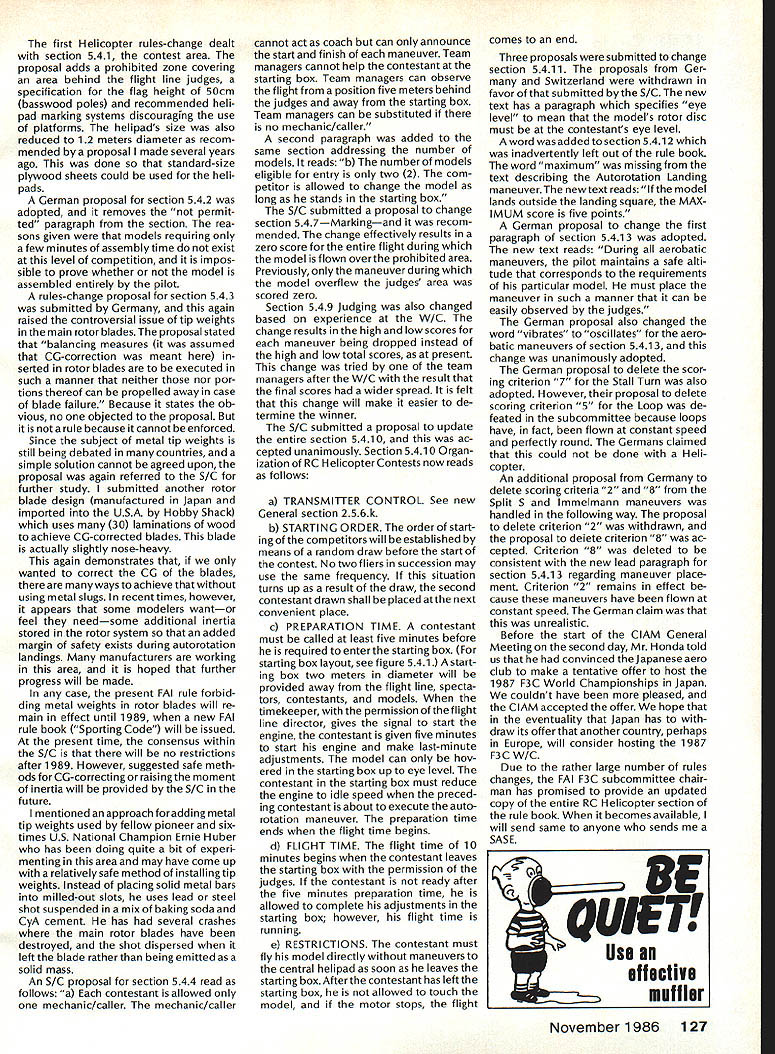
Section 5.4.10 — Organization of RC Helicopter Contests
Section 5.4.10 was updated and accepted unanimously. The section now reads as follows:
a) TRANSMITTER CONTROL See new General section 2.5.6.k.
b) STARTING ORDER The order of starting will be established by random draw before the contest. No two fliers in succession may use the same frequency. If the draw produces such a situation, the second contestant drawn shall be placed at the next convenient place.
c) PREPARATION TIME A contestant must be called at least five minutes before being required to enter the starting box. A start position two meters in diameter will be provided away from the flight line, spectators, contestants, and models. When the timekeeper, with permission of the flight line director, gives the signal to start the engine, the contestant has five minutes to start the engine and make last-minute adjustments. The model may only be hovered in the starting box up to eye level. The contestant in the starting box must reduce the engine to idle speed when the preceding contestant is about to execute the autorotation maneuver. Preparation time ends when flight time begins.
d) FLIGHT TIME Flight time of ten minutes begins when the contestant leaves the starting box with the judges' permission. If the contestant is not ready after the five-minute preparation time, he may complete adjustments in the starting box; however, flight time will not be running during this period.
e) RESTRICTIONS The contestant must fly his model directly, without maneuvers, to the central helipad as soon as he leaves the starting box. After leaving the starting box the contestant may not touch the model; if the motor stops, the flight ends.
Other Rule Changes and Clarifications
- Section 5.4.11: Three proposals were submitted; Germany and Switzerland withdrew theirs in favor of the S/C submission. The new text specifies "eye level" means the model's rotor disk must be at the contestant's eye level.
- Section 5.4.12: The missing word "maximum" was added to the Autorotation Landing maneuver. The new text reads: "If the model lands outside the landing square, the MAXIMUM score is five points."
- Section 5.4.13 (Aerobatic Maneuvers): A German proposal changed the lead paragraph to require pilots to maintain a safe altitude appropriate to the model and place maneuvers so judges can easily observe them. The word "vibrates" was changed to "oscillates" and adopted unanimously.
- The Germans' proposal to delete criterium "V" for the Stall Turn was adopted; their proposal to delete "V" for the Loop was not adopted.
- A German proposal to delete scoring criteria "2" and "8" for the Split S and Immelmann maneuvers was handled as follows: the proposal to delete criterion "2" was withdrawn; the proposal to delete criterion "8" was accepted (to be consistent with the new maneuver-placement paragraph). Criterion "2" remains because these maneuvers have been flown at constant speed; the German claim that this was unrealistic was not accepted.
Before the CIAM General Meeting on the second day, Mr. Honda informed us he had convinced the Japanese aeroclub to make a tentative offer to host the 1987 F3C World Championships in Japan. The CIAM accepted the offer. We hope the eventual host will make a final bid before the entry date or that another country, perhaps in Europe, will consider hosting the 1987 W/C.
Because of the number of rules changes, the FAI F3C subcommittee chairman has promised an updated copy of the entire RC Helicopter section of the rule book. I will send a copy to anyone who sends me a stamped, self-addressed envelope (SASE) when the update becomes available.
World Championships — Static & Team Report
Bob Underwood
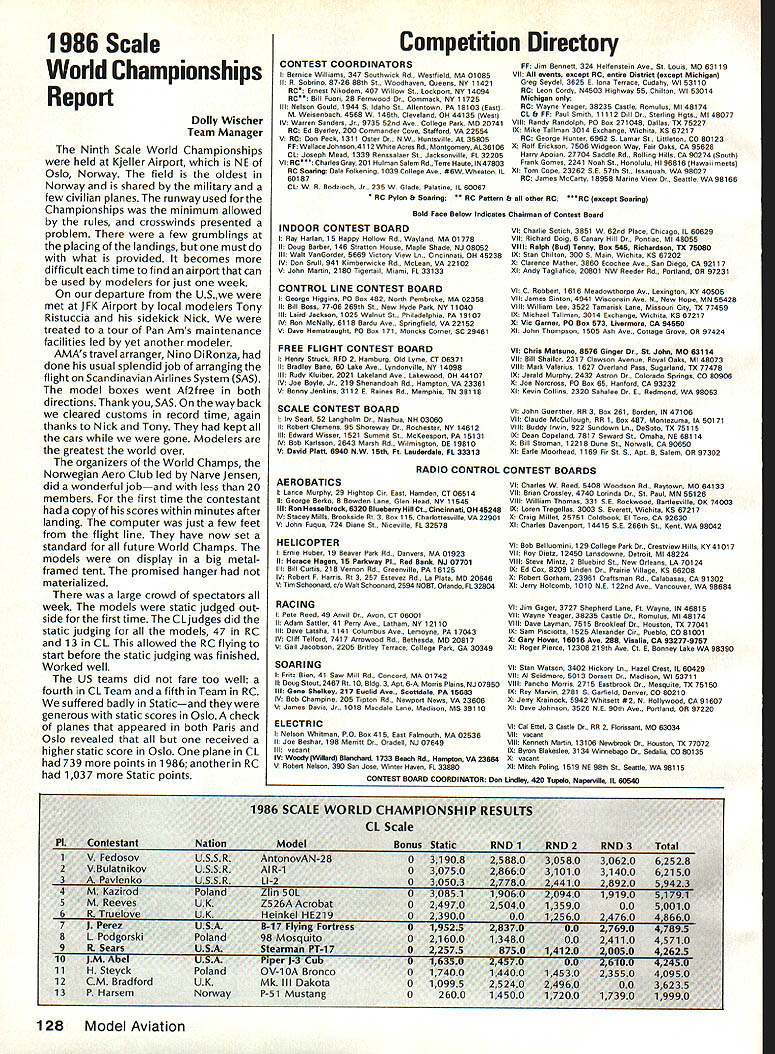
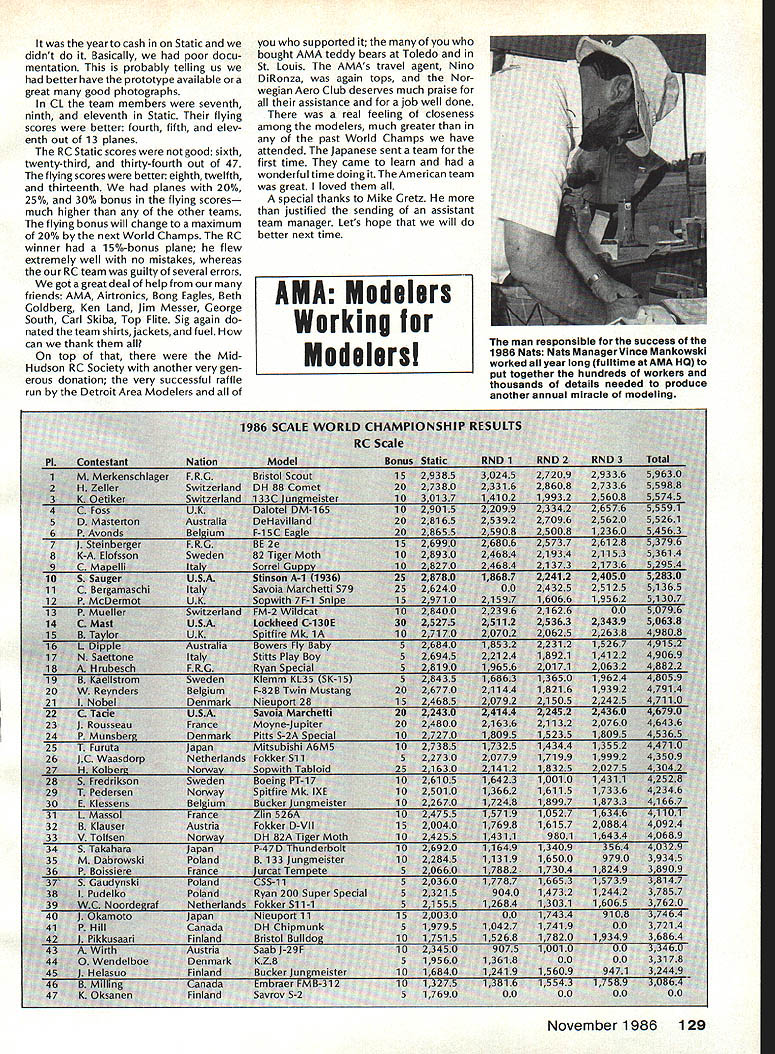
It was the year to cash in on Static and we didn't do it — essentially we had poor documentation. This suggests we should have prototypes available or many good photographs in future.
- Control Line (CL): Team members placed 7th, 9th, and 11th in Static. Flying scores were 4th, 5th, and 11th out of 13 planes.
- RC Static: Team placings were 6th, 23rd, and 34th out of 47. Flying scores were better: 8th, 12th, and 13th. Our planes had 20%, 25%, and 30% flying bonuses — higher than many other teams. Note: the flying bonus will be reduced to a maximum of 20% by the next World Championships. The RC winner had a 15% bonus plane and flew without mistakes; our RC team had several errors.
We received enormous help from many friends and organizations:
- AMA, Airtronics, Bong Eagles, Beth Goldberg, Ken Land, Jim Messer, George South, Carl Skiba, Top Flite
- Sig donated team shirts, jackets, and fuel again
- Midwest RC Society donated generously; Detroit Area Modelers ran a successful raffle
- Many who bought AMA teddy bears at Toledo and in St. Louis supported us
- AMA travel agent Nino DiRonza provided top service
- Norwegian Aero Club provided much assistance and deserve praise
There was a strong feeling of closeness among modelers, greater than in past World Champs. The Japanese sent a team for the first time to learn and had a wonderful experience. The American team was great — special thanks to Mike Gretz for justifying the sending of an assistant team manager.
Let's hope we do better next time.
— Bob Underwood
Transcribed from original scans by AI. Minor OCR errors may remain.

