
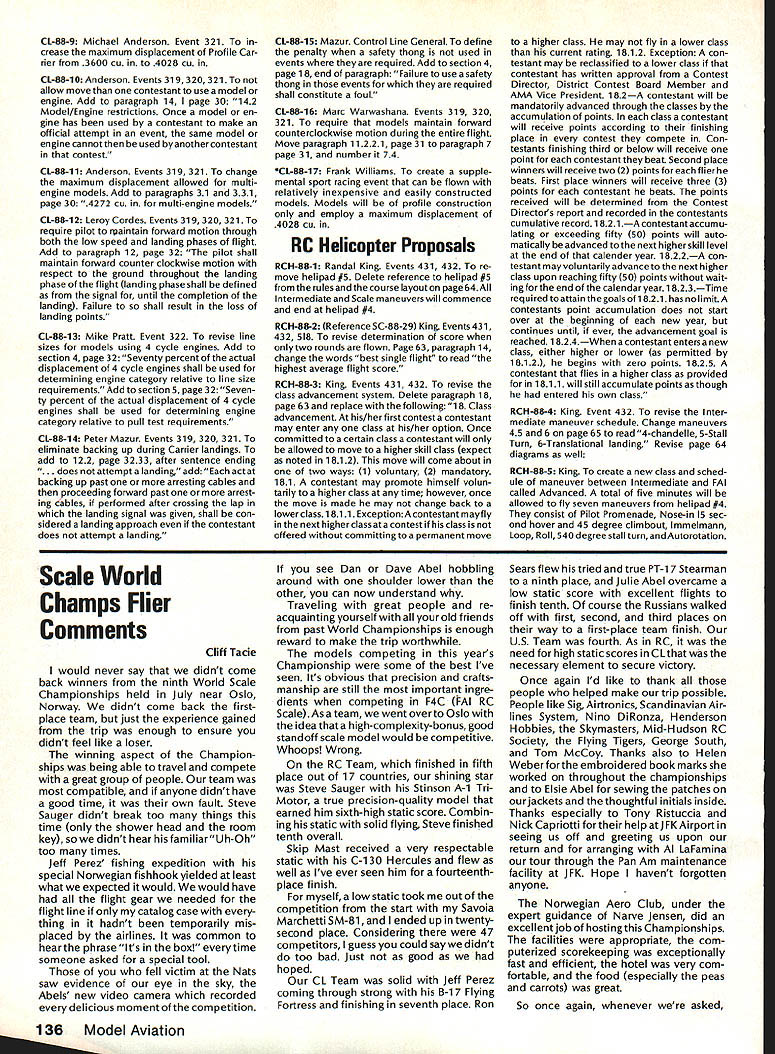
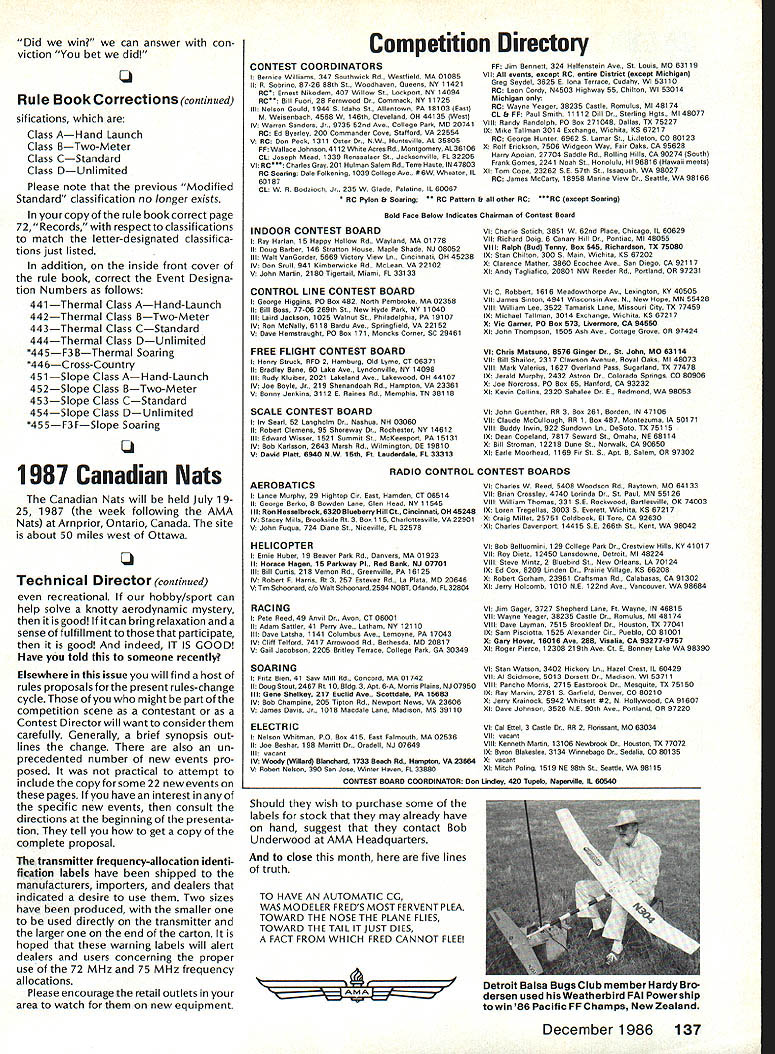
Competition Newsletter
Thanks From Hungary
The following letter was received by AMA Executive Director John Worth and is shared with the AMA membership. Dated Budapest, Hungary, August 27, 1986.
Dear Sirs,
This is to thank you sincerely for the kind assistance given to us directly and indirectly in the organization of the Control Line World Championships 1986. This has been a new proof of the friendship established through sports which does not know borders.
Your delegates, Mr. Don Jehlik and Mr. Mac Henry, accomplished outstanding work and deserve the greatest appreciation not only in our country but also among the best sportsmen of the participating foreign countries. We have become acquainted with two outstanding personalities who can be considered an example to modelers worldwide.
We also thank you for the activity of Dr. Laird Jackson, who resolved many difficult situations by his modesty, knowledge, and patience together with his colleagues on the jury.
We wish you good health and lots of success in your activities done in the interests of modeling.
With the best sports regards,
Yours sincerely, Istvan Gombocz Secretary-General, Hungarian Association of Modelers
---
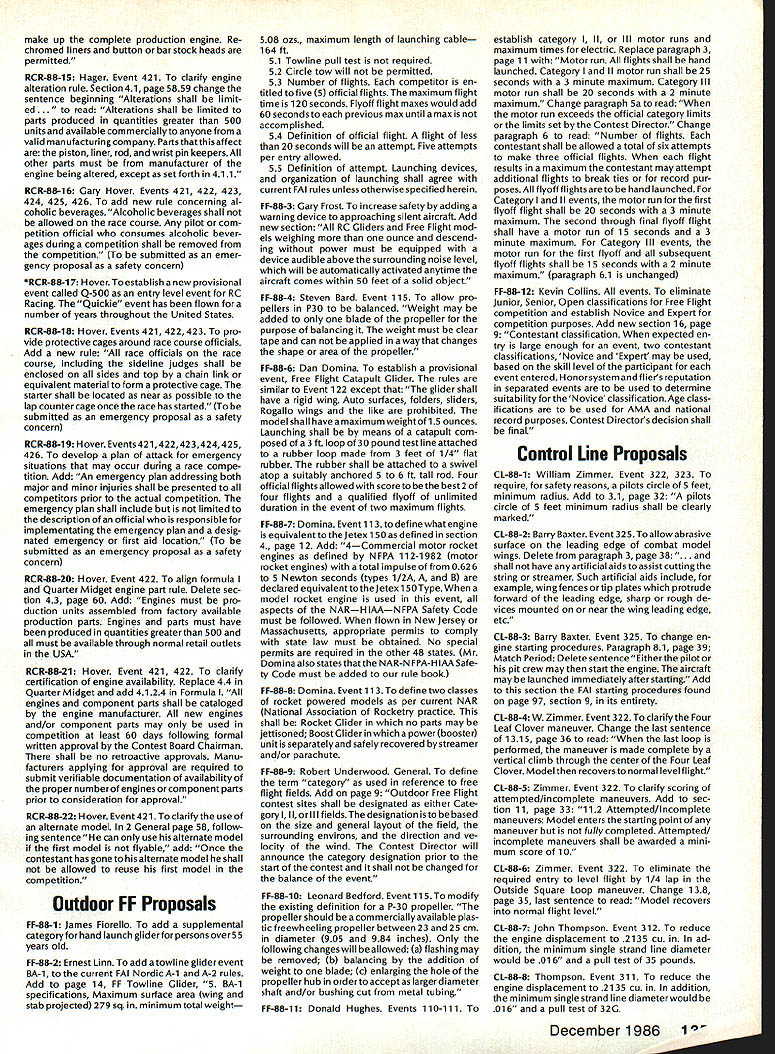
The 1988–89 Rules Proposals
The rules proposals printed below represent all proposals received at AMA Headquarters by the cutoff date for submittals. The next step will be the Initial Vote by the various Contest Boards.
- The Initial Vote ballots must be postmarked no later than December 1, 1986. Modelers wishing to register opinions for or against any proposal should contact their AMA district Contest Board member prior to balloting. The purpose of the Initial Vote is to "weed out" proposals unsuitable for further consideration. A Final Vote will occur next year to determine which surviving proposals will be adopted for the 1988–89 AMA Official Model Aircraft Regulations (rule book).
- The results of the Initial Vote will be printed in the March 1987 issue.
- *Indicates new events or extensive rewrites. Due to space restrictions, complete text may not be printed. For a full copy, contact the Competition Department at AMA Headquarters and indicate the proposal number requested.*
Unassigned Proposals
- Joe Beshar: Establish a new provisional event called "AMA Vintage," combining Free Flight and Radio Control for models designed, kitted, or published prior to December 31, 1942.
- Glenn Greens: Establish a new provisional event "RC Duration" to provide competition in many areas where space for conventional free flight is not available. Contest procedures have been tested in "Old Timer" events held by the Society of Antique Modelers.
- Donald Mulligan: Create a new Radio Control category for replicas of models designed for and flown in Free Flight competition prior to 1951.
Electric Proposals
- ELC-88-2: W. S. Blanchard. Establish unified rules for electric model airplane competition, covering events such as Class A Free Flight, Class B Free Flight, Class S Control Line Speed, Control Line Precision Aerobatics, RC Class A and B Sailplane Precision Duration, RC Class B Old-Timer (pre-1960), RC Precision Aerobatics, RC Sport, Control Line Classic events, and other radio and control line events. (Exact listings and detailed rules available from the Competition Department.)
General Proposals
- GEN-88-1: John Thompson. Eliminate Senior age classification. Change wording in Section 5, page 6 to: "Contestants under 16 years of age are classified as Juniors. Contestants 16 and older are classified as Open. Records are segregated as Junior or Open depending on the age classification of the contestant at the time the record was established." (Executive Council jurisdiction)
- GEN-88-2: Robert Underwood. Emphasize Contest Directors' responsibility to determine contestant eligibility. Change last sentence, "Responsibilities," page 1 to: "AMA sanctions exist to promote national standards—each C.D. will make a special effort in his AMA events to determine contestant eligibility by checking for current AMA and/or FAI stamp and enforce the rules." (Combined Executive Council and Contest Boards jurisdiction)
- GEN-88-3: Underwood. Define period included in a sanction. Add to 2, page 5: "By definition, an AMA sanctioned event shall be understood to include that period of time when the Contest Director or his appointed representative is in attendance at the named site on the day(s) listed on the sanction." (Executive Council jurisdiction)
- GEN-88-4: Underwood. Clarify model identification. Change first sentence section 4, page 8 to read: "All models entered in rulebook competition events excepting Indoor and Scale models shall . . ." Add to 4.2, page 8: "See AMA Safety Code for rules on identification of models to be flown in other than official AMA rule book events." (Contest Boards jurisdiction)
- GEN-88-5: Underwood. Allow officials to file a protest. Change first sentence, section 18, page 7 to read: "Protests concerning the conduct of a contest or record trial will be considered only when presented in writing, by a contestant or official in that event, . . ." (Combined Executive Council and Contest Boards jurisdiction)
- GEN-88-7: Kevin Collins. Add an overall silencer code. Add new section 9, page 8, General: "A silencer(s). All model aircraft operated with one or more internal combustion engines larger than .051 cu. in. must be equipped with effective silencers. FAI events to be governed by FAI Sporting Code." (Contest Boards jurisdiction)
- Add to section 4, page 6: "This shall include checking for current FAI stamp as is required for any phase of FAI Team Selection event participation." (Executive Council jurisdiction)
RC Aerobatics Proposals
- RCA-88-2: Michael Harrison. Simplify classes by combining Expert and Masters to create a new fixed pattern called "Open."
- RCA-88-1: Michael Harrison. Drop point accumulation for "Open" class (old combined Expert–Masters), contingent on approval of RCA-88-2.
- RCA-88-3: Harrison. Prohibit retracts in Sportsman Class.
- RCA-88-4: Harrison. Require Advanced, Expert, and Masters to meet a sound level no louder than 105 dB or lose 10 points per judge.
- RCA-88-5: Harrison. Change "Expert Pattern Maneuvers" to "Open Pattern Maneuvers," and drop the present Masters Pattern (provides fixed pattern until a new pattern is developed).
- RCA-88-6: William Kern. Establish a new provisional event, "RC Model Sport Flyer Fun Fly," to encourage sport fliers by combining elements of scale, craftsmanship, and flying (addition to current "Club Team Fun Fly").
- RCA-88-7: Robert Worrell. Allow ducted fans to a maximum single engine size of .85 cu. in. displacement, or 1.3 cu. in. for multi installations, to compete in Pattern.
- RCA-88-8: Ronald Hesselbrock. Change maneuvers in Expert Class. Total number increased to 15 from current 12:
- Avalanche
- Half Reverse Cuban Eight
- Slow Roll
- Stall Turn (right or left for wind correction)
- Square loop with four 1/2 rolls
- Immelmann turn
- Three outside loops (from top)
- Half roll into half square loop
- Top Hat (1/2 rolls)
- Stall Turn with 1/2 roll in upline and downline
- Four Point Roll
- Humpty Bump
- Double Immelmann
- Double Humpty Bump
- Two rolls in opposite directions from inverted
- RCA-88-9: Hesselbrock. Change maneuvers in Advanced class (13 maneuvers listed):
- Half Reverse Cuban Eight
- Slow Roll
- Stall Turn (right or left for wind correction)
- Top Hat (1/2 rolls)
- Immelmann Turn
- Three Outside Loops (from the top)
- Half Roll into Half Square Loop
- Double Immelmann
- Stall Turn with 1/2 roll in upline and downline
- Four Point Roll
- Humpty Bump
- Double Humpty Bump
- Two rolls in opposite directions from inverted
- RCA-88-10: Hesselbrock. Delete Master Class from RC Pattern section due to loss of popularity.
- RCA-88-12: Glenn Carter. Extensive rewrite of RC Sport Aerobatics rules (Events 4, 11, 412, 413)—deletions, additions, rewording.
- RCA-88-13: Russell Knetzger. Allow normalizing of scores and flyoff rounds to determine winners in Event 406 without making either mandatory. (Contest Director may choose FAI/EAA process with advance notice.)
- RCA-88-14: Knetzger. Give greater weight to flight track over plane attitude. Add: "All straight lines, both horizontal and vertical, will be graded on the track projected by the model. Changes in attitude of the model to maintain a straight track will not be a reason for downgrading the maneuver."
- RCA-88-15: Knetzger. Revise RC judge suggestions concerning minor downgrades: "Should put the maneuver score down to at least an 8." Also:
- Page 46.D. Add: "The availability of whole and 1/2 points will aid the judge in downgrading for major and minor defects."
- Add to 5th paragraph: "If the judge feels the contestant should be downgraded by at least 1/2 point . . ."
- Modify wording on minor and severe defects to clarify grading (one or two minor defects → at least 8; one severe defect or three/four minor defects → 7 or 6).
- RCA-88-16: Knetzger. Clarify mandatory zero for "landing outside the runway." Add text to RC Pattern Landing: define runway area and allow contest management to define marked runway limits in extensive paved or mowed areas.
- RCA-88-17: Knetzger. Delete mandatory zero for "landing outside the runway" (companion to RCA-88-16—approval or denial will negate the other).
- RCA-88-18: Knetzger. Delay mandatory advancement from Novice to Sportsman until the end of the calendar year rather than immediate.
- RCA-88-19: Charley Reed. Change Expert Class maneuvers (to be "Open" if RCA-88-2 is passed); list of 13 maneuvers including takeoff, Cuban 8, Double Immelmann, slow roll, etc.
- RCA-88-20: Reed. Change Advanced Class maneuvers.
Scale Proposals
- SC-88-1: D. Lindley. Peanut Events 501, 505. Add two characteristics for comparison with full-scale on the score sheet under Scale Score Judging Criteria:
- Wing outline (3 = scale, 2 = slightly out of scale, 1 = grossly out of scale, 0 = poor outline)
- Fuselage outline (same point values)
- SC-88-2: John Quencher. Events 501, 505. Change FF Peanut Scale (Indoor and Outdoor) from provisional to official status.
- SC-88-3: Nicholas Mango. CL Events 508, 509. Change single-engined weight limit to 20 lbs., same as multi-engined in both Sport and Precision.
- SC-88-4: Robert Guilfoyle, RC. Establish provisional event "RC/ARF Scale" to separate factory-built and contest-built scale models; three-view required, no static scores given.
- SC-88-5: Australia Graves. CL Event 508. Allow optional light systems (landing lights, beacons, etc.). Only one light option may be nominated.
- SC-88-6: Graves. CL Event 508. Delete: "Lighting systems will not be permitted as an unlisted operation but will receive consideration during scale judging."
- SC-88-7: Graves. CL Event 508. Delete: "The contestant must also demonstrate engine shutoff at the end of the flight to qualify for maximum points to be awarded."
- SC-88-8: Graves. CL Event 508. Separate engine shutoff and engine control so each can count as an option. "Engine shutoff must operate the same as a full-scale aircrew and only after landing shall the throttle be brought to low speed."
- SC-88-9: Russell Knetzger. RC Events 511, 512, 513, 514, 515, 517, 518. Make 1/2 points available for RC Scale flight judging.
- SC-88-10: Knetzger. RC Events 511–515, 518. Limit helpers and state only the pilot may operate transmitter. "Each pilot is permitted one helper during the flight. Two helpers may be present during engine starting. Once airborne, no person other than the pilot shall operate the transmitter controls. Operation by anyone else shall require disqualification of the flight."
- SC-88-11: Knetzger. Unify RC Scale and RC Pattern safety requirements. Replace RC Sport Scale 2.1 and 2.2 with corresponding RC Pattern sections; clarify takeoff and landing permission with judges or line director.
- SC-88-12: Knetzger. RC page 85. Replace Flight Judging Guide 4.2.4 Landing paragraphs 2 and 3 with: "The landing shall be considered complete when the model has lost flying speed and has completed 15 meters of roll out, or stops, whichever comes first. Within the 15 meter roll out zone, collapsed gear, resting or momentarily touching on the nose shall be grounds for severe downward grading, and flipping of the model onto its back shall be a zero."
- SC-88-13: William Boss. CL Sport Scale. Require multi-engined models with diverse power plants (glow + electric, glow + jet, etc.) to demonstrate all power plants contribute significantly to performance; judges and contestant to agree on demonstration method before the first attempt.
- SC-88-14: Boss. CL Sport Scale Event 509. Contestant's declaration shall not count as part of the total allowable number of pages of documentation.
- SC-88-15: Boss. CL Sport Scale Event 509. Permit larger three-view drawings up to 24" x 36".
- SC-88-16: Boss. CL Sport Scale Event 509. Change number of documentation pages allowed from 6 to 8.
- SC-88-17: Boss. CL Sport Scale Event 509. When a plastic model is used as proof-of-scale, delete only one page of documentation (instead of two).
- SC-88-18: Boss. CL Sport Scale Event 509. Eliminate "Touch and Go" as a 20 point flight option by removing the words from paragraphs 8.3, 9.1 and 9.2.
- SC-88-19: Boss. Duplicate of SC-88-18 (remove Touch and Go wording).
- SC-88-20: Boss. CL Sport Scale Event 509. Delete paragraph 7.4 to eliminate a time limit for completion of the flight (starting times maintained).
- SC-88-21: Boss. CL Precision Event 508. Same as SC-88-13.
- SC-88-22: Boss. CL Precision Event 508. Bring flap operation more in line with full-scale aircraft: "Lowering and raising flaps must be performed as an independent (non-proportional) throttle control function to obtain maximum points."
- SC-88-23: Boss. CL Precision Event 508. Allow prototype-typical operations (folding wings, opening canopy, etc.) to be performed prior to takeoff. Present rules confine operations to the model's official flight.
- SC-88-24: Boss. CL Precision Event 508. Eliminate the "Engine Starting Bonus" (questionable use of electric starters and igniters).
- SC-88-25: Boss. CL Precision Event 508. Eliminate waiver on dummy pilots by deleting sentence starting with "Models built prior to January 1, 1980...."
- SC-88-26: Boss. Unified Scale Judging Regulations. Same as SC-88-20.
- SC-88-27: Boss. Unified Scale Judging Regulations. Limit static judging documentation to 25 pages (prefer use of 11" x 14"); three-view may be up to 24" x 36", counts as one page; declaration not counted.
- SC-88-28: D. R. Platt. RC and CL Sport and Giant Events 509, 511–514. Define static display configuration: any parts of the model may be displayed in any position (canopy open, flaps lowered, etc.). Parts that will not fly with the model may not be added. Judges may request re-configuration to match three-views.
- SC-88-29: Platt. RC Sport and Giant Events 511–514. Define "attempt" and "official" flight: two attempts allowed per official flight. A flight is an attempt if model does not become airborne; if airborne, flight is official. Time and score cancelled for an attempt.
- SC-88-30: Platt. Rubber Scale (Indoor–Outdoor) Event 503, 507. Raise flying point limit to match static point limit: change "90" to "150" in Rule 5.4.
- SC-88-31: Platt. RC Scale Flight Judging Guide. Rename maneuvers in Section 4.2.1 from "Unassisted ROG" to "Take-off."
- SC-88-32: Platt. CL and RC Sport/Giant Events 509, 511–514. Allow drawings with more than three views.
- SC-88-33: Platt. CL and RC Sport Events 509, 511–514. Delete rule 5.3 to allow cockpit detail to count during static judging.
- SC-88-34: Platt. CL and RC Sport Events 509, 511–514. Allow painting of plastic kits when used as documentation in static judging.
- SC-88-35: Platt. CL Sport Events 509, 511–514. Standardize weight limit: "Models shall weigh no more than 20 lbs. ready for flight, except for fuel."
- SC-88-36: Platt. CL and RC Sport/Giant Events 509, 511–514. Increase documentation pages allowed from 6 to 8.
- SC-88-37: Platt. CL and RC Sport/Giant Events 509, 511–514. Award a bonus for original design: 10% of craftsmanship score added to craftsmanship if model is original design (proof required). Replaces present rule requiring a list of purchased parts.
- SC-88-38: Claude McCullough. RC Sport Events 511–513. Use same weight limit for single and multi-engined aircraft: 20 lbs. ready for flight, except fuel.
- SC-88-39: McCullough. RC Precision Event 515. Same as SC-88-38.
- SC-88-40: McCullough. RC Precision Event 515. Apply the same engine formula to Precision as to RC Sport Scale (see 2.7 on page 79).
- SC-88-41: Platt. RC Precision Event 515. Reinstate RC Precision Scale as in the 1980 Rule Book, plus the tie-breaker rule indicated in RC Precision Scale, 3 on page 82. Approval would replace current Event 515.
- SC-88-42: Platt. Outdoor Rubber Event 507. Clarify rule 4.4 by adding: "Note that the airfoil section of the wing may be non-scale."
- SC-88-43: Randall King. RC Scale Helicopter Event 518. Change scoring method on page 81, paragraph 9, to: "In case of only two (2) flying rounds, the final score shall be one-half the static score plus the average flight score."
---
Indoor Contest Board — Final Ballot
The Indoor Contest Board has reached a unanimous decision on the interpretation of Section 81 in the 1986–87 AMA Rule Book. The section shall be interpreted as follows:
- Acceptable use of material other than wood for propeller blades, propeller spars, wire, propeller shaft, and adhesive in assembly is allowed.
- No gadgets of any kind, including variable pitch or variable diameter mechanisms, are permitted as part of the propeller.
- Socketed propeller hubs permit blade replacement; manual pitch adjustment is acceptable.
- This interpretation is consistent with the August 1986 issue (page 113) on the same subject and is enforced immediately.
---
US FAI Pylon Team Selected
At the recently concluded team finals meet, the following three pilots were selected for the US F3D RC Pylon Racing team:
- Dub Jett, Humble, TX
- Brian Richmond, Orlando, FL
- David Shadel, Carlsbad, CA
Callers:
- Bruce Richmond, Dallas, TX (caller for Jett)
- Jim Shinohara, Chula Vista, CA (caller for Shadel)
Team manager: Bob Wallace, Avon, CT
World Championships will be held in Melbourne, Australia, April 16–20, 1987. Supporters who wish to accompany the team must pay entry & lodging fees totaling 500 Swiss Francs to the Competition Department at AMA HQ by January 5, 1987. Travel arrangements must be made separately.
AMA's travel agent: Nino DiRonza, Americana/Fairfax Travel, 419 John Marr Dr., Annandale, VA 22003. Telephone: 703/471-0105.
---
RC Soaring Team Selected
At the recently concluded team finals meet, the following three modelers were selected for the US F3B RC Soaring team:
- Steve Work, Albuquerque, NM
- Richard Spicer, San Jose, CA
- Steven Lewis, Santa Clara, CA
Alternate member: Larry Jolly, Santa Ana, CA Team manager: Lynn C. King, Boulder Creek, CA
Enthusiasts who wish to accompany the team to the World Championships in Osnabrück, Germany, July 24–August 2, 1987 must pay supporter fees by May 1, 1987. Contact the Competition Department, AMA HQ for further information.
---
Rule Book Corrections
- Changes in RC Sailplane classifications that took effect in January 1986 resulted in identity problems within the 1986–87 AMA Rule Book. Page 66 of the rule book contains the correct RC Sailplane classifications.
- Note: Technical Director W. Bob Underwood.
---
Note from Technical Director W. Bob Underwood
Much progress can the life span of an individual absorb before the brain registers system overload? As we have celebrated a half-century along with the Academy, I can recall days of building that were orchestrated—the number of hours it took for glue to dry. Today, standing in the middle of the National Model Aviation Museum in Reston, I recall the sights, sounds, and smells of those days. I would head home, uncork a container of cyanoacrylate, and virtually build a model in an evening.
Mylar, plastics, exotic fibers, and myriad other refinements abound. I wonder at the products and advances in the state of the art. One can find it necessary to become a chemist just to paint a model. I have found, through painful experience, that materials often will react adversely with one another and create a model that resembles a bison in moulting season. Radios, bundles, switches, and electrics develop great gobs of power and gulp huge hunks of juice; designs that never should have flown stagger the mind.
Does the end come? Of course it does not. Nor does our capacity to assimilate advancements for use in our hobby/sport. We must consider our ability to help pioneer unknown frontiers of science. If our hobby/sport can help solve a knotty aerodynamic mystery, it is good. If it brings relaxation and a sense of fulfillment to participants, it is good. And indeed, IT IS GOOD! Have you told someone this recently?
Elsewhere in this issue you will find a host of rules proposals for the present rules-change cycle. Those involved in competition as contestants or Contest Directors should consider them carefully. Generally, a brief synopsis outlines each change. There are also an unexpected number of new events proposed; it was not practical to include the complete copy for some 22 new events in these pages. If you have interest in any specific new event, consult the directions at the beginning of the presentation for how to request a complete proposal.
Transmitter frequency-allocation identification labels have been shipped to manufacturers, importers, and dealers who indicated a desire to use them. Two sizes were produced: the smaller to be used directly on the transmitter and the larger on the end of the carton. It is hoped these warning labels will alert both users and dealers concerning the proper use of the 72 MHz and 75 MHz frequency allocations. Please encourage retail outlets in your area to watch for them on new equipment. If dealers wish to purchase labels for stock they already have on hand, suggest they contact Bob Underwood at AMA Headquarters.
Five lines of truth to close this month:
TO HAVE AN AUTOMATIC CG, WAS MODELER FRED'S MOST FERVENT PLEA. TOWARD THE NOSE THE PLANE FLIES, TOWARD THE TAIL IT JUST DIES, A FACT FROM WHICH FRED CANNOT FLEE!
---
RC Soaring Proposals
- SC-88-44: King. RC Scale Helicopter Event 518. Change required maneuvers to create a more realistic flight schedule. Replace current schedule with:
- 15-second hover and 45-degree climbout
- Rectangular traffic pattern
- Transitional landing
- 360-degree flyaround
- Freestyle scale flight (2-minute maximum)
Also: all scale maneuvers shall commence and end at helipad #4.
- S0-88-1: Barry Kurath. Class A Handlaunch Event 441. Eliminate the 1-1/2 meter limit for handlaunch wingspan by deleting it from paragraph 3.1.1.
- S0-88-2: Douglas Dorton. Launch Equipment. Add to paragraph 9, p.86: "Winch systems will have a maximum line length of 600 meters, with the turnaround located no more than 300 meters from the winch. Release of the aircraft from the pilot's or helper's hand must occur within those 3 meters of the winch. Hi-Start systems may use any combination of elastic and line, but the stretched length for launching cannot exceed 300 meters."
- S0-88-3: Gary Frost. Soaring general. Increase safety by adding a warning device to sailplanes to indicate approach of silent aircraft: "All RC gliders and Free Flight models weighing more than one ounce and descending without power must be equipped with a device audible above surrounding noise level which will be automatically activated anytime the aircraft comes within 50 feet of a solid object."
Indoor Proposals
- IND-88-1: James Fiorello. Add supplemental Hand Launch Glider category for persons over 55 years of age.
- IND-88-2: Don Domina. Steering of Model. Add to Section 14, page 16: "Steering shall be limited for AMA events to three 15-second periods. The periods may be consecutive (a 45-second steer is permitted)."
- IND-88-3: Don Domina. Combine Hi-Tech and all wood classes of Hand Launch Glider. Change item 5, p.17: "Except for natural flexing, rigid geometry wings are required (no folders, parawings, etc.)."
- IND-88-4: Domina. Change item 12, page 16: allow 20 seconds instead of 10 for a hung model to free itself. Add: "A balloon, pole, etc., may not be used to dislodge a hung model for the purpose of flight continuation."
- IND-88-5: Domina. Event 202. Require Intermediate Stick models to weigh at least 1.5 grams.
- IND-88-6: Douglas Barber. Event 206. Set minimum weight of an Easy B model at 1 gram.
- IND-88-7: Barber. Event 206. Remove restriction that Easy B models must be paper-covered. Page 15, 8.2: "The Easy B model shall be a monoplane covered with any commercially available solid material in sheet form (this excludes microfilm)."
- IND-88-8: Barber. Event 206. Add reinforcement restrictions: structural framework must be entirely wood with adhesive for assembly only. Reinforcement (boron, carbon fiber, kevlar, etc.) not allowed.
- IND-88-9: Barber. Event 206. No bracing allowed on Easy B models. Delete Contest Board interpretation.
- IND-88-10: Barber. Event 208. Change name to "Limited Pennyplane."
- IND-88-11: Richard Doig. Event 205 Manhattan. Add windshield/window requirement: if transparent covering used on the fuselage, windshield and windows must be outlined in a contrasting color.
- IND-88-12: Doig. Event 209. Allow plastic covering on Easy B models: replace 8.2.a to permit paper or plastic film (microfilm not allowed).
- IND-88-13: Doig. Events 212, 213. Combine into single class with no material restrictions. Replace page 7, paragraphs 5a and 5b with: "Construction: all surfaces shall remain fixed except for changes of camber or incidence due to natural flexing of the surfaces. Folding wings and mechanically actuated incidence changes are strictly prohibited."
- IND-88-14: Doig. Events 201–211. Clarify judging at end of flight. Replace item 12, page 16 with explicit definitions for hand-launched events, R.O.C. events, and continuation of present material regarding obstructions.
- IND-88-15: Doig. Event 206. Make official the May 31, 1986 interpretation concerning Easy B propellers: Only wood for propeller blades and spars, one wire for shaft, adhesive for assembly; no gadgets (variable pitch or diameter) permitted; socketed hubs permit blade replacement; manual pitch adjustment acceptable.
- IND-88-16: Kevin Collins. All events. Eliminate Junior, Senior, Open classifications for Free Flight competition and establish Novice and Expert classifications for competition. Add new section 16, page 9: "Contestant Classification" (honor system defined; Contest Director's decision final).
R/C Racing Proposals
- RCR-88-1: Gail Jacobson. Event 422. Allow substitute needle valves in engines where factory needle valve is no longer available. Replace "excluding" with wording to permit approved substitutes.
- RCR-88-2: Jacobson. Event 422. Change engine certification procedure to require at least 250 engines with R/C carburetor or venturi produced and available through normal retail channels in the United States. If unique supplier, maintain average inventory of 100 engines and/or parts in the U.S. (Reference Joe Friend letter, 18 Feb 1983).
- RCR-88-3: Jacobson. Event 422. Require a 60-day period from AMA approval before an engine may be used in contests; certification will be printed in Model Aviation and special interest groups notified by mail.
- RCR-88-4: Jacobson. Event 422. Increase allowed engine size for Quarter Midget: total displacement not over 3.64 cc (2.115 cu. in.).
- RCR-88-5: Wayne Yeager. Event 422. Delete language regarding use of primary and backup aircraft: remove sentence restricting alternate/back-up aircraft use.
- RCR-88-6: Yeager. Event 422. Reduce required number of engines for certification (revision requested).
- RCR-88-7: Yeager. Event 422. Define "production" and "normal retail outlet" in paragraph 4.3; suggest "normal retail outlet" be any source where a consumer can purchase the product at an independent price; clarify commercial availability.
- RCR-88-8: Yeager. Event 422. Delete language prohibiting engine rework (remove paragraphs 4.2, 4.4, 4.6, 4.7).
- RCR-88-9: Yeager. Event 422. Change availability language: engines approved after March 31 may not be used until January 1 of following year.
- RCR-88-10: David Latsha. Event 422. Reduce required number of engines for certification to 100 engines.
- RCR-88-11: John Kilsdonk. Event 421. Clarify scoring system irrespective of number of planes in heat: use 4-3-2-1 system for all contests; in three-plane heats, use equivalent.
- RCR-88-12: Kilsdonk. Event 421. Handle "dead heats" by sharing combined position points equally among tied airplanes; lap totals unchanged.
- RCR-88-13: Kilsdonk. Event 421. Establish a procedure for developing race matrix through assignment of contestant numbers and columns indicating counts of firsts, seconds, thirds.
- RCR-88-14: William Hager. Event 421. Revise engine rules. Section 4.1.1: delete certain wording and clarify recommended liners and heads are permitted.
- RCR-88-15: Hager. Event 421. Clarify engine alteration rule: alterations limited to parts produced in quantities greater than 500 units and available commercially; parts affecting are piston, liner, rod, wrist pin keepers; other parts must be from the manufacturer except as set forth.
- RCR-88-16: Gary Hover. Events 421–426. Add rule concerning alcoholic beverages: "Alcoholic beverages shall not be allowed on the race course. Any pilot, competitor, or official who consumes alcoholic beverages during a competition shall be removed from the competition." (Proposed as emergency safety proposal.)
- RCR-88-17: Hover. Establish new provisional event called Q-500 as an entry-level event for RC Racing ("Quickie" event).
- RCR-88-18: Hover. Events 421–423. Provide protective cages around race course officials: all race officials on the course shall be enclosed on all sides and top by chain link or equivalent material.
- RCR-88-19: Hover. Events 421–426. Develop an emergency plan for injuries during a race; present plan to competitors prior to contest and designate responsible official and first aid location. (Emergency proposal.)
- RCR-88-20: Hover. Event 422. Align Formula I and Quarter Midget engine part rules: engines must be production units assembled from factory-available parts produced in quantities greater than 500 and available through normal retail outlets in the USA.
- RCR-88-21: Hover. Events 421–425. Clarify certification of engine availability: require manufacturers to submit verifiable documentation of availability of required number of engines or parts prior to approval; no retroactive approvals; 60-day waiting period after Contest Board Chairman approval.
- RCR-88-22 to RCR-88-26: (Not listed here; refer to full proposal listings as needed.)
Outdoor Free Flight (FF) Proposals
- FF-88-1: James Fiorello. Add supplemental Hand Launch Glider category for persons over 55 years old.
- FF-88-2: Ernest Linn. Add a towline glider event BA-1 to current FAI Nordic A-1 and A-2 rules. BA-1 specs: maximum surface area 279 sq. in., minimum weight 5.08 oz, maximum launching cable length 164 ft. 5 in., no circle tow, five official flights, max flight time 120 seconds; flyoff flight maxes add 60 seconds until a max not accomplished.
- FF-88-3: (Name not legible on scan). Add warning device requirement for silent aircraft (same as S0-88-3) for RC gliders and Free Flight models over one ounce descending without power.
- FF-88-4: Steven Bard. Event 115 P30. Allow propellers to be balanced. "Weight may be added to only one blade for balancing; weight must be clear tape and cannot change shape or area of the propeller."
- FF-88-5: Dan Domina. Establish provisional Free Flight Catapult Glider event: rules similar to Event 122 with rigid wings only (no auto surfaces, folders, Rogallo wings, etc.), maximum weight 1.5 oz, launch by 3 ft loop of 30-lb test line attached to 3 ft of 1/4" flat rubber, anchored to 5–6 ft rod; four official flights, best two of four count, qualified flyoff of unlimited duration if two maximum flights.
- FF-88-7: Domina. Event 113. Define commercial motor rocket engines equivalent to Jetex 150 using NFPA 112-1982: total impulse 0.62–5.0 N·s (types 1/2A, A, B). When using model rocket engines, NAR–NFPA Safety Code must be followed; permits may be required in some states.
- FF-88-8: Domina. Event 113. Define two classes of rocket-powered models per NAR practice: Rocket Glider (no parts jettisoned) and Boost Glider (booster recovered separately by streamer/parachute).
- FF-88-9: Robert Underwood. Define "category" for free flight fields: designate outdoor free flight contest sites as Category I, II, or III based on size, layout, surroundings, and wind; Contest Director announces category prior to start and it remains for the event.
- FF-88-10: Leonard Bedford. Event 115. Modify P-30 propeller definition: commercially available plastic freewheeling propeller between 2.0 and 2.5 cm diameter; allowed changes: changing hub to be molded or balanced, enlarging hub hole to accept larger shaft/bushing.
- FF-88-11: Donald Hughes. Events 110–111. Establish Category I, II, III motor runs and maximum times for electric RC Pylon Racing; specify motor run and flyoff motor run times and number of attempts for official flights.
- FF-88-12 to FF-88-14: (Additional proposals and clarifications available in full proposal text.)
Control Line Proposals
- CL-88-1: William Zimmer. Events 322, 323. Require a pilots' circle of minimum 5-foot radius; clearly marked.
- CL-88-2: Barry Baxter. Event 325 Combat. Allow abrasive surface on leading edge of wing by deleting prohibition against artificial aids (lead tape, metal edges, etc.) used to assist cutting streamers.
- CL-88-3: Barry Baxter. Event 325. Change engine starting procedures: delete sentence allowing pilot or crew to start engine and launch immediately; add FAI starting procedures from page 97, section 5, in its entirety.
- CL-88-4: W. Zimmer. Event 322. Clarify Four Leaf Clover maneuver: complete maneuver by a vertical climb through center; model then recovers to level flight.
- CL-88-5: Zimmer. Event 322. Clarify scoring for attempted/incomplete maneuvers: attempted/incomplete maneuvers entering the starting point on an incomplete maneuver shall be awarded a minimum score of 10.
- CL-88-6: Zimmer. Event 322. Eliminate requirement to level flight by 1/4 turn in Outside Square Loop maneuver; change wording to recovery into normal level flight.
- CL-88-7: John Thompson. Event 312. Reduce engine displacement to .2135 cu. in.; minimum single strand line diameter .016", pull test 332 lbs.
- CL-88-8: Thompson. Event 311. Same as CL-88-7: reduce engine displacement to .2135 cu. in.; minimum single strand line diameter .016", pull test 332 lbs.
- CL-88-9: Michael Anderson. Event 321. Increase maximum displacement of Profile Carrier from .3600 cu. in. to .4028 cu. in.
- CL-88-10: Anderson. Events 319, 320, 321. Prohibit more than one contestant using the same model or engine in a contest. Add: once a model or engine has been used to make an official attempt, it cannot be used by another contestant in that contest.
- CL-88-11: Anderson. Events 319, 321. Change maximum displacement for multi-engine models to .4272 cu. in.
- CL-88-12: Leroy Cordes. Events 319, 320, 321. Require pilot to maintain forward motion through low speed and landing phases: pilot shall maintain forward counter-clockwise motion relative to ground throughout landing phases; failure to land results in loss of landing points.
- CL-88-13: Mike Pratt. Event 322. Revise line sizes for models using 4-cycle engines: use 70% of actual displacement for determining engine category relative to line size requirements; same for pull test.
- CL-88-14: Peter Mazur. Events 318, 320, 321. Eliminate backing up during Carrier landings; define backing up past arresting cables as a landing approach under certain conditions.
- CL-88-15: Mazur. Control Line General. Define penalty when a safety factor is not used where required: failure to use required safety factor shall constitute a foul.
- CL-88-16: Marc Warshawana. Events 319–321. Require models maintain forward counter-clockwise motion during entire flight.
- CL-88-17: Frank Williams. Create a supplemental sport racing event for profile construction models with maximum displacement of .4028 cu. in.
RC Helicopter Proposals
- RCH-88-1: Randal King. Events 431, 432. Remove helipad #5 from rules and course layout; all Intermediate and Scale maneuvers will commence on and include helipad #4.
- RCH-88-2: King. Events 431, 432, 518. Revise scoring when only two rounds are flown: change "best single flight" to "the highest average flight score."
- RCH-88-3: King. Events 431, 432. Revise class advancement system: allow contestants to enter any class at first contest, permit voluntary and mandatory promotions, and define exceptions and Contest Director authority.
- RCH-88-4: King. Event 432. Revise Intermediate/FAI Scale class rules; create new class and maneuver schedule between Intermediate and FAI called Advanced (five maneuvers).
- RCH-88-5: King. Create Advanced class with specified maneuvers between Intermediate and FAI (details to be added to rule book).
---
Rule Book Correction (continued)
Classifications for Hand Launch Thermal and Slope events are to be corrected as follows:
- Class A — Hand Launch
- Class B — Two-Meter
- Class C — Standard
- Class D — Unlimited
Note: The previous "Modified Standard" classification no longer exists.
Correct page 72, "Records," to match the letter-designated classifications above. Also correct the inside front cover Event Designation Numbers:
- 441 — Thermal Class A — Hand-Launch
- 442 — Thermal Class B — Two-Meter
- 443 — Thermal Class C — Standard
- 444 — Thermal Class D — Unlimited
- 445 — F3B — Thermal Soaring
- 446 — Cross-Country
- 451 — Slope Class A — Hand-Launch
- 452 — Slope Class B — Two-Meter
- 453 — Slope Class C — Standard
- 454 — Slope Class D — Unlimited
- 455 — F3F — Slope Soaring
---
1987 Canadian Nationals
The Canadian Nationals will be held July 19–25, 1987 (the week following the AMA Nats) at Arnprior, Ontario, Canada. The site is about 50 miles west of Ottawa.
---
Technical Director (continued)
Should you wish to purchase transmitter frequency labels for stock, contact Bob Underwood at AMA Headquarters.
(See "Note from Technical Director W. Bob Underwood" above for additional commentary and closing poem.)
Transcribed from original scans by AI. Minor OCR errors may remain.

