
Competition Newsletter
A Note From the Technical Director
Bob Underwood
Don't look now — before you know it 1987 will have pounded on your door, holiday bills will appear, and the stark realization of all that new tax legislation will be upon us.
The most recent Executive Council meeting brought about changes that will make 1987 an interesting and busy year for your Technical Director. Major changes are planned in the rule book structure to better serve the membership.
Plans are being made to publish three books in place of the present single rule book. While all the details as to content and distribution have not been completely worked out at this stage, the general concept has been developed for several reasons.
The general membership needs to be better informed concerning Academy rules and recommendations. At present our rule book contains only a very small section in the back that addresses membership concerns. Although this was expanded from earlier versions, it still does not contain the items necessary to do the job well. In addition, the fact that it is part of a competition-oriented document causes untold confusion for many people.
For example, people call and want to ask a question about "Giant Scale." Quickly it is discovered that they want to ask a question about large models — the event found on page 81 of the competition section. Likewise, individuals have a problem sorting out the proper methods of model identification because of differences that exist between "4 Identification" in the General section of the competition rules (page eight) and item six of the General section of the Official AMA Safety Code (page 133). We can only hope that, by providing a full-blown Membership Manual with appropriate and complete information to the entire membership, we can alleviate many of these problems and make it a meaningful document for everyone.
The Rule Book will become just that. It will be designed for those who are interested in testing their skills in the competitive events that have developed over the years. Contest Directors and competitors alike will know that what is found in this book will apply to the competitive events. This book will be made available to all modelers who wish to be interested in competition. The method which will be employed to distribute this book will be explained at a later date.
The third book will be a printing of the FAI Sporting Code in its entirety. At present, an abridged version of the Code is included in the AMA rule book. It is unfortunate that the entire text is not present. This has caused problems in team selection programs and other FAI events where the version of the FAI rules in the AMA book has been used. By supplying the complete Code and updates we can overcome that problem as well as the fact that we generally cannot acquire enough books from FAI's Paris headquarters to supply our needs. For those of you who fly AMA events which reference the FAI rules, be assured that we will provide all the information required for those events in the regular AMA book. It is planned as of now to make the FAI Sporting Code available as part of the FAI stamp purchase.
This is a very brief overview of the plan, and we will provide additional information in the coming months. This program is slated for implementation at the end of the present rules-change cycle at the beginning of 1988.
Speaking of rules, please note that a very important item was left out of the Safety Code on page 137. Item four of the General section should read:
"If my model weighs over 20 pounds, I will only fly it in accordance with paragraph 5 of this section of the Safety Code, with a minimum separation of 65 feet between spectators and flight operations."
This addition to the Safety Code was approved by the Executive Council several years ago and was "lost" between the minutes of their meeting and the preparation of the 1984-85 rule book. Since it was not in the previous book it failed to be picked up in our present one as well.
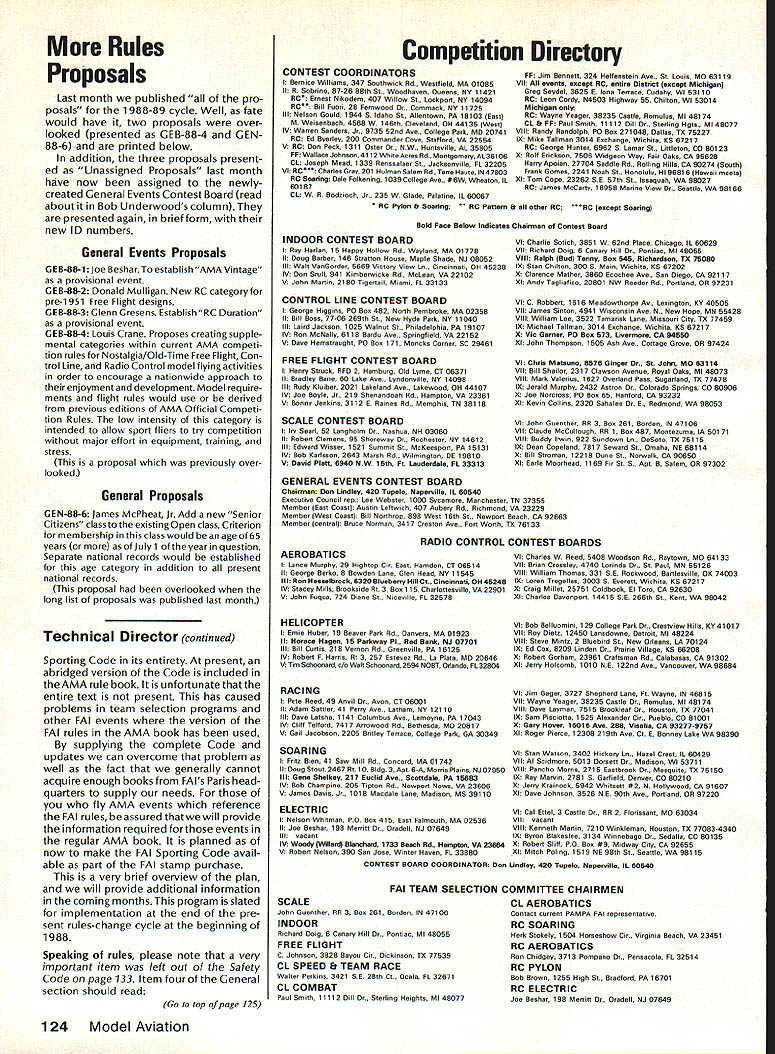
Another item addressed by the Council at the last meeting involved approval of the creation of a General Events Contest Board. This special group was formed to solve a problem that has developed this cycle with the submission of rules for several events which do not fit within the structure of our present Contest Boards. Because these rules proposals combine elements that overlap in the competitive structure, it was felt they should be treated in a special manner. The General Events Board will be composed of five members. The chairman is the Contest Board Coordinator, Don Lindley. In addition, one member is to be selected from the Executive Council and the remaining three from the membership at large.
The Executive Council has developed a committee to work with me to study the current program used to qualify Contest Directors. This is tied to a concern about the need to monitor CD activities.
There are just under 4,000 Contest Directors in the Academy, sanctioning about 2,000 events each year. In performing that function we become agents of the Academy. With our nation's fondness for litigation it is important that we strive for the highest level of CD performance possible in order to reduce the possibility of the Academy's involvement in lawsuits. This high level of performance must include preparation and execution of the event as well as complete, accurate record keeping.
Very soon I will have the final version of a Contest Director's Guide available for the membership. This should help us develop a standard to use in filling out the necessary forms and should also answer questions that currently are causing confusion.
Another set of important items on the Council agenda dealt with Frequency Committee actions. There is not enough room in this column to detail these, and I would suggest that you pay close attention to articles in future issues of all the modeling magazines. There are a host of changes that will occur toward the end of 1987.
The Frequency Committee items which were discussed included a comprehensive set of equipment guidelines for industry, a new flag-identification system, reaffirmation of the phase-in plan, and the appropriation of funds for the purchase of a spectrum analyzer.
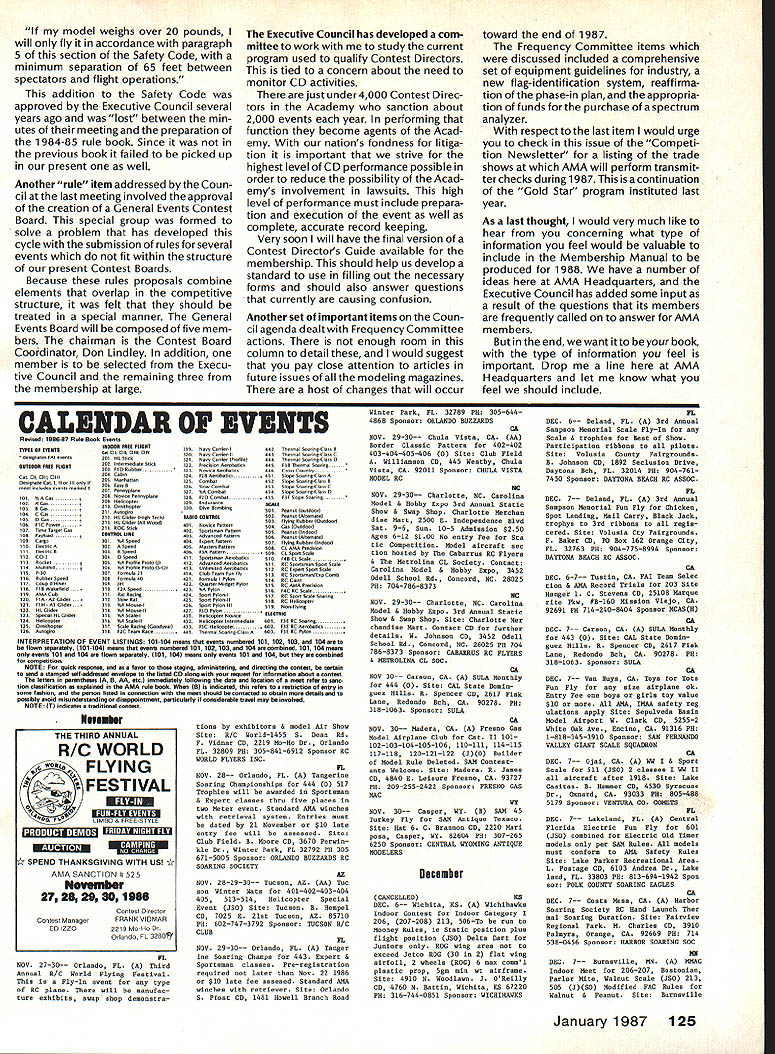
With respect to the last item I would urge you to check in this issue of the Competition Newsletter for a listing of the trade shows at which AMA will perform transmitter checks during 1987. This is a continuation of the "Gold Star" program instituted last year.
As a last thought, I would very much like to hear from you concerning what type of information you feel would be valuable to include in the Membership Manual to be produced for 1988. We have a number of ideas here at AMA Headquarters, and the Executive Council has added some input as a result of the questions that its members are frequently called on to answer for AMA members.
But in the end, we want it to be your book, with the type of information you feel is important. Drop me a line here at AMA Headquarters and let me know what you feel we should include.
— L. Bob Underwood
Academy of Model Aeronautics
Call Bids — RC Helicopter Team Finals Site
The team-selection program plan for the next U.S. FAI RC Helicopter team is still in its formative stages. However, a team finals site will be needed. Details — calendar dates, desired scope, facilities needed — will be forthcoming. Clubs who would be willing to host finals should contact the Competition Department at AMA HQ. At the present time it is believed the forthcoming World Championships may be in Switzerland.
RC Racing Contest Board Acts — Emergency Proposals
The RC Racing Contest Board has just completed balloting on three Emergency Proposals. It has approved one for immediate enforcement; the other two have received "No Immediate Ruling" status and will require further vote. The Board immediately enforced ruling applies to RC Racing events (Event Numbers 421, 422, 423, 424, 425, 426):
- Alcoholic beverages shall be prohibited on the race course. Any pilot or competition official who consumes alcoholic beverages during competition shall be removed from the competition.
The following proposal also applies to RC Racing events and is subject to further Contest Board ballot (No Immediate Ruling):
- An emergency plan addressing both major and minor injuries shall be presented to competitors prior to actual competition. The emergency plan shall include limited designation of the official responsible for implementing the emergency plan and a designated emergency first-aid location.
The following emergency proposal applies to Formula Quarter Midget/1/2-A Racing events (421, 422, 423) and is subject to further Contest Board ballot (No Immediate Ruling):
- Race officials and the race course, including sideline judges, shall be enclosed on sides and top with chain-link or equivalent material to form a protective cage. The starter shall be located as near as possible to the lap-counter cage once the race has started.
Want to Enter FAI Team-Selection Program
Any U.S. modeler who wishes to enter AMA's FAI team-selection programs may do so by sending an initial entry fee of $5 to the Competition Department, AMA HQ. The $5 will be applied toward the entry fee for the team program. Interest will probably be greater than $5, but the $5 will entitle the applicant to receive mailings, announcements and balloting pertaining to the particular program/event the modeler wants to enter. The $5 fee must be paid to enter the program.
— L. Bob Underwood
1987: Thinkin' Lincoln
The 61st National Model Airplane Championships will be held in Lincoln, Nebraska, July 11–19. The official schedule of events will appear here in a future issue. Entry forms will be available in January.
Recent first-hand site visits have generated exciting news. Those who have seen the sites are excited and the word is spreading about an exceptional 1987 NATS.
Free Flight
Hey! Have we got a site for you! Not only is it better than other Lincoln NATS free-flight sites, but it promises to be far better than the site has been for many years. The site (a mile with grazing land as far as the eye can see — not a stalk of corn in sight!) is less than 15 miles from other NATS activities. The State Capitol, as well as the main site, the Lincoln Municipal Airport, is also visible. For the first time, we expect to set up flight operations and, no matter what the wind conditions, remain with one launch site all week long!
Indoor will be flown at Pershing Auditorium. This has proved to be a good site, and like all else at Lincoln, it is within 10 to 15 minutes of all the other flying activities.
Control Line
Control Line participants from previous Nationals held in Lincoln will remember the best CL site in NATS history. Happily, this site is unchanged. The grass area for Combat and a veritable ocean of concrete for the other CL events are ready for NATS '87.
Radio Control
Pattern and Pylon will again be on the ramp area (14 million square feet!) at the Lincoln Municipal Airport. Pattern, Pylon, and Control Line are all within walking distance of each other and the Headquarters operation — a fantastic arrangement.
RC Soaring is to be held at Oak Creek Park, three miles from the airport; it is a grassy area with good spectator exposure and ample space for parking and contest activities.
RC Helicopter events will be held at the Skyknights field, approximately seven miles from the airport. This field is one of the best anywhere, complete with spectator fences, club house, and paved runways.
Two new NATS items of interest:
- Quickie 500 will be added to the 1987 NATS schedule. In response to modeler requests, this popular event will be held at the Lincoln NATS. The NMPRA Q-500 rules will be used and will be published in a future issue. Additionally, a copy of the rules will be sent to all Q-500 entrants.
- Pattern at the 1987 NATS will be flown by class, keeping all Sportsman together and likewise all other classes of Pattern fliers. This change in format is in response to requests by Pattern fliers and will, in many ways, improve the contest for Pattern contestants. Flying by class does require frequency assignment of all Pattern contestants. The allowed frequencies will be published early for easy conversion by some contestants.
The FAI Pattern event will be flown as the event were a continental or world championship, with qualifications and a final. Further, the noise rule in FAI will be enforced. It is intended to upgrade the caliber of the FAI Pattern contest to a world-class meet.
Housing
Housing in Lincoln is top notch. A variety of motels are close to all sites. The Lincoln dorms are remembered as the best of all NATS dorms. A complete motel list and location map will be published in coming months.
To handle the expected interest and participation in the Lincoln NATS, AMA will have official entry forms available earlier than usual. In January, entry forms will be sent to AMA hobby shops and clubs in District 9, plus those in Minnesota, Iowa, and Missouri. All 1986 NATS contestants will receive a 1987 entry form. AMA charter clubs may use the coupon at right to receive forms. Any individual AMA member may obtain an entry form by sending a stamped, self-addressed (business-size) envelope to AMA HQ.
NAME _______________________________
ADDRESS ____________________________
CITY _____________________ STATE ____ ZIP _______
Please rush ___ NATS entry forms to our Club.
Club number __________
AMA 1810 Samuel Morse Drive Reston, VA 22090
RC Pylon Team Selection Finals
Bob Brown Photographs by the author
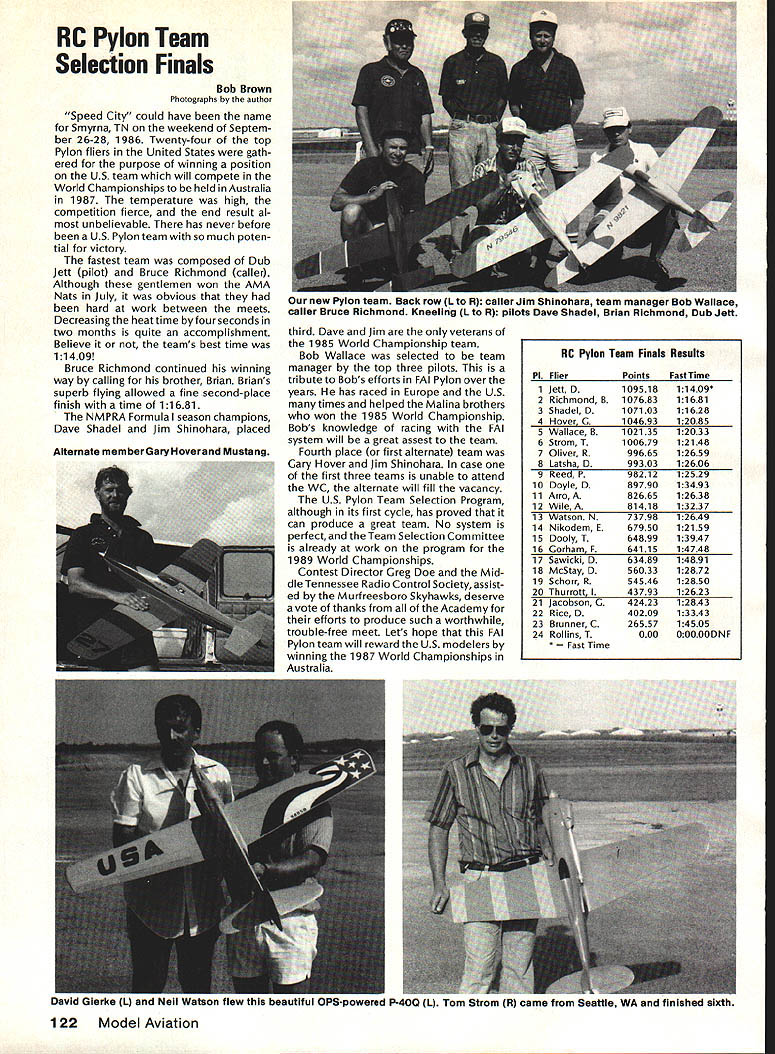
"Speed City" could have been the name for Smyrna, TN on the weekend of September 26–28, 1986. Twenty-four of the top Pylon fliers in the United States were gathered for the purpose of winning a position on the U.S. team which will compete in the World Championships to be held in Australia in 1987. The temperature was high, the competition fierce, and the end result almost unbelievable. There has never before been a U.S. Pylon team with so much potential for victory.
The fastest team was composed of Dub Jett (pilot) and Bruce Richmond (caller). Although these gentlemen won the AMA Nats in July, it was obvious that they had been hard at work between the meets. Decreasing the heat time by four seconds in two months is quite an accomplishment. Believe it or not, the team's best time was 1:14.09!
Bruce Richmond continued his winning ways by calling for his brother, Brian. Brian's superb flying allowed a fine second-place finish with a time of 1:16.81.
The NMPRA Formula I season champions, Dave Shadel and Jim Shinohara, placed third. Dave and Jim are the only veterans of the 1985 World Championship team.
Bob Wallace was selected to be team manager by the top three pilots. This is a tribute to Bob's efforts in FAI Pylon over the years. He has raced in Europe and the U.S. many times and helped the Malina brothers who won the 1985 World Championship. Bob's knowledge of racing with the FAI system will be a great asset to the team.
Fourth place (or first alternate) team was Gary Hover and Jim Shinohara. In case one of the first three teams is unable to attend the World Championships, the alternate will fill the vacancy.
The U.S. Pylon Team Selection Program, although in its first cycle, has proved that it can produce a great team. No system is perfect, and the Team Selection Committee is already at work on the program for the 1989 World Championships.
Contest Director Greg Doe and the Middle Tennessee Radio Control Society, assisted by the Murfreesboro Skyhawks, deserve a vote of thanks from all of the Academy for their efforts to produce such a worthwhile, trouble-free meet. Let's hope that this FAI Pylon team will reward the U.S. modelers by winning the 1987 World Championships in Australia.
RC Pylon Team Finals Results
- Pl. 1. Jett, D. — Points: 1095.18 — Fast Time: 1:14.09*
- Pl. 2. Richmond, B. — Points: 1076.83 — Fast Time: 1:16.81
- Pl. 3. Shadel, D. — Points: 1071.03 — Fast Time: 1:16.28
- Pl. 4. Hover, G. — Points: 1046.93 — Fast Time: 1:20.85
- Pl. 5. Wallace, B. — Points: 1021.35 — Fast Time: 1:20.33
- Pl. 6. Strom, T. — Points: 1006.79 — Fast Time: 1:24.45
- Pl. 7. Oliver, R. — Points: 996.65 — Fast Time: 1:26.59
- Pl. 8. Latsha, D. — Points: 993.03 — Fast Time: 1:26.06
- Pl. 9. Rea, P. — Points: 983.22 — Fast Time: 1:25.29
- Pl. 10. Doyle, D. — Points: 897.70 — Fast Time: 1:34.93
- Pl. 11. Arvo, A. — Points: 826.65 — Fast Time: 1:36.38
- Pl. 12. Wile, A. — Points: 814.18 — Fast Time: 1:32.37
- Pl. 13. Watson, N. — Points: 737.98 — Fast Time: 1:26.44
- Pl. 14. Nikodem, E. — Points: 679.50 — Fast Time: 1:21.35
- Pl. 15. Dooley, T. — Points: 648.99 — Fast Time: 1:23.99
- Pl. 16. Gorham, F. — Points: 641.15 — Fast Time: 1:47.48
- Pl. 17. Savitch, D. — Points: 634.89 — Fast Time: 1:49.71
- Pl. 18. McStay, J. — Points: 560.33 — Fast Time: 1:28.72
- Pl. 19. Schorr, R. — Points: 545.46 — Fast Time: 1:28.50
- Pl. 20. Thurlow, L. — Points: 437.93 — Fast Time: 1:26.23
- Pl. 21. Jacobson, C. — Points: 424.23 — Fast Time: 1:28.33
- Pl. 22. Rice, D. — Points: 402.09 — Fast Time: 1:33.43
- Pl. 23. Brunner, C. — Points: 265.57 — Fast Time: 1:45.05
- Pl. 24. Rollins, T. — Points: 0.00 — Fast Time: 00:00.00 DNF
*Fast Time
No continuation of the Competition Newsletter primary article appears on this scanned page.
More Rules Proposals
Last month we published "all of the proposals" for the 1988–89 cycle. Well, as fate would have it, two proposals were overlooked (presented as GEB-88-4 and GEN-86-8) and are printed below.
In addition, the three proposals presented as "Unassigned Proposals" last month have now been assigned to the newly created General Events Contest Board (read about it in Bob Underwood's column). They are presented again, in brief form, with their new ID numbers.
General Events Proposals
- GEB-88-1: Joe Beshar. To establish "AMA Vintage" as a provisional event.
- GEB-88-2: Donald Mulligan. New RC category for pre-1951 Free Flight designs.
- GEB-88-3: Civilan Greens. Establish "RC Duration" as a provisional event.
- GEB-88-4: Louis Crane. Proposes creating supplemental categories within current AMA competition rules for Nostalgia/Old-Time Free Flight, Control Line, and Radio Control model flying activities in order to encourage a nationwide approach to their enjoyment and development. Model requirements and flight rules would use or be derived from previous editions of AMA Official Competition Rules. The low intensity of this category is intended to allow sport flyers to try competition without major effort in equipment, training, and stress.
(This is a proposal which was previously overlooked.)
General Proposals
- GEN-88-6: James McPheat, Jr. Add a new "Senior Citizens" class to the existing Open class. Criterion for membership in this class would be an age of 65 years (or more) as of July 1 of the year in question. Separate national records would be established for this age category in events normally open to national records.
(This proposal had been overlooked when the long list of proposals was published last month.)
Transcribed from original scans by AI. Minor OCR errors may remain.

