
Competition Newsletter
A Note From the Technical Director
Technical Director W. L. "Bob" Underwood Reston, VA 22090
There are bad days and good days. Bad days leave you with the sense of an eight‑hour wheel‑spinning session; recovery requires two Excedrin and a productive stint in the workshop sanding the latest project. Good days add a whistle to the lips, a lilt to the walk, and the desire to tell others that something great has happened. This office had a good day recently.
The whole matter began negatively. A club operating on a military base in Indiana discovered that the base fire station was using a training robot operating on the aircraft‑only 72 MHz frequency. When this was called to the attention of the fire chief, he sought clarification from an FCC Field Office and was told there were no restrictions — the robot could operate on the 72 MHz band. The modelers' pleas about improper usage were not initially effective.
The club then called the AMA for help. Immediately upon my return from the Chicago trade show, a call was placed to the law firm that represents the AMA in FCC matters. Acting on their advice, a letter was drafted to the FCC describing the problem and noting that this was the second such instance. The result exceeded expectations: Washington provided a clarification and the correct interpretation of Part 95, Subpart C of the FCC regulations was distributed to FCC Field Offices. The manufacturer of the robot equipment was also contacted by the FCC.
Most important, the FCC will treat our letter as an informal request for rulemaking and, upon their motion, will rewrite the confusing section of Part 95 to minimize future misinterpretation. I bring this matter to your attention to show that federal agencies do respond positively when presented with documented concerns. It is imperative that you bring similar issues to our attention and, where possible, document them well so the resources of a large organization like the AMA can be brought to bear.
A side note: I also contacted the manufacturer of the model radio unit used in the robot. That company, in turn, contacted the robot manufacturer to express concern about the improper frequency usage. I have heard from the affected modelers that the fire chief returned the radio transmitter and receiver to the robot manufacturer for "work." It appears the immediate event has been resolved and steps have been taken to prevent similar problems.
During October I conducted a seminar on "Contest Directors and the Rule Book" in Lansing, Michigan, organized by Peter Waters, District VII Vice President. Geoff Styles, AMA Public Relations Director, led a flying site seminar at the same time, so in effect two programs were offered.
At the outset I joked that I would probably learn more than the attendees during my first attempt at this seminar. One surprise was that many participants were not already contest directors, as I had expected. The discussion over five hours revealed a range of concerns and confusions that will guide future rulemaking and interpretation.
The principal conclusion is the need for a clearer distinction between competitive rule structure and the "rules" required for general membership operation. This confusion recurs. We have addressed some of these concerns in earlier Technical columns when we spoke about items such as model identification and reasons for sanctions.
1987 Pylon World Champs
- Dates: April 17–19, 1987
- Location: Laverton Air Force Base, near Melbourne, Australia
- Registration: Modelers (and families) who wish to attend as official team supporters must register with AMA HQ Competition Department by January 5, 1987. Those who fail to do so will face an additional late entry fee of 50 Swiss francs imposed by WC organizers.
- Fees: Basic Supporter entry fee — 200 Swiss francs (includes souvenirs, decals, metal pins, and badges).
- Lodging: Official hotel — Westgate Motor Inn; 300 Swiss francs for five nights, double occupancy; includes lunch, field continental breakfast, and final banquet.
- Travel: Travel plans between the U.S. and Australia are being handled by AMA HQ. Interested persons can contact AMA’s travel agent Nino Dironza, Americana/Fairfax Travel, Inc., telephone 703‑354‑3885.
National Records
The following National Records were processed or approved during November 1986:
- RC Soaring — Thermal Duration
- Class Junior I: 331 — George L. Rodriguez — 9/1/86
- Class B Junior: 10001 — George L. Rodriguez — 9/1/86
- Class C Junior: 2260 — Matthew Coleman — 9/7/86
- RC Soaring — Declared Distance
- Class C Junior: 2 miles — Matthew Coleman — 9/6/86
- RC Soaring — Closed Course Distance
- Class Junior: 324 km — George L. Rodriguez — 10/17/86
- Class B Junior: 324 km — George L. Rodriguez — 10/17/86
- Class B Senior: 07 km — Ernest Chiles III — 6/25/86
- Class C Junior: 324 km — George L. Rodriguez — 10/17/86
- Class D Junior: 324 km — George L. Rodriguez — 10/17/86
Wakefield / Team Selection
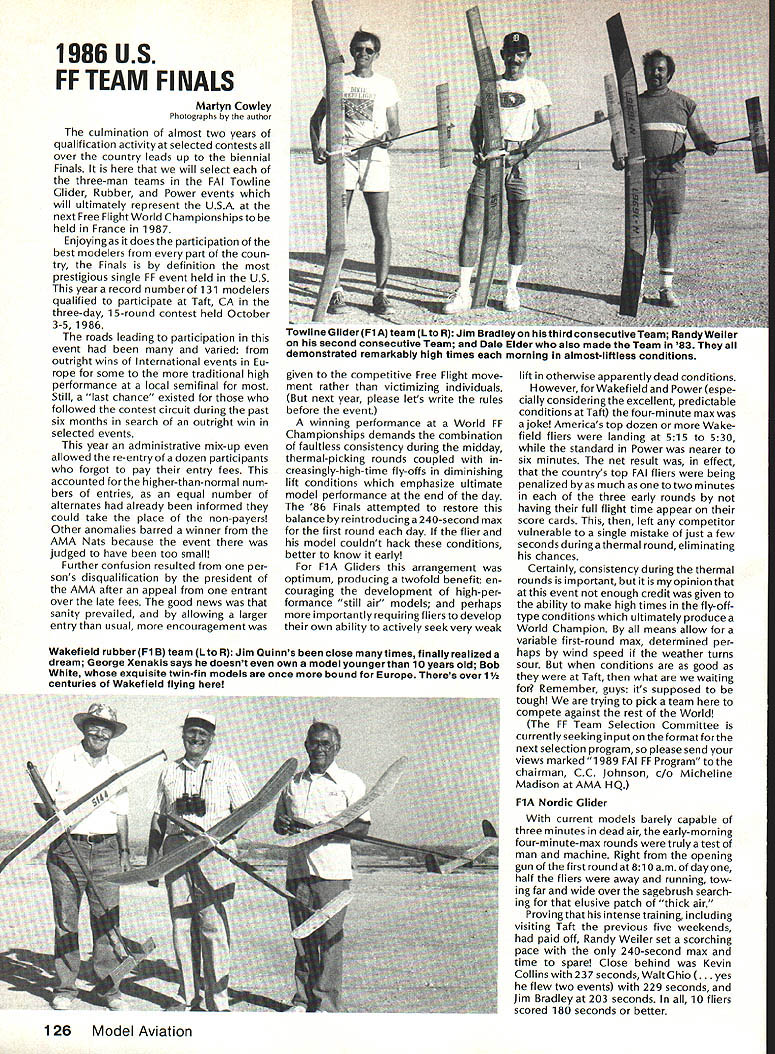
Rounds began under perfect conditions and the top placings looked secure. Round 15 was in progress when Jim Quinn, excited, flew without lighting his DT fuse. Quinn and George Xenakis were already on the team with clear maxes, and Quinn's retrievers joked, "That's OK, Jim! At the Champs you keep losing them, we'll keep finding them!"
Near the end, Bill Gibbons launched quickly and climbed away in strong lift, but the glide was uncertain and meandering. For two minutes the flight could have gone either way, but at 148 seconds Bill was out, repeating his similar fate from the final day in 1984.
Imagine Bob White's surprise when he returned from retrieving downwind to learn he had again made the U.S. team. Only six seconds separated the top three: Jim Quinn totaled 2,862 seconds, George Xenakis 2,858, and Bob White 2,856.
One last notable flight was Bob Wiele's 172 seconds, which produced an equal fourth‑place tie with Bob Piserchio, both one second ahead of Bob Tymchek. However, at subsequent processing Wiele's model was found to have dried out and was underweight; he was forced to withdraw.
Consistent flying and use of his electronic thermal detector gave George Xenakis the only perfect score, with every flight over three minutes. Early‑morning rounds showed the high standard at Wakefield, with eight flyers managing 12‑minute totals: Beebe, Foster, Ghio, Piserchio, Quinn, Rohrke, Tymchek, and White.
It is with sadness we note the sudden loss of Bob's wife, Toni, soon after the event. Toni never missed one of these events and will be fondly remembered by FAI fliers here and overseas. Our sympathies are with Bob at this time.
F1C Power
The standard of FAI Power models at this year's Finals was unusually high; rarely have so many high‑quality models been seen outside a World Championships. Many models represented the latest technology: metal‑skinned panels, high‑aspect‑ratio wings, long tail booms and small stabs, fast motors, and high‑climbing configurations. Equally important, many new faces at the meeting knew how to fly them.
The opening round at 7:30 a.m. put this year's rules in perspective: 26 of the 33 who flew exceeded the 240‑second max, most by one to two minutes. A few missed: Bill Hartill DT'ed early, Reid Simpson scored 207 seconds, Dave Rounsaville had a poor flight of 97 seconds, and Marty Thompson failed to get his motor started on a re‑fly.
As rounds progressed, full scores began to erode. Despite models capable of double the max, many top fliers showed a weakness in reliably detecting and centering in lift — a tactical and detection issue that needs attention.
Al Bissonnette, Hardy Brodersen, Ed Carroll, and Terry Kerger dropped the second round (Kerger was clocked at 2:59.57, rounded down). Terry was a first‑time Finalist with strong equipment.
Round 3 eliminated Achterberg, Bogart, Galbreath, John Hannah, W. Johnson, and Larkin; Round 4 removed Roger Simpson, Happersett, Joyce, and Oliver. Glen Anderson, another first‑time Finalist, had built two new models in a month after earlier losses; Round 5 spoiled his run of maxes, but he is expected to return.
Only nine full scores stood overnight. Despite another set of early‑morning four‑minute maxes, only six remained intact. Out were Bruce Hannah (228 seconds), Sahlberg (192 seconds), and Phair (216 seconds). Still maxed were Randy Archer, Bob Guitai, Dale Mateer, Gil Morris, Norm Poti, and Bob Sifleet.
On the second day most fliers maxed consistently; only in the final flight did Gil Morris slip to 173 seconds. The last day began with Power at 8:10 a.m. Dale Mateer halted his best model on a practice flight but used a spare that performed flawlessly. Twenty‑one of the remaining 25 competitors made their 240‑second maxes; a few were off‑pattern or no‑flights.
Randy Archer, flying his first FAI Finals, had one inexplicable 60‑second flight despite having models with excellent climb. Norm Poti, a member of the 1983 team, fell apart in the final rounds, dropping both of his last flights. Gil Morris finished fourth with 2,867 seconds, ahead of Doug Galbreath at 2,861 seconds.
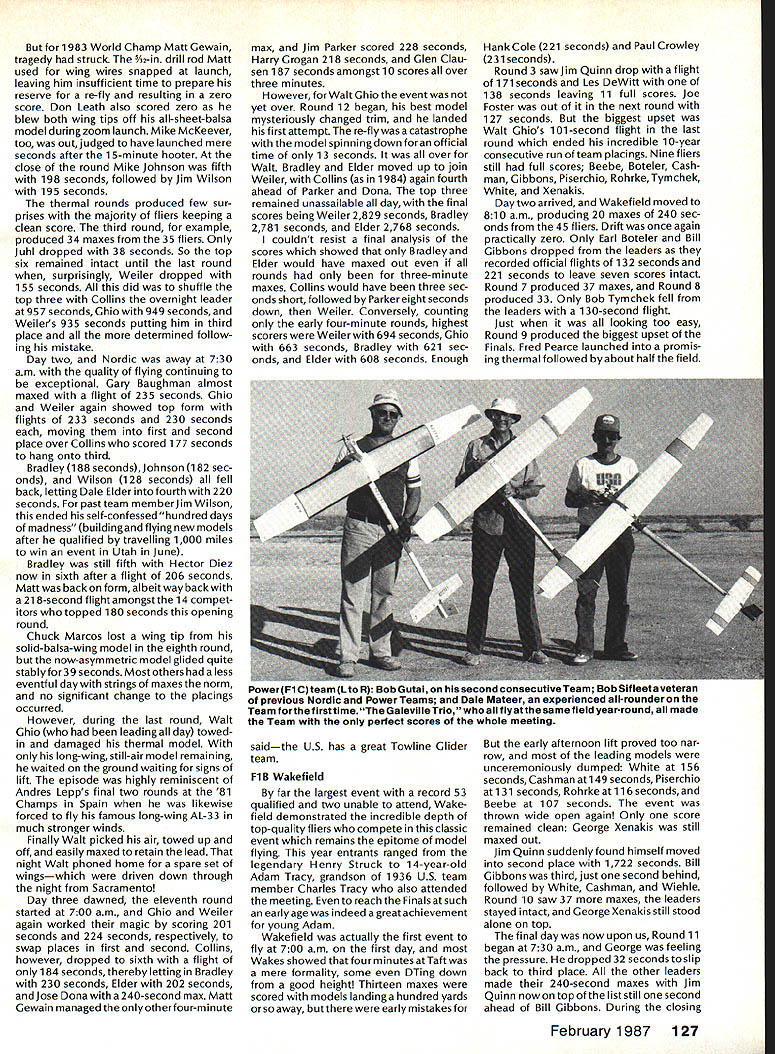
Only a small group preserved perfect scores to make the team. Bob Guitai (on the 1985 Team) flew improved models with aluminum‑skinned center panels. Dale Mateer showed seasoned consistency. Bob Sifleet demonstrated remarkable lift‑picking with sensibly trimmed, dependable designs — a decisive factor.
These three — Bob Guitai, Dale Mateer, and Bob Sifleet — would still have been the only full scores even if all 15 rounds had been flown, illustrating that in high‑tech F1C competition consistency through the middle rounds is at a premium. In fly‑off situations America has a strong edge, as evidenced by the final four fliers each maxing all early‑morning rounds.
One last item: Walt Chio will not miss the '87 Champs after all; he has been elected Team manager.
Rules Proposals Revisited
There has been substantial last‑minute activity in the Competition Department regarding the 1988–89 rules proposals. Considerable behind‑the‑scenes work occurred on the Electric proposal ELC‑88‑2 during the current rules‑change cycle. To keep interested modelers informed, the latest revised version of ELC‑88‑2 is printed in its entirety. This version has been distributed by the Electric Contest Board. Initial Vote ballots must be postmarked December 1, 1986.
ELC-88-2 (substitute) — ELECTRIC
Purpose: The purpose of this document is to present in a single place a unified set of rules for electric model airplane competition.
1.0 Definition
An electric‑powered model airplane (model airplane) that is propelled only by electric motor(s) which receive their power from an on‑board nickel‑cadmium battery pack. No electrical connection to the ground is permitted. Except as specifically allowed by the Contest Director, on‑board battery chargers (such as, for example, solar cells) shall be allowed.
1.1 General Characteristics
- Maximum surface area: 2,333 square inches
- Maximum weight: 11 pounds
- Maximum surface loading: 24.95 oz. per sq. ft.
- Minimum surface loading: 3.93 oz. per sq. ft.
- Maximum battery voltage: 42 volts
- Maximum number of cells: 30 cells
- Maximum battery capacity: 1.2 Ampere‑hours
2.0 Contest Rules for Electric Competitions
#### 2.1 Class A Free Flight
- Any motor(s) and one battery pack containing up to thirty nickel‑cadmium cells. Gearboxes, multiple motors, and folding propellers are permitted. Radio control is not permitted.
- Motor run limited to a maximum of 25 seconds but may be shorter at the Contest Director's discretion. Motors must be equipped with a brake to stop the propeller when power is off; free‑wheeling propellers are not permitted.
- Objective: achieve a three‑minute flight time including motor run.
- At the CD's discretion (to accommodate small fields or high winds), motor run and target flight time may be decreased proportionately.
- Scoring: one point per second of flight time.
- Ties: fly‑off with motor run decreased by five seconds each succeeding round until a winner is determined.
#### 2.2 Class B Free Flight
- Same provisions as Class A except: motor run limited to a maximum of 15 seconds (CD may shorten).
- Objective: achieve a one‑minute flight time including motor run.
- Scoring and tie procedures as in Class A.
#### 2.3 Class C Control Line Speed
- Any motor(s); battery pack limited to a maximum of seven nickel‑cadmium cells. Gearboxes and multiple motors permitted. No electrical power may be transmitted through control lines. Radio control not permitted.
- Model must be equipped with two solid control lines, pass a 10G pull‑test prior to flight, and have a single line break allowance based on the five laps of the circuit following the start signal.
- Control lines shall be 42 feet long.
#### 2.3a Class B Control Line Speed
- Any motor(s); battery pack limited to a maximum of thirty nickel‑cadmium cells in series. Gearboxes and multiple motors permitted. No electrical power through control lines. Radio control not permitted.
- Model must pass a 40G pull‑test prior to flight.
- Pair of solid steel control lines must be at least 0.016 inches in diameter and not shorter than 60 feet long. Multistrand lines are not permitted.
- Flight speed calculated based on ten laps following the start signal. Model must ROG; no hand‑launches permitted.
#### 2.4 Control Line Precision Aerobatics
- Any motor(s) and one Ni‑Cd battery pack up to 30 cells. Gearboxes and multiple motors permitted. No electrical power through control lines. Radio control not permitted.
- Model and control lines must pass a 10G pull‑test prior to flight.
- Control lines must be at least 25 feet and no more than 60 feet long.
- Scoring based on precision of the listed maneuvers (number of required maneuvers may be reduced at the CD's discretion).
CONTROL LINE PRECISION FLIGHT MANEUVERS:
- Takeoff
- Reverse wing over
- Inside loops (3)
- Inverted flight (2 laps)
- Outside loops (3)
- Inside square loops (2)
- Outside square loops (2)
- Triangular loops (2)
- Horizontal eights (2)
- Horizontal square eights (2)
- Vertical eights (2)
- Hourglass figure
- Overhead eights (2)
- Four leaf clover
- Landing
#### 2.5 Radio Control Class A Sailplane Precision Duration
- Any motor(s) and one Ni‑Cd battery pack containing a maximum of seven cells. Gearboxes, folding propellers, and multiple motors permitted. Operator must demonstrate ability to start and stop motors by radio command.
- Flight task: eight‑minute precision duration including motor run. Timing begins at launch and stops when the model first contacts the ground or any object. Optional landing task at the CD's discretion.
- Three flights will be performed with no battery charging allowed between flights; models may be impounded between flights at the CD's discretion. Scoring: sum of three flights; one point per second of flight time; one penalty point for each second in excess of the eight‑minute target. Landing task up to 25 points per flight. Motor cannot run during the last minute of each flight.
- CD may elect an alternative: limit motor run to first 45 seconds of each flight with recharging between flights.
- At the CD's discretion flights may be flown "man‑on‑man": best score in each group awarded 1,000 points and others a proportional portion. Flight groups must launch simultaneously; no fewer than four members per group. Ties: fly‑off defined by CD.
#### 2.6 Radio Control Class B Sailplane Precision Duration
- Any motor(s) and one Ni‑Cd battery pack containing a maximum of thirty cells. Gearboxes, folding propellers, and multiple motors permitted. Operator must demonstrate ability to start and stop motors by radio command.
- Motor run is unlimited; motor may be turned on and off at pilot's discretion except it may not be restarted after 24 minutes of flight time.
- Flight task: single 25‑minute precision duration flight. Optional landing task at CD discretion.
#### 2.8 Radio Control Class A Pylon Racing
- Any motor(s); battery pack limited to a maximum of seven Ni‑Cd cells. Gearboxes, folding propellers, and multiple motors permitted. Complete model ready to fly must not weigh more than 42 ounces. Operator must demonstrate ability to start and stop motors by radio command.
- Maximum of four models per heat. All models hand‑launched. Each race: 10 complete laps.
- Penalties: one pylon cut = 10% penalty added to flight time; two pylons cut = no score for that heat and contestant pulls out until heat is over.
- All laps counterclockwise with left turns. Course triangular: 300 ft between pylon 1 and 2, 60 ft between pylon 2 and 3, 300 ft between pylon 3 and 1.
- Scoring: winner selected based on fastest times for each 10‑lap round. Raw score = time in seconds for 10 laps. Net score = 200 − raw score. Final score = sum of net scores from each round. Minimum of two rounds must be flown; if more than two, each contestant may discard his worst score. Ties decided by fastest single round.
#### 2.9 Radio Control Class B Pylon Racing
- Any motor(s); battery pack limited to a maximum of 30 Ni‑Cd cells. Gearboxes, folding propellers, and multiple motors permitted. Complete model ready to fly must not weigh more than 2.5 kg (5.5 lb.). Operator must demonstrate ability to start and stop motors by radio command.
- Penalties: one pylon cut = 10% penalty; two pylons cut = no score for that heat and contestant pulls out until heat is over.
- All laps counterclockwise with left turns. Course triangular: 478 ft between pylon 1 and 2, 100 ft between pylon 2 and 3, 478 ft between pylon 3 and 1 (total distance around the course is 2.0 miles).
- Scoring as in Class A Pylon Racing.
#### 2.10 Radio Control Old‑Timer Texaco
- Any motor(s) and one battery pack up to 30 Ni‑Cd cells. Gearboxes, folding propellers, and multiple motors permitted. Operator must demonstrate ability to start and stop motors by radio command.
- Flight task: single flight with objective of a 25‑minute precision duration count, timing when the motor is turned on. Timing starts at launch and stops when the model first contacts the ground or any object. Scoring: one point per second with a 1 point per second overtime penalty. Optional landing task up to 25 points at CD discretion. Ties: fly‑off defined by CD.
#### 2.11(a) Radio Control Class A Old‑Timer (Pre‑1943)
- Any motor(s) and one Ni‑Cd battery pack up to seven cells. Gearboxes, folding propellers, and multiple motors permitted. Operator must demonstrate ability to start and stop motors by radio command.
- Flight task: eight‑minute precision duration flight, counting motor run. Timing begins at launch and stops at first ground contact. Optional landing task at CD discretion.
- Three flights with no battery charging between flights; models may be impounded at the CD's discretion. Scoring: sum of three flights; one penalty point per second in excess of eight‑minute target. Landing task up to 25 points per flight. Motor cannot run during the last minute.
- Alternative: CD may limit motor run to first 60 seconds of each flight with recharging allowed between flights.
- CD may elect "man‑on‑man" scoring (best score = 1,000 points, others proportional); flight groups must launch simultaneously; no fewer than four members per group. Ties: fly‑off defined by CD.
#### 2.11(b) Radio Control Class B Old‑Timer (Pre‑1943)
- Any motor(s) and one Ni‑Cd battery pack up to thirty cells in series. Gearboxes, folding propellers, and multiple motors permitted. Operator must demonstrate ability to start and stop motors by radio command.
- Flight task and scoring same as Class A Old‑Timer, except alternative motor run limit is 45 seconds of each flight with recharging allowed between flights. Ties: fly‑off defined by CD.
2.13 Radio Control Precision Aerobatics
- Any motor(s) and one Ni‑Cd battery pack up to 30 cells. Gearboxes, folding propellers, and multiple motors permitted. Operator must demonstrate ability to start and stop motors by radio command.
- Flight task: eleven FAI turn‑around aerobatic maneuvers listed below. No points for takeoff and landings. Hand‑launching permitted. Landing gear not required; belly landings allowed without penalty.
- Scoring: ten possible points per maneuver. Any maneuver not completed scores zero. A panel of three judges will be used; total score per round is the sum of the three judges' scores. At least two rounds flown; winner based on sum of scores.
FLIGHT SCHEDULE:
- One inside loop
- Reverse Cuban eight
- Slow roll
- Stall turn
- Square loop
- Immelmann turn
- Outside loop
- Split S
- Snap roll
- Stall turn with half roll
- Two point roll
2.14 Radio Control Sport Scale
- All scale models must be replicas of heavier‑than‑air, man‑carrying aircraft. Only prototype aircraft that have actually flown can be used.
- Proof‑of‑scale documentation is required and the contestant's responsibility. To be eligible for Finish, Color, and Markings points, proof of the prototype's color scheme is required. Documentation should be limited to six pages of 8½ x 11 inch format or equivalent.
- Static judging from 15 feet; models may be placed on a table at CD discretion. Cockpit and cabin interiors not considered; all other visible features (engines, cowlings, propellers) are considered. No changes to the model between judging and flying, except a different propeller may be substituted.
Static scoring (maximum 100 points):
- Accuracy of outline — maximum 40 points
- Craftsmanship — maximum 30 points
- Finish, Color, and Markings — maximum 30 points
Flight plan:
- Ten maneuvers/scale operations: five mandatory and five optional. Mandatory maneuvers: (1) Unassisted ROG; (2) Horizontal figure eight; (3) Fly past; (4) Traffic pattern approach; (5) Landing. Optional maneuvers may be any listed in the AMA Scale Judging Guide or typical scale operations.
Flight scoring:
- Maximum possible flight score: 100 points. Each maneuver/op operation scored 0–10 points. Touch and go counts as two options and scored 0–20 points. Each flight should be scored by at least two judges and averaged to determine the flight score.
Final score:
- Static score plus the average of the best two flight scores. In case of a tie, the highest static score determines the winner.
Transcribed from original scans by AI. Minor OCR errors may remain.

