
Competition Newsletter
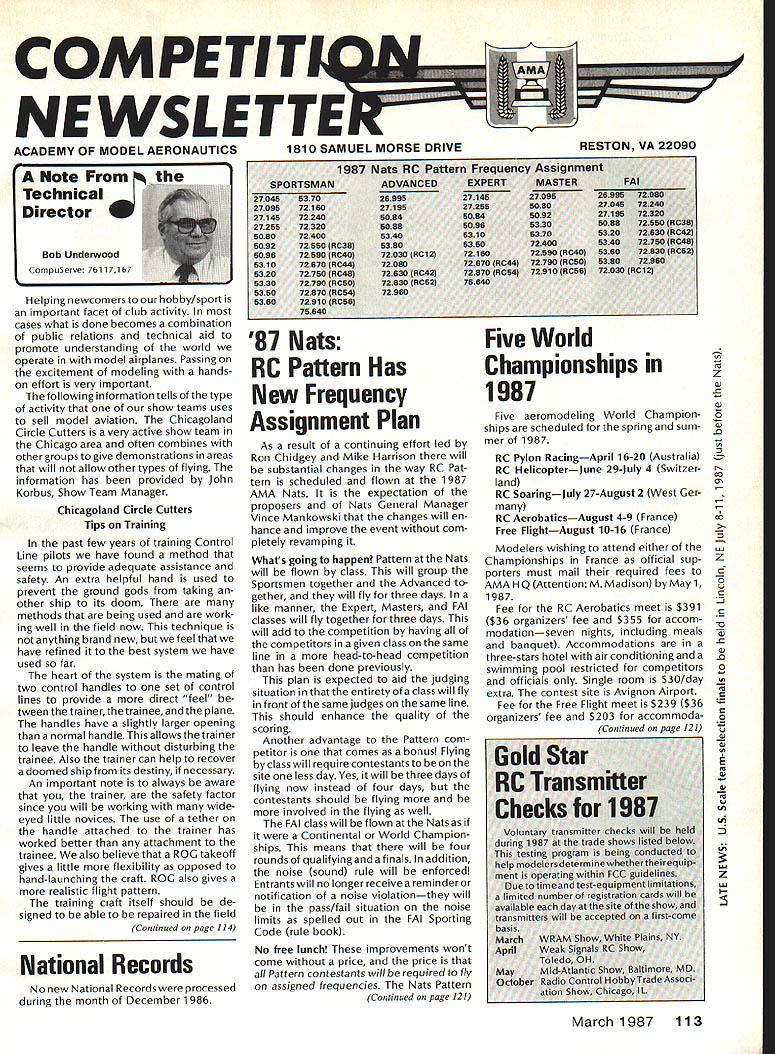
'87 Nats: RC Pattern Has New Frequency Assignment Plan
As a result of a continuing effort led by Ron Chidgey and Mike Harrison, there will be substantial changes in the way RC Pattern is scheduled and flown at the 1987 AMA Nats. The proposers, along with Nats General Manager Vince Mankowski, expect the changes will enhance and improve the event without completely revamping it.
What's going to happen?
- Pattern at the Nats will be flown by class. Sportsman and Advanced will each fly for three days; Expert, Masters, and FAI classes will fly together for three days. This groups all competitors in a given class on the same line for more head-to-head competition.
- The plan is expected to aid judging because an entire class will fly in front of the same judges on the same line, improving scoring consistency.
- Flying by class will reduce the number of days contestants must be on site: three days of flying now instead of four, while allowing contestants to fly more and be more involved.
- The FAI class will be flown at the Nats as if it were a Continental or World Championship: four rounds of qualifying and a final. The FAI noise (sound) rule will be enforced; entrants will be in a pass/fail situation under the noise limits spelled out in the FAI Sporting Code (the rule book).
No free lunch
- These improvements carry a price: all Pattern contestants will be required to fly on assigned frequencies.
Nats RC Frequencies (continued)
- Frequency assignments to be used at the 1987 Nats are allocated by class; only the allocated frequencies shown for each Nats Pattern class will be permitted.
- All Nats RC contestants are encouraged to have their radios checked and serviced before the Nats. Some entrants may need to have their equipment frequency changed as part of regular preventive maintenance to be compatible with the frequency allocations.
- Looking ahead: the 1987 allocations are a warm-up for 1991, when all 50 RC frequencies are expected to be available and all Nats RC events will be allocated specific frequencies. It is anticipated the 1987 Pattern frequency allocations will be compatible with the 1991 allocations.
- The 1991 Nats may be the first since the mid-1930s to have all events flown on a single site.
Five Aeromodeling World Championships Scheduled Spring–Summer 1987
- RC Pylon Racing — April 16–20, Australia
- RC Helicopter — June 29–July 4, Switzerland
- RC Soaring — July 27–August 2, West Germany
- RC Aerobatics — August 4–9, France
- Free Flight — August 10–16, France
- Modelers wishing to attend the Championships in France must mail required fees to AMA HQ, Attention: M. Madison, by May 1, 1987.
Fees and accommodations (France)
- RC Aerobatics meet fee: $391 (includes $36 organizer's fee). Accommodations: $355 — seven nights including meals and banquet. Hotel: three-star, air conditioning, swimming pool. Restricted to competitors and officials. Single room: $30/day extra. Contest site: Avignon Airport.
- Free Flight meet fee: $239 (includes $36 organizer's fee). Accommodations: $203.
Control Line Old-Time Stunt — Unofficial Event
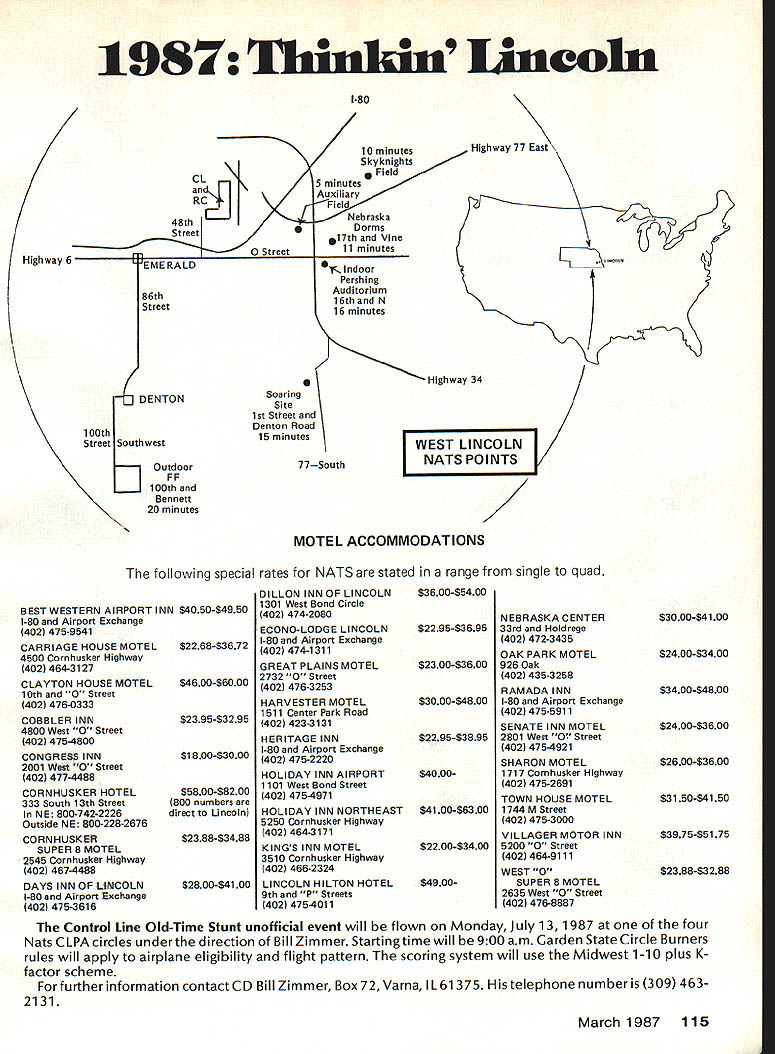
- The Control Line Old-Time Stunt unofficial event will be flown Monday, July 13, 1987, at one of the four Nats CLPA circles under the direction of Bill Zimmer. Starting time: 9:00 a.m.
- Garden State Circle Burners rules will apply to airplane eligibility and flight pattern.
- Scoring will use the Midwest 1–10 plus K-factor scheme.
- For further information contact CD Bill Zimmer, Box 72, Varna, IL 61375. Telephone: (309) 463-2131.
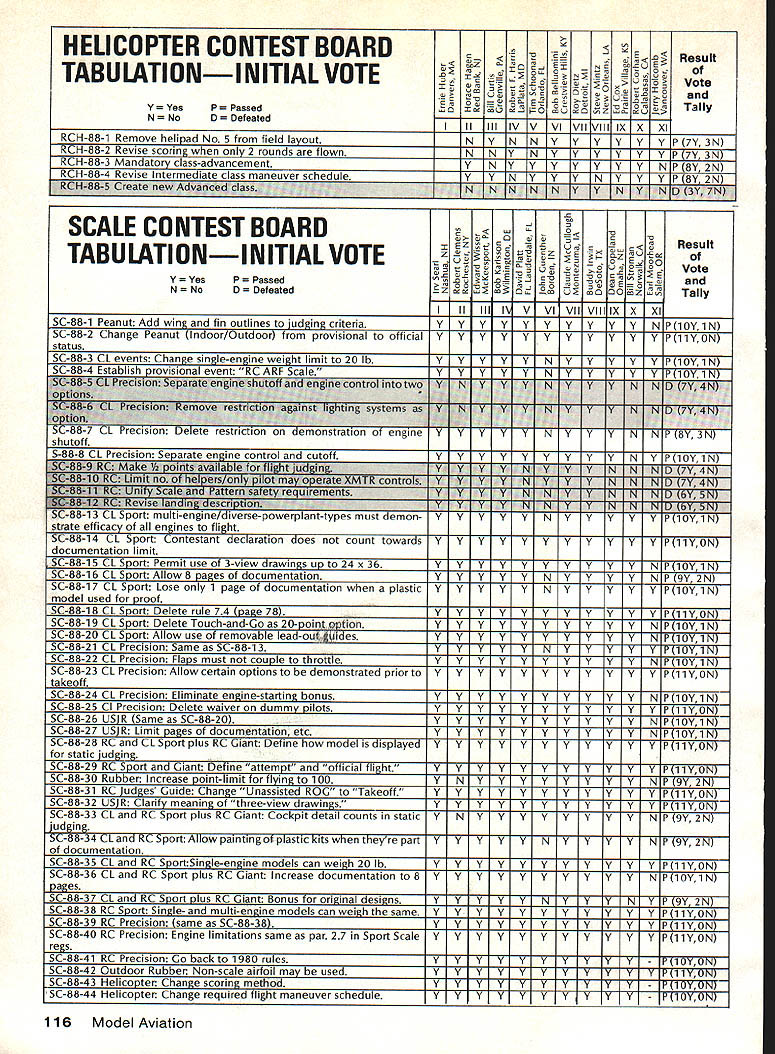
HELICOPTER CONTEST BOARD TABULATION — INITIAL VOTE
Y = Yes P = Passed N = No D = Defeated
- RCH-88-1 Remove helipad No. 5 from field layout.
- RCH-88-2 Revise scoring when only 2 rounds are flown.
- RCH-88-3 Mandatory class advancement.
- RCH-88-4 Revise Intermediate class maneuver schedule.
- RCH-88-5 Create new Advanced class.
SCALE CONTEST BOARD TABULATION — INITIAL VOTE
Y = Yes P = Passed N = No D = Defeated
- SC-88-1 Peanut: Add wing and fin outlines to judging criteria.
- SC-88-2 Change Peanut (Indoor/Outdoor) from provisional to official status.
- SC-88-3 CL events: Change single-engine weight limit to 20 lb.
- SC-88-4 Establish provisional event: "RC ARF Scale."
- SC-88-5 CL Precision: Separate engine shutoff and engine control into two options.
- SC-88-6 CL Precision: Remove restriction against lighting systems as option.
- SC-88-7 CL Precision: Delete restriction on demonstration of engine shutoff.
- SC-88-8 CL Precision: Separate engine control and cutoff.
- SC-88-9 RC: Make ½ points available for flight judging.
- SC-88-10 RC: Limit number of helpers; only pilot may operate transmitter controls.
- SC-88-11 RC: Unify Scale and Pattern safety requirements.
- SC-88-12 RC: Revise landing description.
- SC-88-13 CL Sport: Multi-engine/diverse-powerplant types must demonstrate efficacy of all engines in flight.
- SC-88-14 CL Sport: Contestant declaration does not count toward documentation limit.
- SC-88-15 CL Sport: Permit use of 3-view drawings up to 24 x 36 inches.
- SC-88-16 CL Sport: Allow 8 pages of documentation.
- SC-88-17 CL Sport: Allow use of only 1 page of documentation when a plastic model is used for proof.
- SC-88-18 CL Sport: Delete rule 74 (page 78).
- SC-88-19 CL Sport: Delete Touch-and-Go as a 20-point option.
- SC-88-20 CL Sport: Allow use of removable lead-out guides.
- SC-88-21 CL Precision: Same as SC-88-13.
- SC-88-22 CL Precision: Flaps must not couple to throttle.
- SC-88-23 CL Precision: Allow certain options to be demonstrated prior to takeoff.
- SC-88-24 CL Precision: Eliminate engine-starting bonus.
- SC-88-25 CL Precision: Delete waiver on dummy pilots.
- SC-88-26 USJR: Same as SC-88-20.
- SC-88-27 USJR: Limit pages of documentation, etc.
- SC-88-28 RC and CL Sport plus RC Giant: Define how model is displayed for static judging.
- SC-88-29 RC Sport and Giant: Define "attempt" and "official flight."
- SC-88-30 Rubber: Increase point limit for flying to 100.
- SC-88-31 RC Judges' Guide: Change "Unassisted ROG" to "Takeoff."
- SC-88-32 USJR: Clarify meaning of "three-view drawings."
- SC-88-33 CL and RC Sport plus RC Giant: Cockpit detail counts in static judging.
- SC-88-34 CL and RC Sport: Allow painting of plastic kits when they're part of documentation.
- SC-88-35 CL and RC Sport: Single-engine models can weigh 20 lb.
- SC-88-36 CL and RC Sport plus RC Giant: Increase documentation to 8 pages.
- SC-88-37 CL and RC Sport plus RC Giant: Bonus for original designs.
- SC-88-38 RC Sport: Single- and multi-engine models can weigh the same.
- SC-88-39 RC Precision: Same as SC-88-38.
- SC-88-40 RC Precision: Engine limitations same as par. 2.7 in Sport Scale.
- SC-88-41 RC Precision: Revert to 1980 rules.
- SC-88-42 Outdoor Rubber: Non-scale airfoil may be used.
- SC-88-43 Helicopter: Change scoring method.
- SC-88-44 Helicopter: Change required flight maneuver schedule.
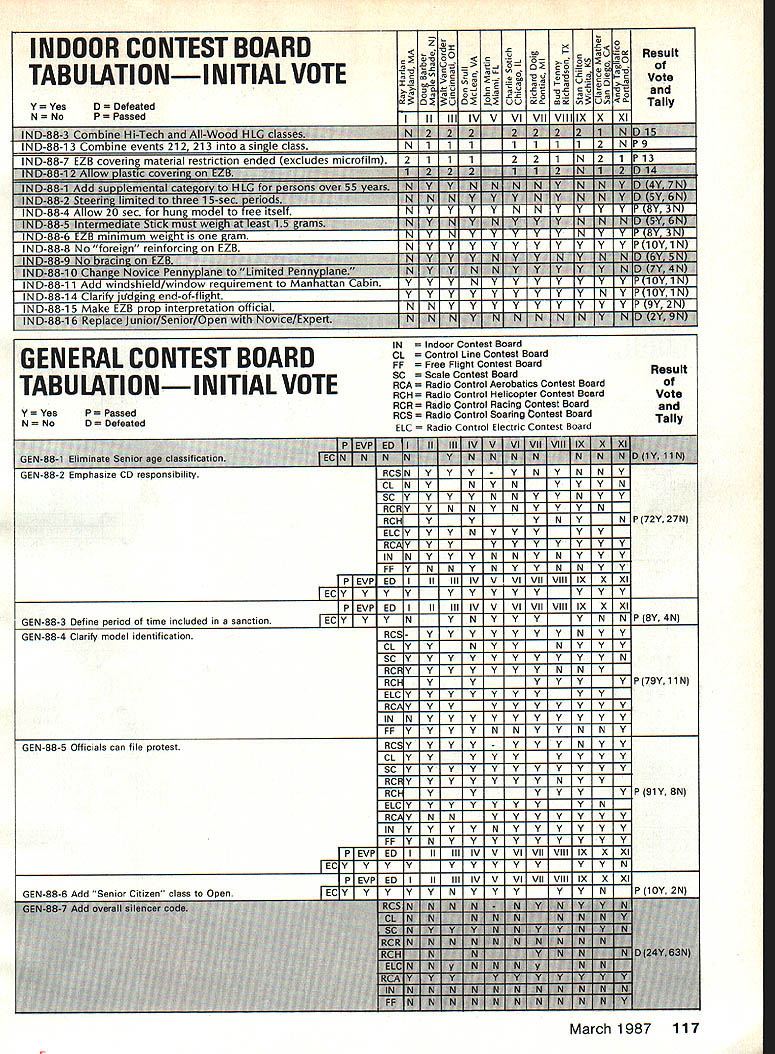
INDOOR CONTEST BOARD TABULATION — INITIAL VOTE
Y = Yes D = Defeated N = No P = Passed
- IND-88-3 Combine Hi-Tech and All-Wood HLG classes.
- IND-88-13 Combine events 212 and 213 into a single class.
- IND-88-7 End EZB covering material restriction (excludes microfilm).
- IND-88-12 Allow plastic covering on EZB.
- IND-88-1 Add supplemental category to HLG for persons over 55 years.
- IND-88-2 Steering limited to three 15-sec. periods.
- IND-88-4 Allow 20 sec. for a hung model to free itself.
- IND-88-5 Intermediate Stick must weigh at least 1.5 grams.
- IND-88-6 EZB minimum weight is one gram.
- IND-88-8 No "foreign" reinforcing on EZB.
- IND-88-9 No bracing on EZB.
- IND-88-10 Change Novice Pennypane to "Limited Pennypane."
- IND-88-11 Add windshield/window requirement to Manhattan Cabin.
- IND-88-14 Clarify judging end-of-flight.
- IND-88-15 Make EZB prop interpretation official.
- IND-88-16 Replace Junior/Senior/Open with Novice/Expert.
GENERAL CONTEST BOARD TABULATION — INITIAL VOTE
Y = Yes P = Passed N = No D = Defeated
- GEN-88-1 Eliminate Senior age classification.
- GEN-88-2 Emphasize CD responsibility.
- GEN-88-3 Define period of time included in a sanction.
- GEN-88-4 Clarify model identification.
- GEN-88-5 Officials can file protest.
- GEN-88-6 Add "Senior Citizen" class to Open.
- GEN-88-7 Add overall silencer code.
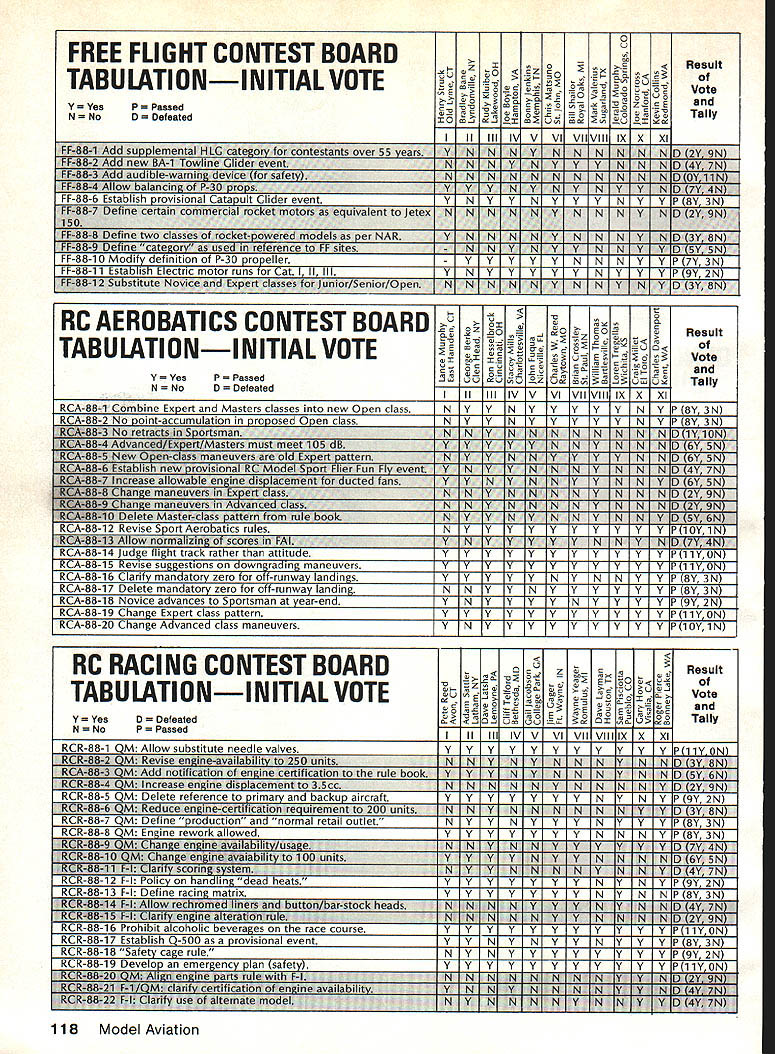
FREE FLIGHT CONTEST BOARD TABULATION — INITIAL VOTE
Y = Yes P = Passed N = No D = Defeated
- FF-88-1 Add supplemental HLG category for contestants over 55 years.
- FF-88-2 Add new BA-T Towline Glider event.
- FF-88-3 Add audible-warning device (for safety).
- FF-88-4 Allow balancing of P-30 props.
- FF-88-5 Establish provisional Catapult Glider event.
- FF-88-7 Define certain commercial rocket motors as equivalent to Jetex 150.
- FF-88-8 Define two classes of rocket-powered models as per NAR.
- FF-88-9 Define "category" as used in reference to FF sites.
- FF-88-10 Modify definition of P-30 propeller.
- FF-88-11 Establish electric motor runs for Cat. I, II, III.
- FF-88-12 Substitute Novice and Expert classes for Junior/Senior/Open.
RC AEROBATICS CONTEST BOARD TABULATION — INITIAL VOTE
Y = Yes P = Passed N = No D = Defeated
- RCA-88-1 Combine Expert and Masters classes into new Open class.
- RCA-88-2 No point accumulation in proposed Open class.
- RCA-88-3 No retracts in Sportsman.
- RCA-88-4 Advanced/Expert/Masters must meet 105 dB.
- RCA-88-5 New Open-class maneuvers are old Expert pattern.
- RCA-88-6 Establish new provisional RC Model Sport Flier Fun Fly event.
- RCA-88-7 Increase allowable engine displacement for ducted fans.
- RCA-88-8 Change maneuvers in Expert class.
- RCA-88-9 Change maneuvers in Advanced class.
- RCA-88-10 Delete Master-class pattern from rule book.
- RCA-88-12 Revise Sport Aerobatics rules.
- RCA-88-13 Allow normalizing of scores in FAI.
- RCA-88-14 Judge flight track rather than attitude.
- RCA-88-15 Revise suggestions on downgrading maneuvers.
- RCA-88-16 Clarify mandatory zero for off-runway landings.
- RCA-88-17 Delete mandatory zero for off-runway landing.
- RCA-88-18 Novice advances to Sportsman at year-end.
- RCA-88-19 Change Expert class pattern.
- RCA-88-20 Change Advanced class maneuvers.
RC RACING CONTEST BOARD TABULATION — INITIAL VOTE
Y = Yes P = Passed N = No D = Defeated
- RCR-88-1 QM: Allow substitute needle valves.
- RCR-88-2 QM: Revise engine-availability to 250 units.
- RCR-88-3 QM: Add notification of engine certification to the rule book.
- RCR-88-4 QM: Increase engine displacement to 3.5 cc.
- RCR-88-5 QM: Delete reference to primary and backup aircraft.
- RCR-88-6 QM: Reduce engine-certification requirement to 200 units.
- RCR-88-7 QM: Define "production" and "normal retail outlet."
- RCR-88-8 QM: Engine rework allowed.
- RCR-88-9 QM: Change engine availability/usage.
- RCR-88-10 QM: Change engine availability to 100 units.
- RCR-88-11 F1: Clarify scoring system.
- RCR-88-12 F1: Policy on handling "dead heats."
- RCR-88-13 F1: Define racing matrix.
- RCR-88-14 F1: Allow rechromed liners and button/bar-stock heads.
- RCR-88-15 F1: Clarify engine alteration rule.
- RCR-88-16 Prohibit alcoholic beverages on the race course.
- RCR-88-17 Establish Q-500 as a provisional event.
- RCR-88-18 "Safety cage rule."
- RCR-88-19 Develop an emergency plan (safety).
- RCR-88-20 QM: Align engine parts rule with FAI.
- RCR-88-21 F1/OM: Clarify certification of engine availability.
- RCR-88-22 F1: Clarify use of alternate model.
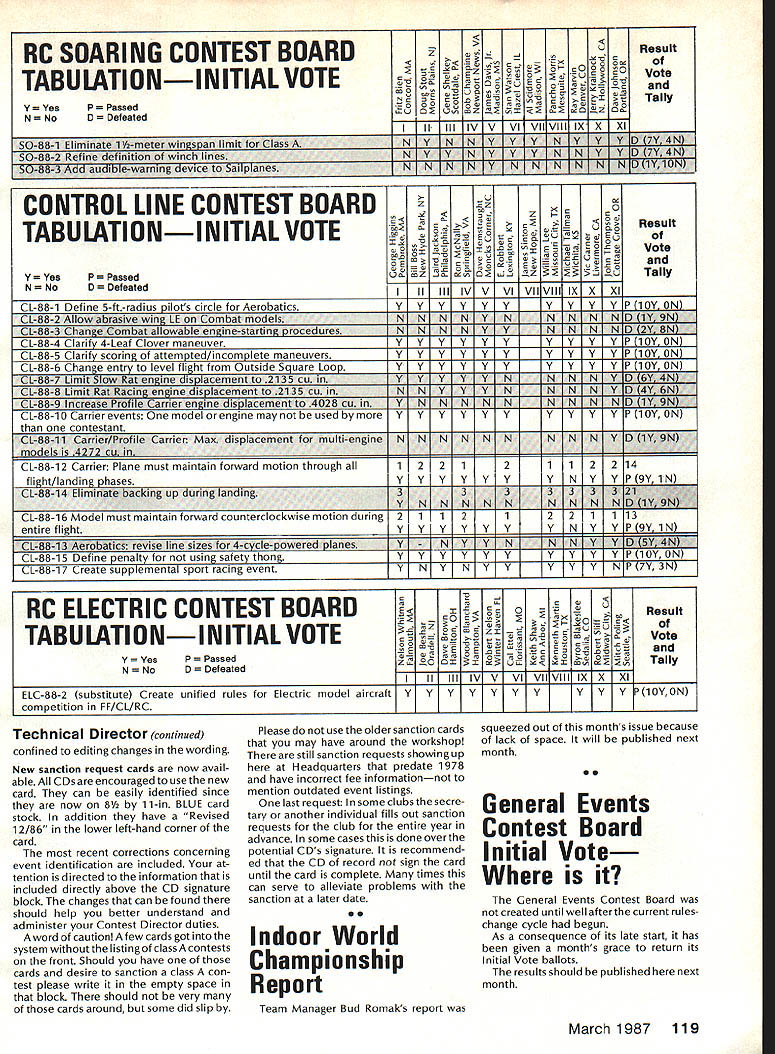
Technical Director (continued)
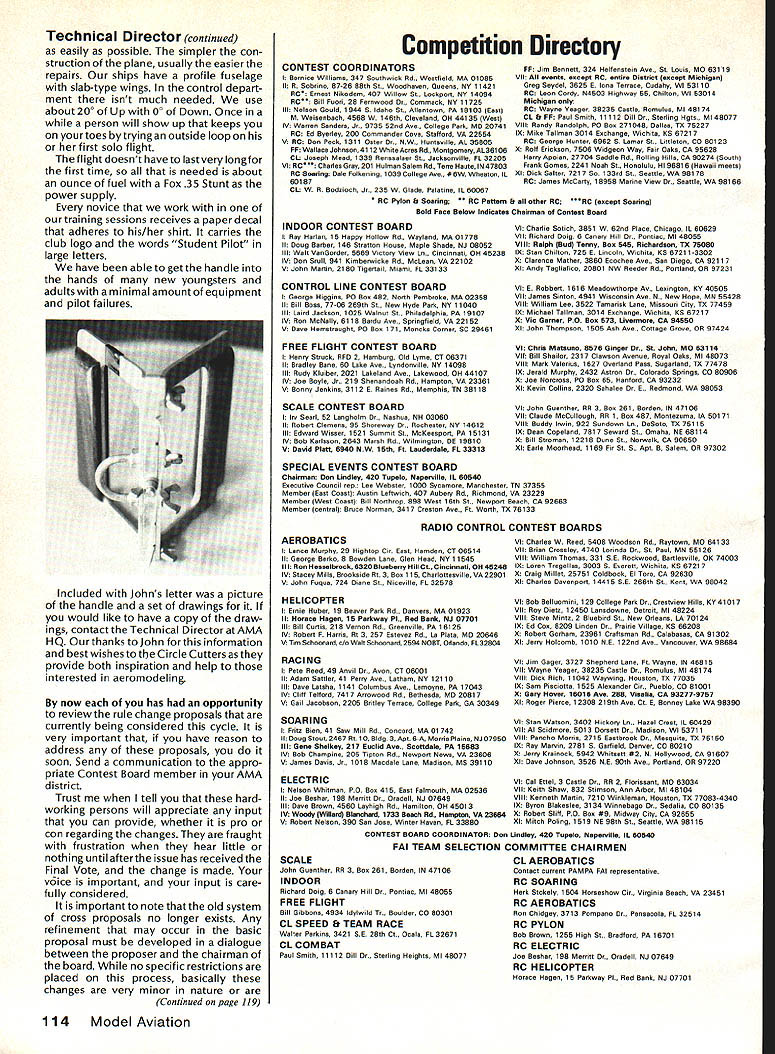
- New sanction request cards are now available. All Contest Directors (CDs) are encouraged to use the new card. They can be easily identified: 8½ by 11-inch blue card stock with "Revised 12/86" in the lower left-hand corner.
- Recent corrections concerning event identification are included. Attention is directed to the information directly above the CD signature block; these changes should help you better understand and administer your Contest Director duties.
- A few cards go into the system without the listing of Class A contests on the front. If you have one of those cards and desire to sanction a Class A contest, write it in the empty space in that block.
- Do not use older sanction cards that may be in your workshop; some predate 1978 and contain incorrect fee information and outdated event listings.
- Recommendation: In some clubs the secretary or another individual fills out sanction requests for the year in advance, sometimes obtaining the CD's signature before the card is complete. It is recommended the CD of record not sign the card until it is complete to prevent later problems.
Indoor World Championship Report
- Team Manager Bud Romak's report was omitted from this month's issue due to lack of space; it will be published next month.
General Events Contest Board Initial Vote — Where is it?
- The General Events Contest Board was not created until well after the current rules-change cycle had begun. As a consequence of its late start, it has been given a month's grace to return its Initial Vote ballots. Results should be published next month.
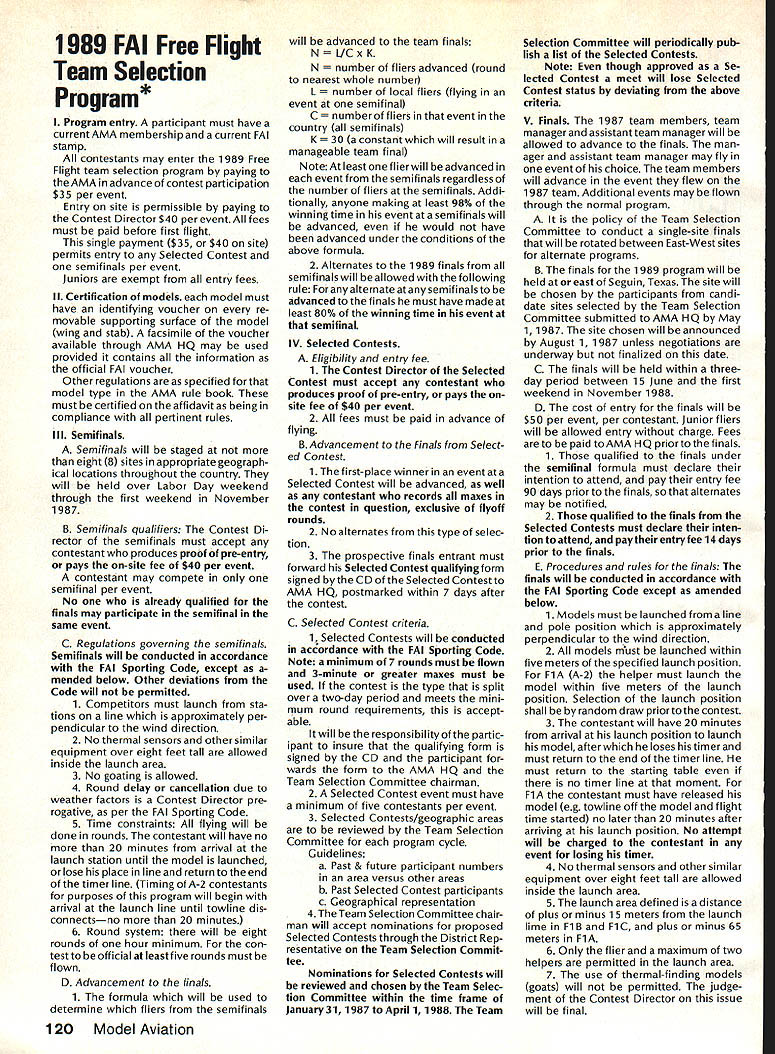
1989 FAI Free Flight Team Selection Program
I. Program entry
- Participants must have current AMA membership and a current FAI stamp.
- Entry fee: $35 per event if paid to AMA in advance of contest participation. On-site entry: pay $40 per event to the Contest Director. All fees must be paid before first flight.
- This single payment ($35 or $40 on site) permits entry to any Selected Contest and one semifinal per event.
- Juniors are exempt from all entry fees.
II. Certification of models
- Each model must have an identifying voucher on every removable supporting surface of the model (wing and stab). A facsimile of the voucher available through AMA HQ may be used if it contains all information required by the official FAI voucher.
- Other regulations are as specified for that model type in the AMA rule book. These must be certified on the affidavit as being in compliance with all pertinent rules.
III. Semifinals
A. Semifinal sites and schedule
- Semifinals will be staged at not more than eight sites, geographically distributed. They will be held from Labor Day weekend through the first weekend in November 1987.
B. Semifinals qualifiers
- The Contest Director of a semifinal must accept any contestant who produces proof of pre-entry or pays the on-site fee of $40 per event.
- A contestant may compete in only one semifinal per event.
- No one already qualified for the finals may participate in the semifinal in that event.
C. Regulations governing the semifinals
- Semifinals will be conducted in accordance with the FAI Sporting Code, except as amended below. Other deviations from the Code are not permitted.
- Competitors must launch from stations on a line approximately perpendicular to the wind direction.
- No thermal sensors or similar equipment over eight feet tall are allowed inside the launch area.
- No "goating" is allowed.
- Round delay or cancellation due to weather factors is at the Contest Director's prerogative, as per the FAI Sporting Code.
- Time constraints: Contestants have no more than 20 minutes from arrival at the launch station until the model is launched, or they lose their place and return to the end of the timer line. (Timing for A-2 contestants begins with arrival at the launch line until towline disconnects — no more than 20 minutes.)
- Round system: There will be eight rounds of one hour minimum. For the contest to be official at least four rounds must be flown.
D. Advancement to the finals
- Advancement formula:
- N = L / C × K
- N = number of fliers advanced (round to nearest whole number)
- L = number of local fliers (flying in an event at one semifinal)
- C = number of fliers in that event in the country (all semifinals)
- K = 30 (constant to yield a manageable team final)
- Note: At least one flier will be advanced in each event from the semifinals regardless of numbers. Additionally, anyone making at least 98% of the winning time in his event at a semifinal will be advanced even if not covered by the formula.
- Alternates: For an alternate at a semifinal to be advanced to the finals, he must have made at least 80% of the winning time in his event at that semifinal.
IV. Selected Contests
A. Eligibility and entry fee
- The Contest Director of a Selected Contest must accept any contestant who produces proof of pre-entry or pays the on-site fee of $40 per event.
- All fees must be paid in advance of flying.
B. Advancement to the finals from Selected Contest
- The first-place winner in an event at a Selected Contest will be advanced, as will any contestant who records all maxes in the contest (exclusive of flyoff rounds).
- No alternates from this selection type.
- The prospective finals entrant must forward his Selected Contest qualifying form signed by the CD to AMA HQ, postmarked within 7 days after the contest.
C. Selected Contest criteria
- Selected Contests will be conducted in accordance with the FAI Sporting Code. Minimum requirements: 7 rounds must be flown and 3-minute or greater maxes used. Split two-day meets meeting minimum rounds are acceptable.
- It is the participant's responsibility to ensure the qualifying form is signed by the CD and forwarded to AMA HQ and the Team Selection Committee chairman.
- A Selected Contest event must have a minimum of five contestants per event.
- Selected Contests/geographic areas will be reviewed by the Team Selection Committee. Guidelines include:
- Past and future participant numbers in an area versus other areas
- Past Selected Contest participants
- Geographical representation
- The Team Selection Committee chairman will submit nominations for Selected Contests through the District Representative on the committee. Nominations will be reviewed and chosen between January 31, 1987 and April 1, 1988. The committee will periodically publish a list of Selected Contests.
- Note: Approved Selected Contests may lose status if they deviate from the criteria.
V. Finals
- The 1987 team members, team manager and assistant manager may advance to the finals. The manager and assistant may fly in one event of his choice. Team members advance in the event they flew on the 1987 team; additional events may be flown through the normal program.
A. Policy: Single-site finals rotated between East and West sites for alternate programs. B. For the 1989 program the finals will be held at or east of Seguin, Texas. The site will be chosen by participants from candidate sites selected by the Team Selection Committee and submitted to AMA HQ by May 1, 1987. The chosen site will be announced by August 1, 1987 unless negotiations are still underway. C. Finals timing: Within a three-day period between June 15 and the first weekend in November 1988. D. Entry cost for finals: $50 per entry, per contestant. Junior fliers allowed entry without charge. Fees paid to AMA HQ prior to the finals. E. Those qualified via semifinals must declare intention to attend and pay entry fee 14 days prior to the finals so alternates may be notified. F. Finals rules: Same as Selected Contest except as amended below.
- Models must be launched from a line and pole position approximately perpendicular to the wind.
- Models must be launched within five meters of the specified launch position. For F1A (A-2) the helper must launch within five meters. Launch positions selected by random draw prior to contest.
- Contestant has 20 minutes from arrival at launch station to launch; otherwise return to end of timer line. For F1A one retrieve per round unless CD authorizes more. Contestant must not leave the launch area during a round unless authorized.
- No thermal sensors or equipment over eight feet tall allowed in the launch area.
- Launch area defined: plus or minus 15 meters from launch line in F1A and F1C; plus or minus 25 meters in F1B and F1D.
- Only the flier and a maximum of two helpers permitted in the launch area.
- Use of thermal-finding devices ("goats") is prohibited; CD judgment is final.
F. Finals rounds format
- Finals consist of 15 rounds.
- The first round each day: 3½-minute max for F1A (N); 4-minute max for F1B (W); 5-minute max for F1C (P) with a 15-minute round.
- The last four rounds each day will be three-minute maxes.
- All three events flown simultaneously in a staggered format.
- Rounds schedule depends on site and date; example rotation:
- Day 1 — Wakefield, Power, Nordic
- Day 2 — Power, Nordic, Wakefield
- Day 3 — Nordic, Wakefield, Power
- The first round shall start no sooner than 30 minutes after local sunrise.
- Cancellation procedure: Rounds may be postponed by the CD. If postponed more than one hour from the announced start time, the round is cancelled. If delayed after an official flight has been recorded, that round must be completed before any other round starts; if this cannot be done before the contest ends, the delayed round and times will be cancelled.
- If at least seven rounds in three days have been completed, teams will be selected based on completed rounds. If fewer than seven rounds are completed after three days, the contest will be completed at a later date, retaining previously completed flight scores.
H. Number of models allowed
- Each finalist may compete with no more than four models per event per day. Models to be used that day must be stated in advance of flying. The flier may possess an unlimited number of models.
- The program is effective January 1, 1987 unless disapproved by program participants.
1987 Team Selection Program for the FAI Helicopter World Championships
Members of the Team Selection Committee:
- District I — Ernie Huber
- District II — Horace Hagen (Chairman)
- District III — Bill Curtis
- District IV — Bob Harris
- District V — Tim Schoonraad
- District VI — Bob Bellov
- District VII — Roy Dietz
- District VIII — Steve Mintz
- District IX — Ed Cox
- District X — Robert Garthon
- District XI — Jerry Holcomb
I. Purpose
- Select three team members to represent the United States at the 1987 FAI F3C World Championships (Switzerland, June 29–July 4, 1987). An alternate will also be chosen.
II. Method
- Team members will be selected by flying in a single elimination contest. The Team Selection Committee will determine date and site.
- Timing rules: If a World Championships is held in the second quarter of a year, team selection occurs in the third quarter of the previous year. If World Championships are in the third quarter, team selection may be held in the second quarter of the same year. A minimum one-month grace period must exist between the trials and the World Championships.
III. Qualification
- Any modeler wishing to qualify must be an AMA member and possess a current FAI stamp.
- Team selection entry fee: $50, mailed to AMA HQ postmarked no later than 30 days before the contest. Late entry fee: $100, payable to the CD up to one hour before the advertised start time.
IV. Contest Criteria
A. Duration
- The team selection contest shall be a two-day event. A minimum of four rounds shall be flown with only one throwaway round. The exact number of rounds will be announced by the CD. The contest shall strictly adhere to the current FAI Sporting Code.
B. Protests
- Protests must be submitted to the FAI Jury presiding at the contest, in writing, within one hour of the infraction. A $25 fee must accompany the protest. If the protest is rejected by the jury, the fee is forfeited to the team selection fund. If the protest is allowed, the fee is returned to the protestor.
C. Scoring
- Flight scores will be posted publicly at the end of each round. Posted scores become official one hour after posting.
D. Final results
- Final results will be posted within one-half hour of contest conclusion and become official one hour after conclusion or after resolution of any protest. Protests will not be accepted after scores are declared official by the CD.
E. Official team
- The official U.S. team will consist of the pilots with the three highest scores. The alternate is the next-highest scoring pilot. Upon registration for the World Championships each team member shall designate his official mechanic.
F. Team manager
- The team manager shall be elected by the first three team members within one hour after the conclusion of team selection. The team manager cannot be a mechanic or any pilot of the U.S. team.
V. Finances
A. Team expenses covered by the AMA include:
- Entry fees, including lodging and meals for the duration of the official days of the World Championships.
- The lowest available amount for a direct coach flight from a major city's airport nearest the team members' home to the nearest city to the World Championships; if no direct flight exists, the most economical fare route. Arrangements by AMA's travel agent.
- Team lodging costs for practice for up to three days prior to the World Championships at the event site.
- Model box transportation up to 80% of actual cost (model boxes to be transported as excess baggage, not freight).
- The same funding policy applies even if the World Championships are held in the United States.
B. Team fund
- The official U.S.A./F3C team fund will be held in an account at AMA HQ under control of the Team Selection Committee. All entry fees, additional income, and donations shall be kept in this fund.
C. Team trial expenses
- Team trial expenses, including payments to the host club, shall be no more than 25% of the entry fees collected at the team selection contest.
D. Team Selection Committee allocations
- The committee shall allocate from the team fund monies for:
- Travel expenses not covered by the AMA.
- Vehicle rentals.
- Excess baggage expenses.
- Team uniforms.
- Expenses approved by a majority vote of the Team Selection Committee.
E. Restrictions
- Team fund monies can only be spent on team expenses and the team selection contest.
VI. Jury
- The FAI jury presiding at the team selection contest shall consist of a member of the FAI-C F3C Subcommittee, a member of the AMA Executive Council, and a Contest Director (other than the CD in charge).
VII. Additional items
- Additional administrative or procedural items as established by the Team Selection Committee.
(End of Competition Newsletter)
Transcribed from original scans by AI. Minor OCR errors may remain.

