
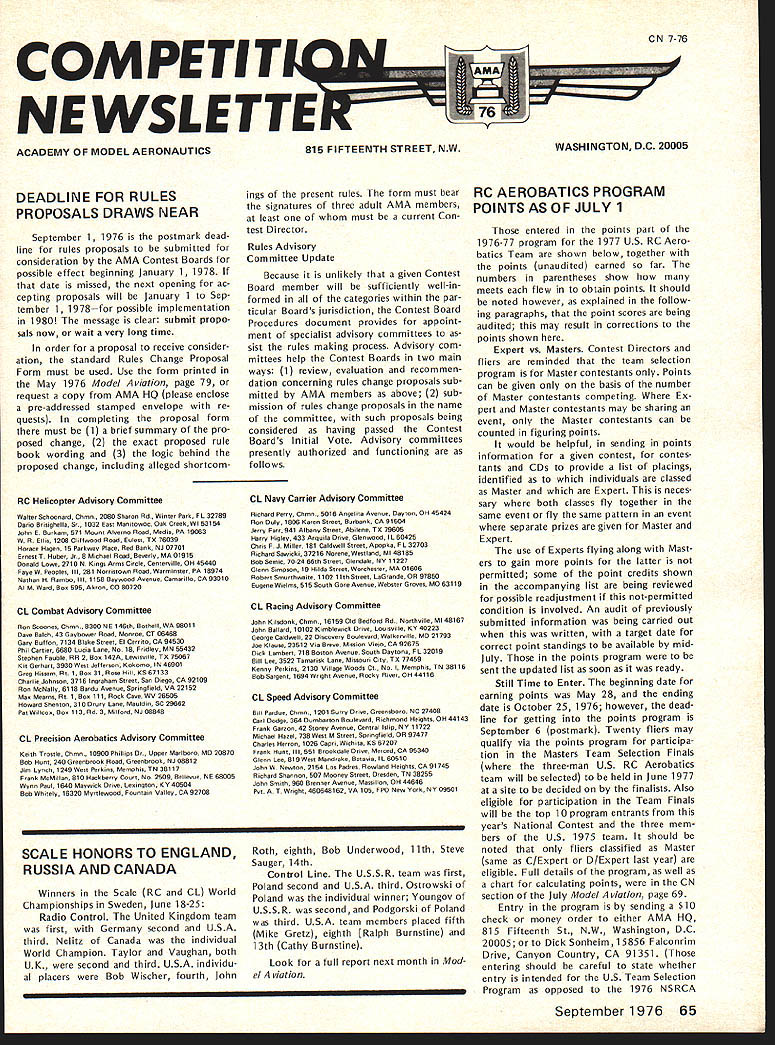
DEADLINE FOR RULES PROPOSALS DRAWS NEAR
September 1, 1976 is the postmark deadline for rules proposals to be submitted for consideration by the AMA Contest Boards for possible effect beginning January 1, 1978. If that date is missed, the next opening for accepting proposals will be January 1 to September 1, 1978 — for possible implementation in 1980! The message is clear: submit proposals now, or wait a very long time.
In order for a proposal to receive consideration, the standard Rules Change Proposal Form must be used. Use the form printed in the May 1976 Model Aviation, page 79, or request a copy from AMA HQ (please enclose a pre-addressed stamped envelope with requests). In completing the proposal form the request must include (1) a brief summary of the proposed change, (2) the exact proposed rule book wording and (3) the logic behind the proposed change, including alleged shortcomings of the present rules. The form must bear the signatures of three adult AMA members, at least one of whom must be a current Contest Director.
Rules Advisory Committee Update
Because it is unlikely that a given Contest Board member will be sufficiently well-informed in all of the categories within the particular Board's jurisdiction, the Contest Board Procedures document provides for appointment of specialist advisory committees to assist the rules making process. Advisory committees help the Contest Boards in two main ways: (1) review, evaluation and recommendation concerning rules change proposals submitted by AMA members as above; (2) submission of rules change proposals in the name of the committee, such proposals being considered as having passed the Contest Board's Initial Vote. Advisory committees presently authorized and functioning are as follows:
Competition Newsletter
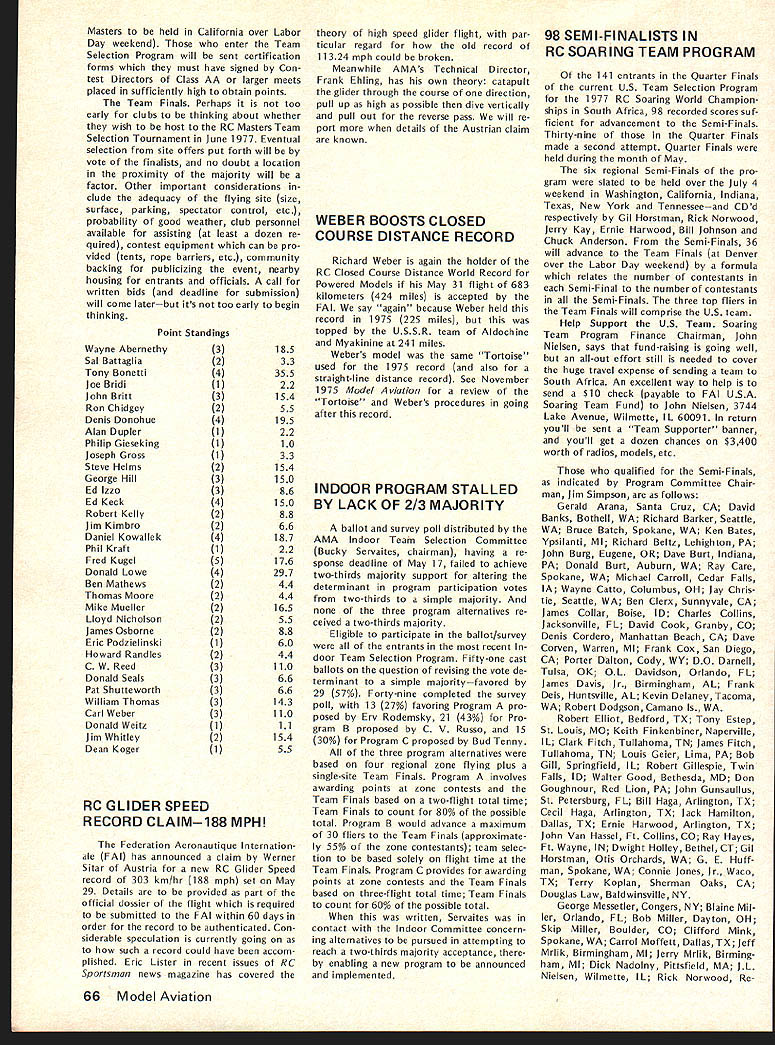
RC GLIDER SPEED RECORD CLAIM — 188 MPH!
The Fédération Aéronautique Internationale (FAI) has announced a claim by Werner Sitar of Austria for a new RC glider speed record of 303 km/hr (188 mph) set on May 29. Details are to be provided as part of the official dossier of the flight, which is required to be submitted to the FAI within 60 days in order for the record to be authenticated.
Considerable speculation is currently going on as to how such a record could have been accomplished. Eric Linter in recent issues of RC Sportsman news magazine has covered the theory of high-speed glider flight, with particular regard for how the old record of 113.24 mph could be broken.
Meanwhile AMA’s Technical Director, Frank Ehling, has his own theory: catapult the glider through the course of one direction, pull up as high as possible then dive vertically and pull out for the reverse pass. We will report more when details of the Austrian claim are known.
WEBER BOOSTS CLOSED COURSE DISTANCE RECORD
Richard Weber is again the holder of the FAI Closed Course Distance World Record for powered models if his May 31 flight of 683 kilometers (424 miles) is accepted by the FAI. We say “again” because Weber held this record in 1975 (225 miles), but this was topped by the U.S.S.R. team of Aldonchine and Myakinine at 241 miles.
Weber’s model was the same “Tortoise” used for the 1975 record (and also for a straight-line distance record). See November 1975 Model Aviation for a review of the “Tortoise” and Weber’s procedures in going after this record.
INDOOR PROGRAM STALLED BY LACK OF 2/3 MAJORITY
A ballot and survey poll distributed by the AMA Indoor Team Selection Committee (Bucky Servaites, chairman), having a response deadline of May 17, failed to achieve the two-thirds majority support for altering the determinant in program participation votes from a two-thirds to a simple majority. None of the three program alternatives received a two-thirds majority.
Eligible to participate in the ballot were all entrants in the most recent Indoor Team Selection Program. Fifty-one cast ballots on the question of revising the vote determinant to a simple majority—23 (57%) favored the change. Forty-nine completed the survey poll, with 13 (27%) favoring Program A proposed by Erv Rodemsky, 21 (43%) for Program B proposed by C. V. Russo, and 15 (30%) for Program C proposed by D. B. Tenny.
All of the three program alternatives were based on four regional zone flyings plus a single-site Team Finals. Program A involves awarding points at zone contests and one Team Finals based on a two-flight total; Team Finals to count for 80% of the possible total. Program B would advance a maximum of 30 fliers to the Team Finals (approximately 55% of the zone contestants); teams selected to be based solely on flight time at the Team Finals. Program C provides for awarding points at zone contests and the Team Finals based on three-flight total time; Team Finals to count for 60% of the possible total.
When this was written, Servaites was in contact with the Indoor Committee concerning alternatives to be pursued in attempting to reach a two-thirds majority acceptance, thereby enabling a new program to be announced and implemented.
98 SEMI-FINALISTS IN RC SOARING TEAM PROGRAM
Of the 141 entrants in the Quarter Finals of the current U.S. Team Selection Program for the 1977 RC Soaring World Championships in South Africa, 98 recorded scores sufficient for advancement to the Semi-Finals. Thirty-nine of those in the Quarter Finals made a second attempt. Quarter Finals were held during the month of May.
The six regional Semi-Finals of the program were slated to be held over the July 4 weekend in Washington, California, Indiana, Texas, New York and Tennessee — and contest directors respectively Gil Horstman, Rick Norwood, Jerry Kay, Ernie Harwood, Bill Johnson and Chuck Anderson. From the Semi-Finals, 36 will advance to the Team Finals (at Dayton over the Labor Day weekend) by a formula which relates the number of contestants in each Semi-Final to the number of contestants in all the Semi-Finals. The three top fliers in the Team Finals will compose the U.S. Team.
Help Support the U.S. Team. Soaring Team Program Finance Chairman John Nielsen says that fund-raising is going well, but that an all-out effort still is needed to cover the huge travel expense of sending a team to South Africa. An excellent way to help is to send a $10 check (payable to FAI U.S.A. Soaring Team Fund) to John Nielsen, 3744 Lake Avenue, Wilmette, IL 60091. In return you’ll be sent a “Team Supporter” banner, and you’ll get a chance to win $3,400 worth of radios, models, etc.
Those who qualified for the Semi-Finals, as indicated by Program Committee Chairman Jim Simpson, are as follows: Gerald Arana, Santa Cruz, CA; David Banks, Bothell, WA; Richard Barker, Seattle, WA; Bruce Batch, Spokane, WA; Ken Bates, Ypsilanti, MI; Richard Belt, Lewiston, PA; John Burg, Eugene, OR; Dave Burt, Indiana, PA; Donald Burt, Auburn, WA; Ray Carey, Spokane, WA; Michael Carroll, Cedar Falls, IA; Wayne Catto, Columbus, OH; Jay Cram, Seattle, WA; Ben Clerk, Sunnyvale, CA; James Collor, Boise, ID; Charles Collins, Jacksonville, FL; David Cook, Granbury, CO; Dennis Cordero, Manhattan Beach, CA; Dave Corven, Ventura, MI; Frank Cox, San Diego, CA; Porter Dalton, Cody, WY; D.O. Darnell, Tulsa, OK; L.L. Davidson, Orlando, FL; James Davis, Jr., Birmingham, AL; Frank Deis, Huntsville, AL; Kevin Delaney, Tacoma, WA; Robert Dodson, Cameron, KS; Robert Elliot, Bedford, TX; Tony Espey, St. Louis, MO; Keith Finkenbinder, Naperville, IL; Clark Fitch, Tullahoma, TN; James Fitch, Tullahoma, TN; Louis Geier, Lima, PA; Bob Gill, Springfield, IL; Robert Gillespie, Blue Falls, ID; Walter Good, Bethesda, MD; Don Goughnour, Lando, PA; John Gough, Pauls, St. Petersburg, FL; Bill Haag, Arlington, TX; Cecil Hagan, Arlington, TX; Jack Hamilton, Dallas, TX; Ernie Harwood, Arlington, TX; John Van Hassel, Ft. Collins, CO; Ray Hayes, Ft. Wayne, IN; Dwight Holley, Bethel, CT; Bill Horn, Otis Orchards, WA; G. E. Huffman, Spokane, WA; Connie Jones, Jr., Monroe, TX; Terry Kaplan, Sherman Oaks, CA; Douglas Lay, Baldwinville, NY; George Meister, Conners, NY; Blaine Miller, Orlando, FL; Bob Miller, Dayton, OH; Skip Miller, Boulder, CO; Carroll Mink, Spokane, WA; Carroll Moffatt, Dallas, TX; Jeff Mroczkowski, Birmingham, MI; Jerry Mirich, Birmingham, MI; Dick Nadolny, Pittsfield, MA; L. Nielsen, Wilmette, IL; Rick Norwood, Reno, NV; [additional qualifiers continue beyond this page]
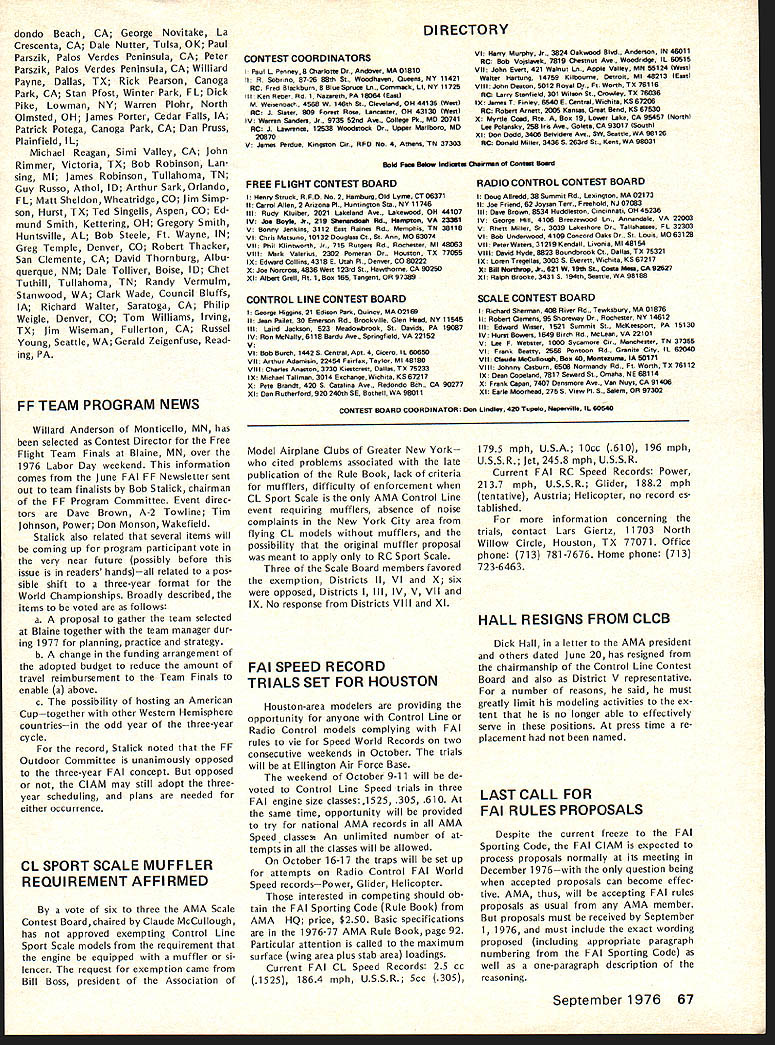
FF TEAM PROGRAM NEWS
Willard Anderson of Monticello, MN, has been selected as Contest Director for the Free Flight Team Finals at Blaine, MN, over the 1976 Labor Day weekend. This information was given to the Team Program Committee by Bob Stalcik, chairman of the FF Program Committee. Event directors are Dave Brown, A/Towline; Tim Johnson, Power; Don Monson, Wakefield.
Stalcik also related that several items will be coming up for program participant vote in the very near future (possibly before the issue goes to the readers' hands)—all related to a possible shift to a three-year format for the World Championships. Broadly described, the items to be voted on are as follows:
- A proposal to gather the team selected at Blaine together with the team manager during 1977 for planning, practice and strategy.
- A change in the funding arrangement of the adopted budget to reduce the amount of travel reimbursement to the Team Finals to enable (1) above.
- The possibility of hosting an American Cup—together with other Western Hemisphere countries—in the odd year of the three-year cycle.
For the record, Stalcik noted that the FF Outdoor Committee is unanimously opposed to the three-year FAI concept. But opposed or not, the CIAM may still adopt the three-year scheduling, and plans are needed for either occurrence.
CL SPORT SCALE MUFFLER REQUIREMENT AFFIRMED
By a vote of six to three the AMA Scale Contest Board, chaired by Claude McCullough, has not approved exempting Control Line Sport Scale models from the requirement that the engine be equipped with a muffler or silencer. The request for exemption came from Bill Boss, president of the Association of Model Airplane Clubs of Greater New York—who cited problems associated with the late publication of the Rule Book, lack of criteria for mufflers, difficulty of enforcement when CL Sport Scale is the only AMA Control Line event running, mufflers, absence of noise complaints in the New York City area from flying CL models without mufflers, and the possibility that the original muffler proposal was meant to apply only to RC Sport Scale.
Three of the Scale Board members favored the exemption, Districts II, VI and XI; six were opposed, Districts I, III, IV, V, VII and IX. No response from Districts VIII and X.
FAI SPEED RECORD TRIALS SET FOR HOUSTON
Houston-area modelers are providing the opportunity for anyone with Control Line or Radio Control models complying with FAI rules to vie for Speed World Records on two consecutive weekends in October. The trials will be at Ellington Air Force Base.
The weekend of October 9-11 will be devoted to Control Line Speed trials in the FAI engine size classes .1525, .305, .610. At the same time, opportunities will be provided for national AMA records in all AMA Speed classes. An unlimited number of attempts in all classes will be allowed.
On October 16-17 the trials will be set up for attempts on Radio Control’s FAI World Speed records—Power, Glider, Helicopter and Jet.
Those interested in competing should obtain the FAI Sporting Code (Rule Book) from AMA HQ; price, $2.50. Basic specifications are in the 1976-77 AMA Rule Book, page 92. Particular attention is called to the maximum surface (wing area plus stab area) loadings.
Current FAI CL Speed Records: 2.5 cc (.1525), 186.4 mph, U.S.S.R.; .5 cc (.305), 179.5 mph, U.S.S.R.; 10 cc (.610), 196 mph, U.S.S.R.; Jet, 245.8 mph, U.S.S.R. Current FAI RC Speed Records: Power, 213.7 mph, U.S.S.R.; Glider, 188.2 mph (tentative), Austria; Helicopter, no record established.
For more information concerning the trials, contact Lars Giertz, 11703 North Willow Circle, Houston, TX 77071. Office phone: (713) 781-7676. Home phone: (713) 723-6463.
HALL RESIGNS FROM CLCB
Dick Hall, in a letter to the AMA president and others dated June 20, has resigned from the chairmanship of the Control Line Contest Board and also as district V representative. For a number of reasons, he said, he must greatly limit his modeling activities to the extent that he is no longer able to effectively serve in these positions. At present time a replacement has not been named.
LAST CALL FOR FAI RULES PROPOSALS
Despite the current freeze in the FAI Sporting Code, the FAI CIAM is expected to process proposals normally at its meeting in December 1976—with the only question being which proposals will be accepted for consideration. The AMA, thus, will be accepting FAI rules proposals from any AMA member for possible submission to CIAM.
All proposals must be received by September 1, 1976, to be considered for possible effect beginning January 1, 1978. If the September 1 date is missed the next opening for accepting proposals will be January 1, 1978 for possible implementation in 1980. The message is clear: submit proposals now — don't wait a very long time.
In order that a proposal receive consideration the standard Rules Change Proposal Form must be used. Use the form printed May 1976 Model Aviation, page 79. To request a copy from AMA HQ please enclose a pre-addressed stamped envelope. Requests for completing the proposal form must include:
- A brief summary of the proposed change.
- Exact proposed rule book wording.
- Logic behind proposed change including alleged shortcoming(s).
Send proposals to: RC Helicopter Advisory Committee, Waine Schoonover, Chmn., 2080 Sharon Rd., Winter Park, FL 32789.
Competition Newsletter
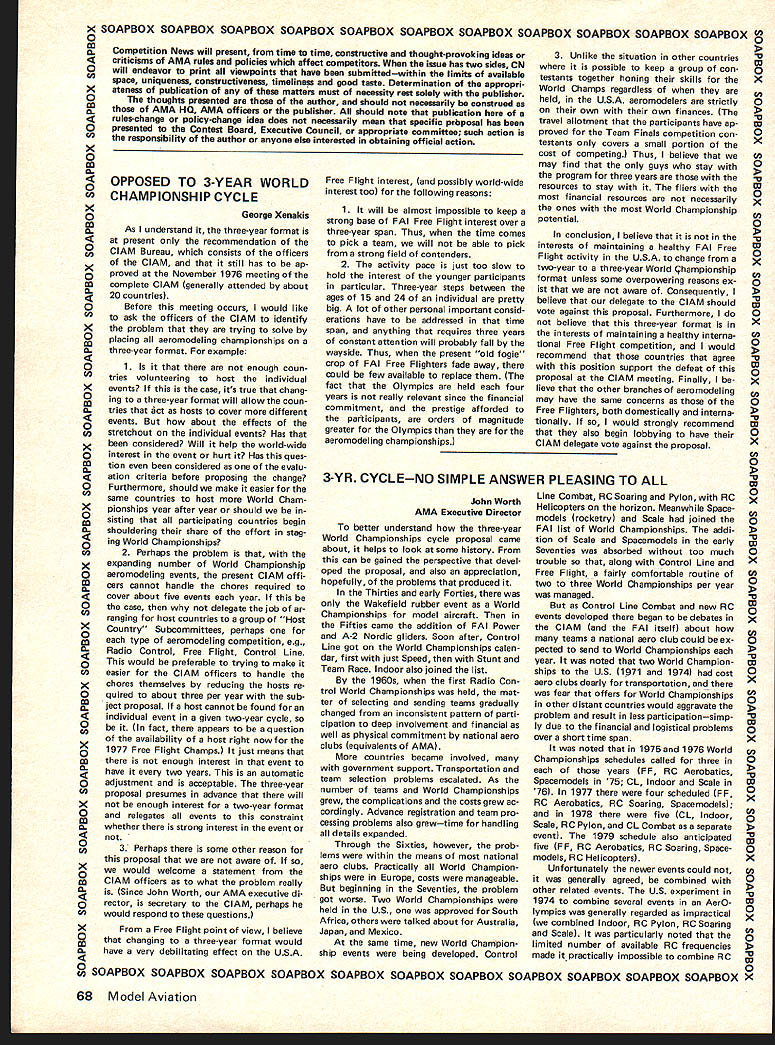
OPPOSED TO 3-YEAR WORLD CHAMPIONSHIP CYCLE
George Xenakis
As I understand it, the three-year format is at present only the recommendation of the CIAM Bureau, which consists of the officers of the CIAM, and that it still has to be approved at the November 1976 meeting of the complete CIAM (generally attended by about 20 countries).
Before this meeting occurs, I would like to ask the officers of the CIAM to identify the problem that they are trying to solve by placing all aeromodeling championships on a three-year format. For example:
- Is it that there are not enough countries volunteering to host the individual events? If this is the case, it's true that changing to a three-year format will allow the countries that act as hosts to cover more different events. But how about the effects of the stretchout on the individual events? Has that been considered? Will it help the world-wide interest in the event or hurt it? Has this question even been considered as one of the evaluation criteria before proposing the change? Furthermore, should we make it easier for the same countries to host more World Championships year after year? Could we be in effect supporting the interest of the strong nations while shortchanging the weaker ones?
- Perhaps the problem is that, with the expanding number of World Championship aeromodeling events, the present CIAM officers cannot handle the chores required to cover about five events each year. If this is the case, then why not delegate the job of arranging for host countries to a group of "Host Country" Subcommittees, perhaps one for each type of aeromodeling competition, e.g., Radio Control, Free Flight, Control Line. This would be preferable to trying to make it easier for the CIAM officers to handle the chores themselves by reducing the hosts required to about three per year with the substantial drawback that a host cannot be found for an individual event in a given two-year cycle. So be it. (In fact, there appears to be a question of the availability of a host right now for the 1977 Free Flight Champs.) It just means that there is not enough interest in that event to have it every two years. This is an automatic adjustment and is acceptable. The three-year proposal presumes in advance that there will not be enough interest for a two-year format and relegates all events to this constraint whether there is strong interest in the event or not.
- Perhaps there is some other reason for this proposal that we are not aware of. If so, we would welcome a statement from the CIAM officers as to what the problem really is. (Since John Worth, our AMA executive director, is secretary to the CIAM, perhaps he would respond to these questions.)
From a Free Flight point of view, I believe that changing to a three-year format would have a very debilitating effect on the U.S.A. Free Flight interest (and possibly world-wide interest too) for the following reasons:
- It will be almost impossible to keep a strong base of FAI Free Flight interest over a three-year span. Thus, when the time comes to pick a team, we will not be able to pick from a strong field of contenders.
- The activity of the sport is just too slow to hold the interest of the younger participants in particular. Three-year steps between the ages of 15 and 24 of an individual are pretty big. A lot of other personal important considerations have to be addressed in that time span, and anything that requires three years of constant attention will probably fall by the wayside. Thus, when the present "old-timers" crop of FAI Free Fliers fade away, there could be few available to replace them. (The fact that the Olympics are held each four years is not really relevant since the financial commitment, and the prestige offered to competitors, and the orders of magnitude are far greater for the Olympics than they are for the aeromodeling championships.)
In conclusion, I believe that it is not in the interests of maintaining a healthy FAI Free Flight activity in the U.S.A. to change from a two-year to a three-year World Championship format unless some overriding reasons exist that we are not aware of. Consequently, I believe that our delegates to the CIAM should vote against this proposal. Furthermore, I do not believe that this three-year format is in the interests of maintaining a healthy international Free Flight competition, and I would recommend that those countries that agree with this position support the defeat of this proposal at the CIAM meeting. Finally, I believe that the other branches of aeromodeling may have the same concerns as those of the Free Fliers, both domestically and internationally. If so, I would strongly recommend that they also begin lobbying to have their CIAM delegate vote against the proposal.
3-YR. CYCLE—NO SIMPLE ANSWER PLEASING TO ALL
John Worth AMA Executive Director
To better understand how the three-year World Championships cycle proposal came about, it helps to look at some history. From this can be gained the perspective that developed the proposal, and also an appreciation, hopefully, of the problems that produced it.
In the Thirties and early Forties, there was no World Championship for model aircraft. Then in the Fifties came the addition of FAI Power and A-2 Nordic gliders. Soon after, Control Line got on the World Championships bandwagon, first with just Speed, then with Stunt and Team Race. Indoor also joined the bandwagon.
By the 1960s, when the first Radio Control World Championships was held, the matter of selection and sending teams gradually changed from an inconsistent pattern of participation to a broader involvement and financial as well as physical commitment by national aero-clubs (equivalents of AMA).
More countries became involved, many with government support. Transportation and team selection problems escalated. As the number of teams and World Championships grew, the complications and the costs grew accordingly. Advance registration and team processing problems also grew—time for handling all details expanded.
Through the Sixties, however, the problems were within the means of most national aero clubs. Practically all World Championships were in Europe, costs were manageable. But beginning in the Seventies, the problem got worse. Two World Championships were held in the U.S., one was approved for South Africa, others were being considered for Australia, Japan and Mexico.
At the same time, new World Championship events were being developed. Control Line Combat and new RC events developed before were added, and debates began in CIAM (and in national aero clubs) about how many teams a national aero club could be expected to support for World Championships each year. Transportation, accommodation and team selection problems escalated as more events and greater distances were involved.
The increased burden on national aero clubs, plus the financial and administrative strain on host countries, prompted proposals to space World Championships farther apart so that the load would be more manageable for both participants and hosts. The three-year cycle proposal grew out of these concerns as one possible solution—an attempt to reduce the number of World Championships held in any one year and to spread the commitments over a longer period so that national organizations could plan and finance their participation more effectively.
There is no simple answer pleasing to all. The problems are financial, administrative and developmental. They affect different countries in different ways, and they affect different branches of the sport differently. It is important that these factors be considered carefully by the CIAM before any change is adopted.
Competition Newsletter
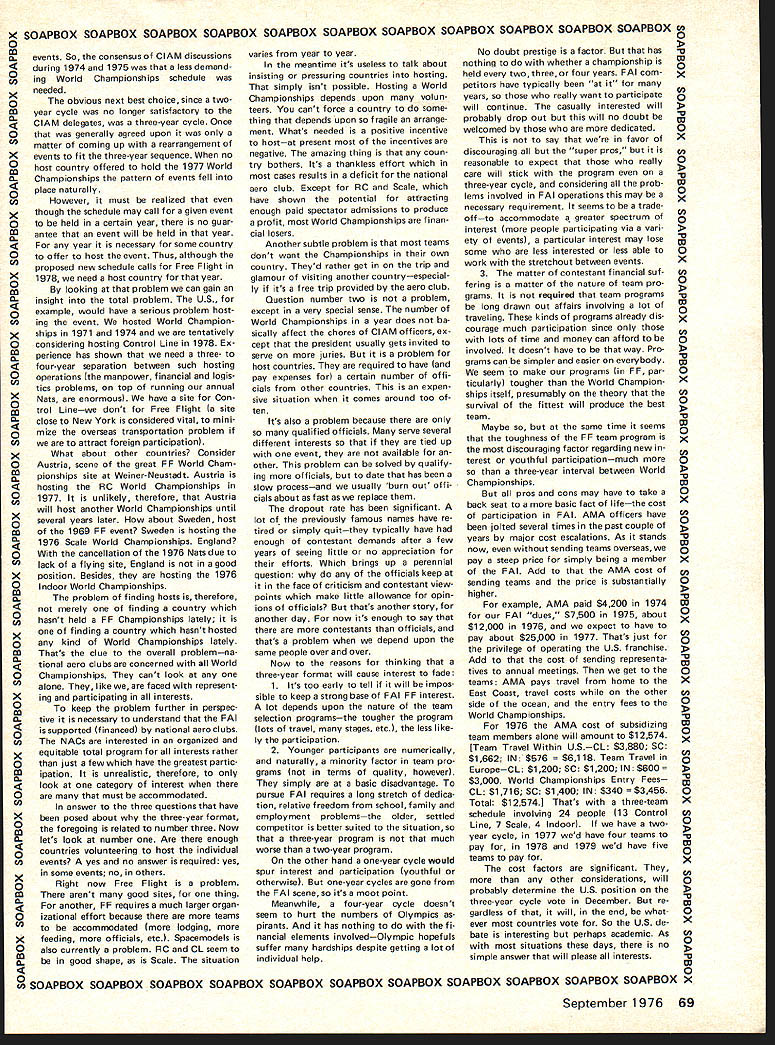
The obvious next best choice, since a two-year cycle was no longer satisfactory to the CIAM delegates, was a three-year cycle. One that was generally agreed upon — it was only a matter of coming up with a rearrangement of events to fit the three-year sequence. When no host country offered to hold the 1977 World Championships the pattern of events fell into place naturally.
However, it must be realized that even though the schedule may call for a given event to be held in a certain year, there is no guarantee that an event will be held in that year. For any year it is necessary for some country to offer to host the event. Thus, although the proposed new schedule calls for Free Flight in 1978, we need a host country for that year.
By looking at that problem we can gain an insight into the total problem. Thus, for example, we would have a serious problem hosting the event. We hosted World Championships in 1971 and 1974 and were at that time considering hosting Control Line in 1978. Experience has shown that we need a three- to four-year separation between such hosting operations (the manpower, financial and logistics problems, on top of running an annual Nats, are enormous). We have a site for Control Line — we don't for Free Flight (a site close to New York is considered vital, to minimize the overseas transportation problem if we are to attract foreign participation).
What about other countries? Consider Austria, scene of the great FF World Championships site at Wiener-Neustadt. Austria is hosting the RC World Championships in 1977. It is unlikely, therefore, that Austria will host another World Championships until several years later. How about Sweden, host of the 1969 FF event? Sweden is hosting the 1976 Scale World Championships. England? With the cancellation of the 1976 Nats due to lack of a flying site, England is not in a good position. Besides, they are hosting the 1976 Indoor World Championships.
The problem of finding hosts is, therefore, not merely one of finding a country which hasn't held a FF Championship lately; it is one of finding a country which hasn't hosted any kind of World Championships lately. That's the choice to the overall problem — national aero clubs are concerned with all World Championships. They can't look at any one alone. They, like we, are faced with representing and participating in all events.
To keep the problem further in perspective it is necessary to understand that the FAI is supported (financed) by national aero clubs. The NACs are interested in an organized and equitable approach to normal efforts rather than just a few events which have the greatest participation. It is unrealistic, therefore, to only look at one category of interest when there are many that must be accommodated.
In answer to the three questions that have been posed about why the three-year format, the foregoing is related to number three. Now let's look at number one. Are there enough countries volunteering to host the individual events? A yes-and-no answer is required; yes, in some events; no, in others.
Right now Free Flight is a problem. There aren't many good sites for Free Flight. For another, FF requires a much larger organization and effort because there are more teams to be accommodated (there are more teams per country in FF) and also because the events are spread over several days. There is a major problem with the large number of team members and also with the fact that most of the teams ask for accommodations that are not readily available. To this, the problem is one of cost and transportation. The cost of travel to these championships has been increasing in real terms and will continue to increase. Some countries have less and less funds available for the travel, accommodation and equipment costs. They must choose some events and give up others. The FAI has recognized that this is a problem and has tried to maintain participation by means of subsidies and other financial aids, but this is only partial relief.
No doubt prestige is a factor. But that has nothing to do with whether a championship is held every two, three, or four years. FAI commissions have typically been "at it" for many years, so those who really want to participate will continue. The casualty interest will probably drop but this will not, doubtless, be welcomed by those who are more dedicated.
It is not to say that we are in favor of discouraging all but the "super pros," but it is reasonable to expect that those who really care will stick with the program even on a three-year cycle, and considering all the problems involved in FAI operations this may be a necessary requirement. It seems to be a trade-off — to accommodate a greater spectrum of interest (more people participating via a variety of events), a particular interest may lose some who are less interested or less able to work with the stretched intervals between events.
The matter of team personnel suffering is predominantly one of the nature of team programs. It is not unlike that team programs already discourage much participation since only those with lots of time and money can afford to be involved. In many cases the team programs can be simpler and easier on everybody. We seem to make our programs (in FF, particularly) tougher than the World Championships itself, presumably on the theory that the survival of the fittest will produce the best team.
Maybe so, but at the same time it seems that the toughness of the FF team programs may be the most discouraging factor regarding lower-entry or youthful participation — much more so than a three-year interval between World Championships.
But all pros and cons may have to take a back seat to a more basic fact of life — the cost of participation in FAI. AMA officers have been jolted several times in the past couple of years by major cost escalations. As it stands now, even without sending teams overseas, we pay a steep price for simply being a member of the FAI. Add to that the costs of sending representatives to annual meetings, and the price is substantial.
For example, AMA paid $4,200 in 1974 for our FAI "dues," $7,500 in 1975, about $12,000 in 1976, and we expect to have to pay about $25,000 in 1977. That's just for the privilege of operating the U.S. franchise. Add to that the costs of sending representatives to annual meetings. Travel, subsistence and incidental costs mount rapidly. That, plus the costs of teams (airfare, local transportation, equipment and support) makes the financial burden heavy.
The cost factors are significant. They, more than any other considerations, will probably determine the U.S. position on the three-year cycle vote in December. But whatever the U.S. decision, it is the FAI itself that will determine the future schedule. It is interesting but perhaps academic. As with most situations these days, there is no simple answer that will please all interests.
Competition Newsletter
ACADEMY OF MODEL AERONAUTICS — DEADLINE FOR RULES PROPOSALS DRAWS NEAR
September 1976 postmark deadline for rules proposals submitted for consideration by AMA Contest Boards with possible effect beginning January 1, 1978. If you miss this date the next opening for accepting proposals will be January 1–September 1, 1978 for possible implementation 1980. The message is clear — submit proposals now; don't wait very long. In order for a proposal to receive consideration the standard Rules Change Proposal Form must be used. Use form printed May 1976 Model Aviation page 79. To request copy write AMA HQ; please enclose pre-addressed stamped envelope. Requests completing proposal form must include: 1) brief summary of proposed change; 2) exact proposed rule book wording; 3) logic behind proposed change including alleged shortcomings.
Contest Director Rules Advisory Committee Update
Because it is unlikely that any Contest Board member will be sufficiently well-informed in all categories within that particular Board's jurisdiction, the Contest Board Procedures document provides for appointment of specialist advisory committees to assist the rules-making process. Advisory committees help Contest Boards in two main ways:
- Review, evaluate and recommend concerning rules change proposals submitted by AMA members.
- Submit rules change proposals in the name of the committee; such proposals being considered only after having passed the Contest Board's initial vote.
Advisory committees presently authorized and functioning follows:
RC Helicopter Advisory Committee
- Wayne Schoonover, Chmn., 2080 Sharon Rd., Winter Park, FL 32789
- Dario Brisighella, St. 1032 East Manitowoc, Oak Creek, WI 53154
- John E. Borkan, 571 Mount Alverno Road, Media, PA 19063
- W. R. Ellis, 1208 Cliffwood Road, Euless, TX 76039
- Horace Hagen, 15 Parkway Place, Red Bank, NJ 07701
- Ernest T. Hobbs, Jr., 8 Michael Road, Beverly, MA 01910
- Donald Lowe, 2710 N. Kings Ann Circle, Centerville, OH 45440
- Faye W. People, III, 281 Norristown Road, Warrington, PA 18934
- Nathan H. Ramos III, 1158 Baywood Avenue, Camarillo, CA 93010
- Al M. Ward, Box 595, Alamosa, CO 80720
(Note: Addresses and name spellings have been corrected where clearly evident from the scan.)
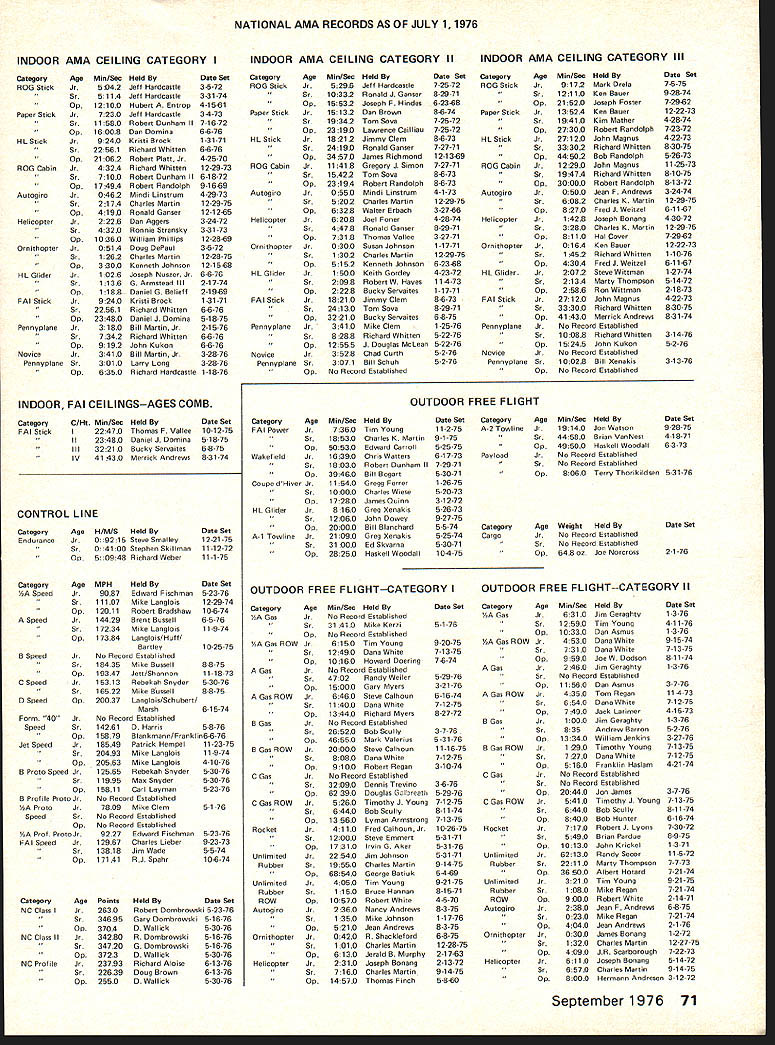
NATIONAL AMA RECORDS AS OF JULY 1, 1976
INDOOR AMA CEILING CATEGORY I
ROG Stick
- Jr. 5:04.2 Jeff Hardcastle 3-5-72
- Sr. 11:10.4 Jeff Hardcastle 3-31-74
Paper Stick
- Jr. 2:10.0 Hubert A. Entrop 4-15-61
- Sr. 5:23.0 Jeff Hardcastle 3-5-72
HL Stick
- Jr. 9:22.4 Ron Dorna 6-6-76
- Sr. 9:24.0 Kristi Brock 11-3-71
ROG Cabin
- Jr. 21.02 Richard Hittiner 6-6-73
- Sr. 4:32.4 Robert Dunham 1-6-78
Autogiro
- Jr. 7:14.0 Robert Dunham 6-16-79
- Sr. 2:46.2 David L. Linstrum 4-29-73
Helicopter
- Jr. 2:17.4 Charles Martin 12-29-75
- Sr. 4:12.6 Ronald Goers 3-24-75
Ornithopter
- Jr. 4:32.6 Ronnie Strasen 3-31-73
- Sr. 0:16.0 William Phillips 12-28-69
HL Glider
- Jr. 3:20.0 Doyle Delag 3-26-75
- Sr. 3:00.0 Kenneth Johnson 12-15-78
FAI Stick
- Jr. 8:20.0 Richard Miller 6-6-76
- Sr. 5:39.0 Daniel H. Ostler 12-25-75
Pennytplane
- Jr. 3:18.0 Bill Martin, Jr. 2-5-76
- Sr. 3:20.0 Richard Whitner 6-6-76
Novice Pennytplane
- Jr. 3:41.0 Larry Long 3-28-76
- Sr. 3:00.0 Richard Hardcastle 1-18-76
INDOOR AMA CEILING CATEGORY II
ROG Stick
- Jr. 5:59.5 Jeff Hardcastle 3-5-72
- Sr. 10:33.2 Ronald J. Ganser 8-20-71
Paper Stick
- Jr. 15:53.2 Joseph F. Hinds 6-23-68
- Sr. 12:39.2 Dan Brown 6-26-72
HL Stick
- Jr. 19:34.2 Tom Sova 2-25-72
- Sr. 19:34.2 Lawrence Calliou 7-26-72
ROG Cabin
- Jr. 21:22.1 Jimmy Clem 6-8-73
- Sr. 24:19.0 Ronald Ganser 12-7-71
Autogiro
- Jr. 3:44.0 James Richmond 1-23-69
- Sr. 11:41.2 Gregory J. Simon 7-27-71
Helicopter
- Jr. 5:42.0 Tom Sova 6-8-73
- Sr. 3:19.4 Robert Randolph 6-12-73
Ornithopter
- Jr. 5:15.1 Robert Randolph 11-27-73
- Sr. 5:14.2 Walter Eberbach 2-27-66
HL Glider
- Jr. 5:10.2 Jon Klein 12-2-72
- Sr. 5:01.6 Bubey Svrates 1-8-73
FAI Stick
- Jr. 3:36.0 Tom Sova 10-8-72
- Sr. 24:31.0 Bob Sova 5-12-76
Pennytplane
- Jr. 12:55.5 J. Douglas McLean 5-28-76
- Sr. 3:12.0 Buck McVeolia 1-2-76
Novice Pennytplane
- Jr. 3:07.1 Bill Schuh 5-2-76
- Sr. No Record Established
INDOOR AMA CEILING CATEGORY III
ROG Stick
- Op. 9:17.0 Mark Drela 7-5-75
- Op. 9:36.8 Mark Drela 9-28-74
Paper Stick
- Op. 21:52.0 Joseph Foster 7-29-72
- Op. 13:14.0 Ken Baer 2-22-73
HL Stick
- Op. 21:30.0 Kim Mather 3-22-73
- Op. 19:24.0 Robert Randolph 4-28-73
ROG Cabin
- Jr. 27:10.0 John Magnus 11-8-73
- Sr. 29:17.0 Richard Whitner 6-16-75
Autogiro
- Op. 3:00.0 John Magnus 8-13-72
- Op. 6:02.0 Charles K. Martin 2-26-75
Helicopter
- Op. 2:50.0 Jean F. Andrews 3-24-74
- Op. 3:18.0 Charles K. Martin 12-29-76
Ornithopter
- Op. 0:12.4 Charles K. Martin 2-29-76
- Op. 1:00.0 Ken Baer 12-25-72
HL Glider
- Op. 4:30.4 Fred W. Weitzel 6-1-76
- Op. 2:00.2 Steve Williamson 12-17-74
FAI Stick
- Op. 2:58.0 Norm Whitman 4-28-73
- Op. 3:02.0 John Magnus 2-14-73
Pennytplane
- Op. 3:30.0 Richard Whitner 3-12-76
- Op. 3:25.0 John Kukan 5-14-76
Novice Pennytplane
- Op. No Record Established
INDOOR, FAI CEILINGS—AGES COMB.
FAI Stick
- C/HTL Min/Sec Held By Date Set
- I 3:20.10 Thomas F. Valle 10-12-75
- II 3:22.10 Daniel J. Dominus 5-18-75
- III 4:31.40 D. Merick Andrews 8-31-74
OUTDOOR FREE FLIGHT
FAI Power
- Category Age Min/Sec Held By Date Set
- Open 3:06.10 Tom Young 11-12-75
- Sr. 9:03.00 Charles R. Martin 5-30-72
Wakefield
- Open 10:56.30 Edward Carnahan 6-17-73
- Sr. 12:03.00 Chris Waters 6-27-71
Coupé d’hiver
- Open 1:07:40 Robert Dunham 1-26-75
H. Glider
- A-1 Towline Op. 1:58.00 John Dovey 3-24-75
- Sr. ? (no record)
OUTDOOR FREE FLIGHT—CATEGORY I
A Gas
- Op. 3:46.10 No Record Established
- Sr. 1:31.40 Mike Kerri 5-7-75
A Gas ROW
- Op. 3:07.10 No Record Established
- Sr. 2:19.60 Dan White 9-17-75
B Gas
- Op. 4:02.40 Randy Meier 5-23-76
- Sr. 3:44.10 Henry Blythe 6-1-75
C Gas
- Op. 3:46.10 Ray Miller 5-21-76
- Sr. 3:48.20 W. Stanton 5-9-75
D Gas
- Op. 3:20.00 George Clark 5-16-76
- Sr. 3:12.10 Robert P. Hunt 6-5-75
Unlimited Rubber
- Op. 1:22:40 John Stephens 5-4-75
- Sr. 22:54.00 Tom Young 5-22-74
Rubber ROW
- Op. 1:36:50 Clarence Martin 5-1-71
- Sr. 1:26:40 George Garbutt 4-6-75
OUTDOOR FREE FLIGHT—CATEGORY II
A Gas
- Op. 31:10 R. Germagsten 4-3-76
- Jr. 2:56.10 Jim Gregg 4-1-76
A Gas ROW
- Op. 2:20.10 Sam Draper 3-15-73
- Jr. 2:15.40 Dan White 3-15-75
B Gas
- Op. 3:18.50 Dan White 3-15-75
- Jr. 3:16.40 Jim Rogers 5-12-76
C Gas
- Op. 3:24.70 Joe Kramer 6-14-75
- Jr. 3:10.30 Larry Peters 4-17-75
D Gas
- Op. 2:44.10 Tom Regan 4-5-76
- Jr. 2:34.40 Jack Mallory 3-16-75
Rubber
- Op. 1:11:10 Albert Horner 5-11-75
- Jr. 1:02:10 Alan Young 6-4-75
Helicopter
- Op. 5:07.0 Charles Martin 5-5-76
- Jr. 3:12.0 Thomas Finch 5-6-70
(End of National AMA Records listing)
September 1976 71
Transcribed from original scans by AI. Minor OCR errors may remain.

