
Competition Newsletter
A Note From the Technical Director
W. Bob Underwood CompuServe: 76117,167
The activity in this office has reached a frantic level recently. Many questions and concerns have surfaced regarding the rules proposals; the resulting calls and letters fill many hours. The FAI agenda has occupied Micheline Madison's time as preparation is made for the April meeting. Trade-show routine, RC frequency concerns, and the beginning stages of preparation for the three books that will replace the current single rule book have the two desks occupied by your Competition Director and Technical Director looking a little like the beach at Normandy during the invasion.
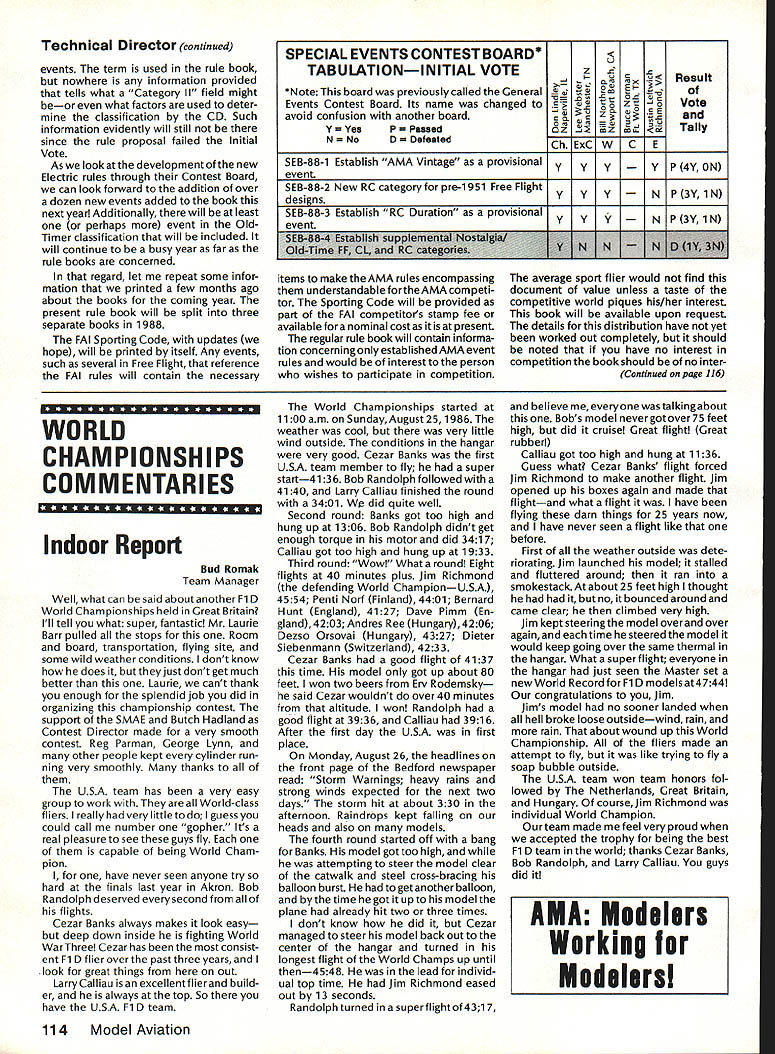
The March edition of the Competition Newsletter contained a listing of the vote on the bulk of the rules proposals. A significant number of proposals failed the Initial Vote this cycle. In one case, RC Soaring: only three proposals were submitted and all three were turned down. Aside from small editing changes (misspelled words, unusual sentence construction, etc.), it is safe to say the Soaring rules are set for the next two-year cycle.
A very controversial item — the requirement for silencers on all engines over .051 cu. in. — was not passed. Many letters addressing that proposal arrived by newsletter and general mail. The problem is difficult to handle because it often comes down to the use of words like "effective silencers" and what constitutes objectionable levels of sound. It is not likely that this issue will remain quiet, at least in some areas or groups.
I was particularly interested in the failure of one of the Free Flight rule proposals — one I had submitted to answer questions Headquarters has had about how the term "category" is defined for outdoor events. The term is used in the rule book, but nowhere is any information provided that tells what a "Category IV" field might be — or even what factors are used to determine the classification by the CD. That information evidently will still not be provided since the proposal failed the Initial Vote.
As we look at the development of the new Electric rules through their Contest Board, we can look forward to the addition of over a dozen new events to the book next year. Additionally, there will be at least one (perhaps more) event in the Old Timer classification included. It will continue to be a busy year as far as the rule books are concerned.
Technical Director (continued)
The present rule book will be split into three separate books in 1988:
- The FAI Sporting Code, with updates, printed separately. Events that reference FAI rules will contain the necessary items to make the AMA rules understandable for the AMA competitor. The Sporting Code will be provided as part of the FAI competitor's stamp fee or available for a nominal cost.
- The regular rule book, containing information concerning only established AMA event rules, intended for those who wish to participate in competition. The average sport flier would not find this document of value unless interested in competition.
- A membership manual to be provided to all members. A few pages in the back of the current rule book are devoted to this information; the new manual will vastly expand the material to better inform membership and to reduce confusion between items that are "rules" and those that are recommendations for competitors and sport fliers.
In the radio frequency area, during the IMS show in California a meeting was held with a number of radio manufacturers and importers. Members of the Executive Council, Headquarters staff, and the Frequency Committee attended. Some time ago copies of the Frequency Committee's 1991 Guidelines were provided to industry in hopes that, together, we can effectively handle the phase-in of the new frequencies. The primary thrust of the meeting was how concerns should be addressed and how to develop the cooperation and communication required.
By the time you read this there will have been a formal meeting of industry members designed to develop liaison with AMA. One key issue is whether it will be necessary to request tighter requirements from the FCC — an action that would require concerted industry/AMA effort.
A new device on the market, the Icom Communications Receiver (IC R7000), has been purchased by several Frequency Committee members and has proven an excellent means of scanning and performing basic transmitter evaluation. Features and notes include:
- Programmable for all commonly used frequencies.
- Fine-tuning knob and meter allow evaluation of sidebands, frequency deviation, and signal level.
- Battery pack makes the unit portable.
- Not a spectrum analyzer — you cannot view the signal on a screen as with an analyzer.
- Approximate cost: the receiver (bar unit, minus antenna and plugs) about $950 depending on supplier and discounts; battery pack about $12.95.
While this is a sizable sum, it may be a valuable tool for those who need it.
One last item: a program was established to select a person or group to receive a Technical Award acknowledging significant contributions to the technical end of our hobby/sport. At the last Executive Council meeting the recommendation of the Council of Past Vice Presidents was acted upon, and a Technical Award will be given to Bob Hunter of Satellite City for the introduction of cyanoacrylate adhesives to the modeling community. Details of this award will appear in a future issue of Model Aviation.
Enough for now — lots more later!
Transcribed from original scans by AI. Minor OCR errors may remain.

