
Competition Newsletter
A Note From the Technical Director
Bob Underwood CompuServe: 76117,167
It's time for another reminder about rule books for 1988. Some months ago this column informed you that next year we will be issuing three separate books, replacing the current two-year rule book. We are making an effort to inform the membership of this change as early as possible to eliminate confusion.
Every member will receive a Membership Manual at the beginning of the year. This document will contain a great variety of information, some of which is already in the current rule book beginning on page 123. You will note that items such as the Safety Code, Frequency Committee recommendations, laws, and Headquarters departments can be found in that section. We plan to add additional material to make a much more usable book for the entire membership.
Beyond providing additional important information, the change will emphasize that competition rules and regulations are distinct from items that affect the general membership. This column has repeatedly addressed the problem of such questions as "Do I have to put my AMA number on the wing?" The answer still depends on whether you are a competitor or a sport flier. The new Membership Manual will help make the proper distinctions between competitors and sport fliers.
A second book will be the competitor rule book. It will contain information relevant to those who compete in rule-book events. The weekend sport flier will have no need for this book; it will be available by request after membership renewal—watch for instructions on how to request it.
The third book will be the complete, updated FAI Sporting Code. The FAI Sporting Code section in the current AMA rule book is abridged and outdated; the Sporting Code itself is printed only every four years. Micheline Madison, AMA Competition Director, has spent countless hours updating the Sporting Code information to include changes since 1984. Updated material is being submitted to Tony Aarts, FAI Technical Director, for approval and is being placed on the AMA Headquarters computer.
The task remaining for this cycle is considerable, especially since we will be doing typesetting and final layout at Headquarters (previously subcontracted). We are working hard to produce a quality product useful to sport fliers and competitors alike. Watch for more details soon.
Bits and Pieces
Last month we discussed the differences between rules and recommendations. Due to space constraints, some points were cut; here are additional thoughts about club rules:
- Keep them as simple as possible. (Maybe you can live with the Safety Code alone.)
- Don't use "Don't" in your rules. Using negatives often requires many more statements; it's better to state what to do.
- Review your club rules periodically for necessary changes. (I recently visited a field that still had a rule posted indicating an FCC license was required.)
- Rules are rules, but recommendations are not—maybe. Make a clear separation between what is a rule and what is not.
- Beware the "rule" that cannot be enforced. If a rule no longer makes sense, get rid of it.
Another frequency matter—several changes are being made to the AMA Safety Code affecting Radio Control operation. The additions becoming effective soon address frequency usage:
- All operations must be on frequencies set aside by the FCC for model use (except as per item 2). If you continue to use the so-called "old" frequencies, or operate on frequencies legal for models in other countries but not in the U.S. (35 MHz, for example), you will be in violation of the Safety Code.
- If you operate on frequencies that are legal for properly licensed Amateurs (53 MHz, for example) but do not possess that license, you will be in violation of the Safety Code.
Please note: printed at the top of the Safety Code is the statement that "Model flying must be in accordance with this code in order for AMA liability protection to apply."
'Nuff for now!
National Records
The following National Records were processed and approved during July 1987:
- Indoor Category Novice Pennyplane Open 847 — Jim Clem, 4/18/87
- Indoor Category III Ornithopter Open 840 — Roy White, 4/25/87
- Indoor Category IV Ornithopter Junior 207 — Scott Robbins, 4/4/87
- Ornithopter Open 154 — Roy White, 5/16/87
- Easy B Junior 109 — Mark Richmond, 6/6/87
- Manhattan Cabin Junior 431 — Jim Buxton, 6/7/87
- Outdoor FF P-30 Junior 1016 — Channing Booth, 5/23/87
- A-1 Towline Open 5856 — Martyn Cowley, 5/25/87
- Outdoor FF Category III 1/2A Gas Open 1824 — Bob J. Combs, 6/7/87
- B Gas Open 1623 — Robert Dunham II, 6/7/87
1988 Nats Set — Chesapeake, Virginia
Exact dates for the 1988 Nats will be announced in the next issue. The Nats site will be Chesapeake, Virginia, just south of Norfolk, a few miles from the Atlantic Ocean near Virginia Beach. The main site will be the Navy airfield at Fentress. The location is about a four-hour drive south of Washington, D.C., and a few hours' drive north of Kitty Hawk, N.C. There is potential sightseeing for a great family vacation—tremendous visits include the AMA Museum (about 18 miles west of D.C.), the Smithsonian Air and Space Museum in D.C., ocean bathing at Virginia Beach, and visiting the Wright brothers' first flight site in North Carolina.
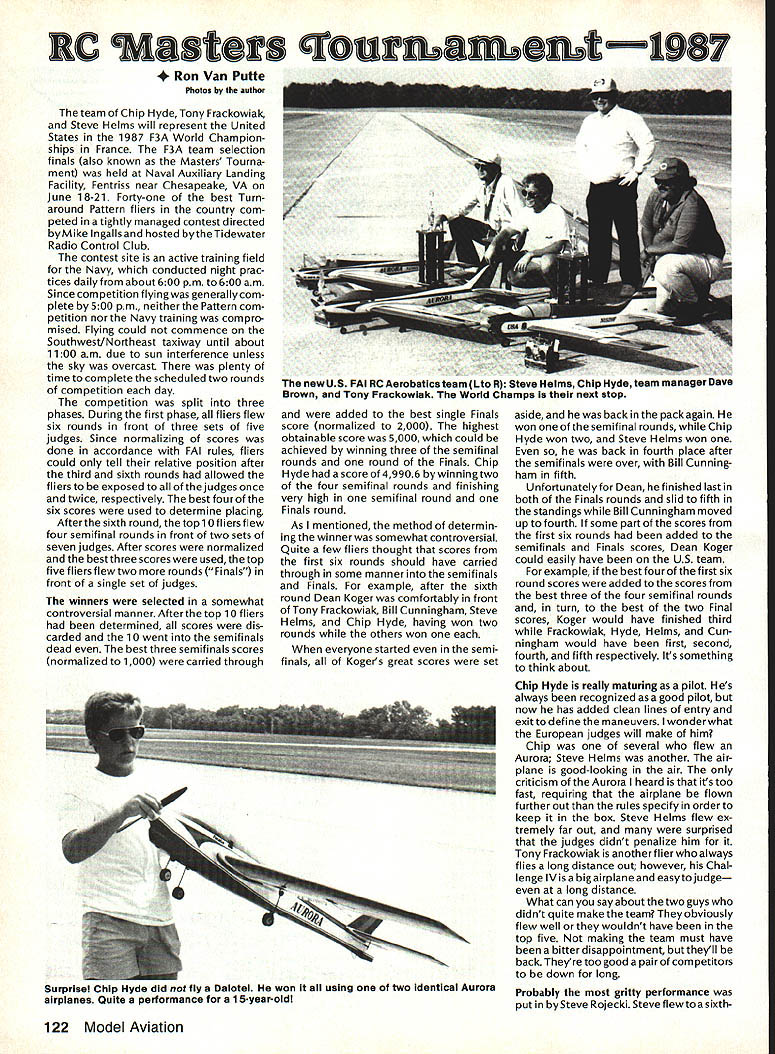
Model flying has used Fentress for years. The 1987 RC Aerobatic Team finals were held there last June; the site was also being considered for the 1989 RC World Championships, which would include Aerobatics, Pylon Racing, Helicopters, and Soaring.
New CD Sanctioning Procedures
Action taken by the Executive Council at its July meeting resulted in an extensive restructuring of methods used to approve new Contest Directors (CDs) and to sanction events. The new procedures replace some traditional methods that were cumbersome and made tracking information difficult. It is hoped the new procedures will solve those problem areas. The following is a synopsis of the changes.
Contest Director Approval
Members who wish to become Contest Directors may apply by obtaining an application form from their district vice-president, associate vice-president, or AMA Headquarters. The form requires signatures of other AMA members willing to attest to the candidate's qualifications in organizing and running model airplane activities. The form also contains a questionnaire designed to determine the applicant's basic knowledge of the AMA rule book.
The revised questionnaire presents a list of 19 conditions or situations; the applicant is required to list the page and item number in the rule book that provides information about each condition. The twentieth item on the questionnaire is a subjective, essay-type question.
Once the application and questionnaire are completed, the form and the $20 fee are mailed directly to AMA Headquarters in care of the Competition/Technical Department. AMA memberships of those signing the application will be verified and the questionnaire checked. If all requirements are fulfilled, the application will be held for 10 days while the district vice-president is contacted for approval. If no objection is raised within 10 days, the application will be turned over to the Membership Department for processing.
All new Contest Director memberships are issued with a one-year probationary period. The previous practice of awarding a year's free membership to a CD for running a sanctioned event will be continued, but only after the probationary period has been completed.
Event Sanctioning
Many clarifications and changes were made to event sanctioning. One clarification notes that "AAAA" status for an event is issued only upon Executive Council recommendation; that requirement has been added to the sanctioning procedure.
Major changes separate events into meaningful groups. The "A" and "B" classifications will henceforth be used only for rule-book events:
- "A" — Unrestricted entry (to AMA members). Events must include at least one rule-book event.
- "AA" — Same as item 3.6, page 5 in the 1986-87 rule book.
- "AAA" — Same as item 3.7, page 5 in the 1986-87 rule book.
- "AAAA" — Same as item 3.8, page 5 in the 1986-87 rule book (requires Executive Council approval).
- "B" — Same as item 3.4, page 5 in the 1986-87 rule book.
With the exception of event 519, all rule-book events are flying events; specific rules are contained within the rule book. If the Calendar of Events lists event 514, the contestant should expect the event to be run using the rules found on page 81. Minor changes by event organizers may be allowed, but they must be listed in detail on the sanction request and in advance advertisements.
New classifications "C" and "CC" were created for non-rule-book flying events:
- "C" — Non-rule-book flying events (may be fly-ins or competitive fun-flys using local rules).
- "CC" — Non-rule-book flying events upgraded to "higher" status in conformance with item 2.5 on page 5.
These classifications accommodate special events run under locally developed rules—examples include contests requiring special flying sites, model designs/kits for racing, special free-flight models, or unique fun-fly rules. Such events should not be listed as rule-book events on sanction requests.
Additional categories:
- "D" — Demonstrations (usually public relations events at airports or other flying sites).
- "F" — Mall shows and other nonflying events.
Sanction requests for "D" and "F" will be sent directly to AMA Headquarters for processing rather than to the district Contest Coordinator.
The intent behind these changes is to separate rule-book from non-rule-book events and to separate flying from non-flying events. The old "A" classification became a catchall that could include everything from a regular rule-book event to a club picnic, which was not the intent of the sanctioning procedure.
Note: Popular events like the "Giant Scale Fly-In" have frequently been sanctioned as "A" or higher with applicants checking off event 514. Most of these are not competitive events using the rules found on page 81 and therefore should be sanctioned as "C" or "D" events. The same applies to event 414, "Club Team Fun Fly," when local rules are used instead of the rule-book rules on page 58.
New Procedures (questionnaire and processing)
- The questionnaire format was changed from multiple-choice to the page-and-item lookup format described above.
- After submission and verification, applications are held for 10 days for district approval.
- New CDs receive a one-year probationary CD membership; the free one-year membership for running a sanctioned event is awarded after probation.
US F3C Team
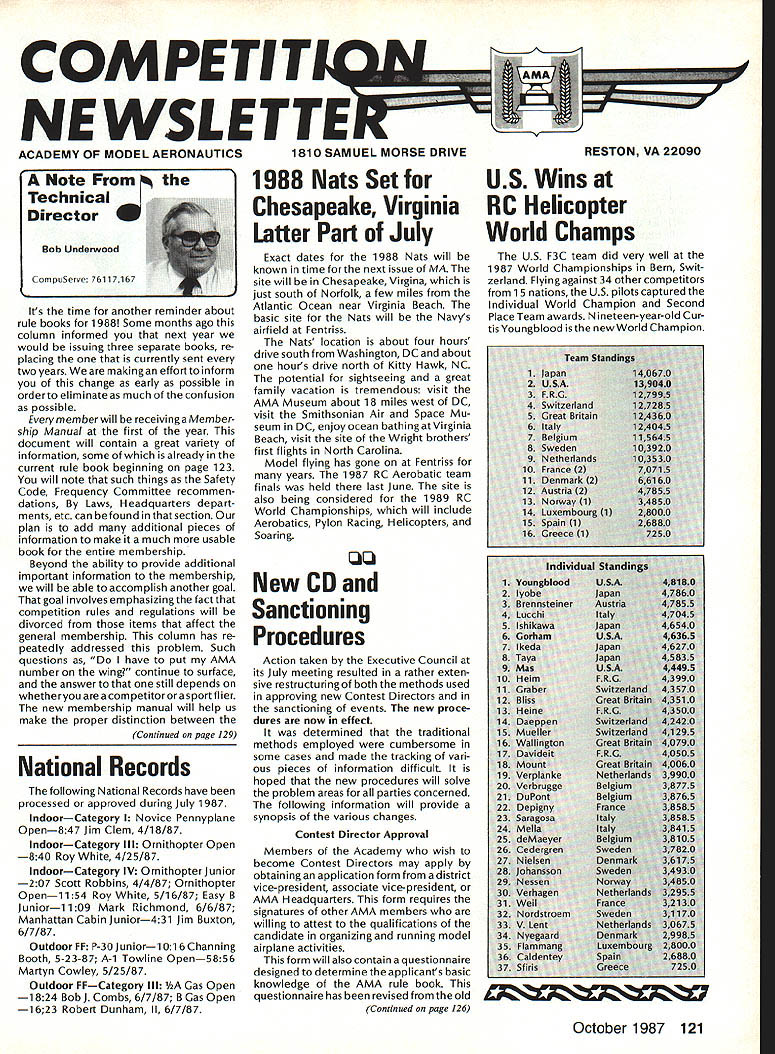
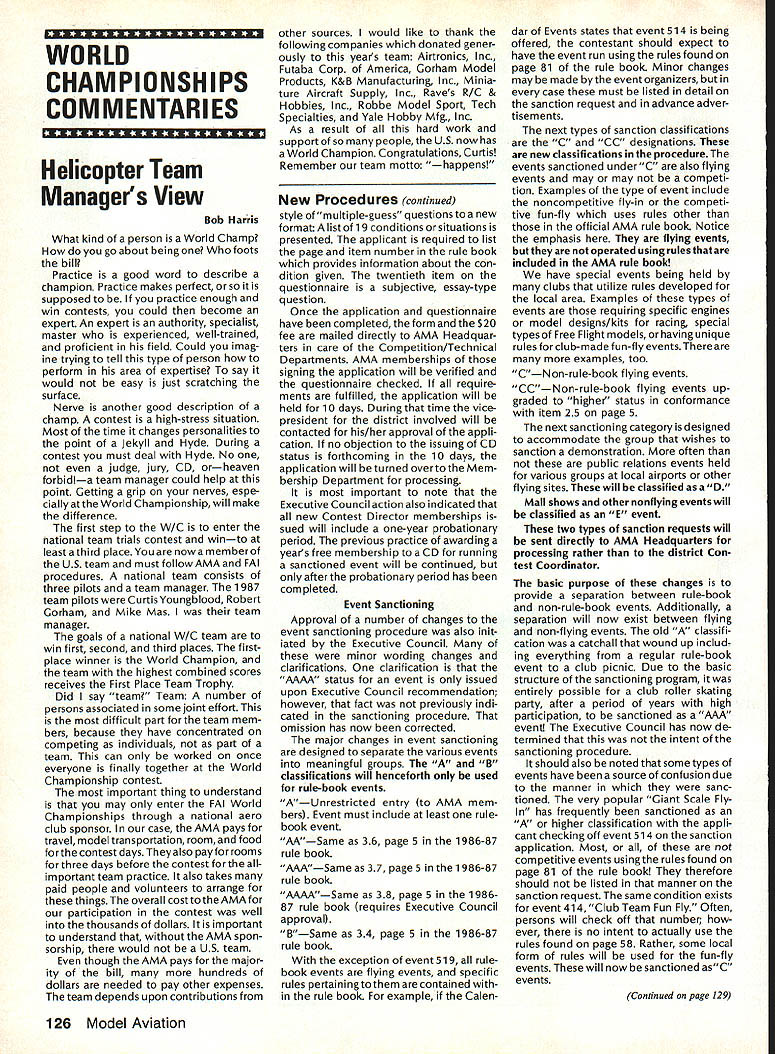
The US F3C team performed very well at the 1987 World Championships in Bern, Switzerland. Flying against 34 competitors from 15 nations, US pilots captured the Individual World Champion and Second Place Team awards. Nineteen-year-old Curtis Youngblood is the new World Champion.
Team standings:
- Japan
- USA
- FRG
- Switzerland
- Great Britain
- Italy
- Belgium
- Sweden
- Netherlands
- France
- Denmark
- Austria
- Norway
- Luxembourg
- Spain
- Greece
Masters' Tournament (recap and observations)
Several longtime Pattern fliers appeared at this year's Masters' Tournament, which prompted some reminiscence.
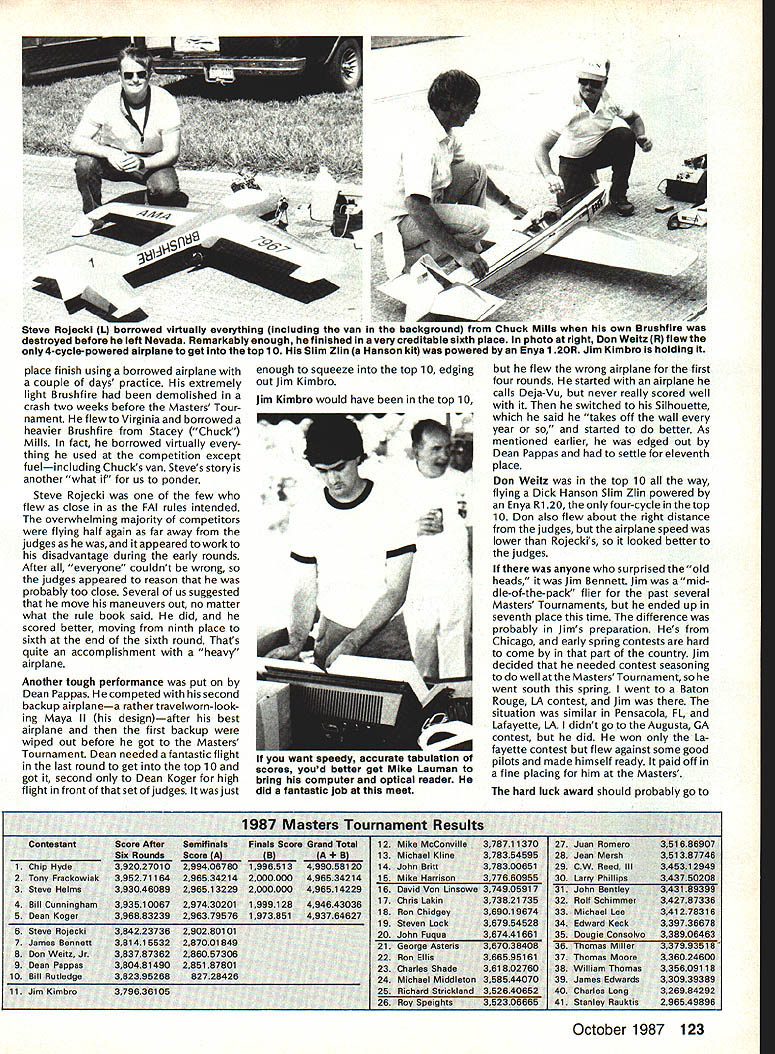
- Bill Rutledge flew consistently for the first six rounds and was in eighth place when the top 10 all started even. Then his YS engine—which had run flawlessly for six rounds—refused to run. He flamed out in the first three semifinal rounds and elected not to fly the last round because he had no chance.
- Veteran Jim Edwards, winner of the 1967 Masters' Tournament, returned to competition after a long absence. He didn't win, but it was nice to see his name on the score sheets again.
- Ed Keck was recognized at the Saturday banquet for having flown in every Masters' Tournament. He still displays the enthusiasm and craftsmanship others admire.
- For the first time, Tom Lowe (AMA President) did not compete; he served as a jury member along with Howard Crispin and John Worth.
- At the banquet, past U.S. team members were asked to stand: Ron Chidgey, Jim Edwards, Dave Brown, Steve Helms, Bill Cunningham, Dean Koger, Tony Frackowiak, and Rhett Miller.
Judging and noise measurements:
- Judging was handled by a broad spectrum of judges; there was a judge from every AMA district with a flier in the competition. Performances by the judges will be evaluated by Russell Knetzger of the United Scale and Pattern Judging Association to aid future selections.
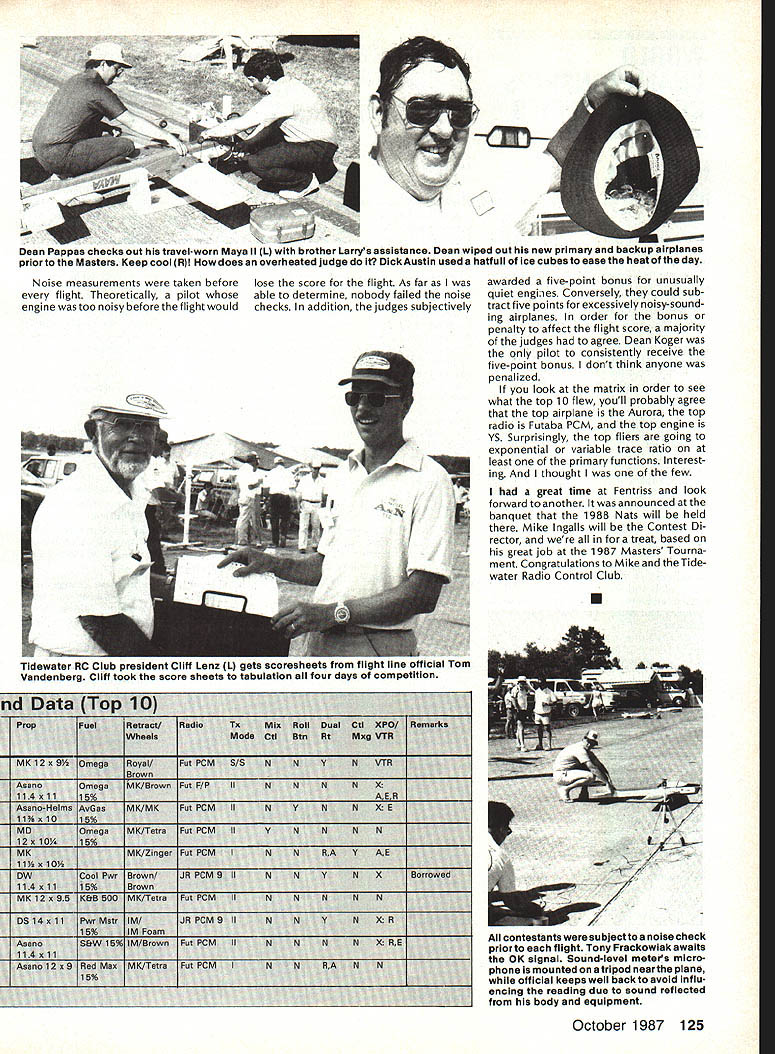
- Noise measurements were taken before every flight. Theoretically, a pilot whose engine was too noisy before the flight would lose the score for that flight, but nobody failed the noise checks as far as reported.
- Judges could award a subjective five-point bonus for unusually quiet engines or subtract five points for excessively noisy-sounding airplanes; a majority of the judges had to agree for the bonus or penalty to affect the flight score. Dean Koger consistently received the five-point bonus; no one was reported penalized.
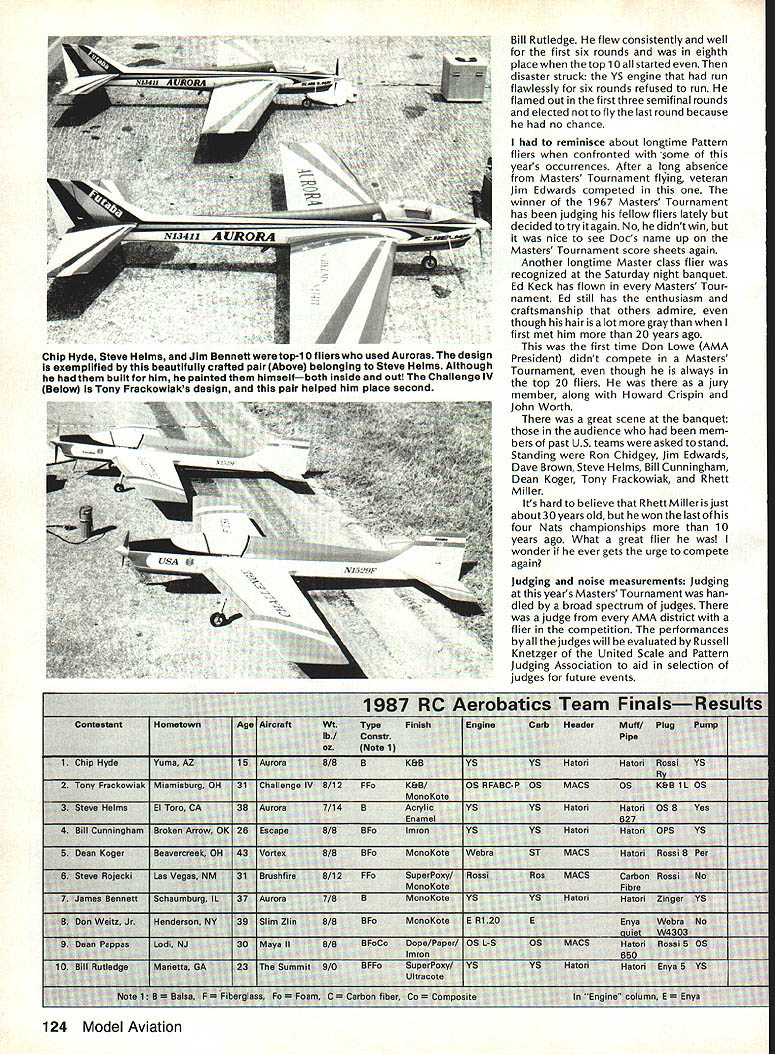
- Looking at the top 10, the most common equipment was the Aurora airframe, Futaba PCM radio, and YS engine. Many top fliers were using exponential or variable rates on at least one primary control.
It was announced at the banquet that the 1988 Nats will be held at Fentress. Mike Ingalls will be the Contest Director—congratulations to Mike and the Tidewater Radio Control Club for a great job at the 1987 Masters' Tournament.
Certification of Equipment
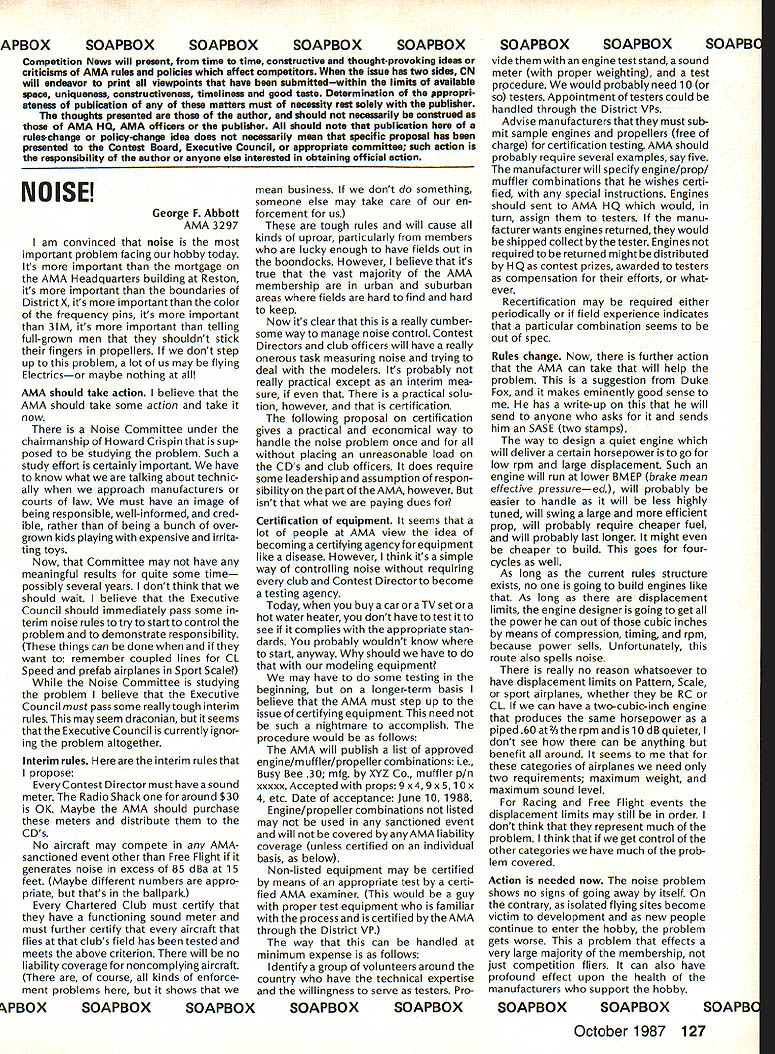
There is resistance to the idea of the AMA becoming a certifying agency for equipment, but certification could be a practical way of controlling noise without requiring every club and Contest Director to be a testing agency. A possible procedure:
- The AMA will publish a list of approved engine/muffler/propeller combinations. Example: Busy Bee .30; mfg. XYZ Co.; muffler p/n xxxxxx. Accepted with props: 9 x 4, 9 x 5, 10 x 4, etc. Date of acceptance: June 10, 1988. Engine/propeller combinations not listed may not be used in any sanctioned event and will not be covered by AMA liability coverage unless certified individually.
- Non-listed equipment may be certified by an appropriate test administered by a certified AMA examiner (a person with proper test equipment certified by the AMA through the District VP).
- To minimize expense:
- Identify volunteers nationwide with the technical expertise and willingness to serve as testers.
- Provide them with an engine test stand, a sound meter (with proper weighting), and a test procedure. Ten testers might be sufficient. Appointment could be handled through District VPs.
- Advise manufacturers to submit sample engines and propellers (free of charge) for certification testing—preferably multiple examples, e.g., five. Manufacturers will specify the engine/prop/muffler combinations they wish certified. Engines should be sent to AMA HQ, which would assign tests to testers. If manufacturers want engines returned, they would be shipped collect to the tester. Engines not returned could be used as contest prizes, given to testers as compensation, or otherwise disposed of.
- Recertification may be required periodically or if field experience indicates a combination is out of spec.
Rules Change (noise and engine design)
A suggestion from Duke Fox, which makes good sense, concerns designing quieter engines by favoring low RPM and large displacement. Such engines run at lower BMEP, are easier to handle, swing larger and more efficient props, may require cheaper fuel, and often last longer. However, as long as displacement limits exist, designers will maximize power within those limits via compression, timing, and RPM—producing noise.
Proposal:
- For Pattern, Scale, and sport airplanes (RC or CL), consider eliminating displacement limits and instead regulate by maximum weight and maximum sound level. If a two-cubic-inch engine can produce the same horsepower as a .60 but be 10 dB quieter, everyone benefits.
- For Racing and Free Flight events, displacement limits may still be appropriate.
Action is needed now. The noise problem will worsen as flying sites are lost to development and new people enter the hobby. This affects a large majority of the membership and the manufacturers who support the hobby.
Transcribed from original scans by AI. Minor OCR errors may remain.

