
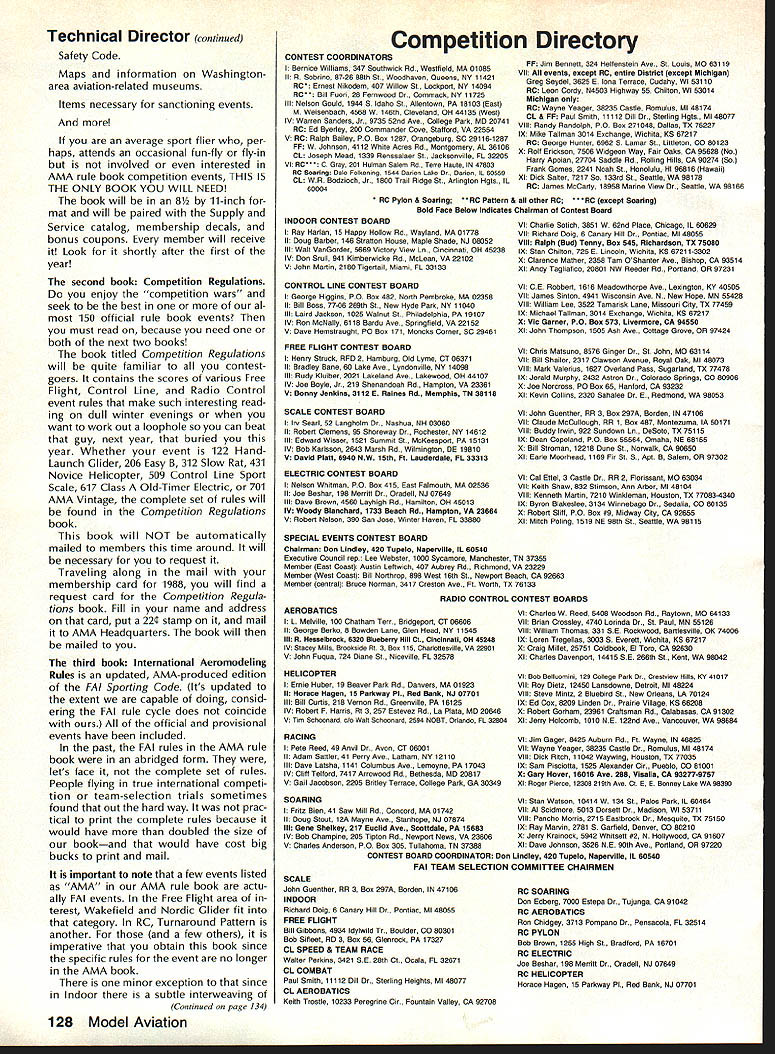
A Note From the Technical Director
Bob Underwood CompuServe: 76111767
LOOK! There's some important stuff here!
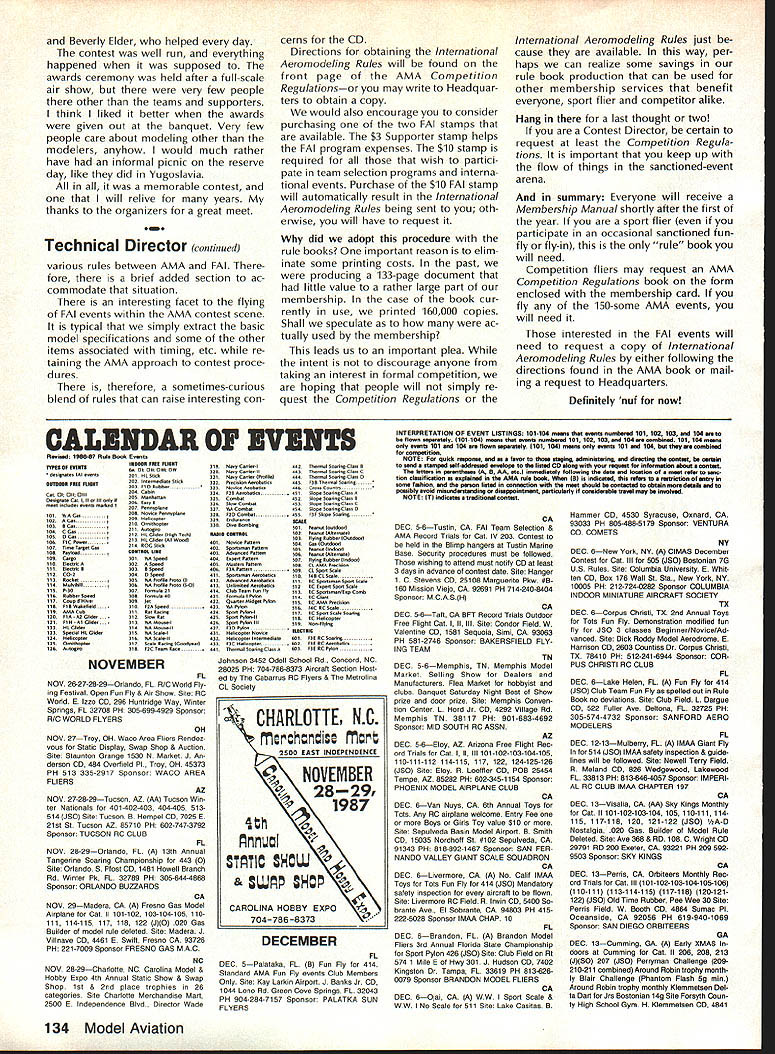
A BIG CHANGE is coming for AMA members in 1988. Instead of a single rule book, three separate books will be published: Membership Manual, Competition Regulations, and International Aeromodeling Rules. Please read the following carefully and inform your modeling friends about the changes.
Why the split?
The present rule book actually contains two distinct sections; the portion beginning on page 123 is the "Membership Manual." Many members who received the Official Model Aircraft Regulations never looked past the first part and therefore missed important membership information. Splitting the book makes the membership material more visible and useful, especially for club officers and sport fliers.
The first book: Membership Manual
The Membership Manual will be mailed to the entire membership shortly after the first of the year. A partial listing of items included:
- Organizational information: Bylaws, scholarship program, who to contact at Headquarters for various concerns, awards, Patron program, Executive Council information, etc.
- RC frequency information: Frequency Utilization Plan, Guidelines, and Frequency Committee recommendations.
- Special Interest Groups and their contact persons.
- Flying site recommendations.
- General insurance information, including facts about coverage.
The second book: Competition Regulations
The Competition Regulations will contain the complete set of AMA event rules—Free Flight, Control Line, and Radio Control events (about 150 events). Examples include 122 Hand Launch Glider, 206 Easy B, 312 Slow Rat, 431 Novice Helicopter, 509 Control Line Sport Scale, 617 Class A Old-Timer Electric, and 701 AMA Vintage.
This book will NOT be automatically mailed. A request card will be mailed with your 1988 membership card. To obtain the Competition Regulations:
- Fill in your name and address on the request card included with your membership card.
- Affix a 22¢ stamp and mail the card to AMA Headquarters.
- The book will be mailed to you.
Contest Directors and regular competitors should be certain to request the Competition Regulations to keep up with sanctioned-event rules.
The third book: International Aeromodeling Rules
The International Aeromodeling Rules is an updated AMA-produced edition of the FAI Sporting Code (updated to the extent possible within differing FAI rule cycles). It includes all official and provisional FAI events.
- In the past, FAI rules in the AMA book were abridged; the new book will present the complete rules so people competing internationally or in team selection have the correct references.
- Some events listed as AMA in our rule book are actually FAI events (examples: Wakefield and Nordic Glider in Free Flight; Turnaround Pattern in RC). For those events you must obtain the International Aeromodeling Rules because their specific rules are no longer included in the AMA Competition Regulations.
- Directions for obtaining the International Aeromodeling Rules will be printed on the front page of the AMA Competition Regulations, or you may write to Headquarters.
We also encourage purchase of FAI stamps:
- $3 Supporter stamp: helps FAI program expenses.
- $10 stamp: required for those wishing to participate in team selection and international events. Purchasing the $10 FAI stamp will automatically result in the International Aeromodeling Rules being sent to you; otherwise you must request it.
A plea and summary
We adopted this procedure largely to reduce printing and mailing costs. In the past we produced a large book of which a substantial portion was irrelevant to many members. Please don't request the Competition Regulations or International Aeromodeling Rules unless you need them; this will help control costs and allow savings to be used for other member services.
Summary:
- Everyone will receive the Membership Manual shortly after the first of the year.
- Sport fliers who do not compete regularly will likely need only the Membership Manual.
- Competition fliers should request the Competition Regulations using the form enclosed with the membership card.
- Those interested in FAI events should request the International Aeromodeling Rules (or purchase the $10 FAI stamp to receive it automatically).
Definitely 'nuff for now!
---
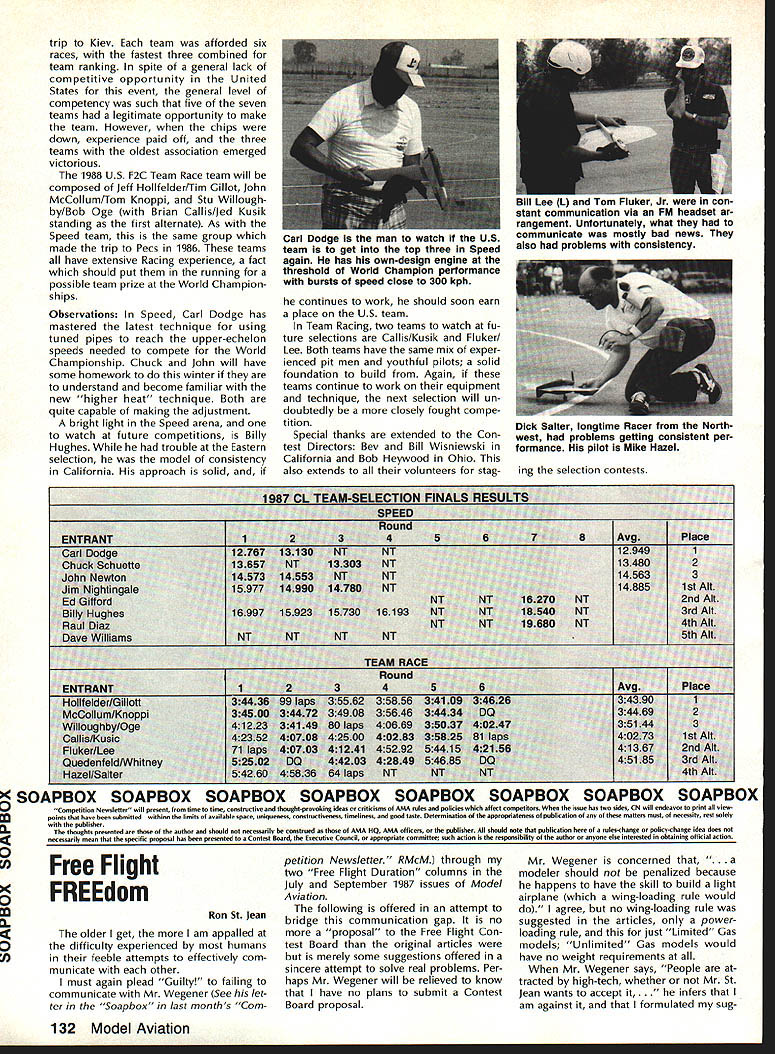
U.S. FAI Control Line Team-Selection Finals
Combat Finals Charlie Johnson Photos by the author
SURPRISE! If you'd believed the predictions about the 1987 Combat Team Trials, you'd have expected a very low turnout, planes that fell out of the sky, and nothing in the way of organization. The unprecedented success of the Team Trials held in Detroit proved those predictions wrong. The Trials had 35 paid entries (33 actually flew), exciting matches, a perfect site, and the best organization seen in any modern-day contest.
Much of the success goes to the Team Selection Committee—especially Paul Smith—and the fantastic team of judges, officials, and jury members. Art Adamisin did a superior job directing the contest and inspiring all in attendance.
Results and highlights:
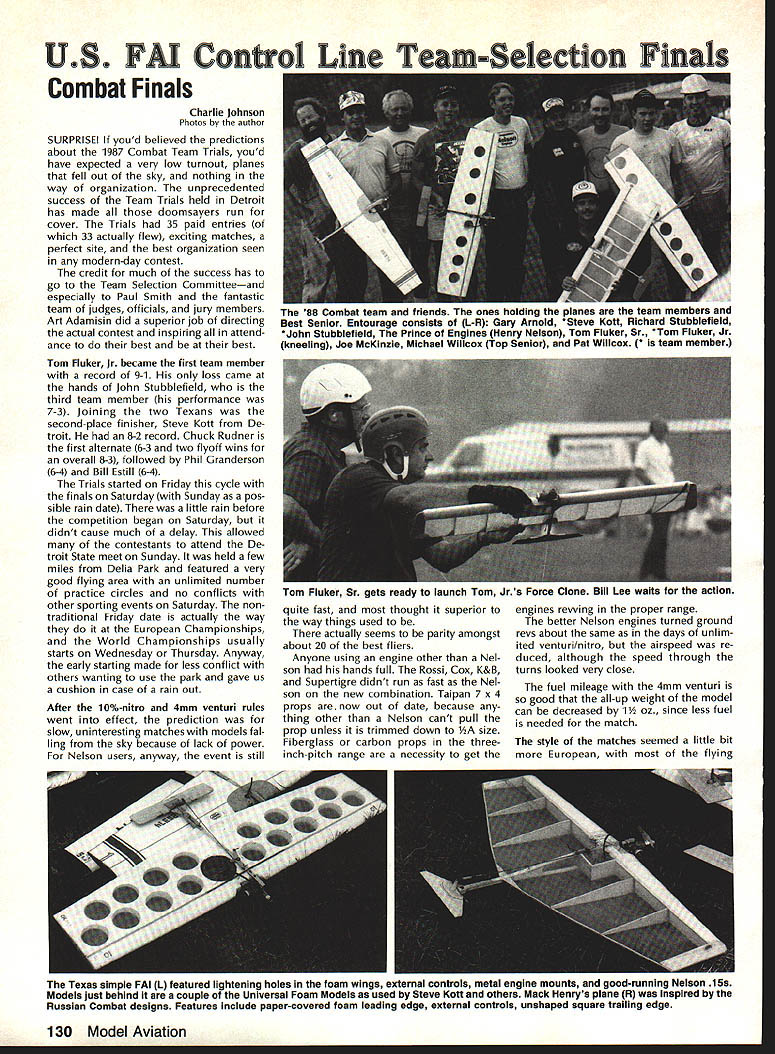
- Tom Fluker, Jr. led the team with a 9-1 record; his only loss was to John Stubblefield.
- John Stubblefield finished with a 7-3 record and notably flew perhaps the best match of his career.
- Steve Kott (Detroit) finished second with an 8-2 record.
- Chuck Rudner is first alternate (6-3 plus two flyoff wins for overall 8-3).
- Phil Granderson (6-4) and Bill Estill (6-4) rounded out the top finishers.
Event logistics:
- Trials began on Friday with finals on Saturday and Sunday as a rain date option. The schedule minimized conflicts and allowed contestants to attend the nearby Detroit State meet on Sunday.
- Despite rule changes (10%-nitro and 4mm venturi), the event remained fast and exciting—particularly for Nelson engine users.
- The 4mm venturi provided excellent fuel mileage, allowing a reduction in all-up weight by about 1½ oz.
Equipment and design trends:
- Nelson engines were dominant. Other engines (Rossi, Cox, K&B, Super Tigre) struggled to match the Nelson on the new restrictions.
- Propellers shifted toward fiberglass or carbon props in the three-inch-pitch range; Taipan 7x4 props became out of date unless trimmed.
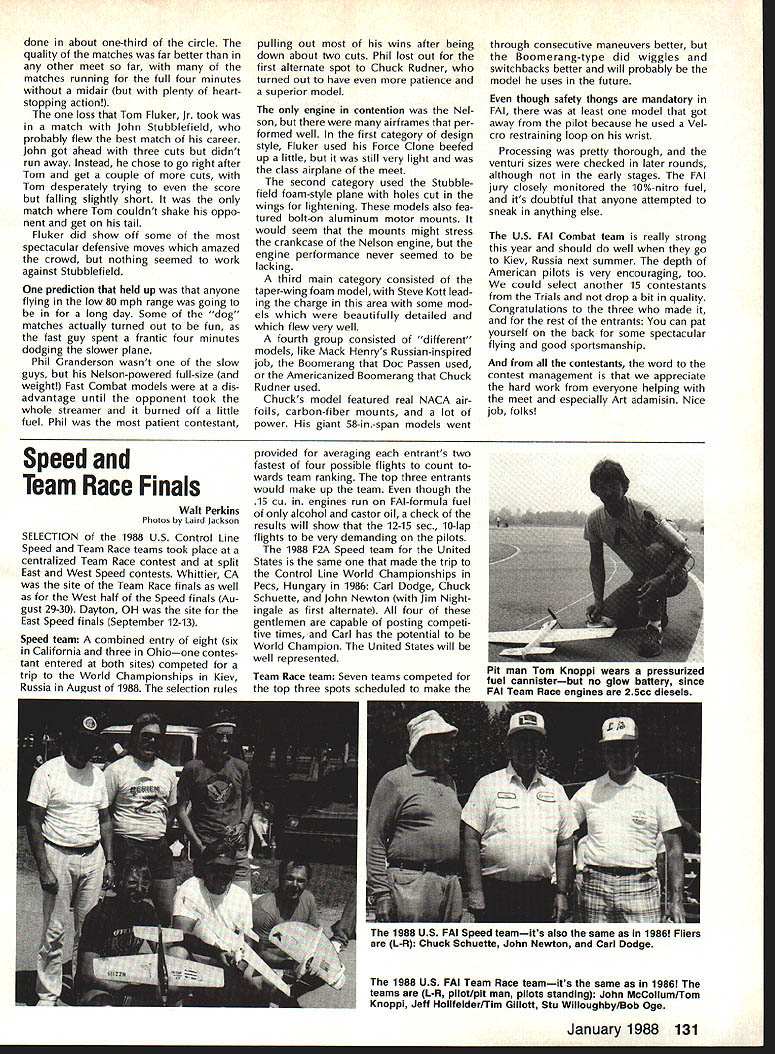
- Airframes showed parity: Fluker's beefed-up Force Clone (light but strong), Stubblefield's foam-style planes with lightening holes and bolt-on aluminum motor mounts, taper-wing foam models (Steve Kott), and unusual designs (Mack Henry's Russian-inspired, Doc Passen's Boomerang, Chuck Rudner's Americanized Boomerang).
- Chuck Rudner's large 58-in.-span models used NACA airfoils and carbon-fiber mounts; Boomerang-type models offered better wiggles and switchbacks.
Safety and processing:
- One model got away because the pilot used a Velcro wrist restraining loop.
- Processing was thorough; venturi sizes were checked in later rounds and the FAI jury closely monitored 10%-nitro fuel.
Outlook: The U.S. FAI Combat team is strong and should perform well at the World Championships in Kiev next summer. The depth of American pilots is encouraging—another 15 contestants could probably have been selected without dropping quality. Congratulations to the team members and thanks to the contest management, especially Art Adamisin.
---
Competition Newsletter
ACADEMY OF MODEL AERONAUTICS
#### RC Electric Team Finals Site Bid Request Clubs interested in hosting the 1988 team-selection finals for the U.S. RC Electric team are invited to submit a bid to host the finals scheduled for June 1988. Bids should be addressed to Micheline Madison, AMA Headquarters. Site selection will be made by the Team Selection Committee among bids received.
Club officers interested in submitting a bid may contact Committee Chairman Joe Beshar before submitting: 201-768-5500 (work) or 201-198-1261 (home). Bids mailed to AMA HQ must be postmarked no later than March 15, 1988.
#### Coordinating Sanctioned Events Clarification Problems have occurred when IMAA fly-ins (large RC models) are scheduled close to same-day contests featuring Event 514, RC Giant Scale. Since both event types attract the same participants, clubs and contest directors should use appropriate date/distance separation guidelines. See the "Protected Flying Area" recommendations in the Guidelines Contest Coordinators section of the AMA rule book.
#### Frequency Utilization Plan Clarification The June issue of Model Aviation contained conflicting information about new frequency-identification flags for RC transmitter antennas. Introductory comments indicated the new streamers and channel-number plaques were required at AMA-sanctioned events and recommended at club fields; the plan itself stated the flag system was recommended. The intent is that the flag plan is strongly recommended for sanctioned flying (both general sport and sanctioned events) to promote uniformity. Note from Technical Director W. Bob Underwood, CompuServe 76117167.
---
Letters and Commentary: Free Flight, RC-Assist, and Nats Site Concerns
(Responding to Mr. Wegener and others)
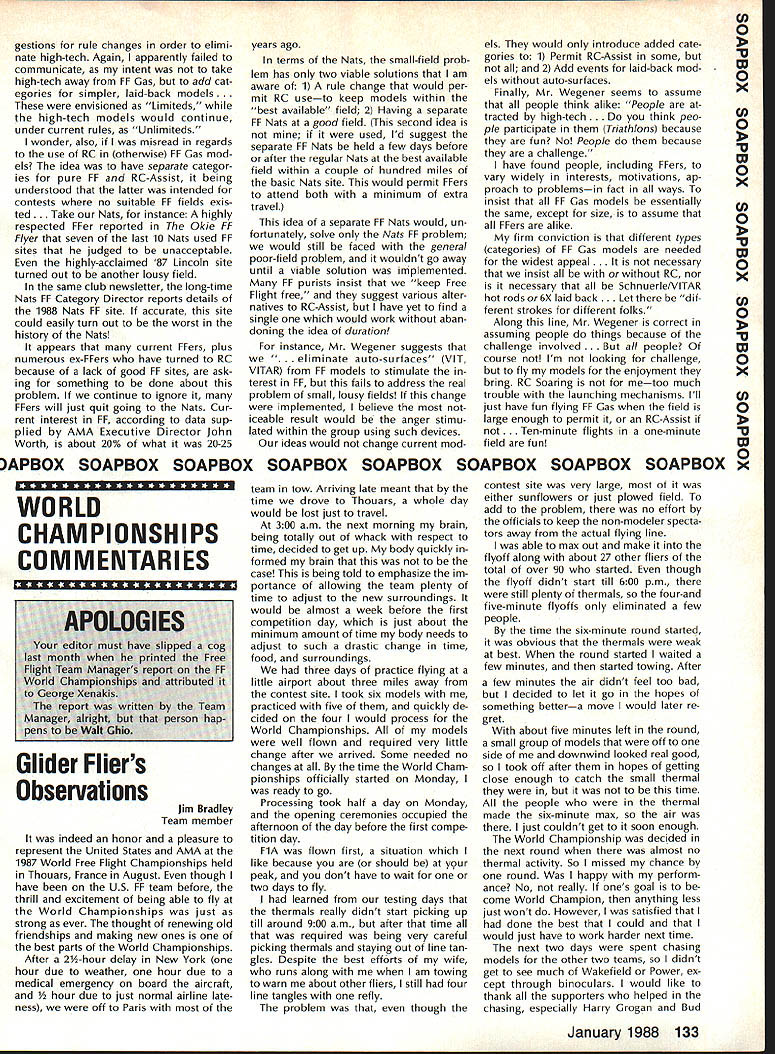
I apparently failed to communicate earlier; my intent was not to remove high-tech from Free Flight Gas (FF Gas) but to add categories for simpler, laid-back models. These were envisioned as "Limiteds," while high-tech models would continue as "Unlimiteds."
Regarding RC use in otherwise FF Gas models: the idea was to have separate categories for pure FF and RC-Assist. The latter was intended for contests where no suitable FF fields exist. Many competitors have been driven from FF to RC due to lack of good FF sites. For example, a respected FFer reported that seven of the last 10 Nats used FF sites he judged unacceptable; the 1987 Lincoln site also proved poor. If the situation continues, many FFers may quit attending the Nats. Current FF interest, according to AMA Executive Director John Worth, is about 20% of what it was 20 years ago.
For the Nats, the small-field problem has two viable solutions:
- A rule change permitting RC use to allow models to perform within the "best available" field; or
- A separate FF Nats held at a good field (a few days before or after the regular Nats at a nearby quality site), allowing FFers to attend both with minimal extra travel.
A separate FF Nats would only solve the Nats problem; it would not fix the broader poor-field issue for club contests and other events.
Some FF purists suggest alternatives (for example, eliminating auto-surfaces like VIT/VITAR) to stimulate FF interest, but that doesn't address the core small-field problem. Removing such devices would likely anger those who use them and would not attract those who quit due to poor fields.
Different types of FF Gas models and categories are needed to appeal to a wider range of participants. It's unnecessary to insist all models be the same, nor that all use RC or be high-tech hot rods. Let there be "different strokes for different folks." Some participants seek challenge; others seek simple enjoyment. For example, RC Soaring may be unappealing to some due to launch complexities, while they would enjoy FF Gas when fields permit or RC-Assist when they do not. Ten-minute flights in a one-minute field can still be fun.
LOOK — There's some important stuff — BIG CHANGE a-coming (summarized)
- Three books in 1988: Membership Manual (mailed to all), Competition Regulations (request via card and 22¢ stamp), International Aeromodeling Rules (obtain via Competition Regulations directions, HQ request, or $10 FAI stamp).
- Please request only what you need to help control printing/mailing costs.
- Contest Directors: be sure to request the Competition Regulations.
Transcribed from original scans by AI. Minor OCR errors may remain.

