
SCALE WORLD CHAMPIONSHIPS REPORTS
CN wishes to thank those of the U.S. RC and CL Scale World Championships Teams, the manager, and participating U.S. judges, who responded to our request for their own personal views of participating in the event — the highlights, the good times and, yes, the problems.
The reports which follow are recommended reading as is the comprehensive report by Bob and Dolly Wischer (Bob competed as the reigning World Champion, rather than as a member of the U.S. team), which begins on page 3 of this issue. Together, they form a unique picture of U.S. participation in the 1976 Scale World Championships.
SCALE WORLD CHAMPS
"Light—Night—Flight" Report by Hale Wallace U.S. Team Manager
What a fitting theme the above title made for the 1976 Scale World Championships held at Borlänge, Sweden, June 18-25, 1976. Our trip to Sweden will be long remembered, but more about that later.
My fourth Scale World Championships started on June 16th with a rather uneventful flight from Binghamton, NY, to Kennedy Airport via Command Airways Beech 99. I was able to walk over to the SAS terminal only to find it locked with not a person in sight!
About an hour after I arrived, the terminal was opened and shortly after that Bob and Dolly Wischer arrived. Soon after, the Underwoods, Roths, Gretzes and Burnstines arrived. Don McGovern, Flying Models, had arrived to assist with the parking of cars during the teams' absence.
The boxes were taken to the SAS Cargo Building and customs vouchers prepared to allow easy claiming upon return to the U.S. Returning to the terminal, we found the Saugers, which meant we had a complete team.
I made arrangements to start checking in the baggage and also arranged for a block of 18 seats. A few minutes before boarding, the Shebers arrived right on schedule.
The SAS flight left about an hour late, but overall the flight was excellent with only one period of minor turbulence. The meals were excellent and everyone enjoyed the 747 flight, which stopped in Copenhagen for an hour before proceeding to Stockholm.
Upon arrival in Stockholm, while waiting for customs processing, my name was paged on the PA system. Clearing customs, we were greeted by John Lyrsell, Coordinating Contest Director and former Swedish team member. John had found out that "Avis" had fouled up our Micro Bus rentals and had gone ahead and arranged a huge tour bus for us for the three-hour trip to Borlänge. This example of Swedish organizational efficiency was to be appreciated.
OUTDOOR RUBBER SCALE RULE BOOK ERROR
In a memo to the Scale Contest Board dated July 2, Chairman Claude McCullough indicated that he had included a mistake in his editing of copy for the 1976-77 rule book pertaining to total score in the Outdoor Rubber Scale category. Incorrectly shown was a new method for determining total score (5.07) as proposed in the last rules review cycle but actually defeated in the Scale Contest Board's Final Vote. Thus, this item of the rules should have continued without change from the 1974-75 rule book: 7. Total Score. The winner is determined by the total of Scale Fidelity, Workmanship and Flying scores. All are requested to make this correction in the 1976-77 rule books.
Scale Rules Interpretations
In response to questions which have been posed, the Scale Contest Board Chairman has issued interpretative responses which have been approved by the Scale Contest Board by the margins indicated.
- Peanut Scale Launching. Since no mention is made of the method of launching in the Peanut Scale rules, launching is optional within the Free Flight General regulations (5.3, 5.31, 5.32). Approved 10 to 0.
- Peanut Scale Covering. The score in 5.17.C can only be awarded to tissue-covered models. This does not include condenser paper. The score in 5.17.D can be awarded to models with surfaces that are double-covered with any material. (This includes tissue, condenser paper and microfilm.) Approved 10 to 0.
- CL Scale Electric Power. In line with a previous vote on allowing electric power for Scale models, a notation should have been included in the CL Scale rules (as it was in the CL Sport Scale rules) allowing use of electric motors of any size. Considering the circumstances of the original proposal, and recalling the discussion of the question with Scale Contest Board members at the time, my interpretation of the intent of the rule is that the batteries or electric power source for the motor must be contained in the model. Power for propulsion cannot, under the present rules, be transmitted over the control lines. Control signals only can be transmitted over the lines; the same qualifications also apply to CL Sport Scale. Approved 10 to 0.
Wallace Report (Cont.)
repeated again and again during the coming week!
We arrived at Dala Airport about 2 pm and unloaded the model boxes. We then proceeded to Borlange and checked into the Hotel Brage. Due to the jet time lag, we all took the opportunity to clean up and relax for the balance of the day.
Up bright and early on Friday, we took the city bus to the airport and spent the day unpacking and assembling the airplanes. The other teams began arriving, and old acquaintances were soon renewed. I continue to be convinced that if everyone in the world built model airplanes, there would be no wars!
The local Volvo dealer provided us with a bright orange Volvo station wagon to use for the week — which was another expression of the warm Swedish hospitality we continued to encounter.
Friday also gave the team and supporters their first experience at ordering from a Swedish menu. Cathy Burnstine had dreams of reindeer all week!
Saturday gave the U.S. team members their first opportunity to get all decked out in their beautiful white team shirts, again donated by Big Mfg. Co., and their navy blue Sears & Roebuck team slacks. Sure was a sharp looking team this year! The day was spent processing models and transmitters. The Swedes had come up with the most impressive weighing and measuring equipment I've ever seen, another example of superb organization. Photographs of each model on the scale, showing both the model and weight, were taken and filed. Got our laugh for the day when Steve Sauger came back to tell us he'd put gas in the Volvo — five liters! Needless to say, the tank was still empty!
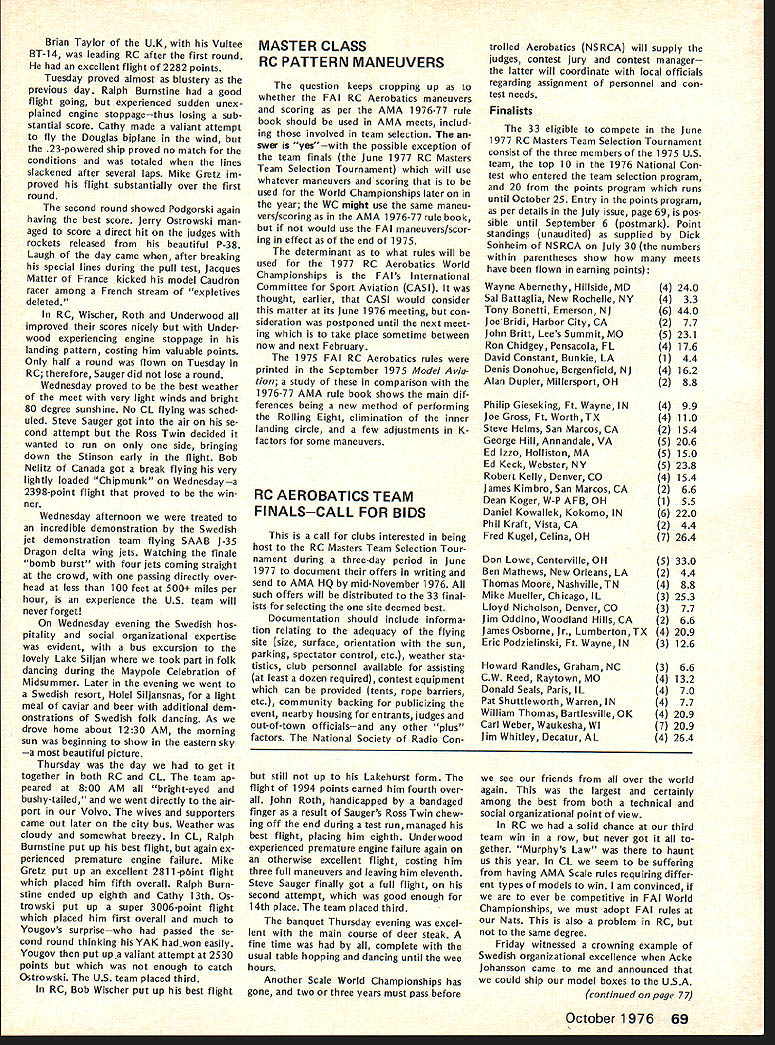
Static judging started on Saturday, and although the judges worked long hours on Saturday and Sunday, the last RC model was not finished until late Monday morning just prior to the official flying. A total of 14 were entered in Control Line Scale and 25 in Radio Control Scale.
In addition, there were 15 entrants in Stand-Off Scale and eight in Helicopter. These two events were being flown on a provisional basis, and no attempt will be made to cover them in this article as time did not allow close examination of the models or watching official flights. I did note a helicopter doing loops and rolls after official flying!
Each new championship has added something new and exciting to the Scale modeling world. This year it was the Soviets once again with a twin-ducted fan CL and a single-ducted fan RC! Both were superb models, and both flew in practice but were damaged and not flown in official competition. They wisely had not "officially" entered the CL model; therefore, they were still able to field a full team.
Competition Newsletter
What a fitting theme above the title made the 1976 Scale World Championships held Borlänge, Sweden, June 18-25, 1976. The trip to Sweden will be long remembered; more about that later. The fourth Scale World Championships started June 16th rather uneventfully. Flight from Binghamton, N.Y. to Kennedy Airport via Command Airways Beech 99. We were able to walk over to the SAS terminal and find it locked — no person in sight. About an hour after we arrived the terminal opened; shortly after Bob Wischer arrived. Soon after Underwood, Roth, Gretz and Burnstine arrived. Don McGovern (Flying Models) arrived.
Returning to the terminal, arrangements were made to start checking baggage; a block of 18 seats was arranged a few minutes before boarding. The SAS flight left about an hour late; overall the flight was excellent. The 747 stopped in Copenhagen about an hour before proceeding to Stockholm. Upon arrival in Stockholm we waited for customs processing while names were paged over the PA system. Clearing customs we were greeted by John Lyrsell, Coordinating Contest Director and former Swedish team member. John found that Avis had fouled up the microbus rentals and had gone ahead and arranged a huge tour bus for the three-hour trip to Borlänge — an example of Swedish organizational efficiency.
The banquet Thursday evening was excellent, with the main course of deer steak. A fine time was had by all, complete with the usual table hopping and dancing until the wee hours.
Another Scale World Championships has gone, and two or three years must pass before we see our friends from all over the world again. This was the largest and certainly among the best from both a technical and social-organizational point of view.
In RC we had a solid chance at our third team win in a row, but never got it all together. "Murphy's Law" was there to haunt us this year. In CL we see teams suffering from having AMA Scale rules requiring different types of models to win. I am convinced, if we are to be competitive in FAI World Championships, we must adopt FAI rules at our national meets. This is also a problem in RC, but not to the same degree.
Friday witnessed a crowning example of Swedish organizational excellence when Acke Johansson came to me and announced that we could ship our model boxes to the U.S.A.
(continued on page 77)
CL SCALE WORLD CHAMPS
Report by Mike Gretz U.S. Team Member, 5th Place
The just-completed Scale World Championships was the most spectacular and enjoyable model airplane contest that I have ever participated in. This being my second trip as a contestant, I was pleasantly surprised when the competitive and social aspects of this event proved to be even more enjoyable than before. This was in large part due to the organization and spirit of the Swedish people who were represented by their aeromodelling group, the SMFF. They did an incredible job of organizing this contest in a very short period of time. Their efforts, along with a beautiful contest site in the heart of Sweden, provided the participants with an experience that will be hard to forget. I think that the organization of this championships will be an example that other countries will be hard pressed to match in future years.
In CL Scale there were many experienced and familiar competitors with new airplanes and innovations that we hadn't seen before. Generally, I felt that the quality of the airplanes was slightly higher than what I had seen at the championships in Lakehurst. The winners always touch Polish and Russian teams keep pushing to more incredible levels of static perfection each year. Jerzy Ostrowski's P-38 and Viktor Yougov's Yak 18 (U.S.S.R.) were both outstanding and almost impossible to fault. Yougov's Yak at first glance appeared to be just another fine Russian Scale model, but close examination revealed some awesome features. Along with very complete and well-done details, he had under the cowl (which had operating shutters in front) a geared engine driving an adjustable (while running) pitch prop, and also a built-in recoil engine starter that was operated from the center of the circle. In static points these two models led the pack by a substantial margin, and gave the U.S.S.R. and Poland the top bids for the individual champion titles.
A quick survey of the rest of the CL models left me feeling that our team of Cathy Burnstine, Ralph Burnstine, and myself had a good chance of winning the team championship trophy. The static judging confirmed my hopes and suspicions, with our models being solidly grouped in the middle of the static bunch. Ralph's Boeing F4B-4 was 6th in static, my Zlin Akrobat was 7th, and Cathy's Douglas 025C was 10th. The point spread between most of the models was small enough that the flying portion of the contest would determine the final placings.
The only problems to develop during the flight portion of the championships stemmed from the fact that the CL and RC competitions were held at the same time at separate, distant locations. This made a ridiculous situation for some team managers who were often needed at both flying sites. Some of our equipment had to be run from one flying site to the other each day. Worst of all, this made it impossible for the contestants, press, and spectators to see all of the competition. I hope that this situation can be avoided in future Scale Championships as it was at both Cranfield and Lakehurst.
First Round Flying. It was cold (about 60 degrees) with a gusty, variable wind that often changed directions completely within a few seconds. A brief morning rain sent everyone running for the hangars at one point. The flying order was to be the same each day with Ralph up third, Cathy ninth, and myself 14th.
Ralph's Flight: He had to go up in extremely gusty wind—some of the worst of that day. Wasn't able to get in a full flight as his engine died when he throttled back for a touch-and-go. Both wings of the Boeing were cracked when it landed hard, dead-stick.
Cathy: Her Douglas was small and very light. She decided not to attempt a flight in this wind and wait for, hopefully, better conditions in the second round.
My Flight: I got a break in the wind at the end of the day but wasn't able to take advantage of it. My engine quit in high throttle, cutting the flight short.
Thus, the first round was discouraging due to the wind and our poor performance so far. But we weren't alone—a third of the total CL contestants failed to achieve a first round flight mainly because of the weather. Ralph had to work late into the night to patch the wings of the F4B-4. Little did we know that the worst of our bad luck was yet to come.
Second Round Flying. The wind was still gusty and even stronger than the day before, but it was partly sunny and a little warmer (almost 70 degrees).
Ralph: Put in a good flight, but it was disqualified when his drop tank, which wasn't a scheduled option, fell off in flight. Even though it landed smoothly, both wings of the F4B-4 were re-broken in the same spots as before. They had broken in flight.
Cathy: She felt that she had to attempt a flight in this round. We all knew that in the type of competition you should avoid having all of the hopes and pressures of the contest riding on your last flight attempt. And the way the wind had been previously, it did not seem likely that it would be any better the next day.
Immediately after takeoff it was obvious that the little Douglas was going to have serious trouble. When the plane came around in the wind, it would start to climb steeply then be buffeted as it passed high on the upwind side of the circle. For the first three laps, Cathy managed to keep the nose down into the wind, checking the steep climb. But on the fourth lap the wind blew the plane towards the center of the circle, slackening the outer lines. Cathy gamely tried to keep it airborne long enough to achieve a qualifying flight (10 laps), but each time the model came down the lines would slacken again. On the lap that the lines slacked hopelessly, the Douglas hit near the center of the circle.
My Turn: By this time, I had seen the planes destroyed by the gusty wind—earlier two of the French team entries had also been crashed. But I had flown my Zlin in strong winds before, had never had any trouble (due to its size and power), and honestly didn't expect to have any problems now. I was shocked when, taxiing around the circle before takeoff, when I lifted the outboard wing and pushed the Zlin up on its nose, stopping the engine. I quickly restarted the engine and attempted to take off. I foolishly lifted off on the upwind side of the circle, the Zlin banked towards me, the lines went slack, and I had to step back quickly to right the plane and regain control. Being aggravated with myself and the wind, I then proceeded to put in a lousy flight which was scored accordingly.
All in all, the second round was a disaster for our CL team. We had blown four of our nine flights and it was looking pretty bad for our hopes for the Team Championship.
Third Round Flying. This round proved anticlimactic after the first two. However, Ralph and I both knew that this was our last chance to improve our places in the standings. With the wind down somewhat, we both put in our best flights. Ralph doubled his previous best flight score and landed in 8th place overall. My flight was also greatly improved (3rd highest of the contest) and gave me 5th place.
Regardless of where you place in a Scale World Championship, the greatest pleasure usually comes from other aspects of the event. You get to see the style and innovations of the best Scale modelers in the world, and associate with their ingenious builders. I want to thank Hale Wallace, our team manager, for his capable guidance, and the AMA staff and membership for the support that they provided.
CL SCALE WORLD CHAMPS
Report by Ralph Burnstine U.S. Team Member, 8th Place
As before, the World Championships give us new ideas on competition that will help to see many innovations first-hand and also the style of the winning models.
After competing in two World Championships, I would like to see our team picked using FAI rules. This would enable us to work with these rules which would be a valuable experience. Maybe AMA Scale should become FAI Scale?
CL SCALE WORLD CHAMPS
Report by Cathy Burnstine U.S. Team Member, 13th Place
Being a first-time participant in the Scale World Championships, I left the U.S. knowing that I had a lot to learn, and I was certainly right. I knew I was going to be faced with competition of the highest quality and be involved with people who were experts and champions in the field. I can honestly say that I wasn't disappointed. Most of the models were outstanding, and the attitudes of all of the fliers were extremely commendable.
The meet ran smoothly thanks to the hard work and planning of the SMFF. The Swedish people have to be about the most hospitable I've ever met. They not only organized the meet, but arranged very nice hotel and meal accommodations, as well as planning tours of their country for team members and supporters.
I, as well as the rest of the team, would like to thank everyone who contributed to the FAI Team Fund. These World Championships were an experience that I will never forget.
CL SCALE WORLD CHAMPS
Report by Andy Sheber CL Judge, Livonia, Mich.
It would be impossible to describe the 1976 Scale World Championships in just a few paragraphs. I'll try to cover the highlights as seen from my point of view.
The SMFF did a superb job of setting up the contest site and all the facilities. It was a tight schedule during the day with the evenings spent relaxing on sightseeing tours through the countryside. To start with, the championships were held at Dala Airport, which turned out to be a great flying site with static displays set up on tables in a hangar allowing the public to meet the contestants and see their planes.
The static judging was held in another hangar away from public view. There was ample parking for the public, and bus transportation to and from Hotel Brage, where the contestants stayed in Borlänge, was only 15 minutes away. The events taking place were handled on a PA system in several languages, along with background music. A newsletter published each day kept everyone informed of the day's events and provided each day's scores.
Had the weather been nicer when competition flying started, it would have even been better for the contestants. As it turned out, the first and second rounds for the Control Line flying were a real challenge. Heavy, fast-flying models had the advantage.
Overall, the skill and workmanship of the models was outstanding and difficult to judge. Many planes had retracting landing gears, working flaps, rocket launchers, bomb drops, and one starter charged the engine from the control handle.
To sum it all up, it was a great contest which meant meeting and making friends, working hard, trying your best, helping each other out, enjoying it, and looking forward to the next time. (Skol!)
UNDERWOOD (Cont.)
I wish I could have had the "Bonzo" I built for the Championships but crashed right before Easter.
Perhaps with those wishes and the others that each of our team members could make, the trophies would once again be with us in the United States. But that was not to be.
During those hectic times before the competition, I often sat exhausted in my cluttered workshop and wondered, "Why am I doing this?" Having done it, now I know. In many ways, I have broadened my understandings of people through the contacts I have enjoyed. This is multiplied by four in my case since my wife and two daughters went along. My wallet is filled with cards and scraps of paper containing names and addresses of persons I enjoyed being with, if even for so short a period.
A closing thought would be that I found some solace in the fact that at least one other modeler in the world tends to pick unlikely (or ugly) models. My daughters were the first to note that often as the spectators passed by our table, they would point to the "Bonzo" and laugh. It seems a pity that they could not appreciate the more esthetic things of life. However, one of the French team shared my interest in the Golden Thirties and produced a big, blue Caudron racer in Control Line. While we could not converse, it was a great joy when she suggested we put them together outside the hangar for photographs.
Unfortunately, his model was reduced to blue dust after (1) he drop-kicked the wing when they broke his lines on pull test and (2) he proved that if you hit the ground on the downwind side of the circle every lap for seven laps, there won't be much left!
To Bob Wischer and the AMX, thank you for the opportunity to compete in the championships. To the winners and the Swedish hosts, a toast of "well done!"
Quietly, to myself—I've got to get ready for the next one!
Competition Newsletter
CN wishes to thank the U.S. RC Scale World Championships teams, managers and participating U.S. judges who responded to its request for their personal views on participating in the event — the highlights, good times and, yes, problems. Reports follow and are recommended reading. A comprehensive report by Bob "Dolly" Wischer, who competed as the reigning World Champion rather than as a member of the U.S. team, begins on page 3 of this issue. Together they form a unique picture of U.S. participation in the 1976 Scale World Championships.
SCALE WORLD CHAMPS — Light Night Flight Report: Hale Wallace, U.S. Team Manager
What a fitting theme above the title made the 1976 Scale World Championships held Borlänge, Sweden, June 18-25, 1976. The trip to Sweden will be long remembered — more about that later. The fourth Scale World Championships started June 16th with a rather uneventful flight from Binghamton, NY to Kennedy Airport via Command Airways Beech 99. We were able to walk over to the SAS terminal but found it locked, no person in sight. About an hour after we arrived the terminal opened; shortly after Bob "Dolly" Wischer arrived. Soon after, Underwood, Roth, Gretz, Burnstine arrived. Don McGovern of Flying Models arrived.
Sauger then completed the team. Arrangements were made to start checking baggage and a block of 18 seats was reserved a few minutes before boarding. Sheb[e]rs arrived right on schedule. The SAS flight left about an hour late; overall flight excellent. The 747 stopped at Copenhagen an hour before proceeding to Stockholm. Upon arrival in Stockholm, we waited through customs processing and were paged over the PA system. Clearing customs we were greeted by John Lyrsell, Coordinating Contest Director and former Swedish team member. John found that Avis had fouled up the micro-bus rentals, so he arranged a huge tour bus. The three-hour trip to Borlänge was an example of Swedish organizational efficiency.
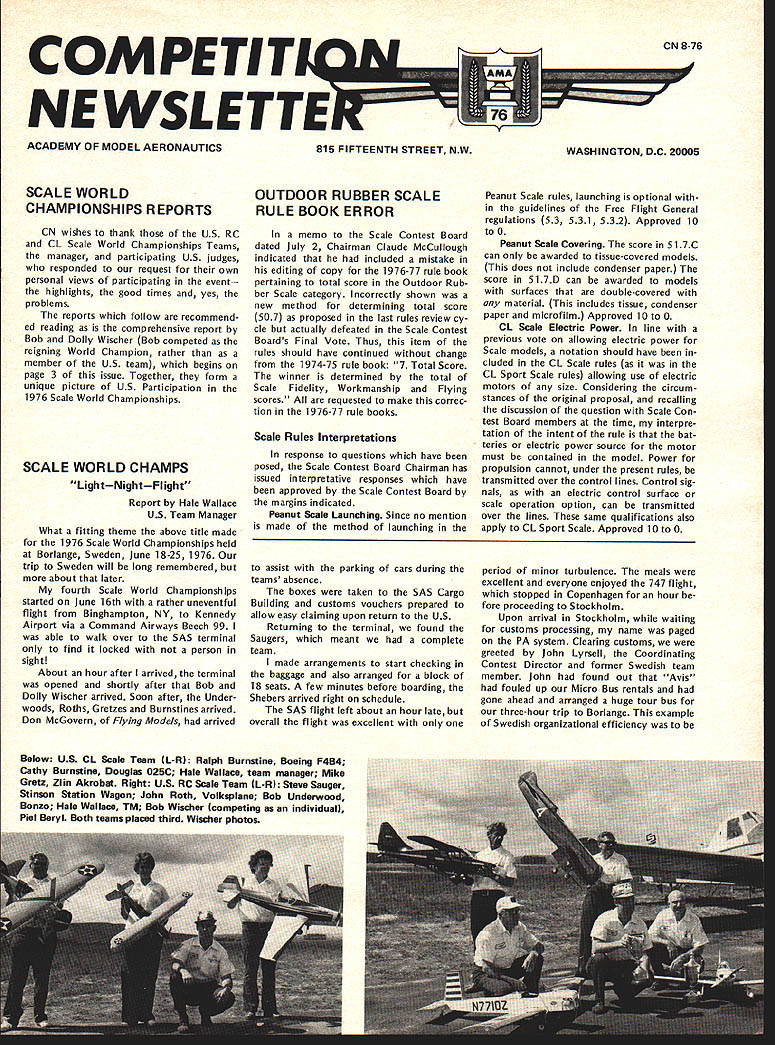
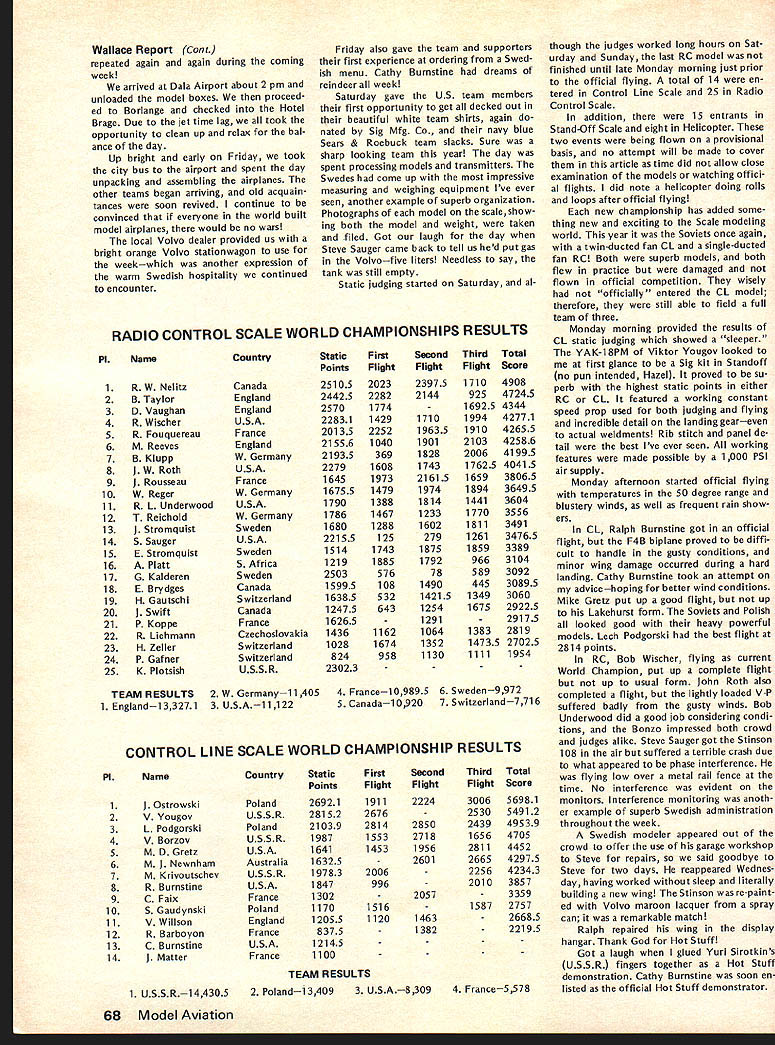
Below: U.S. CL Scale Team (L–R) Ralph Burnstine, Boeing F4B4; Cathy Burnstine, Douglas D-558C; Hale Wallace, team manager; Mike Gretz, Zlin Akrobat. Right: U.S. RC Scale Team (L–R) Steve Sauger, Stinson Station Wagon; John Roth, Volkaplane; Bob Underwood, Bonzo; Hale Wallace TM; Bob Wischer, competing individual, Piel Beryl.
Both teams placed third.
Transcribed from original scans by AI. Minor OCR errors may remain.

