
Competition Newsletter
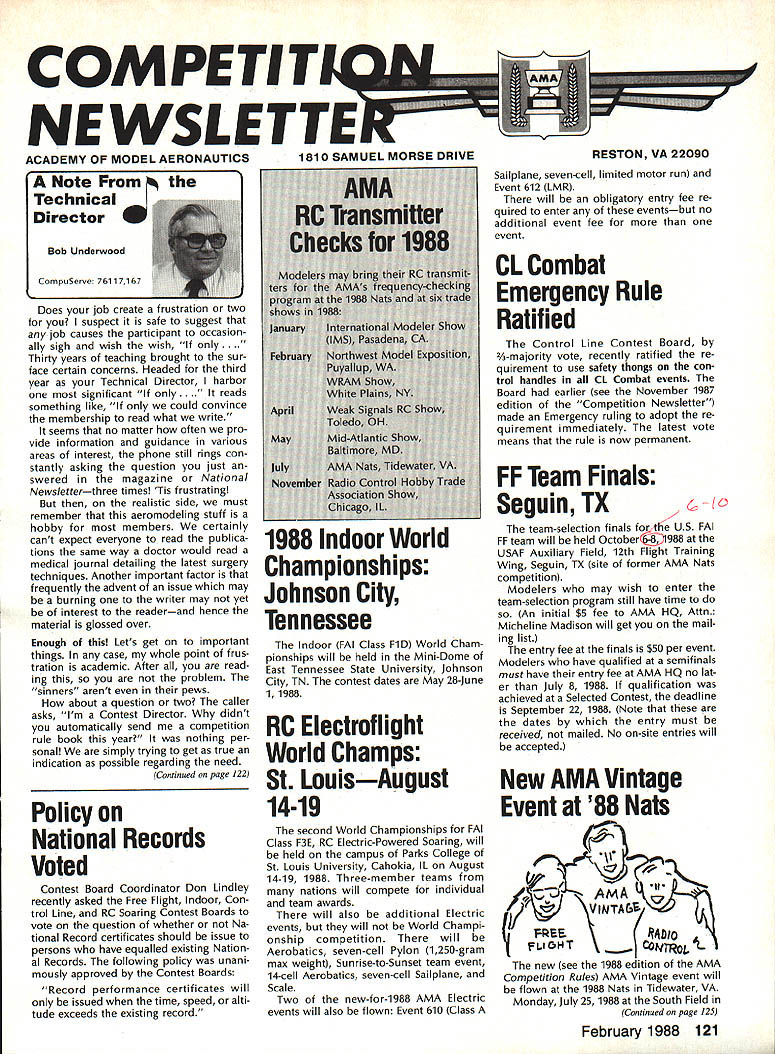
A Note From the Technical Director
Bob Underwood CompuServe: 76117,167
Does our job create a frustration or two for you? I suspect it is safe to suggest that any job causes the participant to occasionally sigh and wish, "If only ..." Thirty years of teaching brought to the surface certain concerns. Headed for the third year as your Technical Director, I harbor one most significant "If only ..." It reads something like, "If only we could convince the membership to read what we write."
It seems that no matter how often we provide information and guidance in various areas of interest, the phone still rings constantly asking the question you just answered in the magazine or National Newsletter—three times! 'Tis frustrating! But then, on the realistic side, we must remember that this aeromodeling stuff is a hobby for most members. We certainly can't expect everyone to read the publications the same way a doctor would read a medical journal detailing the latest surgery techniques. Another important factor is that frequently the advent of an issue may be burning to the writer and may not yet be of interest to the reader—and hence the material is glossed over.
Enough of this! Let's get on to important things. In any case, my whole point of frustration is academic. After all, you are reading this, so you are not the problem. The "sinners" aren't even in their pews.
How about a question or two? The caller asks, "I'm a Contest Director. Why didn't you automatically send me a competition rule book this year?" It was nothing personal! We are simply trying to get as true an indication as possible regarding the need.
Technical Director (continued)
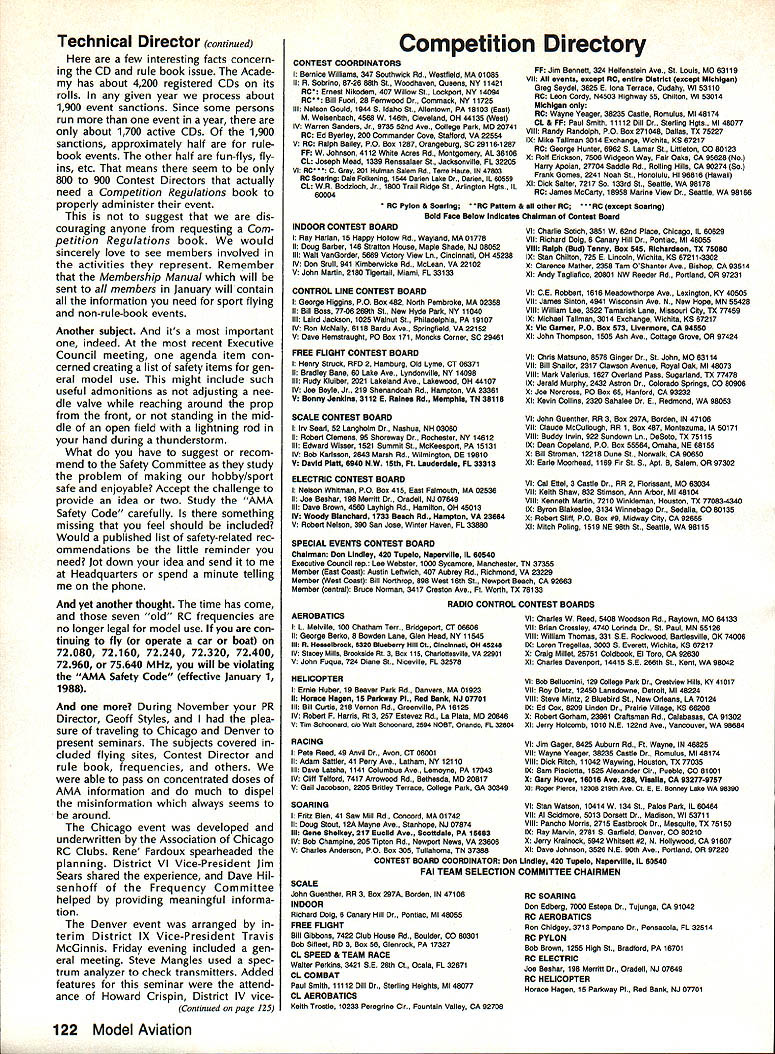
Here are a few interesting facts concerning the CD and rule book issue. The Academy has about 4,200 registered Contest Directors on its rolls. In any given year we process about 1,900 event sanction notices. Since some persons run more than one event in a year, there are only about 1,700 active Contest Directors. Of the 1,900 sanctions, approximately half are for rule-book events. The other half are fun-flys, fly‑ins, etc. That means there seem to be only about 800 to 900 Contest Directors that actually need a Competition Regulations book to properly administer their event.
This is not to suggest that we are discouraging anyone from requesting a Competition Regulations book. We would sincerely love to see members involved in the activities they represent. Remember that the Membership Manual, which will be sent to all members in January, will contain all the information you need for sport flying and non‑rule‑book events.
Another subject, and it's a most important one indeed: at the most recent Executive Council meeting, one agenda item concerned creating a list of safety items for general model use. This might include such useful admonitions as not adjusting a needle valve while reaching around the prop from the front, or not standing in the middle of an open field with a lightning rod in your hand.
And yet another thought: the time has come, and those seven "old" RC frequencies are no longer legal for model use. If you are continuing to fly or operate a car or boat on any of the following frequencies, you will be violating the AMA Safety Code (effective January 1, 1988):
- 72.080 MHz
- 72.160 MHz
- 72.240 MHz
- 72.320 MHz
- 72.400 MHz
- 72.640 MHz
- 72.960 MHz
During November your PR Director, Geoff Styles, and I had the pleasure of traveling to Chicago and Denver to present seminars. The subjects covered included flying sites, Contest Director and rule book, frequencies, and others. We were able to pass on concentrated doses of AMA information and do much to dispel the misinformation which always seems to be around.
- Chicago event: developed and underwritten by the Association of Chicago RC Clubs. District IV Vice‑President Jim Sears shared the experience, and Dave Hillenhoff of the Frequency Committee helped by providing meaningful information.
- Denver event: arranged by interim District IX Vice‑President Travis McGinnis. Friday evening included a general meeting. Steve Manglos used a spectrum analyzer to check transmitters. Added features for this seminar were the attendance of Howard Crispin (District IV vice‑president) and Don Lowe (AMA president), who presented many general items. These programs are very valuable to the membership—be certain to avail yourself of the presentations should they materialize in your area.
And now, the last (I promise): the Academy will be working with the Experimental Aircraft Association (EAA) as they present a weekend Air Academy experience for 13- to 17‑year‑old young people. This is a hands-on building experience with models as well as full-scale, combined with motivational material, theory, and aviation history.
The pilot programs for 1988 will utilize personnel from EAA chapters and AMA clubs in four cities. Clubs in the following locations will be contacted to see if they can provide help for the 2½‑day programs:
- Washington, DC
- Indianapolis, IN
- Tulsa, OK
- Minneapolis–St. Paul, MN
This should prove to be an exciting, useful experience for students and instructors alike.
Transcribed from original scans by AI. Minor OCR errors may remain.

