
AMA Competition Rules: A New Cycle of Revisions Starts Now
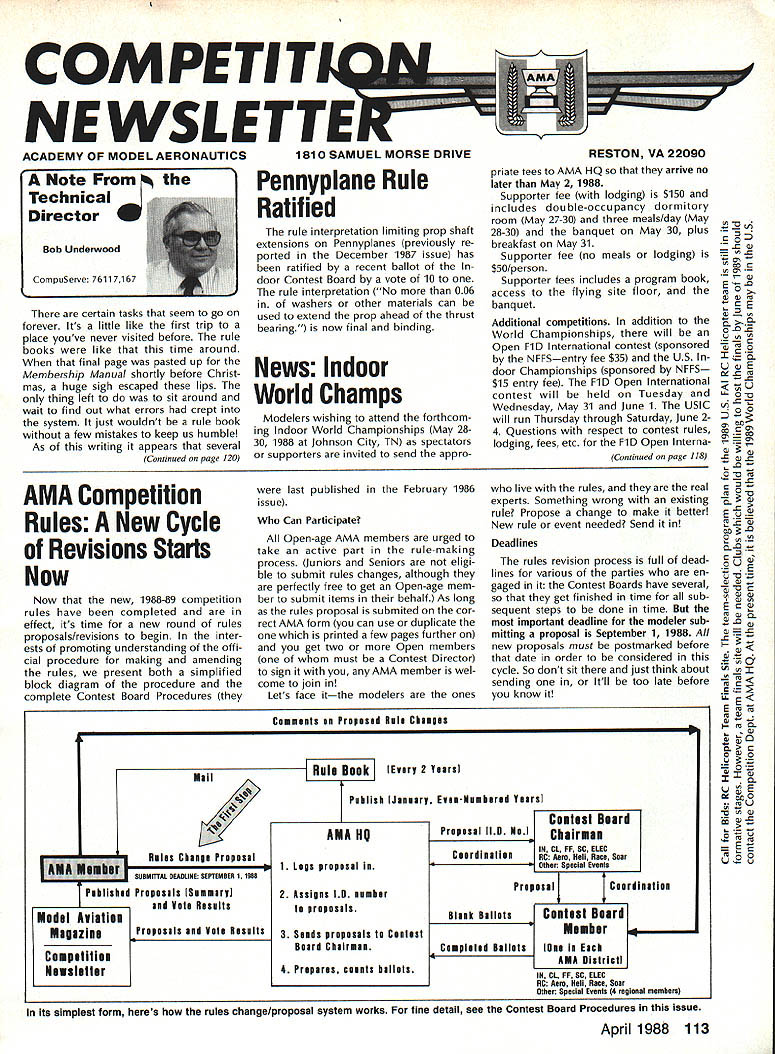
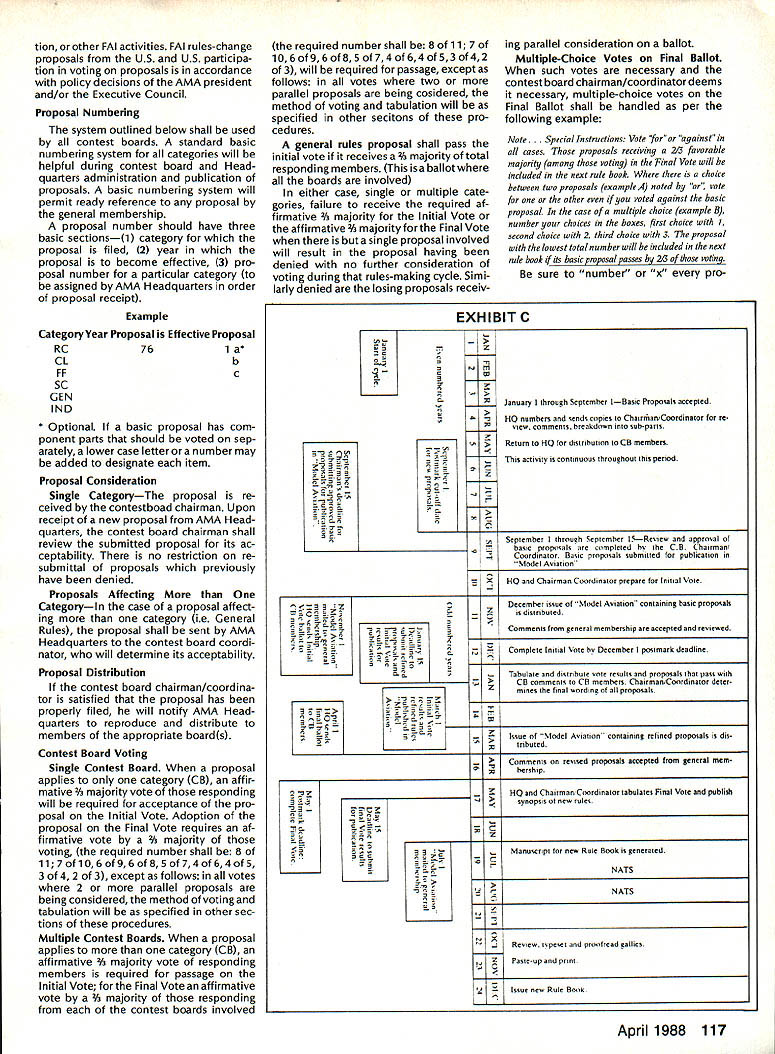
Now that the new 1988–89 competition rules are in effect, a new round of rules proposals and revisions begins. To promote understanding of the official procedure for making and amending the rules, this issue presents a simplified summary of the procedure and the complete Contest Board Procedures.
If something is wrong with an existing rule, propose a change to make it better. If a new rule or event is needed, send it in.
Who Can Participate?
- Any adult (Open-age) AMA member may submit a basic rules-change proposal.
- Juniors and Seniors are not eligible to submit basic proposals directly but may have an Open-age member submit on their behalf.
- Proposals must be submitted on the correct AMA form and must be signed by two or more Open-age members, one of whom must be a Contest Director.
- Photocopies of the proposal form are acceptable; additional forms may be requested from AMA Headquarters (include a stamped, self-addressed envelope).
Deadlines
- The two-year cycle for considering competition rules changes began January 1, 1988; the effective date for changes is January 1, 1990.
- MAIL RULE CHANGE PROPOSALS — SUBMITTAL DEADLINE: postmarked by SEPTEMBER 1, 1988.
- Published proposals (summary) and vote results will appear in Model Aviation magazine. Rule book revisions are on a biennial schedule (published January of even-numbered years).
Simplified Procedure Summary
- Submit a properly completed RULES CHANGE PROPOSAL FORM to AMA Headquarters by the postmark deadline.
- Headquarters reviews the submission for form and completeness.
- Acceptable proposals are distributed to the appropriate contest board(s).
- Contest boards analyze and vote on proposals (Initial and Final Votes).
- Proposals passing all required votes are included in the next Rule Book.
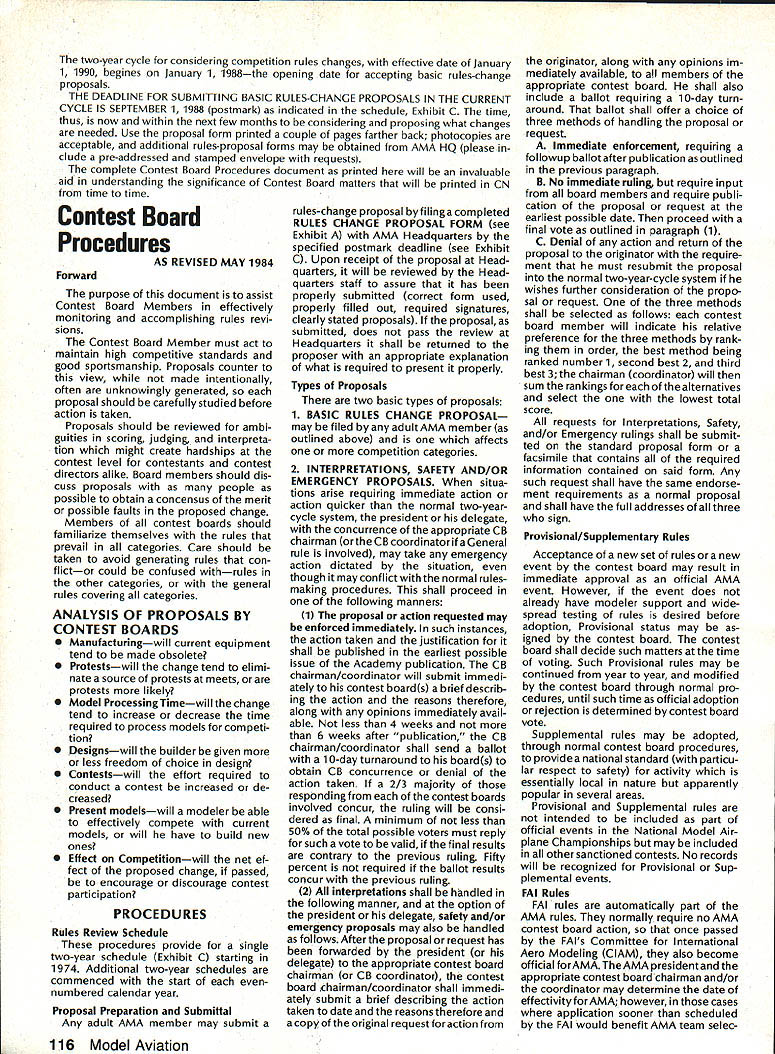
Contest Board Procedures
AS REVISED MAY 1984
Foreword
The purpose of these procedures is to assist Contest Board members in effectively monitoring and accomplishing rules revisions. Board members must act to maintain high competitive standards and good sportsmanship. Proposals should be carefully reviewed for ambiguities in scoring, judging, and interpretation, and for conflicts with rules in other categories or with general rules.
Analysis of Proposals by Contest Boards
Board members should consider the following when analyzing proposals:
- Manufacturing — Will current equipment tend to become obsolete?
- Protests — Will the change reduce or increase sources of protests?
- Model Processing Time — Will model processing time for competition increase or decrease?
- Design Freedom — Will the builder have more or less freedom of choice?
- Contest Effort — Will conducting contests become easier or harder?
- Present Models — Can current models remain competitive, or will new ones be required?
- Effect on Competition — Will the change encourage or discourage participation?
Procedures
#### Rules Review Schedule
- These procedures provide for a single two-year schedule (see Exhibit C). Additional two-year schedules commence with the start of each even-numbered calendar year.
#### Proposal Preparation and Submittal
- Any adult AMA member may submit a rules-change proposal by filing a completed RULES CHANGE PROPOSAL FORM (Exhibit A) with AMA Headquarters by the specified postmark deadline.
- Headquarters reviews submissions for correct form, required signatures, and clarity. Incorrectly submitted proposals are returned with instructions for proper resubmission.
#### Types of Proposals
- BASIC RULES CHANGE PROPOSAL
- May be filed by any adult AMA member and affects one or more competition categories.
- INTERPRETATIONS, SAFETY, AND/OR EMERGENCY PROPOSALS
- When immediate action is required, the president or delegate, with concurrence of the appropriate contest board chairman (or the contest board coordinator for General rules), may take emergency action. Emergency actions proceed in one of two manners:
(1) Immediate Referral and Ballot
- The action taken and justification are published in the earliest possible Academy publication.
- The contest board chairman/coordinator submits a brief and any opinions to the appropriate contest board(s).
- Between 4 and 6 weeks after publication, a ballot with a 10-day turnaround is sent to obtain contest board concurrence or denial.
- A 2/3 majority of responding members from each contest board involved is required for concurrence. A minimum of 50% of the total possible voters must reply for the vote to be valid if the final results are contrary to the previous ruling. Fifty percent is not required if the ballot concurs with the previous ruling.
(2) Immediate Submission with Three-Option Ballot
- The contest board chairman/coordinator sends each member a brief, the original request, and a ballot with a 10-day turnaround offering three handling options:
A. Immediate enforcement with followup publication. B. No immediate ruling; require input from all board members and publication prior to final vote as in (1). C. Denial and return to originator; resubmission into the normal two-year cycle required for further consideration.
- Each contest board member ranks the three alternatives (1 = best, 3 = worst). The chairman/coordinator sums rankings and selects the alternative with the lowest total.
- All Interpretations, Safety, and Emergency requests must be submitted on the standard proposal form or a facsimile containing all required information and the requester's name and addresses of signers.
#### Provisional/Supplementary Rules
- Acceptance of a new rule may result in immediate approval as an official AMA event. If support is inadequate, the contest board may place it on provisional status for field testing before final action.
- Provisional and supplemental rules may be continued year-to-year and modified by contest board votes until final adoption or rejection.
#### FAI Rules
- FAI rules (CIAM) are automatically part of AMA rules; once passed by FAI, they become effective for AMA.
- The AMA president and appropriate contest board chairmen/coordinator may take temporary action to amend or modify FAI rules for AMA use when immediate action is necessary.
Proposal Numbering
- A proposal number should have three sections:
- Category for which the proposal is filed.
- Year in which the proposal is to become effective.
- Proposal number for that category (assigned by AMA Headquarters in order of receipt).
Example:
- RC — 76 — 1a*
- CL — 76 — 1b
- FF — 76 — 1c
- SC — 76 — 1d
- GEN — 76 — 1e
- IND — 76 — 1f
* Optional: lower case letter or number may designate component parts to be voted on separately.
Proposal Consideration
- Single Category — Upon receipt, the contest board chairman reviews the proposal for acceptability. Proposals previously denied may be resubmitted with no restriction.
- Proposals Affecting More than One Category — Headquarters sends the proposal to the contest board coordinator, who determines acceptability.
Proposal Distribution
- If the contest board chairman/coordinator deems the proposal properly filed, he notifies AMA Headquarters to reproduce and distribute it to members of the appropriate board(s).
Contest Board Voting
- Single Contest Board
- Initial Vote: Affirmative 2/3 majority of those responding required for acceptance.
- Final Vote: Affirmative 3/4 majority of those voting required for adoption (examples of required counts provided for small boards).
- Multiple Contest Boards (proposals affecting more than one category)
- Initial Vote: Affirmative 2/3 majority of responding members required.
- Final Vote: Affirmative 3/4 majority of responding members from each contest board involved required.
- General Rules Proposal
- Passes Initial Vote if it receives a 2/3 majority of total responding members (ballot involving all boards).
- Failure to receive required majorities on Initial or Final Vote results in denial for the current rules-making cycle. Parallel losing proposals are also denied.
Multiple-Choice Votes on Final Ballot
- Special instructions: Vote "for" or "against" in all cases.
- Proposals receiving a 2/3 favorable majority in the Final Vote will be included in the next Rule Book.
- When there is a choice between parallel proposals:
- Example A: choose between two alternative scoring systems.
- Example B: rank multiple alternatives; the proposal with the highest number of first-choice votes (converted to ranking totals) and the lowest total ranking number will be included if the basic proposal passes by 2/3.
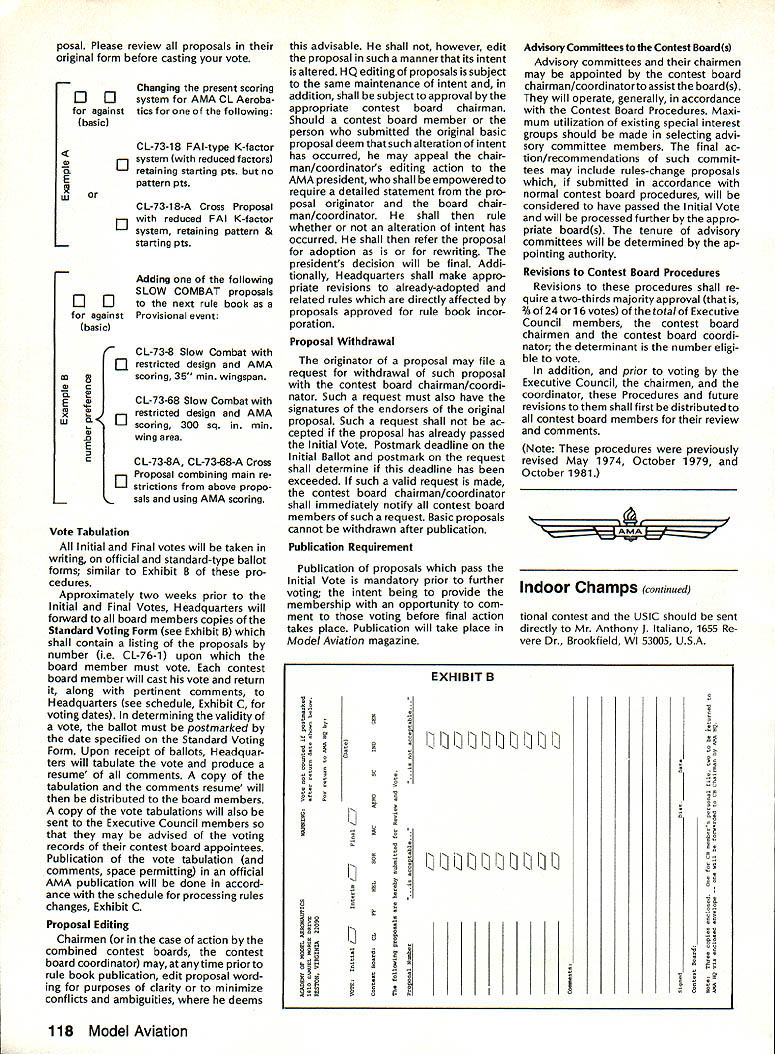
Example A — change CL Aerobatics scoring to one of the following:
- CL-73-18 FAI-type K-factor system (with reduced factors), retaining starting points but no pattern points.
- CL-73-18-A cross proposal with reduced FAI K-factor system, retaining pattern and starting points.
Example B — add one of the following SLOW COMBAT proposals as a provisional event:
- CL-73-6 Slow Combat with restricted design and AMA scoring, 35" minimum wingspan.
- CL-73-68 Slow Combat with restricted design and AMA scoring, 300 sq. in. minimum wing area.
- CL-73-8A / CL-73-68-A cross proposal combining main restrictions from above and using AMA scoring.
- Voters should mark every proposal considered for partial consideration on a ballot and review original proposals before voting.
Vote Tabulation
- All Initial and Final votes shall be taken in writing on official ballot forms (similar to Exhibit B).
- Approximately two weeks prior to voting dates, Headquarters forwards the Standard Voting Form listing proposals by number for board members to vote on.
- Ballots must be postmarked by the date specified on the voting form to be valid.
- Headquarters tabulates votes, produces a resume of comments, and distributes tabulation and comments to board members and to Executive Council members.
- Publication of vote tabulations (space permitting) follows the schedule in Exhibit C.
Proposal Editing
- Chairmen or the contest board coordinator may edit proposal wording prior to rule book publication for clarity or to minimize conflicts or ambiguities, without altering intent.
- Headquarters editing is subject to approval by the appropriate contest board chairman.
- If a contest board member or the originator believes intent has been altered, they may appeal to the AMA president, who may require statements and then rule on whether an alteration of intent occurred; the president's decision is final.
- Headquarters shall also revise related adopted rules affected by approved proposals.
Proposal Withdrawal
- The originator may request withdrawal of a proposal by filing a request with the contest board chairman/coordinator, including signatures of the original endorsers.
- A proposal may not be withdrawn after it has passed the Initial Vote. Postmark deadlines determine validity of withdrawal requests.
- Basic proposals cannot be withdrawn after publication.
Publication Requirement
- Publication of proposals that pass the Initial Vote is mandatory prior to further voting to provide membership opportunity for comment.
- Publication will take place in Model Aviation magazine.
Advisory Committees to the Contest Boards
- Contest board chairmen/coordinator may appoint advisory committees and chairmen to assist the board(s); they generally operate under Contest Board Procedures.
- Existing special interest groups should be utilized when selecting advisory committee members.
- Advisory committees may submit rules-change proposals; if submitted in accordance with normal procedures, such proposals will be considered to have passed the Initial Vote.
- Tenure of advisory committee members is determined by the appointing authority.
Revisions to Contest Board Procedures
- Revisions require two-thirds majority approval of the total of Executive Council members, contest board chairmen, and the contest board coordinator (16 of 24 votes, if 24 eligible).
- Prior to such voting, the procedures and proposed revisions shall be distributed to contest board members for review and comment.
(Note: previous revisions occurred May 1974, October 1979, and October 1981.)
Technical Director (continued)
Several significant editing problems occurred in the last cycle, primarily in Scale and Indoor, and a minor one in RC Pattern. As these items are resolved by the Contest Board chairpersons, corrections will appear in this publication.
The final part of the process occurs after the last vote, when Contest Board chairpersons assemble the material into its final book form. The material is then input into the computer at Headquarters, proofed, and typeset. Improvements in handling text electronically should reduce last-minute errors.
If you ordered the AMA Competition Regulations or the International Aeromodelling Rules (FAI), you should have received them by now. As of the end of January, nearly 6,000 copies of the Competition Regulations had been mailed. The Membership Manual was mailed in mid-January; it contains sanction and related information needed for clubs that run occasional fun-flies or mail shows.
Contest Directors
- The Contest Director (CD) application and quiz process has been informative. The quiz was designed to challenge applicants and refresh knowledge of sanctioned events; to date, every applicant has met the required 85% passing score, with most scoring 100%.
- New CDs have a probationary first year. The earned (free) membership awarded to a CD for running sanctioned events is granted only after the second year of CD activity. For example, a new CD sanctioning events in 1988 and 1989 would receive an earned membership for 1990.
- During the probationary year, elements monitored include proper submission of forms and records, attention to detail, confirming participants' AMA membership, and forwarding membership applications and funds to AMA Headquarters. Failure to forward forms and monies is a common problem.
- Some suggest that clubs should pay the $20 transfer fee required to become a new CD, since prospective CDs provide a service to the club. Clubs sometimes reimburse extra active CD workers who are not otherwise eligible for earned membership.
Frequency Control — A Club Idea
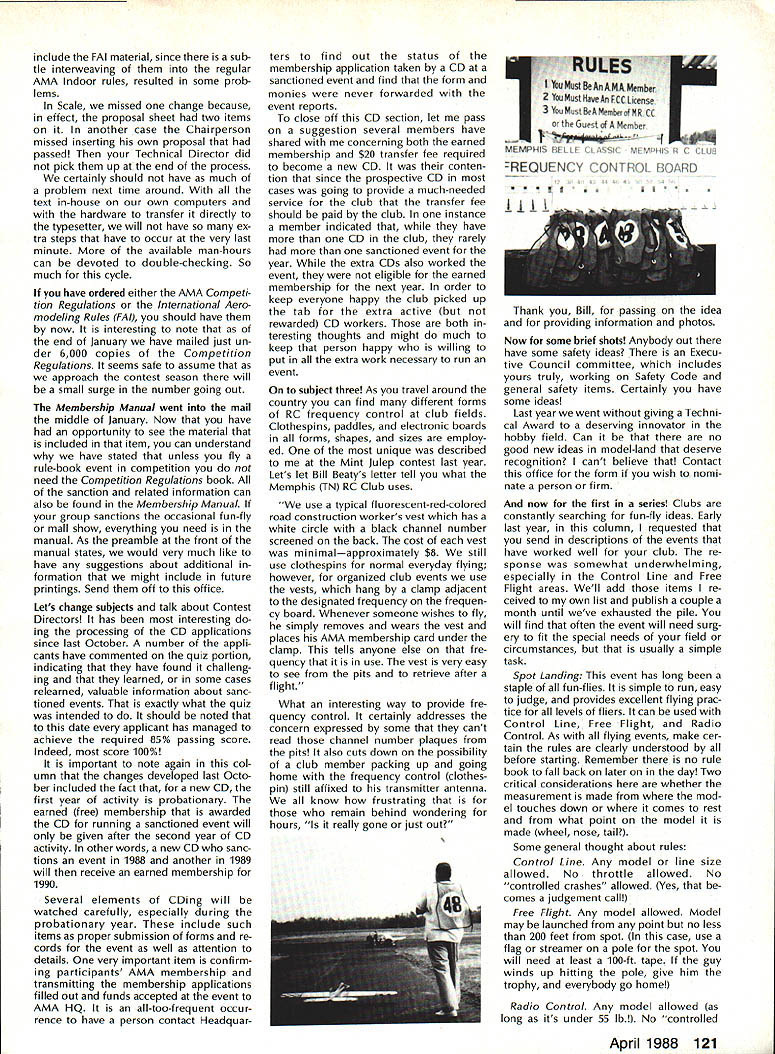
- Many clubs use clothespins, paddles, or electronic boards for RC frequency control. One unique method used by the Memphis (TN) RC Club:
- Use a fluorescent red road worker's vest with a white circle and a black channel number on the back (cost about $8).
- For organized events, vests hang by a clamp adjacent to the designated frequency on the frequency board. A flyer removes and wears the vest and places his AMA membership card under the clamp to indicate frequency use.
- The vest is easy to see from the pits and reduces the chance of someone leaving with a clothespin on their transmitter.
Safety and Awards
- The Executive Council has a committee working on the Safety Code and general safety items. Suggestions are welcome.
- The Technical Award for innovation was not given last year; nominations for deserving innovators are solicited.
Competition Newsletter — Fun-Fly Ideas
Clubs constantly look for fun-fly ideas. A series of simple events will be published; below are two common ones.
Spot Landing
- A classic fun-fly event, easy to run and judge; suitable for Control Line, Free Flight, and Radio Control.
- Clarify rules before starting. Critical considerations:
- Measure from where the model touches down or where it comes to rest.
- Specify the model point used for measurement (wheel, nose, tail).
General rules suggestions:
- Control Line: any model or line size allowed; no throttle allowed; no "controlled crashes."
- Free Flight: any model allowed; model launch no less than 200 feet from the spot. Use a flag or streamer on a pole for the spot and a 100-ft tape for measurement. If the model hits the pole, award the trophy!
- Radio Control: any model under 55 lb allowed; no "controlled crashes."
- Use lime to mark the spot on grass or pavement. Measure after each flight while the next flier prepares. Event can be combined with others to speed activity.
- Hidden-spot variation: mark a spot before the day begins; use half of a 3x5 card in turf or chalk on pavement. Measure once everyone has flown — largely luck-based.
Timed Two Minutes
- Timed events work for all model types; timing need not be exactly two minutes, especially for small fields.
- Control Line: various timing methods; e.g., two minutes from launch to touchdown or from the moment the modeler calls "Start."
- Free Flight: similar to Control Line; no DTs allowed or flight canceled if DT used. (See Competition Regulations event 107, Time Target Gas.)
- Radio Control: typically have the model airborne, then the flier calls "Start" and "Stop" for the timed segment; this allows newcomers to participate without handling takeoff/landing difficulties.
- Winners are those closest to the target time; time measured to the second. Prevent watch-watching during flights; have fun.
FF Team News
- Correct dates for the FAI Free Flight team-selection Finals: October 6–10, 1988.
- The Magnificent Mountain Men will sponsor the Finals; Bill Gibbons is the administrator.
- Contact: Bill Gibbons, 7422 Clubhouse Rd., Boulder, CO 80301; telephone (303) 530-5526.
- Changes to the list of Finals qualifiers since last month:
- New qualifiers: Michael Atcherberg; Charles A. Bruce; C. Wayne Drake; Warren Wicks.
- Pierre Brun has dropped out of the program.
Additional Notices
- Pennyplane Rule Ratified: Rule interpretation No. 006 ratifies a limitation on prop shaft extensions on pennyplanes: no washers or other materials may be used to extend the prop ahead of the thrust bearing.
- Indoor World Champs: Modelers and supporters are invited to the Indoor World Championships, May 28–30, 1988, Johnson City, TN. Send appropriate support information as previously published.
Transcribed from original scans by AI. Minor OCR errors may remain.

