
COMPETITION NEWSLETTER
A Note From the Technical Director
Bob Underwood — Technical Director, CompuServe: 76117167
'Tis the time for bits and pieces. Every now and then major displays of information and large-scale assaults on worldwide problems must succumb to bits and pieces. This is the month.
One item that came to light recently, as the Pattern fliers began their yearly practice for the competition wars, was the fact that a little old number slipped off the rule book page. Sure enough — you can see it for yourself on page 57 in the left-hand column. A K-factor of four for the Vertical Downwards Four-Point Roll just up and walked right off the page. Must have been bad glue in the ink!
Several busy days have been spent revising score sheets so they reflect the rule changes from the last cycle. They are being printed now for Nats use. It really is interesting how a seemingly little change in the rules can cause a flock of forms to become obsolete. I can only hope that you competitors have carefully studied the changes made to those familiar rules of previous years. I'm certain that the CDs for the event you'll be attending have done their homework in that respect. (You HAVE, haven't you?)
While we are on the subject of CDs and forms, let's repeat an appeal that was made a few months ago. Please don't continue to use forms you've saved since the dark ages. If you have had a sanction card for a couple of years, it is most probably outdated. We add new events, change sanctioning procedures, etc., and using an old form just tends to confuse the process. Look in the lower left-hand corner of the form. Each time we have had to redo a form, a date has been placed there indicating the month and year of the revision. As yet not all forms have been updated, but ultimately they will be. If you have any doubt as to the age of the form, check it out with us.
Another little problem indicates that some persons have either:
- A. Not read this column regularly
- B. Not read the sanction card
- C. Not read other parts of Model Aviation
- D. All of the above
Receiving sanction requests that show a rule-book event circled is often an indication the event is some type of fun-fly. DO NOT circle the event number.
F3B/U.S.A. Newsletter
Some recent publicity has appeared in the model press about a newsletter entitled F3B/U.S.A. being available through AMA HQ. This is a trial publication prepared for distribution to participants and prospective participants in the 1989 U.S. F3B team selection program.
Modelers can become participants in the program by paying a program entry fee of either $20 (full participation) or $5 (pre-entry) to AMA HQ (Attention: Micheline Madison). The pre-entry fee will entitle the payee to receive program participant mailings; however, program voting privileges may be restricted.
All program entry and pre-entry fees are deposited into the F3B team fund. None of the payment is used to produce the newsletter.
Experimental Radio Control Aircraft
Recent discussions between AMA and the International Miniature Aircraft Association (IMAA) have resulted in the creation of a program to qualify models in the weight range of 55–100 lb for demonstration flights at AMA-sanctioned events. A very comprehensive set of guidelines, requirements, and inspection procedures are now in place. This includes a system for certifying inspectors in the 11 AMA districts.
Anyone interested in either the procedures for model aircraft qualification or in becoming an inspector should contact Technical Director Bob Underwood at AMA HQ. The necessary forms and information will be forwarded.
AMA RC Transmitter Checks for 1988
Modelers may bring their RC transmitters for the AMA's frequency-checking program at the 1988 Nats and at several trade shows in 1988:
- June: Mid-Atlantic RC Show, Baltimore, MD
- July: AMA Nats, Tidewater, VA
- October: Radio Control Hobby Trade Association Show, Chicago, IL
National Records
The following National Record has been processed during the month of April 1988:
- Indoor — Category I: Novice Pennyplane Open — 9:07 — Jim Clem — 3/10/88
CIAM Highlights From 1988 Paris FAI Meeting
General
- The biggest-ever Control Line World Championships is expected. The meet commences in Kiev, Russia in August 1988. Competitors from 31 countries are expected, with a total of about 340 entrants (approximate distribution: Speed 60, Aerobatics 79, Team Racing 70, Combat 60).
- All CIAM officers were reelected except for the chairmanship of the F3E (Electric) Subcommittee. Rick Ruysick of the Netherlands is the new chairman.
- The FAI is inaugurating World Aviation Games (like the Olympics) in 1991. They will be held every four years and will include aeromodeling.
- Noise reduction is receiving major CIAM attention for all categories of aeromodeling using engine/propeller combinations. Specific action is expected in 1990.
- A new Sporting Code (FAI rule book) is to be available in January 1989.
- Hanno Prettner is the 1989 winner of the FAI/CIAM Penaud aeromodelling award.
- The FAI is seeking sponsors for world championships beginning in 1989.
Free Flight
- Radio control engine shutoff and dethermalizer actuation have been approved.
- The "builder-of-the-model" rule has been eliminated.
- Slope Soaring has been accepted for world championships scheduling.
- The "thermal-generation ban" has been rescinded.
- The 20-second minimum official flight rule was deleted.
- Towline Glider line-crossing was removed from the list of reasons permitting a reflight.
- Flight maxima changed for F1B and F1C: F1B (Wakefield Rubber) — first round max 3:30, next six rounds 3:00; F1C (Power) — first round max 4:00, next six rounds 3:00.
Control Line
- Mechanical fuel shutoffs were banned in F2B (Aerobatics).
- In F2D (Combat), proposals to delete the safety strip were rejected; the pilot circle was increased to a two-meter radius.
- A rule was instituted prohibiting nationals of the same nationality from flying against one another unless there are no remaining competitors.
Radio Control
- Actions affecting F3A (Aerobatics) include requiring noise testing over a hard surface and changes to the distance "out" to the line-of-flight of the model.
Technical Director (continued)
If you plan to run an event using your own event rules, please indicate what those rules are and any special safety precautions that will be taken for the conduct of the event. This is especially important if the event involves activities that might generate a high-level safety concern.
Speaking of safety: a few months ago this column carried pictures of a frequency-control system using vests with big channel numbers displayed on them. I was taken to task for using one of the pictures because it showed a person seemingly taxiing down the taxiway directly toward two kneeling figures at the edge of the runway. That did not constitute a safe practice. What happened was that the picture used was taken from a color slide, and the figures at the runway edge were almost invisible without using a magnifying viewer. The pictures were posed, and the engine wasn't running.
Several persons wrote to tell me that a caption on the other picture indicated the club needs to update their rules, since it clearly stated that "An FCC license is required." Whoops! (Unless, of course, they are referring to an Amateur license for six‑meter use.)
Speaking of frequencies: in spite of a media blitz to try and indicate that those little gold and silver stickers are NOT required on transmitters at this time, I still have received a bunch of calls about the subject. As a CD—or a club—you can require them if you wish, but please make certain that you indicate you are going to do so in all of your advance publicity for any sanctioned event.
Right now I'm flying on channel RC20, and I have a gold sticker on my transmitter, but I sure would be disgruntled if I drove 300 miles to your event, had a transmitter on RC20 that I knew was narrow‑band, and you had not told me in your contest advertising that a sticker would be required. We have suggested a compromise for the CD in such cases: have one sticker be used with the unstickered transmitter to sign a declaration indicating knowledge of the "narrow‑band" rules. If you really feel that you need a form of that type, let me know, and we will whip one up. However, if the need doesn't exist, so be it.
Speaking of fun‑flys: here are two events for the month.
Limbo
- Reserve this one for your expert fliers. The two poles, the ribbon, and the ground can really be intimidating to any flier. Poles are generally placed about 30 to 40 ft apart. The ribbon, generally paper, is initially placed at the top of the pole (about eight feet tall) and moved down in one-foot increments after each successful pass until the model either touches the ground or cuts the ribbon.
- Variations: allow inverted passes and award more points for inverted; give an allotted period (two minutes?) to make as many passes as possible under an unmoved ribbon set about six to eight feet high (this can increase the chance of damaged models).
- Safety notes: DO NOT use human pole holders. Use old trailer tire rims with a short section of pipe welded into the center to hold poles. When tying the ribbon to the poles, prestretch it somewhat; in windy conditions twist it into a thinner "rope" configuration to reduce stretching.
Free Style
- A subjective event that allows a person to show off. Typical maximum time is five minutes. Individuals are judged on "showmanship" while staying within safe flying bounds.
- Rules are flexible; expect many low inverted passes as part of the show. Music accompaniment and aerial choreography are allowable and common. Be sure to set safety boundaries and judging criteria ahead of time.
'Nuff for now — except, where are those safety suggestions that you were going to send me to pass on to the Safety Committee?
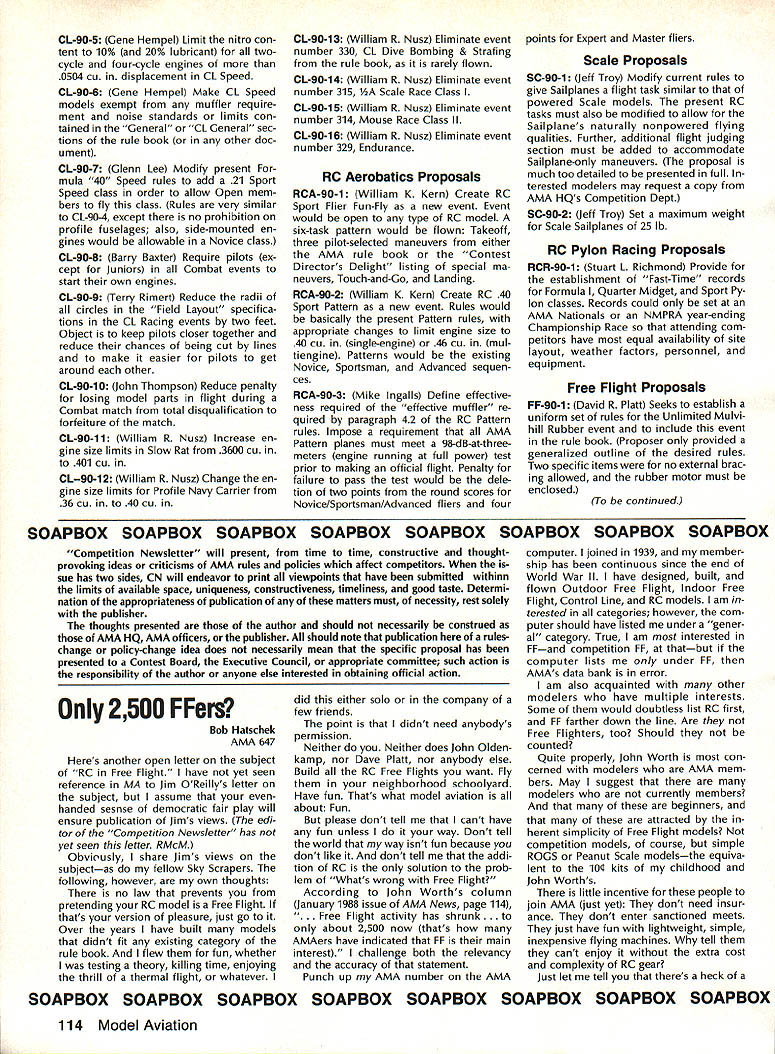
PROPOSALS
Control Line Proposals
- CL-90-5 (Gene Hempel): Limit nitro content to 10% (and 20% lubricant) for all two-cycle and four-cycle engines of more than .050 cu. in. displacement in CL Speed.
- CL-90-6 (Gene Hempel): Make CL Speed models exempt from any muffler requirement and noise standards or limits contained in the "General" or "CL General" sections of the rule book (or in any other document).
- CL-90-7 (Glenn Lee): Modify present Formula "40" Speed rules to add a .21 Sport Speed class to allow Open members to fly this class. Rules similar to CL-90-4, except no prohibition on profile fuselages; side-mounted engines allowable in a Novice class.
- CL-90-8 (Barry Baxter): Require pilots (except Juniors) in all Combat events to start their own engines.
- CL-90-9 (Terry Rimert): Reduce the radii of all circles in the "Field Layout" specifications in CL Racing events by two feet to keep pilots closer and reduce line cuts.
- CL-90-10 (John Thompson): Reduce penalty for losing model parts in flight during a Combat match from total disqualification to forfeiture of the match.
- CL-90-11 (William R. Nusz): Increase engine size limits in Slow Rat from .360 cu. in. to .401 cu. in.
- CL-90-12 (William R. Nusz): Change engine size limits for Profile Navy Carrier from .36 cu. in. to .40 cu. in.
- CL-90-13 (William R. Nusz): Eliminate event number 330, CL Dive Bombing & Strafing, as it is rarely flown.
- CL-90-14 (William R. Nusz): Eliminate event number 315, 1/2A Scale Race Class I.
- CL-90-15 (William R. Nusz): Eliminate event number 314, Mouse Race Class II.
- CL-90-16 (William R. Nusz): Eliminate event number 329, Endurance.
RC Aerobatics Proposals
- RCA-90-1 (William K. Kern): Create RC Sport Flier Fun-Fly as a new event open to any type of RC model. A six-task pattern would be flown: Takeoff, three pilot-selected maneuvers from the AMA rule book or the Contest Director's Delight listing, Touch-and-Go, and Landing.
- RCA-90-2 (William K. Kern): Create RC .40 Sport Pattern as a new event. Rules based on present Pattern rules, limiting engine size to .40 cu. in. (single-engine) or .46 cu. in. (multiengine). Patterns would be the existing Novice, Sportsman, and Advanced sequences.
- RCA-90-3 (Mike Ingalls): Define "effective muffler" required by paragraph 4.2 of the RC Pattern rules. Require all AMA Pattern planes to meet a 9-dB-at-three-meters (engine running at full power) test prior to an official flight. Penalty for failure: deletion of two points from round scores for Novice/Sportsman/Advanced fliers and four points for Expert and Master fliers.
Scale Proposals
- SC-90-1 (Jeff Troy): Modify current rules to give Sailplanes a flight task similar to that of powered Scale models. RC tasks must be modified to allow for sailplane flight qualities; additional flight judging sections must be added to accommodate sailplane-only maneuvers. (Proposal detailed — copies available from AMA HQ Competition Dept.)
- SC-90-2 (Jeff Troy): Set a maximum weight for Scale Sailplanes of 25 lb.
RC Pylon Racing Proposal
- RCR-90-1 (Stuart L. Richmond): Establish "Fast-Time" records for Formula I, Quarter Midget, and Sport Pylon classes. Records could only be set at an AMA Nationals or an NMPRA year-ending Championship Race so competitors have equal availability of site layout, weather, personnel, and equipment.
Free Flight Proposal
- FF-90-1 (David R. Platt): Establish a uniform set of rules for the Unlimited Multi-hull Rubber event and include this event in the rule book. Proposal items include no external bracing allowed and the rubber motor must be enclosed. (Proposer provided a generalized outline; full rules not included here.)
(To be continued.)
Transcribed from original scans by AI. Minor OCR errors may remain.

