
Competition Newsletter
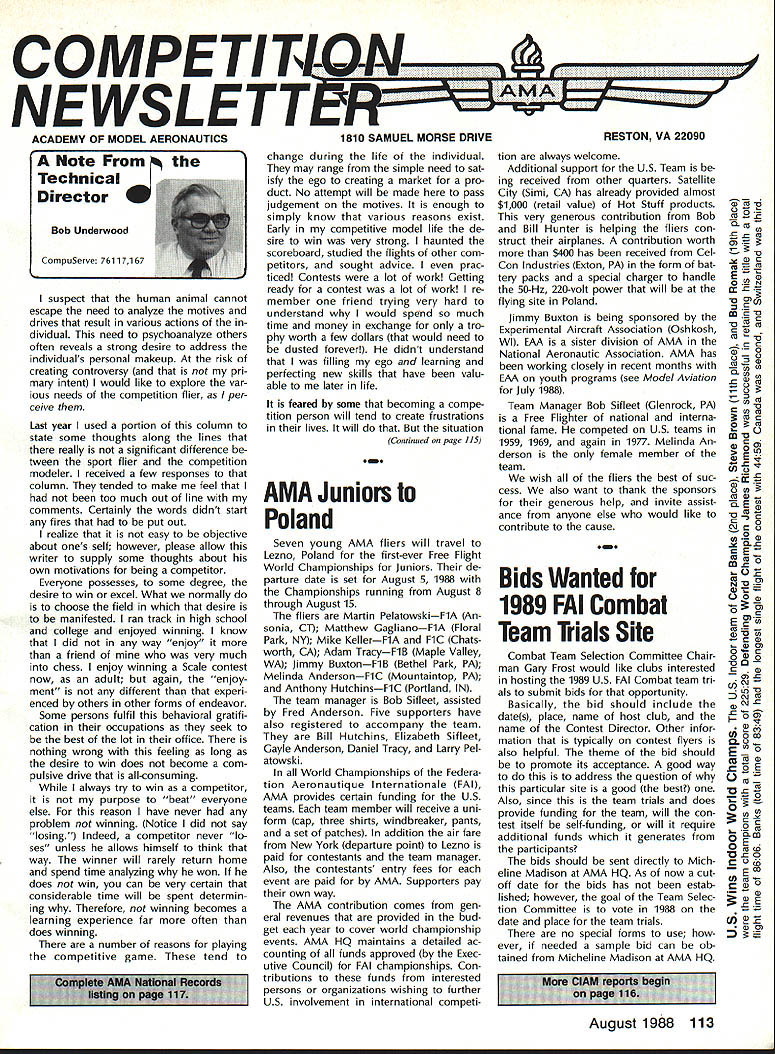
A Note from the Technical Director: W. Bob Underwood, CompuServe 76117,167
I suspect the human animal cannot escape the need to analyze motives and drives that result in various actions. The tendency to psychoanalyze others often masks a desire to understand personal makeup. At the risk of controversy (which is not my primary intent), I want to explore some of the needs of the competition flier, as I perceive them.
On winning and motivation
Everyone possesses, to some degree, the desire to win or to excel. We simply choose the field in which that desire will be manifested. I ran track in high school and college and enjoyed winning. A friend of mine enjoyed chess; the pleasure was much the same. As an adult I enjoy winning a scale contest, and that enjoyment is no different in kind from that in other endeavors.
There is nothing wrong with wanting to win, so long as the desire does not become a compulsive, all-consuming drive. While I always try to win, my purpose is not to "beat" everyone else. Notice I say "not winning," not "losing." A competitor never truly loses unless he allows himself to think that way. Winners rarely return home spending time analyzing why they won; when they don't win, they tend to analyze and learn. Thus, not winning often becomes the greater learning experience.
There are many reasons people compete. Those reasons change over a lifetime and may range from ego gratification to creating a market for a product. I won't judge motives here—it's enough to know they exist.
Early in my competitive model life the desire to win was intense. I watched scoreboards, studied others' flights, sought advice, and practiced. Contests and contest preparation were a lot of work. I remember a friend who couldn't understand why I spent so much time and money for a trophy worth a few dollars. He didn't see that I was filling my ego, learning, and perfecting skills that later proved valuable.
Frustration and growth
Becoming a competition person will create frustrations. That is inevitable, but frustration need not be destructive; it can motivate improvement. I once had a newcomer approach me after his frustrations had reached an intolerable level. A patient conversation and some encouragement convinced him to continue; he is now at the top of the scale world and still enjoys competition.
I experienced a severe bout of frustration in 1978 after qualifying for the U.S. FAI Scale team to compete in England. A serious operation and long recovery left my model unfinished as time ran short. During the summer (when I was a teacher), I logged long hours in the workshop—sometimes 16–18 hours a day—doing and redoing parts of the model. Sleep was difficult because my mind raced with details.
Several things helped me cope: loving support from my wife, encouragement from my daughters, and the calm, patient advice of a model-building friend, Don Murray. After the model and transport box were finished and flown, Don simply smiled and conveyed quiet confidence—essentially saying, "I knew you could do it!"
Were the World Championship experiences worth the trouble? Absolutely. Finishing second was gratifying, but more important was the self-knowledge I gained. That understanding helped me approach problems and people differently and made subsequent World Championship experiences easier. I grew as a result.
By the early 1980s my competitive mood changed. Winning became less important; people and interpersonal relationships at contests became the focus. I still tried to win, but the social aspects and friendships often mattered most.
The role of competition in the hobby
Most modeling activity centers around the sport flier—the person not primarily competition-oriented. Unless you count fun-flys as competition (and I often would), less than 10% of AMA membership flies competitive events regularly. There is also a significant number who "work" contests. Given that small percentage, what does competition contribute to the hobby and sport?
Many say competition advances technology—better engines, better hardware—and that is true. But I believe competition's key contribution is inertia: it helps keep people in the hobby. Competition supplies ongoing challenges and new goals.
If you study a typical club, you'll find a common pattern. Newcomers attack learning with relish: they frequent the field, get involved in club matters, and make rapid progress. After soloing (for RC fliers) and gaining comfort, a second stage often arrives: frustration as harder models are attempted and crashes may increase. After a year or two (or three), many become reasonably accomplished fliers—then face a plateau. The challenge disappears, attendance drops, and more time is spent socializing. Some members eventually show up without a model at all. If we don't "catch" them, they become part of a 20–25% dropout rate in the hobby.
Competition can supply the challenge beyond routine flying. But not every person is inclined to spend hundreds of dollars at a contest to win a ten-dollar trophy. We must offer alternatives.
Keeping people involved
Ways to help individuals at all levels:
- Provide challenges and structured goals appropriate to their skill level.
- Offer encouragement and solicit their advice to bolster their ego and involvement.
- Give opportunities for service—club officer roles, contest worker roles, mentoring.
- Foster groups where members ask what they can give to the group, not only what they can get.
I heard of a club program for qualifying fliers in which many never progressed beyond the "solo" level to "Pilot" or "Instructor." That fits the known behavior pattern. We should create programs and incentives that help fliers progress and remain engaged.
Decades down the trail, those who were encouraged to give back often remain contributing members of the group.
Are there "old-time" competitors who still love to compete? Certainly. Their needs may have shifted, but the thrill remains. Each of us must find some continuing challenge within aeromodeling to keep learning and growing; otherwise we'll gravitate to other interests and reach another plateau of disinterest. What a waste that becomes.
'Nuf for now!
Free Flight — categories, autopilots, and team flying
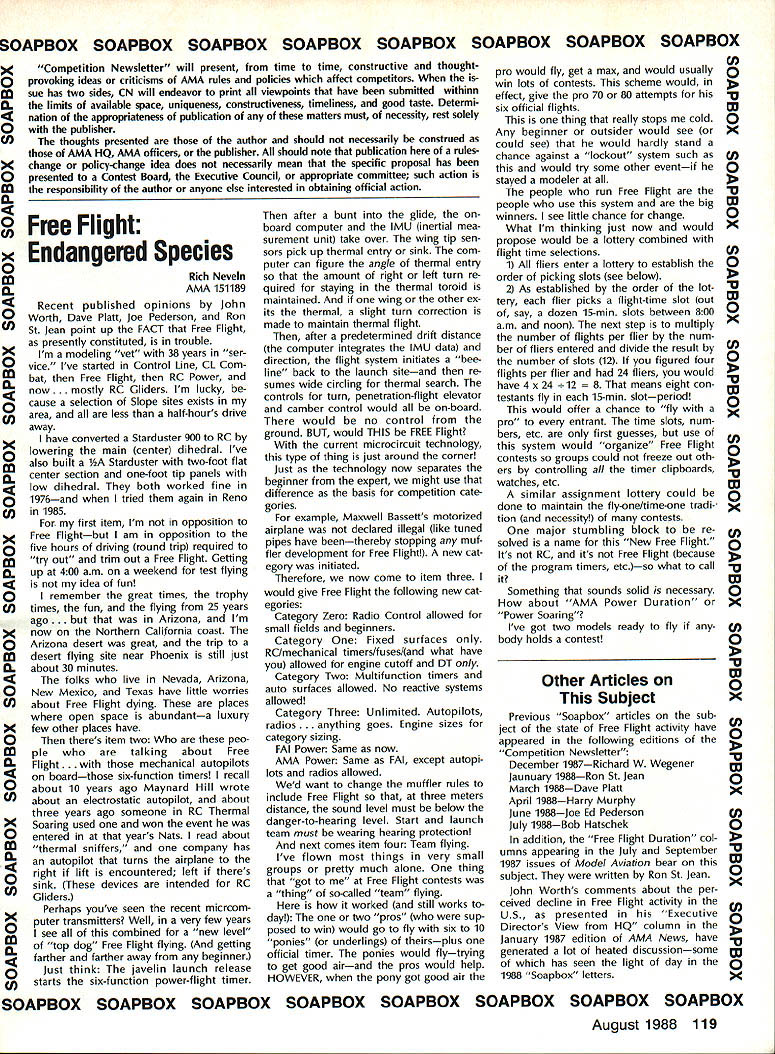
Modern microprocessor technology, on-board sensors, and autopilot systems make new forms of flight behavior possible. For example, an on-board computer could integrate IMU data, detect thermals via wingtip sensors, adjust turns, control camber and elevator for penetration and circling, and switch between thermal search and beeline navigation back to the launch site. With current technology, such capabilities are not far off.
If these systems proliferate, Free Flight may require new categories to preserve fair play and meaningful competition. A suggested category breakdown:
- Category Zero: Radio control allowed for small fields and beginners.
- Category One: Fixed surfaces only; RC/mechanical timers/fuzes allowed for engine cutoff and DT (drop) only.
- Category Two: Multifunction timers and autosurfaces allowed; no reactive systems.
- Category Three: Unlimited—autopilots, radios, anything goes. Engine-size-based classing as necessary.
Power rules could mirror current FAI and AMA limits, with AMA perhaps allowing autopilots and radios where FAI does not. Muffler/noise rules should be revisited: require sound limits (e.g., measured at 3 meters) below danger-to-hearing thresholds and require hearing protection for start/launch teams.
Team flying in Free Flight has sometimes become abused: "pros" bring many helpers ("ponies") to fly repeatedly, and the pros pick the best air and use multiple attempts, effectively giving them 70 or 80 attempts to achieve a few official flights. This locks out beginners and discourages participation.
One proposal to reduce lockout and equalize opportunities is a lottery combined with flight-time slot selection:
- All fliers enter a lottery to establish the order of picking slots.
- In lottery order, each flier picks a flight-time slot (for example, a dozen 15-minute slots between 8:00 a.m. and noon). Multiply number of flights per flier by number of fliers to determine how many fliers per slot. For example, four flights per flier and 24 fliers yields 96 attempts total, or eight contestants per 15-minute slot—period.
This system gives every entrant a chance to "fly with a pro" and prevents groups from controlling all timer clipboards and watches. A similar assignment lottery could be used to maintain fly-one-time traditions. Details (slot duration, number of slots) are negotiable.
We need a name for this hybrid program (not quite R/C, not quite traditional Free Flight). Suggestions: "AMA Power Duration" or "Power Soaring."
I have two models ready to fly if anyone holds a contest!
Academy of Model Aeronautics
AMA, 1810 Samuel Morse Drive, Reston, VA 22090
Transcribed from original scans by AI. Minor OCR errors may remain.

