
Competition Newsletter
1988 Nats Free Flight Site Lost!
Bane of Free Flighters Strikes AMA
In a letter dated July 7, 1988, Nats General Manager Vince Mankowski relayed bad news to Nats-bound Outdoor Free Flight competitors and volunteer workers: the primary site selected for the Free Flight events at the 1988 Nats had been lost, the designated backup site was unavailable, and a third alternate site had been lost just two weeks prior to the Nats.
The letter explained that drought conditions in the American Midwest and resulting economic pressures on the Tidewater, VA farming community forced many landowners to till available pastureland. Even one of the largest sod farms used a seed drill and planted soybeans, negating sod sales for the next few years. The current market demand for soybeans made these decisions difficult to avoid.
With no feasible outdoor site remaining, the AMA had no alternative but to cancel all Outdoor Free Flight events at the Nats. However:
- Free Flight Scale events were flown at the Nats at Fentress Field.
- Free Flight Indoor competition was held at the Scope Center Coliseum.
A great deal of time and effort had been expended attempting to keep the Outdoor Free Flight competition in the 1988 Nats. The loss was due to factors beyond control—droughts, planting cycles, military missions, and similar conditions—not lack of effort or funding. Free Flight modelers, Nats officials, and AMA officers were understandably disappointed.
This situation exemplifies recurring site-procurement problems faced by the Nats Committee. It is feared similar situations may become more prevalent. Nats Manager Vince Mankowski is scouring the country for feasible future sites. Modelers should note that the sites previously used at Lake Charles, LA and Lincoln, NE are no longer available as Nats sites; the Chicopee, MA site has been lost in the near term but may be available in the future.
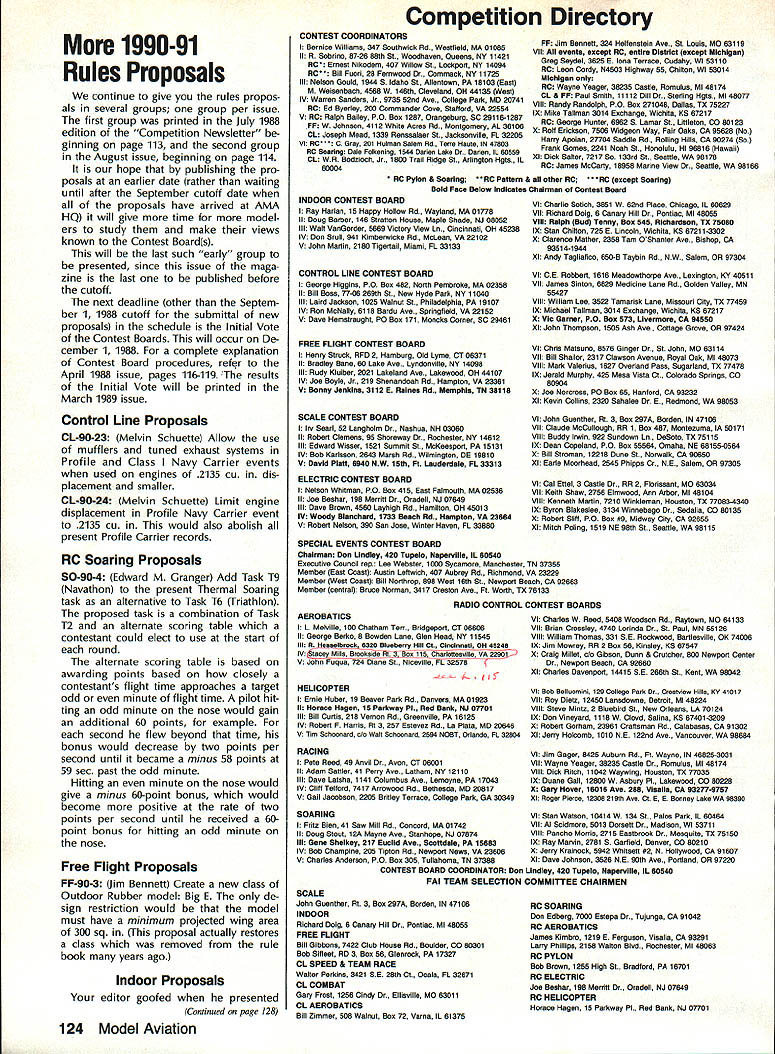
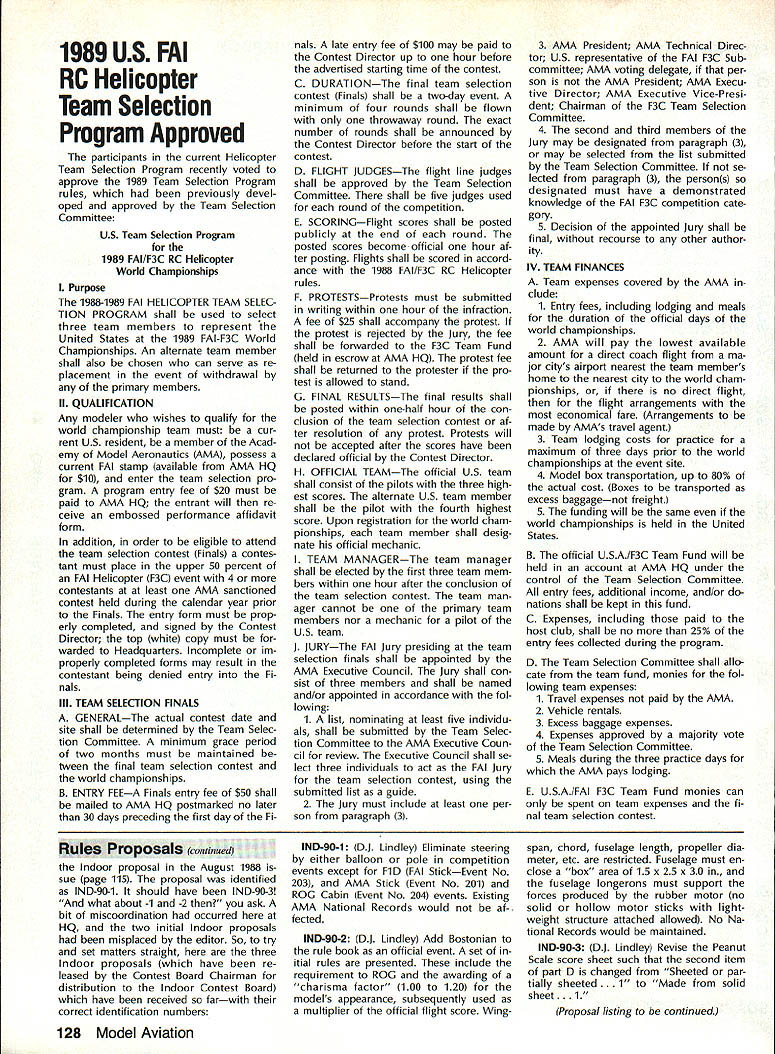
More 1990–91 Rules Proposals
We continue to publish rules proposals in groups to give modelers more time to study them and comment before the September 1, 1988 cutoff. The next important date is the Initial Vote of the Contest Boards on December 1, 1988. For full Contest Board procedures see the April 1988 issue, pages 116–119. Results of the Initial Vote will be printed in the March 1989 issue.
Control Line Proposals
- CL-90-23 (Melvin Schuette): Allow the use of mufflers and tuned exhaust systems in Profile and Class I Navy Carrier events when used on engines of .2135 cu. in. displacement and smaller.
- CL-90-24 (Melvin Schuette): Limit engine displacement in Profile Navy Carrier event to .2135 cu. in. This would also abolish all present Profile Carrier records.
RC Soaring Proposals
- SO-90-4 (Edward M. Granger): Add Task T9 (Narrowband) to the present Thermal Soaring task as an alternative to Task T6 (Triathlon). The proposed task combines Task T2 with an alternate soaring table which a contestant could elect to use at the start of each round.
The alternate scoring table awards bonus/penalty points based on how closely a contestant's flight time approaches a target odd or even minute. For example, hitting an odd minute on the nose gains an additional +60 points; for each second beyond that minute the bonus decreases by two points per second until it becomes −58 at 59 seconds past. Hitting an even minute gives −60 points on the nose, which becomes more positive at two points per second until plus 60 for the next odd minute.
Free Flight Proposals
- FF-90-3 (Jim Bennett): Create a new class of Outdoor Rubber model: Big E. The only design restriction would be a minimum projected wing area of 300 sq. in. (This restores a class that was removed from the rule book many years ago.)
Indoor Proposals
Your editor goofed when he presented
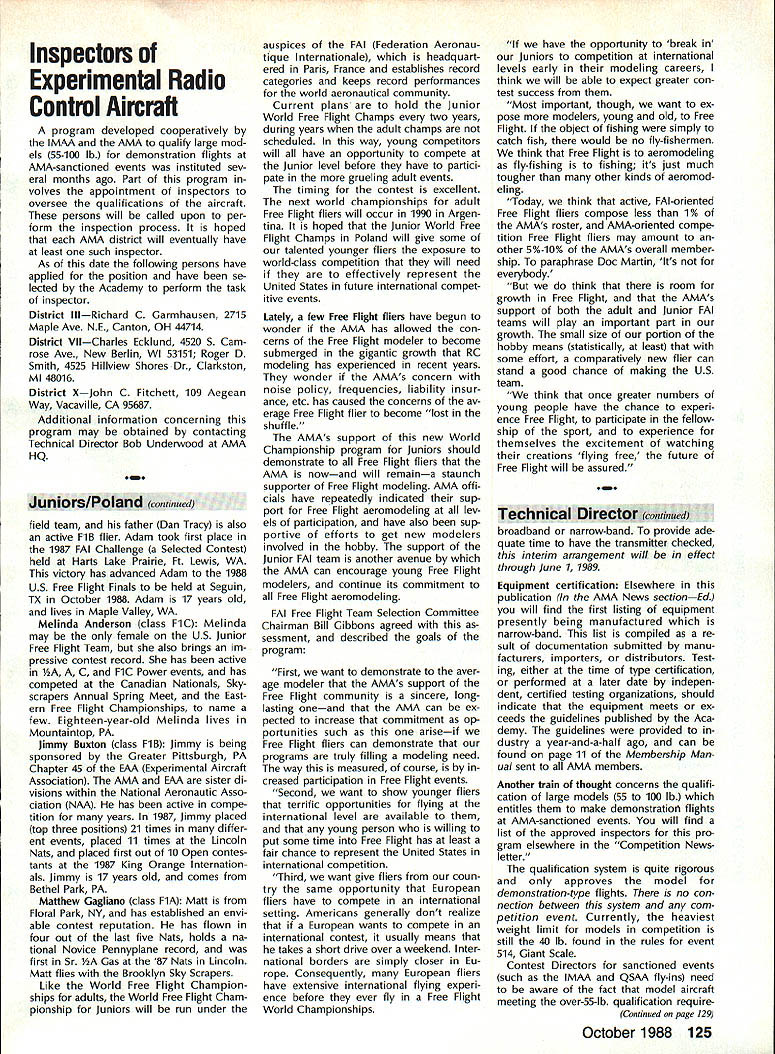
Juniors/Poland (continued)
The first FAI World Free Flight Championships for Juniors will be held near Leszno, Poland, August 8–15, 1988. With support from the AMA U.S. FAI Free Flight Team Selection Committee and several sponsors, the United States will send a seven-member junior team.
Team support and sponsorship:
- The AMA will provide official uniforms (cap, three shirts, windbreaker, pants, and patches) and pay event entry fees and air fare from New York City to Leszno.
- Satellite City Hot Stuff donated $1,000 worth of products to help contestants finish airplanes.
- CelCon Industries (Exton, PA) donated $400 worth of battery packs and a specialized charger designed to operate on 50 Hz, 220-volt power available at the flying site.
Selected junior team members (highlights):
- Adam Tracy (class F1B): Adam comes from a highly active free flight family; his father, Dan Tracy, is an active F1B flier. Adam won the 1987 FAI Challenge Selected Contest at Harts Lake Prairie, Ft. Lewis, WA, qualifying him for the 1988 U.S. Free Flight Finals in Seguin, TX. He is 17 and lives in Maple Valley, WA.
- Melinda Anderson (class F1C): Active in 1/2A, A, C and F1C power events, Melinda has competed at the Canadian Nationals, Skyscrapers Annual Spring Meet, and Eastern Free Flight Championships. She is 18 and lives in Mountaintop, PA.
- Jimmy Buxton (class F1B): Sponsored by the Greater Pittsburgh Chapter 45 of the EAA, Jimmy has a long competition record, including first-place junior finishes in 1987 and notable placings at Lincoln Nats and the King Orange Internationals. He is 17 and from Bethel Park, PA.
- Matthew Gaetano (class F1A): From Floral Park, NY, Matt has flown in four of the last five Nats, holds a national Novice Pennyplane record, and was first in Sr. 2A Gas at the 1987 Nats in Lincoln. He flies with the Brooklyn Sky Scrapers.
Three events will be flown at the Junior Champs. Current plans are to hold the Junior World Free Flight Championships every two years, in the years when the adult championships are not scheduled, to give young competitors international experience before moving into adult events. The next adult World Free Flight Championships are scheduled for 1990 in Argentina.
Concerns had been voiced by some Free Flight fliers that AMA priorities might favor RC modeling given its growth. The AMA's support of the Junior FAI program demonstrates continued commitment to Free Flight at all levels and to encouraging young modelers to participate.
FAI Free Flight Team Selection Committee Chairman Bill Gibbons summarized the program goals:
- Demonstrate the AMA's sincere, long-term support for the Free Flight community and encourage participation.
- Show younger fliers the opportunities available at the international level and that dedicated juniors can fairly compete for U.S. representation.
- Give U.S. juniors similar opportunities to European fliers who can easily travel across borders to compete in many countries.
- Expose more modelers, young and old, to Free Flight and help assure the future of the discipline by increasing participation.
Technical Director (continued)
Interim broadband/narrow-band arrangement:
- To provide adequate time for transmitter checks, an interim arrangement for identifying transmitters as broadband or narrow-band will be in effect through June 1, 1989.
Equipment certification:
- A listing of equipment presently manufactured as narrow-band will appear in AMA News. This list is compiled from documentation submitted by manufacturers, importers, or distributors.
- Testing—either at type certification or later by independent certified testing organizations—should indicate whether equipment meets or exceeds Academy guidelines. Test criteria are published in the Membership Manual and will be used to identify equipment acceptable for AMA-sanctioned events.
Qualification of large demonstration models:
- There is concern about qualification of large models (55 to 100 lb.) intended for demonstration flights at AMA-sanctioned events. A rigorous qualification system is in place; approved inspectors and procedures will be listed in the "Competition News" column.
- The qualification system is for demonstration flights only and is separate from competition rules. The heaviest weight class for competition remains the 40 lb. class as defined in the rules for Giant Scale.
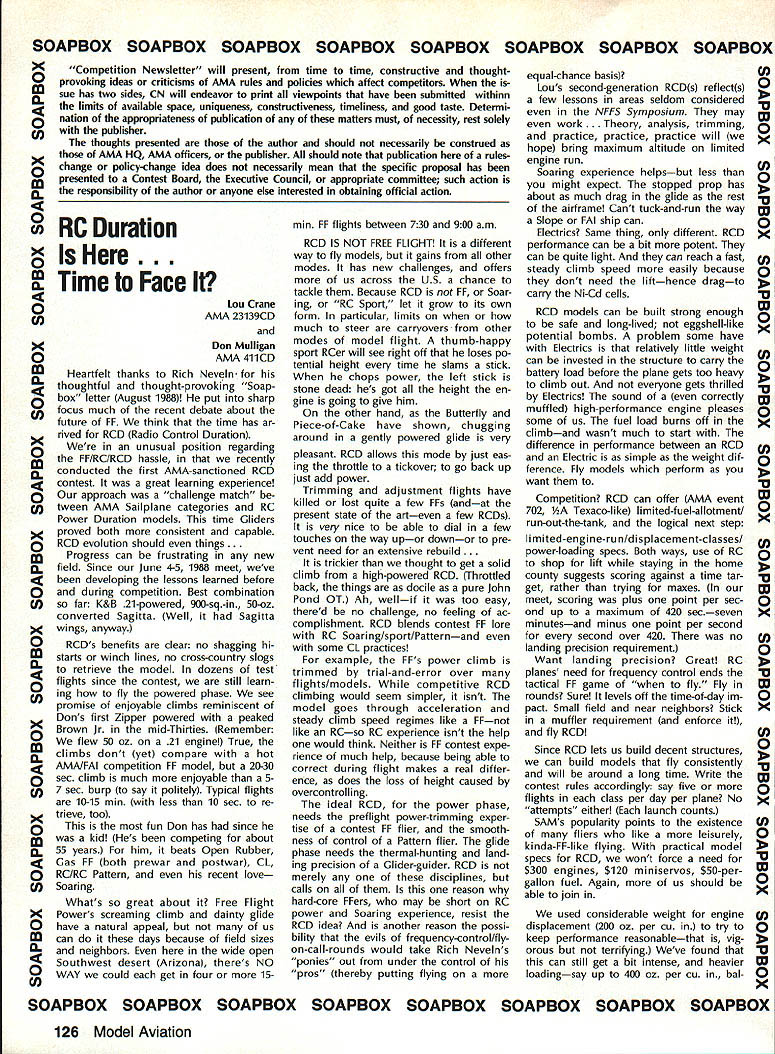
RC Duration Is Here . . . Time to Face It?
Lou Crane, AMA 23193CD and Don Mulligan, AMA 4111CD
We thank Rich Neveln for his thoughtful "Soapbox" letter (August 1988). It sharpened the recent debate about the future of Free Flight. We believe the time has arrived for RCD (Radio Control Duration).
We recently conducted the first AMA-sanctioned RCD contest (a challenge match between AMA Sailplane categories and RC Power Duration models). Gliders proved more consistent and capable this time, but RCD evolution should even things out.
Lessons learned and observations:
- Best combination so far: K&B .21-powered, 900-sq.-in., 50-oz. converted Sagitta (wings from a Sagitta). Typical flights ran 10–15 minutes with very short retrieval time.
- RCD benefits: no shagging hills, no long starts, fewer cross-country retrievals. Trimming and adjustment flights are less punishing than in FF because small corrections are possible in-flight.
- RCD is not Free Flight: it is a different form that borrows from FF, RC Soaring, sport RC, and even some CL practices. It requires new skills and blends the needs of power trimming, smooth control, thermal-hunting, and landing precision.
- Climbing is trickier than expected. The powered phase follows acceleration and steady climb regimes similar to FF models and demands expertise from both contest FF and Pattern fliers.
- Electrics offer different advantages—lighter construction and steady climb speed—but batteries add structural weight that can penalize climb performance.
- RCD models can be built strong and long-lived; rules and class structure can be designed to keep costs reasonable and encourage participation.
Competition proposals and scoring ideas:
- Use time-target scoring rather than pure maxes. In our meet we scored +1 point per second up to a max of 420 seconds (7 minutes) and −1 point per second for every second over 420. No landing precision was required.
- Offer classes with limited fuel/altimeter-run-out-the-tank (Texaco-like), limited engine-run, displacement classes, or power-loading specs.
- To reduce neighborhood issues and noise, require mufflers and enforce them.
- Fly rounds to level the time-of-day advantage and limit tactical "when to fly" advantages that occur in FAI/FAI-style events.
- Require a minimum number of flights per plane per day (e.g., five flights) and count each launch—no "attempts."
RCD can attract fliers who enjoy a more leisurely, FF-like experience without forcing expensive equipment purchases. Let it grow into its own discipline—learn from FF lore, RC soaring, and pattern flying—and write contest rules that encourage broad participation.
Fly RCD!
Academy of Model Aeronautics
Note: Technical Director W. Bob Underwood, CompuServe 76117,167
Late June brought activity to the Academy from the National Fun-Fly. At the Executive Council meeting and weekend fun-fly, several items of business important to Contest Directors looking toward 1989 were discussed. Two or three Frequency Committee recommendations were approved concerning sanctioned events.
Key approved action:
- Stickers on transmitters used at sanctioned events: Effective January 1, 1989, transmitters used at AMA-sanctioned events will be required to carry either a Silver or Gold sticker indicating broadband or narrow-band operating channels RC12 through RC34. A Gold sticker will be required for [certain?] participants at sanctioned events.
- Participants are reminded that transmitters can be checked and stickered during routine servicing by manufacturers/importers, at trade shows, and at special AMA events. An interim arrangement was approved to allow a participant to sign a declaration indicating knowledge of the transmitter's bandwidth status while obtaining authorization at sanctioned events.
National Records
The following new National Records were processed and approved during July 1988.
Indoor
- Category IV Intermediate Stick Senior — Don Slusarczyk — 5/14/88 — 2241 (previous 2521 on 6/2/88)
- Ornithopter Senior — Don Slusarczyk — 5/15/88 — 624 (previous 840 on 6/2/88)
- Novice Pennyplane Senior — Don Slusarczyk — 6/4/88 — 1153
- Pennyplane Senior — Don Slusarczyk — 6/4/88 — 1400
Free Flight
- Category I/2A Gas Open — Bob Sundberg — 5/28/88 — 5937
- Category III B Gas Open — Mike McKeever — 6/26/88 — 2730
- B Gas Open — Marvin R. Mace — 7/2/88 — 3611
Outdoor Free Flight
- Cargo Senior (25 oz) — Melanie Sanford — 7/2/88
AMA Juniors Represent U.S. in Poland — First Junior FAI Free Flight Champs
John Berryman reported on the first FAI World Free Flight Championships for Juniors near Leszno, Poland (August 8–15, 1988). With AMA support and sponsor contributions, the U.S. will send a seven-member team and provide uniforms, travel, entry fees, and equipment assistance. The event aims to give young U.S. fliers international experience and to strengthen junior participation in Free Flight worldwide.
Transcribed from original scans by AI. Minor OCR errors may remain.

