
COMPETITION NEWSLETTER
A Note From the Technical Director
Bob Underwood
The term "stretch" is very interesting. The good old dictionary gives a whole lot of different usages for the word, whether verb or noun. I remember well what my high school and college track coaches meant when they used the word! It meant that my muscles would ache in the warm-up, the stride would lengthen in my kick at the finish, or I'd better be in the lead in the final length of the track just before the tape! The "stretching" I had to accomplish may have caused some physical pain but there were no deep philosophical concerns. There are some "stretch" problems that do cause operational and philosophical difficulties, however.
In the September edition of the Competition Newsletter, this column explored some of the little problems dealing with rule deviations regarding sanctions. The question was asked as to how far the rules can be stretched before the event loses its identity as far as the rule book is concerned. In addition, it was noted that we are left with little or no guidance in the area of what to do if an apparent safety rule is "stretched" (or deleted).
The problem came home to roost a short time ago when a couple of AMA Free Flight contests were sanctioned. Nothing very serious about that, right? Well, they both included a deviation from the AMA rule book. The builder-of-the-model rule was waived. Granted, there is no safety concern to be noted here—but there are procedural problems in that National Records are homologated in the Free Flight events. The intended change was noted by the Free Flight Contest Board Chairperson and the Contest Board Coordinator. It was determined that approval of any record set under the direction of such a waiver would be suspect. Therefore, Headquarters was directed to inform the Contest Director that any potential record performances occurring during such an event would not be approved.
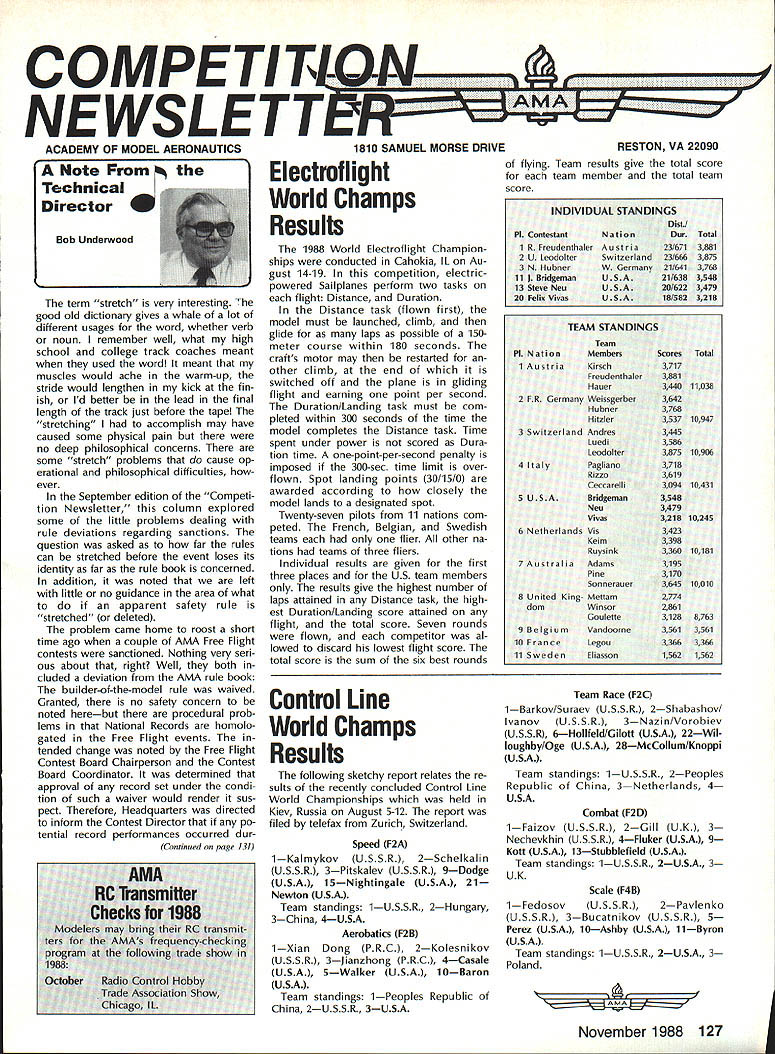
Electroflight World Champs Results
The 1988 World Electroflight Championships were conducted at Cahokia, IL, August 14–19. Competition for electric-powered sailplanes performed two tasks: Distance and Duration.
Distance task (flown first): The model must be launched, climb and glide as many laps as possible on a 150-meter course within 180 seconds. The craft's motor may be restarted on another climb; at the end it is switched off and the plane glides. Flight time earns one point per second.
Duration/Landing task: Must be completed within 300 seconds. Time spent after the model completes the Distance task and time spent under power is scored as Duration time. A one-point-per-second penalty is imposed for time over the 300-second time limit. Spot-landing points (30/15/0) are awarded according to how closely the model lands on the designated spot.
Twenty-seven pilots from 11 nations competed. French, Belgian and Swedish teams flew three fliers; other nations' teams varied. Individual results give the first three places. For U.S. team members, results give the highest number of laps attained in the Distance task, the highest Duration/Landing score attained, and the flight total score. Seven rounds were flown; each competitor was allowed to discard the lowest flight score. The total score is the sum of the six best rounds.
Control Line World Champs Results
The following sketchy report relates results of the recently concluded Control Line World Championships held in Kiev, USSR, August 5–12. Report filed via telefax from Zurich, Switzerland.
Speed F2A
- Kalmykov, USSR
- Schelkalin, USSR
- Pitskalev, USSR
- Dodge, USA
- Nightingale, USA
- Newton, USA
Team standings
- USSR
- Hungary
- China
- USA
Aerobatics F2B
- Xian Dong, PRC
- Kolesnikov, USSR
- Jianzhong, PRC
- Casale, USA
- Walker, USA
- Baron, USA
Team standings
- Peoples Republic of China
- USSR
- USA
Individual standings (excerpt)
- R. Freudenthaler, Austria — 23/6713 881
- U. Leodolter, Switzerland — 23/6663 875
- N. Hubner, W. Germany — 21/6413 768
- Bridgeman, USA — 21/6383 548
- Steve Neu, USA — 20/6223 479
- Felix Vivas, USA — 18/5823 218
Team standings (excerpt)
- Austria — Kirsch 3717, Freudenthaler 3881, Hauer 3440 — Total 11038
- FR Germany — Weissgerber 3642, Hubner 3760, Hitzler 3537 — Total 10947
- Switzerland — Andres 3445, Luedi 3586, Leodolter 3875 — Total 10906
- Italy — Pagliano 3718, Rizzo 3619, Ceccarelli 3094 — Total 10431
- USA — Bridgeman 3548, Neu 3479, Vivas 3218 — Total 10245
- Netherlands — Vis 3423, Keim 3398, Ruysink 3360 — Total 10181
- Australia — Adams 3195, Pine 3170, Sonnerauer 3645 — Total 10010
- United Kingdom — Mettam 2774, Winsor 2861, Goulette 3128 — Total 8763
- Belgium — Vandoorne 3561? (partial)
- France — Legou 3366? (partial)
Sweden — Fliasson (partial)
Team Race F2C
- Barkov/Suraev, USSR
- Shabashov/Ivanov, USSR
- Nazin/Vorobiev, USSR
- Hollfeld/Giloff, USA
- Willoughby/Oge, USA
(Note: Report was sketchy and some scores/names are partially reported.)
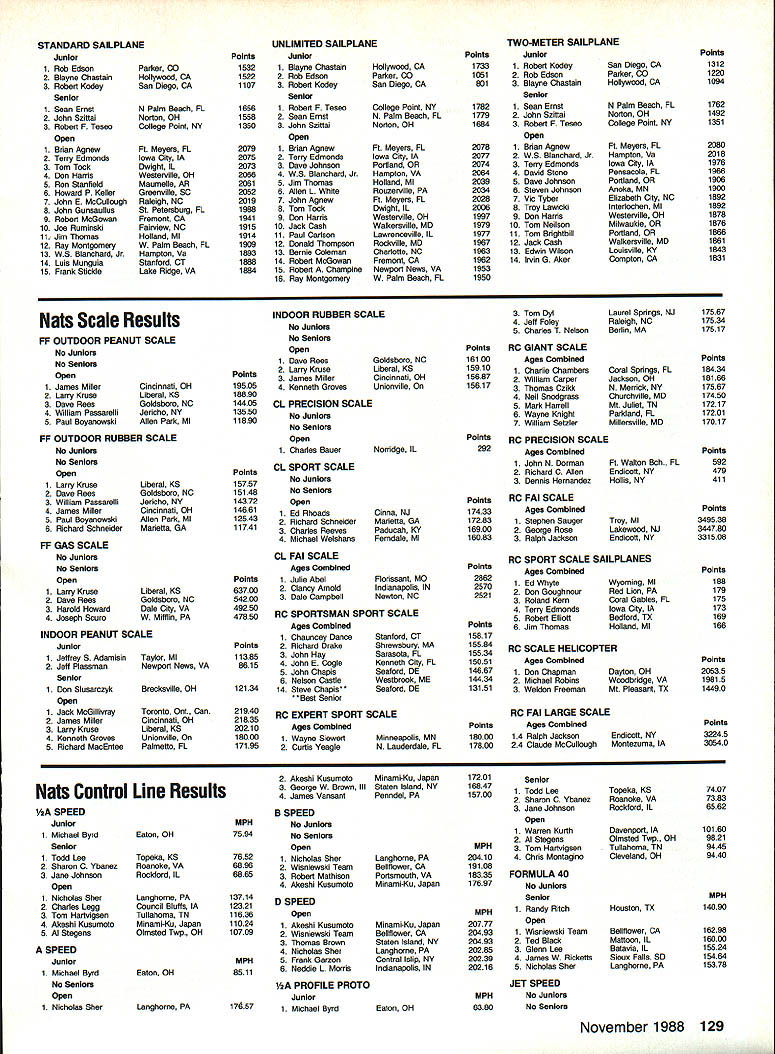
STANDARD SAILPLANE
Junior
- Rob Edson, Parker, CO — 1532
- Blayne Chastain, Hollywood, CA — 1522
- Robert Kodey, San Diego, CA — 1107
Senior
- Sean Ernst, N. Palm Beach, FL — 1658
- John Ezzo, Norton, OH — 1552
- Robert F. Teseo, College Point, NY — 1505
Open
- Brian Agnew, Ft. Meyers, FL — 2079
- Terry Edmonds, Iowa City, IA — 2074
- Tom Tock, Dwight, IL — 2073
- Don Harris, Westerville, OH — 2065
- Ron Stanfield, Muncie, AR — 2058
- Howard P. Keller, Greenville, SC — 2042
- John E. McCullough, Raleigh, NC — 2039
- John Gauslao, St. Petersburg, FL — 2034
- Robert McGowan, Fenton, CA — 2029
- Joe Tumminelli, Harker Heights, TX — 2014
- Jim Thomas, Holland, MI — 1915
- Ray Montgomery, W. Palm Beach, FL — 1911
- W.S. Blanchard, Jr., Hampton, VA — 1904
- Luis Munguia, Stamford, CT — 1888
- Frank Stickle, Lake Ridge, VA — 1884
UNLIMITED SAILPLANE
Junior
- Blayne Chastain, Hollywood, CA — 1733
- Rob Edson, Parker, CO — 1501
- Robert Kodey, San Diego, CA — 1094
Senior
- Robert F. Teseo, College Point, NY — 1782
- Sean Ernst, N. Palm Beach, FL — 1779
- John Ezzo, Norton, OH — 1731
Open
- Brian Agnew, Ft. Meyers, FL — 2078
- Terry Edmonds, Iowa City, IA — 2077
- Dave Johnson, Portland, OR — 2074
- W.S. Blanchard, Jr., Hampton, VA — 2046
- Jim Thomas, Holland, MI — 2044
- Allan J. White, Portage, IN — 2028
- John Agnew, Ft. Meyers, FL — 2006
- Don Harris, Westerville, OH — 1997
- Tom Tock, Dwight, IL — 1979
- Jack Carlson, Waukesha, WI — 1977
- Paul Carlson, Lawrenceville, IL — 1974
- Donald Thompson, Crooksville, OH — 1973
- Bernie Coleman, Ridgetown, ON — 1971
- Robert McGowan, Fenton, CA — 1952
- Robert A. Champagne, Newport News, VA — 1950
- Ray Montgomery, W. Palm Beach, FL — 1950
TWO-METER SAILPLANE
Junior
- Robert Kodey, San Diego, CA — 1312
- Rob Edson, Parker, CO — 1220
- Blayne Chastain, Hollywood, CA — 1094
Senior
- Sean Ernst, N. Palm Beach, FL — 1762
- John Ezzo, Norton, OH — 1492
- Robert F. Teseo, College Point, NY — 1381
Open
- Brian Agnew, Ft. Meyers, FL — 2080
- W.S. Blanchard, Jr., Hampton, VA — 1976
- Terry Edmonds, Iowa City, IA — 1976
- David Stone, Pensacola, FL — 1976
- Dave Johnson, Portland, OR — 1976
- Steve Johnson, Ankeny, IA — 1968
- Vic Tyber, Elizabeth City, NC — 1892
- Troy Lawkowski, Interlochen, MI — 1892
- Don Harris, Westerville, OH — 1889
- Tom Nelson, Milwaukee, OR — 1886
- Tom Brightbill, Portland, OR — 1864
- Jack Akin, Waukesha, WI — 1849
- Edwin Scott, Lewisville, TX — 1841
- Irving G. Aker, Compton, CA — 1831
Nats Scale Results
FF OUTDOOR PEANUT SCALE
No Juniors No Seniors Open
- James Miller, Cincinnati, OH — Points 195.05
- Larry Kruse, Liberal, KS — 188.90
- Dave Rees, Goldsboro, NC — 144.85
- William Passarelli, Jersey Shore, NY — 135.00
- Paul Boyanowski, Allen Park, MI — 118.90
FF OUTDOOR RUBBER SCALE
No Juniors No Seniors Open
- Larry Kruse, Liberal, KS — 157.57
- Dave Rees, Goldsboro, NC — 151.48
- James Miller, Cincinnati, OH — 143.27
- William Passarelli, Jersey Shore, NY — 143.72
- Paul Boyanowski, Allen Park, MI — 125.43
- Richard Schneider, Marietta, GA — 117.41
FF GAS SCALE
No Juniors No Seniors Open
- Larry Kruse, Liberal, KS — Points 637.00
- Dave Rees, Goldsboro, NC — 542.00
- Harold Howard, Dale City, VA — 492.50
- Joseph Scuro, W. Mifflin, PA — 478.50
INDOOR PEANUT SCALE
Junior
- Jeffrey S. Adamiak, Taylor, MI — 113.85
- Jeff Plassman, Newport News, VA — 86.15
Senior
- Don Sluszarczyk, Brecksville, OH — 121.34
Open
- Jack McGillivray, Toronto, Ont., Can. — 219.40
- James Miller, Cincinnati, OH — 218.35
- Larry Kruse, Liberal, KS — 202.10
- Ken Neth, Cleveland, OH — 180.00
- Richard MacAfee, Palmetto, FL — 171.95
INDOOR RUBBER SCALE
No Juniors No Seniors Open
- Dave Rees, Goldsboro, NC — 161.00
- Larry Kruse, Liberal, KS — 159.10
- James Miller, Cincinnati, OH — 156.17
- Kenneth Groves, Unionville, ON — 156.17
CL PRECISION SCALE
No Juniors No Seniors Open
- Charles Pearce, Norridge, IL — Points 292
CL SPORT SCALE
No Juniors No Seniors Open
- Ed Rhoads, Cinnna, NJ — Points 174.33
- Richard Schneier, Marietta, GA — 172.83
- Charles Reeves, Paducah, KY — 172.63
- Michael Welsher, Ferndale, MI — 169.33
CL FAI SCALE
Ages Combined
- Julie Abell, Florissant, MO — Points 2862
- Clancy Arnold, Indianapolis, IN — 2570
- Dale Campbell, Newton, NC — 2521
RC SPORTSMAN SPORT SCALE
Ages Combined
- Chauncey Doane, Stanford, CT — Points 158.17
- Richard Clarke, Shrewsbury, MA — 155.84
- John Kelly, Sarasota, FL — 155.34
- John H. Cagle, Kennesaw, GA — 153.84
- John Chapla, Seaford, DE — 151.34
- Nelson Castle, Westbrook, ME — 150.34
- Steve Shapiro, Seaford, DE — 144.34
- "Best Senior" — (entry listed as "Best Senior") — Points 142.84
RC EXPERT SPORT SCALE
Ages Combined
- Vance Stover, Minneapolis, MN — Points 190.00
- Curtis Yeagle, N. Lauderdale, FL — 178.00
RC GIANT SCALE
Ages Combined
- Charlie Chambers, Coral Springs, FL — Points 184.34
- William Crisler, Jackson, OH — 181.66
- Thomas Gczk? (name uncertain) — Points 176.07
- Neil Snodgrass, Mt. Carmel, MD — 172.95
- Mark Harrell, Mt. Juliet, TN — 171.65
- Wayne Knopik, Palmyra, PA — 170.17
- William Setzler, Millersville, MD — 170.17
RC PRECISION SCALE
Ages Combined
- John N. Dorman, Ft. Walton Beach, FL — Points 592
- Richard K. Allen, Endicott, NY — 592? (partial)
- Dennis Menard, Hollis, NY — 592? (scores partially reported)
RC FAI SCALE
Ages Combined
- Stephen Sager, Troy, MI — Points 3495.80
- George Rose, Lakewood, NJ — 3474.80
- Ralph Jackson, Endicott, NY — 3315.08
RC SPORT SCALE SAILPLANES
Ages Combined
- Ed Whyte, Wyoming, MI — Points 189
- Don Dougherty, Red Lion, PA — 175
- Roy Gander, Coral Gables, FL — 173
- Ed Barcus, Ocean City, MD — 170
- Scott Lemon, Bedford, TX — 169
- Jim Thomas, Holland, MI — 168
RC SCALE HELICOPTER
Ages Combined
- Don Chapman, Dayton, OH — Points 2053.5
- Michael Robbins, Woodbridge, VA — 1981.5
- Jim Konopinski, Mt. Pleasant, MI — 1449.0
RC FAI LARGE SCALE
Ages Combined
- Ralph Jackson, Endicott, NY — Points 3224.5
- Claude MacCullough, Montezuma, IA — 3060.4
Nats Control Line Results
1/2A SPEED
Junior
- Michael Byrd, Eaton, OH — MPH 75.94
Senior
- Todd Lee, Topeka, KS — 72.82
- Jason C. Ybanez, Roanoke, VA — 68.96
Open
- Jane Johnson, Rockford, IL — 66.95
- Others (partial scores reported)
A SPEED
Junior
- Michael Byrd, Eaton, OH — MPH 85.11
Senior
- Nicholas Sher, Langhorne, PA — MPH 176.57
B SPEED
No Juniors No Seniors Open
- Nicholas Sher, Langhorne, PA — MPH 204.10
- Dave Fisher, Bellflower, CA — 193.35
- Robert Matheson, Portsmouth, VA — 188.35
- Akashi Kusumoto, Minami-Ku, Japan — 176.97
D SPEED
Open
- Akashi Kusumoto, Minami-Ku, Japan — MPH 207.77
- Winsiewski Team, Bellflower, CA — 204.93
- Thomas Brown, Staten Island, NY — 203.09
- Nick Sieracki, Franklin, PA — 200.26
- E. Neidel, Indianapolis, IN — 202.16
1/2 A PROFILE PRO
Junior
- Michael Byrd, Eaton, OH — MPH 63.00
SENIOR
- Todd Lee, Topeka, KS — Points 74.07
- Jason C. Ybanez, Roanoke, VA — 73.82
- Jane Johnson, Rockford, IL — 68.62
FUEL
Open
- Warren Kurz, Davenport, IA — 101.60
- Tom Hartigson, Oelwein, IA — 95.86
- Bob Montgomery, Clara, OH — 93.45
FORMULA 40
No Juniors Senior
- Randy Ritch, Houston, TX — MPH 140.90
Open
- Winsiewski Team, Bellflower, CA — MPH 162.00
- Ted Black, Mattoon, IL — 159.90
- Glenn Lee, Batavia, IL — 152.87
- James W. Ricketts, Sioux Falls, SD — 153.78
- Nicholas Sher, Langhorne, PA — 153.78
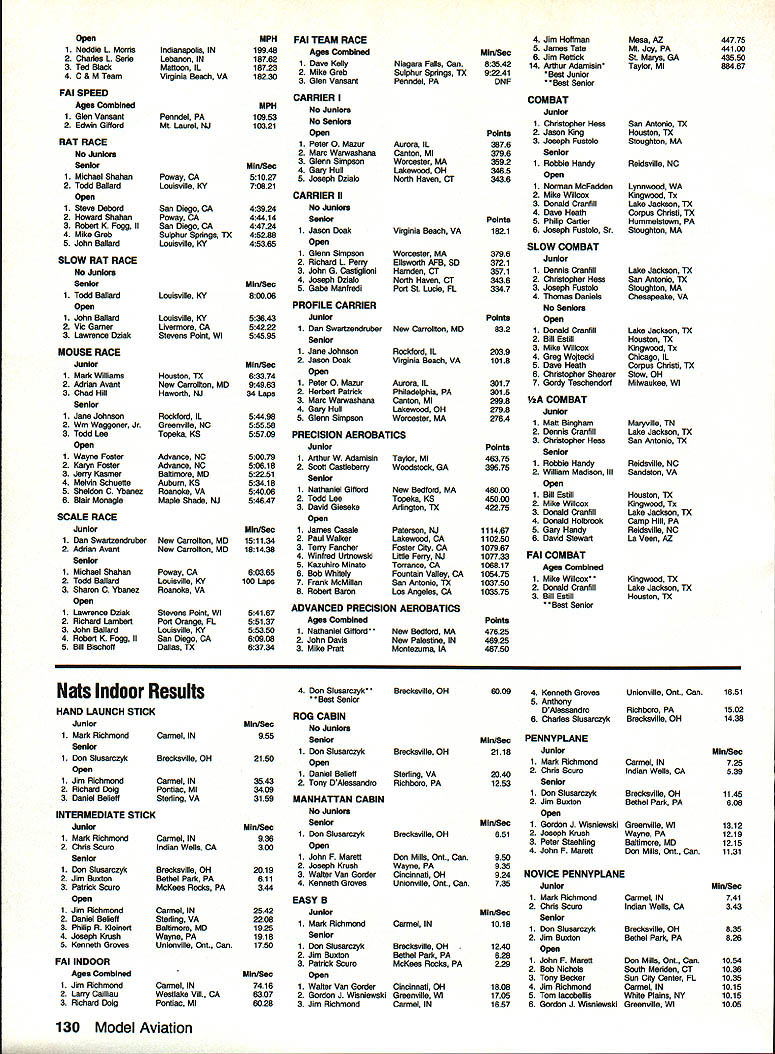
JET SPEED
No Juniors No Seniors
Open
- Noddle L. Morris, Indianapolis, IN — MPH 199.48
- Charles L. Serie, Lebanon, IN — 187.62
- Ted Black, Mattoon, IL — 187.23
- C & M Team, Virginia Beach, VA — 182.30
FAI SPEED
Ages Combined
- Glen Vansant, Penndel, PA — 109.53
- Edwin Gifford, Mt. Laurel, NJ — 103.21
RAT RACE
No Juniors Senior
- Michael Chalsman, Poway, CA — Min/Sec 5:10.27
- Todd Ballard, Louisville, KY — 7:08.21
Open
- Steve Debord, San Diego, CA — 4:39.24
- Howard Shaha, Poway, CA — 4:44.14
- Robert K. Fogg, II, San Diego, CA — 4:47.24
- Mike Grob, Sulphur Springs, TX — 4:52.88
- John Ballard, Louisville, KY — 4:53.65
SLOW RAT RACE
No Juniors Senior
- Todd Ballard, Louisville, KY — Min/Sec 8:00.06
Open
- John Ballard, Louisville, KY — 5:36.43
- Vic Garner, Livermore, CA — 5:42.22
- Lawrence Dziak, Stevens Point, WI — 5:45.95
MOUSE RACE
Junior
- Mark Williams, Houston, TX — Min/Sec 6:33.74
- Adrian Avant, New Carrollton, MD — 9:49.83
- Chad Hill, Haworth, NJ — 34.49 Laps
Senior
- Jane Johnson, Rockford, IL — Min/Sec 5:44.98
- William Gagner, Jr., Greenville, NC — 5:55.58
- Todd Lee, Topeka, KS — 5:57.09
SCALE RACE
- Wayne Foster, Advance, NC — Min/Sec 5:00.79
- Larry Foster, Advance, NC — 5:06.18
- Jerry Kasmer, Baltimore, MD — 5:22.51
- Melvin Schutte, Auburn, KS — 5:34.18
- Sheldon O. Yanez, Roanoke, VA — 5:40.06
- Blair Monagle, Maple Shade, NJ — 5:46.47
SCALE RACE (continued)
- Dan Swartzendruber, New Carrollton, MD — Min/Sec 15:11.34
- Adrian Avant, New Carrollton, MD — 18:14.38
Senior
- Michael Shahan, Poway, CA — 6:03.65
- Todd Ballard, Louisville, KY — 100 Laps
- Sharon G. Yanez, Roanoke, VA
Open
- Lawrence Dziak, Stevens Point, WI — 5:41.87
- Richard Lambert, Port Orange, FL — 5:51.37
- John Ballard, Louisville, KY — 5:53.50
- Robert K. Fogg, II, San Diego, CA — 6:09.08
- Bill Bischoff, Dallas, TX — 6:37.34
FAI TEAM RACE
Ages Combined (Open results not reported)
GABS Combined (Ages Combined)
- Dave Kelly, Niagara Falls, Can. — Min/Sec 8:25.42
- Mike Greb, Sulphur Springs, TX — 9:22.41
- Glen Vansant, Penndel, PA
CARRIER I
No Juniors No Seniors Open
- Peter O. Mazur, Aurora, IL — Points 387.61
- Marc Warwashana, Canton, MI — 379.60
- Glenn Simpson, Worcester, MA — 359.20
- Gary Hull, Lakewood, OH — 346.50
- Joseph Diaz, North Haven, CT — 343.60
CARRIER II
No Juniors Senior
- Jason Doak, Virginia Beach, VA — Points 182.10
Open
- Glenn Simpson, Worcester, MA — 379.60
- Richard L. Perry, Ellsworth AFB, SD — 372.10
- John G. Castiglioni, Hamden, CT — 357.10
- Joseph Diaz, North Haven, CT — 342.70
- Gabe Madriloff, Port St. Lucie, FL — 334.70
PROFILE CARRIER
Junior
- Dan Swartzendruber, New Carrollton, MD — Points 83.20
Senior
- Jane Johnson, Rockford, IL — 203.90
- Jason Doak, Virginia Beach, VA — 101.80
Open
- Peter O. Mazur, Aurora, IL — 301.70
- Robert Patrick, Philadelphia, PA — 301.50
- Marc Warwashana, Canton, MI — 301.10
- Gary Hull, Lakewood, OH — 276.40
- Glenn Simpson, Worcester, MA — 276.40
PRECISION AEROBATICS
Junior
- Arthur W. Adamisin, Taylor, MI — Points 463.75
- Scott Castleberry, Woodstock, GA — 395.75
Senior
- Nathaniel Gifford, New Bedford, MA — 480.00
- Todd Lee, Topeka, KS — 450.00
- David Gieske, Arlington, TX — 422.75
Open
- James Casale, Paterson, NJ — 1114.67
- Paul Walker, Lakewood, CA — 1102.50
- Terry Fancher, Foster City, CA — 1097.67
- Winfred Urtnowski, Little Ferry, NJ — 1077.33
- Kazunori Mihara, Torrance, CA — 1054.67
- Bob Whitely, Fountain Valley, CA — 1037.50
- Robert Baron, San Antonio, TX — 1035.50
ADVANCED PRECISION AEROBATICS
Ages Combined
- Nathaniel Gifford, New Bedford, MA — Points 476.25
- John Davis, New Palestine, IN — 469.25
- Mike Pratt, Montezuma, IA — 457.50
COMBAT
Junior
- Christopher Hess, San Antonio, TX
- Jason King, Houston, TX
- Joseph Fustolo, Stoughton, MA
Senior
- Robbie Handy, Reidsville, NC
Open
- Normand McFadden, Lynnwood, WA
- Mike Wilcox, Kingwood, TX
- Donald Cranfill, Lake Jackson, TX
- Dave Harts, Corpus Christi, TX
- Phillip Carter, Hummelstown, PA
- Joseph Fustolo, Stoughton, MA
SLOW COMBAT
Junior
- Dennis Cranfill, Lake Jackson, TX
- Christopher Hess, San Antonio, TX
- Joseph Fustolo, Stoughton, MA
No Seniors
1/2 A COMBAT
Junior
- Donald Cranfill, Lake Jackson, TX
- Bill Estill, Houston, TX
- Mike Wilcox, Kingwood, TX
Open
- David Heath, Corpus Christi, TX
- Christopher Hear, Chicago, IL
- Gary Hardy, Corpus Christi, TX
- Dorothy Townesend, Milwaukee, WI
FAI COMBAT
Ages Combined
- Mike Wilcox, Kingwood, TX
- Donald Cranfill, Lake Jackson, TX
- Bill Estill, Houston, TX
- Best Senior
TEAM RACE F2C
- Barkov/Suraev, USSR
- Shabashov/Ivanov, USSR
- Nazin/Vorobiev, USSR
- Hollfeld/Giloff, USA
- Willoughby/Oge, USA
Nats Indoor Results
HAND LAUNCH STICK
Junior
- Mark Richmond, Carmel, IN — Min/Sec 9.55
Senior
- Don Sluszarczyk, Brecksville, OH — 21.50
Open
- Jim Richmond, Carmel, IN — 35.43
- Richard Doig, Portage, MI — 34.09
- Daniel Beileff, Sterling, VA — 31.59
INTERMEDIATE STICK
Junior
- Mark Richmond, Carmel, IN — Min/Sec 9.36
- Chris Scuro, Indian Wells, CA — 3.00
Senior
- Don Sluszarczyk, Brecksville, OH — 20.19
- Jim Buxton, Bethel Park, PA — 6.11
- Patrick Scuro, McKees Rocks, PA — 3.44
Open
- Jim Richmond, Carmel, IN — 25.42
- Daniel Beileff, Sterling, VA — 22.08
- Don Sluszarczyk, Brecksville, OH — 22.66
- Philip R. Kustia, Baldwyn, MO — 19.25
- Joseph Krush, Wayne, PA — 19.18
- Kenneth Groves, Unionville, Ont., Can. — 17.50
FAI INDOOR
Ages Combined
- Jim Richmond, Carmel, IN — Min/Sec 74.16
- Larry Camilli, Westlake Vill., CA — 63.07
- Richard Doig, Portage, MI — 60.28
ROG CABIN
No Juniors Senior
- Don Sluszarczyk, Brecksville, OH — Min/Sec 21.18
Open
- Don Sluszarczyk, Brecksville, OH — 21.18
- Daniel Beileff, Sterling, VA — 20.40
- Tony D'Alessandro, Richboro, PA — 12.53
MANHATTAN CABIN
No Juniors Senior
- Don Sluszarczyk, Brecksville, OH — Min/Sec 8.51
Open
- John P. Marett, Don Mills, Ont., Can. — 9.50
- Joseph Krush, Wayne, PA — 8.51
- Walter Van Gorder, Cincinnati, OH — 7.35
- Kenneth Groves, Unionville, Ont., Can. — 7.35
EASY B
Junior
- Mark Richmond, Carmel, IN — Min/Sec 10.18
Senior
- Don Sluszarczyk, Brecksville, OH — 12.40
- Jim Buxton, Bethel Park, PA — 2.29
- Patrick Scuro, McKees Rocks, PA — 2.18
Open
- Over Van Gorder, Cincinnati, OH — Min/Sec 18.08
- G. W. Wisniewski, Greenville, IN — 16.08
- Jim Richmond — 15.57
PENNYPLANE
Junior
- Mark Richmond, Carmel, IN — Min/Sec 7.25
Senior
- Jim Richmond, Carmel, IN — Min/Sec 7.25
Open
- Don Sluszarczyk, Brecksville, OH — 7.35
- Jim Buxton, Bethel Park, PA — 6.02
- Gordon J. Wisniewski, Greenville, WI — 12.18
NOVICE PENNYPLANE
Junior
- Mark Richmond, Carmel, IN — Min/Sec 7.41
- Chris Scuro, Indian Wells, CA — 3.43
Senior
- Don Sluszarczyk, Brecksville, OH — 8.24
- Jim Buxton, Bethel Park, PA — 8.26
Open
- Don Sluszarczyk, Brecksville, OH — Min/Sec 10.54
- Bob Nichols, South Moline, IL — 10.46
- Gordon J. Wisniewski, Greenville, WI — 10.30
Competition Newsletter
Technical Director (continued)
In such an event, record performances would not be approved. The Contest Director elected to reinstate the builder-of-the-model rule under that condition.
How far can the rules be stretched before they no longer fit the definition of a "rule book" event? Safety is a paramount issue to consider. We could "what if" the issue to death, but what if a local Control Line contest wanted to waive the line diameter sizes for various events? If that event happened to be Speed, I could not only see a safety problem, but it could make record homologation difficult if they elected to go to smaller line diameter sizes. Please understand that this is used simply as an example. I can't imagine a CD running an event and doing that specific thing. But there are a zillion possibilities within the rule book structure where deviations are allowed quite often. It should be noted that events which deviate from the standard rule book terminology cause issues.
Deviations are not necessarily a bad thing by any means. Often the experimentation that occurs develops into proposed rule changes which create a much better event than the original. Such experiments become a trial-by-error situation that is a much better proving ground than the lofty mental issue of simply thinking about what might improve an event and proving it "in the mind." It is only suggested that very careful consideration be given to all the ramifications of the changes to assure that they are fully understood by everyone involved and that they not violate safety or procedural concerns.
From this vantage point there appear to be two options we can consider with respect to the rule book when it comes to the subject of deviations. First, we can simply state that if any deviations to the rules are made (stretching), then the event can no longer be sanctioned as an "A" classification and must be listed as a "C" event (fun-flys, fly-ins, etc.). The sanction requests for those events are already supposed to contain information dealing with safety concerns for the type flying to be done. Regular rule book events generally incorporate safety concerns within the rule structure.
I rather suspect that such a ruling would not be terribly popular. Therefore, consider a second proposal that would allow rule deviations but would make them subject to a review in order to determine whether they raise safety concerns or present procedural problems such as the record homologation issue mentioned earlier. The practical application of such a program would not be too hard to institute.
From a personal viewpoint, on those occasions when I function as a Contest Director I am always a little uncomfortable "stretching" the rules even in instances where these changes are advertised in advance. I live in the fear that someone didn't get the word and will be disappointed—or, worse yet, unable to compete—when they get to the event. I attended a contest this year where a field was removed a timing feature from the event. It would have been nice if the change had been publicized in advance. The contestants that used the timing feature felt they had been disadvantaged. I don't have a complete solution for this problem, but I do think there is some middle ground that makes sense. It seems to me that the Contest Director should be allowed to make minor changes to accommodate local conditions as long as those changes are made well in advance and clearly announced and posted. If the changes will affect sanctions, records or classification, the Contest Director should contact Headquarters and the appropriate Contest Board for guidance.
This change was not mentioned in advance advertising. The logic in taking out the time factor was to allow the contest to be more relaxed and laid back. While to my knowledge the deletion of the rule did not result in changing the finishing order of the contestants, the possibility certainly existed. Such concerns raise interesting issues both for the contestant and for the Contest Director.
There is a good chance that the issue of rule deviations will be addressed during this rule cycle. I can only hope that we will be able to develop a satisfactory means of approaching the problem.
Changing subjects! The National Fun-Fly and the Nats have come and gone. While there may still be much written about these events, I would like to call attention to one very important detail that tends to be overlooked in the rhetoric. In the RC portions of these events, hundreds—even thousands—of flights occurred with little or no problems as far as radios and interference were concerned. I wonder why? Is it because there was strict frequency control? Could it be because flight stations were assigned? Does the fact that the equipment was checked to see if it was working properly have anything to do with the fact that the events went smoothly without cries of "Interference!" or "I ain't got it!"?
Hardly a week goes by without a phone call from an AMA member indicating that they have problems with frequencies at their field. Through asking questions it is almost always possible to determine that the problem is not one of interference, but rather the lack of frequency discipline and proper operating procedures.
Picture, if you will, the following classic examples:
- The caller relates that there is interference at his field. While waiting to take off, his model went into high throttle, took off, and promptly crashed out of control. He related that everything worked fine after the crash.
Now, as to the details gained after several minutes of questions: The crash occurred during a fun-fly. There were seven models already in the air. All seven pilots were standing in a small box at the end of the runway. (Do you see the picture of the clanking antennas?) The caller's model had just taxied out onto the taxiway, turned onto the runway, and was poised directly under these seven antennas, not over 10 ft. away! The caller (and his transmitter) was some 30 ft. or more away from the model with the seven "noisemakers" between him and his model. His engine went into high throttle, the model took off and crashed! I wonder—do you suppose that it was field procedures that caused this crash—or was it "interference" as it is generally defined?
- Or consider the two calls (about a year apart, from different areas), asking if AMA would mediate or assign blame in the case of models shot down at fields that, most of the time, used no formal frequency control system. At one of the two fields they generally used a pin system, but when there were just a few of the regulars flying, they didn't. Guess when it was that a newcomer came along and was interjected into the "system"?
At the second field, they only used a pin system when they had a sanctioned event. The day following a sanctioned event the pin system was still out but was not being used by anybody except for one person (who only flew at the field infrequently). Guess who got shot down?
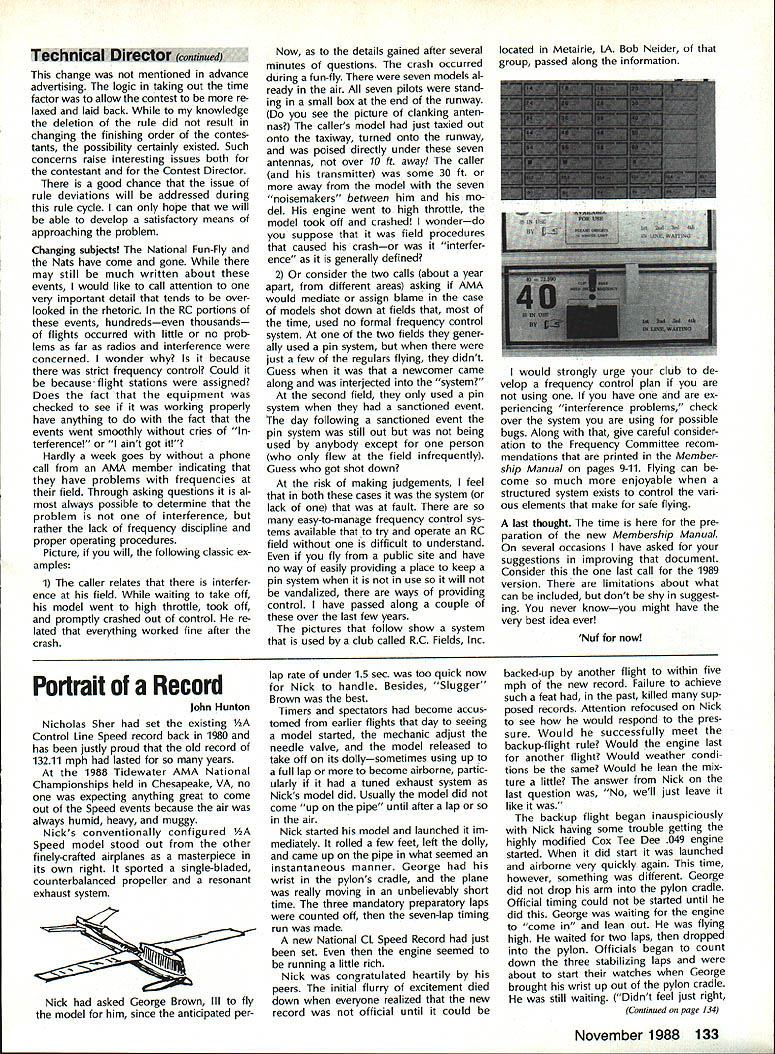
At the risk of making judgements, I feel that in both these cases it was the system (or lack of one) that was at fault. There are so many easy-to-manage frequency control systems available that to try and operate an RC field without one is difficult to understand. Even if you fly from a public site and have no way of easily providing a place to keep a pin system when it is not in use so it will not be vandalized, there are ways of providing control. I have passed along a couple of these over the last few years.
The pictures that follow show a system that is used by a club called R.C. Fields, Inc., located in Metairie, LA. Bob Neider, of that group, passed along the information.
I would strongly urge your club to develop a frequency control plan if you are not using one. If you have one and are experiencing "interference problems," check over the system that you are using for possible bugs. Along with that, give careful consideration to the Frequency Committee recommendations that are printed in the Membership Manual on pages 9–11. Flying can become so much more enjoyable when a structured system exists to control the various elements that make for safe flying.
A last thought. The time is here for the preparation of the new Membership Manual. On several occasions I have asked for your suggestions in improving that document. Consider this the one last call for the 1989 version. There are limitations about what can be included, but don't be shy in suggesting. You never know—you might have the very best idea ever!
'Nuf for now!
More 1990–91 Rules Proposals
We continue to give you the rules proposals in several groups; one group per issue. The first group was printed in the July 1988 edition of the Competition Newsletter beginning on page 113, the second group in the August issue, beginning on page 114, and the third group in the October issue, beginning on page 124. It is our hope that by publishing the proposals at an earlier date (rather than waiting until after the September cutoff date when all of the proposals have arrived at AMA HQ) it will give more time for more modelers to study them and make their views known to the Contest Board(s).
The next deadline in the schedule is the Initial Vote of the Contest Boards. This will occur on December 1, 1988. For a complete explanation of Contest Board procedures, refer to the April 1988 issue, pages 116–119. The results of the Initial Vote will be printed in the March 1989 issue.
Control Line Proposals
- CL-90-25: (Frank E. Williams) Add Quickie Rat Race as a provisional event. The purpose is to provide a racing event that may easily be flown "three up" and which employs relatively inexpensive and easily constructed CL racing models. To encourage and promote the success of the average CL flier in RC racing competition. Models would be restricted to profile fuselage types having completely exposed control systems and .049–.028-in. engines (front-intake, single bypass port, no ABAC/ACC, no variable-area carburetors, no tuned pipes or exhaust extensions, and venturis with a bore of 0.305 in. or less, spraybar 0.155-in. diameter). Fuel would be "standard" 10%-nitromethane, contest-supplied.
- CL-90-26: (Frank E. Williams) A modified version of CL-90-25. Engine venturi bores are restricted according to the age-class of the flier (0.125 in. for Juniors, 0.285 in. for Seniors, and 0.305 in. for Open). It is shown that lap times are a function of venturi bore. The smaller the bore, the slower the plane. Proposed bore sizes are an attempt to match maximum racing speeds to the anticipated capabilities of the pilots.
- CL-90-27: (Stewart Willoughby) Establish National Record categories for AMA and FAI Racing events.
Racing events:
- CL-90-28: (Paul M. Smith) Add provisions for clearing line tangles involving the safety strap in Fast, Slow, and 1/4 Combat. "A single flying aircraft shall be permitted to perform maneuvers such as loops and figure eights while a line tangle is being cleared. During this condition the flying model shall not score air time, and mechanics shall not be permitted to enter the flying circle. Mechanics shall not pilot the downed model. They must immediately remove his wrist strap and assist the flying pilot to clear the line tangle."
- CL-90-29: (Paul M. Smith) Establish policy and penalties for "wrist strap" violations. Essentially requires continuous use of the strap and penalties for not maintaining a hold on the control handle while the engine is running and the model is airborne. Failure to do so will result in minimum score for the flight or disqualification from the event in question (depending on the circumstances).
- CL-90-30: (Paul M. Smith) Permit the engines to be started and the planes to be launched up to two minutes prior to the start of Combat in all events. No air time would be accrued prior to the "go" signal.
- CL-90-31: (Paul M. Smith) Eliminate all reasons for ending a Combat match except for a "kill" in Fast, Slow & 1/4. Amend rules for Event 325, CL Combat; delete paragraphs 8.1, 8.2, etc., and that portion of 9.1 which deals with timing the interval between a crash due to a midair collision and the determination of the flyability of planes. "This proposal will effectively make the AMA match procedure similar to FAI rules. It will also bring the AMA rule book into alignment with the way the event is actually flown at the local level in most areas."
- CL-90-32: (Paul M. Smith) Ban carbon fiber, fiberglass, boron, epoxy, and similar propellers in Combat. Add new paragraph in rules for Event 325, CL Combat: "3.3 Propellers. Only mass-produced wood or molded plastic or nylon propellers may be used. Homemade or limited-production carbon fiber, fiberglass, boron, polyester, or epoxy-type propellers are prohibited."
Transcribed from original scans by AI. Minor OCR errors may remain.

