
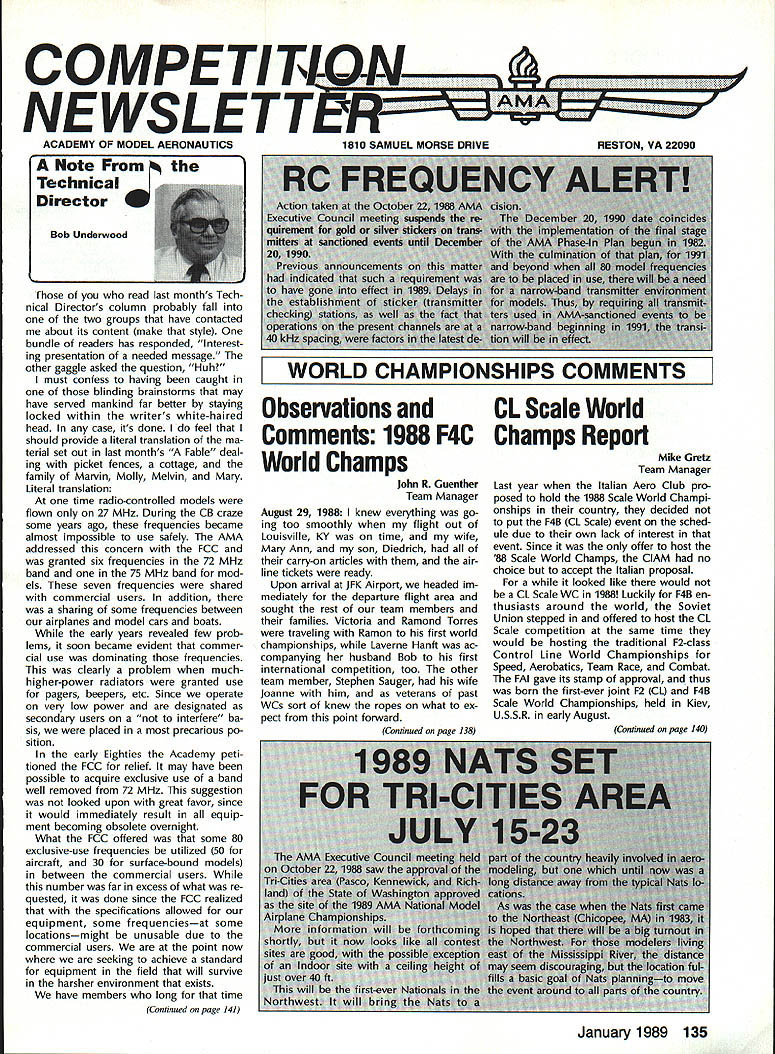
A Note From the Technical Director
Bob Underwood
Those of you who read last month's Technical Director column probably fall into one of two groups that contacted me about its content (make that style). One group responded, "Interesting presentation of a needed message." The other asked, "Huh?" I must confess to having been caught in one of those blinding brainstorms that may have served mankind far better by staying locked within the writer's white‑haired head case. In any case, it's done. I feel I should provide a literal translation of last month's "A Fable" dealing with picket fences, a cottage, and the family of Marvin, Molly, Melvin and Mary.
Literal translation:
At one time radio‑controlled models were flown only on 27 MHz. During the CB craze some years ago these frequencies became almost impossible to use safely. The AMA addressed this concern with the FCC and was granted six frequencies in the 72 MHz band and seven in the 75 MHz band for models. These frequencies were shared with commercial users. In addition, there was sharing of some frequencies between our airplanes and model cars and boats.
While the early years revealed few problems, it soon became evident that commercial use was dominating those frequencies. This was clearly a problem when much higher‑power radiators were granted use for pagers, beepers, etc. Since we operate on very low power and are designated as secondary users on a "not to interfere" basis, we were placed in a most precarious position.
In the early Eighties the Academy petitioned the FCC for relief. It may have been possible to acquire exclusive use of a band well removed from 72 MHz. This suggestion was not looked upon with great favor since it would immediately result in all equipment becoming obsolete overnight.
What the FCC offered was that some 80 exclusive‑use frequencies would be utilized (50 for aircraft and 30 for surface‑bound models) between the commercial users. While this number was far in excess of what was requested, it was done since the FCC realized that equipment on some frequencies at some locations might be unusable due to commercial users. We are now seeking to achieve a standard for equipment in the field that will survive the harsher environment that exists. We have members who long for that time.
Be certain to read the "Frequency Alert" message found elsewhere in this edition of the Competition Newsletter.
Technical Director (continued)
In regard to other matters, consider a few observations about Contest Directors (CDs) and rule‑making. In October 1987 a new policy was instigated that required applicants for CD status to serve a probationary period before the granting of the earned membership. This means new CDs must sanction an event and file the proper report forms before they are removed from probation. From that point on, each time they sanction an event they are awarded an earned membership for the following year. If a new CD sanctions two or more events during the first year of activity, the probationary period will have been fulfilled.
If a CD allows his or her membership to lapse at any time and then rejoins the Academy one or more years later, the CD status will also have lapsed. It will then be necessary to reestablish that status under the procedures in force at that time. This is true even if they are able to reacquire their original CD membership number. Note that if you do not actually serve as the CD for an event you do not lose CD status (nor do you receive an earned membership).
A last thought on CDs: about 200 persons applied between October 1987 and October 1988. Over half of those persons did not act in the capacity of a CD for any event since becoming a CD. That makes you wonder, doesn't it?
On the subject of rule‑making: this year we see a continued movement to provide a number of additional events. Typically many of these are old events with a new twist. As a result we are creating a myriad of events that differ in only very subtle ways. Most of these changes reflect local variations. Such a condition makes running national events quite difficult for both organizers and participants. It surely thwarts efforts to be competitive on the international scene.
There is one frustration that haunts this writer: the effort to create the "easy" event — an event designed so anybody, even the newest competitor, can win. It can't be done. Every time someone comes along with an "entry level" event that is open to anyone, the person who has worked years to hone his skills is still going to win.
Years ago I entered an indoor contest with an Easy B (the world's most misnamed model) because someone convinced me it was the best way to get started in indoor and that I had a better chance to win. Hogwash! Jim Richmond still beat me — by a bundle.
You can work all day designing a simple golf course that the fledgling golfer can win on. But if you let Arnold Palmer play on it against you, you will lose just as badly as you would at the hardest course in the world. We have proven this point repeatedly in every discipline in our sport.
Events that allow the uninitiated and untried to win are not competitive events but "lotteries" designed to allow one and all to win a trophy. There's nothing wrong with that, but "it ain't competition."
Perhaps we should review our rules and see if they reflect the elements of true competition. Maybe we can utilize the concept of pilot skill level to segregate competition so the apprentice doesn't have to take on the master, rather than trying to limit the equipment to perform the task.
What say ye?
'Nuf for now.
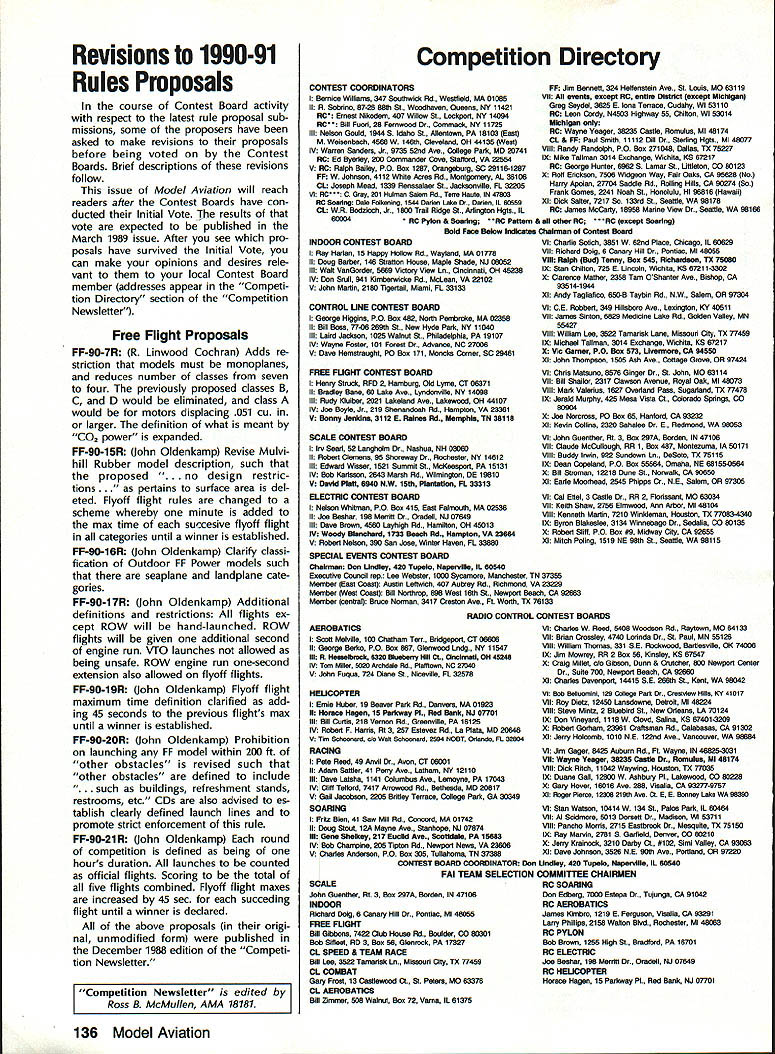
Revisions to 1990–91 Rules Proposals
In the course of Contest Board activity with the latest rule proposal submissions, some proposers have been asked to make revisions to their proposals before being voted on by the Contest Boards. Brief descriptions of these revisions follow.
This issue of Model Aviation will reach readers after the Contest Boards have conducted their Initial Vote. The results of that vote are expected to be published in the March 1989 issue. After you see which proposals have survived the Initial Vote, you can make your opinions and desires relevant to the way your local Contest Board member votes (addresses appear in the "Competition Directory" section of the Competition Newsletter).
Free Flight Proposals
- FF‑90‑7R (R. Linwood Cochran): Adds restriction that models must be monoplanes and reduces number of classes from seven to four. The previously proposed classes B, C, and D would be eliminated; class A would be for motors displacing .051 cu. in. or larger. The definition of "CO2 power" is expanded.
- FF‑90‑15R (John Oldenkamp): Revises Mulvihill rubber model description by deleting the proposed "... no design restrictions ..." language as it pertains to surface area. Flyoff flight rules are changed so that one minute is added to the maximum time of each successive flyoff flight in all categories until a winner is established.
- FF‑90‑16R (John Oldenkamp): Clarifies classification of Outdoor FF Power models such that there are seaplane and landplane categories.
- FF‑90‑17R (John Oldenkamp): Additional definitions and restrictions: all flights except ROW will be hand‑launched. ROW flights will be given one additional second of engine run. VTO launches are not allowed as being unsafe. The ROW engine‑run one‑second extension is also allowed on flyoff flights.
- FF‑90‑19R (John Oldenkamp): Clarifies flyoff flight maximum time definition as adding 45 seconds to the previous flight's maximum until a winner is established.
- FF‑90‑20R (John Oldenkamp): Prohibition on launching any FF model within 200 ft. of "other obstacles" is revised so that "other obstacles" are defined to include "... such as buildings, refreshment stands, restrooms, etc." Contest Directors (CDs) are advised to establish clearly defined launch lines and to promote strict enforcement of this rule.
- FF‑90‑21R (John Oldenkamp): Each round of competition is defined as being one of five flights. The score of the best four flights will be counted as official flights. Scoring to be the total of all five flights combined. Flyoff flight maximums are increased by 45 seconds for each succeeding flight until a winner is declared.
All of the above proposals (in their original, unmodified form) were published in the December 1988 edition of the Competition Newsletter.
Competition Newsletter is edited by Ross B. McMullen, AMA 18181.
Transcribed from original scans by AI. Minor OCR errors may remain.

