
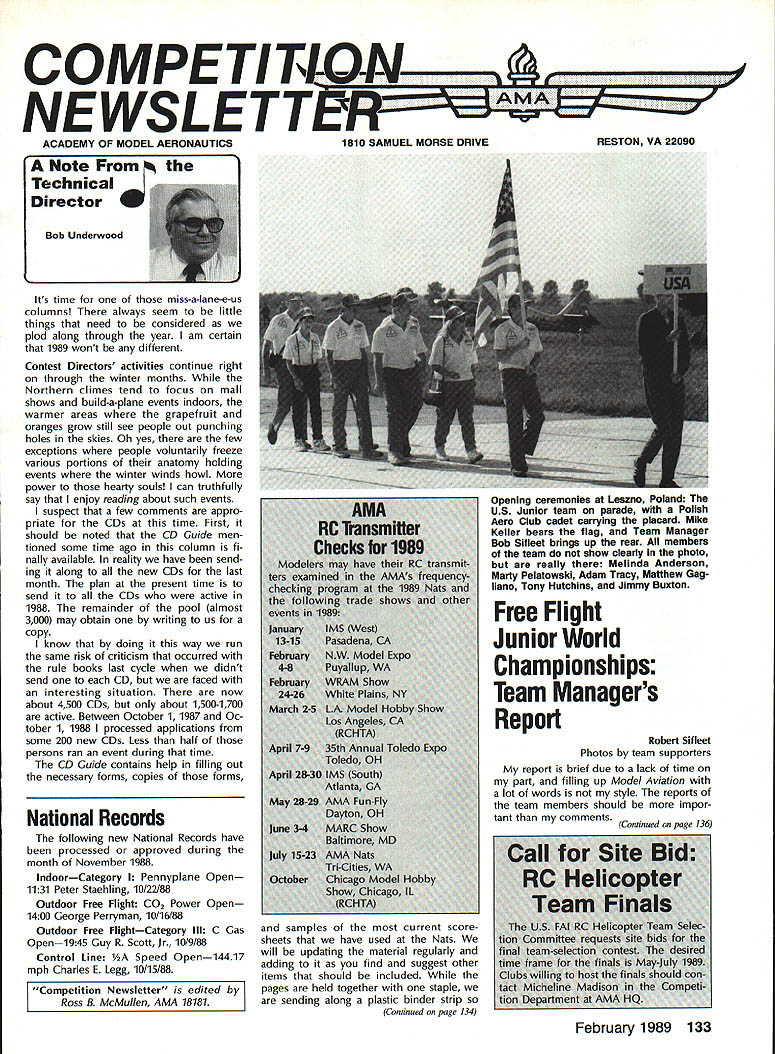
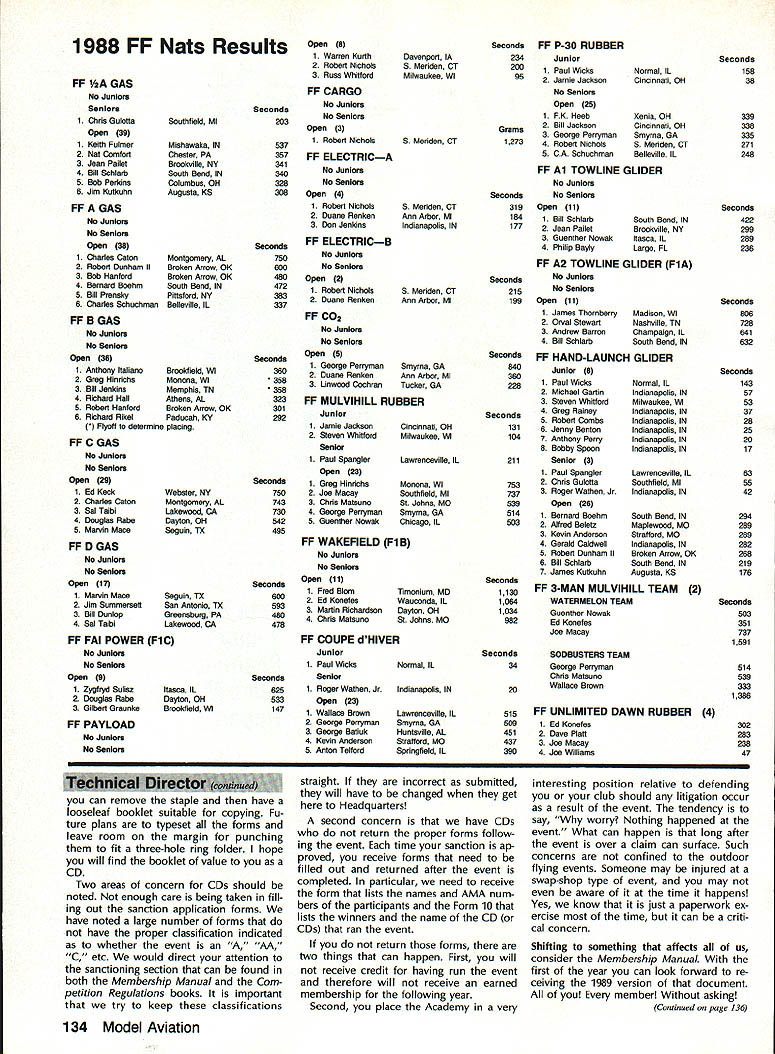
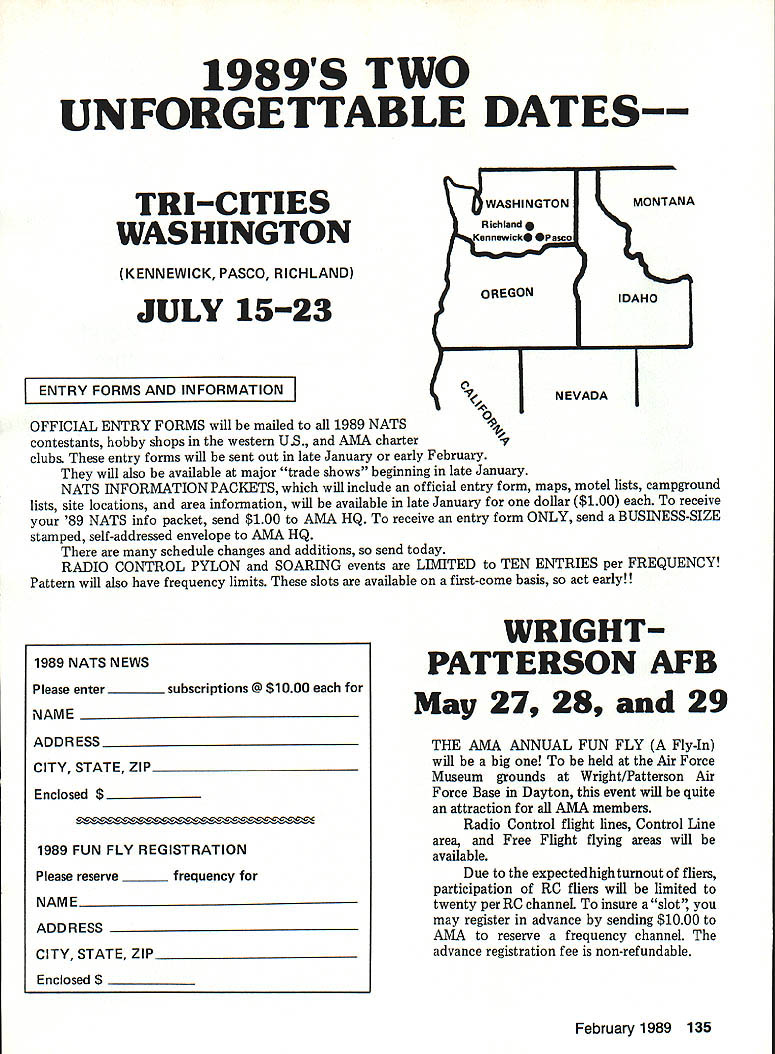
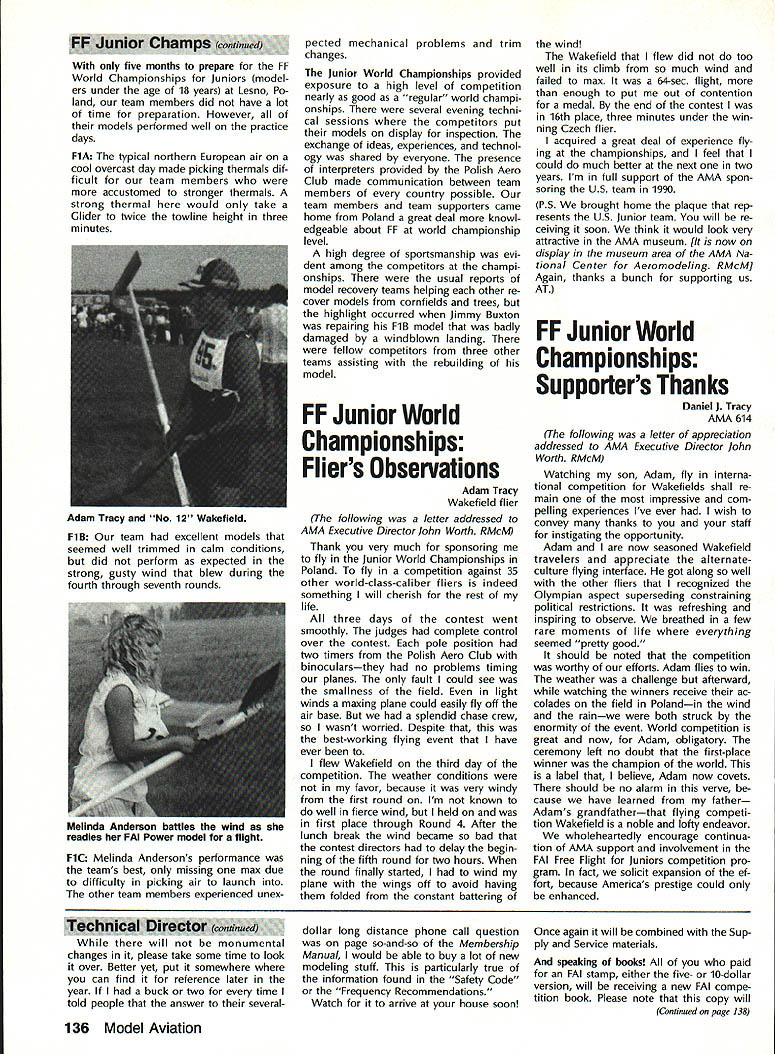
COMPETITION NEWSLETTER
A Note From the Technical Director
Bob Underwood
It's time for one of those miscellaneous columns! There always seem to be little things that need to be considered as we plod along through the year. I am certain that 1989 won't be any different.
Contest Directors' activities continue right on through the winter months. While the Northern climes tend to focus on mall shows and build-a-plane events indoors, the warmer areas where the grapefruit and oranges grow still see people out punching holes in the skies. Oh yes, there are the few exceptions where people voluntarily freeze various portions of their anatomy holding events where the winter winds howl. More power to those hearty souls! I can truthfully say that I enjoy reading about such events.
I suspect that a few comments are appropriate for the CDs at this time. First, it should be noted that the CD Guide mentioned some time ago in this column is finally available. In reality we have been sending it along to all the new CDs for the last month. The plan at the present time is to send it to all the CDs who were active in 1988. The remainder of the pool (almost 3,000) may obtain one by writing to us for a copy.
I know that by doing it this way we run the same risk of criticism that occurred with the rule books last cycle when we didn't send one to each CD, but we are faced with an interesting situation. There are now about 4,500 CDs, but only about 1,500–1,700 are active. Between October 1, 1987 and October 1, 1988 I processed applications from some 200 new CDs. Less than half of those persons ran an event during that time.
The CD Guide contains help in filling out the necessary forms, copies of those forms, and samples of the most current score-sheets that we have used at the Nats. We will be updating the material regularly and adding to it as you find and suggest other items that should be included. While the sheets are held together with one staple, we are sending along a plastic binder strip. You can remove the staple and then have a looseleaf booklet suitable for copying. Future plans are to typeset all the forms and leave room on the margin for punching them to fit a three-hole ring folder. I hope you will find the booklet of value to you as a CD.
Two areas of concern for CDs should be noted. Not enough care is being taken in filling out the sanction application forms. We have noted a large number of forms that do not have the proper classification indicated as to whether the event is an "A," "AA," "C," etc. We would direct your attention to the sanctioning section that can be found in both the Membership Manual and the Competition Regulations books. It is important that we try to keep these classifications straight. If they are incorrect as submitted, they will have to be changed when they get here to Headquarters!
A second concern is that we have CDs who do not return the proper forms following the event. Each time your sanction is approved, you receive forms that need to be filled out and returned after the event is completed. In particular, we need to receive the form that lists the names and AMA numbers of the participants and the Form 10 that lists the winners and the name of the CD (or CDs) that ran the event.
If you do not return those forms, there are things that can happen. First, you will not receive credit for having run the event and therefore will not receive an earned membership for the following year. Second, you place the Academy in an interesting position relative to defending you or your club should any litigation occur as a result of the event. The tendency is to say, "Why worry? Nothing happened at the event." What can happen is that long after the event is over a claim can surface. Such claims are not confined to the outdoor flying events. Someone may be injured at a swap shop type of event, and you may not even be aware of it at the time it happens! Yes, we know that it is just a paperwork exercise most of the time, but it can be a critical situation.
Shifting to something that affects all of us, consider the Membership Manual. With the first of the year you can look forward to receiving the 1989 version of that document. All of you! Every member! Without asking!
Technical Director (continued)
While there will not be monumental changes in it, please take some time to look it over. Better yet, put it somewhere where you can find it for reference later in the year. If I had a buck or two for every time I told people that the answer to their several-dollar long distance phone call question was on page so-and-so of the Membership Manual, I would be able to buy a lot of new modeling stuff. This is particularly true of the information found in the "Safety Code" or the "Frequency Recommendations."
Watch for it to arrive at your house soon!
Once again it will be combined with the Supply and Service materials.
1988 U.S. Free Flight Team Selection Finals
Photos by the author
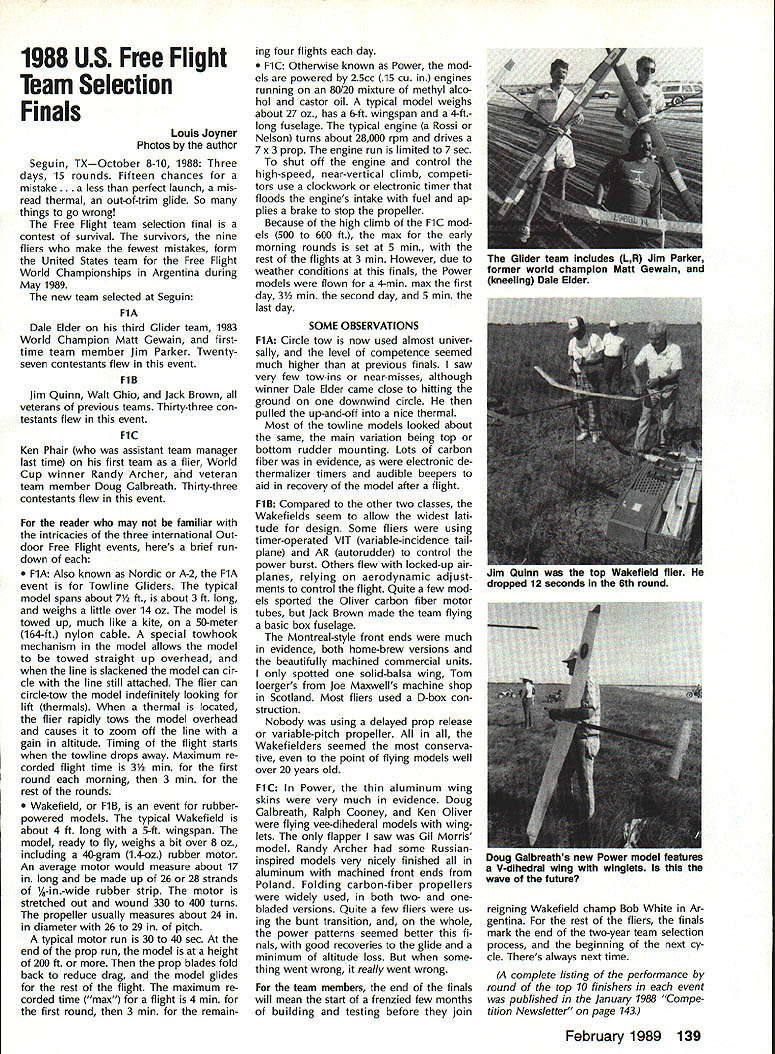
Seguin, TX — October 8–10, 1988: Three days, 15 rounds. Fifteen chances for a mistake — a less than perfect launch, a misread thermal, an out-of-trim glide. So many things to go wrong!
The Free Flight team selection final is a contest of survival. The survivors, the nine fliers who make the fewest mistakes, form the United States team for the Free Flight World Championships in Argentina during May 1989.
The new team selected at Seguin:
- F1A: Dale Elder on his third Glider team, 1983 World Champion Matt Gewain, and first-time team member Jim Parker. Twenty-seven contestants flew in this event.
- F1B: Jim Quinn, Walt Ghia, and Jack Brown, all veterans of previous teams. Thirty-three contestants flew in this event.
- F1C: Ken Phair (who was assistant team manager last time) on his first team as a flier, World Cup winner Randy Archer, and veteran team member Doug Galbreath. Thirty-three contestants flew in this event.
For the reader who may not be familiar with the intricacies of the three international outdoor Free Flight events, here's a brief rundown of each:
- F1A: Also known as Nordic or A-2, the F1A event is for towline gliders. The typical model spans about 7½ ft., is about 3 ft. long, and weighs a little over 14 oz. The model is towed up, much like a kite, on a 50-meter (164-ft.) nylon cable. A special tow-hook mechanism in the model allows the model to be towed straight up overhead, and when the line is slackened the model can circle with the line still attached. The flier can circle the model indefinitely looking for lift (thermals). When a thermal is located, the flier rapidly tows the model overhead and causes it to zoom off the line with a gain in altitude. Timing of the flight starts when the towline drops away. Maximum recorded flight time is 3½ min. for the first round each morning, then 3 min. for the rest of the rounds.
- F1B: Wakefield, or F1B, is an event for rubber-powered models. The typical Wakefield is about 4 ft. long with a 5-ft. wingspan. The model, ready to fly, weighs a bit over 8 oz., including a 40-gram (1.4-oz.) rubber motor. An average motor would measure about 17 in. long and be made up of 26 or 28 strands of 1/4-in.-wide rubber strip. The motor is stretched out and wound 330 to 400 turns. The propeller usually measures about 24 in. in diameter with 26 to 29 in. of pitch. A typical motor run is 30 to 40 sec. At the end of the prop run, the model is at a height of 200 ft. or more. Then the prop blades fold back to reduce drag, and the model glides for the rest of the flight. The maximum recorded time ("max") for a flight is 4 min. for the first round, then 3 min. for the remaining four flights each day.
- F1C: Otherwise known as Power, the models are powered by 2.5 cc (0.15 cu. in.) engines running on an 80/20 mixture of methanol alcohol and castor oil. A typical model weighs about 27 oz., has a 6-ft. wingspan and a 4-ft.-long fuselage. The typical engine (a Rossi or Nelson) turns about 28,000 rpm and drives a 7 × 3 prop. The engine run is limited to 7 sec. To shut off the engine and control the high-speed, near-vertical climb, competitors use a clockwork or electronic timer that floods the engine's intake with fuel and applies a brake to stop the propeller. Because of the high climb of the F1C models (500 to 600 ft.), the max for the early morning rounds is set at 5 min., with the rest of the flights at 3 min. However, due to weather conditions at this finals, the Power models were flown for a 4-min. max the first day, 3½ min. the second day, and 5 min. the last day.
SOME OBSERVATIONS
#### F1A Circle tow is now used almost universally, and the level of competence seemed much higher than at previous finals. I saw very few tow-ins or near-misses, although winner Dale Elder came close to hitting the ground on one downwind circle. He then pulled the up-and-off into a nice thermal.
Most of the towline models looked about the same, the main variation being top- or bottom-rudder mounting. Lots of carbon fiber was in evidence, as were electronic dethermalizers and audible beepers to aid in recovery of the model after a flight.
#### F1B Compared to the other two classes, the Wakefields seem to allow the widest latitude for design. Some fliers were using remote-operated VIT (variable-incidence tailplane) and AR (autorudder) to control the power burst. Others flew with locked-up airplanes, relying on aerodynamic adjustments to control the flight. Quite a few models sported the Oliver carbon-fiber motor tubes, but Jack Brown made the team flying a basic box fuselage.
The Montreal-style front ends were much in evidence, both home-brew versions and the beautifully machined commercial units. I only spotted one solid-balsa wing, Tom Joerger's from Joe Maxwell's machine shop in Scotland. Most fliers used a D-box construction.
Nobody was using a delayed prop release or variable-pitch propeller. All in all, the Wakefielders seemed the most conservative, even to the point of flying models well over 20 years old.
#### F1C In Power, the thin aluminum wing skins were very much in evidence. Doug Galbreath, Ralph Cooney, and Ken Olivier were flying vee-dihedral models with built-in cowl flaps. The only flapper I saw was Gil Morris's model. Randy Archer had some Russian-inspired models very nicely fitted and balanced, along with machined front ends from Poland. Folding carbon-fiber propellers are widely used, with both two- and one-bladed versions. Quite a few fliers were using Futaba reflex systems, with added variable-pitch extensions for power homes.
For the team members, the end of the finals will mean the start of a frenzied few months of building and testing before they join reigning Wakefield champ Bob White in Argentina. For the rest of the fliers, the finals mark the end of the two-year team selection process, and the beginning of the next cycle. There's always next time.
(A complete listing of the performance by round for the top 10 finishers in each event was published in the January 1989 "Competition Newsletter" on page 143.)
RC Aerobatics: Improvements Needed?
Luis Escalona AMA 17594
Last summer I had the pleasure of supporting our U.S. team at the F3A World Championships for the fourth time. Since reading Ron Chidgey's article about last year's championship, I have done quite a bit of thinking.
I — and many of the others with whom I spoke — was quite disturbed by the rather obvious partiality shown by the judges for the European teams, and by the discomfort and disappointment shown by most of the members of the North and Central American teams, as well as by the three European teams which were steamrollered by these judges. In fact, one very famous contestant commented to me that the judges were blind; he felt that he had performed very poorly (because he was not feeling well), while the judges gave him one of the highest single-flight scores of the contest.
Of course this is all water under the bridge now, and it does no one any good to complain about the quality (or lack thereof) of the judging of the past contest. The question is, what can we do to improve our team's chances of winning in the future?
Mr. Chidgey recommends that we try to forget about style. This is all well and good, but even if it were possible, I think that the sport would be worse off without it. Every flight is an expression of the pilot's character and personality, and if that expression is removed there wouldn't be much left. Better to build robots to do the flying. Of course, then the winner would be the team which could afford the best robot — but that's a different subject altogether.
I have some proposals of my own which I'd now like to make; these are based on my own observations and on the comments I've received from a number of world-class fliers.
- Limit the influence of manufacturers, both at the national level as well as at the world championships. At the very least, separate "factory fliers" into their own category at the contest. I think that F3A and AMA competition should both remain amateur events. At each contest I attend, I see more and more instances of factory sponsorship and contestants who are using prototype or other special equipment not available to other contestants or to the modeling community at large. I have also seen contestants who are paid employees of a manufacturer and who may be spending working hours flying and practicing for contests, giving them a competitive advantage.
- Ensure true world representation in the selection of judges for each contest. There should be at least one judge from each geographic area (for example, one each from North, South, and Central America) having a team participating at a world championships. I realize this would increase the cost of holding contests, but I feel it is the only way to ensure impartiality.
- Have the FAI make public all details of world championship competition available to all participating countries 18 months in advance.
- Eliminate the practice of normalizing scores. Use raw scores instead, due to the unbalancing effect of normalization.
- Open the flyoff to at least 15 competitors. Also, start the flyoff fresh with no scores carried over from previous flights.
- Institute novice and sportsman classes of the FAI pattern within the AMA. It does our future U.S. world competition team members no good to start flying one type of pattern while the rest of the world flies another.
That's about it. I'd like to thank you for reading this overly long letter. I'd like to close with one request to all members: Please participate! After all, the AMA is not just the administrator for insurance as many people think it is. The AMA is the representative body for our hobby. Vote!
Transcribed from original scans by AI. Minor OCR errors may remain.

