
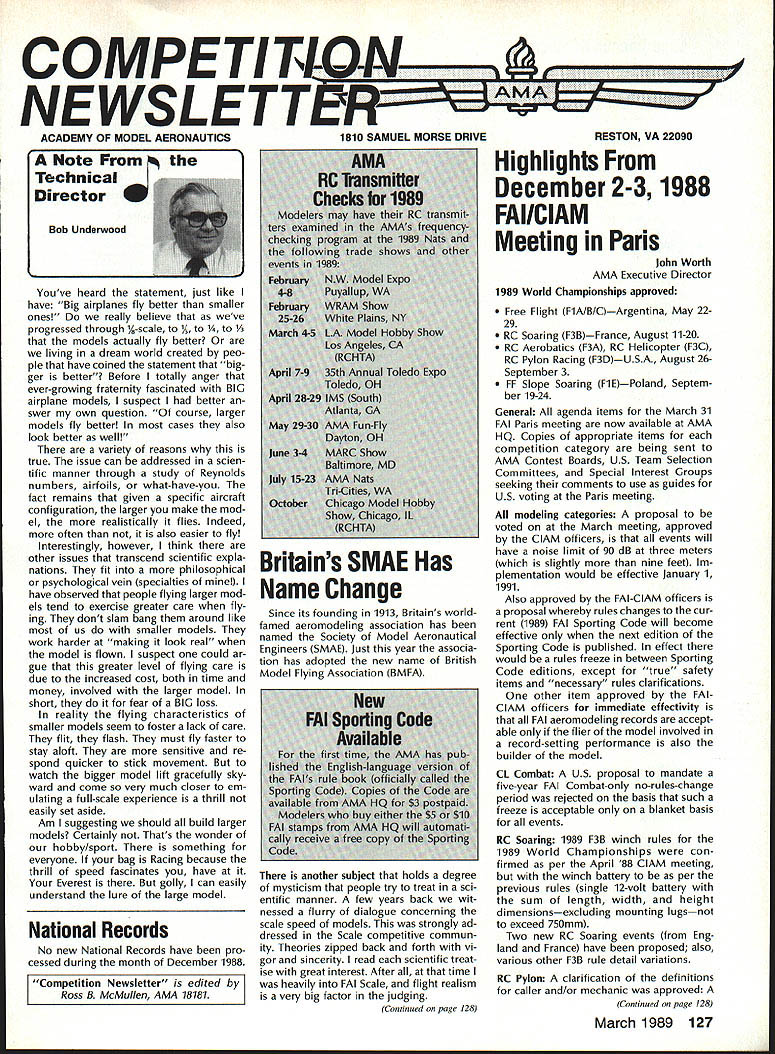
COMPETITION NEWSLETTER
A Note From the Technical Director
Bob Underwood
You've heard the statement, just like I have: "Big airplanes fly better than smaller ones!" Do we really believe that as we've progressed through 1/2-scale, to 3/4, to 1/2, to 1/4 that the models actually fly better? Or are we living in a dream world created by people who coined the statement "bigger is better"?
Before I totally anger the ever-growing fraternity fascinated with BIG airplane models, I suspect I had better answer my own question: of course, larger models often fly better! In most cases they also look better as well.
There are a variety of reasons why this is true. The issue can be addressed scientifically through a study of Reynolds numbers, airfoils, and related factors. The fact remains that given a specific aircraft configuration, the larger you make the model, the more realistically it flies. Indeed, more often than not, it is also easier to fly.
Interestingly, however, other issues transcend scientific explanations. They fit into a more philosophical or psychological vein. I have observed that people flying larger models tend to exercise greater care when flying. They don't slam them around like those with smaller models. They work harder at "making it look real" when the model is flown. I suspect this greater level of care is due to the increased cost, both in time and money, involved with the larger model — in short, they do it for fear of a BIG loss.
In reality, the flying characteristics of smaller models seem to foster a lack of care. They flash and flit; they must fly faster to stay aloft. They are more sensitive and respond quicker to stick movement. But watch the bigger model lift gracefully skyward and come much closer to emulating a full-scale experience. It is a thrill not easily set aside.
Am I suggesting we should all build larger models? Certainly not. That's the wonder of our hobby/sport. There is something for everyone. If your bag is Racing because the thrill of speed fascinates you, have at it. Your Everest is there. But I can easily understand the lure of the large model.
There is another subject that holds a degree of mysticism that people try to treat scientifically: scale speed. A few years back we witnessed a flurry of dialogue concerning the scale speed of models, strongly addressed in the Scale competitive community. Theories zipped back and forth with vigor and sincerity. At that time I was heavily into FAI Scale, and flight realism is a very big factor in judging.
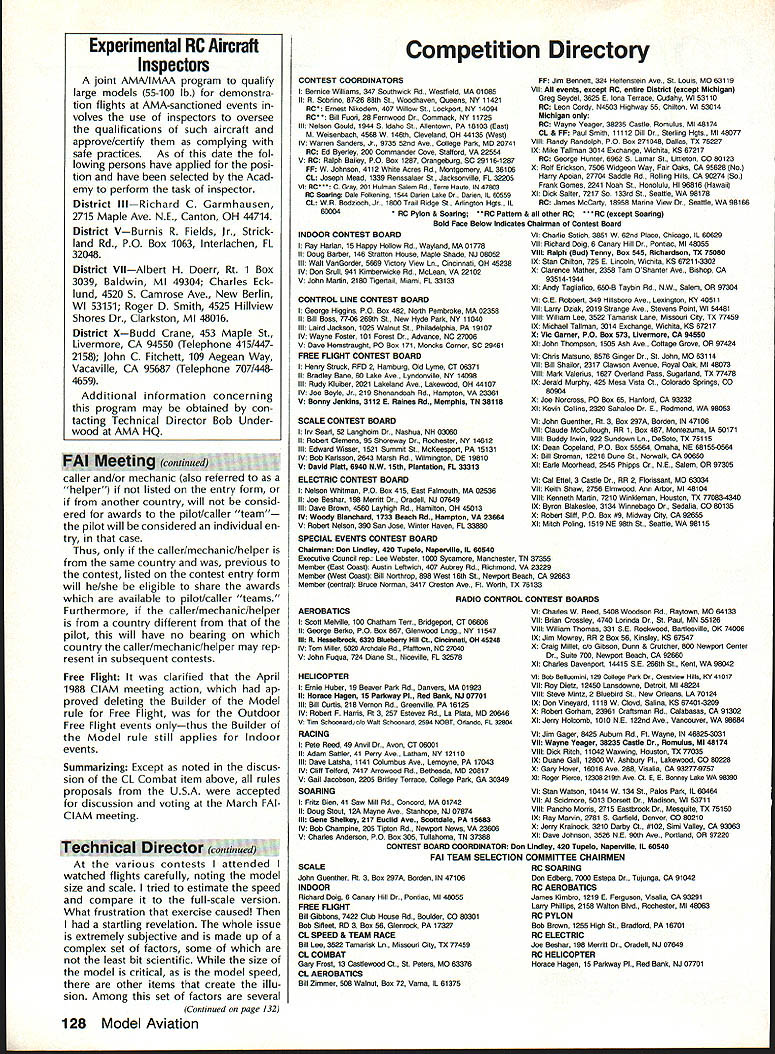
FAI Meeting (continued)
- If a caller and/or mechanic (also referred to as a "helper") is not listed on the entry form, or if the helper is from another country, they will not be considered for awards to the pilot/caller "team" — the pilot will be considered an individual entry in that case.
- Thus, only if the caller/mechanic/helper is from the same country and was, prior to the contest, listed on the contest entry form, will he/she be eligible to share awards available to pilot/caller "teams." If the helper is from a different country than the pilot, this will have no bearing on which country the helper may represent in subsequent contests.
Free Flight: It was clarified that the April 1988 CIAM meeting action, which had approved deleting the Builder of the Model rule for Free Flight, was for Outdoor Free Flight events only — the Builder of the Model rule still applies for Indoor events.
Summarizing: Except as noted in the discussion of the CL Combat item, all rules proposals from the U.S.A. are accepted for discussion and voting at the March FAI-CIAM meeting.
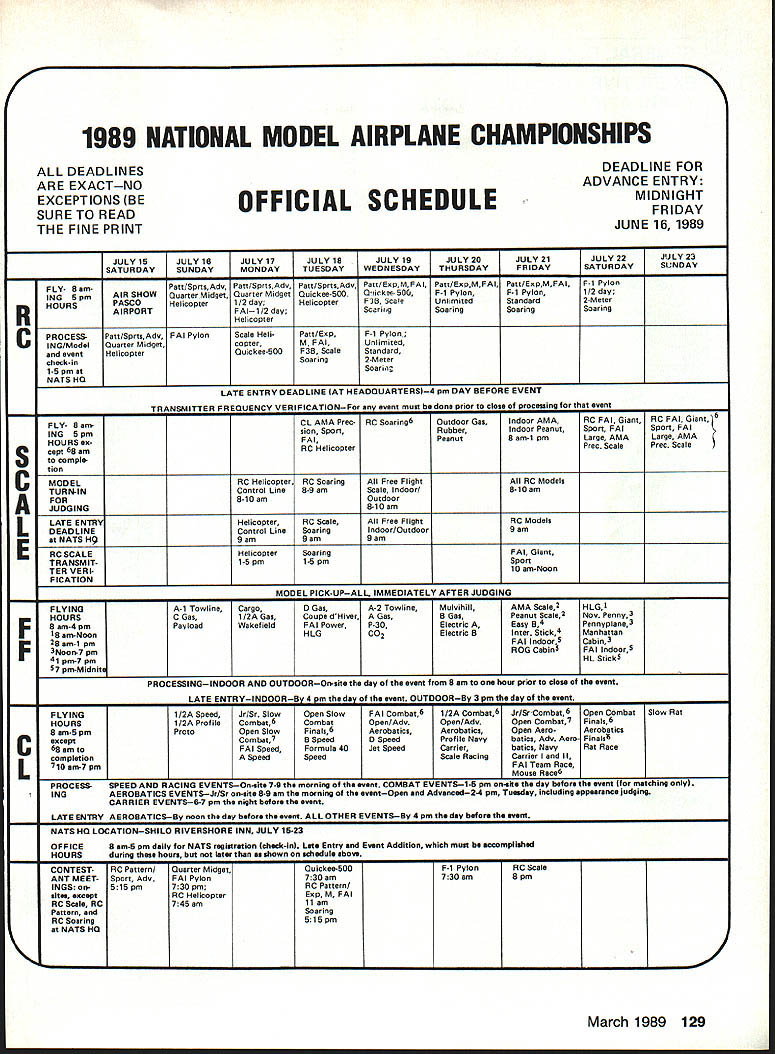
1989 NATIONAL MODEL AIRPLANE CHAMPIONSHIPS
ALL DEADLINES ARE EXACT—NO EXCEPTIONS (BE SURE TO READ THE FINE PRINT)
OFFICIAL SCHEDULE
- Deadline for advance entry: Midnight, Friday, June 16, 1989
- Late entry deadline (at Headquarters): 4:00 pm the day before the event
- Transmitter frequency verification: For any event must be done prior to close of processing for that event
- Model pick-up: All — immediately after judging
Processing (indoor and outdoor)
- On-site the day of the event from 8:00 am to one hour prior to close of the event.
- Late entry — Indoor: By 4:00 pm the day of the event. Outdoor: By 3:00 pm the day of the event.
Processing (speed and racing events)
- On-site 7:00–9:00 am the morning of the event.
- Combat events: 1:00–5:00 pm on the day before the event (for matching only).
- Aerobatics events: Junior/Senior on-site 8:00–9:00 am the morning of the event; Open and Advanced 2:00–4:00 pm Tuesday, including appearance judging.
- Carrier events: 6:00–7:00 pm the night before the event.
- Late entry aerobatics: By noon the day before the event. All other events: By 4:00 pm the day before the event.
NATS HQ Location: Shilo Rivershore Inn, July 16–23
Office hours: 8:00 am–5:00 pm daily for NATS registration (check-in). Late entry and event addition must be accomplished during these hours, but not later than the deadlines shown above.
Contestant meetings: See schedule at NATS HQ
(The full daily schedule lists events by date—July 15 Saturday through July 23 Sunday—including R/C Scale, Free Flight, Control Line categories with specific event times such as FAI Pylon, RC Soaring F3B, RC Aerobatics F3A, RC Helicopter F3C, RC Pylon F3D, and many sport and AMA events. Event-specific processing, transmitter check, and judging times are to follow the table above and are subject to the deadlines noted.)
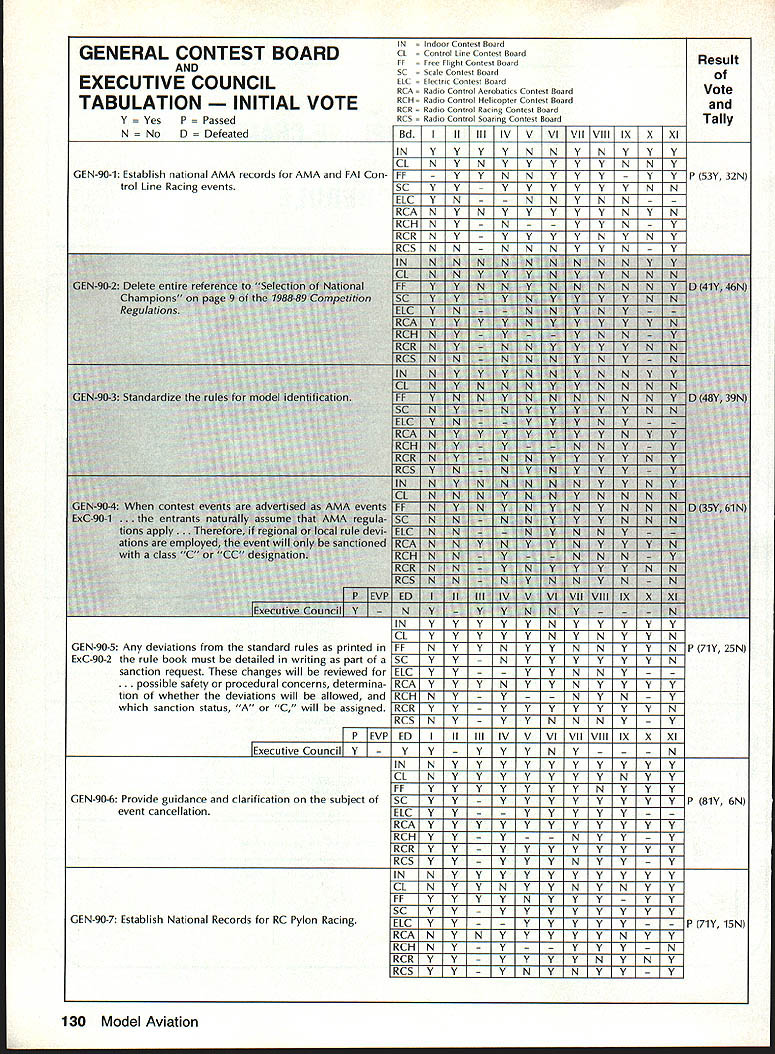
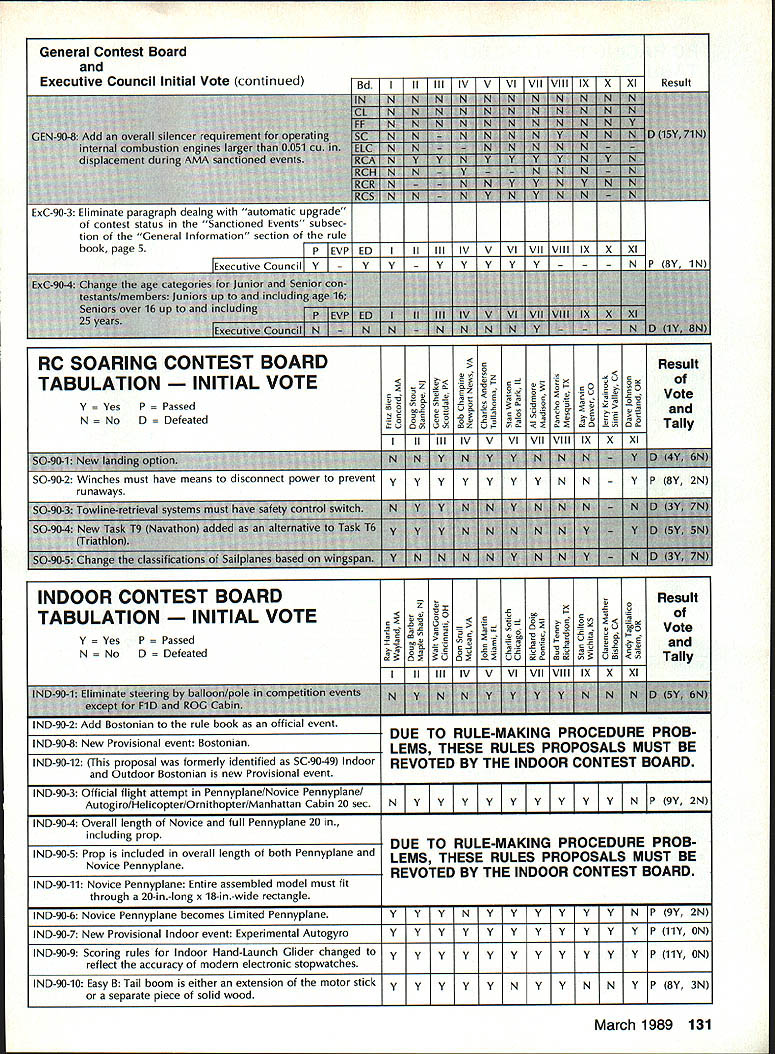
GENERAL CONTEST BOARD AND EXECUTIVE COUNCIL TABULATION — INITIAL VOTE
Board abbreviations:
- IN = Indoor Contest Board
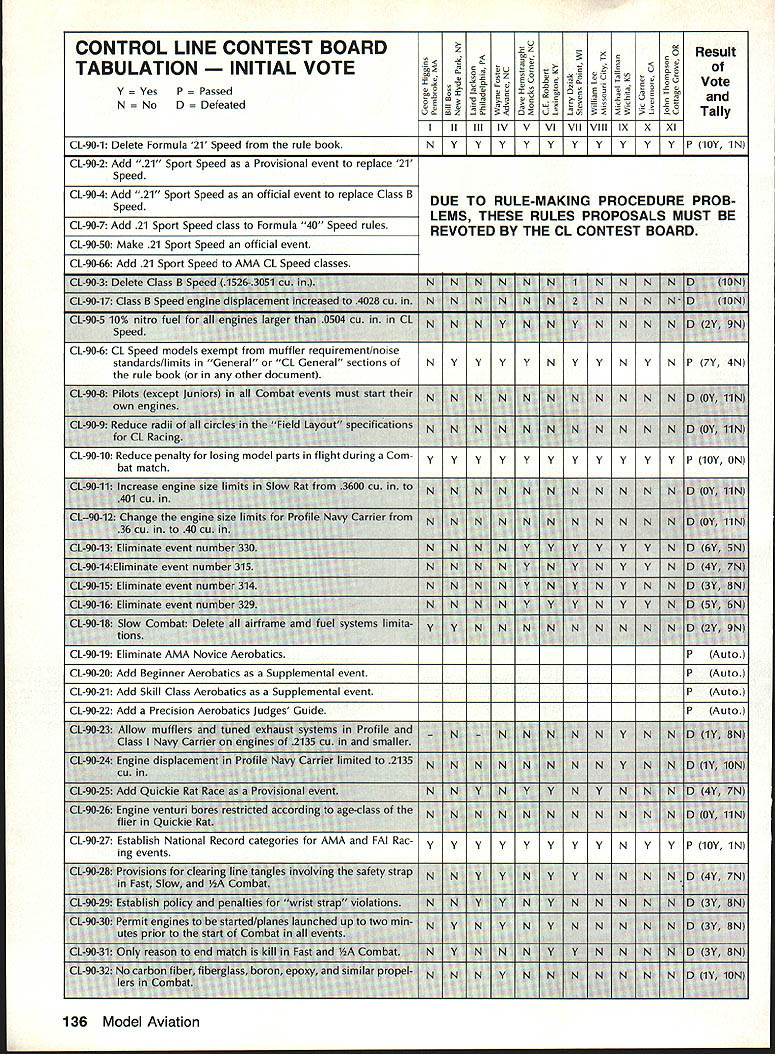
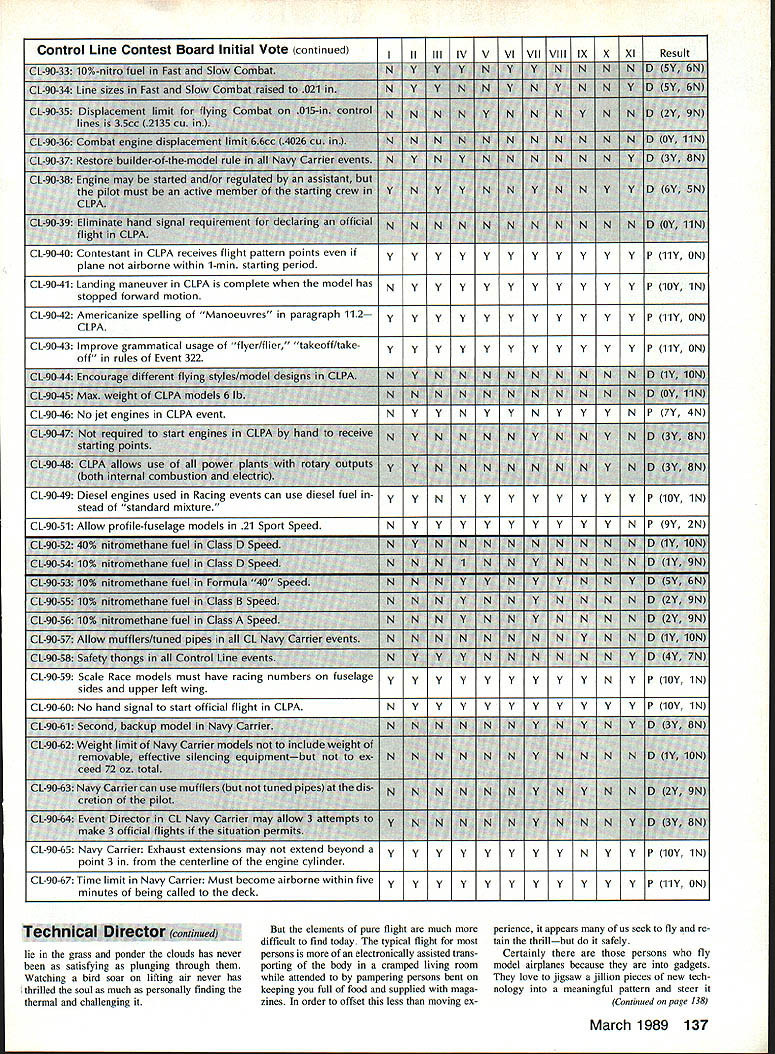
- CL = Control Line Contest Board
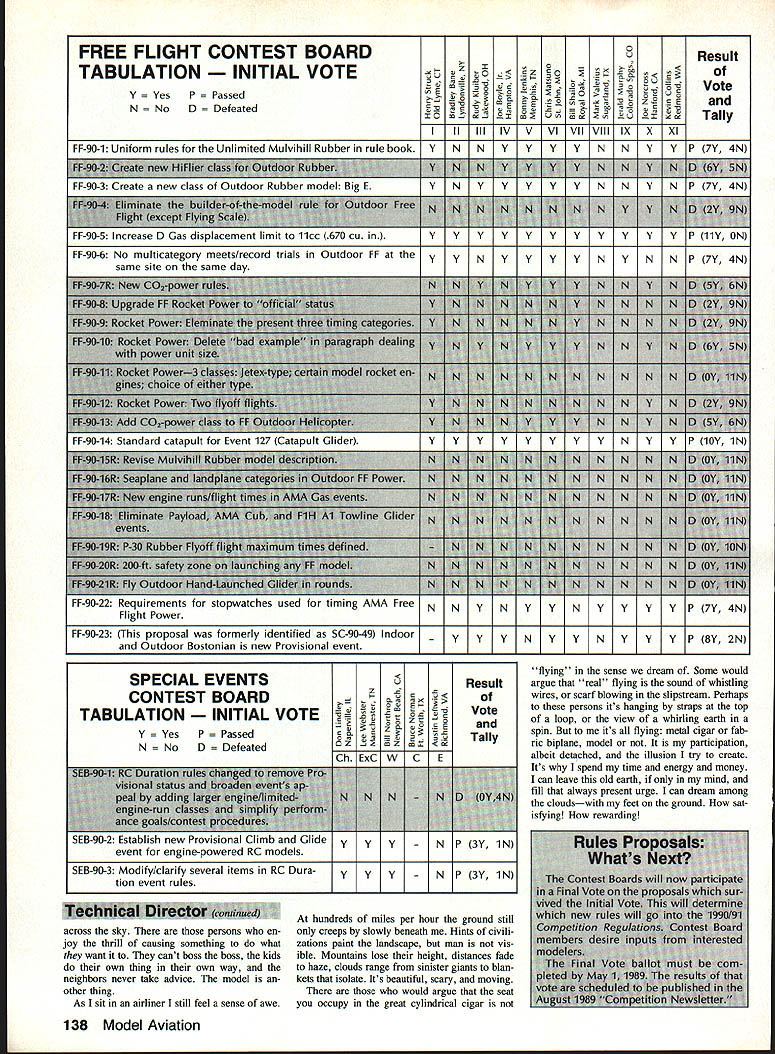
- FF = Free Flight Contest Board
- SC = Scale Contest Board
- ELC = Electric Contest Board
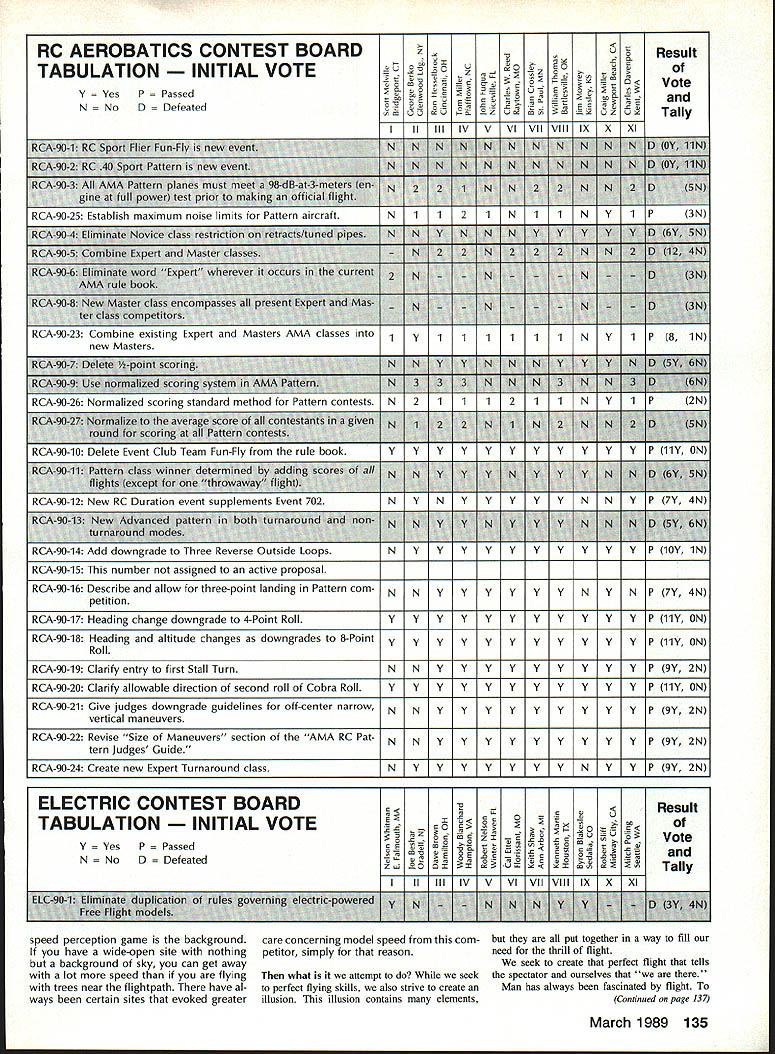
- RCA = Radio Control Aerobatics Contest Board
- RCH = Radio Control Helicopter Contest Board
- RCR = Radio Control Racing Contest Board
- RCS = Radio Control Soaring Contest Board
GEN-90-1: Establish national AMA records for AMA and FAI control line racing events. (P 53Y, 32N)
GEN-90-2: Delete entire reference to "Selection of National Champions" on page 9 of the 1988–89 Competition Regulations. (D 41Y, 46N)
GEN-90-3: Standardize the rules for model identification. (D 48Y, 39N)
GEN-90-4: When contest events are advertised as AMA events the entrants naturally assume that AMA regulations apply. Therefore, if regional or local rule deviations are employed, the event will only be sanctioned with a class "C" or "CC" designation. Executive Council: Y N (D 35Y, 61N)
GEN-90-5: Any deviations from the standard rules as printed in the rule book must be detailed in writing as part of a sanction request. These changes will be reviewed for possible safety or procedural concerns, determination of whether the deviations will be allowed, and which sanction status, "A" or "C," will be assigned. Executive Council: Y Y (P 71Y, 25N)
GEN-90-6: Provide guidance and clarification on the subject of event cancellation. (P 81Y, 6N)
GEN-90-7: Establish national records for RC Pylon Racing. (P 71Y, 15N)
General Contest Board and Executive Council Initial Vote (continued)
GEN-90-8: Add an overall silencer requirement for operating internal combustion engines larger than 0.051 cu. in. displacement during AMA sanctioned events. Result: D (15Y, 71N)
ExC-90-3: Eliminate paragraph dealing with "automatic upgrade" of contest status in the "Sanctioned Events" subsection of the "General Information" section of the rule book, page 5. Executive Council Result: P (8Y, 1N)
ExC-90-4: Change the age categories for Junior and Senior contestants/members: Juniors up to and including age 16; Seniors over 16 up to and including 25 years. Executive Council Result: D (1Y, 8N)
RC Soaring Contest Board Tabulation — Initial Vote
Y = Yes P = Passed N = No D = Defeated
- SO-90-1: New landing option. Result: D (4Y, 6N)
- SO-90-2: Winches must have means to disconnect power to prevent runaways. Result: P (8Y, 2N)
- SO-90-3: Towline-retrieval systems must have safety control switch. Result: D (3Y, 7N)
- SO-90-4: New Task T9 (Navathon) added as an alternative to Task T6 (Triathlon). Result: D (5Y, 5N)
- SO-90-5: Change the classifications of sailplanes based on wingspan. Result: D (3Y, 7N)
Indoor Contest Board Tabulation — Initial Vote
Y = Yes P = Passed N = No D = Defeated
- IND-90-1: Eliminate steering by balloon/pole in competition events except for F1D and ROC Cabin. Result: D (5Y, 6N)
- IND-90-2: Add Bostonian to the rule book as an official event.
- IND-90-8: New provisional event: Bostonian.
- IND-90-12: (Formerly SC-90-49) Indoor and Outdoor Bostonian is new provisional event.
DUE TO RULE-MAKING PROCEDURE PROBLEMS, THESE RULES PROPOSALS MUST BE REVOTED BY THE INDOOR CONTEST BOARD.
- IND-90-3: Official flight attempt in Pennyplane/Novice Pennyplane/Autogyro/Helicopter/Ornithopter/Manhattan Cabin — 20 seconds. Result: N (9Y, 2N)
- IND-90-4: Overall length of Novice and full Pennyplane — 20 in., including prop.
- IND-90-5: Prop is included in overall length of both Pennyplane and Novice Pennyplane.
- IND-90-11: Novice Pennyplane: Entire assembled model must fit through a 20-in.-long x 18-in.-wide rectangle. Result: P (9Y, 2N)
- IND-90-6: Novice Pennyplane becomes Limited Pennyplane. Result: P (9Y, 2N)
- IND-90-7: New provisional indoor event: Experimental Autogyro. Result: P (11Y, 0N)
- IND-90-9: Scoring rules for Indoor Hand-Launch Glider changed to reflect the accuracy of modern electronic stopwatches. Result: P (11Y, 0N)
- IND-90-10: Easy B: Tail boom is either an extension of the motor stick or a separate piece of solid wood. Result: P (8Y, 3N)
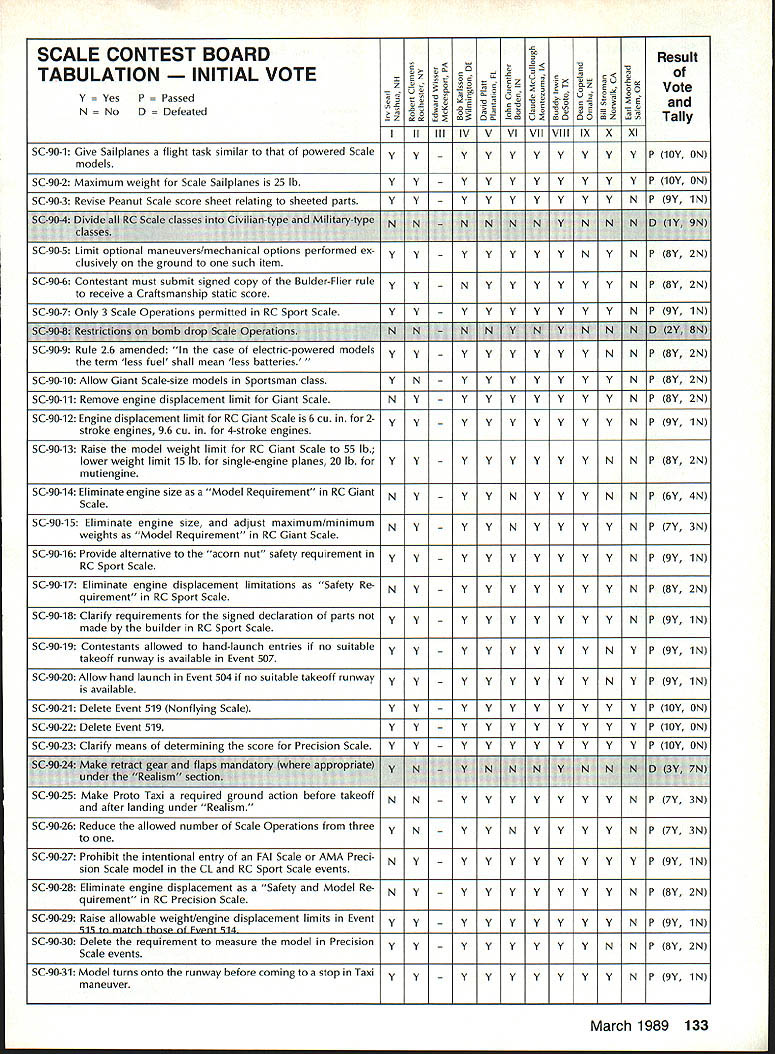
- SC-90-1: Give sailplanes a flight task similar to that of powered Scale models. P (10Y, 0N)
- SC-90-2: Maximum weight for Scale sailplanes is 25 lb. P (10Y, 0N)
- SC-90-3: Revise Peanut Scale score sheet relating to sheeted parts. P (9Y, 1N)
- SC-90-4: Divide all RC Scale classes into Civilian-type and Military-type classes. P (9Y, 1N)
- SC-90-5: Limit optional maneuvers/mechanical options performed exclusively on the ground to one such item. P (8Y, 2N)
- SC-90-6: Contestant must submit signed copy of the Builder-Flier rule to receive a Craftsmanship static score. P (8Y, 2N)
- SC-90-7: Only 3 Scale Operations permitted in RC Sport Scale. P (9Y, 1N)
- SC-90-8: Restrictions on bomb drop Scale Operations. D (2Y, 8N)
- SC-90-9: Rule 2.6 amended: "In the case of electric-powered models the term 'less fuel' shall mean 'less batteries'." P (8Y, 2N)
- SC-90-10: Allow Giant Scale-size models in Sportsman class. P (8Y, 2N)
- SC-90-11: Remove engine displacement limit for Giant Scale. P (9Y, 1N)
- SC-90-12: Engine displacement limit for RC Giant Scale is 6 cu. in. for 2-stroke engines, 9.6 cu. in. for 4-stroke engines. P (9Y, 1N)
- SC-90-13: Raise the model weight limit for RC Giant Scale to 55 lb.; lower weight limit 15 lb. for single-engine planes, 20 lb. for multiengine. P (8Y, 2N)
- SC-90-14: Eliminate engine size as a "Model Requirement" in RC Giant Scale. P (6Y, 4N)
- SC-90-15: Eliminate engine size, and adjust maximum/minimum weights as "Model Requirement" in RC Giant Scale. P (7Y, 3N)
- SC-90-16: Provide alternative to the "acorn nut" safety requirement in RC Sport Scale. P (8Y, 2N)
- SC-90-17: Eliminate engine displacement limitations as "Safety Requirement" in RC Sport Scale. P (8Y, 2N)
- SC-90-18: Clarify requirements for the signed declaration of parts not made by the builder in RC Sport Scale. P (9Y, 1N)
- SC-90-19: Contestants allowed to hand-launch entries if no suitable takeoff runway is available in Event 507. P (9Y, 1N)
- SC-90-20: Allow hand launch in Event 504 if no suitable takeoff runway is available. P (9Y, 1N)
- SC-90-21: Delete Event 519 (Nonflying Scale). P (10Y, 0N)
- SC-90-22: Delete Event 519. P (10Y, 0N)
- SC-90-23: Clarify means of determining the score for Precision Scale. P (10Y, 0N)
- SC-90-24: Make retract gear and flaps mandatory (where appropriate) under the "Realism" section. D (3Y, 7N)
- SC-90-25: Make Proto Taxi a required ground action before takeoff and after landing under "Realism." P (7Y, 3N)
- SC-90-26: Reduce the allowed number of Scale Operations from three to one. P (7Y, 3N)
- SC-90-27: Prohibit the intentional entry of an FAI Scale or AMA Precision Scale model in the CL and RC Sport Scale events. P (9Y, 1N)
- SC-90-28: Eliminate engine displacement as a "Safety and Model Requirement" in RC Precision Scale. P (9Y, 1N)
- SC-90-29: Raise allowable weight/engine displacement limits in Event 515 to match those of Event 514. P (9Y, 1N)
- SC-90-30: Delete the requirement to measure the model in Precision Scale events. P (8Y, 2N)
- SC-90-31: Model turns onto the runway before coming to a stop in Taxi maneuver. P (9Y, 1N)
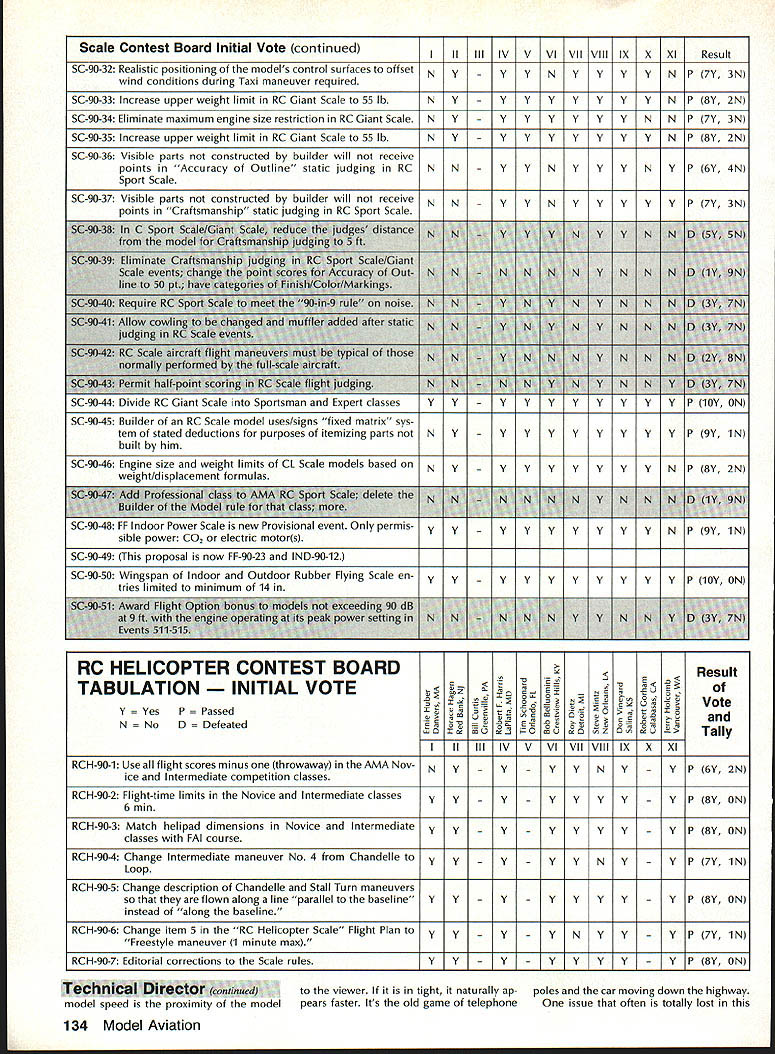
- SC-90-32: Realistic positioning of the model's control surfaces to offset wind conditions during Taxi maneuver required.
- SC-90-33: Increase upper weight limit in RC Giant Scale to 55 lb.
- SC-90-34: Eliminate maximum engine size restriction in RC Giant Scale.
- SC-90-35: Increase upper weight limit in RC Giant Scale to 55 lb.
- SC-90-36: Visible parts not constructed by builder will not receive points in "Accuracy of Outline" static judging in RC Sport Scale.
- SC-90-37: Visible parts not constructed by builder will not receive points in "Craftsmanship" static judging in RC Sport Scale.
- SC-90-38: In C Sport Scale/Giant Scale, reduce the judges' distance from the model for Craftsmanship judging to 5 ft.
- SC-90-39: Eliminate Craftsmanship judging in RC Sport Scale/Giant Scale events; change the point scores for Accuracy of Outline to 50 points; have categories of Finish/Color/Markings.
- SC-90-40: Require RC Sport Scale to meet the "90-in-9" rule on noise.
- SC-90-41: Allow cowling to be changed and muffler added after static judging in RC Scale events.
- SC-90-42: RC Scale aircraft flight maneuvers must be typical of those normally performed by the full-scale aircraft.
- SC-90-43: Permit half-point scoring in RC Scale flight judging.
- SC-90-44: Divide RC Giant Scale into Sportsman and Expert classes.
- SC-90-45: Builder of an RC Scale model uses/signs "fixed matrix" system of stated deductions for purposes of itemizing parts not built by the builder.
- SC-90-46: Engine size and weight limits of CL Scale models based on weight/displacement formulas.
- SC-90-47: Add Professional class to AMA RC Sport Scale; delete the Builder of the Model rule for that class.
- SC-90-48: FF Indoor Power Scale is new provisional event. Only permissible power: CO2 or electric motor(s).
- SC-90-49: (This proposal is now FF-90-23 and IND-90-12.)
- SC-90-50: Wingspan of Indoor and Outdoor Rubber Flying Scale entries limited to minimum of 14 in.
- SC-90-51: Award Flight Option bonus to models not exceeding 90 dB at 9 ft. with the engine operating at its peak power setting in Events 511–515.
- RCH-90-1: Use all flight scores minus one (throwaway) in the AMA Novice and Intermediate competition classes.
- RCH-90-2: Flight-time limits in the Novice and Intermediate classes — 6 minutes.
- RCH-90-3: Match helipad dimensions in Novice and Intermediate classes with FAI course.
- RCH-90-4: Change Intermediate maneuver No. 4 from Chandelle to Loop.
- RCH-90-5: Change description of Chandelle and Stall Turn maneuvers so that they are flown along a line "parallel to the baseline" instead of "along the baseline."
- RCH-90-6: Change Item 5 in the "RC Helicopter Scale" Flight Plan to "Freestyle maneuver (1 minute max)."
- RCH-90-7: Editorial corrections to the Scale rules.
- Free Flight F1A/B/C — Argentina, May 22–29
- RC Soaring F3B — France, August 11–20
- RC Aerobatics F3A
- RC Helicopter F3C
- RC Pylon Racing F3D — USA, August 26–September 3
- FF Slope Soaring F1E — Poland, September 19–24
- March 31 FAI Paris meeting materials are available. AMA HQ copies of appropriate items in each competition category are being sent to AMA Contest Boards, US Team Selection Committees, and Special Interest Groups seeking comments. Use these guides for US voting at the Paris meeting.
- Modeling categories proposal voted at the March meeting approved.
- CIAM officers: events will have a noise limit of 90 dB at three meters (approximately nine feet). Implementation effective January 1, 1991.
- Also approved: FAI-CIAM officers' proposal whereby rules changes to the current 1989 FAI Sporting Code will become effective with the next edition of the Sporting Code. The effect would be a rules freeze between Sporting Code editions except for true safety items and necessary rules clarifications.
- Another item approved by FAI-CIAM officers, effective immediately: for FAI aeromodeling records, the acceptable flier of the model involved in record-setting performance is also considered the builder of the model.
- CL Combat: U.S. proposal to mandate a five-year FAI Combat-only no-rules-change period was rejected; a blanket freeze is not acceptable for events.
- RC Soaring: 1989 F3B winch rules for the 1989 World Championships confirmed per April 1988 CIAM meeting. Winch battery per previous rules: single 12-volt battery; sum of length + width + height dimensions (excluding mounting lugs) not to exceed 750 mm.
- Two new RC Soaring events (England, France) have been proposed; various other F3B rule detail variations have been discussed.
- RC Pylon: clarification of definitions was discussed.
- FF-90-1: Uniform rules for the Unlimited Mulvihill Rubber in rule book.
- FF-90-2: Create new HiFlier class for Outdoor Rubber.
- FF-90-3: Create a new class of Outdoor Rubber model: Big E.
- FF-90-4: Eliminate the builder-of-the-model rule for Outdoor Free Flight (except Flying Scale).
- FF-90-5: Increase D Gas displacement limit to 11cc (.670 cu. in.).
- FF-90-6: No multicategory meets/record trials in Outdoor FF at the same site on the same day.
- FF-90-7R: New CO2-power rules.
- FF-90-8: Upgrade FF Rocket Power to "official" status.
- FF-90-9: Rocket Power: Eliminate the present three timing categories.
- FF-90-10: Rocket Power: Delete "bad example" in paragraph dealing with power unit size.
- FF-90-11: Rocket Power — three classes: Jetex-type; certain model rocket engines; choice of either type.
- FF-90-12: Rocket Power: Two flyoff flights.
- FF-90-13: Add CO2-power class to FF Outdoor Helicopter.
- FF-90-14: Standard catapult for Event 127 (Catapult Glider).
- FF-90-15R: Revise Mulvihill Rubber model description.
- FF-90-16R: Seaplane and landplane categories in Outdoor FF Power.
- FF-90-17R: New engine runs/flight times in AMA Gas events.
- FF-90-18: Eliminate Payload, AMA Cub, and F1H A1 Towline Glider events.
- FF-90-19R: P-30 Rubber Flyoff flight maximum times defined.
- FF-90-20R: 200-ft. safety zone on launching any FF model.
- FF-90-21R: Fly Outdoor Hand-Launched Glider in rounds.
- FF-90-22: Requirements for stopwatches used for timing AMA Free Flight Power.
- FF-90-23: (Formerly SC-90-49) Indoor and Outdoor Bostonian is new provisional event.
- SEB-90-1: RC Duration rules changed to remove Provisional status and broaden event's appeal by adding larger engine/limited-engine-run classes and simplify performance goals/contest procedures.
- SEB-90-2: Establish new provisional Climb and Glide event for engine-powered RC models.
- SEB-90-3: Modify/clarify several items in RC Duration event rules.
- National records: No new national records were processed during December 1988.
- Britain's SMAE has a name change: Since its founding in 1913, Britain's association was the Society of Model Aeronautical Engineers (SMAE). The association has adopted a new name: the British Model Flying Association (BMFA).
SCALE CONTEST BOARD TABULATION — INITIAL VOTE
Y = Yes P = Passed N = No D = Defeated
RC HELICOPTER CONTEST BOARD — INITIAL VOTE
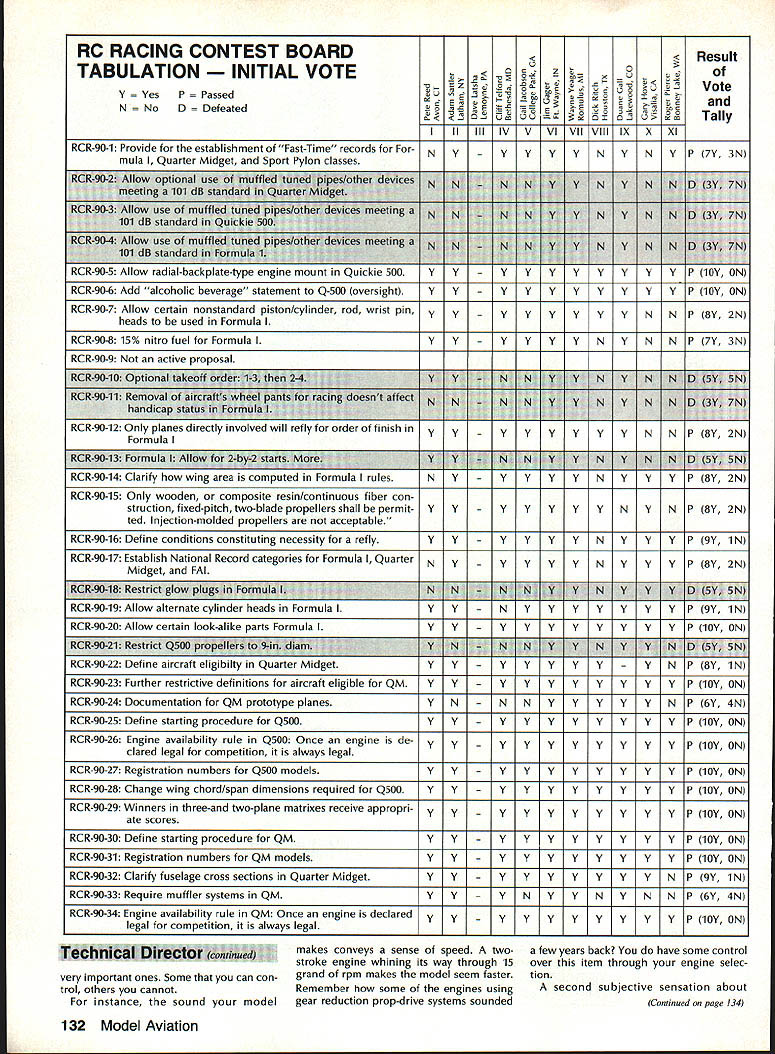
Technical Director (continued)
The speed perception game is the background. If you have a wide-open site with nothing but a background of sky, you can get away with a lot more speed than if you are flying with trees near the flight path. There have always been certain sites that evoke greater care concerning model speed from competitors, simply for that reason.
Then what is it we attempt to do? While we seek to perfect flying skills, we also strive to create an illusion. This illusion contains many elements, but they are all put together in a way to fill our need for the thrill of flight.
We seek to create that perfect flight that tells the spectator and ourselves that "we are there." Man has always been fascinated by flight. To be sure, you've heard the statement just like this: "Big airplanes fly better than smaller ones." People really believe it. As you progress through 1/2-scale, 1/3-scale, etc., the larger ones actually fly better. The dream world created by people who coined "bigger is better" is persuasive, but the experience and science support the larger-model advantage in many cases.
As I sit in an airliner I still feel a sense of awe. At hundreds of miles per hour the ground still only creeps by slowly beneath me. Hints of civilization pass in the landscape, but man is not visible. Mountains lose their height, distances fade to haze, clouds range from sinister giants to blankets that isolate. It's beautiful, scary, and moving.
There are those who would argue that the thing you occupy in the great cylindrical cigar is not "flying" in the sense we dream of. Some would argue that "real" flying is the sound of whistling wires or a scarf blowing in the slipstream. Perhaps to these persons it's hanging by straps at the top of a loop, or the view from a whirling earth in a spin. But to me it's all flying: metal cigar or fabric biplane, model or not. It is my participation, albeit detached, and the illusion I try to create. It's why I spend my time, energy, and money. I can leave this old earth, if only in my mind, and into the clouds — what a treat. How satisfying! How rewarding!
Rules Proposals: What's Next?
The Contest Boards will now participate in a Final Vote on the proposals which survived the Initial Vote. This will determine which new rules will go into the 1990/91 Competition Regulations. Contest Board members desire input from interested modelers.
The Final Vote ballot must be completed by May 1, 1989. The results of that vote are scheduled to be published in the August 1989 "Competition Newsletter."
FAI SCALE JUDGE RESPONDS TO CRITICISM
Eric Coates, Fareham, England
I have read the report on the 1988 F4C World Championships in the January issue of the AMA "Competition Newsletter," by John Guenther, with dismay. Dismay is not only for the personal attack on myself and the remainder of the judges, but also for the sheer inaccuracies of many statements in his report.
I trust you will allow me space in your newsletter to put the case for my team of judges and correct some of John's statements.
Firstly, may I state that I have been a scale modeler for over 40 years, have judged nationally for nearly 30 years, and judged in six previous Scale World Championships. With this experience I have learned that you do not criticize the work of static judges without all the details in front of you; i.e., the full documentation and the model. Many of us least experienced fall into the trap of seeing a well-built, well-finished, and detailed model — without its documentation — and instantly consider it to be of top standard worthy of the highest marks. If that were the case there would be no need for judges — just an audience appreciation panel!
FAI static Scale judging today places most emphasis on accuracy of scale, details, and workmanship when judged at a distance of 0.5 to 1.0 meter. There is, therefore, much less emphasis on the model details and very much less on the observed interior detail than was the case a few years ago. A surprisingly large number of models at Cambrils had major errors in shapes. Some of them, I believe, were deliberate to assist flying qualities, such as thickened wing sections and lengthened noses. Others were genuine mistakes, often because the C.G. drawing they were working to did not agree with the prime documentation, i.e., the photographs. Ramon Torres' T-44A, I am afraid, came into this category. The engine nacelle line was set far too low in relation to the fuselage. It was not the flawless model John Guenther states it was.
A Chief Judge should be selected because of his ability and long experience to spot errors such as this quickly. Contrary to John's statement, there is less time to nit-pick than ever before. The entry list in 1988 for F4C was nearly twice as long as in 1982. It requires half an hour to judge a model properly in this class. This leaves no time for frivolous dissertation.
The method adopted this year, aided by the excellent rotating table provided by the Italian organizers (a must for all future world championships), was to pose the model in the attitude presented in the documentation photographs and note the errors. The whole panel of judges then discussed the marks to be awarded in each category. Far from the "revolt" reported by John, there was harmonious agreement, within half a point, among all the judges on practically every occasion. Only once did all disagree on one error. During the final review of all the marks, Cavenick considered that none of the Czechoslovakian models should have its marks upgraded. By a majority of 4:1 this was disallowed.
All the models entered, even the top-marked DH.98 of McDermott, had errors. Some obviously more serious than others. The job of the judges is to grade these errors to reflect the correct static mark. This will always be a bone of contention among modelers who don't like their errors to be found and corresponding marks deducted.
At national competitions, certainly among some nations, static judging is limited and of a lower standard and perhaps the quality of the judging less searching; they get high marks. It comes hard when they get lower marks in a world championship. To please all the contestants, static marks should be awarded between 9 and 10 throughout. To do so would be to make the competition a mockery, and the judges would not be obeying the instructions given in the "Judges Guide."
The team of judges worked very hard this year to try and achieve a fair result without national bias. To ensure this, while U.K. models were being judged, for instance, I left it to the other four judges to suggest the marks. We also found many errors which were apparently based on under-documentation by individual entrants. What is more, in order that the entrants may learn at world championships during the judging, I always keep notes as to the faults found in the various models. At the conclusion of static judging I then make a point of discussing these errors with the contestants who are willing to listen. This provides various reactions, often dependent on the nationality of the listener. I have always had warm and friendly relations with the American teams who usually take note of the discussions in the spirit intended.
I distinctly remember on this occasion mentioning the nacelle error to Ramon Torres. He at first showed his model and documentation, then showed the original photograph. He accepted the error and immediately said I was wrong, and we then both turned out to be right. From then on he conceded the error and apologized.
I also had long discussions with Bob Hanft regarding the reasons for his low marks. These were as much due to substandard documentation as to inaccuracies on his Nieuport 28. He again thanked me for the time taken to explain.
Within the foregoing background, I therefore find the remarks made by John Guenther about the fairness of the judging hard to take. Perhaps further study of the FAI rule book and the "Judges Guide," plus further discussions with members of the U.S.A. team, may bring forth a moderation in his views.
HIGHLIGHTS — December 2–3, 1988 FAI/CIAM Meeting, Paris
John Worth, AMA Executive Director
1989 World Championships approved:
General agenda items:
FREE FLIGHT CONTEST BOARD TABULATION — INITIAL VOTE
Y = Yes P = Passed N = No D = Defeated
SPECIAL EVENTS CONTEST BOARD TABULATION — INITIAL VOTE
Y = Yes P = Passed N = No D = Defeated
ACADEMY OF MODEL AERONAUTICS
1810 Samuel Morse Drive Reston, VA 22090
Technical Director: Bob Underwood
Transcribed from original scans by AI. Minor OCR errors may remain.

