
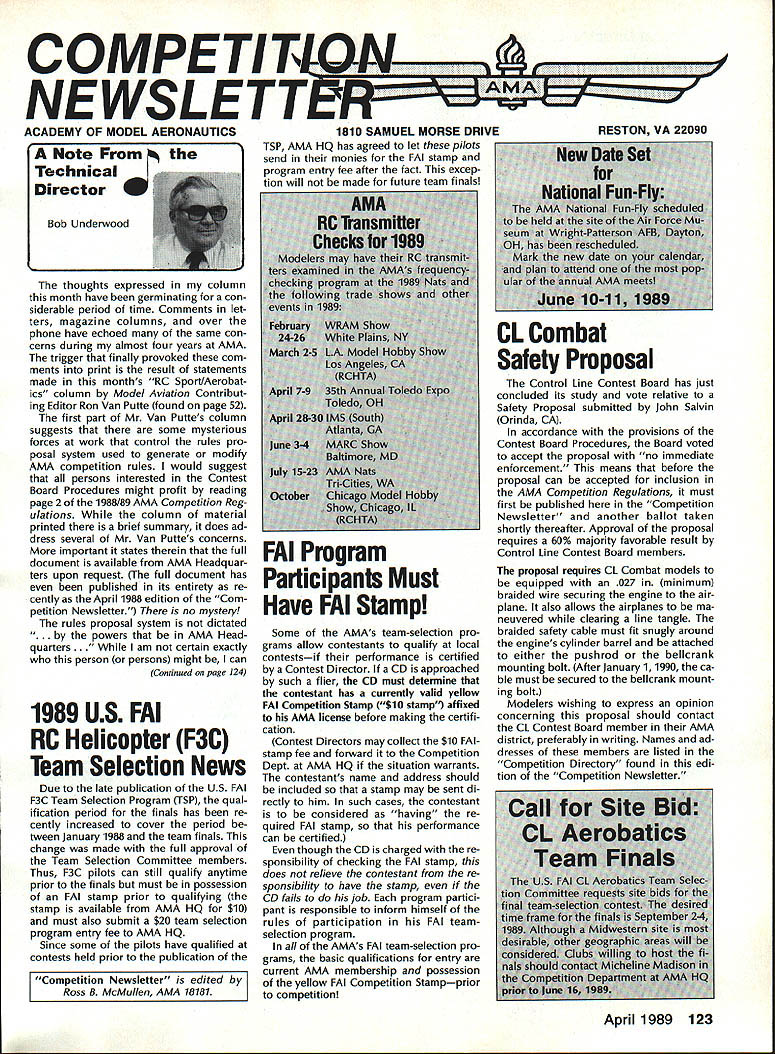
Competition Newsletter
A Note from the Technical Director
Bob Underwood
The thoughts expressed in my column this month have been germinating for a considerable period of time. Comments in letters, magazine columns, and over the phone have echoed many of the same concerns during my almost four years at AMA. The trigger that finally provoked these comments into print is the result of statements made in this month's "RC Sport/Aerobatics" column by Model Aviation contributing editor Ron Van Putte (found on page 52).
The first part of Mr. Van Putte's column suggests that there are some mysterious forces at work that control the rules proposal system used to generate or modify AMA competition rules. I would suggest that all persons interested in the Contest Board procedures might profit by reading page 2 of the 1988/89 AMA Competition Regulations. While the material printed there is a brief summary, it does address several of Mr. Van Putte's concerns. More important, it states that the full document is available from AMA Headquarters upon request. (The full document was even published in its entirety as recently as the April 1988 edition of the Competition Newsletter.) There is no mystery! The rules proposal system is not dictated by some unknown power at AMA Headquarters. While I am not certain exactly who this person (or persons) might be, I can assure you that the staff of the Competition Department is simply committed to fulfilling the requirements set forth within the "Contest Board Procedure" document.
As noted in the rule book, that document undergoes revision by joint Contest Board chairperson/Executive Council action. Any suggestions concerning changes should be directed to either of those parties. No mystery there at all. Certainly none of the decisions designed to alter the system are made at a "lower level."
Mr. Van Putte has suggested that a one-man rule was at the core of the system. There may be such a competitor. At one point in time such a thing was attempted — and then quickly abandoned. While I was not at Headquarters during that period, I have been given to understand the one-year cycle was abandoned because it did not allow for the functioning of two ingredients deemed important to the rules change cycle:
- The time frame required for proper internal Contest Board communications, combined with the lead time for magazine reproduction (which is the vehicle we use in an attempt to keep all interested AMA members informed as to what is being proposed and how the various Contest Boards voted), did not allow adequate time for general member input before the Contest Boards' final vote. While it grieves us to have to admit it, we must state that little actual member comment (to the Contest Boards) in fact occurs; however, the retention of this democratic aspect in the process is considered to be very important.
- For large portions of the United States there was little or no opportunity to use the next set of rules in actual competition before the next cycle began (under the one-year cycle). It should be noted that a common complaint for many years — that the new rule book was late getting distributed — has not occurred the last two cycles.
While it may be true that this era of electronic communications affords the opportunity to shorten the response times involved in the system, it must be understood that the commitment to use these means would require a sizable outlay for equipment, a mailing cost many times the present one, or the selection of Contest Board members not only for their knowledge and involvement in a particular event, but also for whether they had easy access to the electronic means of communication. Under the present Contest Board Procedures system, input concerning changes in the rule book involves a total of 119 individuals in addition to Headquarters personnel.
A few areas of the rule book are acted upon more rapidly than others, but the present system, in my opinion, represents a reasonable compromise between the need for member involvement and the practical limitations of communications and publication schedules.
Certain items are acted upon jointly by the Executive Council and the Contest Boards. A few other items are the sole jurisdiction of the Executive Council. These include such concerns as sanctioning procedures, age categories, etc. In any case the structure has been set up to provide as democratic a procedure as possible, including general member input. No mysteries!
Technical Director (continued)
And now a last thought concerning Van Putte's April 1988 "RC Sport/Aerobatics" column: therein an anonymous source is credited with the suggestion that perhaps a vote of RC Pattern contestants should be taken to help determine the direction AMA should take regarding Turnaround Pattern. Specifically, it states that the vote would be conducted among fliers "who had competed in at least one Pattern contest during the past three years." Hmmm!
I wonder if the anonymous writer of that suggestion provided thoughts on how to generate the list of eligible voters. Consideration of a method to implement such a vote is most important.
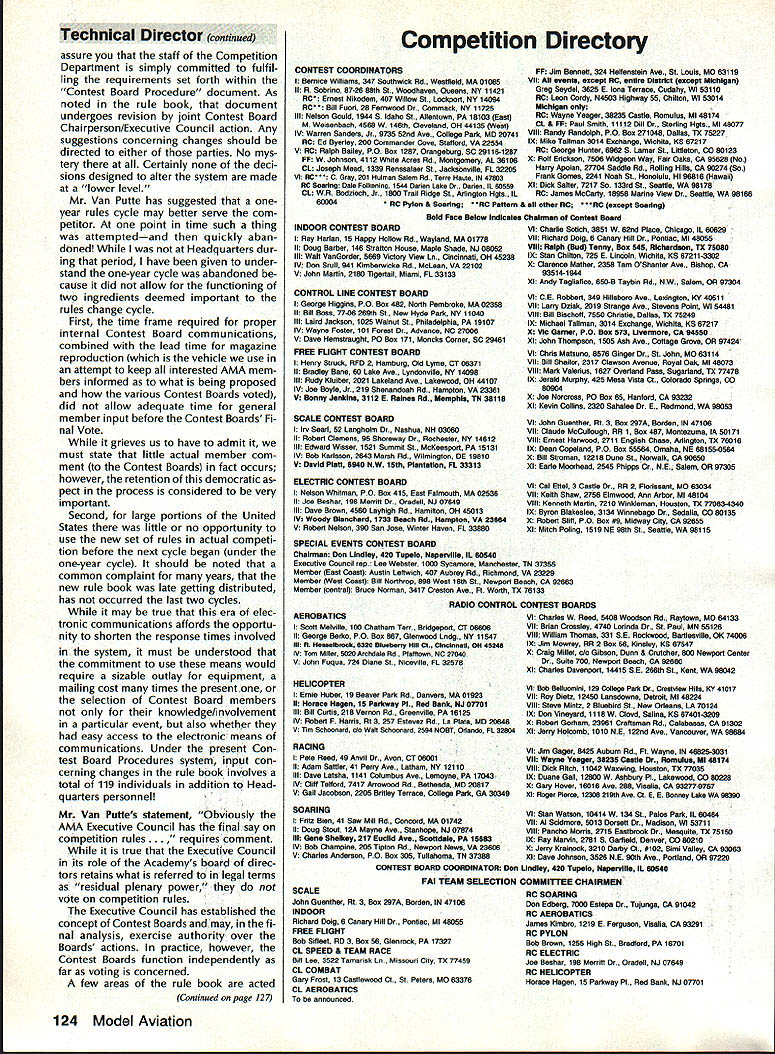
A subject found in a recent article in another model publication (and not an issue in Mr. Van Putte's column) concerns the appointment of Contest Board members. The current practice is for Contest Board members to be appointed by each of the AMA district vice presidents. We have nine boards of 11 members each. In addition, there is a Special Events board consisting of five members, and a Contest Board Coordinator who oversees all Contest Board activity. The selection of the board members centers around their experience in the specific discipline area. The chairperson for each board is appointed from among the board membership by the AMA president.
The article in question suggested that the Contest Board members should be elected rather than appointed. There is a degree of merit to this concept, of course. What better way to assure that those who develop the rules are "of the people"? Unfortunately, no effective method of administering such a program was included in the article.
A nominating procedure, along with a number of other basic mechanics, would be easy to develop if it were decided to go this route. Somehow I think we would hit an interesting stumbling block when we got around to the question of "Who votes?"
- Would all 150,000 AMA members be eligible?
- Or should only those people directly involved with the event — the competitors — be allowed to vote?
- If so, how do we identify competitors? If I fly in a Pattern contest, a Scale contest, and winch a Sailplane into the blue, do I get to vote for all three boards?
- How do we manage to keep track of who is eligible?
- Do we vote every two years?
There are many interesting questions that would have to be addressed.
In reality, what has always been lacking in the overall competition rules scene is general member input. I served for six rules cycles, first on the old Radio Control Contest Board, then on the Scale Board, before becoming the Technical Director. I also served one term as a vice president. A typical member response during any rules change cycle would consist of perhaps six letters. It seemed that there would always be three "yeas" and three "nays" for any given proposal!
After the completion of the cycle, when I attended contests without fail a significant response would appear. Generally, such response was negative. The question here must be, "Why were these opinions not expressed during the cycle?" It is possible that some people simply did not like to write letters. I don't think that most contest-oriented people are natural correspondents; they want to fly. Another reason, perhaps, is that many are not aware of the process and how it functions. Also, the rules change cycle is a periodic event; interest wanes after an issue is decided. There may be many reasons.
The Contest Board procedures were established to allow member input. However, they are not perfect. A review of the present system might be appropriate.
In like manner, the vice presidents are in a position to respond to the needs of their constituents concerning Contest Board members in their districts. The system of elected vice presidents appointing Contest Board members allows administration relative to the active members. Simply put, such input rarely occurs. Certainly such input should never be capricious or designed to meet the whims of the moment. But the possibility for input concerning board members does exist.
A last thought centers around the special interest groups and advisory boards. They constitute an important role in the system and should be considered for your participation. Not all disciplines within the competitive community are represented, but many are.
- The special interest groups are listed in the Membership Manual, complete with contact names and addresses.
- Information concerning advisory boards can be obtained from the Competition Department at AMA Headquarters.
- The Contest Board members and Contest Coordinators are listed in Model Aviation every month in the "Competition Directory" section of the Competition Newsletter.
A mechanism for member input does exist.
No mysteries!
Transcribed from original scans by AI. Minor OCR errors may remain.

