
Competition Newsletter
A Note From the Technical Director — Bob Underwood
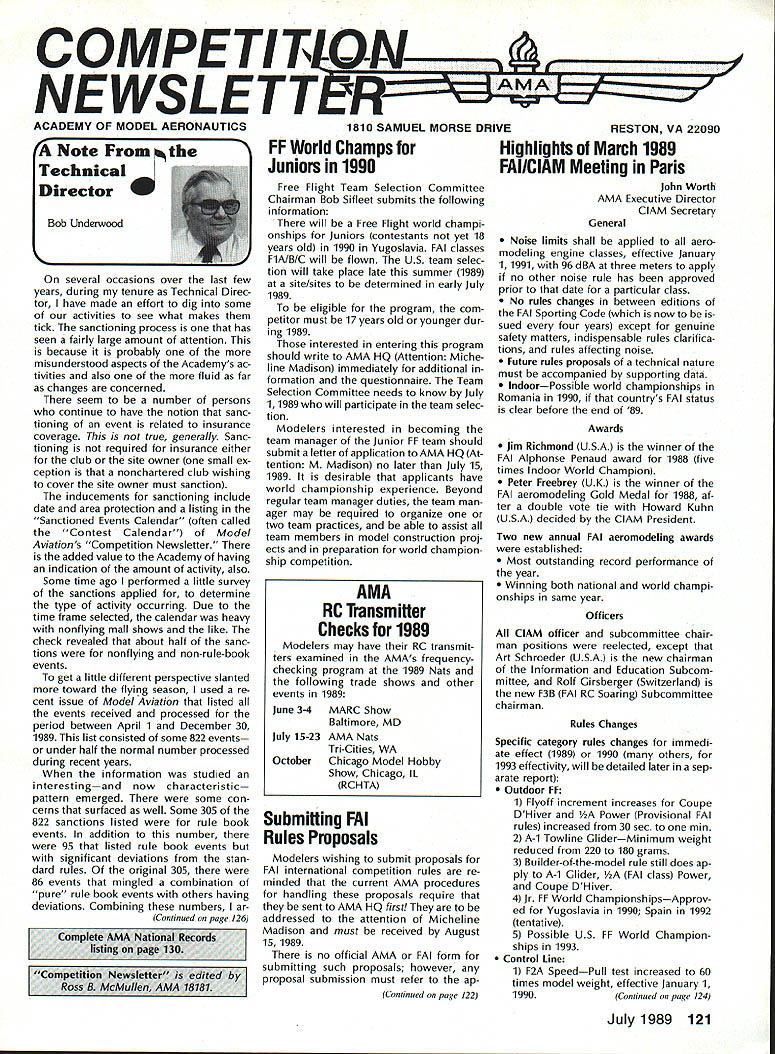
On several occasions over the last few years, during my tenure as Technical Director, I have made an effort to dig into some of our activities to see what makes them tick. The sanctioning process is one that has seen a fair amount of attention because it is probably one of the more misunderstood aspects of the Academy's activities and also one of the more fluid as changes are concerned.
There seem to be a number of persons who continue to have the notion that sanctioning of an event is related to insurance coverage. This is not generally true. Sanctioning is not required for insurance either for the club or the site owner (one small exception is that a nonchartered club wishing to cover the site owner must sanction). The inducements for sanctioning include date and area protection and a listing in the "Sanctioned Events Calendar" (often called the "Contest Calendar") of Model Aviation's Competition Newsletter. There is the added value to the Academy of having an indication of the amount of activity, also.
Some time ago I performed a little survey of the sanctions applied for, to determine the type of activity occurring. Due to the time frame selected, the calendar was heavy with nonflying mall shows and the like. The check revealed that about half of the sanctions were for nonflying and non–rule-book events.
To get a different perspective slanted more toward the flying season, I used a recent issue of Model Aviation that listed all the events received and processed for the period between April 1 and December 30, 1989. This list consisted of some 822 events — under half the normal number processed during recent years.
Key findings from that review:
- Total events listed: 822
- Rule-book events (standard rules): 305
- Events listing rule-book events but with significant deviations: 95
- Of the original 305, events mixing “pure” rule-book events with others having deviations: 86
(Portions of the original article continued on a later page and were not present on the scanned page.)
Sanctioning observations and common problems
One interesting trend that developed was the number of rule-book events that were described with phrases like "No deviations" or "AMA rules strictly adhered to." That suggests many events operate with deviations — or at least that many persons think so. Recent years have tended to bring ever-increasing numbers of operational deviations at events.
Some fun-flys listed had cryptic messages. One that appeared several times was that the events to be flown would "be announced at the contest." A nonlocal modeler going to the fun-fly might have no idea what was planned. Some event names were easier to interpret than others; for an event listed as "Easter Bunny's Revenge," I guessed an egg drop.
A very large percentage of the fun-flys listed incorrect information. Examples:
- A CD circled event 414 (Club Team Fun Fly) on the sanction application when that wasn't what was to be flown.
- One CD stated they were flying 414 "except no team events, no bomb drop, and two added events" — which doesn't sound like event 414.
- Another stated "414 — modified from rule book to be announced at the contest." What was left of 414 in that case?
The point: if you indicate that your event will be administered by the rule book when you circle numbers on the sanction card, make certain you substantially follow those rules — or don't list it that way. To list one thing, then another, only creates an environment for unhappy contestants, especially if they travel a long distance to participate.
I was pleased to see that an ongoing problem was being resolved. For a while, IMAA fly-ins were being listed as "A" events and 514 (Giant Scale) being circled on the card. Almost without exception, these events are now listed as "C" without 514 being circled. I often wondered how a CD would have handled a contestant who drove 300 miles expecting to enter event 514.
Another problem is misunderstanding what constitutes a "B-type" event. Several were listed as "B" events that were not. One CD claimed an event was "B" because it was "restricted" to AMA members. Another called his event "B" because he used a rule deviation restricting the event to one type of model. Neither example qualified as a "B" event. Please remember: read the Competition Regulations or the Membership Manual for definitions.
We will be taking a closer look at one area of sanctioning: a noticeable number of cases where two one-day events are being sanctioned separately, offering the same flying events but with two different CDs. The question has been raised as to whether these are actually two separate events with separate awards, or one event with separate CDs. More on this later.
Speaking of Contest Directors, we have encountered a problem in processing new ones. Increasingly, individuals apply for CD status at the same time they send a sanction request for an event very close to the desired date (in one case, a week before). Up to this point we have tried to accommodate applicants and push processing through. Unfortunately, it consumes significant time across departments, puts the Contest Coordinator in a bind, raises opportunities for slipups, and violates the rule that sanctions are to be submitted a minimum of 30 days prior to the event.
Effective now: if you are applying for CD status, allow a minimum of 60 days between your application and the date of your sanction request. This permits approximately two weeks to process your CD application and still allows you sufficient time to get your sanction request to the Contest Coordinator before the 30-day minimum required prior to the event.
A last thought: I was invited to the Top Gun Scale event. The event, spearheaded by Frank Tiano, was first-rate and used a completely new set of rules developed specifically for that event. They worked well. Notably, the so-called "heavy metal" airplanes (WWII, etc.) did not dominate the top places — homebuilts and civilian biplanes placed among the top 10. The flight line setup was especially noteworthy.
Many were concerned about operating what amounted to four little lines at a single site. We feared midairs and other problems; they didn't happen. There were a few incidents when traffic got heavy on the runway, but no real problems. It proved that with communication between lines, effective control, and experienced flyers conversant with contest routine, even four lines on one site can work.
Congratulations to contest management, especially the Condors and local Jaycees, for making the event special.
Control Line (CL) Racing — Call to Action
Places to voice opinions are limited; we sometimes only see vested inputs into the Racing Advisory Committee or CLCB. A two-thirds majority vote of the CLCB has so much inertia built into it that it's almost impossible for needed change or timely response to stifle performance tricks that threaten an event.
Somebody needs to step up, take charge, and provide needed, unbiased direction for CL Racing competition. We've quite literally got the wolves guarding the henhouse. The rules-making and changing process is passive: it responds only to external inputs, and then often only every other year. It's up to participants to speak up and help make things happen. If you used to fly Rat but now fly sailplanes for lack of a Racing pilot, write AMA a quick note: "I'm mad as hell, and I want to fly AMA Control Line Racing, too."
CL Racing has declined not only because experts dominated entry-level events but also because physical requirements to fly the events greatly limited participation. It's bad when not even all the experts can compete in the entry-level event any more, and we still can't get the event rules changed. This decline may affect RC Racing and overall CL participation. Speak up if you want change.
Do We Really Need More Turnaround Pattern? — Tim White, Claflin, KS
This letter is a response to Luis Escalona's February 1989 "Soapbox" item, which concluded: "I'd like to see the AMA institute novice and sportsman classes of FAI Pattern. After all, it does our future U.S. world competition team members no good to start flying one type of pattern while the rest of the world flies another."
If this proposal takes place, it will be at the expense of the present AMA classes, or we will end up with seven or eight classes of Pattern at each contest. Would it be a beneficial change for all concerned?
If two classes are added to the existing six, you would have a total of eight for CDs to contend with. Isn't that too much?
Just how many Pattern fliers are there in the U.S.? How many entrants fly three or more contests yearly? How many enter the team selection program each qualifying period? How many actually qualify and then enter the Masters Tournament?
I don't have all the answers, but I'll try: about 2,500 of us enter three or more contests each year. As of December 28, 1988 (Ed.), 96 people had paid and signed up for this qualification period. Of these, 42 have qualified and 16 others are still pending. For the last team selection at Fentress, VA (also site of the 1988 AMA Nats—Ed.), there were 43 or 44 contestants who actually showed up. The names and numbers were published in Model Aviation for those who care to look them up.
Do we make major changes to benefit only a select few? The F3A community often feels this way. If the majority of participants want a change, it will happen through the RC Aerobatics Contest Board. For now, participants in the AMA classes far outnumber the F3A community, and without us there would be no contests or places to fly from.
Rules Proposals, AMA Contest Boards, and How You and I Are Part of the "Mysterious Forces at Work" — John R. Guenther, Borden, IN
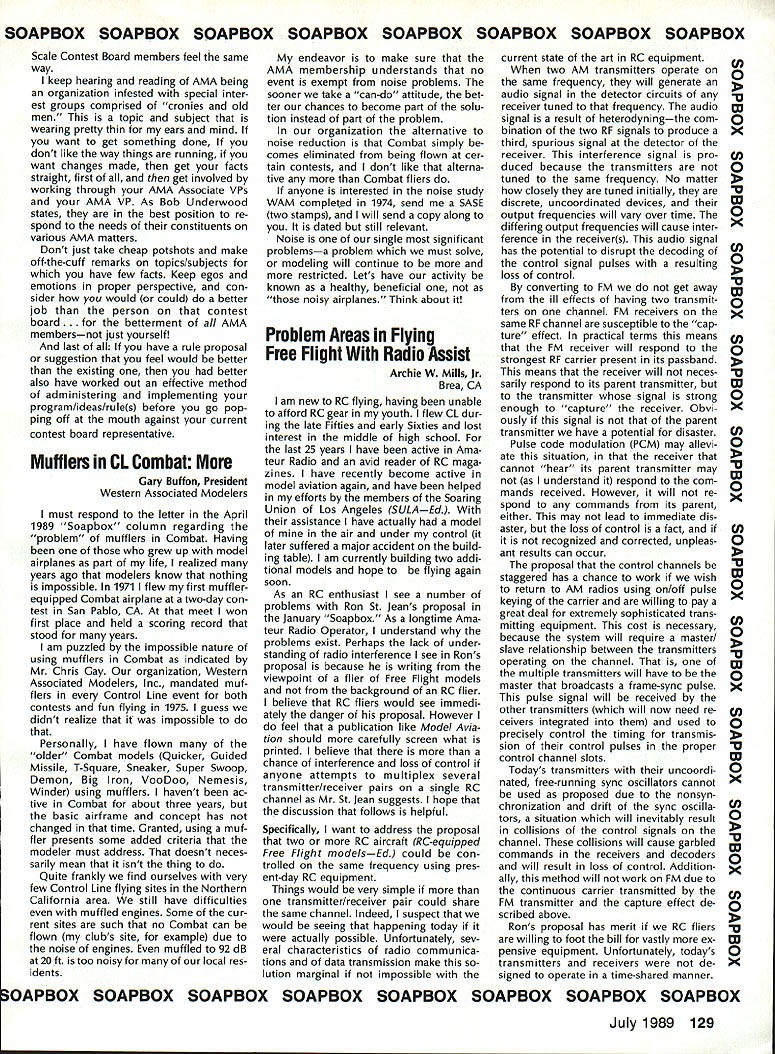
I recently enjoyed Bob Underwood's April 1989 "A Note From the Technical Director," which dealt with many topics and feelings I share. There have been articles suggesting an "inner sanctum of AMA" comprised of contest board cronies who scratch one another's backs to get proposals approved. Such criticisms have been leveled at the Scale Contest Board, of which I am a member.
As Bob suggests, pick up the 1988/89 AMA Competition Regulations and read them to find out how proposals and voting actually work. Seldom did Bob—or I—receive written comments or even phone calls about rule proposals. If you want to influence a vote, you must communicate.
Why do contest-board members vote the way they do? Sometimes based on feeling, sometimes based on what constituents tell them. I often rely on comments from my model club, what I hear at contests and mail shows, what I read in magazines, and occasional phone calls from concerned AMA members. These conversations are usually short but generally convey the point.
In the past two or three years I've heard more from people outside my AMA district than from within it on Scale rule proposals. District VI is large with much Scale activity; you'd think constituents most affected would take the time to contact me, but that often isn't the case.
We often hear moaning and groaning about rules and "Why aren't things changed?" People claim mysterious forces are running things. Regarding how one gets on or off a Contest Board: there's been discussion of an election process similar to district VP elections. I support election of contest-board members as long as autonomy is maintained: you should be able to vote for your district representative only. Such a program would go a long way.
If constituents are discontented with a contest-board member, they can contact their AMA District VP and lodge a major complaint. VPs are not likely to make hasty changes without reflection and investigation. They recognize that personalities and egos can lead to perceived problems.
I keep hearing that AMA is infested with special interest groups of "cronies and old men." That charge is wearing thin. If you want change, get your facts straight and work through your AMA Associate VPs and AMA VP. Bob Underwood is right: they are best positioned to respond to constituents' needs.
Don't take cheap potshots or make off-the-cuff remarks on topics for which you have few facts. Keep egos and emotions in perspective and consider how you would do a better job than the current contest-board person for the betterment of all AMA members.
If you have a rule proposal, also present a practical method of administering and implementing your idea before criticizing the current contest board.
Noise and Combat
Noise is a significant problem. If we take a "can-do" attitude, we have a better chance to be part of the solution instead of part of the problem. The alternative to noise reduction is that Combat may be eliminated from some contests, and I don't like that alternative any more than Combat flyers do.
If anyone is interested in the noise study (WAM) completed in 1974, send a SASE (two stamps) and I will send a copy. It is dated but still relevant.
F3J and F3B Update
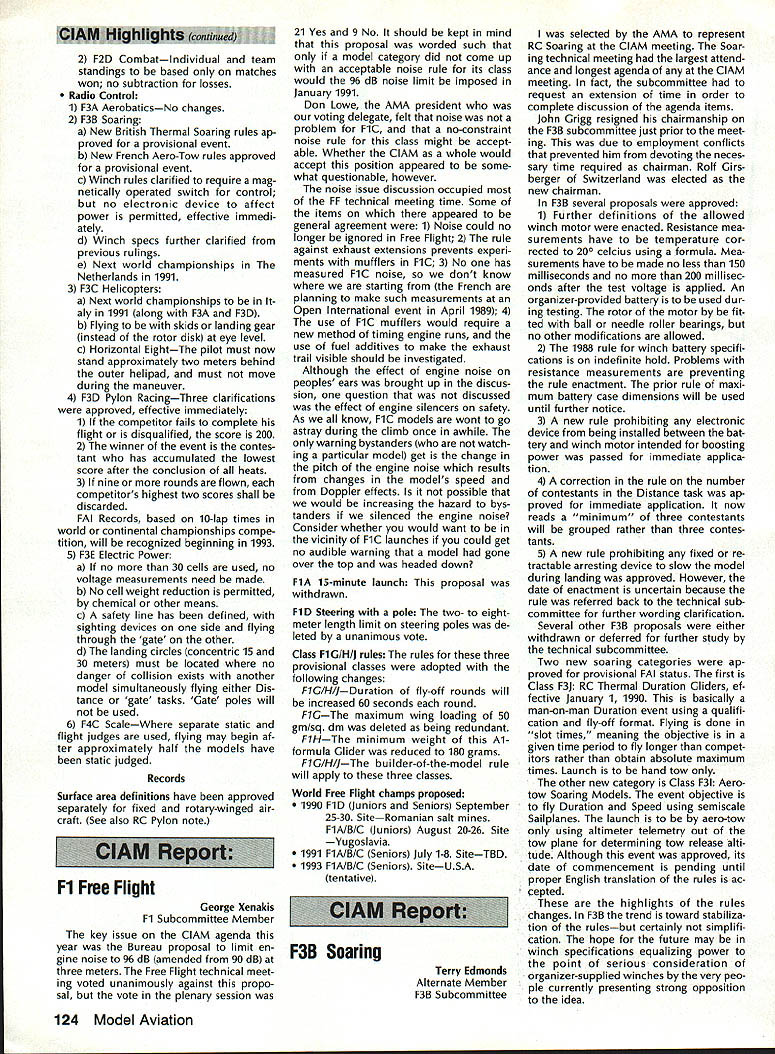
The new F3J class is very exciting. Although the rules probably are not what the United States have proposed for a Duration event, it opens the door for international competition of a type in which the large majority of U.S. soaring competitors are interested.
A bid for the 1991 F3B World Championships from the Netherlands was approved. A detailed report of the meeting will appear in the Soaring model press and in next month's Competition Newsletter. It will include information on the complete new rules for the F3J class as well as details of the F3B changes.
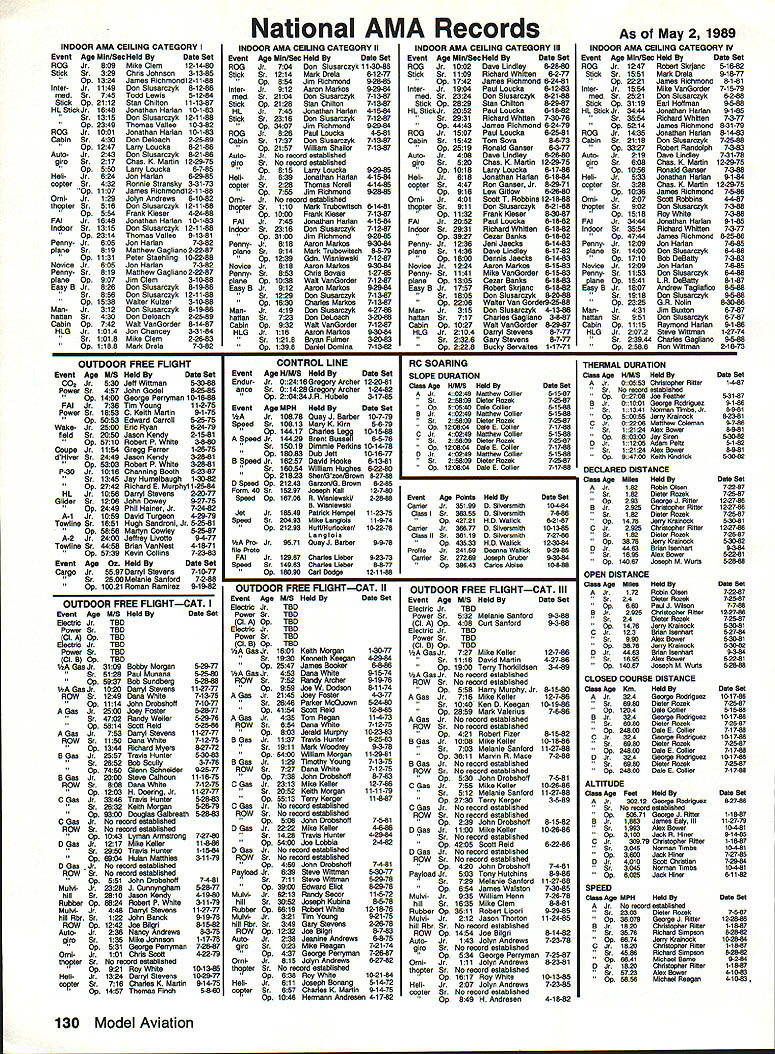
National AMA Records
As of May 2, 1989
Note: the scanned page contains the National AMA Records table — multiple columns of record categories, events, record values, record holders and dates — and does not contain a textual continuation of the Competition Newsletter article. If you would like, I can fully transcribe and correct the tabular records from this page; please confirm whether you want specific columns/categories or the entire table transcribed.
Transcribed from original scans by AI. Minor OCR errors may remain.

