
Competition Newsletter
A Note From the Technical Director
Bob Underwood
If you are an RCer and you haven't read it yet—for shame! I am speaking of the feature article entitled "Battle for RC Frequencies" written by Dr. Walter Good which appeared in three parts beginning with the May issue of Model Aviation. In this writer's humble opinion it is one of the most meaningful articles to appear in a model publication.
Several factors make this true. It is chockfull of valuable background information concerning the history of model frequency activity, told in a straightforward, easy-to-read form. The style matches Dr. Good's personality. As you read the material you will feel that you are visiting with a longtime friend as he shares trials and triumphs with you. The prose flows in easy, candid waves from experience to experience. Actually, Dr. Good would probably be far more comfortable if I referred to him as Walt!
The important aspect of the series comes from its message. Recent arrivals on the RC scene are not aware of the struggle that has gone on for so long concerning use of radio frequencies. Actually, many old-timers may not be aware as well. We can hope that through Walt's work everyone can better appreciate the vast amount of deliberation and anguish devoted to the frequency cause by a cadre of volunteers over the years.
The struggle continues today. While the FCC has more fully recognized the increasing importance of model aviation because of the work done by "Walt" of the Academy, we continue to be threatened by many forces. A primary ingredient that will always cause us concern is the ever more complex radio environment in which we are forced to operate. Many persons have stated that they long for the good old days where there were no problems. As you read Walt's words, you will better understand that only one of the two adjectives we've used to describe the past is actually true. If you have not read the series, do it now! You can always come back to this column later.
Besides, the other is a heck of a lot more important, anyway!
Attention, Contest Directors!
Technical Director (continued)
The issue is an announcement concerning the submittal of sanction requests. I am including some comments in this column in the hope that we will reach more individuals with the message.
AMA Headquarters has recently encountered increasing difficulty in the processing of sanctions. The basic problem does not center around the volume, but rather lies in the timing.
In reading the sanctioning information in Competition Regulations (a.k.a. "the rule book") or the Membership Manual, you will discover that certain time requirements exist concerning the filing of sanction requests. In the case of flying events such as contests, fun-flys, fly-ins, etc., they should be in the Contest Coordinator's hand a minimum of 30 days prior to the event. When the sanction request can be sent directly to Headquarters (as in the case of demonstrations and mall shows) there is a 20-day time frame.
Unfortunately, more and more sanction requests are arriving, either at the Coordinator or at Headquarters, less than a week before the event! (In some cases they arrive the day before—or even after the event!) The Coordinators and Headquarters have made every effort to try and process these requests. In some cases the CD may not have the paperwork in hand at the event because it is impossible to get it to them in time. This leaves an element of doubt in everyone's minds.
Here at Headquarters the problem takes the form of interrupted routines, greater opportunity for errors to occur, increased time for processing, and increased expense. Through a memo to the Contest Coordinators, we have requested that they maintain the 30-day time frame called for in the rules. We are very much aware that sometimes extenuating circumstances occur regarding a site or a date. We cannot allow the exception to become the rule, however. When it comes right down to it, since insurance is not predicated on sanctioning (except for a nonchartered club), the "last-minute sanction request" is not a necessity anyway!
Last month we told you about the need to allow 60 days between the time a member files for CD status and any proposed sanction request from that person. This allows time to provide the service necessary for the sanction processing.
While we are speaking of CDs, let's repeat a few items that have appeared before in this column from time to time. Since 1987 new CDs have been required to serve a probationary period. That period consists of the time between their acceptance as a CD and the sanctioning of the first event. If all of the necessary paperwork is filed and no problems develop, the period ends with that first sanction. From that point forward an active CD receives an earned membership for the year following one or more events sanctioned. These are not cumulative! If you sanction 47 events for the year, you do not receive earned membership for the rest of your life—which would probably be very short anyway if you ran 47 events for the year!
Your membership status remains Contest Director for life as long as you do not allow your AMA membership to lapse even for one year! If you allow membership to lapse, in order to reinstate the CD status you will be required to follow whatever process is currently in effect. There is also no guarantee that your old number will still be available.
If you are thinking of applying for CD status, please seek out a current application form. The one in use at the present time has "Rev. 1/88" in the lower left-hand corner. If you use one of the older forms, the processing may be delayed, since the form may not have all of the required information on it. This means that you will be required to play "mail tag." Also, PLEASE read the entire form! Almost 10% of applications received do not include a check for the transfer fee. More delay!
I love grading the quiz that is part of the application. I guess that comes from my 30 years of teaching. It may interest you to know that the most common grade is 100. Of course it is a so-called "open book test," but be assured that almost everyone I have talked with concerning the quiz indicates that they have learned things they thought they already knew. By the way, if you are applying please request a current Competition Regulations book before trying the quiz. While I have no problem grading it even if you use a book from 1986–87, I am not inclined to go further back than that. Recently, an application came in which, as near as I could tell, was filled out using a book from the Seventies! I didn't try to research the answers.
The last item on the quiz is the most interesting to me. It asks that you indicate, in 25 words or less, why you want to become a CD. I know that may seem like a weird request, but there is a specific reason for it.
Back when I was in college preparing to become a teacher, I had to go before a board after two years of study. One question that was always asked was, "Why do you want to teach?" The standard question and standard answer back then was the person would answer that question by saying, "I LOVE children!"
Some years after I had graduated I was speaking with several faculty members who served on that board, and I asked them what answer they expected to the question. They laughed and informed me that the answer didn't matter in any way. All they wanted us to do was to ponder the question at least once in our lives.
And a last thought for those who are CDs. Please try to use correct forms. We appreciate the fact that you wish to be pennywise, but some of the forms were received really complicated on this end. Some of the sanction request forms received date from what could be considered prehistoric times. At least they are from before some of the current events existed. The current sanction request form is yellow and has "Rev. 8/87" in the lower left-hand corner.
There will be a new form toward the end of this year to accommodate rule changes. When that happens, take those forms that you have in your file at home and light the barbecue grill with them. Or paper your work area. Or fold them into a model and have a contest that you sanction using a new, current form!
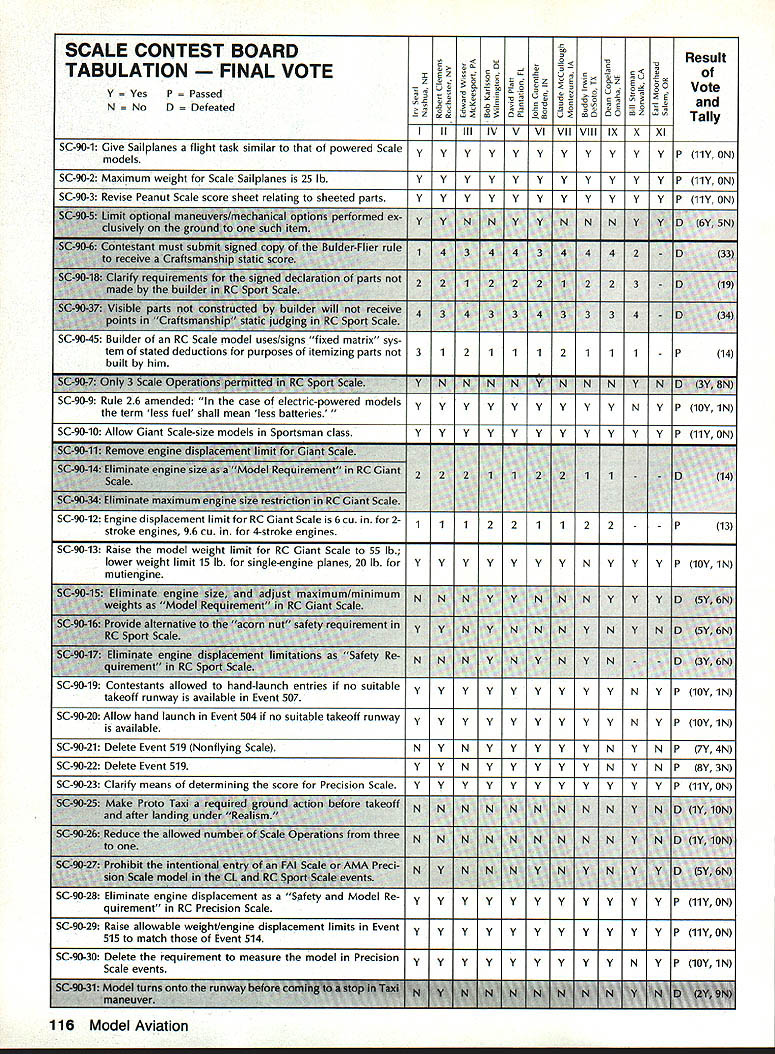
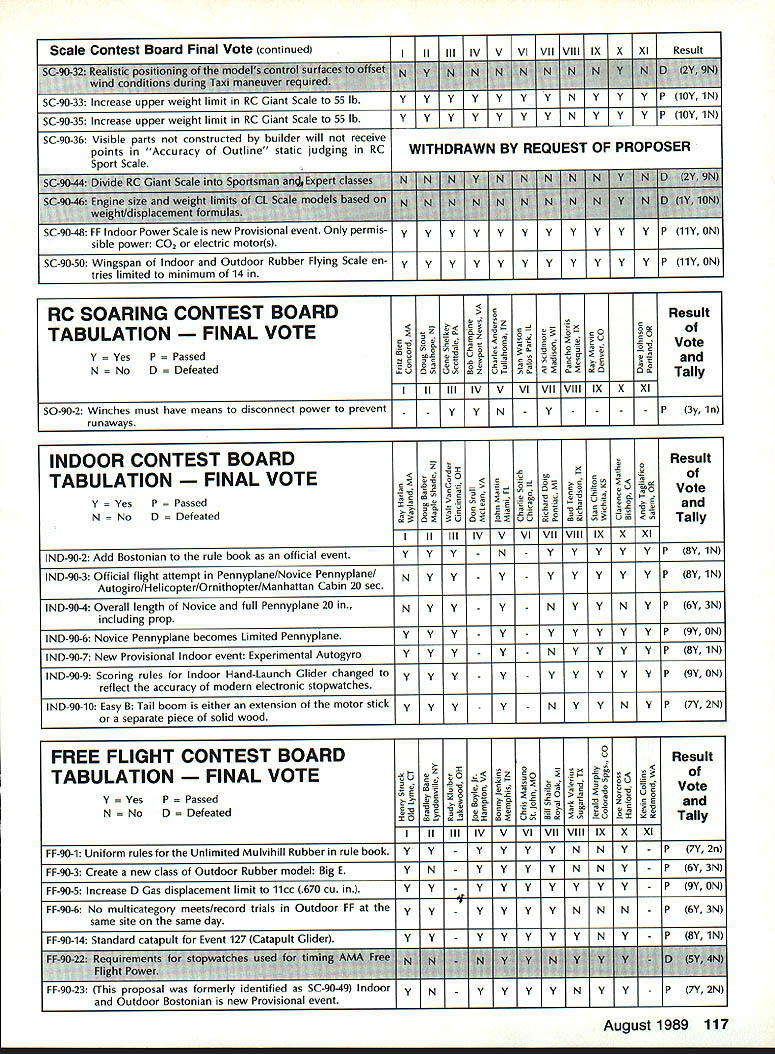
SCALE CONTEST BOARD TABULATION — FINAL VOTE
Y = Yes P = Passed N = No D = Defeated
- SC-90-1: Give Sailplanes a flight task similar to that of powered Scale models. P (11Y, 0N)
- SC-90-2: Maximum weight for Scale Sailplanes is 25 lb. P (11Y, 0N)
- SC-90-3: Revise Peanut Scale score sheet relating to sheeted parts. P (11Y, 0N)
- SC-90-5: Limit optional maneuvers/mechanical options performed exclusively on the ground to one such item. D (6Y, 5N)
- SC-90-6: Contestant must submit signed copy of the Builder-Flier rule to receive a Craftsmanship static score. D (3Y, 3N) (33)
- SC-90-18: Clarify requirements for the signed declaration of parts not made by the builder in RC Sport Scale. D (2Y, 1N, 2?) (19)
- SC-90-37: Visible parts not constructed by builder will not receive points in "Craftsmanship" static judging in RC Sport Scale. D (34)
- SC-90-45: Builder of an RC Scale model uses/signs "fixed matrix" system of stated deductions for purposes of itemizing parts not built by him. P (14)
- SC-90-7: Only 3 Scale Operations permitted in RC Sport Scale. D (3Y, 8N)
- SC-90-9: Rule 2.6 amended: "In the case of electric-powered models the term 'less fuel' shall mean 'less batteries'." P (10Y, 1N)
- SC-90-10: Allow Giant Scale-size models in Sportsman class. P (11Y, 0N)
- SC-90-11: Remove engine displacement limit for Giant Scale. D (?)
- SC-90-14: Eliminate engine size as a "Model Requirement" in RC Giant Scale. D (14)
- SC-90-34: Eliminate maximum engine size restriction in RC Giant Scale. No result shown
- SC-90-12: Engine displacement limit for RC Giant Scale is 6 cu. in. for 2-stroke engines, 9.6 cu. in. for 4-stroke engines. P (13)
- SC-90-13: Raise the model weight limit for RC Giant Scale to 55 lb.; lower weight limit 15 lb. for single-engine planes, 20 lb. for multiengine. P (10Y, 1N)
- SC-90-15: Eliminate engine size, and adjust maximum/minimum weights as "Model Requirement" in RC Giant Scale. D (5Y, 6N)
- SC-90-16: Provide alternative to the "acorn nut" safety requirement in RC Sport Scale. D (5Y, 6N)
- SC-90-17: Eliminate engine displacement limitations as "Safety Requirement" in RC Sport Scale. D (3Y, 6N)
- SC-90-19: Contestants allowed to hand-launch entries if no suitable takeoff runway is available in Event 507. P (10Y, 1N)
- SC-90-20: Allow hand launch in Event 504 if no suitable takeoff runway is available. P (10Y, 1N)
- SC-90-21: Delete Event 519 (Nonflying Scale). N (7Y, 4N)
- SC-90-22: Delete Event 519. N (8Y, 3N)
- SC-90-23: Clarify means of determining the score for Precision Scale. P (11Y, 0N)
- SC-90-25: Make Proto Taxi a required ground action before takeoff and after landing under "Realism." D (1Y, 10N)
- SC-90-26: Reduce the allowed number of Scale Operations from three to one. D (1Y, 10N)
- SC-90-27: Prohibit the intentional entry of an FAI Scale or AMA Precision Scale model in the CL and RC Sport Scale events. D (5Y, 6N)
- SC-90-28: Eliminate engine displacement as a "Safety and Model Requirement" in RC Precision Scale. P (11Y, 0N)
- SC-90-29: Raise allowable weight/engine displacement limits in Event 515 to match those of Event 514. P (11Y, 0N)
- SC-90-30: Delete the requirement to measure the model in Precision Scale events. P (11Y, 0N)
- SC-90-31: Model turns onto the runway before coming to a stop in Taxi maneuver. D (2Y, 9N)
Scale Contest Board Final Vote (continued)
- SC-90-32: Realistic positioning of the model's control surfaces to offset wind conditions during Taxi maneuver required. D (2Y, 9N)
- SC-90-33: Increase upper weight limit in RC Giant Scale to 55 lb. P (10Y, 1N)
- SC-90-35: Increase upper weight limit in RC Giant Scale to 55 lb. P (10Y, 1N)
- SC-90-36: Visible parts not constructed by builder will not receive points in "Accuracy of Outline" static judging in RC Sport Scale. Withdrawn by request of proposer
- SC-90-44: Divide R/C Giant Scale into Sportsman and Expert classes. D (2Y, 9N)
- SC-90-46: Engine size and weight limits of CL Scale models based on weight/displacement formulas. D (1Y, 10N)
- SC-90-48: FF Indoor Power Scale is new Provisional event. Only permissible power: CO2 or electric motor(s). P (11Y, 0N)
- SC-90-50: Wingspan of Indoor and Outdoor Rubber Flying Scale entries limited to minimum of 14 in. P (11Y, 0N)
RC Soaring Contest Board Tabulation — Final Vote
- SO-90-2: Winches must have means to disconnect power to prevent runaways. P (3Y, 1N)
Indoor Contest Board Tabulation — Final Vote
- IND-90-2: Add Bostonian to the rule book as an official event. P (8Y, 1N)
- IND-90-3: Official flight attempt in Pennypane/Novice Pennypane/Autogiro/Helicopter/Ornithopter/Manhattan Cabin 20 sec. P (8Y, 1N)
- IND-90-4: Overall length of Novice and full Pennypane 20 in., including prop. P (6Y, 3N)
- IND-90-6: Novice Pennypane becomes Limited Pennypane. P (9Y, 0N)
- IND-90-7: New Provisional Indoor event: Experimental Autogyro. P (8Y, 1N)
- IND-90-9: Scoring rules for Indoor Hand-Launch Glider changed to reflect the accuracy of modern electronic stopwatches. P (9Y, 0N)
- IND-90-10: Easy B: Tail boom is either an extension of the motor stick or a separate piece of solid wood. P (7Y, 2N)
Free Flight Contest Board Tabulation — Final Vote
- FF-90-1: Uniform rules for the Unlimited Mulvihill Rubber in rule book. P (7Y, 2N)
- FF-90-3: Create a new class of Outdoor Rubber model: Big E. P (6Y, 3N)
- FF-90-5: Increase D Gas displacement limit to 11cc (.670 cu. in.). P (9Y, 0N)
- FF-90-6: No multicategory meets/record trials in Outdoor FF at the same site on the same day. P (6Y, 3N)
- FF-90-14: Standard catapult for Event 127 (Catapult Glider). P (8Y, 1N)
- FF-90-22: Requirements for stopwatches used for timing AMA Free Flight Power. D (5Y, 4N)
- FF-90-23: (This proposal was formerly identified as SC-90-49) Indoor and Outdoor Bostonian is new Provisional event. P (7Y, 2N)
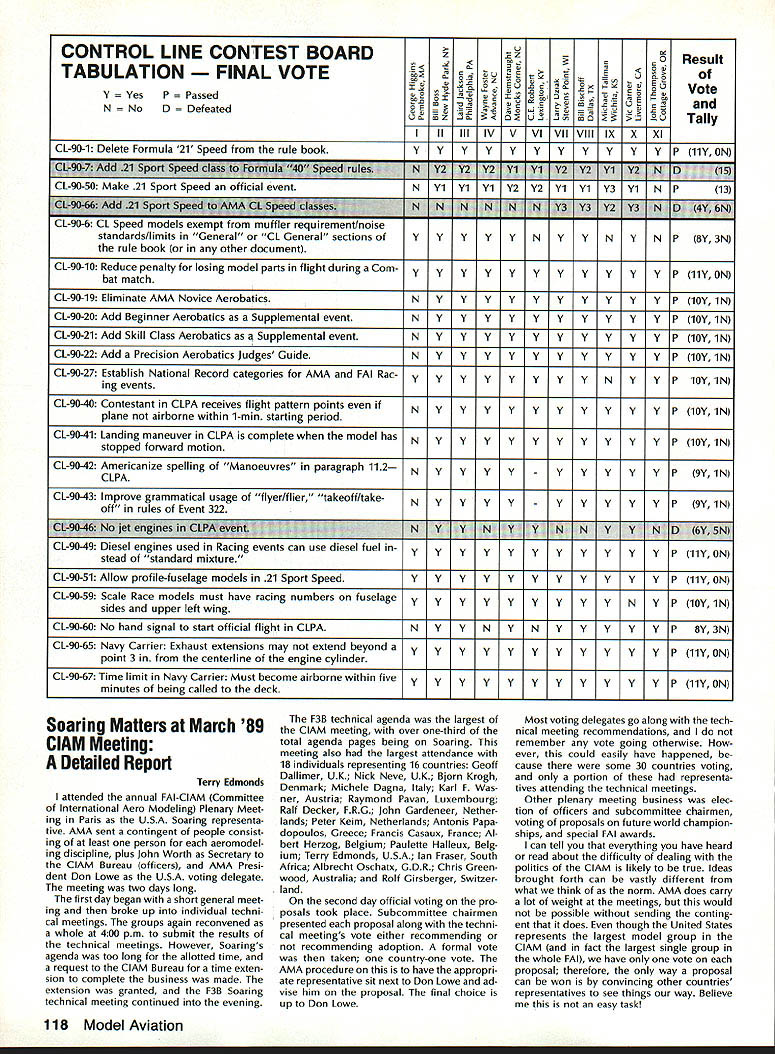
CONTROL LINE CONTEST BOARD TABULATION — FINAL VOTE
Y = Yes P = Passed N = No D = Defeated
- CL-90-1: Delete Formula "21" Speed from the rule book. P (11Y, 0N)
- CL-90-7: Add .21 Sport Speed class to Formula "40" Speed rules. D (15)
- CL-90-50: Make .21 Sport Speed an official event. P (13)
- CL-90-66: Add .21 Sport Speed to AMA CL Speed classes. D (4Y, 6N)
- CL-90-6: CL Speed models exempt from muffler requirement/noise standards/limits in "General" or "CL General" sections of the rule book (or in any other document). P (8Y, 3N)
- CL-90-10: Reduce penalty for losing model parts in flight during a Combat match. P (11Y, 0N)
- CL-90-19: Eliminate AMA Novice Aerobatics. P (10Y, 1N)
- CL-90-20: Add Beginner Aerobatics as a Supplemental event. P (10Y, 1N)
- CL-90-21: Add Skill Class Aerobatics as a Supplemental event. P (10Y, 1N)
- CL-90-22: Add a Precision Aerobatics Judges' Guide. P (10Y, 1N)
- CL-90-27: Establish National Record categories for AMA and FAI Racing events. P (10Y, 1N)
- CL-90-40: Contestant in CLPA receives flight pattern points even if plane not airborne within 1-min. starting period. P (10Y, 1N)
- CL-90-41: Landing maneuver in CLPA is complete when the model has stopped forward motion. P (10Y, 1N)
- CL-90-42: Americanize spelling of "Manoeuvres" in paragraph 11.2 — CLPA. P (9Y, 1N)
- CL-90-43: Improve grammatical usage of "flyer/flier," "takeoff/take-off" in rules of Event 322. P (9Y, 1N)
- CL-90-46: No jet engines in CLPA event. D (6Y, 5N)
- CL-90-49: Diesel engines used in Racing events can use diesel fuel instead of "standard mixture." P (11Y, 0N)
- CL-90-51: Allow profile-fuselage models in .21 Sport Speed. P (11Y, 0N)
- CL-90-59: Scale Race models must have racing numbers on fuselage sides and upper left wing. P (10Y, 1N)
- CL-90-60: No hand signal to start official flight in CLPA. P (8Y, 3N)
- CL-90-65: Navy Carrier: Exhaust extensions may not extend beyond a point 3 in. from the centerline of the engine cylinder. P (11Y, 0N)
- CL-90-67: Time limit in Navy Carrier: Must become airborne within five minutes of being called to the deck. P (11Y, 0N)
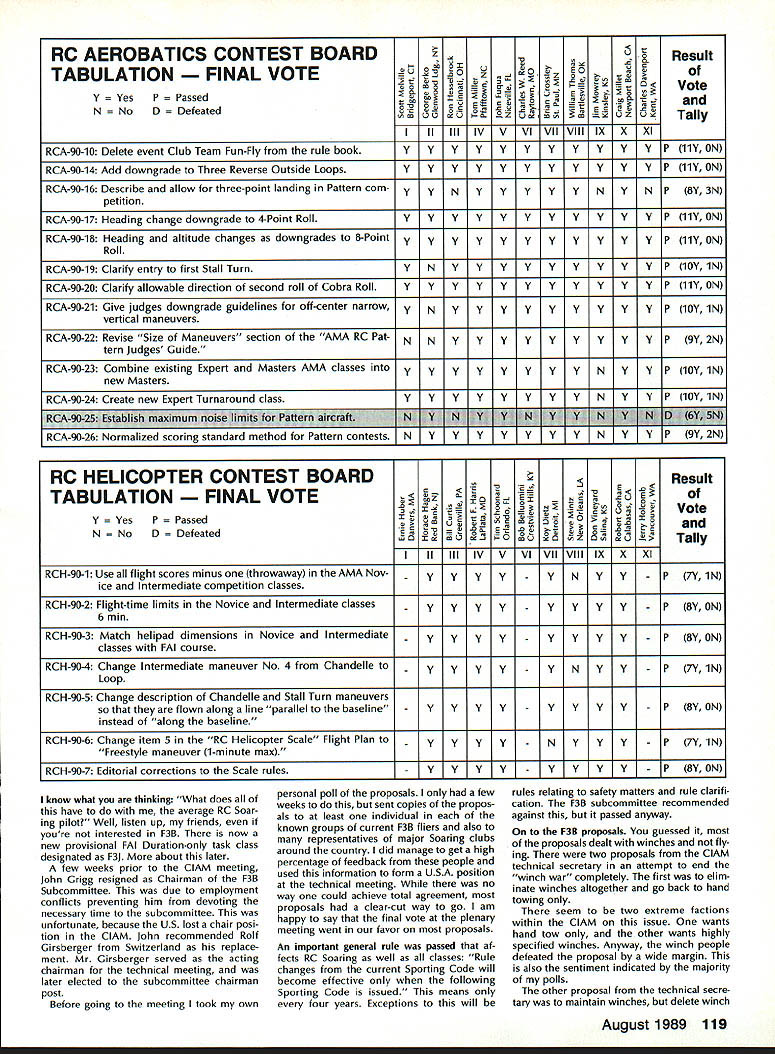
RC AEROBATICS CONTEST BOARD TABULATION — FINAL VOTE
Y = Yes P = Passed N = No D = Defeated
- RCA-90-10: Delete event Club Team Fun-Fly from the rule book. P (11Y, 0N)
- RCA-90-14: Add downgrade to Three Reverse Outside Loops. P (11Y, 0N)
- RCA-90-16: Describe and allow for three-point landing in Pattern competition. P (8Y, 3N)
- RCA-90-17: Heading change downgrade to 4-Point Roll. P (11Y, 0N)
- RCA-90-18: Heading and altitude changes as downgrades to 8-Point Roll. P (11Y, 0N)
- RCA-90-19: Clarify entry to first Stall Turn. P (10Y, 1N)
- RCA-90-20: Clarify allowable direction of second roll of Cobra Roll. P (11Y, 0N)
- RCA-90-21: Give judges downgrade guidelines for off-center narrow, vertical maneuvers. P (10Y, 1N)
- RCA-90-22: Revise "Size of Maneuvers" section of the "AMA RC Pattern Judges' Guide". P (9Y, 2N)
- RCA-90-23: Combine existing Expert and Masters AMA classes into new Masters. P (10Y, 1N)
- RCA-90-24: Create new Expert Turnaround class. P (10Y, 1N)
- RCA-90-25: Establish maximum noise limits for Pattern aircraft. D (6Y, 5N)
- RCA-90-26: Normalized scoring standard method for Pattern contests. P (9Y, 2N)
RC HELICOPTER CONTEST BOARD TABULATION — FINAL VOTE
Y = Yes P = Passed N = No D = Defeated
- RCH-90-1: Use all flight scores minus one (throwaway) in the AMA Novice and Intermediate competition classes. P (7Y, 1N)
- RCH-90-2: Flight-time limits in the Novice and Intermediate classes — 6 min. P (8Y, 0N)
- RCH-90-3: Match helipad dimensions in Novice and Intermediate classes with FAI course. P (8Y, 0N)
- RCH-90-4: Change Intermediate maneuver No. 4 from Chandelle to Loop. P (7Y, 1N)
- RCH-90-5: Change description of Chandelle and Stall Turn maneuvers so that they are flown along a line "parallel to the baseline" instead of "along the baseline." P (8Y, 0N)
- RCH-90-6: Change item 5 in the "RC Helicopter Scale" Flight Plan to "Freestyle maneuver (1-minute max)." P (7Y, 1N)
- RCH-90-7: Editorial corrections to the Scale rules. P (8Y, 0N)
RC Soaring — International (CIAM) Report
I know what you are thinking: "What does all of this have to do with me, the average RC Soaring pilot?" Well, listen up, my friends, even if you're not interested in F3B, there is now a new provisional FAI duration class designated as F3B. More about this later.
A few weeks prior to the CIAM meeting John Grigs resigned as Chairman of the F3B Subcommittee. This was due to employment conflicts preventing him from devoting the necessary time to the subcommittee. This was unfortunate, because the U.S. lost a chair position in the CIAM. John recommended Rolf Girsberger from Switzerland as his replacement. Mr. Girsberger agreed to serve as the acting chairman for the technical meeting, and was later elected to the subcommittee chairman post.
Before going to the meeting I took my own personal poll of the proposals. I only had a few weeks to do this, but sent copies of the proposals to at least one individual in each of the known groups of current F3B fliers and also to many representatives of major Soaring clubs around the country. I did manage to get a high percentage of feedback from these people and used this information to form a U.S.A. position at the meeting. While there was no way one could achieve total agreement among all proposals, a clear-cut way to go emerged. I am happy to say that the final vote at the plenary meeting went in our favor on most proposals.
An important general rule was passed that affects RC Soaring as well as all classes: "Rule changes from the current Sporting Code will become effective only when the following Sporting Code is issued." This cycle will be every four years. Exceptions to this will be rules relating to safety matters and rule clarification. The F3B subcommittee recommended against this, but it passed anyway.
On the F3B proposals you guessed it, most of the proposals dealt with winches and winch rules. There were two proposals from the CIAM technical secretary in an attempt to end the "winch war" completely. The first was to eliminate winches altogether and go back to hand towing only.
There seem to be two extreme factions within the CIAM on this issue. One wants hand tow only, and the other wants highly specified winches. The winch faction defeated the proposal by a wide margin. This is also the sentiment indicated by the majority of my polls.
The other proposal from the technical secretary was to maintain winches, but delete winch specifications and add the following restrictions:
"The model should be released from the towline in normal horizontal flight, at normal flying speed (no overspeed), with the winch stopped and the towline slackened. Any noticeable gain in height by the model immediately after release from the towline will result in disqualification of the flight."
My poll indicated most people thought this would be difficult to enforce, especially in high wind. The technical meeting felt the same way, and the proposal was easily defeated.
There were three different proposals from the United Kingdom, Federal Republic of Germany, and Switzerland on further definition of the winch motor specifications. All three proposals were similar, except the FRG and Swiss proposals called for lowering the resistance from 15 milliohms to 12 milliohms. Information from my sources interpreted this as an attempt to raise winch power, and we opposed it.
The German representative argued that lower-cost motors at 12 milliohms were available. This argument didn't hold water, as one can still use the 12-milliohm motor with an external resistor to bring it within the 15-milliohm specification. This part of the proposal was defeated, and the 15-milliohm specification stands.
The remaining parts of the three proposals were combined into one that was acceptable to the entire subcommittee. This included a formula for temperature correction in motor testing, precise definition of measurement timing, and allowed motor modifications. It should also be noted that an organizer-supplied battery is to be used during motor testing. The proposal passed the plenary vote and was implemented immediately as a rule clarification. Rule 5.3.2.2.b(2) is amended to read as follows:
"The winch shall be fitted with a single production starter motor having an internal resistance of at least 15.0 milliohms at surrounding temperature corrected to 20°C using the formula:
R(20°C) = R(t) / [1 + 0.003 × (t - 20°C)]
where R = internal resistance, and t = surrounding (ambient) temperature in degrees centigrade.
"The measurement has to be made by digital storage instrument no less than 150 milliseconds and no more than 200 milliseconds after the test voltage is applied and during which time the motor shaft shall have stopped rotating. These measurements should be made using the test equipment and procedure shown in Annex 5C.
"Battery voltage, current flow, and voltage at the motor terminals (including any additional adjusting resistor), shall be instantaneously displayed and then recorded to enable calculation of motor internal resistance. The measured value may be obtained by adding an external resistor, but the design must dissipate any change of the total resistance (for instance by bridging the resistor). Resistance of any control device does not count.
"The rotor of the motor may be fitted at each end with ball or needle roller bearings. (Text continued in Annex 5C.)"
COMPETITION NEWSLETTER
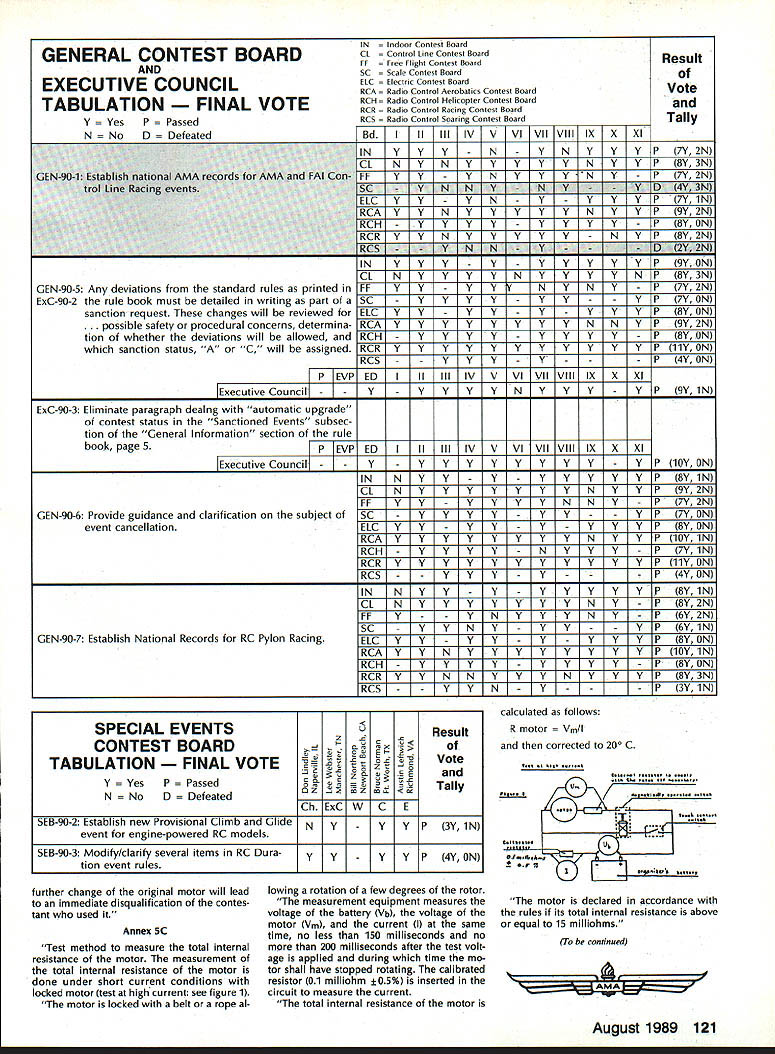
GENERAL CONTEST BOARD AND EXECUTIVE COUNCIL TABULATION — FINAL VOTE
Y = Yes P = Passed N = No D = Defeated
IN = Indoor Contest Board CL = Control Line Contest Board FF = Free Flight Contest Board SC = Scale Contest Board ELC = Electric Contest Board RCA = Radio Control Aerobatics Contest Board RCH = Radio Control Helicopter Contest Board RCR = Radio Control Racing Contest Board RCS = Radio Control Soaring Contest Board
- GEN-90-1: Establish national AMA records for AMA and FAI Control Line Racing events. (7Y, 2N)
- GEN-90-5: Any deviations from the standard rules as printed in ExC-90-2 the rule book must be detailed in writing as part of a sanction request. These changes will be reviewed for possible safety or procedural concerns, determination of whether the deviations will be allowed, and which sanction status, "A" or "C," will be assigned.
- ExC-90-3: Eliminate paragraph dealing with "automatic upgrade" of contest status in the "Sanctioned Events" subsection of the "General Information" section of the rule book, page 5.
- GEN-90-6: Provide guidance and clarification on the subject of event cancellation.
- GEN-90-7: Establish National Records for RC Pylon Racing.
SPECIAL EVENTS CONTEST BOARD TABULATION — FINAL VOTE
Y = Yes P = Passed N = No D = Defeated
- SEB-90-2: Establish new Provisional Climb and Glide event for engine-powered RC models. (3Y, 1N)
- SEB-90-3: Modify/clarify several items in RC Duration event rules. (4Y, 0N)
ANNEX 5C
Test method to measure the total internal resistance of the motor. The measurement of the total internal resistance of the motor is done under short current conditions with locked motor (test at high current: see figure 1).
- The motor is locked with a belt or a rope allowing a rotation of a few degrees of the rotor.
- The measurement equipment measures the voltage of the battery (Vb), the voltage of the motor (Vm), and the current (I) at the same time, no less than 150 milliseconds and no more than 200 milliseconds after the test voltage is applied and during which time the motor shall have stopped rotating. The calibrated resistor (0.1 milliohm ±0.5%) is inserted in the circuit to measure the current.
- The total internal resistance of the motor is calculated as follows:
R_motor = Vm / I and then corrected to 20°C.
- The motor is declared in accordance with the rules if its total internal resistance is above or equal to 15 milliohms.
(To be continued)
Transcribed from original scans by AI. Minor OCR errors may remain.

