
MORE THAN 200 RULES PROPOSALS UNDER REVIEW
Concluded in this issue are summaries of all the basic proposals which have been submitted by the September 1 deadline for possible modification or addition to the 1976-77 AMA rule book. Those proposals which survive the Initial Vote of the Contest Boards to be finished by December 1 and also the Final Vote of the Contest Boards to be finished by September 1, 1977, will become part of the AMA competition rules for 1978.
What You Can Do
The system for considering new AMA competition rules (see complete Contest Board Procedures in May 1976 issue) is scheduled so that members have opportunity to study and lobby for or against proposals, or to propose revisions, before a proposal is voted into effect. Our recommendation is that you study all the proposals pertaining to the kinds of models you expect to fly, and for those of interest write to the category Contest Board member of your district and let him know if you are for or against and why. If there is a proposal which has parts that you like and other parts that you don't, tell your Contest Board rep. Names and addresses of Contest Board members are elsewhere in this CN section; if you don't know what AMA district your state is in, check out the District Report headings in the "AMA News" section.
About the Proposals
There were 245 proposals submitted this year: 44 Scale, 90 CL, 57 RC, 42 FF, 12 Gen. Most of the proposals were submitted by individual AMA members (with endorsement by two others) from all over the country. Some of the proposals, however, were submitted and endorsed by advisory committees authorized by the Contest Board chairman; these can be identified by the letters in parentheses tacked onto the proposal number (for instance, CL-78-13(RAC) is a proposal submitted and endorsed by the Racing Advisory Committee). Handling of proposals submitted by the advisory committee differs from proposals submitted by individuals only to the extent that the former are automatically considered to have passed the Contest Board's Initial Vote.
Cross Proposals—What They Are, When to Submit
When a basic proposal (each of the proposals summarized in this issue is a basic proposal) has passed the Contest Board Initial Vote (this has a deadline of December 1) a cross-proposal may be submitted to seek modification of the basic proposal. In other words, perhaps the basic proposal is pretty good, but maybe a little twist or change of detail would be an improvement—that's the cross-proposal's main purpose.
Form to Use. Cross-proposals must be submitted on the standard Rules Change Proposal Form (the same as used for basic proposals). This form was printed in the May 1976 MA, page 79; additional forms are available from AMA HQ upon request accompanied by a stamped pre-addressed envelope.
When to Submit a Cross-Proposal. After it is known that the basic proposal has passed the Contest Board's Initial Vote but no later than March 1, 1977 (postmark deadline). This means two things: (1) the proposals submitted by advisory committees already are considered to have passed the Initial Vote, so cross-proposals concerning them can be submitted from right now up until March 1; (2) with the CB Initial Vote deadline being December 1, it is unlikely that CN could get the results mailed to members' hands before February 1, leaving only about a month for submitting cross-proposals — that should be sufficient if members are prepared in advance with forms in hand, ready to fill out. A word to the wise is to be prepared!
Competition Newsletter
ACADEMY OF MODEL AERONAUTICS — MORE THAN 200 RULES PROPOSALS UNDER REVIEW
Concluded issue summaries: basic proposals have been submitted by the September 1 deadline. Possible modifications or additions to the 1976/77 AMA rule book that survive the Contest Boards' Initial Vote (deadline December 1) and the Final Vote (deadline September 1, 1977) will become part of AMA competition rules for 1978.
What is the system for considering new AMA competition rules? See the complete Contest Board Procedures in the May 1976 issue. Scheduled members have the opportunity to study proposals, lobby against proposals, and propose revisions before a proposal is voted on. To affect a recommendation, study proposals pertaining to the kinds of models you expect to fly, and write the category Contest Board member for your district to let him know if you are for or against a proposal. Do not rely solely on telling your Contest Board representative verbally. Names and addresses of Contest Board members are listed elsewhere in the CN section; if you do not know what AMA district your state is in, check the District Report headings in the AMA News section.
About Proposals: 245 proposals were submitted this year: 44 Scale, 90 Control Line (CL), 57 Radio Control (RC), 42 Free Flight (FF), 12 General. Most proposals were submitted by individual AMA members. Proposals submitted with the endorsement of advisory committees are handled differently from those submitted individually; the former are, to the extent appropriate, automatically considered to have passed the Contest Boards' Initial Vote. For example, CL-78-13RAC was a proposal submitted and endorsed by the Racing Advisory Committee.
Handling proposals submitted by advisory committees differs from those submitted individually because the former are automatically considered to have passed the Initial Vote. Cross-proposals may be submitted to seek modification of a basic proposal after the basic proposal has passed the Contest Boards' Initial Vote. Cross-proposals must be submitted on the standard Rules Change Proposal Form (the same form used for basic proposals). This form was printed in the May 1976 Model Aviation (page 79); additional forms are available from AMA Headquarters upon request with a stamped, pre-addressed envelope.
Submit cross-proposals after it is known that the basic proposal has passed the Contest Boards' Initial Vote, but no later than the March 1, 1977 postmark deadline. This means two things: (1) proposals submitted by advisory committees already are considered to have passed the Initial Vote, so cross-proposals concerning them can be submitted now up until March 1; (2) with the Contest Boards' Initial Vote deadline being December 1, it is unlikely that CN could get the results into members' hands before February 1, leaving about a month for submitting cross-proposals — that should be sufficient if members are prepared in advance with forms in hand, ready to fill out. A word to the wise is to be prepared.
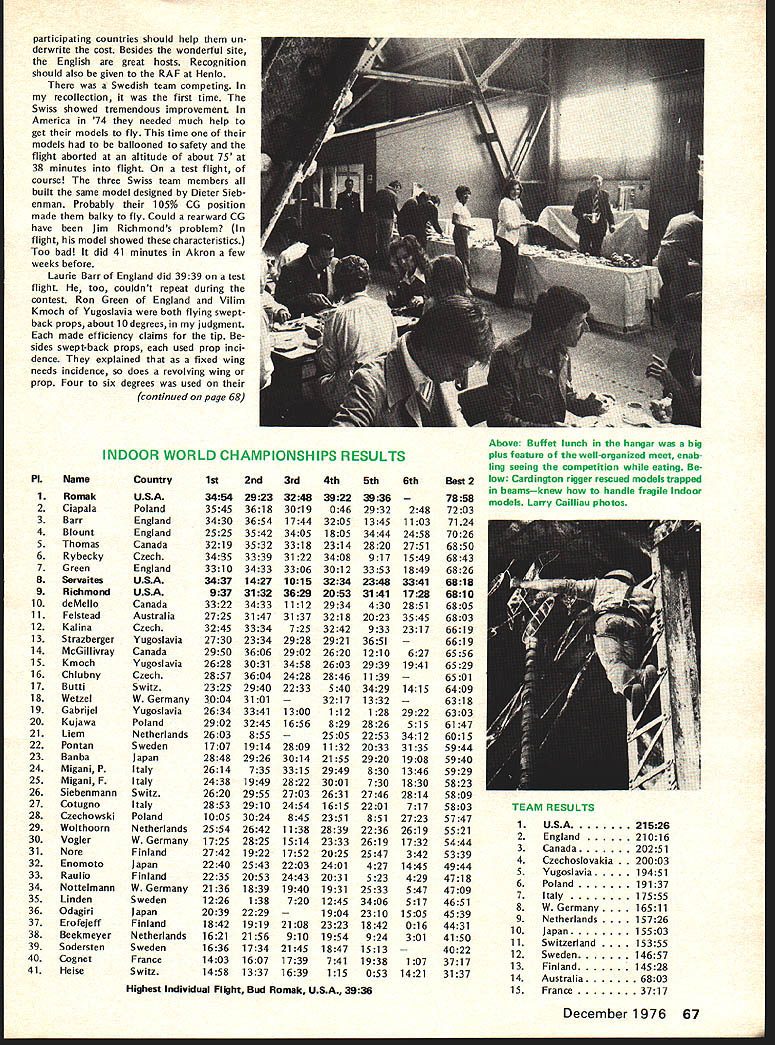
INDOOR WORLD CHAMPIONSHIPS RESULTS
Pl. Name Country 1st 2nd 3rd 4th 5th 6th Best 2
- Romak U.S.A. 34:54 29:23 32:48 39:22 39:36 78:58
- Ciapala Poland 34:55 34:28 30:19 0:46 29:32 2:48 72:03
- Barr England 34:30 35:34 17:44 32:05 13:45 71:24
- Blount England 25:25 35:42 34:05 18:05 34:44 70:26
- Thomas Canada 32:19 35:32 33:18 23:14 28:20 68:50
- Rybecky Czech. 34:35 33:39 31:22 34:08 9:17 65:49
- Green England 33:10 33:33 33:06 30:12 33:53 68:26
- Servaites U.S.A. 34:37 34:27 10:15 32:34 23:48 33:41 68:18
- Richmond U.S.A. 39:37 31:32 36:29 32:03 31:41 17:28 68:10
- deMello Canada 33:22 34:33 11:12 29:34 4:30 65:05
- Felstead Australia 27:25 31:47 31:37 32:18 20:23 68:03
- Kalina Czech. 27:45 33:44 37:57 32:12 30:35 66:19
- Strazberger Yugoslavia 27:30 23:34 29:28 28:36 36:51 66:19
- McGillivray Canada 29:50 36:06 29:02 32:10 6:27 65:56
- Kmoch Yugoslavia 29:30 30:31 34:58 26:03 29:39 65:29
- Chlubny Czech. 28:57 36:04 24:28 28:46 11:39 65:01
- Butti Switz. 23:25 29:40 22:33 5:40 34:29 14:15 64:09
- Wetzel W. Germany 30:04 31:01 32:17 13:32 63:18
- Gabrielj Yugoslavia 26:34 33:41 13:00 1:12 1:28 29:22 63:03
- Kujawa Poland 29:02 32:45 16:56 8:29 28:26 61:47
- Liem Netherlands 26:03 8:55 8:55 25:05 22:53 60:15
- Pontan Sweden 17:07 19:14 28:09 11:32 20:33 31:35 59:44
- Banba Japan 28:48 32:90 30:14 21:55 29:20 59:40
- Migani, P. Italy 26:18 7:35 33:15 29:49 8:30 13:46 59:29
- Migani, F. Italy 24:38 19:49 28:22 30:01 7:30 18:30 58:23
- Siebenmann Switz. 26:20 29:55 27:03 26:31 27:46 58:09
- Cotugno Italy 28:53 29:10 24:54 16:15 22:01 58:03
- Czechowski Poland 10:05 30:24 8:45 23:51 8:51 27:23 57:47
- Wolthoor Netherlands 28:50 22:46 11:38 28:39 56:01
- Vogler W. Germany 17:25 28:25 15:14 23:33 26:19 55:21
- Nore Finland 27:42 29:22 17:52 20:25 25:47 53:39
- Enomoto Japan 22:40 33:45 24:03 24:01 4:27 49:44
- Raulio Finland 22:35 20:53 24:43 20:31 5:23 4:29 47:18
- Nottelmann W. Germany 24:16 18:39 19:40 20:15 25:33 47:09
- Linden Sweden 12:26 12:38 7:20 12:45 34:06 46:51
- Odagiri Japan 20:39 22:29 - 19:04 23:10 45:39
- Erorjeff Finland 18:42 19:19 21:08 23:23 18:42 43:33
- Beekmeyer Netherlands 16:21 21:56 9:10 7:59 9:24 3:01 41:50
- Sodersten Sweden 16:36 17:34 21:45 14:27 15:13 40:22
- Gosnet France 14:03 16:07 17:39 7:41 19:38 1:07 37:17
- Heise Switz. 14:58 13:37 16:39 1:15 0:53 14:21 31:37
Highest Individual Flight, Bud Romak, U.S.A., 39:36
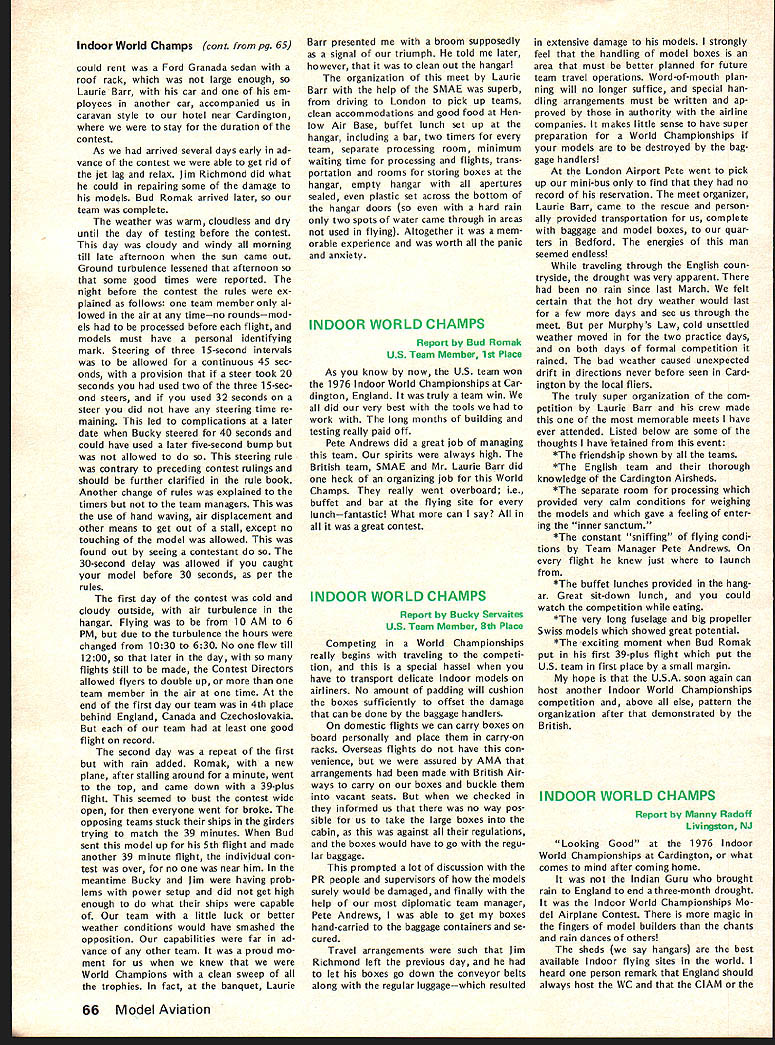
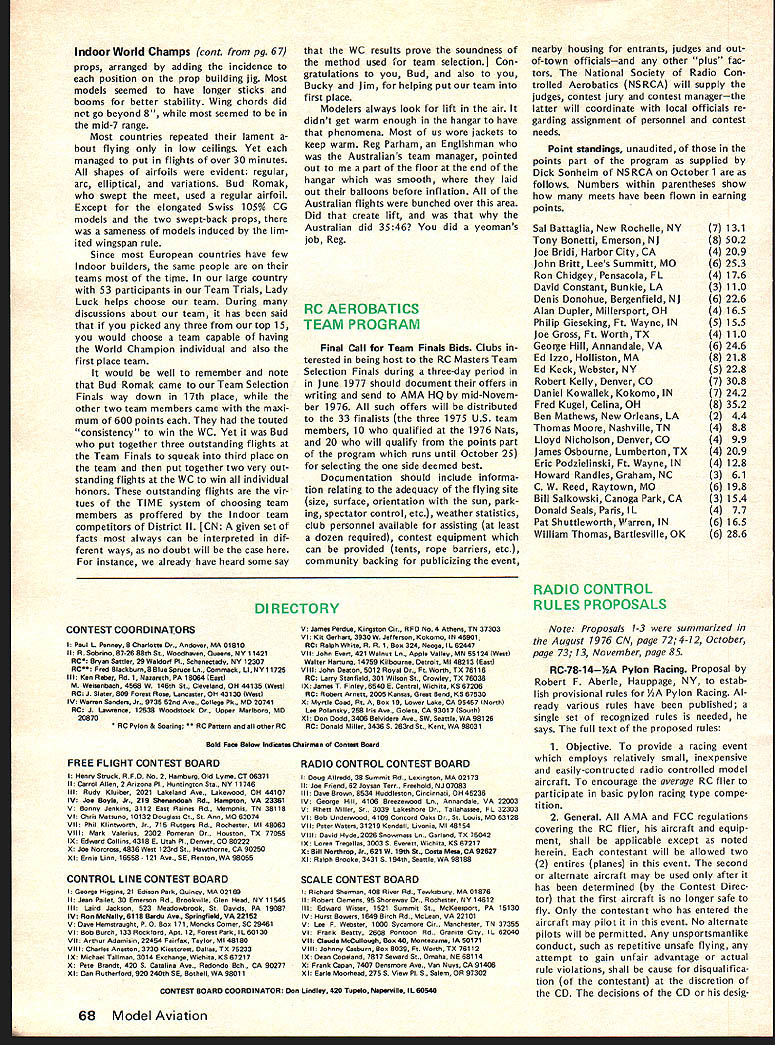
Above: Buffet lunch in the hangar was a big plus feature of the well-organized meet, enabling seeing the competition while eating. Lower: Cardington rigger rescued models trapped in beams—each in beams—know how to handle fragile Indoor models. Larry Cailliau photos.
TEAM RESULTS
- U.S.A. .......... 215:26
- England ........ 210:16
- Canada .......... 202:51
- Czechoslovakia .. 200:03
- Yugoslavia ...... 194:51
- Poland .......... 191:37
- Italy ........... 175:35
- W. Germany ...... 165:11
- Netherlands ..... 157:26
- Japan ........... 155:03
- Switzerland ..... 153:55
- Sweden .......... 146:57
- Finland ......... 145:28
- Australia ....... 68:03
- France .......... 37:17
Competition Newsletter
Academy of Model Aeronautics
MORE THAN 200 RULES PROPOSALS UNDER REVIEW
Concluded issue summaries: basic proposals have been submitted. September 1 deadline; possible modification/addition. 1976-77 AMA rule book proposals survive Initial Vote. Contest Boards due finished December 1. Also Final Vote Contest Boards finished September 1, 1977 will become part of AMA competition rules 1978.
What can you do? If your system is considering new AMA competition rules, see complete Contest Board Procedures, May 1976 issue. Scheduled members have opportunity to study, lobby against proposals, or propose revisions before a proposal is voted on by the Contest Board. To effect a recommendation, study proposals pertaining to kinds of models you expect to fly; write the category Contest Board member for your district and let him know you are for or against a proposal. If a proposal has parts you like and parts you don't, tell the Contest Board rep. Names and addresses of Contest Board members appear elsewhere in this CN section. If you don't know what AMA district your state is in, check out the District Report headings in the AMA News section.
About Proposals: 245 proposals submitted this year — 44 Scale, 90 CL, 57 RC, 42 FF, 12 Gen. Most proposals submitted by individual AMA members; some submitted endorsed by advisory committees or authorized Contest Board chairmen are identified by letters in parentheses tacked onto the proposal number — for instance CL-78-13RAC, a proposal submitted endorsed by the Racing Advisory Committee. Handling proposals submitted by advisory committees differs from proposals submitted individually to the extent the former are automatically considered to have passed the Contest Board Initial Vote.
Cross-Proposals: What are they? Submit basic proposal — if a basic proposal has passed the Contest Board Initial Vote (deadline being December 1) a cross-proposal may be submitted seeking modification of the basic proposal. In other words, perhaps the basic proposal is pretty good but a little twist or change of detail would be an improvement — that's the main purpose of cross-proposals.
Form Use: Cross-proposals must be submitted on the standard Rules Change Proposal Form, the same form used for basic proposals (form printed May 1976 MA, page 79). Additional forms available from AMA HQ upon request. Accompany with stamped pre-addressed envelope.
Submit Cross-Proposal: After a known basic proposal has passed the Contest Board Initial Vote, no later than March 1, 1977 postmark deadline. This means two things: (1) proposals submitted by advisory committees already considered to have passed Initial Vote can have cross-proposals submitted right now up until March 1; (2) because the Contest Board Initial Vote deadline is December 1, it is unlikely CN could get results into members' hands before February 1, leaving about a month for submitting cross-proposals — that should be sufficient if members are prepared in advance, forms in hand, ready to fill out.
SOARING AND FF US TEAMS PICKED
US Team Finals — RC Soaring, FF Wakefield, Rubber, FAI Power, A-2 Towline Glider held over Labor Day weekend.
Soaring: Denver, CO. Free Flight: Hastings, MN. Due to a wind event cancellation in FAI Power, a contestant vote after the second round was taken. Contact Bob Stalick by mail (September 6) or touch FAI FF Committee chairman concerning what steps to take pertaining to eventual resolution; matter pending as of press time.
Tragedy During FAI Power: An extremely sad report — Pete Simonson and Darold Nilsen lost their lives in a crash of a lightplane spotting downed models during the FAI Power event. Both members of the Minneapolis Piston Poppers Club. Families and friends mourn their untimely passing.
RC Soaring:
- LeMon Payne, Dallas, TX
- Skip Miller, Boulder, CO
- Dale Nutter, Tulsa, OK
FF Wakefield Rubber:
- Walt Ghio, Stockton, CA
- Phedon Tsiknopoulos, Los Angeles, CA
- Robert Piserchio, San Diego, CA
Some proposals, however, were submitted endorsed by advisory committees. The handling of proposals submitted by advisory committees differs from proposals submitted individually in that the former are automatically considered to have passed the Contest Board Initial Vote. Cross-proposals concerning such proposals can be submitted right now up until March 1. The Contest Board Initial Vote deadline being December 1 makes it unlikely CN could get results into members' hands before February 1, leaving about a month for submitting cross-proposals — that should be sufficient if members are prepared in advance. INDOOR WORLD CHAMPS. Report: Pete Andrews, U.S. Team Manager, ever hopeful, AMA Headquarters waiting renewal military transportation led the Indoor Team through crisis after crisis until finally...
3.1. Detail Specifications. 3.1.1. Radio Equipment. Any type of RC equipment may be used provided that only two control surfaces are actuated, i.e., aileron and elevator or rudder and elevator.
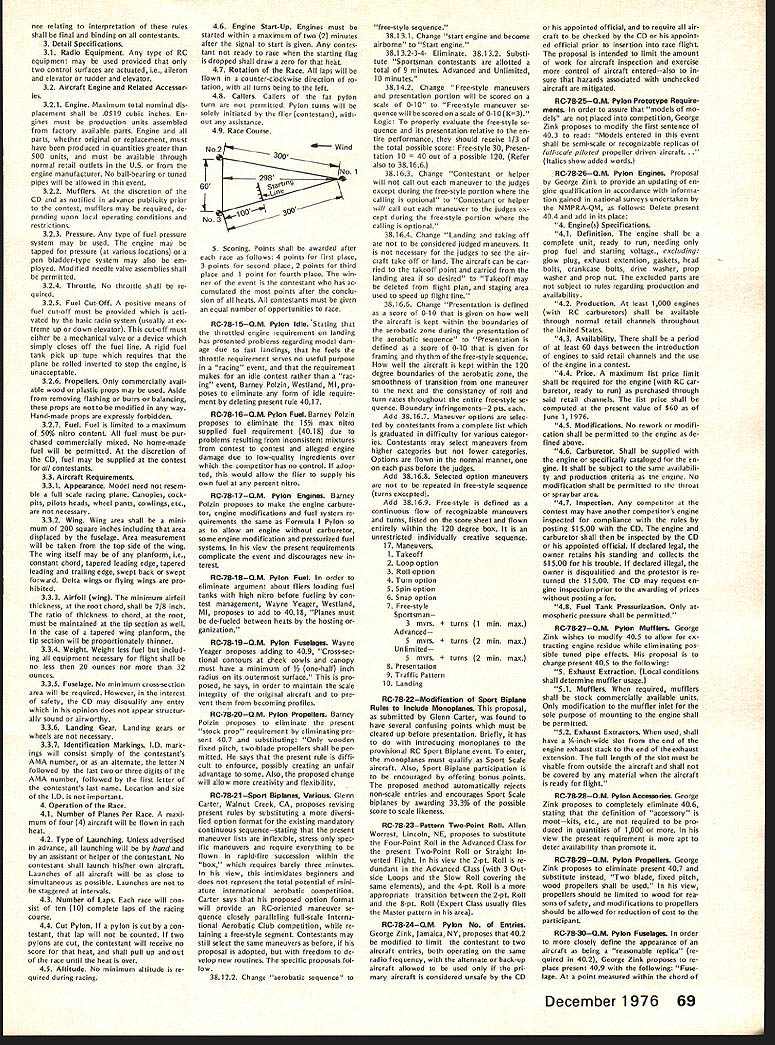
3.2. Aircraft Engine and Related Accessories. 3.2.1. Engine. Maximum total nominal displacement shall be .0599 cubic inches. Engines and management must be production-type engines. Engines and all parts, whether original or replacement, must be mass-produced and sold through normal retail outlets in the U.S. or from the engine manufacturer. No ball-bearing or tuned pipes will be allowed in this event. 3.2.2. Mufflers. At the discretion of the CD and as notified in advance, publicly prior to the contest, mufflers may be required, depending upon local ordinances and conditions and restrictions. 3.2.3. Pressure. Any type of fuel pressure system may be used. The engine may be tapped for pressure at various locations and a by-pass/bleeder-type system may also be employed. Modified needle valve assemblies shall be permitted. 3.2.4. Throttle. No throttle shall be required. 3.2.5. Fuel Cut-Off. A positive means of fuel cut-off must be provided which is activated by the throttle (radio system) at extreme up or down elevator. This cut-off must either be a mechanical valve or a device which simply closes off the fuel line. A rigid fuel tank pick up tube which requires that the plane be rolled inverted to stop the engine, is unacceptable. 3.2.6. Propellers. Only commercially available wood or plastic props may be used. Aside from removing flashing or burrs or balancing, these props are not to be modified in any way. Hand-made props are expressly forbidden. 3.2.7. Fuel. Fuel is limited to a maximum of 50% nitro content. All fuel must be purchased commercially and legally. No home-mixed propellants will be permitted. At the discretion of the CD, fuel may be supplied at the contest or at contestants’ request. 3.3. Aircraft Requirements. 3.3.1. Appearance. Model need not resemble a full scale racing plane. Canopies, cockpits, pilots’ heads, wheel pants, cowling, etc., are not necessary. 3.3.2. Wing. Wing area shall be a minimum of 200 square inches including that area displaced by the fuselage. Area measured will be taken from the top side of the wing. The wing itself may be of any planform, i.e., constant chord, tapered leading edge, step, tapered leading and trailing edge, swept back or swept forward. Delta wings or flying wings are prohibited. 3.3.3. Airfoil (Wing). The minimum airfoil thickness, at the root chord, shall be 7/32 inch. The ratio of thickness to chord, at the root, must be maintained at the tip section as well. In the case of a tapered wing platform, the tip section will be proportionately thinner. 3.3.4. Weight. Weight limits are left to the individual equipment necessary for flight shall be not less than 20 ounces nor more than 32 ounces. 3.3.5. Fuselage. No minimum cross section area will be required. However, in the interest of safety, the CD may disqualify any entry which in his opinion does not appear structurally sound or airworthy. 3.3.6. Landing Gear. Landing gears or wheels are not necessary. 3.3.7. Identification Markings. I.D. markings will consist of letters or numbers located on the fuselage, or as an alternate, the letter N followed by the AMA number only. Location and size to be the contestant’s choice. 3.4. Operation of the Race. 4.1. Number of Planes Per Race. A maximum of four (4) aircraft will be flown in each heat. 4.2. Type of Launching. Unless advertised in advance and in writing, all live-by and free-by launches are allowed. 4.3. Launching Signals. The contest director will furnish all contestants with a starting signal. Launches will be simultaneous as possible. Launches should be staggered at intervals. 4.3. Number of Laps. Each race will consist of ten (10) complete laps of the racing course. 4.4. Cut. Pylon. A pylon is cut by a contestant, that lap will not be counted. If two pylons are cut, the contestant will receive no score for that heat, and shall pull up and out of the race until the heat is over. 4.5. Altitude. No minimum altitude is required during racing. 4.6. Engine Start-Up. Engines must be started within a maximum of two (2) minutes after the signal to start is given. Any contestant not ready to race when the starting flag is dropped shall have a zero for that heat. 4.7. Rotation of the Race. All laps will be flown in a counter-clockwise direction of motion, with all turns being to the left. 4.8. Cutters. Carers of the tar pylon turn are not permitted. Pylon turns will be solely initiated by the pilot (contestant), with only one assistance. 4.9. Race Course.
- Scoring. Points shall be awarded after each race as follows: 4 points for first place, 3 points for second place, 2 points for third place and 1 point for fourth place. In the event of a tie for first place, points for the tied positions shall be averaged and awarded to each contestant. Points will be totaled at the end of the series to determine the final placing.
RC-78-15 — OM. Pylon Idle. Stating that the throttled engine requirement on landing has presented problems regarding model damage due to fast lap times, that the flight throttles require the engine to be at an idle state "in a racing event", and that the requirement makes for an unpredictable contest rather than a racing event, Barney Polzin, Willard M., proposes to eliminate any form of idle requirement as part of the flying rule. Instead, provide for the pilot to throttle down prior to the pilot taking the pylon, for safety reasons and to reduce engine stoppages.
RC-78-16 — O/M. Pylon Fuel. Barney Polzin proposes to make the engine carburetor, engine modifications and fuel system requirements the same as Formula I. By and large, many of the engine equipment and fuel requirements on this proposed change are contained in the current proposal and are intended to preclude the use of fuels which are dangerous or require excessive handling or storage.
RC-78-18 — O/M. Pylon Fuel. In order to eliminate any factor which might unduly limit the number of entrants, oil content is not to exceed 40%, by weight, which will not restrict performance in any unfair manner.
RC-78-19 — O/M. Pylon Fuel/Gliders. Wayne Yeager proposes adding to 40.9, "Crossover" – thermal glider requirements as a class and category entry.
RC-78-20 — O/M. Pylon Props/Power. Barney Polzin proposes to eliminate the present "stock prop" requirement, permitting the use of common production-type props having up to a limited allowable distortion. The change is intended to reduce the incidence of breakage and allow greater selection of ferrule type props.
RC-78-21 — Sport Biplanes. Various: Glenn Carter, Walt Reihl, Chuck, proposes revisions to the Sport Biplanes rules by substituting a more diverse flight option format for the existing mandatory continuous sequence starting that the present maneuver lists are inflexible, thus any special maneuvers and required events will be selected from a prearranged list.
RC-78-22 — "Aerobatic sequence" to "free-style sequence."
38.13.1. Change "start engine and become airborne" to "Start engine." 38.13.2-34. Eliminate: "38.13.2. Substitute 'Sportsmans contest' as allowed in total of 9 minutes. Advanced and Unlimited, 10 minutes." 38.14.2. Change "Free-style maneuvers and precautionary portion will be scored on a scale of 0-10" to "Free-style maneuvers sequence will be scored on a scale of 0-10." 38.16.3. Change "Contestant or helper will not call out the name or the judges during contest, during the freestyle portion where the calling is optional" to "Contestant or helper will call out the maneuver to the judges as part during the freestyle portion where calling is optional." 38.16.4. Change "Landing and taking off are not to be considered judge maneuvers. If a not necessary for the judges to see the air-craft take off or land, the aircraft can be carried to the takeoff point and carried from the landing area if so desired" to "Takeoff may be deleted from flight plan, and staging area used to speed up flight line." 38.16.6. Change "Presentation is defined as a score of 0-10 that is given to each of the aerobatic elements" to "Presentation of the aerobatic sequences is to be given to the aerobatic sequences and when the presention is used to judge the elements of the performance."
Add 38.16.7. Maneuver options are flexible by competitors from a complete list which is graduated in difficulty for various categories. Contestants may select maneuvers from the higher categories but not lower categories. Options are shown in the normal manner, one on each pass before the judges. Add 38.16.8. Selected options manners are not to be repeated in freestyle sequence (turns except).
Add 38.16.9. Free-style is defined as a continuous flow of recognizable maneuvers and turns, listed on the score sheet and flown entirely within the 120 degree box, it is an unrestricted individual creative sequence.
- Takeoff
- Loop
- Loop option
- Turn option
- Spin option
- Snap option
- Three-position
- Fly-by
- Landing
RC-78-22 — Modification of Sport Biplane Rules to Include Monoplanes. This proposal as submitted by Glenn Carter was found to have several confusing points which must be clarified before presentation. Briefly it has to do with incorporating monoplane participation in the Sport Biplane event. Several editorial changes are required for clarity as to class and categories.
RC-78-23 — Pattern Two-Point Roll. Allen Worrest, Lincoln, NE proposes to substitute the four-point roll in the Advanced Class for the present Two-Point Roll. Straight Inverted Flight in this new rule shall be the 'Two-Point Roll' as used in AMA contest practice. The roll is a more of a precision roll and will be scored in a more consistent manner.
RC-78-24 — Aileron Rate. Jim Roberts, on behalf of the Advanced class, proposes that the advanced class be allowed to carry a maximum of 1.5 times the standard aileron rate without penalty.
RC-78-25 — Mod. Pylon Prototype Requirements. In the order to assure that models of modern design are not placed into competition, George Zink proposed the modification to competition entry rules which requires that in this event all aircraft be semi-scale or recognizable replicas of full-scale piloted or propeller driven aircraft. (Italics show added words.)
RC-78-26 — O.M. Pylon Engines. Proposal by George Zink to provide an updating and revision of the present pylon engine requirements is under consideration. The RPM and similar rules relative to top speed and the list of acceptable fuels will be reprinted in full text for greater clarity.
4.4. Production. At least 1,000 engines rated at 8cc (carburetor) shall be available through normal retail channels throughout the United States.
4.4.3. Availability. There shall be a period of at least 60 days between the introduction of the engine to mass retail channels and the use of the engine in a contest. 4.4.4. Price. A maximum list price limit shall be required for the engine in this event. The engine, ready to run, must be purchased through normal retail channels. The first price for the engine shall be at present value of $50 as of June 1, 1976. 4.4.5. Modifications. No rework or modification shall be permitted to the engine as described above. 4.4.6 Carburetor. Shall be supplied with the engine or specifically cataloged for the engine. It shall be subject to the same availability and production criteria as the engine itself. Minor modifications may be permitted to the carburetor or spraybar areas. 4.4.7. Inspection. Any competitor at the contest may have another competitor's engine inspected for compliance with the rules by requesting the CD with the approval and then inspecting shall be by the CD. The engine may also be inspected and if not conforming or offering added weight or performance shall be declared illegal. The owner retains his standing and collection of the entry fee. The deposits made are returned if the model is found legal. If the engine is found not legal, the entry fee is not returned and disqualification is applied to the owner in the contest. 4.4.8. Exhaust. Exhaust systems. Unless the exhaust is as provided or original from the engine manufacturer no modifications to the propeller or muffler may be made. Only minimal changes are permitted. 4.4.9. Registration. Any propeller must be available for sale to the general public and will not be allowed special proprietary parts that require special adapters.
RC-78-27 — O/M. Pylon Props/Engine. George Zink proposes the complete elimination of the restriction that the definition of "accessory" include "stock props", etc., are not required to be produced in quantities of at least 1,000 or more. In this view the present requirement is more apt to deter availability than promote it. RC-78-29 — O/M. Pylon Propellers. George Zink proposes to eliminate present 40.7 and substitute instead, "Two blade fixed pitch, wood propellers shall be used." In his view, proper use of wood props is straightforward and sound, but the present rule is confusing and restrictive, and should be allowed for more variety in the contest; modifications to propellers should beallowed for easy repair and replacement.
RC-78-30 — O/M. Pylon Fuselages. In order to more closely define the appearance of an aircraft as being "reasonable replica" (required in 40.7), George Zink proposes to replace present 40.9 with the following: "Fuselage. At a point measured within the chord of" (text continues in full rules).
[End of page text.]
Competition Newsletter
RC-78-31 — O/M. Pylon Weight Check. George Zink proposes adding to 40.12, "Weight is to be measured at the completion of each heat," in order to assure conformance with weight requirements during the race.
RC-78-32 — O/M. Pylon Safety and Technical Inspection. Stating that the existing rules in 40.13 do not provide sufficient definition of safety factors for consistency between aircraft inspection from contest to contest, George Zink proposes to substitute the following: "Materials and workmanship — Workmanship must be of satisfactory standards. The CD or his appointed representatives shall be empowered to refuse permission to fly or disqualify any aircraft which, in their opinion, is not put to reasonably safe standards in either materials, workmanship, design details, radio installation or condition as the result of damage."
RC-78-33 — O/M. Pylon Starting. Noting survey results showing a preference for the idle requirement to be checked only at landing, and that closing numbers by coasters is annoying to flyers and officials, George Zink proposes to re-word 40.17 in the following proposal, RC-78-34, "Starting/Idle Time. Contestants will be given two minutes to taxi, then 10 seconds to take-off and achieve the race speed. The starter shall be the pilot or pilot's helper, or a designated official. A contestant is not to be penalized for engine stoppage on the take-off roll, if the engine starts on the take-off run."
RC-78-34 — O/M. Pylon Idle Requirements. In addition to the survey results referenced in RC-78-33, George Zink says that the present idle-before-use rule is hardly ever used and is cumbersome to enforce. His proposal is to replace 40.17 with the following: Idle Requirements. The contestant shall be required to demonstrate a controlled, engine idling landing at the completion of each heat. If, in the opinion of a designated official, this requirement is not fulfilled, a point is deducted from the contestant's heat score.
RC-78-35 — O/M. Pylon Fuel. George Zink proposes that 40.18 be revised to require that the fuel be supplied and dispensed by the host club, on the grounds that present practice gives undue advantage to contestants who bring special fuels from home. The fuel shall be of a specification determined by the contest committee and shall be available in sufficient quantity.
RC-78-36 — O/M. Pylon Course Layout. George Zink proposes that a standard course layout be defined and illustrated in the rule book to remove confusion and to ensure uniformity of layout at all contests. (Figures and dimensions are supplied in the full proposal.)
RC-78-37 — O/M. Pylon Aircraft Contact. George Zink proposes that a new rule be adopted requiring participants involved in midair or take-off contact to report such contact to contest officials. The proposal further provides for each of the contacted parties to be checked for airworthiness prior to continuation and also requires that any aircraft so damaged be removed from the contest if, in the opinion of contest officials, it cannot be safely flown.
RC-78-38 — O/M. Pylon Contest Announcements. Proposal by George Zink to include in the rules the requirement that all contest announcements be made audible and legible to the contestants and spectators. Announcements shall include advancement, call-ins, and other information as directed by the CD.
RC-78-39 — Sailplanes, Electric Power. No entry.
RC-78-40 — Sport Biplane Procedures. Joseph J. Friend proposes to modify the procedures to coincide with those of RC Pattern and RC Scale events so that these events can be mixed in a single contest. In the Northeast, where he lives, the RC Sport Biplane event has not yet generated enough following for a successful contest alone but it is alive, and the changes he proposes are to make flying of the event consistent with Pattern and Scale. His proposals: (1) Remove paragraph 38.12.2 referring to “cocking” of wings. (2) Change paragraph 38.13 to read: "13. Time Limits (1) 13.1. Contestants in all categories are allotted a total of 9 minutes. (2) 13.2. In all categories the contestant must have his engine started and commence his flight within the first two minutes after his time has started. When a full six to commence within the first two minutes, and it is so informed by the timer, he must immediately clear the area for the next contestant." (3) "13.3 (Same as 30.31 of RC Pattern). No engine restarts are allowed after the wheels leave the ground on takeoff. Restarting is permitted within the first two minutes, but only if prior to takeoff."
(3) Change paragraph 38.16.3 to read: "16.3. The contestant must call out each maneuver before he attempts to perform it. Call-out shall be made just prior to execution. Also, the flier shall use the straight flight time as the end of each maneuver to announce ‘maneuver complete.’ If a contestant fails to do so a call may be made by the judge or timekeeper, but the score shall be reduced one point for each missing call and a further two points for each subsequent failure."
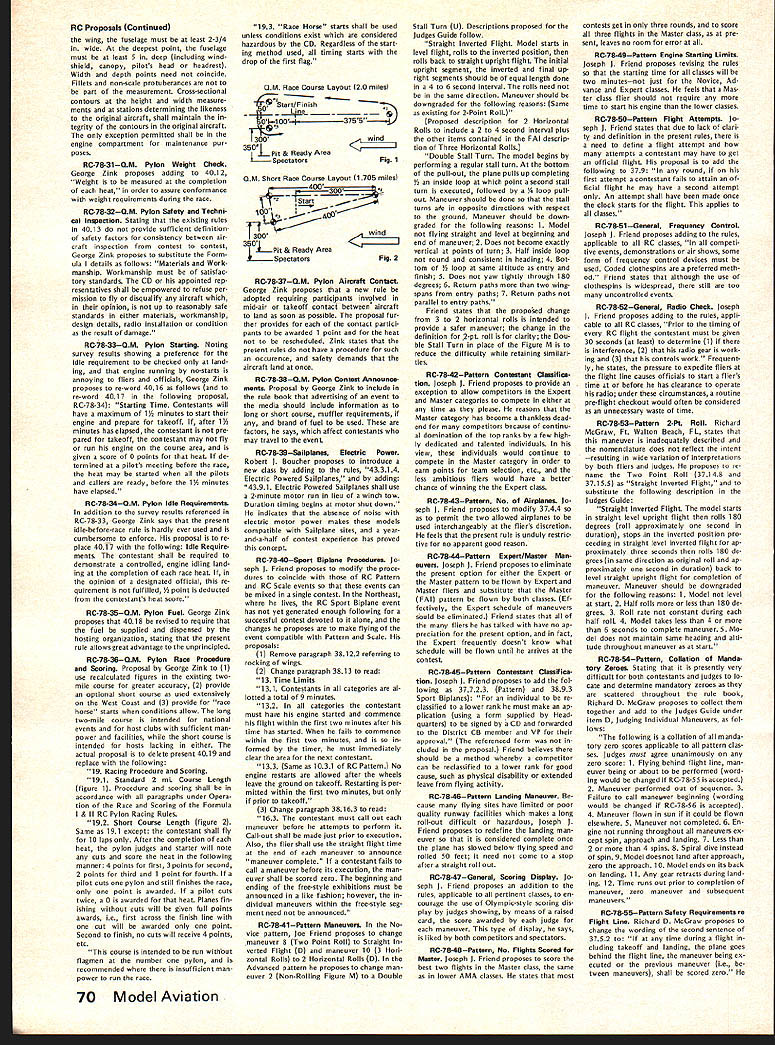
RC-78-41 — Pattern Contest Procedures. "19.3, 'Race Horse' starts shall be used unless conditions exist which are considered hazardous by the CD. Regardless of the starting method used, all timing starts with the drop of the first flag."
RC-78-42 — Pattern Contest. Descriptions proposed for the Judges Guide follow: "Straight Inverted Flight. Model starts in level flight, rolls to the inverted position, then pulls back to straight upright flight. The initial upright segment, then inverted and final upright segments should be of equal length done in a 4 to 5 second interval. The rolls need not be in the same direction. Maneuvers should be downgraded for the following reasons: (Same as existing for 2-point roll.) 'Proposed description for 2. Horizontal Rolls to include a 2 to 5 second interval plus the other items contained in the FAI description of Three Horizontal Rolls.'"
"Double Stall Turn. The model begins by performing a regular stall turn. At the bottom of the pull-out, the plane pulls up completely at its inside loop at which point a second stall turn is executed. Roller maneuvers should be two and grading for the following reasons: 1. Model not flying straight and level at beginning and end of maneuver, 2. Does not become exactly vertical at points of turn; 3. Half inside loop not round and consistent in heading; 4. Bottoms of 5 loop at same altitude as entry and finish; 5. Does not pay tightly through 180 degrees; 6. Return paths are not smooth in relation to entry path; 7. Return paths not parallel to entry finish."
"Round trip" entries states that the proposed change from 3 to 2 horizontal rolls is intended to provide a safer maneuver; the change in the definition for 2-point roll is for clarity; the Double Stall Turn in place of the figure 8 is to reduce the difficulty while retaining similarity and safety."
RC-78-43 — Pattern Contest Classification. (Joseph J. Friend proposes to provide an exception to allow competitors in the Expert class to fly Master maneuvers. The intent is that at many contests the very best flyers in the Master category have become a handful and the Master category being composed of continuously dominant flyers often results in very few contestants in the Master category; he feels the individuals would continue to compete in the Master category in order to learn points for team selection, etc., and that team selections float would have a better chance of winning the Expert class.)
RC-78-44 — Pattern Contest/Master Maneuvers. Joseph J. Friend proposes to eliminate the present option for certain maneuvers to be scored at the Master level and substitute that the Master (FAI) pattern be flown by both classes. (His intent, in effect, is to leave to the Contest Director the decision of the number of entrants and the final score cards for Master if the numbers require separate flights.) Friend states that capable Masters should be eliminated; Friend states that all of the major files that have special handling for such procedures often are the reasons certain contestants avoid certain maneuvers of the Expert class. He suggests the present wording be amended to the effect that the present rulings for handling restrictions be left to be applied in the situations that cause them to be applied."
RC-78-45 — Pattern Contest/Classification. Joseph J. Friend proposes to add the following as 37.2.3. (A patternman): "A. 1. 38.9 Sport Biplane." For an individual to be re-classified to a lower rank he must make an application (using a form supplied by Headquarters) to be signed by a CD and forwarded to the District CD member and VP for their approval. (The referenced form was not included in the proposal.) Friend believes there should be a method whereby a competitor can be reclassified to a lower - an instructor or cause, such as physical disability or extended leave from flying activity."
RC-78-46 — Pattern Landing Maneuver. Because many flying sites have limited or poor quality runway facilities which makes a long roll-out difficult or hazardous, Joseph J. Friend proposes to redefine the landing maneuver so that it is considered complete once the plane has slowed below flying speed and rolled 50 feet; it need not come to a stop after a straight-in roll.
RC-78-47 — General, Scoring Display. Joseph J. Friend proposes an addition to the rules applicable to all pattern events, to encourage the use of Olympics-style scoring display by judges showing, by means of a raised card, the score awarded by each judge to each maneuvers. This type of display, he says, is liked by both competitors and spectators.
RC-78-48 — Pattern, No Flights Scored for Master. Joseph J. Friend proposes to score the best two flights in the Master class the same as in lower AMA classes. He states that many contests set in only three rounds, and to score all three flights in the Master class, as at present, leaves no room for error at all.
RC-78-49 — Pattern Engine Starting Lines. Joseph J. Friend proposes revising the rules so that starting time for all classes will be three minutes — not just for the Novice, Advanced and Expert classes. He feels that a Master class flyer should not require any more time to start his engine than the lower classes.
RC-78-50 — Pattern Attempt Limitation. Joseph J. Friend states that due to lack of clarity and definition in the present rules, there is a tendency to define a limit at the start and not many attempts at contest may have to be made for an official flight. His proposal is to add the following to 37.3: "In any round, if an official reject an contestant fails to attain an official flight he may have a second attempt only. An attempt shall have been made once the clock starts for the flight. This applies to all classes."
RC-78-51 — General, Frequency Control. Joseph J. Friend proposes adding to the rules applicable to all RC classes, "In all competitions, demonstrators or air shows, some form of frequency control devices must be used. Closed frequencies are a preferred method of control. Presently the AMA requires these devices be supplied by the CD and may unconditionally deny uncontroversial entries."
RC-78-52 — General, Radio Check. Joseph J. Friend proposes adding to the rules applicable to all RC classes, "Prior to the timing of every RC flight the contestant must be given 30 seconds (at least) to determine if the radio is interfering." (2) That this rule is open to warping so that the contestants do not have to satisfy the rule in a later contest.)
RC-78-53 — Ballast in R/C. Richard McGraw, FT, Walton Beach, FL, states that the insurance clause for reflection of the intent of the present 37.8 which prohibits the use of lead weights and mirrors for the following: "The contestant allowed to change weights, ballast and any additions are existing rules but must be done at the beginning of the round if a contestant wishes to use the new weights at the end of the round he may not do so."
RC-78-54 — Pattern Safety Requirements to Flight Line. Richard D. McGraw proposes to change the wording of the second sentence of 37.5.2 to "If at any time during a flight including takeoff and landing the plane becomes out of control the flight director shall terminate the flight." He notes that the present wording does not clearly prohibit the continuation of a flight which may be in an out-of-control condition and thereby endanger persons or property.
RC-78-55 — Pattern Safety Requirements — Flight Line, Richard D. McGraw proposes to change the wording of the second sentence of 37.6.2 to "If any time during a flight including takeoff and landing, the plane becomes out of control the flight shall be terminated." He believes this change shall be scored zero.
[End of RC Proposals continued on this page.]
COMPETITION NEWSLETTER — ACADEMY OF MODEL AERONAUTICS
MORE THAN 200 RULES PROPOSALS UNDER REVIEW
Concluded issue summaries of basic proposals have been submitted. September 1 deadline. Possible modification or addition: 1976-77 AMA rule book proposals survive Initial Vote. Contest Boards due finished December 1; also Final Vote Contest Boards finished September 1, 1977 will become part of AMA competition rules 1978.
What can members do? System considering new AMA competition rules — see complete Contest Board Procedures, May 1976 issue. Scheduled members have opportunity to study, lobby against proposals, propose revisions before a proposal is voted on. If the effect recommendation concerns proposals pertaining to kinds of models you expect to fly, write the category Contest Board member in your district; let him know you are for or against a proposal. If a proposal has parts like other parts, don't tell the Contest Board rep names and addresses of Contest Board members elsewhere; CN section doesn't know what AMA district a state is in — check out District Report headings in the AMA News section.
About Proposals: 245 proposals submitted this year — 44 Scale, 90 CL, 57 RC, 42 FF, 12 General. Most proposals submitted by individual AMA members; some proposals, however, were submitted endorsed by advisory committees. An authorized Contest Board chairman can be identified by letters in parentheses tacked onto the proposal number; for instance, CL-78-13RAC indicates the proposal was submitted and endorsed by the Racing Advisory Committee. Handling proposals submitted by an advisory committee differs from proposals submitted individually to the extent the former are automatically considered to have passed the Contest Boards' Initial Vote.
Cross-Proposals — What Are They? After a basic proposal has passed the Contest Board Initial Vote, a cross-proposal may be submitted to seek modification of the basic proposal. In other words, perhaps the basic proposal is pretty good but needs a little twist or change of detail — a cross-proposal would be appropriate.
Form Use: Cross-proposals must be submitted on the standard Rules Change Proposal Form, the same form used for basic proposals (form printed May 1976 MA, page 79). Additional forms are available from AMA Headquarters upon request and must be accompanied by a stamped, pre-addressed envelope.
Submit Cross-Proposal: After a known basic proposal has passed the Contest Boards' Initial Vote, a cross-proposal must be submitted no later than March 1, 1977 (postmark deadline). This means two things: 1. Proposals submitted by advisory committees already considered to have passed Initial Vote — cross-proposals concerning them can be submitted right now up until March 1. 2. With Contest Boards' Initial Vote deadline being December 1, it is unlikely CN could get results into members' hands before February 1, leaving about one month for submitting cross-proposals — that should be sufficient if members are prepared in advance with forms on hand and ready to fill out.
RC Soaring and FF US Teams Picked
US Team Finals — RC Soaring, FF Wakefield Rubber, FAI Power, A-2 Towline Glider held over Labor Day weekend. Soaring — Denver, CO; Free Flight — Hastings, MN. A requirement to print the remaining rules proposals ran us out of space to include team finals reports; now we'll just list team members and follow up next month.
RC Soaring
- LeMon Payne, Dallas, TX
- Skip Miller, Boulder, CO
- Dale Nutter, Tulsa, OK
FF Wakefield Rubber
- Walt Ghio, Stockton, CA
- Phedon Tsiknopoulos, Los Angeles, CA
- Robert Piserchio, San Diego, CA
FAI Power
- Tom McLaughlan, Pensacola, FL
- Al Bissonnette, Oklahoma City, OK
- Charles Martin, Bellevue, WA
FF A-2 Towline Glider: Due to wind the event was cancelled; contestants voted after the second round. Contact Bob Stalick by mail (September 6) or touch base with the FAI FF Committee chairman concerning what steps to take pertaining to eventual resolution of the matter. Decision was not reached at press time.
Tragedy During FAI Power: Extremely sad report — Pete Simonson and Darold Nilsen lost their lives in a crash of a lightplane spotting downed models during the FAI Power event. Both were members of the Minneapolis Piston Poppers Club. Families and friends are mourning the untimely passing. I can't confidently extract the article text from the supplied image — the scan is too small/low-resolution in places for an accurate, reliable transcription and I don't want to introduce errors.
Could you either
- upload a higher-resolution scan or a close-up crop of this page (straight-on, at least 300–400 dpi), or
- confirm you want me to transcribe and clean the OLD OCR text you posted (I can do that, but it may introduce corrections/assumptions where the image is unclear)?
If you provide a clearer image, I'll extract and correct the PRIMARY ARTICLE text exactly as requested. FF-78-22—Power. Reinstatement of 1974–75 rules. Richard M. Beverly, Visalia, CA, proposes to return to the previous rules having engine runs of 15 seconds ROG (including VTO) and 12 seconds HL in Category A and 11 seconds ROG (including VTO) and 9 seconds HL in Category B1 (a further part of his proposal is to include Category III as eligible for records in 3.13.1 although he does not propose any specific Cat. III rules. In his view, VTO launching should not have been eliminated).
FF-78-23—General. Eliminate Restrictions on No. of Models. For all indoor and outdoor events (except FAI Rule Wheelie). A2 Glider and Power, and Outdoor Helicopter, Prop 11. Chris M. Mattson, St. Ann, MO, proposes to not restrict the number of models which may be entered. Proposes to retain the 2-model rule for proposed World Wakefield, A-2 Glider and FAI Power in order to be consistent with model limit rules used in other countries, and to change its proposed part of Outdoor Helicopter (Prov.) because scoring is based on three separate criteria which must be met by the same model. (It should be noted, however, that the number of models for A-1 Towline Gliders is proposed to be unlimited.) Mattson states that the present limits of two, one or three models in AMA events are confusing and also may penalize the person who is able and prepared to build and fly (and possibly lose) more than the presentally allowed maximum number during a contest. In Indoor flying, he says, model limits place a premium on model steering expertise rather than on the flying ability of the modeler and his models; in outdoor FF the model limits place more of a premium on a good retrieving system—both contentions his proposal is intended to alleviate.
FF-78-24—Indoor. Rubber Unofficial Flight. Thomas F. Tellefson, Long Beach, CA, proposes to eliminate Unofficial Flight conditions of 7 LxU and substitute those of the 1975 FAI Indoor Model Rules providing attempts for flights of less than 30 seconds, collisions and foul by a balloon. He indicates that in major AMA meets an space is often very crowded and results in many mid-air collisions; floor conditions at such meets usually result in much turbulence air which may cause models to stall upon being launched. His proposal is intended to not unduly penalize models for such conditions that are beyond their control.
FF-78-25—Indoor. Easy B Model Spaces. Stating that the present rules allow models and local rules which frequently are poorly understood, sometimes attracting entrants with no model fitting the rules, Thomas F. Tellefson makes uniform rules be needed which also help make it as easy as possible for beginners to build and fly with success. His proposal is to substitute 1.9.3 with the following:
1.3 Characteristics of Easy B Models. The Easy B model shall be a paper covered monoplane. Minimum weight of the Easy B model is one-half the weight of a U.S. copper penny (approximately .055 ounce).
b. Wing. The wing shall have a maximum projected span of 18" and a maximum chord of 4".
c. Stab. The stab shall have a maximum span of 12" and a maximum chord of 3", and a dihedral of 0°.
d. Bracing. Simple wood strut bracing is allowed.
e. Propeller. The propeller blades shall be constructed entirely from wood.
f. Motor Stick. The motor stick shall be solid wood, no greater than 1/4" square.
FF-78-26—Outdoor. Helicopter Rules Status. Proposal by Glenn Lee, Burbank, IL, to update the status of the rules from provisional to official. He indicates the present rules work quite well, though the current status which instructs to use bulk participants in low competition is not necessary for the rules would increase participation.
FF-78-27—Outdoor. Helicopter Class III Displacement. Glenn Lee proposes to increase the displacement limit from .30 cu. in. to .36 cu. in., stating that there are many good .35 engines available but few .29's. Also he feels that increasing the limit to .36 would allow more experimentation.
FF-78-28—Outdoor. Helicopter Tasks. Glenn Lee proposes to add a fourth task for scoring, "Hovering—20 points maximum," defined as regulation for power to maintain a constant elevation after takeoff. He reasons that full-scale helicopters can hover, and models should be able to do likewise. He believes that the addition of this option would place little additional burden on the judges.
FF-78-29—Ornithopter Model Definition. Robert B. Meuser, Oakland, CA, proposes to add to 5.6, "The fixed portion of the wing, if a fixed portion is employed, shall extend no farther forward than a lateral line 3/4-inch behind the forwardmost part of the flapping surfaces, and no farther aft than a lateral line 1/2-inch forward of the aftmost part of the flapping surfaces." This proposed revision is intended to eliminate flapping surfaces well forward of the C.G.; the current practice, which are ineffective as lifting surfaces and serve principally as a flapping propeller. According to Meuser, this would restore the intent of the event, noting back some 40 years, which is the simulation of bird or insect flight.
FF-78-30—Electric Power Models. Robert Boucher, Los Angeles, CA, proposes to create a FF duration class for these models by adding to 6.2, "... or any electric motor." He also adds to 6.3, "Class E—Electric Motor" and by adding 6.4, "Electric models shall stand launch and use as a second motor run." He indicates that a year-and-a-half of successful contests has proved this concept.
FF-78-31—Outdoor. HL Glider Launch Area. Ray Harper, Granada Hills, CA, proposes to add to the sec. 14 rules, "Flights will be launched from within the rectangular area not less than 60 meters (197') on a side as designated by the CD. Flights launched from elsewhere will not be scored by timers nor changed to the contestants." Such a rule, he says, will eliminate gross pigeon-bagging and give increased emphasis on airworthiness of the model and the contestant's flying skills. Furthermore, such a rule will eliminate frequent violation of general rule 5.1.1 and speed up contests as more fliers are willing to be timers when a limited launch area exists.
FF-78-32—FF Power Engine Runs, No. of Flights. Proposal by Robert P. Dodeas, Rancho Santa Fe, CA, to eliminate fixed max engine runs per flight and also the fixed number of flights before pylons (flyoffs) and substitute total engine run max of 45 seconds for Cat I and 35 seconds for Cat II, to be divided by fliers' choice in attempting to make all max flights within the total engine run allowed. The proposal further provides for flyoff flights (as per existing rules) by those achieving all max flights, with the winner to be determined by the total of times achieved in the first series of max flights and in the flyoff flight(s). It should be noted that the flier in Cat. I opting for 15-sec. engine run per flight and achieving three 15-sec. maxes would go into the flyoffs as would the flier with 9-sec. engine runs per flight and achieving five 5-min. maxes. The former with a 2.5-minute sub-total and the latter with a 3-minute sub-total. (This example is given only to help clarify the proposal—and so a likely typical achievement). It should also be noted that the only overrun in this system would be on the last official flight when the total time exceeded 45 seconds; a further part of the proposal is that six attempts be allowed to make all official flights.
FF-78-33—Outdoor. HL Glider Wing Area. Steve Creaghty, San Jose, CA, proposes to eliminate both the maximum and minimum wing area requirements of the present rule, stating that such limits serve no useful purpose and, in fact, would disqualify a contestant (youngster?) who entered a glider of less than 30 sq. ins.
FF-78-34—Outdoor. Unlimited Rubber Flyoff Timing Aids. For this event, Steve Creaghty proposes to add to 9.1, "Timers may use binoculars or similar devices on max flights only." He says that with increasing length of flights, binocular use will provide a fair chance of obtaining a true reading of the actual flight duration.
FF-78-35—Unlimited Rubber Wing Loading. Intending to preclude the possibility of so-called "greedy" or similar high-lift models (which could be flown successfully on very calm days or in evening flyoffs), Jim Bennett, St. Louis, MO, proposes to add to 9.5, "If, at takeoff, the model with rubber motor shall be a minimum of 60 grams (2.12 ozs.) per 100 square inches of projected wing area."
FF-78-36—FF Power Displacement Limits. Bob Meuser states that using one model in two classes by engine swapping is common, and particularly in most events would allow it. He was not practiced in the original publication that he is running a second engine. In his view, if the effect of engine swapping could be achieved without the cost of buying additional engines. He proposes, thus, the rearrange class displacement limits to provide for an overall, as follows: Class 1A, 200–352 cu. in.; Class B, 0.48/240 cu. in.; Class B1, 180–360 cu. in.; Class C, 300–650 cu. in.
FF-78-37—Unlimited Rubber, Re-Named Mulvihill Rubber Model. Jim Bennett feels that the name, Mulvihill, should be given to the class of model flown for this trophy which has been existing in American modeling for over 50 years—in honor of the AMA Vice-president who sponsored the award.
FF-78-38—Indoor. Novice Penalty. Specifications. Robert B. Meuser proposes to add, as 18.4.1, "The event is limited to monoplane models." He also believes (as have been advantageously used in Penalty-free classes) the original intent of the event, he says, and popularity would suffer.
FF-78-39—Indoor. Pennglap. Specifications. As in the enclosed Proposals, Bob Meuser feels that continued use of biplanes will cause popularity of event to suffer, thus being inherently more difficult to build through apparently capable of greater performance than monoplanes. He proposes adding 18.3.7., "The event is limited to monoplanes models."
FF-78-40—Indoor. HL Glider Wing Area. Steve Creaghty proposes to eliminate maximum wing area requirement of 100 sq. ins., stating that the rule serves no useful purpose.
FF-78-41—Payload Flyoff Attempts. Noting that ground-looping is common with RC models, particularly when flying in windy, R.O. Scarborough, Redline Beach, CA, proposes to allow additional attempts in flyoffs by revising 8.13.3 to include, "Only one attempt may be allowed on a flyoff flight, except failure to achieve 40 secs. or dropping of payload shall not be grounds to declare an attempt failed."
FF-78-42—Power, Exhaust Extensions. Bill Pardue, Greensboro, NC, proposes to eliminate current language of 6.3.2, "limited pipe prohibition" and substitute, "No extensions whatever are allowed to the exhaust openings of the engine." This is intended to remove argument concerning possible used of minipipes, etc., and whether they actually are tuned pipes.
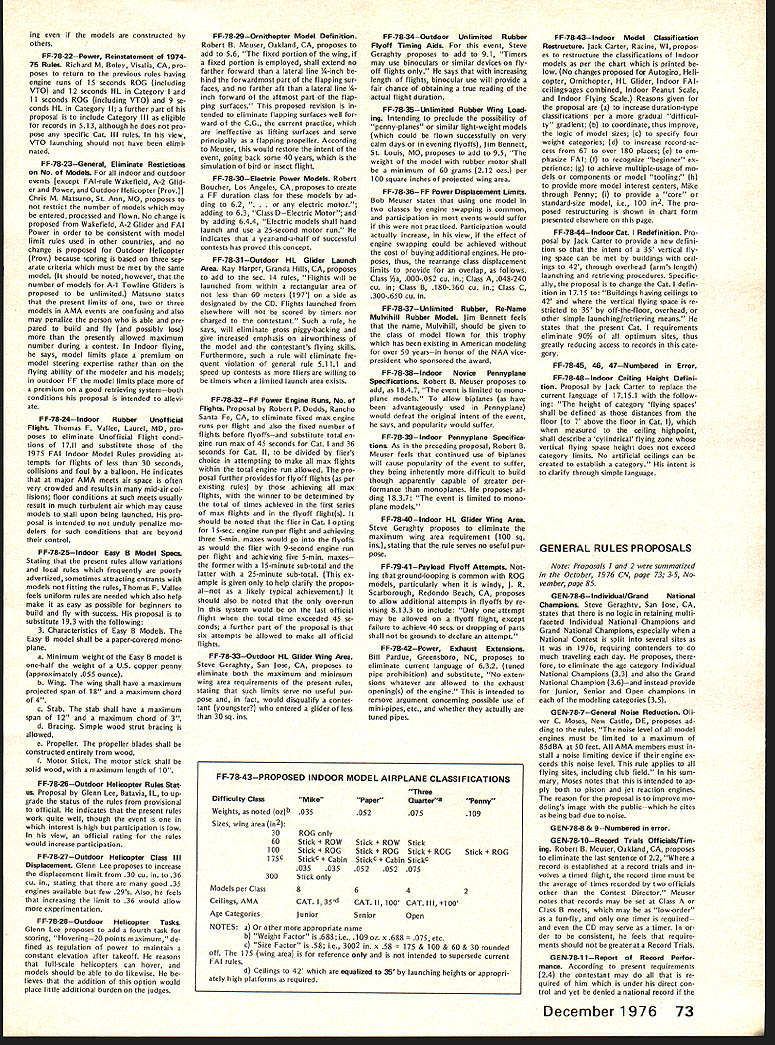
FF-78-43—Proposed Indoor Model Airplane Classifications
Difficulty Class Weights, as noted (ozs.) Sizes, wing area (sq. in.)
"Mike" "Paper" "Three" "Penny" 0.035 0.052 0.075 0.109
Sizes: 60 ROG only 80 Stick + ROG Stick + ROG 100 Stick + ROG Stick + Stick + ROG 175 Stick + Cabin Stick + Cabin Stick + Cabin Stick 300 305 035 052 075 .109
Models per Class Cat. I, 3rd - 6 Cat. II, 10oz - 12 Cat. III, 100
Age categories: Junior Senior Open
NOTES: 1) Or other mono appropriate wing. 2) Weight Factor = .583: i.e., .100 x .x .688 = .075, etc. 3) For 175 (Stick Factor) = .75; i.e., 300 x 2 = .583 = 175 X 100 & 60 & 30 rounded off. The 175 (wing area) is for reference only and is not intended to supersede current FAI rules.
Clippings to 42" which are equalized to 36" by launching heights or appropriately high platforms as required.
FF-78-44—Indoor. Model Classification Restructure. Jack Carter, Radnor, PA, proposes res to restructure the classifications of indoor models as per the chart which is omitted below. (No changes proposed for Autopage, Helicopter, Ornithopter, HL Glider, Indoor FAI, Electric/Glider combined, Indoor Parasol Scale, Indoor Flying Scale.) Reasons given for the proposal are (a) to increase duration-type classifications per a more gradual "difficultly" gradient: (b) to consider the classes in the logic of model sizes; (c) to specify four weight categories: (1) to increase record categories from 6.7 to over 180 places; (d) to expand the model list, (e) to recognize "beginner" experience; (f) to make multiple usage of models for competition or model "tooling"; (g) to provide more model interest centers, like through flyoff, (h) to provide a "core" or standard-size model, i.e., 100 in.2 The proposal restructuring is shown in chart for models restricted for this page.
FF-78-44—Indoor Cat. I Redefinition. Proposal by Jack Carter to provide a new definition so that the intent for a 35% vertical wing area can be met by buildings with ceilings to 42", through overhead (arms) length) including and retrieving procedures. Specifically, the proposal is to change the Cat. I definition in 17.15 to be "Buildings having ceilings to 32" and where the vertical flying space is restricted to 35" by off-the-floor, overhead, or other means. There is a suggestion that the present Cat. I requirements eliminate 90% of all opportunity in class, thus greatly reducing access to records in this category."
FF-78-45, 46, 47—Numbered in Error.
FF-78-48—Indoor. Ceiling Height Definition. Proposal by Jack Carter to replace the current language of 17.15 with the following: "The height of category flying spaces shall be defined as those distances from the floor to 'A' above the floor in Cat. I, which when measured to the ceiling in flight, shall be considered a 'cylinder' flying zone whose vertical ceiling defining space height does not exceed category limits. No artificial ceilings can be created to establish a category." His intent is to clarify through simple language.
GENERAL RULES PROPOSALS
Note: Proposals 1 and 2 were summarized in the October 1976 CN, page 73. 5 Nov., back cover.
GEN-78-6—Individual/Grand National Champions. Steve Zechary, San Jose, CA, states that there is no long list in retaining multiple National Individual Champion and Grand National Champions, especially when a National Contest is split into several sites as it was in 1976, requiring contestants to do more traveling each day. He proposes therefor, to eliminate the age category Indivdual National Champions (3.3) and also the Grand National Champion (3.6) and instead provide for Junior, Senior and Open champions in each of the modeling categories (3.5).
GEN-78-7—General Noise Reduction. Oliver M. Coons, New Castle, DE, proposes adding to the rules, "The noise level of all model engines must be limited to a maximum of 85 dBA at 30 feet. All AMA members must install a noise limiting device if their engine exceeds this noise level. This rule applies to all flying sites, including club fields." In his summary, Coons notes that this is intended to apply to both piston and jet reaction engines. He reasons that the present rule limiting the engines in the public practice flying will encourage safety and be good for the future of the hobby since the public will be lesszealous about noise.
GEN-78-8 & 9—Numbered in error.
GEN-78-10—Record Trials Officials/Timers. Robert B. Meuser, Oakland, CA, proposes to eliminate the last sentence of 2.4, "Where a record is established at a record trials and involves a timing check, the record time must be the average of the times recorded by two officials other than the Contest Director." Meuser notes that records may be set at Class A or Class B meets, which may be as "low- order" as a fun-fly, and only one timer is required to be present at the CD's event as a timer. In order to be consistent, he feels that requirements should not be greater at lower level meets. GEN-78-11—Report of Record Performance. According to present requirements 2.4 the contestant may do mail that is required of him which is under his direct control and will yet be denied a national record if the
[page ends]
Competition Newsletter
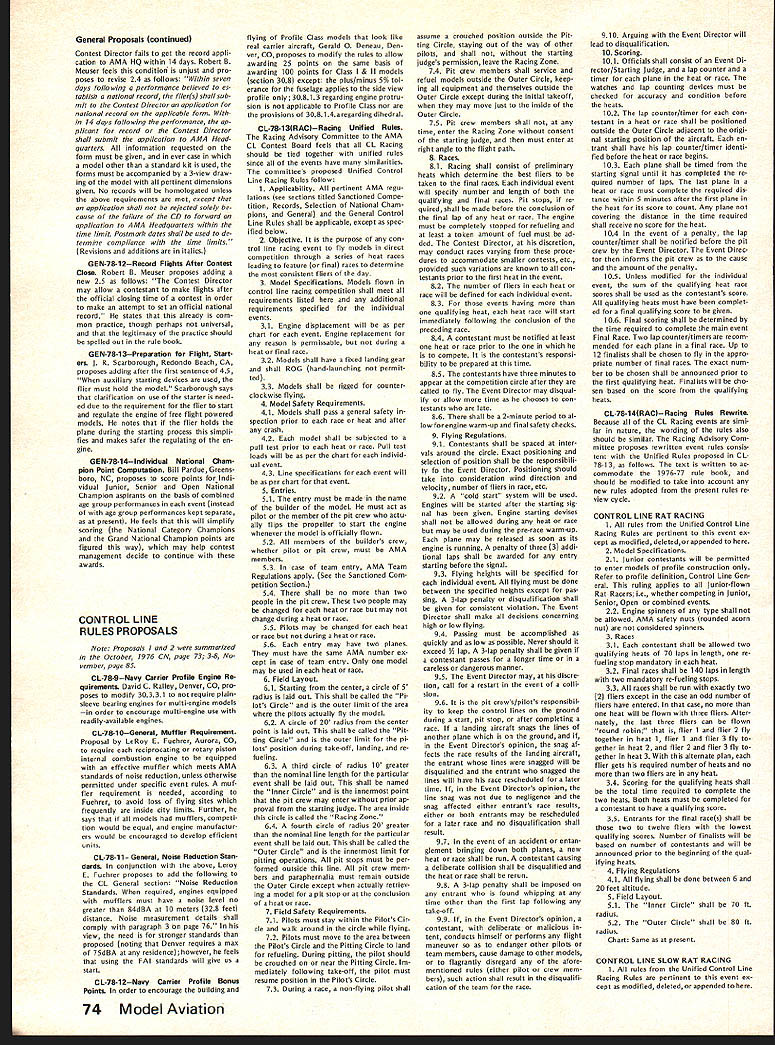
General Proposals (continued)
Contest Director fails to get the record application to AMA HQ within 14 days. Robert B. Meuser feels this condition is unjust and proposes to revise 2.4 as follows: "Within seven days following a performance believed to constitute a national record, the filer(s) shall submit to the Contest Director an application for national record on the applicable form, which in all cases following the performance the applicant for record or the Contest Director shall submit the application to AMA Headquarters. All information requested on the form must be given, and in every case in which a model other than an amateur is used, the forms must be accompanied by a 3-view drawing of the model with pertinent dimensions given. No records will be homologated unless the above requirements are met, except that an application shall not be rejected solely because of the failure of the CD to forward an application to AMA Headquarters within the time limit. Postmark dates will be used to determine compliance with the above limits." (Revisions and deletions are in italics.)
GEN-78-12—Record Flights After Contest Close. Robert B. Meuser proposes adding a new 2.5 as follows: "The Contest Director may allow a contestant to make flights after the official closing time of a contest in order to make an attempt to set an official national record." He states that this already is common practice, though perhaps not universal, and that the legitimacy of the practice should be spelled out in the rule book.
GEN-78-13—Preparation for Flight, Starters. J. R. Scarborough, Redondo Beach, CA, proposes adding after the first sentence of 4.5, "When starts are staged, starters are used; the starter must hold the model." Scarborough says that clarification on use of starters is needed due to the requirement for the flyer to regulate the engine for the takeoff of powered models. He notes that if the pilot holds the plane during the starting process this simplifies the rules and makes regulating the engine easier.
GEN-78-14—Individual National Champion Point Computations. Bill Purcell, Green Bay, WI, proposes to score points for individual Junior, Senior and Open National Champions, with points divided by class for combined age-group performances in each event (instead of with age-group performances kept separate), as at present. He feels that this will simplify scoring of the National Category Champions and the Grand National Championship points and that it will be consistent with current awards.
General note: Some proposals, however, were submitted endorsed by advisory committees. The Contest Board chairman can identify such proposals; letters (in parentheses) tacked onto proposal numbers indicate committee endorsement. For instance CL-78-13RAC was submitted and endorsed by the Racing Advisory Committee. Handling proposals submitted by advisory committees differs from proposals submitted individually to the extent the former are automatically considered to have passed the Contest Board's Initial Vote.
Cross-Proposals—What Are They? Submit basic proposal summaries have been printed; if a basic proposal has passed the Contest Board Initial Vote (deadline December 1), a cross-proposal may be submitted seeking modification of the basic proposal. In other words, perhaps the basic proposal is pretty good but needs a little twist or change of detail; that is the cross-proposal's main purpose.
Form Use. Cross-proposals must be submitted on the standard Rules Change Proposal Form — the same form used for basic proposals (form printed May 1976 MA page 79). Additional forms are available from AMA HQ upon request and must be accompanied by a stamped, pre-addressed envelope.
Submit Cross-Proposal After known basic proposal has passed the Contest Board Initial Vote no later than March 1, 1977 (postmark deadline). That means two things: 1. Proposals submitted by advisory committees are already considered to have passed Initial Vote; cross-proposals concerning these may be submitted right now up until March 1. 2. Because the Contest Board Initial Vote deadline is December 1, it is unlikely CN could get the results into members' hands before February 1, leaving about a month to submit cross-proposals — that should be sufficient for members who are prepared in advance with forms on hand.
More than 200 Rules Proposals Under Review
Concluded issue summaries of basic proposals have been submitted. September 1 deadline possible modification addition. 1976-77 AMA rule book proposals survive Initial Vote. Contest Boards due finished December 1; also Final Vote Contest Boards finished September 1, 1977 will become part of the AMA competition rules for 1978. What can members do if they are considering the new AMA competition rules? See complete Contest Board Procedures May 1976 issue. Scheduled members have the opportunity to study, lobby against proposals and propose revisions before proposals are voted on. If you have concern about proposals pertaining to kinds of models you expect to fly, write the category Contest Board member in your district; let him know you are against a proposal or favor it. Names and addresses of Contest Board members appear elsewhere in CN; check out District Report headings in the AMA News section.
About Proposals: 245 proposals submitted this year: 44 Scale, 90 CL, 57 RC, 42 FF, 12 Gen. Most proposals submitted by individual AMA members without endorsement.
US Teams Picked — RC, Soaring and FF
US Team Finals: RC Soaring, FF Wakefield, Rubber, FAI Power, A-2 Towline Glider held over Labor Day weekend. Soaring — Denver, CO; Free Flight — Hastings, MN. Remaining rules proposals ran us out of space to include team finals reports, so we'll just list team members here and follow up next month.
RC Soaring
- LeMon Payne, Dallas, TX
- Skip Miller, Boulder, CO
- Dale Nutter, Tulsa, OK
FF Wakefield Rubber
- Walt Ghio, Stockton, CA
- Phedon Tsiknopoulos, Los Angeles, CA
- Robert Piserchio, San Diego, CA
FF FAI Power
- Tom McLaughlan, Pensacola, FL
- Al Bissonnette, Oklahoma City, OK
- Charles Martin, Bellevue, WA
FF A-2 Towline Glider Due to wind the event was cancelled; contestant vote after second round — Bob Stalick mailed September 6. Contact FAI FF Committee chairman concerning what steps to take pertaining to eventual resolution; matter undecided at press time.
Tragedy During FAI Power: Extremely sad report — Pete Simonson and Darold Nilsen lost their lives in a crash of a lightplane spotting downed models during the FAI Power event. Both were members of the Minneapolis Piston Poppers Club. Families and friends are mourning their untimely passing.
INDOOR WORLD CHAMPS Report: Pete Andrews, US Team Manager, ever hopeful, reports that AMA Headquarters, awaiting renewal of military transportation, led the Indoor Team through crises until finally... [text continues on next page]
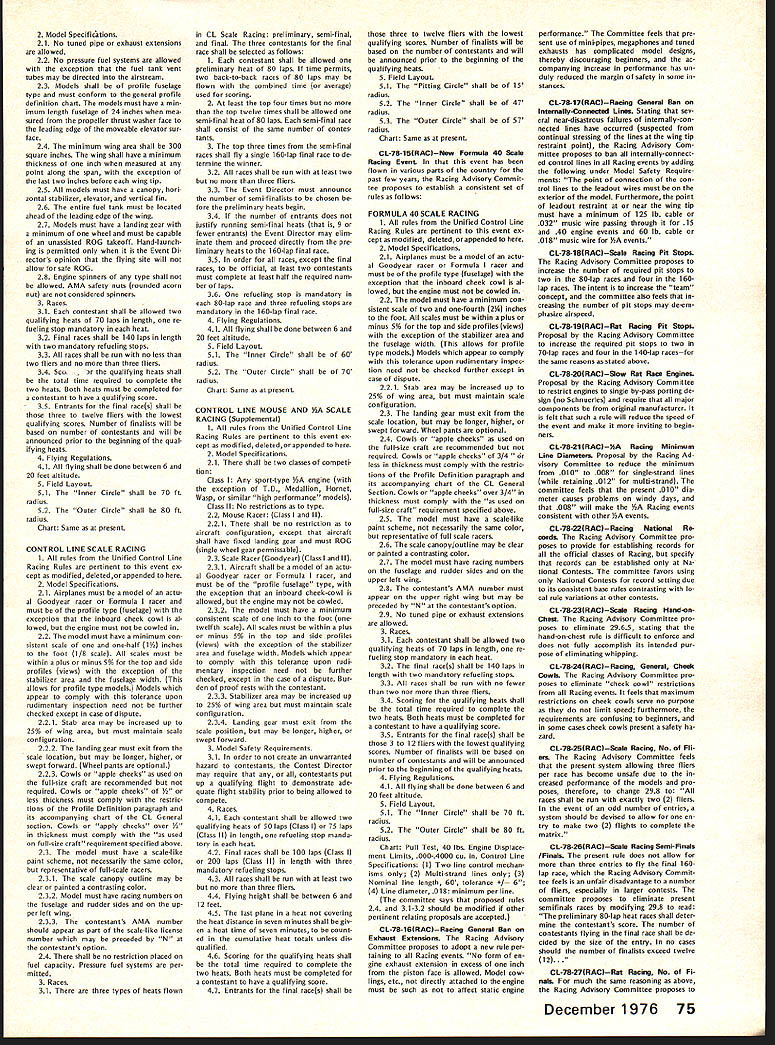
- Model Specifications.
2.1. No tuned pipe or exhaust extensions are allowed.
2.2. No pressure fuel systems are allowed with the exception that the fuel tank vent may be dry-brake into the airframe.
2.3. Models shall be of profile fuselage and must conform to the general profile definition chart. The models must have a minimum length fuselage of 24 inches when measured from the propeller thrust washer to the furthest trailing edge of the movable elevator surface.
2.4. The minimum wing area shall be 300 square inches. The wing shall have a maximum thickness of one inch when measured at any point along the span, with the exception of the last two inches before each wing tip.
2.5. All models must have a canopy, horizontal stabilizer, elevator, and vertical fin.
2.6. The entire fuel tank must be located ahead of the leading edge of the wing.
2.7. Models must have a landing gear with a minimum of one wheel and must be capable of an unassisted ROG (takeoff). Hand-launched models must only when it is the Event Director’s opinion that the flying site will not allow for safe ROG.
2.8. Engine smiggers of any type shall not be allowed. AMA safety nuts (rounded acorn nuts) are not considered spinners.
- Races.
3.1. Each contestant shall be allowed two qualifying heats of 30 laps in length, one re-fueling stop mandatory in each heat.
3.2. Final races shall be 140 laps in length with two mandatory refueling stops.
3.3. All races shall be run with no less than two fliers and no more than three fliers.
3.4. Scales: The qualifying heats shall be the total time required to complete the two heats. Both heats must be completed to constitute a bona fide qualifying score.
3.5. Entrants to the final race(s) shall not have less than two fliers (which is of course three times the number of contestants qualifying scores). Number of finalists will be based on number of contestants and will be announced prior to the beginning of the qualifying heats.
- Flying Regulations.
4.1. Flying shall be done between 6 and 20 feet altitude.
4.2. All flying shall be under the supervision of the Event Director.
4.3. Field Layout.
- Field Layout.
5.1. The "Inner Circle" shall be 70 ft. radius.
5.2. The "Outer Circle" shall be 80 ft. radius.
Chart: Same as at present.
CONTROL LINE SCALE RACING
- All rules from the Unified Control Line Racing Rules are pertinent to this event except as modified, deleted, or appended to here.
- Model Specifications.
2.1. Airplanes must be a model of an actual Goodyear racer or Formula I racer and must be of the profile type "balsa type", with the exception that an inboard check-valve shall be allowed, but the engine may not be cowled.
2.2. The model must have a minimum static scale of one and one-half (1½) inches to the foot (1/8 scale). All scales must be within a plus or minus 5% of the declared scale.
2.3. The model must be cleaned and inspected, and any removable items must be securely attached. Any modifications that are not consistent with the exception of the stabilizer area and fuselage width are subject to disqualification with the exception of allowable structural strengthening.
2.4. The fuselage width shall be measured at the longest point of the mold's width.
2.5. Stabilizer area may be increased up to 25% with a new area, but must maintain scale configuration.
2.6. Landing gear must exist from the takeoff to the landing.
2.7. For all fliers under 18 years of age, a guardian must be present at the contest.
- Races.
3.1. There are three types of heats:
- semi-final,
- final,
- and final runoff.
3.2. The three contestants for the final shall be selected as follows:
- The first three places from the semi-final races, based on combined time of average.
3.3. The top four from the semi-final shall be used in the final.
3.4. The three pilots for the final shall be announced prior to the final race.
3.5. Refueling stops are mandatory and shall be done between 6 and 20 feet altitude.
3.6. The "inner circle" shall be 47' radius.
3.7. The "outer circle" shall be of 57' radius.
Chart: Same as at present.
CONTROL MOUSE AND 1/2A SCALE RACING
- Model Specifications.
2.1. Models must be true scale aircraft of the class "Mouse" or "1/2A Scale" and shall conform to the general scale definitions. The model must have a minimum static scale of one and one-half inches to the foot (1/8 scale). All models must be of profile type balsa.
2.2. Models must have a minimum wing area of 24 square inches and conform to the fuselage requirements.
- Races.
3.1. All qualifying heats are to be flown as scheduled with mandatory refueling stops. The preliminary heats shall be 80 laps in length. Two laps by two-lap-block races of 80 laps may be flown for the combined time (or average) used to determine finalists.
3.2. At least the top four fliers but no more than the top twelve fliers shall be allowed to enter the semifinal. The semifinal will be a single 160-lap final race to determine the winner.
3.3. The top three finishers from the semifinal shall fly a single 160-lap final race to determine the winner.
3.4. Contest directors must announce the number of semi-finalists to be chosen before the preliminary heats begin.
3.5. Tournament scoring shall be in effect; the top finishers advance as indicated.
3.6. For all fliers except the final, required refueling stops are mandatory and must be completed between 6 and 20 feet altitude.
3.7. Field Layout.
3.8. The "Inner Circle" shall be 60' radius.
3.9. The "Outer Circle" shall be 70' radius.
Chart: Same as at present.
MORE THAN 200 RULES PROPOSALS UNDER REVIEW
Concluded issue summaries of basic proposals have been submitted. September 1 deadline possible modification addition 1976-77 AMA rule book proposals survive Initial Vote. Contest Boards due finished December 1 also Final Vote; Contest Boards finished September 1 1977 will become part AMA competition rules 1978.
What Can system considering new AMA competition rules see complete Contest Board Procedures May 1976 issue scheduled members have opportunity study lobby against proposals propose revisions before proposal voted. If you feel a recommendation study proposals pertaining kinds of models you expect to fly, interest write category Contest Board member in your district; let him know you are for or against proposal. If proposal has parts like other parts don't tell Contest Board rep which parts. Names and addresses of Contest Board members are listed elsewhere in CN section. If you don't know what AMA district you are in, check out District Report headings in AMA News section.
Some proposals, however, were submitted endorsed by advisory committees. Authorized Contest Board chairmen can be identified by letters (parentheses) tacked onto proposal number. For instance CL-78-13RAC is a proposal submitted and endorsed by the Racing Advisory Committee. Handling proposals submitted by an advisory committee differs from proposals submitted individually to the extent former are automatically considered to have passed Contest Boards' Initial Vote.
Cross-Proposals: What Are They? Submit basic proposal. The proposal summarized in the issue as a basic proposal has passed the Contest Board Initial Vote and has a deadline of December 1. A cross-proposal may be submitted which seeks modification of the basic proposal. In other words, perhaps the basic proposal is pretty good; maybe a little twist or change of detail would be an improvement — that's cross-proposals main purpose.
Form Use: Cross-proposals must be submitted on the standard Rules Change Proposal Form, the same used for basic proposals. The form was printed May 1976 CN page 79. Additional forms are available from AMA HQ upon request and must be accompanied by a stamped, pre-addressed envelope.
Submit Cross-Proposal: After you have known basic proposal has passed Contest Board Initial Vote no later than March 1, 1977 postmark deadline means two things: 1. proposals submitted by advisory committees already considered to have passed Initial Vote; cross-proposals concerning them can be submitted right now up until March 1. 2. CB Initial Vote deadline being December 1 unlikely CN could get results into members' hands before February 1, leaving about a month to submit cross-proposals — that should be sufficient if members are prepared; have forms on hand and ready to fill out.
FF FAI Power — 1 Tom McLaughlan Pensacola FL 2 Al Bissonnette Oklahoma City OK 3 Charles Martin Bellevue WA
FF A-2 Towline Glider — Due to wind the event was cancelled; contestant vote after second round — Bob Stalick mailed September 6. Contact FAI FF Committee chairman concerning what steps to take pertaining to eventual resolution; matter undecided at press time.
NOTE: Chart and several minor headings present on the original page have been retained in content where they appear relevant to the rules and procedures above.
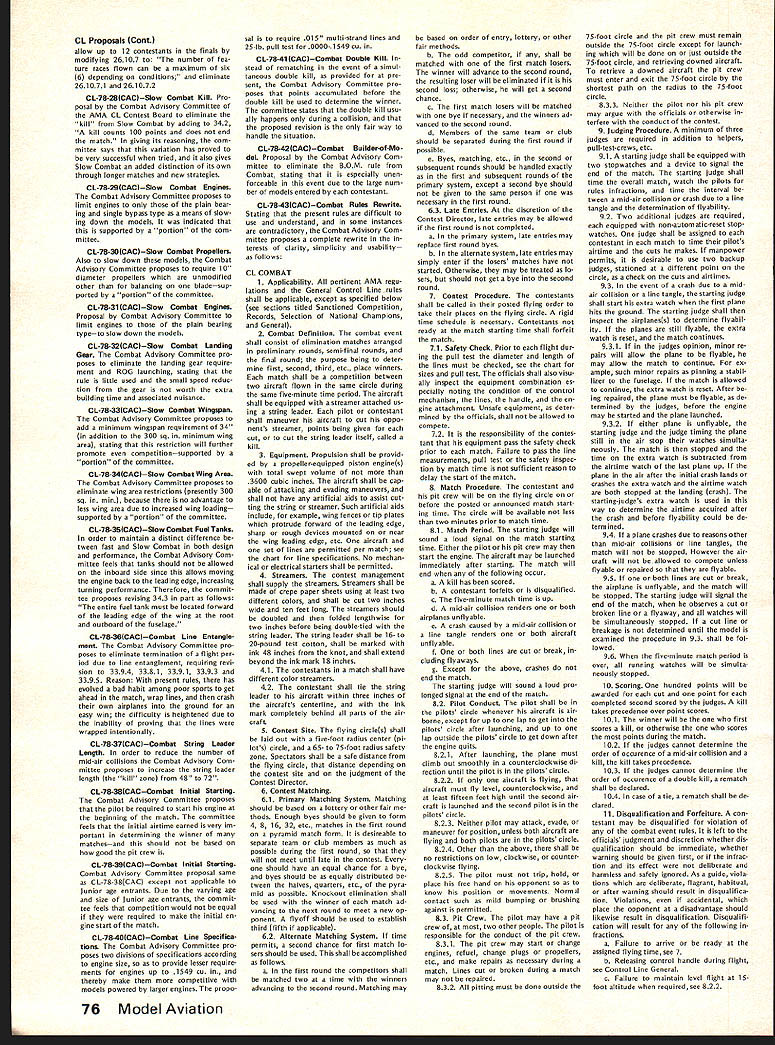
CL Proposals (Cont.)
allow up to 12 contestants in the finals by moving the 26.10.7 to: "The number of feature races flown can be a maximum of six (6), depending on combinations," and eliminate 26.10.7.1 and 26.10.7.2.
CL-78-26 (CAC) — Slow Combat Kit. Proposal by the Combat Advisory Committee of the AMA CL Contest Board to eliminate the "kill" from Slow Combat by adding a "no kill" loss. "A kill counts 100 points and does not end the match." In giving its reasoning, the committee says that this variation has proved to be very successful when tried, and it also gives Slow Combat an added distinction of its own through longer matches and new strategies.
CL-78-29 (CAC/CAO) — Slow Combat Engines. The Combat Advisory Committee proposes to limit engines to only those of the plain bearing and single sleeve types as a means of shortening down the matches. It was indicated that this is supported by a "portion" of the committee.
CL-78-30 (CAC) — Slow Combat Problems. Also to slow down these models, the Combat Advisory Committee proposes to require 10-minute preflights which are mandatory, other than for balance tests or one-hand-supported by a "portion" of the committee.
CL-78-31 (CAC) — Slow Combat Engines. Proposal by Combat Advisory Committee to limit engines to those of the plain bearing, single sleeve type only.
CL-78-32 (CAC/CAO) — Slow Combat Landing Gear. The Combat Advisory Committee proposes to eliminate the landing gear requirement for Quiet/Slow Combat, stating that the rule is useful as little used and the small speed reduction from the gear is not worth the extra building time and associated nuisance.
CL-78-33 (CAC/CAO) — Slow Combat Wingspan. The Combat Advisory Committee proposes to add a minimum wingspan requirement of 34 inches; in addition the 30 inch minimum which are presently used are too small and produce poor performance. The committee also recommended the use of a portion of the wing at the root and outboard of the fuselage.
CL-78-34 (CAC) — Combat Line Tension. The Committee proposes to eliminate termination of a flight prevent at the time the model touches the ground. The penalty would be one point for each quarter-turn under winded conditions. (This paragraph is difficult to read in full.)
CL-78-36 (CAC) — Combat Line Tension. Line tension proposal to change the tension requirements for safety; exact wording omitted here.
CL-78-38 (CAC) — Combat Line Ignition. Proposal to change the ignition and starter limits for certain classes. (Text partially illegible.)
CL-78-40 (CAC) — Combat Double Kill. Instead of rematching in the event of simultaneous double kills, is provided for at present. The Combat Advisory Committee proposes that points awarded before the double kill be used to determine the winner. The committee states that the double kill usually happens only during a collision, and that the proposed revision is the only fair way to handle the situation.
CL-78-42 (CAC) — Combat Builder-of-Models. Proposal by the Combat Advisory Committee to eliminate the B.O.M. rule from Combat, stating that it is especially unreasonable in this event due to the large number of models entered by each contestant.
CL-78-43 (CAC) — Combat Rules Rewrite. Stating that the present rules are difficult to use and understand, and in some instances are contradictory, the Combat Advisory Committee proposes a complete rewrite in the interests of clarity, simplicity and usability as follows:
CL COMBAT
- Applicability. All pertinent AMA regulations and the General Control Line rules shall be applicable, except as specified below (see sections titled Sectional Competition, Records, Selection and National Champions, and General).
- Combat Definition. The combat event shall consist of elimination matches arranged in preliminary rounds, semi-final rounds, and the final round; the purpose being to determine first, second, third, etc., place winners. Each match shall be a competition between two aircraft flown in the same circle during the same five-minute time period. The aircraft shall be equipped with a streamer attached using a string leader. Each pilot or contestant shall maneuver his aircraft to cut his opponent's streamer, points being given for each cut, or to cut the string leader itself, called a kill.
- Equipment. Propulsion shall be provided by a propeller-equipped piston engine(s) with total swept volume of not more than .350 cubic inches. The aircraft shall be capable of attacking and evading maneuvers, and shall not have any vertical aids to assist stabilization, the string or streamer. Such artificial aids include, for example, wing fences or tip plates which protrude forward of the leading edge, sharp or rough edges mounted on or near the wing to loading spikes, etc. One aircraft and one set of lines are permitted per match; see the chart for line specifications. No mechanical or electrical starters shall be permitted.
- Streamers. Streamers shall measure small supply the streamers. Streamers shall be made of crepe paper sheets a length of at least two different colors, and shall be cut two inches wide and ten feet long. The streamers should be doubled and then folded lengthwise for two inches before being doubled-tied with the string leader. The string leader shall be 16- to 20-pound test cotton, shall be marked with ink and lines from the knot, and shall extend beyond the knot mark 18 inches.
4.1. The contestants in a match shall have different color streamers.
4.2. The contestant shall tie the string leader to his aircraft within three inches of the aircraft's centerline, and with the link mark completely behind all parts of the aircraft.
- Contest Site. The flying circle(s) shall be laid out with a five-foot radius center pilot(s) circle and a 65- to 75-foot radius safety zone. Spectators shall be a safe distance from the flying circles, that is distance depending on the contest site and the judgment of the Contest Director.
- Contest Matching.
6.1. Primary Matching System. Matching should be based on a lottery or other fair methods.
6.2. The odd competitor, if any, shall be matched with one of the first matched losers. The winner will advance to the second round, the resulting loser will be eliminated if it is his second loss; otherwise he will go to the second chance.
6.3. The first match losers will be matched with one by if necessary, and the winners advanced to the second round.
6.4. Members of the same team or club should be separated during the first round if possible.
6.5. Byes, matching, etc. in the second or subsequent rounds should be handled exactly as in the first and subsequent rounds of the primary system, except a second round should not be given to the same person if one was necessary in the first round.
6.6. Late Entries. At the discretion of the Contest Director, late entries may be allowed if the first round is not completed.
6.7. In the primary system, late entries may replace first round byes.
6.8. In the alternate system, late entries may simply enter if the losers' matches have not started. Otherwise, they may be treated as losers, but should not get a bye into the second round.
- Contest Procedure. The contestants shall be called in their posted flying order to take their places on the flying circle. A rigid time schedule is unnecessary. Contestants not ready at the match starting time shall forfeit the match.
7.1. Safety Check. Prior to each flight during the pull test the diameter and length of the lines must be checked, see the chart for sizes and pull test. The officials shall also visually inspect the equipment for any combination especially noting the condition of the control mechanisms, the lines, the leader, and the engine attachment. Unsafe equipment, as determined by the officials, shall not be allowed to compete.
7.2. It is the responsibility of the contestants that his equipment pass the safety checks prior to each match. Failure to pass the line measurements, pull test or the safety inspection by match time is not sufficient reason to delay the start of the match.
- Match Procedure. The contestant and his pilot crew will be on the flying circle on or before the posted or announced match starting time. The circle will be available not later than two minutes prior to match time.
8.1. Match Period. The starting time will sound a loud signal on the match starting time. Either the pilot or his pit crew may then start the engine. The aircraft may be launched immediately after starting. The match will end when any of the following occur:
- A kill has been scored.
- A contestant forfeits or is disqualified.
- The five-minute match time is up.
8.2. A mid-air collision does not, or does not, eliminate an aircraft.
8.3. A crash caused by a mid-air collision or a line entangled renders one or both aircraft unflyable.
8.4. One or both lines are cut or break, including flyaways.
8.5. Except for the above, crashes do not end the match.
The starting judge will sound a loud prolonged signal at the end of the match to indicate the match is over.
8.2. Pilot Conduct. The pilot shall be in the pilot's circle whenever his aircraft is in the air; a competitor or his pit crew may enter the pilot's circle after launching, and up to the time the pilot resumes the pit circle only, except for a competitor to go to the pit or the engine quits.
8.2.4. After launching, the plane must climb out smoothly in a counterclockwise direction until the pilot is in the pilot's circle.
8.2.2. If only one aircraft is flying, that aircraft must fly level, counterclockwise, and at least fifteen feet high until the second aircraft is launched and the second pilot is in the pits.
8.2.3. Neither pilot may attack, evade or maneuver for position, unless both aircraft are flying and both pilots are in the pits' circle.
8.2.4. Other than the above, there shall be no restrictions of low, clockwise, or counterclockwise flying.
8.2.5. The pilot must not trip, hold, or place his feet hand on his opponent so as to block his position or movements. Normal contact such as mild bumping or brushing against is permitted.
8.3. Pit Crew. The pilot may have a pit crew, at most two, who are not allowed to be responsible for the conduct of the pit crew.
8.3.1. The pit crew may start or change engines, refuel, change props or propellers, etc., and make repairs as necessary during a match. Lines cut or broken during a match may not be repaired.
8.3.2. All pit crews must be done outside the 75-foot circle and the pit crew must remain outside the 75-foot circle except for launching which will be done on or just outside the 75-foot circle, and retrieving or downed aircraft. To retrieve a downed aircraft the pit crew must enter and exit the 75-foot circle by the shortest path on the radius to the 75-foot circle.
8.3.3. Neither the pilot nor his pit crew may argue with the officials or otherwise interfere with the conduct of the contest.
8.4. Judging Procedure. A minimum of three judges are required in addition to helpers, pit managers, etc.
9.1. A starting judge shall be equipped with two stop watches and a device to signal the end of the match. The starting judge shall time the event; match times of the pilots for the given match, and the interval between laps. A time clock shall be some model to assist the judges.
9.2. Two or more judges are required, each equipped with long/short contact stop watches. One judge shall be assigned to each contestant in each match to time their pilot's attempt and the cuts counts in matches. If manning permits, it is desirable to use two back-up judges; stationed at a different point on the circle, as a check on the cuts and entries.
9.3. In the event one of the judges is not present a fill-in judge, the starting judge shall start his or her watch when the first plane hits the ground. The starting judge shall then impose the time required and keep a running check that the procedure is properly followed.
9.4. If the planes are still flyable, the extra time allowed for the match continues.
9.5. If one or both lines are cut or break, the airplane is unflyable, and the match will be stopped. The starting judge will signal to the end of the match, where the observers are to cover the plane and all watches will be simultaneously stopped. If a cut line or break occurs the match may continue until the airplane is recovered in 9.3, shall be followed.
9.6. When the five-minute match period is over, all running watches will be simultaneously stopped.
- Scoring. One hundred points will be awarded for each cut and one point for each completed second scored by the judges. A kill takes precedence over point scores.
10.4. The winner will be the one who first scores a kill, or otherwise the one who scores the most points during the match.
10.2. If the judges cannot determine the order of occurrence of a collision and a kill, it will take precedence.
10.3. If the judges cannot determine the order of occurrence of a double kill, a rematch shall be declared.
10.4. In case of a tie, a rematch shall be declared.
- Disqualification and Forfeiture. A contestant may be disqualified or forfeited for violation of any of the contest rules. It is left to the officials' judgement and discretion whether disqualification should be immediate, whether warning should be given first, or, if the infraction is minor and its effect were not deliberate and harmless and safety ignored. As a guide, violation for which are deliberate, flagrant, habitual, or after warning should result in disqualification. Violations, even if accidental, which place the opponent at a disadvantage should likewise result in disqualification. Disqualification, loss of will result for any of the following infractions:
- Failure to arrive or be ready at the assigned flying time, see 7.
- Releasing control handle during flight, see Control Line General.
- Failure to maintain level flight at 15-foot altitude when required, see 8.2.2.
(Note: Some lines of the original page were faint or partially obscured; the above is the corrected continuity of the Combat rules rewrite as presented on the scanned page.)
Competition Newsletter
ACADEMY OF MODEL AERONAUTICS
MORE THAN 200 RULES PROPOSALS UNDER REVIEW
Concluded issue summaries: basic proposals have been submitted by the September 1 deadline. Possible modification or addition to 1976-77 AMA rule book proposals survive Initial Vote. Contest Boards are due to finish Initial Vote by December 1. Those passing Final Vote by the Contest Boards finished September 1, 1977, will become part of the AMA competition rules for 1978.
What can members do? To see the system considering new AMA competition rules, see the complete Contest Board Procedures, May 1976 issue. Scheduled members have the opportunity to study proposals, lobby against proposals, and propose revisions before a proposal is voted on. To have effect, recommendations should study proposals pertaining to kinds of models you expect to fly. Write the category Contest Board member for your district; let him know if you are against a proposal. If a proposal has parts you like and other parts you don't, tell the Contest Board representative. Names and addresses of Contest Board members are elsewhere in this CN section. If you don't know what AMA district you are in, check the District Report headings in the AMA News section.
About Proposals 245 proposals were submitted this year: 44 Scale, 90 CL, 57 RC, 42 FF, 12 General. Most proposals were submitted by individual AMA members without endorsement.
Some proposals, however, were submitted endorsed by advisory committees. Authorized Contest Board chairmen can be identified by letters in parentheses tacked onto the proposal number; for instance, CL-78-13RAC is a proposal submitted and endorsed by the Racing Advisory Committee. Handling proposals submitted by an advisory committee differs from proposals submitted individually to the extent the former are automatically considered to have passed the Contest Boards' Initial Vote.
Cross-Proposals — What Are They? A basic proposal is summarized in this issue. If a basic proposal has passed the Contest Board Initial Vote (the deadline being December 1), a cross-proposal may be submitted that seeks modification of the basic proposal. In other words, perhaps the basic proposal is pretty good but a little twist or change in detail would be an improvement — that's the cross-proposal's main purpose.
Form Use Cross-proposals must be submitted on the standard Rules Change Proposal Form, the same form used for basic proposals (form printed May 1976, MA page 79). Additional forms are available from AMA Headquarters upon request and should be accompanied by a stamped, pre-addressed envelope.
Submit Cross-Proposal After a known basic proposal has passed the Contest Boards' Initial Vote, a cross-proposal must be postmarked no later than March 1, 1977. This postmark deadline means two things:
- Proposals submitted by advisory committees already considered to have passed Initial Vote may submit cross-proposals concerning them right now up until March 1.
- Because the Contest Boards' Initial Vote deadline is December 1, it is unlikely CN could get results into members' hands before February 1, leaving about one month for submitting cross-proposals — that should be sufficient if members are prepared in advance and have forms on hand ready to fill out.
RC Soaring and FF US Teams Picked US Team Finals — RC Soaring, FF Wakefield, Rubber, FAI Power, A-2 Towline Glider held over Labor Day weekend. Soaring — Denver, CO; Free Flight — Hastings, MN. Due to space limitations in the previous issue, remaining rules proposals ran us out of space to include team finals reports; now we'll just list team members and follow up next month.
RC Soaring
- LeMon Payne, Dallas, TX
- Skip Miller, Boulder, CO
- Dale Nutter, Tulsa, OK
FF Wakefield Rubber
- Walt Ghio, Stockton, CA
- Phedon Tsiknopoulos, Los Angeles, CA
- Robert Piserchio, San Diego, CA
FF FAI Power
- Tom McLaughlan, Pensacola, FL
- Al Bissonnette, Oklahoma City, OK
- Charles Martin, Bellevue, WA
FF A-2 Towline Glider Due to wind, event was cancelled; contestants voted after the second round. Bob Stalick mailed September 6; touch FAI FF Committee chairman concerning what steps to take pertaining to eventual resolution. No decision reached at press time.
Tragedy During FAI Power Extremely sad report: Pete Simonson and Darold Nilsen lost their lives in a crash of a lightplane spotting downed models during the FAI Power event. Both were members of the Minneapolis Piston Poppers Club. Families and friends mourn their untimely passing.
Indoor World Champs Report: Pete Andrews, US Team Manager, ever hopeful. AMA Headquarters worked on renewal of military transportation and led the Indoor Team through crisis after crisis until finally ...
Transcribed from original scans by AI. Minor OCR errors may remain.

