
COMPETITION NEWSLETTER
A Note From the Technical Director
Bob Underwood
It's back-to-school time for the kids, and in many parts of the country contests and flying events will wind down. Here at AMA Headquarters we are in the final stages of putting the new 1990–91 Competition Regulations book together and off to the printer so that it will be available by the first of the year.
There are some comments that need to be made about happenings in this rules-change cycle. Some of them have already happened, and others will occur in the near future.
First, let's address how the 1990–91 Competition Regulations book will get into your hands at the beginning of 1990. As you know, the present book was available to all members upon request. An effort was made to convince the membership that the only persons who really needed the 1988–89 Competition Regulations book were those who intended to participate in so‑called "rule-book" events — things such as FF Gas, CL Navy Carrier II, RC Advanced Pattern, RC Formula I Pylon, RC Intermediate Helicopter, RC Thermal Soaring Unlimited, Peanut Scale, Electric, AMA Vintage, and about 140 other rule-book events.
Those of you who attend IMAA fly-ins or loop, roll, and limbo with your buddies some Sunday at a fun-fly didn't need the Competition Regulations book, because there wasn't anything in it concerning your type of activity (except, maybe, the sanctioning information — and that's in the Membership Manual that everybody received).
---
National Records
The following new National Records have been processed during July 1989:
- Indoor Category
- Hand-Launched Glider — Open — 228 ft — Stanley K. Buddenbohm — 6/8/89
- Outdoor Free Flight Category
- III Payload — Open — 716 g — Warren Kurth — 6/19/89
- RC Soaring
- Distance, Class B — Open — 74.75 miles — Jack R. Hiner — 5/27/89
- Altitude, Class B Junior — 8,875 ft — Matthew Collier — 5/7/89
- Altitude, Class Open — 18,128 ft — Dale E. Collier — 5/7/89
- Speed Class
- Open — 379.3 mph — Rex B. Powell — 6/11/89
---
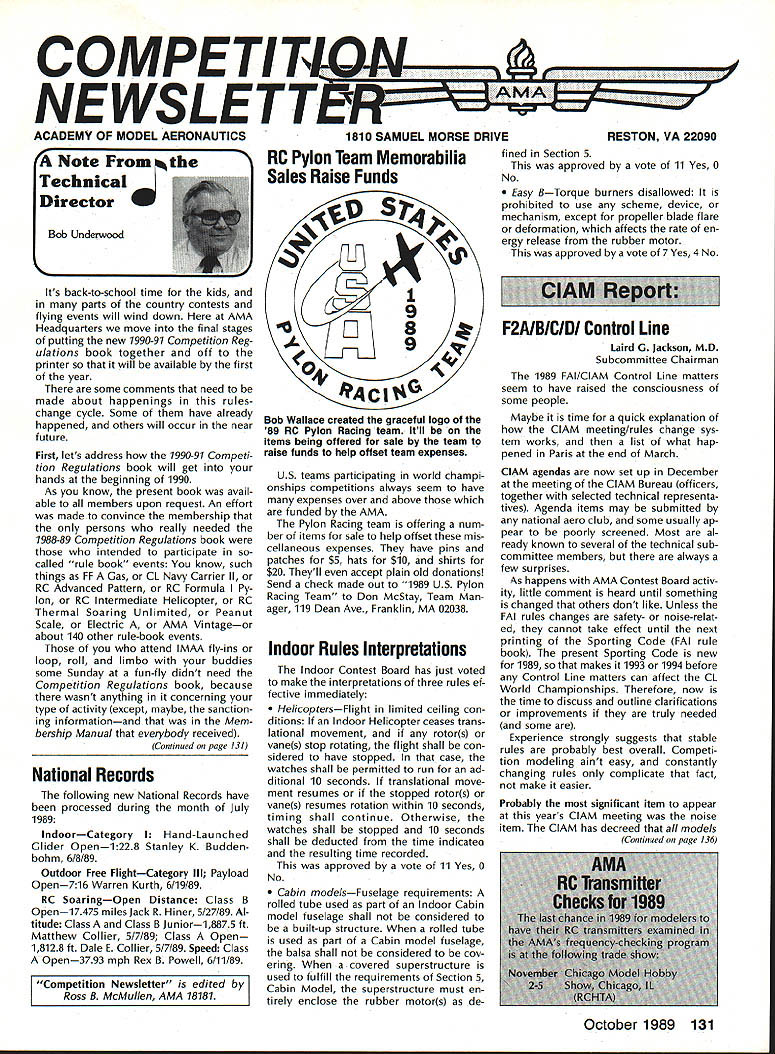
RC Pylon Team Memorabilia Sales Raise Funds
Bob Wallace created the graceful logo for the 1989 RC Pylon Racing Team. It will be on items being offered for sale to help the team raise funds to offset team expenses. U.S. teams participating in world championships and competitions always seem to have expenses over and above what is funded.
The AMA Pylon Racing Team is offering items for sale to help offset miscellaneous expenses:
- Pins and patches — $5
- Hats — $10
- Shirts — $20
- Plain donations accepted
Send checks made out to: 1989 U.S. Pylon Racing Team Don McStay, Team Manager 119 Dean Ave. Franklin, MA 02038
---
Indoor Rules Interpretations
The Indoor Contest Board has voted to make interpretations of three rules effective immediately:
- Helicopters — Flight‑limited ceiling conditions
If an indoor helicopter ceases translational movement and the rotors/vanes stop rotating, the flight shall be considered to have stopped. In that case, watches shall be permitted to run an additional 10 seconds. If translational movement resumes and the stopped rotors/vanes resume rotation within 10 seconds, timing shall continue. Otherwise, watches shall be stopped. If 10 seconds are deducted from the time indicated, the resulting time shall be recorded. Approved vote: 11 Yes, 0 No.
- Cabin models / Fuselage requirements
A rolled tube used as part of an indoor cabin model fuselage shall be considered a built‑up structure. A rolled tube used as part of a cabin model fuselage or balsa covering shall be considered covering; covered superstructure may be used to fulfill the requirements of Section 5. Cabin model superstructure must entirely enclose rubber motors as defined in Section 5. Approved vote: 11 Yes, 0 No.
- Easy‑8 / Torque burners
Torque burners are disallowed; the use of a torque‑burner type device or mechanism is prohibited, except where propeller blade flare or deformation affects the rate of energy release of the rubber motor. Approved vote: 7 Yes, 4 No.
---
F2A/B/C/D Control Line
Laird G. Jackson, M.D., Subcommittee Chairman
FAI/CIAM Control Line matters have raised the consciousness of some people. A quick explanation of how the CIAM meeting/rules-change system works: CIAM agendas are set up at the December meeting. CIAM Bureau officers select technical representatives. Agenda items may be submitted by a national aero club; some appear poorly screened. Most items are already known to several technical subcommittee members, with always a few surprises.
As with AMA Contest Board activity, little comment is heard until something is changed that others don’t like. Unless FAI rule changes are safety- or noise‑related, they cannot take effect until the appropriate FAI/CIAM procedures are completed.
A few specific outcomes and issues:
- Additional record classifications have been established in Control Line.
- Some RC Pattern classes have been reorganized.
- In Pylon Quarter Midget, a misplacement of an "and" created a problem that went unnoticed until late in the process.
- Scale: a rule allowing Giant and Precision Scale models to go to the maximum AMA weight limit of 55 lb was passed, but it was applied as 55 lb dry (no fuel). The AMA Safety Code sets the maximum at 55 lb wet (with fuel), so the competition rules cannot violate the Safety Code. An adjustment was necessary.
- Scale (sailplanes): pay close attention to the changes for event 517 — that whole section is completely replaced.
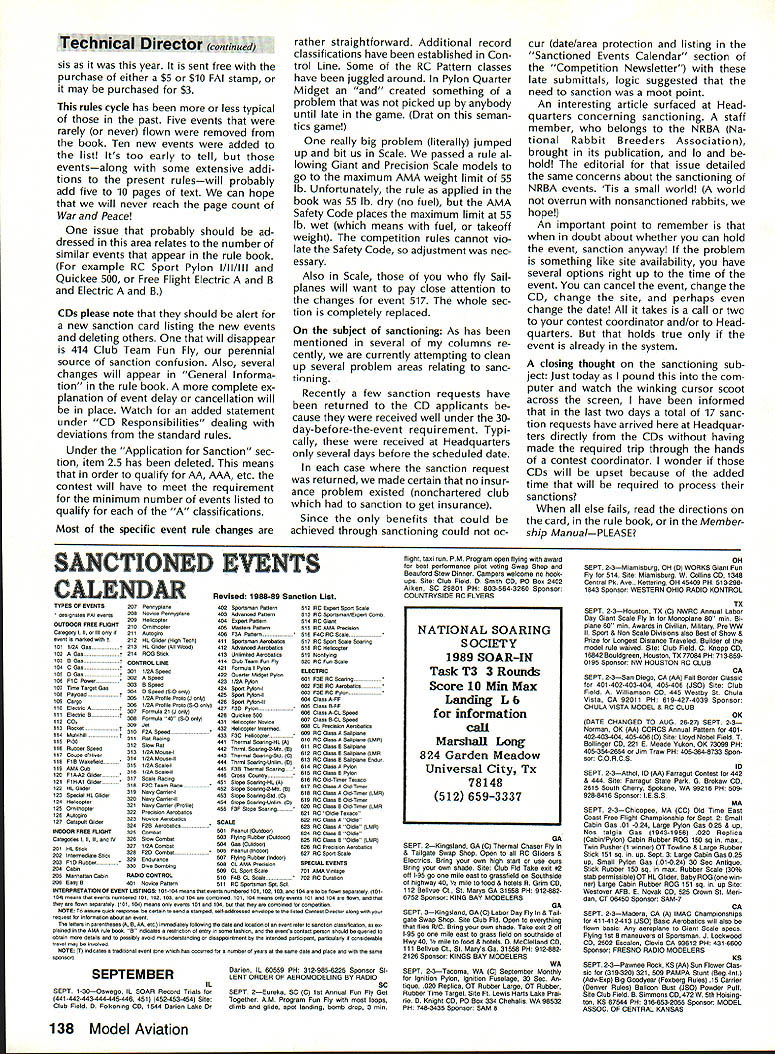
On the subject of sanctioning: we are attempting to clean up several problem areas. Recently a few sanction requests were returned to contest directors because they were received well under the 30‑day‑before‑the‑event requirement. Typically, these were received at Headquarters only several days before the scheduled date. In each case where the sanction request was returned, we checked that no insurance problem existed (a non‑chartered club needing sanctioning to obtain insurance). Since the benefits of sanctioning (date/area protection and listing in the Sanctioned Events Calendar) could not be achieved with these late submittals, sanctioning was moot.
An interesting note: a staff member who belongs to another sanctioning organization found similar concerns in that group's publication — a small world!
Important points about sanctioning:
- When in doubt about whether you can hold the event, sanction anyway.
- If the problem is site availability or similar, you have options up to the time of the event: cancel, change the CD, change the site, or change the date. All it takes is a call or two to your contest coordinator and/or to Headquarters — but only if the event is already in the system.
A closing thought: in the last two days a total of 17 sanction requests arrived at Headquarters directly from CDs without having gone through the required contest coordinator. That extra processing will add time. Please read the directions on the card, in the rule book, or in the Membership Manual.
---
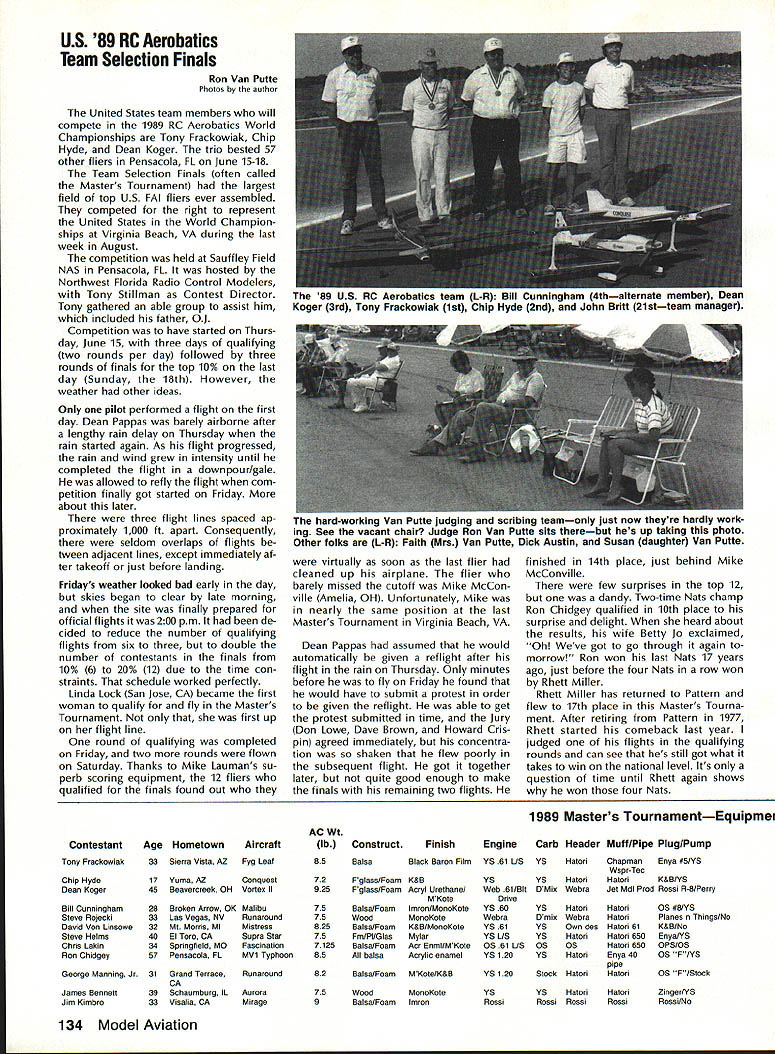
U.S. '89 RC Aerobatics Team — Notes
There were several things that stood out in the competition:
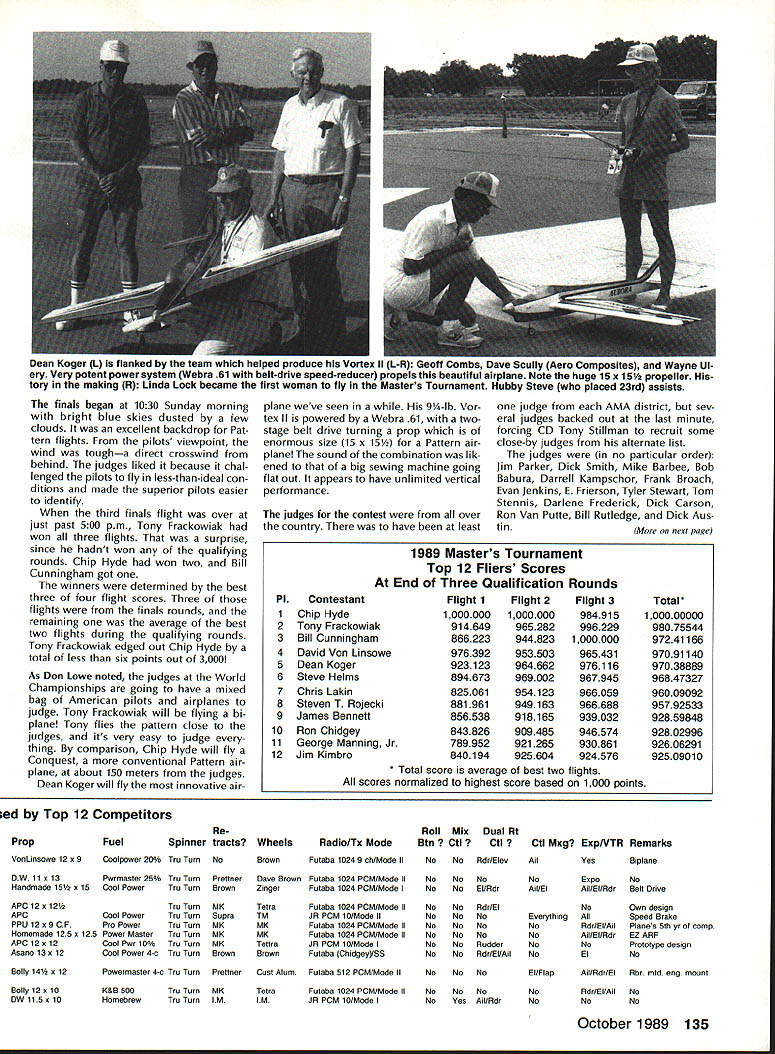
- Airplane noise: Most airplanes were quiet, but only one consistently got the noise bonus — Chris Lakin's Fascination, which used an OS .61 Long Stroke/Pump engine, a Hack 10‑spoke, and one of the new APC 12x12 props.
- APC props: These props are unusual in shape and very quiet. Bill Cunningham used an APC 12x12 on his Malibu and showed no limit in vertical performance. He demonstrated this with a mile‑high Figure M with Half Rolls maneuver. APC props are worth trying; Bill even painted his prop to match his airplane.
- Spinners: Every top pilot used a Tru‑Turn spinner — they're good, and the top pilots know it.
- YS .61 Long Stroke engines: A few were in use. Price is high, but performance is good. Pilots are still learning which prop works best; there was no common choice.
- Upcoming competition: We will have a very interesting competition at Virginia Beach. It will be interesting to see what the European judges think of the U.S. team. We'll find out shortly.
Transcribed from original scans by AI. Minor OCR errors may remain.

